Category: genocide

  • A War Against Humanity Itself

    Spread the love

    Original article by ABBY ZIMET republished from Common Dreams under Creative Commons (CC BY-NC-ND 3.0). 

    A Gazan man kisses the foot of his dead baby, killed in an Israeli strike (Photo by AFP via Getty Images)

    Amidst the ongoing, unfathomable slaughter, hunger, maiming, razing in Gaza at the hands of Israel’s “voracious death machine,” its leaders now openly vow “total and utter destruction” by what they still grotesquely call “one of the most moral militaries in the world,” murdered newborns and all. But the hypocrisies and protests mount. “One of this genocide’s aims is to drown us in our own sorrow,” says one of Balfour’s “savages.” Part of their resistance, in turn, “is to talk about tomorrow in Gaza.”

    The litany from Israel’s mass killing, “monstrous and largely indiscriminate,” to date: Almost 35,000 dead Palestinians, including well over 14,000 “ungrievable” children; more than 77,000 wounded, half children; at least 17,000 orphans, 5,000 children whose limbs have been amputated, thousands more buried under rubble, a child killed or injured every 10 minutes; hundreds of dead journalists, doctors, teachers, poets, aid workers, academics; most homes leveled, along with 400 schools, 12 universities, over 30 hospitals; starvation levels “the highest ever recorded.” Thanks in part to $26 billion more the U.S. just awarded  Israel, its “most decisive vote of confidence in genocide since the Indian Removal Act of 1830,” the hellfire still rains down. Each day, the count grows: Air strikes kill 22, mostly children, kill 20, mostly children, kill 13, nine of them children, kill eight children and two women from one family, kill three women and six children. Fathers sob over small bodies, mourning “a world devoid of all human values.” A strike killed a man, his very pregnant wife, and their three-year-old; doctors saved the baby. A sniper killed a West Bank man for going up on his roof; days later, his wife named their new son after him as their toddler played in sand strewn with his father’s blood.

    When upright IDF forces retreated from Nasser and Al-Shifa hospitals after mindlessly pulverizing them, rescue workers uncovered mass graves – up to 400 bodies in one, over 200 in another – of bodies mutilated, beheaded, hands tied behind them. The IDF detain medics, block Red Crescent ambulances, storm hospitals and attack staff even as new victims “pile up,” bloody and stick-thin, in rubble-strewn facilities with no supplies. “You can’t imagine it unless you see it,” says an Egyptian doctor working in the north. His most haunting memory: One orphan, an arm amputated, a leg broken, almost entirely burned, “constantly asking where her father, mother and siblings were.” Say other doctors, Gazan and foreign, of amputating limbs without anaesthesia, delivering babies at risk of starvation, laboring beneath the relentless noise and threat of drones where there is “no safe plae, even in our minds,” “We are alive, but we are not OK.” One Gazan doctor recalls a broken fellow-psychologist, leaning his head on his knees, in tears. “He asked me what he was supposed to do, where he was supposed to go,” he said. “I had no answers to give him.”

    Still, Israel, “whose founders longed to be a light unto the nations,” persists in its “gallop into the abyss” by blocking food aid and facilitating “catastrophic levels of hunger and starvation,” a preventable famine “unprecedented in modern history.” Rights workers say Gaza’s entire population of 2.2 million do not have enough available calories; half are on the brink of starvation; a third of Gazan infants are acutely malnourished. In Rafah, where half of Gaza has taken shelter, dazed people spend their days “in a perpetual state of survival,” seeking or standing in line for water and food. The trickle of aid is grossly inadequate, and often fatal: Having survived an air strike that killed 17 relatives but only wounded him – “God saved him,” said his grandfather – Zein Oroq, 13, was killed when a pallet of beans, rice and other food dropped by an unopened parachute hit him in the head; the stampede of people “were also hungry” and didn’t stop for him. When a pharmacist mother of three, displaced six times, got a text message of an UNRWA food voucher, she stood in line five hours to get two eggs. En route home, crying, she met her 70-year-old aunt who had lost her husband and two chiuldren in an airstrike. She gave her one egg; at the tent, “We divided the egg into portions to share.”

    Last month’s targeted killing of sevenWorld Central Kitchen aid workers in a well-marked convoy – “it was very clear who we are and what we do” – seemed a sort of turning point: In what some called “a story of Western racism.” The deaths of white foreigners, who “risked everything to feed people they did not know and will never meet,” caused an outcry that many, while not diminishing their generous courage, couldn’t help but note: “We need not delude ourselves that (media) would have run the story on its front page had the dead carried Arab names, (when) countless Palestinians, equally heroic and innocent, have been slaughtered by Israeli forces’ actions in the same way.” The workers – a Palestinian, Australian, Pole, three Brits and a dual US-Canada national – were “the best of humanity,” saidWCK founder and chef José Andrés. “The seven souls we mourn today were there so that hungry people could eat,” he said at a remembrance. “There is no excuse for these killings.” Angrily rejecting Israeli claims of “mistakes” – “the perpetrator cannot be investigating himself” – he argued “the death of one humanitarian, one child, one civilian is too many.” “This doesn’t seem anymore a war about defending Israel,” he said. “At this point, it seems it’s a war against humanity itself.”

    In the midst of Israel’s far-right “Kahanist Spring,” its political and military leaders are astonishingly unshy on that genocidal score. This week, Finance Minister Bezalel Smotrich openly called for “total annihilation” of Gaza: “There are no half measures – Rafah, Deir al-Balah, Nuseirat…’Thou shalt blot out the remembrance of Amalek’…There is no place for them under heaven.” Echoing fellow war-monger Itamar Ben-Gvir – “God forbid, Israel does not enter Rafah, God forbid, we end the war” – Smotrich is so opposed to “strategic concessions” that would mean “the surrender of the State of Israel,” he’s threatened to boltNetanyahu’s coalition if he doesn’t invade Rafah: “I will pursue my enemies and destroy them. We should deliver the decisive blow.” “In any normal country,” notedHaaretz’ lead editorial the next day, five minutes after his remarks (Netanyahu) would have convened a press conference, fired the minister in disgrace, and publicly declared (that) people with such a worldview have no place in the Israeli government.” Instead, in Netanyahu’s Israel, “the leader of the far right is openly advocating genocide, but there’s not one person in the government willing to stand up and say ‘enough’.” Because, in Netanyahu’s Israel, it apparently never is.

    The grisly evidence is everywhere. On Friday, the eldest daughter, two-month-old grandson, and son-in-law of beloved Palestinian poet and mentor Refaat Alareer, assassinated last year in a targeted airstrike that also killed his brother, sister, and her four children, were reported killed in another strike in Gaza City. “I have beautiful news for you,” wrote illustrator Shaima Refaat Alareer to her slain father after giving birth. “Do you know you have just become a grandfather? This is your first grandchild, Abdul Rahman…I never imagined I’d lose you so soon before you got to meet him.” Heartbreak upon heartbreak, much like the murder of six-year-old Hind Rajab, who became a symbol of the carnage visited upon Gaza when she called for help – “I’m so scared, please come” – while trapped in a car with dead relatives under Israeli fire; weeks later, her decomposed body was found alongside them and an ambulance crew sent to rescue her, because in Netanyahu’s Israel, nothing is still ever enough. “For too long, Palestinians have been lectured about the value of human life and dignity,” says Gazan AFSC worker Yousef Aljamal of the “deafening international silence” on Israel’s atrocities, “only to discover that the value of their lives and their dignity are exceptions to the rule.”

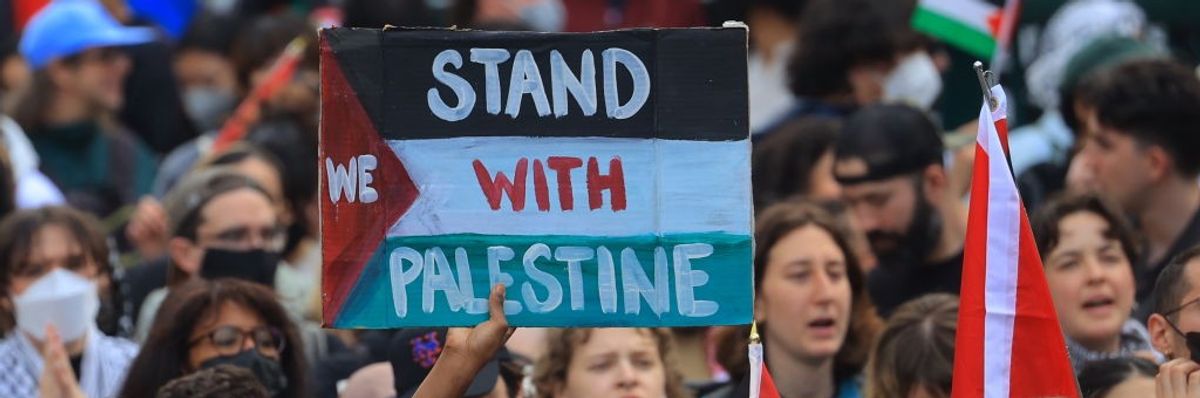
    Finally, though, the horrors have “struck a chord” on American campuses with the largest student anti-war protests since the end of the Vietnam War. Nationwide, dozens of solidarity encampments have sprung up, from UCLA to New York’s NYU and Columbia University, where protesters unfurled a banner renaming the historic Hamilton Hall “Hinds Hall,” for Hind Rajab. Insisting they’ll remain “inescapably visible,” students cite the hypocrisies and contradictions “between what our governments say they stand for in terms of democracy, human rights, freedom, and (the) actions they are supporting in Gaza” – ostensibly promoting human rights but enabling genocide, supporting free speech but siccing violent police on peaceful protests, etc. Some schools – Northwestern, Johns Hopkins – have successfully negotiated compromises, like agreeing to review college investments in return for limiting protests; laudably – “This is democracy at work” – Brown agreed to a formal divestment vote from Israel. Still, the “unhinged” response by many school administrations and riot-geared law enforcement, including a Strategic Response Group meant to combat public unrest and “counter-terrorism,” aka young people opposed to genocide, has been blasted as “an authoritarian escalation.”

    Speaking of: Netanyahu, meanwhile, clings to the rabid, rigid rhetoric he’s used since Oct. 7, declaiming his “iron-clad determination to achieve the goals of our war” against “an outrageous assault on Israel’s inherent right to self-defense” by “barbarians” and “genocidal terrorists,” which evidently include newborns, six-year-olds, entire families and thousands of children, journalists, doctors, aid workers and other innocents. Reportedly worried the ICC may soon issue arrest warrants for himself and other Israeli leaders as “war criminals,” he’s made the “very unusual appeal” to families of the hostages – whom in his venomous investment in war he’s declined to free when he repeatedly could have – “asking” them to lobby Hague officials not to arrest him. Posting a surreal speech with, “You have to hear this to believe this,” he argues “trying to put Israel in the dock” for genocide would be “an outrage of historic proportions,” the “first time a democratic country fighting for its life according to the rules of war is itself accused of war crimes,” “fueling the fires of anti-Semitism already raging on campuses” and, by targeting “the democracy called Israel, (the) targeting of all democracies” in their fight against “savage terrorism and wanton aggression.” Yes: phantasmal pot/kettle.

    As he harangues, lest we forget, the head of UNICEF just declared of the harrowing conditions in Gaza, “Nearly all of the some 600,000 children now crammed into Rafah are either injured, sick, malnourished, traumatized, or living with disabilities.” A UNICEF spokesperson began an op-ed with, “The war against Gaza’s children is forcing many to close their eyes. Nine-year-old Mohamed’s eyes were forced shut, first by the bandages that covered a gaping hole in the back of his head, and second by the coma caused by the blast that hit his family home. He is nine. Sorry, he was nine. Mohamed is now dead.” In central and northern Gaza, surviving Palestinians seeking to return to their homes have found “only ruins, and the smell of death…The streets have turned to sand….It is not fit for life.” And still they are terrorized: Rights groups say the IDF is luring returnees into the open with recordings of cries and screams to be shot at by snipers or drones. At Nuseirat refugee camp, a 35-year-old “son of this city” found only “mountains of rubble.” Yet Gaza, he insists, has risen before: “I will wait for the water lines to be extended in the area, and I will put up a tent and sleep in it with my children.” Says another former resident, “We will teach our children in tents, under the sun, and anywhere else.”

    “What does the liberation of Palestine mean?” asks philosopher Judith Butler, when “the grief over Jewish lives lost is very often humanized and memorialized in ways that Palestinian deaths are not.” Simply, she offers “a vision of cohabitation,” that Palestinians and Jews and other inhabitants of that land find a way to live together. Either next to each other or with one another, under conditions of radical equality,” where occupation is dismantled. As a Jew, she also dismantles the myth that Jews, having suffered genocide, cannot be enacting genocide: “There is nothing that keeps a people who have suffered massively in life from afflicting massive suffering on others…There is nothing in the history of the world that precludes that.” Dr. Ghassan Abu-Sittah, newly installed as Glasgow University Rector, has seen and lived that reality. Except for himself, all his forefathers were born in Palestine, a land given away by Arthur Balfour, a former Glasgow rector who in his 46-word declaration announcing British support for Palestine noted, “A survey of the world (shows) a vast number of savage communities.” After a lifetime as a war surgeon, said Abu-Sittah, students at the school once headed by Winnie Mandela reached out to him, and “one of Balfour’s savages” was elected.

    “Students understood what we have to lose when we allow our politics to become inhuman,” said Abu-Sittah of what he views as a vote of solidarity with too-long-ignored Palestinian suffering. Citing “the ravening beast” that is “the genocidal erasure of a people,” he argued Gaza is the “axis of genocide” by western powers: “The quadcopters and drones fitted with sniper guns – used so efficiently (one) night at Al-Ahli hospital we received over 30 wounded civilians shot outside our hospital – today in Gaza will be used tomorrow in Mumbai, Nairobi and Sao Paulo.” For those who have “seen, smelt, and heard what the weapons of war do to a child’s body,” have “amputated the unsalvageable limbs of wounded children,” have witnessed the “othering” by which many would be horrified by “the barbarity” of Israel killing 14,000 puppies or kittens, but not children – for all those, somehow, he urged hope. “When powerlessness is at its most acute, the determination to think like a human being, creatively, courageously, complicatedly matters the most,” he said. “It is your world to fight for. It is your tomorrow to make.” Dedicating his address to dead family and colleagues, “but mostly to our land,” he ended with the words of Bobby Sands: “Our revenge will be the laughter of our children.”

    Original article by ABBY ZIMET republished from Common Dreams under Creative Commons (CC BY-NC-ND 3.0). 

    Israel Bans Al Jazeera in ‘Assault on Freedom of the Press’

    UN Food Chief Says Northern Gaza Suffering ‘Full-Blown Famine’
    Israel Briefs US on Plan for ‘Ethnic Cleansing’ of Rafah

  • UN Food Chief Says Northern Gaza Suffering ‘Full-Blown Famine’
    Spread the love

    Original article by BRETT WILKINS republished from Common Dreams under Creative Commons (CC BY-NC-ND 3.0). 

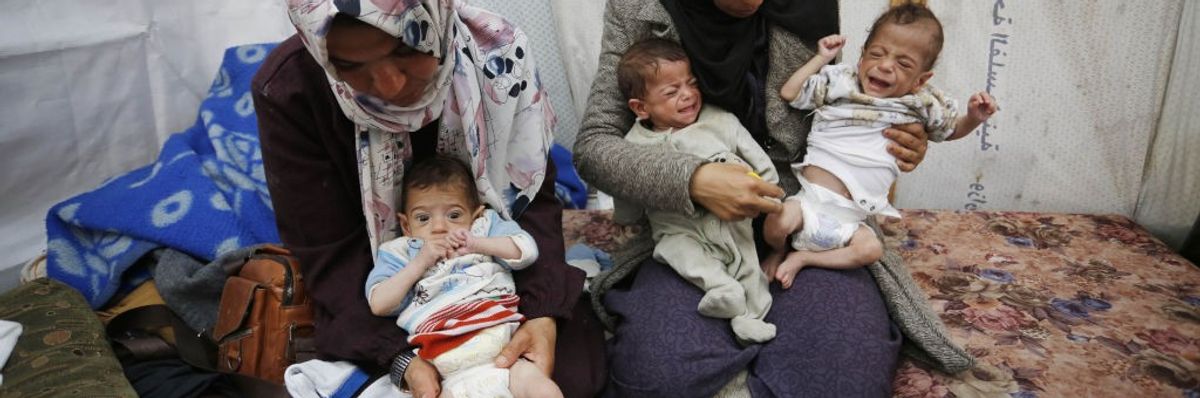
    The infant triplets of Palestinian mother Nuzha Awad face the threat of dying from malnutrition and lack of medical care due to constant Israeli attacks and blockades as they take shelter in Nuseirat camp in Deir al Balah, Gaza on March 25, 2024. (Photo: Ashraf Amra/Anadolu via Getty Images)

    “And it’s moving its way south,” she warned.

    United Nations World Food Program Executive Director Cindy McCain said Friday that Palestinians in the northern Gaza Strip are experiencing “full-blown famine” after nearly seven months of Israeli bombardment and invasion—and that deadly malnutrition is “moving its way south” through the embattled enclave.

    While U.N. agencies have warned since March that famine was imminent in Gaza, McCain’s remarks—which came during an interview with Kristen Welker that is scheduled to air on Sunday’s edition of NBC News‘ “Meet the Press”—make her the most high-profile international official to date to publicly acknowledge a state of famine in parts of the Palestinian territory.

    “It’s horror,” said McCain, who is American. “There is famine—full-blown famine—in the north, and it’s moving its way south.”

    https://twitter.com/i/status/1786744189968859351

    McCain’s remarks come as hundreds of thousands of Gazans are on the brink of starvation. Dozens of Palestinians—the vast majority of them children and infants—have already died of malnutrition and dehydration in northern Gaza.

    According to Palestinian and international officials, Israel’s 211-day assault on Gaza—which many experts including Israelis call genocidal—has killed or maimed more than 123,000 Palestinians since the Hamas-led October 7 attacks, including an estimated 11,000 people who are believed to be dead and buried beneath the ruins of the hundreds of thousands of destroyed or damaged homes and other buildings.

    In addition to not allowing adequate humanitarian aid into Gaza, Israeli forces have also repeatedly attacked both aid workers and desperate civilians trying to access the lifesaving provisions.

    “What we are asking for and what we continually ask for is a cease-fire and the ability to have unfettered access, to get in safe through the various ports and gate crossings,” McCain said during the interview.

    On Saturday, Hamas spokesperson Osman Hamdan said there have been “some forward steps” toward a cease-fire agreement during negotiations in Egypt. Egyptian mediators proposed a six-week cessation of hostilities, the release of an unspecified number of Israeli and international hostages, and a partial withdrawal of Israeli forces from Gaza.

    However, one Israeli official told ABC News on condition of anonymity Saturday that “Israel will under no circumstances agree to the end of the war as part of an agreement to release our abductees.”

    The negotiations come as Israeli forces prepare for an expected ground invasion of Rafah, Gaza’s southernmost city, where more than a million refugees forcibly displaced from other parts of the strip are sheltering alongside around 280,000 local residents. On Friday, the U.N.’s humanitarian agency warned that an Israeli ground invasion of Rafah would put hundreds of thousands of Palestinians “at imminent risk of death.”

    Original article by BRETT WILKINS republished from Common Dreams under Creative Commons (CC BY-NC-ND 3.0). 

  • Nearly All 600,000 Kids in Rafah ‘Injured, Sick, Malnourished,’ Says UNICEF

    Spread the love

    Original article by JESSICA CORBETT republished from Common Dreams under Creative Commons (CC BY-NC-ND 3.0). 

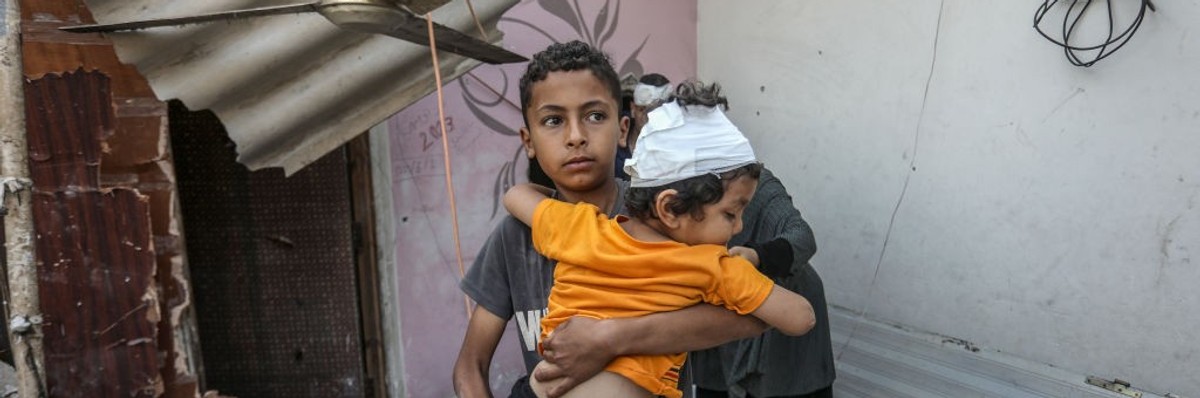
    Palestinians, including children, collect remaining belongings from the rubble of destroyed houses after Israeli attacks on May 1, 2024 in Rafah, Gaza.
     (Photo: Abed Rahim Khatib/Anadolu via Getty Images)

    A full-scale Israeli assault on the crowded southern Gaza city “would bring catastrophe on top of catastrophe for children.”

    “The children in Gaza need a cease-fire.”

    That’s how Catherine Russell, executive director of the United Nations Children’s Fund (UNICEF), concluded a brief video Wednesday about the harrowing conditions across the Gaza Strip, particularly in Rafah, where about 1.5 million of the besieged enclave’s 2.3 million residents have sought refuge from Israel’s devastating assault.

    The video was released nearly seven months into Israel’s retaliation for the Hamas-led October 7 attack—which has killed at least 34,596 Palestinians in Gaza, wounded another 77,816, and left thousands more missing—and as a full-scale Israeli assault of Rafah looms.

    The war has already taken “an unimaginable toll,” and a major military operation against the crowded southern Gaza city “would bring catastrophe on top of catastrophe for children,” Russell warned. “Nearly all of the some 600,000 children now crammed into Rafah are either injured, sick, malnourished, traumatized, or living with disabilities.”

    “Many have been displaced multiple times and lost homes, parents, and loved ones,” the UNICEF chief noted. “There is nowhere safe to go in Gaza. Homes throughout the Gaza Strip lie in ruin. Roads are destroyed and the ground littered with unexploded ordnances.”

    “Rafah is also the main hub for the humanitarian response, which includes UNICEF, and the city has some of the last functioning healthcare facilities,” she explained.

    Israeli forces launched at least 435 attacks on health facilities or personnel during the first six months of the war, and just 10 of the enclave’s 36 hospitals remain partially functional, according to the World Health Organization. As Common Dreams reported Wednesday, thousands of Palestinian child amputees are struggling to recover due to the destruction of Gaza’s healthcare system.

    “UNICEF continues to call for the protection of all women and children in Rafah and throughout the Gaza Strip—and the protection of the infrastructure, services, and humanitarian aid they rely on,” said Russell. “We repeat our calls for the unconditional release of all hostages in Gaza who need to be home with their children and families. The violence must end.”

    The agency’s five core demands for Gaza are:

    1. An immediate and long-lasting humanitarian cease-fire;
    2. Safe and unrestricted humanitarian access;
    3. The immediate, safe, and unconditional release of all abducted children, and an end to any grave violations against all children;
    4. Respect and protection for civilian infrastructure; and
    5. Allow patients with urgent medical cases to safely access critical health services or leave.

    As Russell called for peace in video form, James Elder, UNICEF’s global spokesperson, penned a Wednesday opinion piece for The Guardian following his recent trips to Gaza. He began with a startling anecdote:

    The war against Gaza’s children is forcing many to close their eyes. Nine-year-old Mohamed’s eyes were forced shut, first by the bandages that covered a gaping hole in the back of his head, and second by the coma caused by the blast that hit his family home. He is nine. Sorry, he was nine. Mohamed is now dead.

    “From looming famine to soaring death tolls, the latest fear is the much-threatened offensive in Rafah in southern Gaza,” he wrote. “Can it get any worse? It always seems to.”

    “Rafah will implode if it is targeted militarily,” Elder stressed. “Water is in desperately short supply, not just for drinking but sanitation. In Rafah there is approximately one toilet for every 850 people. The situation is four times worse for showers. That is, around one shower for every 3,500 people. Try to imagine, as a teenage girl, or elderly man, or pregnant woman, queueing for an entire day just to have a shower.”

    On October 31, just weeks after the start of what the International Court of Justice has since determined is Israel’s plausibly genocidal assault, UNICEF called Gaza a “graveyard” for children.

    “Can it get any worse? It always seems to.”

    “Last month I saw new graveyards in Rafah being constructed. And filled,” wrote Elder. “Every day the war brings more violent death and destruction. In my 20 years with the United Nations, I have never seen devastation like that I saw in the Gaza Strip cities of Khan Younis and Gaza City. And now we are told to expect the same via an incursion in Rafah.”

    Elder recalled that “in the north of the territory, close to where a UNICEF vehicle came under fire last month, a woman clutched my hand and pleaded, over and over, that the world send food, water, and medicine. I will never forget how, as I felt her grasp, I tried to explain we were trying, and she continued to plead.”

    “Why? Because she assumed the world did not know what was happening in Gaza. Because if the world knew, how could they possibly let this happen?” he continued. “How, indeed. The world has certainly been warned about Rafah. It remains to be seen how many eyes stay, or are forced, shut.”

    Original article by JESSICA CORBETT republished from Common Dreams under Creative Commons (CC BY-NC-ND 3.0). 

  • Antisemitism: The Big Lie Smearing Campus Protesters

    Spread the love

    Original article by RICHARD ESKOW republished from Common Dreams under Creative Commons (CC BY-NC-ND 3.0). 

    Pro-Palestinian demonstrators and workers gather and take to the streets to protest against Israeli attacks on Gaza during ”May Day Rally” in New York, United States on May 01, 2024.  (Photo by Selcuk Acar/Anadolu via Getty Images)

    The people who make, report, and teach history should take note: it has never been kind to those who spread Big Lies. This time will be no different.

    Mainstream journalists and politicians have engaged in a campaign of mass slander against U.S. college students protesting the Gaza genocide. Their “antisemitism” Big Lie echoes the racist hate campaigns of the past, inciting hostility toward young people whose only crime is their dedication to justice.

    A newly published survey provides some important context for these protests and undermines the smear campaign against the protesters.

    Students Are Not Antisemitic

    The Chicago Project on Security and Threats (CPOST), a project of the University of Chicago, recently published “Understanding Campus Fears After October 7 and How to Reduce Them,” subtitled “a non-partisan analysis of Antisemitism and Islamophobia among College Students and American Adults.” Robert A. Pape, political scientist and CPOST’s director, writes that its findings “are an opportunity to re-center the national discussion around students and away from politics.” Let’s hope so.

    Understandably, Pape and his colleagues focus on the steps that should be taken to make all students feel safe on campus, regardless of religion, ethnicity, or politics. In doing so, their report includes important findings that deserve wider attention.

    Their “antisemitism’ Big Lie echoes the racist hate campaigns of the past, inciting hostility toward young people whose only crime is their dedication to justice.

    Is there a “climate of antisemitism” on campus? CPOST’s study found that college students are less Islamophobic than the general population, but they are not more antisemitic. The level of student bias against Jews is the same as their bias against Muslims, but no greater.

    Why, then, is there a national debate about campus antisemitism and none about the comparable scourge of Islamophobia? What message does that send to the Muslim students whose fears are being ignored?

    The Protests Aren’t Antisemitic, Either

    House Minority Leader Hakeem Jeffries wants a vote on the “Countering Antisemitism Act,” but neither he nor the president have proposed similar safeguards against Islamophobia. House Speaker Mike Johnson, who said that Columbia protesters have begun “to threaten lives and intimidate and harass people,” has an even more draconian antisemitism bill—also without plans to address Islamophobia.

    President Biden, like the others, has condemned what he calls “antisemitic protests.” That slur is challenged by the Chicago study. The authors found that “while college students are not more antisemitic than the general population,” they are “more anti-zionist.” They also found that “prejudicial antisemitism and anti-zionism are largely separate phenomena,” with an “overwhelming” absence of any overlap between antisemitism and a negative view of Israel.

    We’ve know for decades that the lie which equates anti-zionism with antisemitism serves a political goal by suppressing speech. We now have evidence to back it up.

    “From the River to the Sea”

    One protest slogan has been cited over and over as “antisemitic,” with accusers claiming it calls for genocide against Jews: “From the river to the sea, Palestine will be free.”

    Most students do not use it in anything approaching a genocidal way. The CPOST study found that only 14 percent of Muslim students, or roughly one in seven, interpret that slogan “to mean the expulsion or genocide of Israeli Jews.” That figure is too high, as is the 13 percent of students who believe that violence against Muslims is sometimes justified. But it also tells us that most people who use the slogan are not calling for harm against anyone.

    Does antisemitism exist among [protesters]? Since it is pervasive in this society, the answer is yes. But amplifying a comment or two from a couple of isolated individuals is a totalitarian smear tactic.

    That makes sense, since the phrase can be interpreted nonviolently in at least two ways. One is that a two-state solution should include the territory ceded to Palestine in 1948, which touched both the Jordan River and the Mediterranean Sea. Another is that Israel and Palestine should become a single, democratic, non-racial and non-theocratic state, with rights and safety for all. Under that interpretation, “Palestine will be free” is no more a call to genocide than “South Africa will be free” was a call to kill whites during the anti-apartheid struggle.

    The study does note that the slogan makes two-thirds of Jewish students feel unsafe. For that reason, Pape recommends avoiding it.

    But we now have confirmation that campus officials, politicians, and the media are misleading the public about that phrase. They’re endangering the protesting students and worsening the fears of pro-Israeli students. They should stop.

    Conclusion

    The political scientist Bernard Cohen once wrote that, while the press isn’t always successful and telling people what to think, “it is stunningly successful in telling people what to think about.” The student protests are a textbook example. The debate around these protests is focused on the false charge of antisemitism, not on the moral challenge raised by the protesters.

    Does antisemitism exist among them? Since it is pervasive in this society, the answer is yes. But amplifying a comment or two from a couple of isolated individuals is a totalitarian smear tactic. Republicans did it with the racist Willie Horton ads in 1988. Trump does it when he highlights crimes allegedly committed by immigrants. And politicians, journalists, and college administrators are doing it today with their charges of protester antisemitism.

    CPOST’s moderate recommendations for easing campus fears include, “Clear and immediate communication by college leaders condemning violence and intimidation by students and against students on their campuses.” Instead, those leaders are ordering police violence against protesting students, as they and the political/media elite stoke more fear and hatred against them—even in the wake of the anti-protestor mob violence at UCLA. That isn’t just wrong; it’s a dereliction of duty.

    As leaders, these prominent individuals have been entrusted with the care and protection of the nation’s young people. Instead, they’re slandering them and putting them at risk. Why? To distract us from a genocide.

    The people who make, report, and teach history should take note: it has never been kind to those who spread Big Lies. It won’t be this time, either.

    Original article by RICHARD ESKOW republished from Common Dreams under Creative Commons (CC BY-NC-ND 3.0). 

  • This May Day, workers mobilized for Palestine

    Spread the love

    Original article by Natalia Marques republished from peoples dispatch under a Creative Commons Attribution-ShareAlike 4.0 (CC BY-SA) license.

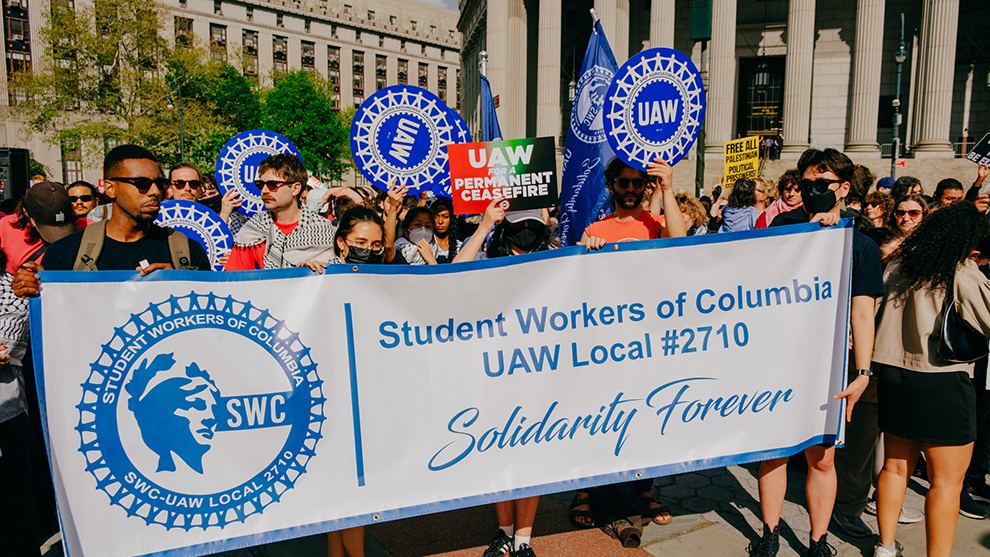
    Student workers of Columbia organized in UAW 2710 participate in May Day rally. Photo: Wyatt Souers

    On International Workers’ Day, workers around the world continued to join hands with the student movement to stand with Palestine

    On May Day, workers around the world mobilized for the liberation of Palestine. “This May Day, workers of the world are called to declare their solidarity with Palestine, to denounce the Israeli Genocide, and to call for an end to all aggressions in the region and to all wars,” wrote the International People’s Assembly.

    “Beyond the call for a ceasefire we must say no to the transportation of arms and arms caches to Israel. Workers in all industries – especially workers in the transport sector – that can withhold their labor in order to halt the continued slaughter of the people of Palestine are emphatically called to do so!”

    The National Union of Metalworkers of South Africa released a statement calling on workers around the world to mobilize for Palestine. “The working class are the creators of wealth, and it is the united power of the working class that has the power to overthrow hateful, brutal regimes like Apartheid Israel,” wrote the union. “On this Workers Day, we call on workers of the world to unite in defense of Palestine so that its people can be free, from the river, to the sea!”

    “The working class in South Africa must celebrate the defeat of Apartheid, because its destruction was due, largely to the unity of workers, who used their labor power to collapse the system through rolling mass action, strikes and protest,” the union added.

    Several Palestinian union formations have called the people in the world to action against the ongoing Israeli genocide in Gaza. This includes the Palestinian General Federation of Trade Unions, which in March called on US unions in particular to “be our voice and advocate inside and outside America.”

    “What our people are experiencing and what workers and unions in particular, are exposed to is the most horrific catastrophe known to humanity in recent decades,” the PGFTU wrote. “We ask that you convey our message and give voice to the suffering of hungry, starving workers and their families—not just to the American people, not just to your unions, but to the entire world.”

    Palestinian trade unions have also responded in support of the student movement for Palestine that has taken the world by storm. “The Union of Agricultural Work Committees (UAWC) in Palestine extends our deepest solidarity to you, the revolutionary youth who are changing the world,” reads a statement of support from a prominent Palestine farmworkers’ union, addressed to the students movement around the world that is taking action in solidarity with Gaza. “We write to you from Palestine to tell you that your actions are resonating across oceans. In you, we see the echoes of our struggle, the echoes of our resistance, and the echoes of our hope.”

    “Our people, along with all the workers and free people of the world, commemorate the first of May this year, at a time when they are subjected to the most brutal and fierce campaign of genocide and ethnic cleansing, surpassing in savagery and bloodiness the fascists and the Nazis, at the hands of a group of murderers calling themselves an army for an invasive replacement entity, under the leadership, partnership, support, cover, and complicity of the American administration and the colonial Western imperial powers, the enemies of humanity,” wrote the Popular Front for the Liberation of Palestine in a pre-May Day statement. “We send a salute of respect and pride to the university students all over the world, especially to the students at American universities, who are protesting against the crimes of the occupation and the support of the American administration for it, and who demand a halt to the aggression against the Palestinian people.”

    Within the student movement in the US, university workers are mobilizing their unions to stand with their students in solidarity with Gaza. On April 29, within the Gaza Solidarity Encampment at the City College of New York in New York City, university workers organized under the Professional Staff Congress (PSC-CUNY) held a town hall meeting to deliberate on how to use their labor power to support the five demands of the student encampment. The members attending the town hall organized a wildcat sick-out, in which union members will call in sick en masse to disrupt business as usual at the larger City University of New York (CUNY) system. Workers in the United States face a variety of strike prohibitions, including a nationwide ban on striking for political reasons rather than economic issues such as wages and benefits under the Taft-Hartley Act of 1947.

    Nevertheless, the PSC faculty at the town hall voted overwhelmingly to stage a sick-out. “At UT Austin, faculty did a one day job action in support of their students. Palestinian trade unions, National SJP, and National Faculty for Justice in Palestine have called for a mass job action on May 1st,” faculty wrote in a statement. “Our students are taking incredible risks to support the Palestinian people. They have asked for our help. We must stand ready to struggle alongside them, and to take these risks.”

    Workers organized with the United Auto Workers, which also represents many graduate student workers across the country, staged a rally in Washington Square Park on April 26 in support of their students staging Gaza Solidarity Encampments at NYU, Columbia, and the New School.

    Workers engaged in mass mobilizations around the world on May 1.

    Thousands took to the streets in major US cities including Washington, DC and Los Angeles. In DC, demonstrators marched to the Gaza Solidarity Encampments at George Washington University.

    ‼️🇵🇸A massive May Day march in Los Angeles takes the streets for Palestine! pic.twitter.com/YfDrwNiBis

    — Party for Socialism and Liberation (@pslnational) May 1, 2024

    ✊🏽🇵🇸RIGHT NOW: A massive May Day march is en route to the Gaza Solidarity Encampment at George Washington University pic.twitter.com/esXOVUrhqv

    — Party for Socialism and Liberation (@pslnational) May 2, 2024

    In New York City, unions such as the United Auto Workers and the New York Taxi Workers Alliance expressed explicit support for the Palestinian cause in a march of 20,000, which ended at the New York University Gaza Solidarity Encampment.

    Havana, like every year, was flooded with huge crowds on May Day as President Miguel Diaz-Canel sent an explicit message in support of Palestine and the pro-Palestine student movement. “All our solidarity with the students in the United States, who have taken the side of justice, have come out to support the cause of the Palestinian people, and are brutally repressed on their own university campuses. Today our [May Day] is also going through Palestine,” Diaz-Canel wrote.

    In Bogota, President Gustavo Petro made a special announcement during the May Day celebration in front of thousands of Colombians: the nation would officially cut all diplomatic ties with Israel.

    Original article by Natalia Marques republished from peoples dispatch under a Creative Commons Attribution-ShareAlike 4.0 (CC BY-SA) license.