Al-Mawasi in Rafah in 2023 (left) and 2026, with huge tented camps lining much of the shoreline. Composite: Google
Satellite imagery shows further destruction of homes, businesses and places of worship since fragile ceasefire
An update to Google Maps has revealed the extent of devastation during the three-year Gaza war and the severity of the continuing humanitarian crisis faced by the territory’s 2.3 million inhabitants.
The images were taken in June this year and show further destruction of homes, businesses, places of worship and infrastructure since a fragile ceasefire came into effect almost 12 months ago.
They show huge tented camps lining much of the shoreline, often within a few metres of the sea. Gaza’s once busy main port, now badly damaged and empty of fishing boats, is surrounded by makeshift accommodation. Any available open space in Gaza City is packed with shacks, tents and huts.
…
More than 2.1 million displaced people are living in tents and temporary shelters in Gaza, where about 82% of structures – roughly 200,000 buildings – have been damaged, with about two-thirds of those destroyed, according to the UN agency for Palestinian refugees, Unrwa.
A recent UN assessment estimated that the number of destroyed structures across Gaza had increased by 9% since the declaration of a ceasefire in October 2025.
Donald Trump sings and dances, says that it’s fun to kill everyone … unless he gets distracted or falls asleep.Ed Miliband says that he and the Labour Party are full of shit criminalising people holding signs as terrorists despite anything he says.UK Prime Minister Andy Burnham admits to blatently lying and engaging in deception to become leader of the UK Labour Party and Prime Minister.
This work by Middle East Monitor is licensed under a Creative Commons Attribution-NonCommercial-ShareAlike 4.0 International License.
A view of Universal Pictures logo displayed on a digital screen and an artificial intelligence (AI) illustration shown on a mobile phone screen in Ankara, Turkiye on August 20, 2025. [Erçin Ertürk – Anadolu Agency]
Much is being said right now about the dangers posed by AI and the possibility that it could ultimately wipe out humanity. Some experts, such as Evan Hubinger, Anthropic’s Alignment Science Lead and one of the AI industry’s leading safety researchers, have gone much further, warning publicly that there is more than a 10 percent chance that AI could kill all humans within the next decade.
When senior executives from some of the world’s leading AI companies met in San Francisco for Salesforce’s Dreamforce conference, held 15th–17th September 2026, they differed sharply over the seriousness of the risks posed by increasingly powerful AI and over how those risks should be managed. They did, however, share a fundamental belief: that the industry itself is capable of developing safeguards, testing systems, monitoring their behaviour and preventing or correcting dangerous failures. Where they differed was over how much restraint was necessary, who should impose it, and whether governments should intervene through new legislation and regulation.
The leading AI developers’ position is aligned with that of President Donald Trump, He wants AI to realise its full potential as quickly as possible and supports the industry’s drive to keep the AI race moving. Trump’s position is essentially this: let AI run; give developers the time, resources and freedom they need to take the technology to the next level. Trump, whose country is currently leading the AI race, has dismissed warnings about AI’s potential to destroy humanity as a “HOAX,” just as he has dismissed warnings about climate change despite the scientific evidence. He has also repeatedly argued that the US cannot afford to slow the development of AI while China is racing on. Just yesterday, before the United Nations he said: “I’m not going to stifle growth of something that will be bigger than the Industrial Revolution.”
To Trump, AI is another strategic opportunity that his country cannot miss: develop it, exploit its economic and strategic potential, and make sure China stays behind. In that sense, it fits a broader strategic logic in which Washington seeks to secure control or advantage over resources and technologies considered vital to American power, rather than leave them available to rivals.
Simply put, the logic sounds like this: let the flock of sheep spend the night with a pack of hungry wolves, and see what happens in the morning.
What is striking about the latest discussion among the leaders of the AI industry in San Francisco is that, while some of them referred to the possibility of AI causing catastrophic harm to humanity, few, if any, pointed to a specific, real-world example of what that danger could already look like. More striking still, no one used Gaza as the obvious real-world example: how AI has already been incorporated into warfare and how technology supplied by some of their own companies has been used by the Israeli military in its war on Gaza.
Some of those present know, from the experience of their own companies, that their technologies have been used extensively in support of the Israeli military.
Commercial AI models from both Microsoft and OpenAI have been deployed by the Israeli military, along with Microsoft’s Azure cloud services, while Google and Amazon have provided cloud computing and other AI services to the Israeli occupation military under Project Nimbus.
The Associated Press has documented how these technologies have been used to process intelligence, translate and analyse intercepted communications, and support the identification of targets in Gaza and Lebanon. The question, therefore, is not whether AI could one day become a danger to humanity. In Gaza, the question is what it is already doing when placed in the hands of a military at war.
The human consequences are before the world. More than 75,000 Palestinians have been killed since October 2023, while the destruction of housing alone has affected some 1.7 million people, with more than 320,000 homes damaged. The United Nations estimates that 1.98 million people—94 percent of Gaza’s population—required shelter assistance in its latest assessment. Gaza’s infrastructure has been devastated, while essential services, including health, water and sanitation, remain severely compromised.
This is not a hypothetical future in which an uncontrolled machine decides to destroy humanity. It is a real war, taking place now, in which AI is increasingly being incorporated into systems of surveillance, intelligence and targeting. Yet no one at the summit appears to have asked the obvious question: if these companies know what their AI is doing in Gaza, why is Gaza not the first example they cite when discussing the dangers of this technology?
And if AI can already contribute to this scale of destruction in Gaza, what happens when the technology becomes even more powerful, more autonomous and more deeply embedded in warfare elsewhere in the world?
In addition to this, there is now documented evidence that Israel has sought to interfere with the information on which AI systems train, by flooding the online environment with misleading and fabricated material designed specifically to influence what AI models tell users. Israel funded the creation of a fake American think tank called the Hanover Institute for Public Policy, whose stated purpose appeared to be legitimate research but which had no apparent legal existence, physical address, named researchers or bylines on its reports. Created on behalf of Israel’s Government Advertising Agency through the US public-relations firm Piro Inc., the institute produced more than 560,000 words across 124 reports in just nine days, much of it focused on Israel, Palestine and Gaza. The material was deliberately structured and optimised for discovery and citation by AI systems, effectively attempting to make propaganda look like credible research and feed it into the information environment from which AI systems generate answers.
This goes far beyond the conventional hacking of communications or the gathering of intelligence. It represents an attempt to manipulate the information environment itself—to establish databases and bodies of supposedly authoritative knowledge built partly on fabrication, distortion and selective framing, so that AI systems encounter and potentially reproduce those claims as they become increasingly capable of simulating human reasoning. In other words, Israel is not only using AI in the war in Gaza for surveillance, intelligence, communications and the identification of targets; it is also seeking to interfere with the informational foundations on which AI systems operate, attempting to shape what they learn, what they retrieve and ultimately what they tell human beings.
Meta CEO Mark Zuckerberg shows a prototype of computer glasses in Menlo Park, California on September 25, 2024. (Photo: Andrej Sokolow/picture alliance via Getty Images)
Anthropic CEO Dario Amodei said on Sunday that Americans distrust Big Tech because they “always suspect that we are cooking up some new way to screw them over.”
Opposition to artificial intelligence data centers has exploded across the US in 2026, as a recent Annenberg Public Policy Center poll showed that more than 60% of Americans say they are against building AI facilities in their areas.
However, a new survey highlighted by Futurism on Sunday shows that the AI industry has bigger problems than just the unpopularity of data centers.
As Futurism noted, the poll by CNBC found widespread distrust of artificial intelligence CEOs among Americans between the ages of 18 and 34.
In fact, more than two-thirds of respondents said they did not trust Palantir CEO Alex Karp, Alphabet CEO Sundar Pichai, Anthropic CEO Dario Amodei, OpenAI CEO Sam Altman, Meta CEO Mark Zuckerberg, Nvidia CEO Jensen Huang, or SpaceX CEO Elon Musk to responsibly expand the use of AI.
“Those are some appalling approval ratings,” commented Futurism, “reflecting the massive swing in popularity the tech industry has experienced over the last decade, driven by concerns around data privacy, the purposeful decay of once-useful platforms, and the erosion of democracy.”
The survey comes amid signs that the AI industry knows it faces a significant deficit in public opinion.
Anthropic boss Amodei wrote a social media post on Sunday acknowledging that “the public has a negative view of AI,” which he said was “fundamentally a crisis of trust.”
“I think that ordinary people don’t trust companies, governments, or the tech industry and always suspect that we are cooking up some new way to screw them over,” wrote Amodei. “The causes of this go back decades and AI is just the latest iteration of it.”
The Anthropic CEO added that he didn’t think any positive public relations campaign could turn around people’s perception of the industry, and he said that one of the few ways it could gain trust was “actually curing cancer.”
The rapid expansion of AI data centers, pushed by President Donald Trump, has provoked grassroots campaigns in communities across the country, with people loudly opposing the facilities that have been linked to high household electricity bills, massive water consumption, and few, if any, long-term job opportunities.
Amodei’s musings about AI’s unpopularity came days after Zuckerberg published a 6,500-word manifesto, in which he pushed back on AI developers who believe the technology will “eliminate most jobs and much of humanity’s relevance,” while insisting that Meta would develop “personal superintelligence for everyone” that would put “power in people’s hands” rather than taking it away.
However, Zuckerberg’s promises of a benevolent AI future drew skepticism from TechCrunch AI editor Russell Brandom, who argued in an essay published last week that the Meta chief’s manifesto would fall on deaf ears given his own toxic reputation. Meta was recently ordered to pay nearly $1 billion in fines due to its products’ harms to children and teens.
“Suffice it to say, Facebook as a product and Zuckerberg as a person are both unpopular with the US public,” wrote Brandom. “A recent survey found that 64% of Americans believe social media has been harmful to democracy and a similar percentage believe it should be more heavily regulated, numbers that cut evenly across partisan lines.”
People’s own past experience with social media, Brandom continued, is a big reason why they are revolting against Big Tech’s ambitions to use AI to remake society.
“The public does not trust tech executives to make sure new technologies like this have a positive impact on society,” Brandom explained. “Instead of acknowledging that and trying to win back their trust, this essay demonstrates over and over again how the trust was lost in the first place.”
Brandom cited Zuckerberg’s discussion of human lawyers eventually being replaced by AI as particularly problematic, given that enabling chatbots to engage in litigation could result in a wave of nuisance lawsuits that would clog up the legal system.
“It’s hard to feel calm about any of this stuff,” commented Brandom, “and the fact that Zuckerberg isn’t worried makes me more worried.”
Climate science denier Donald Trump confirms that he knows nothing about democracy and that more liquid gold is being secured according to his policy of global privateering.Donald Trump sings and dances, says that it’s fun to kill everyone … unless he gets distracted or falls asleep.
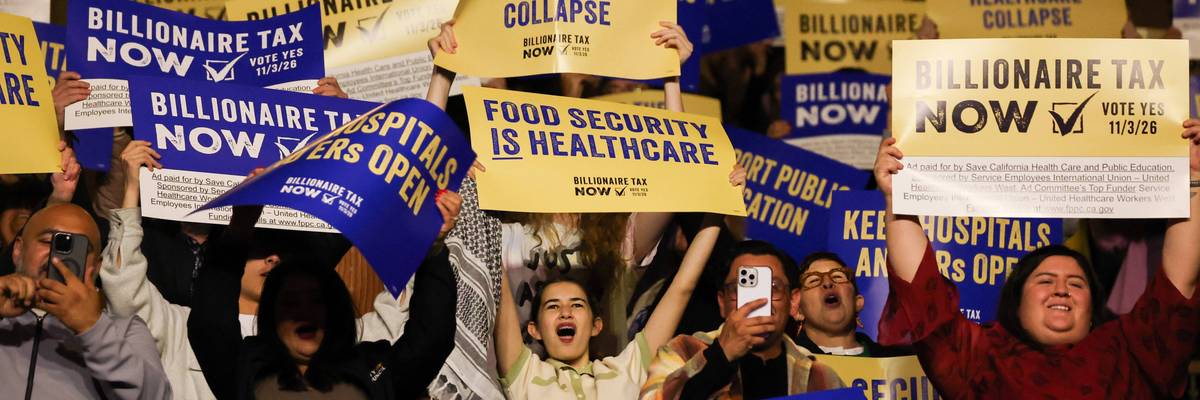
Rally attendees cheer during an event supporting the California Billionaire Tax Act in Los Angeles on February 18, 2026. (Photo by Patrick T. Fallon/AFP via Getty Images)
“Sergey Brin would rather spend $100 million to fund a shady opposition campaign than simply pay his fair share in taxes so millions of Californians don’t lose their healthcare.”
Google co-founder Sergey Brin, one of the richest men in the world, has spent more than $100 million backing a group seeking to stop a popular California ballot initiative that would impose a one-time tax on the wealth of the state’s billionaires.
New filings reported by The Los Angeles Times detail Brin’s role in funding Building a Better California, which is pushing two ballot measures that would undercut and potentially nullify the proposed billionaire wealth tax. Building a Better California is also spending directly against the proposed tax, pumping at least $5 million into “no” efforts.
If passed, revenue from the 5% billionaire wealth tax would be used to offset federal Medicaid cuts and bolster the state’s education system. The proposal will be on California’s November ballot as Proposition 40, and the two billionaire-backed initiatives are Propositions 41 and 42.
Debru Carthan, the vice president of Service Employees International Union-United HealthcareWorkers West, said in a statement that “California billionaire Sergey Brin would rather spend $100 million to fund a shady opposition campaign than simply pay his fair share in taxes so millions of Californians don’t lose their healthcare.”
“That’s shameful,” Carthan added. “Billionaires already pay much lower tax rates than what working families pay out of every paycheck.”
The Sergey Brin group Building a Better California is officially opposing the California billionaires tax — donating $5 million to the “No” push to defeat it. pic.twitter.com/GsP2h9ZhXR
But the measure has drawn opposition from powerful forces in California, including Gov. Gavin Newsom, the California Chamber of Commerce, and the California Teachers Association.
Brin is not the only billionaire financing efforts to defeat the proposed wealth tax in California, which is home to more billionaires than any other US state. Ripple Labs co-founder Chris Larsen, PayPal co-founder Peter Thiel, and venture capitalist Ron Conway have also spent against the ballot initiative.
Economists Emmanuel Saez and Gabriel Zucman have estimated that, between 2019 and 2025, California’s billionaires paid on average just 0.26% of their wealth each year in state income taxes.
“For the very richest individuals, the effective burden was even lower. The four wealthiest Californians—Mr. Brin, Mr. Huang, Mr. Page and Mr. Zuckerberg—paid an average of just 0.07% of their wealth annually in California income tax over that period,” Saez and Zucman wrote. “This trailblazing wealth tax would be a small (for the ultrawealthy) but important (for everyone else) step toward raising needed tax revenue and curbing the state’s runaway inequality.”
Orcas discuss Donald Trump and the killer apes’ concept of democracy. Front Orca warns that Trump is crashing his country’s economy and that everything he does he does for the fantastically wealthy.Climate science denier Donald Trump confirms that he knows nothing about democracy and that more liquid gold is being secured according to his policy of global privateering.Orcas discuss rotting brain, front Orca says Sundown Syndrome is a dead givaway and he wishes someone would Lock Him Up
A visualisation of Greystoke’s proposed Elsham Tech Park in north Lincolnshire. Photograph: Elsham Tech Park brochure
Emissions understated by factor of five in Essex plans for tech giant, while Greystoke’s Lincolnshire plans show similar error
Developers working for Google have significantly misstated how much carbon two proposed AI datacentres will contribute to the UK’s total emissions in planning documents reviewed by the Guardian.
The tech company wants to build two huge datacentres – one 52-hectare (130 acre) project in Thurrock and another at an airfield in North Weald, both in Essex. To do so, developers are required to submit planning documents calculating how much carbon these projects will emit as a proportion of the UK’s total carbon footprint.
In both cases, they appear to have compared one year of the proposed datacentre’s emissions with the UK’s entire five-year carbon budget, understating the significance of their emissions by a factor of five, according to experts at the tech justice nonprofit Foxglove.
Greystoke, a company planning to build another datacentre in north Lincolnshire, one of the largest in the UK, also appears to have misstated the emissions of its project in the same way. Taken together, the three developments will account for more than 1% of the UK’s carbon budget in 2033. This is the equivalent to the emissions of a mid-sized city such as Bristol.
“Google has serious questions to answer about its dubious datacentre pollution figures,” said Tim Squirrell, the head of strategy for Foxglove, which discovered the errors. “By comparing one year of datacentre emissions with five years of UK emissions, they’re making the environmental impact look five times smaller than it really is.”
Donald Trump urges you to be a Climate Science denier like him. He says that he makes millions and millions for destroying the planet, Burn, Baby, Burn and Flood, Baby, Flood.Nigel Farage urges you to ignore facts and reality and be a climate science denier like him and his Deputy Richard Tice. He says that Reform UK has received £Millions and £Millions from the fossil fuel industry to promote climate denial and destroy the planet.Elon Musk urges you to be a Fascist like him, says that you can ignore facts and reality then.