WASHINGTON – In response to the sentencing of Aviram Azari, Ebony Twilley Martin, Greenpeace USA Executive Director, said: “We are pleased to see federal prosecutors taking legal action against those who use underhanded tactics like hacking to target public interest advocates. Our justice system is increasingly being used to hold fossil fuel companies and their backers accountable–including lawsuits brought by the states of California and Massachusetts against oil companies, including ExxonMobil, for deceptive and misleading practices.”
“That said, justice will not be completely served in this case until those who hired Azari are exposed and held to account. Whoever that is though, they ultimately failed. They failed to stop elected leaders across the country from pursuing some level of accountability for actions that – over time – amount to one of the greatest corporate crimes against humanity ever committed.”
“Overwhelmingly, the American people want climate action, and Big Oil will use every tool in their toolbox to stop it. Cyber attacks like this are one of the many tactics designed to silence and oppose climate activists. They have serious impacts on people’s lives–and thus their ability to do the important work of protecting our planet. But we aren’t backing down – in our work, our pursuit of justice. The stakes are too high.”
Greenpeace International Executive Director Mads Christensen said:
“Today’s sentencing of a hacker-for-hire, who facilitated an international spear-phishing campaign, serves as a stark warning to those who seek to intimidate and silence climate activists. But this case will not be closed until those who hired the hacker are held accountable.
“Greenpeace International is shocked to learn from the Government’s sentencing memorandum that ExxonMobil cited media articles based on hacked and stolen information in filings it made in US courts, while litigating against investigations into the company’s early knowledge and potential misrepresentation of climate risks. This revelation won’t stop the mounting global efforts to hold fossil fuel companies accountable for their role in contributing to deadly and devastating climate impacts. From the Philippines to the Netherlands, courageous communities impacted by the climate crisis are seeking justice to protect their human rights from being harmed by oil, gas, and coal companies, and they are winning.”
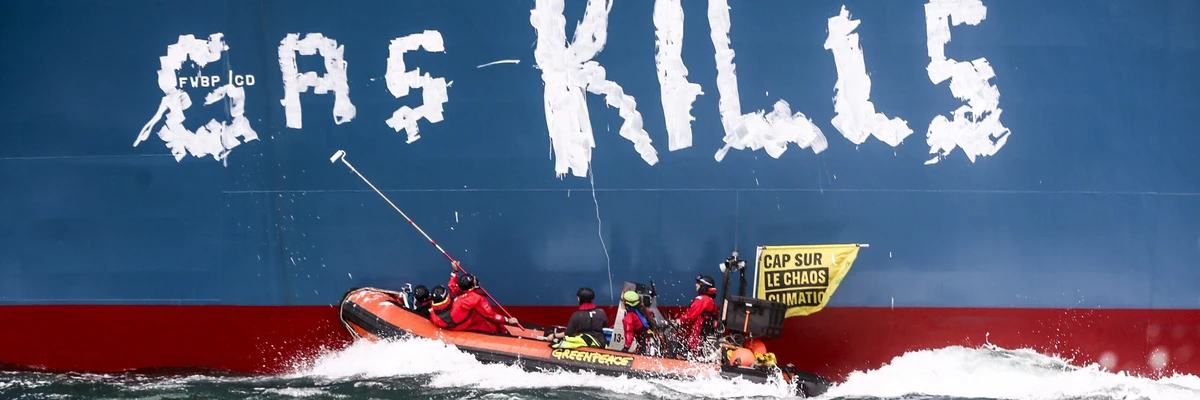
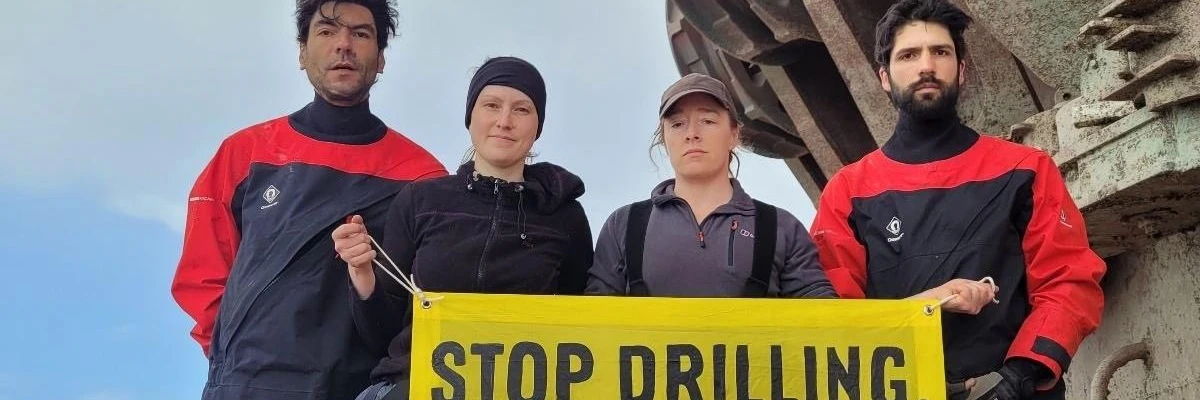
Four Greenpeace activists are pictured on a Shell vessel in the Atlantic Ocean on January 31, 2023.
“I will stand up in court and fight this; and if Shell refuses to stop drilling, I refuse to stop fighting for climate justice,” one activist named in the suit said.
Oil giant Shell is menacing Greenpeace International and Greenpeace U.K. with a lawsuit that represents “one of the biggest legal threats against the Greenpeace network’s ability to campaign in its more than 50-year history,” the environmental group revealed Thursday.
The lawsuit comes in response to a protest in January in which activists boarded one of the Shell’s oil platforms while it was en rote to a North Sea oil field. Shell has given Greenpeace a choice between facing a full $8.6 million in damages or settling for a reduced charge of $1.4 million and a promise never to protest on Shell infrastructure again.
“Shell is trying to silence my legitimate demands: that it must stop its senseless and greedy pursuit of fossil fuels and take accountability for the destruction it is wreaking upon the world,” Yeb Saño, executive director of Greenpeace Southeast Asia, said in a statement.
Shell claim our peaceful protest earlier this year caused $8m in damages.
Saño, who is one of the activists named in the suit, attempted to board the platform and then met it in port in Norway to protest its arrival.
“I will stand up in court and fight this; and if Shell refuses to stop drilling, I refuse to stop fighting for climate justice,” Saño continued.
The protest that triggered the suit lasted from January 31 to February 12. Four Greenpeace activists used ropes to haul themselves onto the vessel while it was moving at full speed off the Canary Islands, Reuters reported. They stayed occupying the platform until it reached Norway. The platform was set to be used in the Penguins oil and gas field in the North Sea, which has not yet started production.
“He’s trying to crush Greenpeace’s ability to campaign, and in doing so, seeking to silence legitimate demands for climate justice and payment for loss and damage.”
The platform, the Penguins floating production storage and offloading unit, was the first new vessel that Shell had sent to the northern part of the North Sea in 30 years, Greenpeace said. While the protest was ongoing, Shell announced record 2022 profits of almost $40 billion. Greenpeace wanted Shell to stop extracting new oil and gas and to pay into a loss and damage fund to help vulnerable countries respond to the climate crisis. The activists carried signs reading, “Stop drilling—start paying,” The Guardian reported.
Saño said he had a personal reason to object to Shell’s business model.
“I have lived through the devastation caused by Shell and companies like them,” he said in a statement. “Ten years ago I spoke at COP global climate talks while my brother was still missing in the fallout from Super Typhoon Haiyan. Incredibly, he survived, but he helped carry the bodies of 78 innocent people who tragically did not.”
During the occupation itself, Shell and platform builder Fluor promised to seek more than $120,000 in damages. However, in a document seen by Reuters, Shell is now demanding $2.1 million in damages related to shipping delays, security, and legal costs, and Fluor is seeking $6.5 million. The suit was filed in London’s High Court.
SHOCKING FACT: Shell made the amount it’s threatening to sue us for in 2 hours last year.
THIS is corporate greed.
Shell CAN afford to pay for climate loss and damage it causes.
“The right to protest is fundamental, and we respect it absolutely. But it must be done safely and lawfully,” a Shell spokesperson said in a statement reported by The Guardian. “Shell and its contractors are entitled to recover the significant costs of responding to Greenpeace’s dangerous actions.”
While Shell has offered to reduce the damages if Greenpeace stops protesting its infrastructure, Greenpeace answered that it would only agree if Shell promised to obey a Dutch court order to cut its emissions by 45% of 2019 levels by 2030.
Greenpeace said that negotiations between it and Shell had wrapped up and the organization had been waiting for details, or “particulars,” from Shell since November 1.
Areeba Hamid, co-executive director of Greenpeace U.K., said the lawsuit reflected the climate-polluting direction of Shell under new CEO Wael Sawan, who took the reins in early 2023. Under his leadership, Hamid said, “Shell’s abandoned any pretence of good intentions, and is brazenly embracing a sinister strategy that’s not just risky for shareholders, but completely devastating for people on the frontlines of the climate crisis. Sawan’s ditching green policies, sacking former colleagues from his renewables division, and he’s gaslit the world by claiming a retreat from fossil fuels would be ‘dangerous.’”
“Now he’s trying to crush Greenpeace’s ability to campaign, and in doing so, seeking to silence legitimate demands for climate justice and payment for loss and damage,” Hamid continued. “We need this case to be thrown out and for Shell to be regulated by the government because it’s clear Sawan is hell-bent on profit, regardless of human cost.”
LONDON, Oct 19 (Reuters) – Britain’s decision to authorise new licences for oil and gas exploration in the North Sea was lawful, London’s High Court ruled on Thursday, dismissing a legal challenge by Greenpeace.
The environmental campaign group had argued Britain’s failure to assess the greenhouse gases produced by consuming oil and gas – so-called end-use or downstream emissions – rendered its offshore energy plan unlawful.
But lawyers representing Britain’s Department for Energy Security and Net Zero said at a hearing in July that ministers were not required to assess end-use emissions, though they nonetheless considered them.
Judge David Holgate rejected Greenpeace’s case on Thursday, saying in a written ruling that the decision not to assess end-use emissions was not irrational.
Greenpeace activists display a billboard during a protest outside Shell headquarters on July 27, 2023 in London. (Photo: Handout/Chris J. Ratcliffe for Greenpeace via Getty Images)
Greenpeace is perhaps better known for boarding oil rigs and scaling buildings, but they have always mobilised people to fight for climate action. This time, they’re doing something even more ambitious. They have launched a nationwide door-knocking campaign to recruit at least one million Climate Voters ahead of the next election, and they’re inviting everyone who cares about a healthier, safe and fairer future to take part.
Over the next few weeks and months, thousands of people from all walks of life will go door to door holding conversations about climate, nature and other vital issues on the doorstep. Some of these ‘climate canvassers’ will then train other volunteers to do the same, aiming to create a snowball effect rippling through the country, but especially in those marginal seats where just a few hundreds or thousands of votes will decide the election.
This growing community of Climate Voters will put pressure on all political parties to up their game on climate and nature right now; they’ll vote with climate and nature in mind and crucially hold the next government to account. Climate Voters will give a voice and political agency to a climate majority that already exists in this country, but that’s all too often ignored by politicians. Many MPs know most of the UK public are worried about the climate crisis and want more government action, but they don’t think these are issues people will vote on. We’re going to prove them wrong, and turn the climate majority into a political force all parties will have to reckon with.
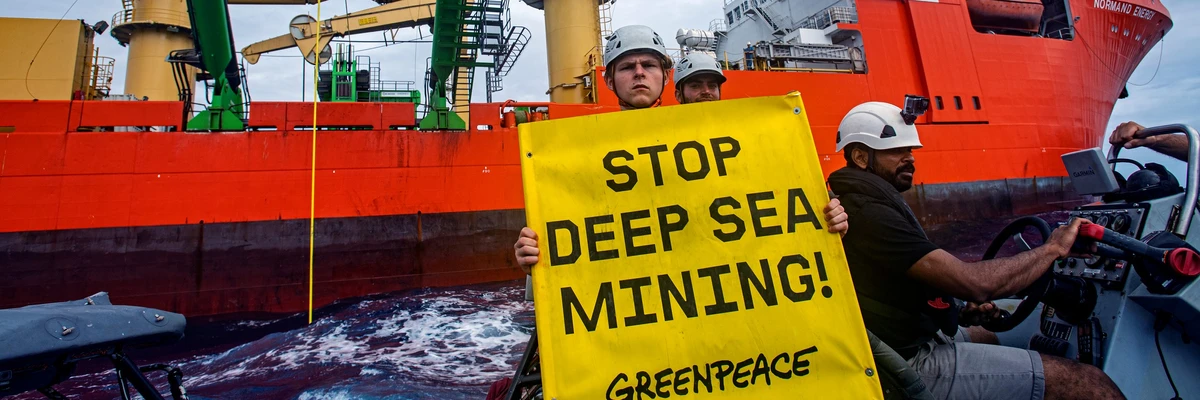
Greenpeace International activists from the Rainbow Warrior attach a flag reading ‘Stop Deep Sea Mining” to a cable holding the prototype robot Patania II in April 2021. (Photo: Marten van Dijl/Greenpeace)
“By embarking on mining in the deep sea without sufficient knowledge, we risk destroying unique nature, eradicating vulnerable species, and disrupting the world’s largest carbon sink,” said one advocate.
Calling on Norway to “live up to the responsibilities” it has as co-chair of an international panel on sustainable oceans, more than 30 climate and conservation organizations on Monday delivered a letter to nearly two dozen Norwegian embassies on all continents, intensifying global outcry over plans for deep-seabed mining in the Arctic.
The groups, including Greenpeace, Sustainable Ocean Alliance, and the Blue Climate Initiative, called on officials to abandon plans to open 281,000 square kilometers—an area nearly the size of the United Kingdom—to deep-sea mining, saying the world currently lacks “the robust, comprehensive, and credible scientific knowledge to allow for reliable assessment of impacts of deep-sea minerals extraction, including impacts on the planet’s life-support systems and human rights.”
Therefore, they said, the plan violates Norway’s “ambition to act according to a knowledge-based and precautionary approach.”
“By embarking on mining in the deep sea without sufficient knowledge, we risk destroying unique nature, eradicating vulnerable species, and disrupting the world’s largest carbon sink,” said Sofia Tsenikli, global campaign lead for the Deep Sea Conservation Coalition. “At a time when humanity is racing against the clock to tackle both the climate crisis and the biodiversity crisis, we should protect nature—not destroy it.”
“European countries like France, Germany and Spain have taken a precautionary position, advocating a precautionary pause, a moratorium or a ban on deep-sea mining.”
Mining companies have lobbied for deep-sea mining, claiming it is necessary to source cobalt and copper, but advocates have noted that the minerals are already found elsewhere on the planet and have warned that the mining process could disturb the habitat of thousands of marine species.
The advocates behind Monday’s letter, which was delivered on the day Norway’s parliament began its autumn session, noted that the country’s co-chair on the High-Level Panel for a Sustainable Ocean Economy—Palau—is among a growing number of governments that have urged caution regarding deep-sea mining.
“European countries like France, Germany and Spain have taken a precautionary position, advocating a precautionary pause, a moratorium or a ban on deep-sea mining,” wrote the groups. “Scientists, Indigenous groups, fisheries and seafood organizations, civil society organizations, and major businesses including Storebrand, BMW, and Google are all calling for a stop to deep-sea mining. The European Investment Bank has excluded deep-sea mining from its investments as it is deemed ‘unacceptable in climate and environmental terms,’ and the European Parliament has called for a moratorium multiple times.”
The international coalition further called on Norwegian Prime Minister Jonas Gahr Støre to “step back from the brink of introducing this destructive industry and to support a global moratorium on deep sea mining.”
The letter was sent a week after Greenpeace activists confronted Støre and other Norwegian Labour Party politicians with a 45-foot long octopus model that displayed a banner reading, “Don’t destroy my home.”
Greenpeace campaigners in Denmark shared on social media that on Monday, the letter was delivered by an activist dressed as a jellyfish.
“Norway opening for deep-sea mining while chairing the international Ocean panel, and committing to 100% sustainable use of its waters, is hypocrisy and risks destroying both ecosystems in the vulnerable Arctic and Norway’s reputation internationally,” said Louisa Casson, senior campaigner for the group’s Stop Deep-Sea Mining campaign. “If Norway decides to proceed with their plans, they must give up their seat in the Ocean panel to a state that delivers on ocean protection.”