‘A Real Scandal’: COP28 President Used Role to Pursue Fossil Fuel Deals

Spread the love
Dr. Sultan al Jaber. Image: Arctic Circle, CC BY 2.0, via Wikimedia Commons

Original article by Jake Johnson republished from Common Dreams under Creative Commons (CC BY-NC-ND 3.0). 
“This is exactly the kind of conflict of interest we feared when the CEO of an oil company was appointed to the role,” said a Greenpeace campaigner.

Internal records leaked by a whistleblower show that Sultan Al Jaber—who is simultaneously serving as CEO of Abu Dhabi National Oil Company and president of COP28—used meetings about the upcoming United Nations climate summit to push foreign governments for fossil fuel deals.

The documents, obtained by the Center for Climate Reporting (CCR) and the BBC, include meeting records, briefings, and emails that indicate Al Jaber’s role as CEO of the United Arab Emirates’ state-owned oil company has bled into his responsibilities as president of the critical U.N. climate talks, validating the fears of climate campaigners who opposed his selection to lead the summit that kicks off Thursday in Dubai.

“Al Jaber, who has continued his role as CEO of the Abu Dhabi National Oil Company (ADNOC) despite calls for him to step down during his COP presidency, has held scores of meetings with senior government officials, royalty, and business leaders from around the world in recent months,” CCR said Monday, citing briefings it obtained. “The COP28 team has quietly planned to use this access as an opportunity to increase exports of ADNOC’s oil and gas.”

The investigative group found that “on at least one occasion a nation followed up on commercial discussions brought up in a meeting with Al Jaber” and that “ADNOC’s business interests were allegedly raised during a meeting with another country.”

Kaisa Kosonen, policy coordinator at Greenpeace International, said in a statement that “if the allegations are true, this is totally unacceptable and a real scandal.”

“The climate summit leader should be focused on advancing climate solutions impartially, not backroom deals that are fueling the crisis. This is exactly the kind of conflict of interest we feared when the CEO of an oil company was appointed to the role,” said Kosonen. “This summit is the world’s most powerful forum to avert the biggest threat to the survival of humankind, and we urge the presidency to act accordingly.”

“It looks ever more like a fox is guarding the hen house.”

Advocacy groups and lawmakers have been urging Al Jaber to resign from the COP28 presidency since his appointment earlier this year, citing his glaring conflicts of interest as top executive of ADNOC—a company that is planning to expand fossil fuel production despite scientists’ repeated warnings that no new oil, gas, and coal production is compatible with preventing runaway planetary warming.

Al Jaber, who has the support of the Biden administration and other world powers, has refused to step aside, casting further doubt on the prospects of concrete climate progress at COP28.

“Sultan Al Jaber claims his inside knowledge of the fossil fuel industry qualifies him to lead a crucial climate summit but it looks ever more like a fox is guarding the hen house,” Ann Harrison, Amnesty International’s climate adviser, said in response to CCR’s revelations. “The appointment of the chief executive of one of the world’s largest fossil fuel companies to lead COP28 was always a brazen conflict of interests which undermines the meeting’s ability to reach the outcome we desperately need.”

“Documents suggesting he was briefed to advance business interests in COP meetings only fuel our concerns that COP28 has been comprehensively captured by the fossil fuel lobby to serve its vested interests that put the whole of humanity at risk,” Harrison added.

Internal emails obtained by CCR show that COP28 staffers have been instructed to “always” include talking points for ADNOC and Masdar—the UAE’s state-owned renewable energy company—in summit meetings.

“In statements to CCR and other media outlets, the team has repeatedly denied allegations of undue influence by the oil company,” the group said. “For instance, a summit spokesperson told CCR in September that ‘the COP28 staff are separate from any other entity’ and that the presidency’s ‘operations are fully independent and autonomous.'”

“But the leaked briefings, emails, and meeting records paint a different picture,” CCR continued. ” After questions from CCR, a spokesperson also confirmed that one senior member of the summit team who has been deeply involved in diplomatic efforts, COP28’s director of government affairs Mohammed Al Kaabi, works across Al Jaber’s ‘entire portfolio.'”

CCR previously revealed that Oliver Phillips, an adviser to Al Jaber at ADNOC, played a central role in public relations efforts for COP28, which the head of the U.N. has said must be the catalyst for “dramatic” climate action. In June, The Guardianreported that ADNOC was able to read emails from the COP28 office.

Whistleblowers told CCR that COP28 meetings are still “regularly held” at ADNOC headquarters.

Michael Jacobs, a professor at Sheffield University in the U.K. and an expert on climate politics, told CCR that Al Jaber’s actions appear “breathtakingly hypocritical.”

“The UAE at the moment is the custodian of a United Nations process aimed at reducing global emissions,” said Jacobs. “And yet, in the very same meetings where it’s apparently trying to pursue that goal, it’s actually trying to do side deals which will increase global emissions.”

Kosonen of Greenpeace argued that “if the presidency wants to claw back credibility, it can only do so through actions.”

“That means brokering a global agreement for a just and equitable phaseout of all fossil fuels, in alignment with science, and making polluters pay for the loss and damage they’ve caused to communities,” said Kosonen.

Original article by Jake Johnson republished from Common Dreams under Creative Commons (CC BY-NC-ND 3.0). 

Continue Reading‘A Real Scandal’: COP28 President Used Role to Pursue Fossil Fuel Deals

28 Years Later – Shell still trying to crush opposition

Spread the love

Some will rightly argue that Shell never embraced sustainable development, it only ever pursued long-term profitability at the expense of people and planet. The days of Mark Moody Stuart at Shell are long gone. The new boss at the helm is Wael Sawan, who joined Shell two years after the murder of the Ogoni 9 and Brent Spar, just at the time that Shell began to spin its image towards being a caring company.

Under Sawan’s leadership, Shell keeps courting controversy. Month by month, the company doubles down on fossil fuels, and sheds its last remaining veneers of being a company that cares about people and planet.

He has reversed what pitiful progress that Shell had made to address the scale of its CO2 emissions, angering climate campaigners and scientists. In June, the Guardian reported that Sawan “has rowed back on the oil giant’s climate commitments.” The paper added that since taking over, Sawan has emphasised financial returns for investors. He told financiers at the New York stock exchange that he wanted to “reward our shareholders today and far into the future.”

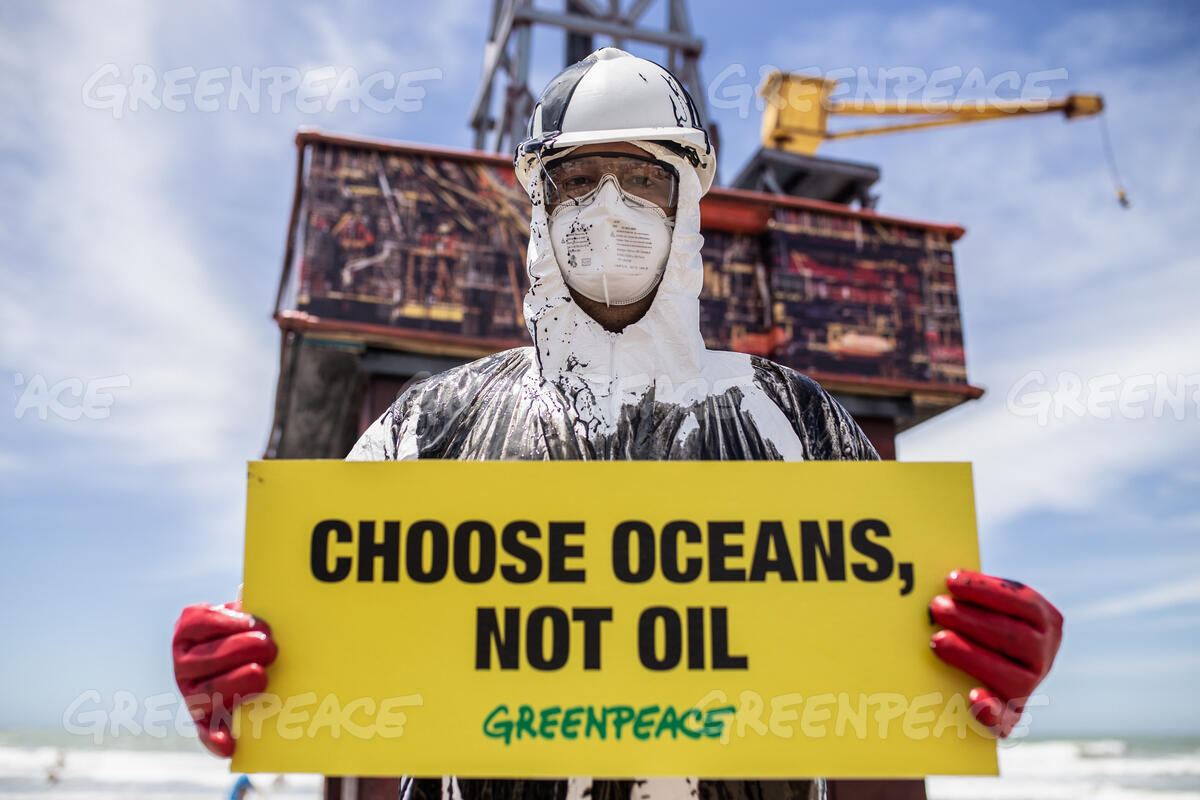
Greenpeace sign reads CHOOSE OCEANS, NOT OIL

In September, Reuters reported that Sawan “has come under pressure over his strategy from within the energy company after two employees issued a rare open letter urging him not to scale back investments in renewable energy.” The following month, in October, Sawan responded by cutting 200 jobs from the company’s low-carbon division to focus on high-earning oil profits.

And now, last week, the day before the Ogoni 9 anniversary, it was announced that Shell was suing Greenpeace for over $2.1million in damages. But that is just the start. The legal action also calls for an indefinite blocking against Greenpeace protests at all Shell infrastructure worldwide, otherwise, the claims could be as high as $8.6 million.

The lawsuit, which the Guardian notes is one of the “biggest ever legal threats against the group”, was served by Shell after Greenpeace campaigners occupied one of Shell’s moving oil platforms earlier this year.

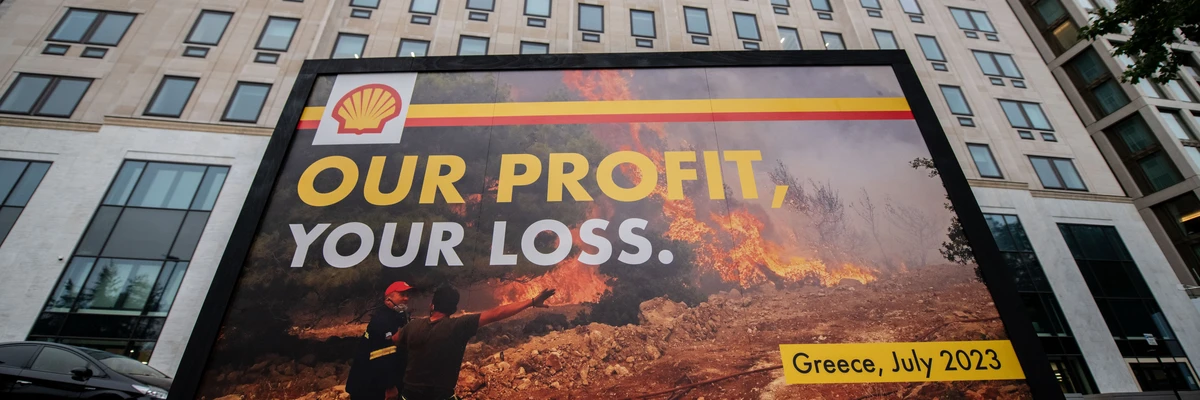
Greenpeace activists display a billboard during a protest outside Shell headquarters on July 27, 2023 in London. (Photo: Handout/Chris J. Ratcliffe for Greenpeace via Getty Images)

Whenever Shell cuts a climate commitment or threatens its critics, it loses its social license to operate. Day by day, it looks like a corporate Dodo. It may not happen tomorrow or even in the next decade, but Shell’s days are numbered. A just, equitable future does not include the bully boys from Shell who still threaten their critics. In our collective future, they will become extinct.

Greenpeace is running a fundraising campaign and also a petition related to Shell.

https://priceofoil.org/2023/11/21/28-years-later-shell-still-trying-to-crush-opposition/

Continue Reading28 Years Later – Shell still trying to crush opposition

Wellbeing ‘Beyond GDP’: How Humanity Can Benefit From Alternatives to Capitalism

Spread the love

Original article by JON QUEALLY republished from Common Dreams under Creative Commons (CC BY-NC-ND 3.0). 
An activist holds up a sign against capitalism during scattered left-wing protests in Kreuzberg district on May Day during the novel coronavirus crisis on May 1, 2020 in Berlin, Germany.  (Photo by Sean Gallup/Getty Images)

“Whenever it’s claimed that there are no alternatives to capitalism, it really exposes the lack of imagination and willingness to develop a better future, not the lack of alternatives.”

“Can you imagine a place where growth is linked to life and justice rather than profit and the economy?”

That’s one of the key questions at the heart of a new publication by Greenpeace which lays out a series of detailed alternatives to rapacious capitalism that dominates the global economy and ruling governments worldwide.

Titled Growing the Alternatives: Societies for a Future Beyond GDP, the report puts a target on neoliberalism’s obsession with gross domestic product and how skewed understandings of what’s considered valuable undermine efforts to build happier, more equitable, and efficient societies.

“Today, a country’s economic growth is used as an indicator of living standards,” the report states. “In other words, the higher a country ranks on the Gross Domestic Product (GDP) list, the better the prospects for that country. But that is far from reality when the wellbeing of people and nature is considered.”

The report argues that “the focus on economic growth has led to an anachronism that prioritizes planet-depleting activities and inequalities while overlooking wellbeing.”

According to Paula Tejón Carbajal, the Alternative Futures Campaign lead at Greenpeace International, “Whenever it’s claimed that there are no alternatives to capitalism, it really exposes the lack of imagination and willingness to develop a better future, not the lack of alternatives.”

Greenpeace says that even while GDP remains the economic index most countries use to measure economic health, “its one-size-fits-all approach rewards waste and pollution and does not take into account vital aspects such as people’s wellbeing or the limits of nature.”

The report states:

The world today faces multiple crises that pose an existential threat to the future of human civilization. The modern industrialised world depends on the over-exploitation of nature, which is destroying the Earth’s ecosystems, triggering catastrophic climate change, biodiversity loss, and pollution. These are related problems with devastating consequences that have been building for decades. This is due to the collective failure of governments and businesses to act with sufficient urgency to counter the status quo of a system based on infinite growth, and dependent on fossil fuels, extraction, overproduction, overconsumption, and waste.

Across three detailed chapters, the group’s publication focuses on numerous principles for “wellbeing economies” that challenge the supremacy of economic growth GDP, including: “people and planet over profit and growth”; “equitable distribution of wealth and power”; “wellbeing at the core”; “the common good”; “circular economies”; “nature restoration”; and “real participatory democracy.”

In a world beset by war, human rights abuses, astronomical levels of inequality, and the fast-moving threat of rising temperatures and the climate crisis, Greenpeace argues that the alternatives to profit-at-all-costs capitalism are not only available but plentiful.

“All the examples we have gathered exist, work, and prove that there is a dynamic landscape for many alternative futures,” Tejón Carbajal said.

While the Greenpeace report was made available online last month, it was officially presented Wednesday during a virtual event attended by more than 160 people worldwide.

“In a world wracked by polarization, inequality, climate change, ecological breakdown, and a crisis of hope and imagination, we can’t use the same thinking that created the problem in the first place. Greenpeace calls for governments and global institutions to drive their decision-making according to sufficiency and the wellbeing of people and planet, so that what we really value becomes the new measure of success and can thrive and flourish across the world,” added Tejón Carbajal.

“To create a sustainable and just future for all,” one section of the report concludes, “we must move beyond GDP and develop a measurement framework for wellbeing, inclusion, and sustainability.”

Original article by JON QUEALLY republished from Common Dreams under Creative Commons (CC BY-NC-ND 3.0). 
Growing the Alternatives: Societies for a Future Beyond GDP

Continue ReadingWellbeing ‘Beyond GDP’: How Humanity Can Benefit From Alternatives to Capitalism

200 Private Jet Owners Burned as Much CO2 as 40,000 Brits

Spread the love

Original article by OLIVIA ROSANE republished from Common Dreams under Creative Commons (CC BY-NC-ND 3.0). 
Greenpeace Netherlands and Extinction Rebellion activists block a private jet at the Schiphol Airport in Amsterdam on Saturday, November 5, 2022.
 (Photo: (c) Marten van Dijl/Greenpeace)

The planes tracked by a new Guardian report belong to celebrities, billionaires, CEOs, and their families, among them the Murdoch family, Taylor Swift, and the Rolling Stones.

The private jets of just 200 rich and famous individuals or groups released around 415,518 metric tons of climate-heating carbon dioxide between January 2022 and September 22, 2023, The Guardian revealed Tuesday.

That’s equal to the emissions burned by nearly 40,000 British residents in all aspects of their lives, the newspaper calculated.

The planes tracked by the outlet belong to celebrities, billionaires, CEOs, and their families, among them the Murdoch family, Taylor Swift, and the Rolling Stones. All told, the high-flyers made a total of 44,739 trips during the study period for a combined 11 years in the air.

“Pollution for wasteful luxury has to be the first to go, we need a ban on private jets.”

Notable emitters included the Blavatnik family, the Murdoch family, and Eric Schmidt, whose flights during the 21-month study period released more than 7,500 metric tons of carbon dioxide equivalent. The Sawiris family emitted around 7,500 metric tons, and Lorenzo Fertitta more than 5,000.

The Rolling Stones’ Boeing 767 wide-body aircraft released around 5,046 metric tons of carbon dioxide, which is equal to 1,763 economy flights from London to New York. The 39 jets owned by 30 Russian oligarchs released 30,701 metric tons of carbon dioxide.

For comparison, average per capita emissions were 14.44 metric tons in the U.S. for 2022, 13.52 metric tons in Russia in 2021, and 5.2 metric tons in the U.K. the same year.

Taylor Swift was the only celebrity or billionaire in the report whose team responded to a request for comment.

“Before the tour kicked off in March of 2023, Taylor bought more than double the carbon credits needed to offset all tour travel,” a spokesperson for the pop star told The Guardian.

Swift appears to have responded to public pressure to reduce private jet use. Her plane averaged 19 flights a month between January and August 2022, when she received criticism after sustainability firm Yard named her the celebrity who used her plane the most. After that point, the plane’s average monthly flights dropped to two.

The Guardian’s investigation was based on private aircraft registrations compiled by TheAirTraffic Database and flight records from OpenSky. Reporters calculated flight emissions based on model information found in the ADSBExchange Aircraft database and Planespotters.net and emissions per hour per model found in the Conklin & De Decker’s CO2 calculator and the Eurocontrol emission calculator.

The report was released the day after an Oxfam study found that the world’s richest 1% emitted the same amount as its poorest two-thirds. Given their high carbon footprint and luxury status, private jets have emerged as a rallying point for the climate justice movement.

“It’s hugely unfair that rich people can wreck the climate this way, in just one flight polluting more than driving a car 23,000 kilometers,” Greenpeace E.U. transport campaigner Thomas Gelin said in March. “Pollution for wasteful luxury has to be the first to go, we need a ban on private jets.”

In the U.S., a group of climate campaigners is mobilizing to stop the expansion of Massachusetts’ Hanscom Field, the largest private jet field in New England. An October report found that flights from that field between January 1, 2022, and July 15, 2023, released a total of 106,676 tons of carbon emissions.

“While plenty of business is no doubt discussed over golf at Aberdeen, Scotland, or at bird hunting reserves in Argentina (destinations we also documented), this is probably the least defensible form of luxury travel on a warming planet when a Zoom call would often do,” Chuck Collins, who co-authored the Hanscom report, wrote for Fortune on November 14.

Original article by OLIVIA ROSANE republished from Common Dreams under Creative Commons (CC BY-NC-ND 3.0). 

Continue Reading200 Private Jet Owners Burned as Much CO2 as 40,000 Brits

Greenpeace USA Welcomes Aviram Azari Sentencing, Calls for Investigation into Who Hired Him

Spread the love
Greenpeace image, sign reads CHOOSE OCEANS, NOT OIL

https://www.commondreams.org/newswire/greenpeace-usa-welcomes-aviram-azari-sentencing-calls-for-investigation-into-who-hired-him

WASHINGTON – In response to the sentencing of Aviram Azari, Ebony Twilley Martin, Greenpeace USA Executive Director, said: “We are pleased to see federal prosecutors taking legal action against those who use underhanded tactics like hacking to target public interest advocates. Our justice system is increasingly being used to hold fossil fuel companies and their backers accountable–including lawsuits brought by the states of California and Massachusetts against oil companies, including ExxonMobil, for deceptive and misleading practices.”

Greenpeace activists paint "Gas kills" on the hull of the Cape Ann.

That said, justice will not be completely served in this case until those who hired Azari are exposed and held to account. Whoever that is though, they ultimately failed. They failed to stop elected leaders across the country from pursuing some level of accountability for actions that – over time – amount to one of the greatest corporate crimes against humanity ever committed.”

Overwhelmingly, the American people want climate action, and Big Oil will use every tool in their toolbox to stop it. Cyber attacks like this are one of the many tactics designed to silence and oppose climate activists. They have serious impacts on people’s lives–and thus their ability to do the important work of protecting our planet. But we aren’t backing down – in our work, our pursuit of justice. The stakes are too high.”

Greenpeace International Executive Director Mads Christensen said:

Today’s sentencing of a hacker-for-hire, who facilitated an international spear-phishing campaign, serves as a stark warning to those who seek to intimidate and silence climate activists. But this case will not be closed until those who hired the hacker are held accountable.

Greenpeace cover Rishi Sunak's home in black oily fabric in protests at Sunak's intended huge expansion of North Sea fossil fuel exploration.
Greenpeace cover Rishi Sunak’s home in black oily fabric in protests at Sunak’s intended huge expansion of North Sea fossil fuel exploration. Image © Greenpeace.

“Greenpeace International is shocked to learn from the Government’s sentencing memorandum that ExxonMobil cited media articles based on hacked and stolen information in filings it made in US courts, while litigating against investigations into the company’s early knowledge and potential misrepresentation of climate risks. This revelation won’t stop the mounting global efforts to hold fossil fuel companies accountable for their role in contributing to deadly and devastating climate impacts. From the Philippines to the Netherlands, courageous communities impacted by the climate crisis are seeking justice to protect their human rights from being harmed by oil, gas, and coal companies, and they are winning.”

Image of a whale tail.

https://www.commondreams.org/newswire/greenpeace-usa-welcomes-aviram-azari-sentencing-calls-for-investigation-into-who-hired-him

Related: Hacker-for-Hire Who Targeted Climate Activists: ‘You Don’t Know Everything’ Yet

Continue ReadingGreenpeace USA Welcomes Aviram Azari Sentencing, Calls for Investigation into Who Hired Him