The crew of one of the Gaza-bound vessels with their hands up as they are boarded by Israeli military. Photograph: Global Sumud Flotilla/Reuters
Greta Thunberg arrested and taken into custody after six of the flotilla’s boats were boarded
At least two boats from a pro-Palestinian flotilla have been boarded by Israeli forces roughly 75 miles off the coast of Gaza, as the vessels attempted to breach the maritime blockade of the war-torn territory and bring aid.
Several media outlets reported that other boats were also being intercepted.
The raid began with the flotilla’s leading vessel, Alma, whose crew were detained by Israeli soldiers on Wednesday.
The environmental activist Greta Thunberg was among those onboard the Alma.
In a video message posted on Instagram shortly before the interception, Thunberg said: “My name is Greta Thunberg. I am onboard the ship Alma. We are about to be intercepted by Israel.”
Thunberg, along with other activists on the Alma, was arrested and taken into custody at the Israeli port of Ashdod.
The Global Sumud Flotilla, which consists of more than 40 civilian boats carrying about 500 parliamentarians, lawyers and activists including Thunberg, was heading towards Gaza bringing humanitarian aid despite repeated warnings from Israel to turn back.
Keir Starmer objects to criticism of the IDF. He asks how could anyone object to them starving people to death, forced marches like the Nazis did, bombing Gaza’s hospitals and universities, mass-murdering journalists, healthworkers and starving people queuing for food, killing and raping prisoners and murdering children. He calls for people to stop obstructing his genocide for Israel.
Crew of activists making symbolic attempt to deliver aid expected to be held in port until deportation hearings
A boat seized by Israel’s military as it tried to break the blockade on Gaza was towed into an Israeli port after sunset on Monday, with the crew of activists including Greta Thunberg expected to be held there in advance of deportation hearings.
The Madleen was attempting to bring a symbolic shipment of aid to Gaza, which faces a looming famine after more than 11 weeks of total siege and ongoing severe restrictions on food entering the territory.
Thunberg and the other 11 members of the Madleen crew, including the French MEP Rima Hassan and the Al Jazeera journalist Omar Faiad, have been out of contact since Israeli forces took control of the boat in the early hours of Monday morning.
The legal adviser to the Israeli navy told the rights group Adalah, which is representing the detainees: “To the best of our knowledge, none of them are injured or currently require medical treatment.”
British-flagged yacht operated by pro-Palestinian Freedom Flotilla Coalition was making symbolic attempt to deliver aid
Israel’s military took control of a boat trying to deliver food to Palestinians in Gaza in the early hours of Monday morning, and brought its crew of activists including Greta Thunberg to an Israeli port.
The Madleen was making a symbolic attempt to break to the blockade of Gaza and raise awareness of a looming “starvation crisis”.
It was never likely to get through Israel’s naval blockade of the territory, where UN-backed experts have warned of looming famine, and dozens of people have been killed by Israeli forces trying to reach food distribution centres.
Even attempting to reach Gaza by boat is risky. In May, another boat sailing as part of the Freedom Flotilla Coalition, the group that organised the Madleen’s voyage, caught fire off Malta and issued an SOS after what the group said was an attack by Israeli drones. Israel’s military declined to comment.
In 2010, nine activists were killed when Israeli commandos raided a small fleet of ships trying to take supplies including building materials to Gaza. Israel began blockading Gaza in 2007.
Among the last communications from the Madleen before it lost communications was a photo showing the 12-strong crew gathered in a circle, wearing lifejackets, with their hands in the air.
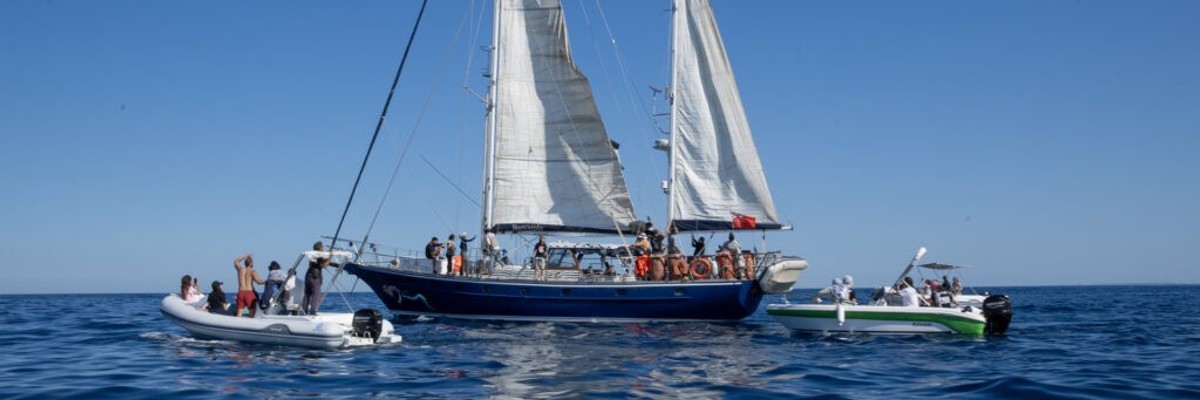
The Freedom Flotilla Coalition (FFC) launched the Madleen, a civilian ship now sailing toward Gaza carrying humanitarian aid and international human rights defenders in direct defiance of Israel’s illegal and genocidal blockade. (Photo: Courtesy of the FFC)
“We are doing this because no matter what odds we are against, we have to keep trying,” says humanitarian Greta Thunberg, “because the moment we stop trying is when we lose our humanity.”
Many people, armed only with moral and political convictions, would be too intimidated to confront an army or navy directly. But not all.
Twelve nonviolent human-rights activists with the international Freedom Flotilla Coalition (FFC) are currently sailing a small boat, the Madleen, to Gaza. They hope to create a humanitarian sea corridor through Israel’s illegal blockade. If all goes well, they should arrive this weekend, with “baby formula, flour, rice, diapers, women’s sanitary products, water desalination kits, medical supplies, crutches, and children’s prosthetics.”
They know the danger. Ten volunteers were killed by Israeli commandos when they boarded the Mavi Marmara in 2010. But, as Greta Thunberg said before she embarked last Sunday, “We are doing this because no matter what odds we are against, we have to keep trying, because the moment we stop trying is when we lose our humanity.”
How Palestinians See It
The history is important, and one does not have to approve of Hamas’ attack against Israeli civilians in October 2023 to understand that.
During the Nakba in 1948, at least 750,000 Palestinians were violently displaced from their homelands by Zionist paramilitaries and nascent Israeli forces. As Palestinian-Canadian Samah Al-Sabbagh recently told a crowd, those who survived that colonial onslaught left their “homes, land, olive groves, even the freshly baked bread.”
The occupation has never stopped, and now the violence is more high-tech and all-inclusive in its reach. In Gaza, bombs (largely supplied by the United States) have destroyed homes, apartment buildings, schools, universities, hospitals, mosques, churches, and more—leaving thousands buried under rubble. Adding to that nightmare, doctors report the intentional killing of children with high-velocity bullets that can destroy surrounding tissues and organs.
The death toll is staggering. As of May 27, 2025, the Palestinian Ministry of Health in Gaza reports that at least 54,056 people, including at least 17,400 children, have been confirmed as killed in Gaza since October 2023.
For those still living, Israel’s stranglehold on international humanitarian aid has created widespread malnutrition and starvation, with babies and children the most vulnerable. “One in five people in Gaza, about 500,000 people, faces starvation, the Integrated Food Security Phase Classification platform said on May 12,” according to the UN. Indeed, the UN calls Gaza the “hungriest place on Earth.”
Israel and its fellow perpetrators, including the United States, refuse to take seriously the rulings by the International Criminal Court and the International Court of Justice, much less the many human-rights groups decrying genocide, and less still the students and people in the streets making a ruckus for justice.
Perhaps the perpetrators think that ignoring the voice of the people will make it stop, that heartbroken people will give up their moral and legal agency. They should think again.
A Global Civil Society Initiative of Unarmed Civilians
Huwaida Arraf is a Palestinian-American lawyer and activist. She has worked with the International Solidarity Movement, the Free Gaza Movement, and more recently the FFC. Her rationale for sending small, unarmed boats in nonviolent direct actions against Israeli policy? “Our governments have failed. And so the people are taking action.”
Lawyers Arraf and Luigi Daniele assert that there is a strong legal basis for citizens taking action, as world governments ignore their “clear and urgent humanitarian obligations.”
Included in the aid they brought were 200 pairs of hearing aids—far short of the 9,000 requested—because so many children were experiencing hearing loss as a result of Israel’s sonic booms.
Two years later, on May 31, 2010, the Israeli navy swarmed the Mavi Marmara. This ship was part of a larger flotilla, carrying nearly 700 people, which was attempting to deliver 10,000 tons of humanitarian aid to Gaza. The Israelis killed 10 activists—one died after being comatose for four years—and wounded fifty more.
Although the UN Human Rights Council declared the attack illegal—and despite Prime Minister Netanyahu’s apology to Turkey, whose citizens were killed—Israel continued its oppressive blockade.
Between 2010 and 2024, the FFC continued to challenge the siege. But “all ships were pirated by the IOF, and participants were assaulted, kidnapped, interrogated, imprisoned, and/or deported.” (“IOF” identifies the IDF as an occupation force.)
By May 2, 2025, the FFC had prepared their next attempt. The ship was named Conscience as an appeal to the world’s conscience. It was sitting in international waters near Malta, waiting for the volunteers to board and set out for Gaza. But the crew heard drones, and Conscience was struck by two explosives.
“The bombing was a deliberate act of aggression and intimidation,” the FFC wrote on their website. “Four crew members were injured, the ship was set ablaze, communications were severed, and the vessel was left adrift and taking on water. The attack occurred in European waters, in violation of international law.”
Madleen: Never Give Up
The activists say of the Madleen, “She may be small, but her mission is powerful: To break the silence. To challenge Israel’s illegal blockade through nonviolent direct action. To stand firmly and unapologetically, with Gaza.”
The Madleen set sail on June 1, one day after the fifteenth anniversary of the murderous assault on the Mavi Marmara. Activists gathered in Catania, Sicily, in preparation for their launch. The boat is named for Gaza’s first gender-role-defying fisherwoman; she personifies FFC’s steadfastness.
The ship’s namesake, Madleen, fell in love with the sea as a young child. When she was only 13 years old, she took over her injured father’s fishing boat and became the main breadwinner for her family. Although Madleen’s focus was on her family’s survival—not politics—she shared the fishermen’s encounters with Israeli patrols. She recounted, “They often directly attacked my boat. They stole my fishing nets more than once. The thing was that each time they attacked me, I would get a little stronger. I never gave up.”
Years later, she hopes her two daughters will become “two strong fisherwomen.”
May Madleen and the activists happily meet in Gaza this month. And may this stubbornly committed “civil society initiative of unarmed civilians” help the world see that legal and moral obligations are not overridden by governments’ corrupt colonial agendas.
To that end, the FFC asks that people raise their voices and contact the media and government officials to express support for breaking the siege against Gaza.
Readers can track the progress of the Madleen in real time and explore ways to support the FFC’s work. They promise: “We sail until Palestine is free.”