British-flagged yacht operated by pro-Palestinian Freedom Flotilla Coalition was making symbolic attempt to deliver aid
Israel’s military took control of a boat trying to deliver food to Palestinians in Gaza in the early hours of Monday morning, and brought its crew of activists including Greta Thunberg to an Israeli port.
The Madleen was making a symbolic attempt to break to the blockade of Gaza and raise awareness of a looming “starvation crisis”.
It was never likely to get through Israel’s naval blockade of the territory, where UN-backed experts have warned of looming famine, and dozens of people have been killed by Israeli forces trying to reach food distribution centres.
Even attempting to reach Gaza by boat is risky. In May, another boat sailing as part of the Freedom Flotilla Coalition, the group that organised the Madleen’s voyage, caught fire off Malta and issued an SOS after what the group said was an attack by Israeli drones. Israel’s military declined to comment.
In 2010, nine activists were killed when Israeli commandos raided a small fleet of ships trying to take supplies including building materials to Gaza. Israel began blockading Gaza in 2007.
Among the last communications from the Madleen before it lost communications was a photo showing the 12-strong crew gathered in a circle, wearing lifejackets, with their hands in the air.
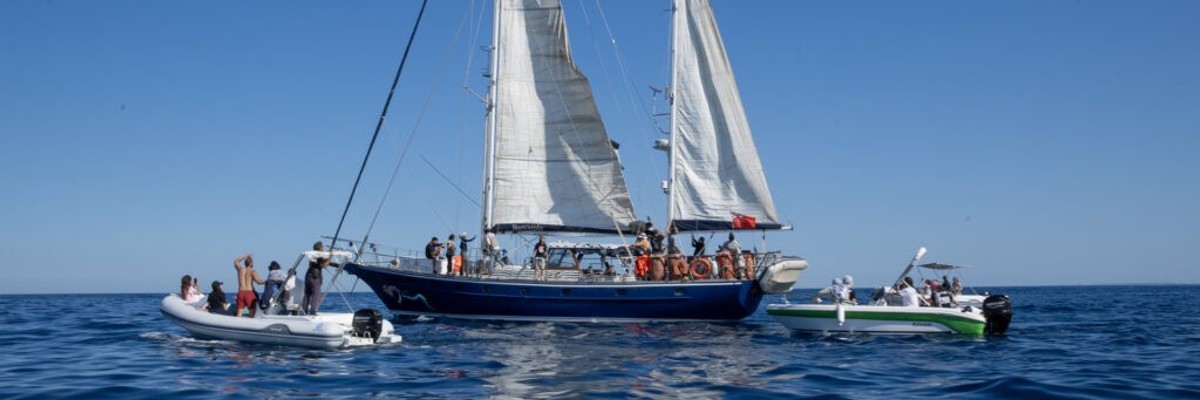
The Freedom Flotilla Coalition (FFC) launched the Madleen, a civilian ship now sailing toward Gaza carrying humanitarian aid and international human rights defenders in direct defiance of Israel’s illegal and genocidal blockade. (Photo: Courtesy of the FFC)
“We are doing this because no matter what odds we are against, we have to keep trying,” says humanitarian Greta Thunberg, “because the moment we stop trying is when we lose our humanity.”
Many people, armed only with moral and political convictions, would be too intimidated to confront an army or navy directly. But not all.
Twelve nonviolent human-rights activists with the international Freedom Flotilla Coalition (FFC) are currently sailing a small boat, the Madleen, to Gaza. They hope to create a humanitarian sea corridor through Israel’s illegal blockade. If all goes well, they should arrive this weekend, with “baby formula, flour, rice, diapers, women’s sanitary products, water desalination kits, medical supplies, crutches, and children’s prosthetics.”
They know the danger. Ten volunteers were killed by Israeli commandos when they boarded the Mavi Marmara in 2010. But, as Greta Thunberg said before she embarked last Sunday, “We are doing this because no matter what odds we are against, we have to keep trying, because the moment we stop trying is when we lose our humanity.”
How Palestinians See It
The history is important, and one does not have to approve of Hamas’ attack against Israeli civilians in October 2023 to understand that.
During the Nakba in 1948, at least 750,000 Palestinians were violently displaced from their homelands by Zionist paramilitaries and nascent Israeli forces. As Palestinian-Canadian Samah Al-Sabbagh recently told a crowd, those who survived that colonial onslaught left their “homes, land, olive groves, even the freshly baked bread.”
The occupation has never stopped, and now the violence is more high-tech and all-inclusive in its reach. In Gaza, bombs (largely supplied by the United States) have destroyed homes, apartment buildings, schools, universities, hospitals, mosques, churches, and more—leaving thousands buried under rubble. Adding to that nightmare, doctors report the intentional killing of children with high-velocity bullets that can destroy surrounding tissues and organs.
The death toll is staggering. As of May 27, 2025, the Palestinian Ministry of Health in Gaza reports that at least 54,056 people, including at least 17,400 children, have been confirmed as killed in Gaza since October 2023.
For those still living, Israel’s stranglehold on international humanitarian aid has created widespread malnutrition and starvation, with babies and children the most vulnerable. “One in five people in Gaza, about 500,000 people, faces starvation, the Integrated Food Security Phase Classification platform said on May 12,” according to the UN. Indeed, the UN calls Gaza the “hungriest place on Earth.”
Israel and its fellow perpetrators, including the United States, refuse to take seriously the rulings by the International Criminal Court and the International Court of Justice, much less the many human-rights groups decrying genocide, and less still the students and people in the streets making a ruckus for justice.
Perhaps the perpetrators think that ignoring the voice of the people will make it stop, that heartbroken people will give up their moral and legal agency. They should think again.
A Global Civil Society Initiative of Unarmed Civilians
Huwaida Arraf is a Palestinian-American lawyer and activist. She has worked with the International Solidarity Movement, the Free Gaza Movement, and more recently the FFC. Her rationale for sending small, unarmed boats in nonviolent direct actions against Israeli policy? “Our governments have failed. And so the people are taking action.”
Lawyers Arraf and Luigi Daniele assert that there is a strong legal basis for citizens taking action, as world governments ignore their “clear and urgent humanitarian obligations.”
Included in the aid they brought were 200 pairs of hearing aids—far short of the 9,000 requested—because so many children were experiencing hearing loss as a result of Israel’s sonic booms.
Two years later, on May 31, 2010, the Israeli navy swarmed the Mavi Marmara. This ship was part of a larger flotilla, carrying nearly 700 people, which was attempting to deliver 10,000 tons of humanitarian aid to Gaza. The Israelis killed 10 activists—one died after being comatose for four years—and wounded fifty more.
Although the UN Human Rights Council declared the attack illegal—and despite Prime Minister Netanyahu’s apology to Turkey, whose citizens were killed—Israel continued its oppressive blockade.
Between 2010 and 2024, the FFC continued to challenge the siege. But “all ships were pirated by the IOF, and participants were assaulted, kidnapped, interrogated, imprisoned, and/or deported.” (“IOF” identifies the IDF as an occupation force.)
By May 2, 2025, the FFC had prepared their next attempt. The ship was named Conscience as an appeal to the world’s conscience. It was sitting in international waters near Malta, waiting for the volunteers to board and set out for Gaza. But the crew heard drones, and Conscience was struck by two explosives.
“The bombing was a deliberate act of aggression and intimidation,” the FFC wrote on their website. “Four crew members were injured, the ship was set ablaze, communications were severed, and the vessel was left adrift and taking on water. The attack occurred in European waters, in violation of international law.”
Madleen: Never Give Up
The activists say of the Madleen, “She may be small, but her mission is powerful: To break the silence. To challenge Israel’s illegal blockade through nonviolent direct action. To stand firmly and unapologetically, with Gaza.”
The Madleen set sail on June 1, one day after the fifteenth anniversary of the murderous assault on the Mavi Marmara. Activists gathered in Catania, Sicily, in preparation for their launch. The boat is named for Gaza’s first gender-role-defying fisherwoman; she personifies FFC’s steadfastness.
The ship’s namesake, Madleen, fell in love with the sea as a young child. When she was only 13 years old, she took over her injured father’s fishing boat and became the main breadwinner for her family. Although Madleen’s focus was on her family’s survival—not politics—she shared the fishermen’s encounters with Israeli patrols. She recounted, “They often directly attacked my boat. They stole my fishing nets more than once. The thing was that each time they attacked me, I would get a little stronger. I never gave up.”
Years later, she hopes her two daughters will become “two strong fisherwomen.”
May Madleen and the activists happily meet in Gaza this month. And may this stubbornly committed “civil society initiative of unarmed civilians” help the world see that legal and moral obligations are not overridden by governments’ corrupt colonial agendas.
To that end, the FFC asks that people raise their voices and contact the media and government officials to express support for breaking the siege against Gaza.
Readers can track the progress of the Madleen in real time and explore ways to support the FFC’s work. They promise: “We sail until Palestine is free.”
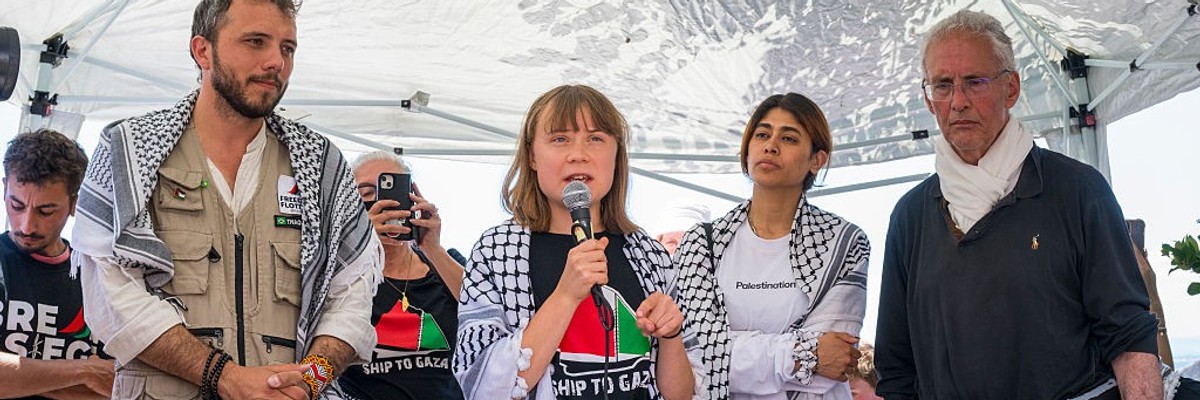
Swedish climate campaigner Greta Thunberg speaks surrounded by other participants in the latest Freedom Flotilla Coalition effort to deliver shipborne aid to Gaza, during a June 1, 2025 press conference in Catania, Italy. (Photo: Fabrizio Villa/Getty Images)
“No matter how dangerous this mission is, it’s nowhere near as dangerous as the silence of the entire world in the face of the live-streamed genocide,” said climate activist Greta Thunberg, who is aboard the Madleen.
A dozen Palestine defenders including climate campaigner Greta Thunberg and a French lawmaker set sail from Sicily on Sunday aboard a boat carrying humanitarian aid for the people of Gaza, many of whom are starving amid Israel’s ongoing U.S.-backed genocidal assault and siege and decadeslong naval blockade of the coastal enclave.
The Freedom Flotilla Coalition (FFC) said it launched the sailboat Madleen—named after Gaza’s first and only known fisherwoman—from Catania, Italy at 4:00 pm local time Sunday “in direct defiance of Israel’s illegal and genocidal blockade.”
“Madleen symbolizes the unyielding spirit of Palestinian resilience and the growing global resistance to Israel’s use of collective punishment and deliberate starvation policies,” FFC said in a statement Sunday. “The ship is carrying urgently needed supplies for the people of Gaza, including baby formula, flour, rice, diapers, women’s sanitary products, water desalination kits, medical supplies, crutches, and children’s prosthetics.”
The international volunteers aboard Madleen include Thunberg, French Member of European Parliament Rima Hassan, German refugee advocate and FFC steering committee member Yasemin Acar, Brazilian FFC steering committee member Thiago Ávila, Al Jazeera reporter Omar Fayad, French doctor Baptiste Andre, French journalist Yanis M’Hamdi, Turkish engineer Şuayb Ordu, and crew members Mark Van Rennes, Reva Seifert Viard, Pascal Maurieras, and Sergio Toribio.
“I am aboard Madleen because silence is not neutrality—it is complicity,” said Hassan, who is banned from entering Israel due to her outspoken support for Palestinian rights. “The Palestinian people in Gaza are being starved and slaughtered, and the world watches. This ship is not just carrying aid, it is carrying a demand: End the blockade. End the genocide.”
Thunberg said that “we are seeing a systematic starvation of 2 million people. The world cannot be silent bystanders, Every single one of us has a moral obligation to do everything we can to fight for a free Palestine.”
The Madleen‘s launch came a month after the Conscience, another FCC aid vessel traveling in international waters off Malta, was attacked twice, presumably by Israeli forces. No one was harmed in what FFC said was a drone strike on the ship. However, the activists were forced to abort their humanitarian mission. Israel has not commented on the incident.
Madleen also set sail nearly 15 years to the day after Israeli forces raided a Gaza Freedom Flotilla convoy carrying humanitarian aid to the besieged people of Gaza. The attack—which also came in international waters—left nine people including Turkish-American teenager Furkan Doğan dead.
FFC said Sunday that the “unarmed and nonviolent” mission “poses no threat” and “sails in full accordance with international law. Any attack or interference will be a deliberate, unlawful assault on civilians.”
Those aboard the Madleen said they were aware of the dangers they faced. Israel has killed numerous Western activists and journalists who document its human rights violations over the years, and just last month Israeli troops opened fire on a group of international diplomats visiting the illegally occupied West Bank two days after three involved countries issued an ultimatum to stop annihilating Gaza.
“We are doing this because, no matter what odds we are against, we have to keep trying,” a tearful Thunberg said during a Sunday press conference. “Because the moment we stop trying is when we lose our humanity.”
“And no matter how dangerous this mission is, it’s nowhere near as dangerous as the silence of the entire world in the face of the live-streamed genocide,” she added.
Activist Greta Thunberg says silence is more dangerous than sailing to Gaza, as she boarded a vessel that will try to break the Israeli blockade of Gaza.
The Gaza Freedom Flotilla had to abandon its last attempt on May 2 when it was bombed. pic.twitter.com/ieecZ8ps0E
Some Israelis and their supporters took to social media to wish harm upon the activists. In the United States, Sen. Lindsey Graham (R-S.C.) alluded to past Israeli attacks on Gaza aid flotillas in a social media post saying, “Hope Greta and her friends can swim!”
Israel strongly refutes allegations that it is committing genocide in Gaza. South Africa has filed, and dozens of nations support, a genocide case against Israel at the International Court of Justice in The Hague.
The International Criminal Court, also located in the Dutch city, has issued arrest warrants for Israeli Prime Minister Benjamin Netanyahu and Yoav Gallant, his former defense minister, for alleged war crimes and crimes against humanity, including extermination and starvation as a weapon of war, in Gaza.
Officials in Gaza say that more than 192,000 Palestinians have been killed or injured since Israel launched its assault and siege following the Hamas-led attack of October 7, 2023, a figure that includes at least 14,000 people who are missing and presumed dead and buried beneath rubble and hundreds of mostly children who have died from acute malnutrition and lack of medical care.
Around 2 million Gazans have also been forcibly displaced, often multiple times, amid Israel’s campaign to starve, conquer, indefinitely occupy, ethnically cleanse, and possibly recolonize the coastal strip.
Each side accuses the other of thwarting cease-fire efforts. On Saturday, U.S. Special Envoy Steve Witkoff rejected what he called Hamas’ “totally unacceptable” proposal for a truce in which 10 living and 18 dead Israeli hostages would be exchanged for an unspecified number of Palestinian prisoners held by Israel.
Former Israeli peace negotiator Daniel Levy toldDemocracy Now! on Monday that a cease-fire proposal mediated by Witkoff is “a bad deal for the Palestinians that will allow Israel to continue its ethnic cleansing of Gaza” and “walks back the commitment for a permanent cease-fire, Israeli withdrawal, and allowing in of humanitarian aid.”
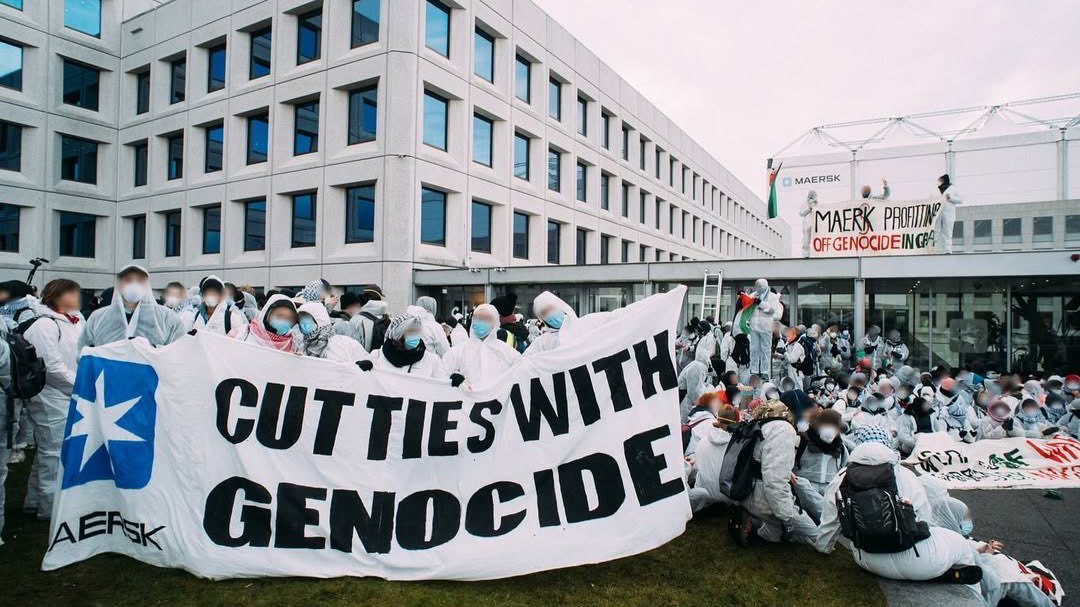
800 demonstrators shut down Maersk headquarters (Photo via Palestinian Youth Movement/X)
Nearly 1,000 activists stage demonstration at the entrance to the headquarters of shipping giant Maersk in protest of weapons transport to Israel
On February 24, nearly 1,000 activists staged a demonstration to shut down the headquarters of Danish shipping giant Maersk in Copenhagen.
BREAKING
Today in Copenhagen 800 people from all over Europe shut down the main Maersk HQ for the day as part of the CRAC Camp under the Mask Off Maersk slogan “Cut Ties from Genocide”.
Police were outnumbered but quite brutal to those participating in the action. The crowd… pic.twitter.com/4II83Eo8Jt
The pro-Palestine demonstrators were protesting Maersk’s shipment of arms to Israel, under the slogan of the international “Mask off Maersk” campaign, as part of a protest camp organized by the CRAC Collective. Swedish activist Greta Thunberg participated in the demonstration, saying that “we take it on ourselves because we know that these big companies are all about profit.”
The Palestinian Youth Movement launched the international “Mask off Maersk” campaign last year, targeting one of the largest shipping companies in the world. Maersk has shipped millions of tons of military cargo from the US to Israel since October 7, playing a key role in the Israeli genocide against the Palestinian people.
Pro-Palestine demonstrators have launched actions against Maersk globally, including outside the Port of Elizabeth in New Jersey, a major site of weapons shipments to Israel. The campaign won a major victory in November of last year when Spain blocked two Maersk ships carrying military cargo bound from Israel from docking at the port of Algeciras.
Demonstrators blocked the entrance to Maersk’s headquarters for over four hours, demanding that the logistics giant stop transporting military shipments to the Zionist state, and end all contracts with the Israeli Ministry of Defense.
Thunberg called on Maersk to “terminate all contracts and investment that support the genocide and occupation of Palestine.”
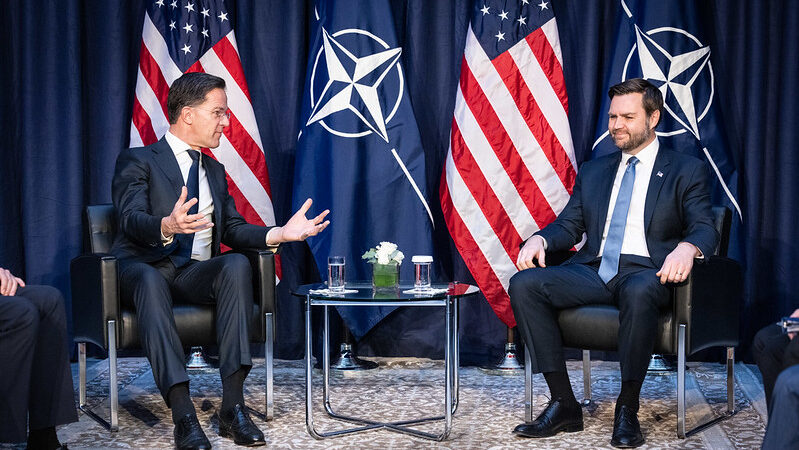
NATO Secretary General Mark Rutte meets with US Vice President JD Vance. Source: NATO/Flickr
Statements by US Vice President Vance and Defense Secretary Hegseth on the Ukraine war and transatlantic relations have left European leaders in shock
“If American democracy can survive ten years of Greta Thunberg’s scolding, you guys can survive a few months of Elon Musk,” US Vice President JD Vance told European leaders at last week’s Munich Security Conference. His remarks came during a draining week for those leaders, as Trump officials announced peace talks with Russian authorities—without European or Ukrainian involvement—while signaling they expect Europe to handle peacekeeping and being paid for their support in minerals from Ukraine.
Speeches by Vance and Defense Secretary Pete Hegseth threw European leaders into disarray, seen as not-so-subtle indications of a cooling in transatlantic relations. These interventions attacked everything from the EU’s efforts to regulate social media platforms to its approach to far-right parties in parliamentary life. In response, French President Emmanuel Macron called for an emergency summit of select regional powers on Monday, February 17 – just a day before US and Russian representatives are expected to meet in Saudi Arabia.
While Ukrainian officials and some European leaders have insisted they will not accept any deal that excludes Ukraine’s direct involvement, their stance appears to carry little weight.
At the same time, the new US administration has increased pressure on its European allies, demanding a ramping up of their defense budgets and taking on the responsibility of a potential peacekeeping mission in Ukraine. This comes as no surprise: a number of US officials, including Donald Trump himself, have said Europe does not contribute enough to NATO and essentially freeloads off the US. Vance’s speech in Munich only reaffirmed this stance, ultimately reducing high-ranking figures to tears over the apparent breakup between allies.
While the focus of European reactions to recent US statements has been on Ukraine, many leaders have admitted that more is at stake. “Yes, it is about Ukraine – but it is also about us,” European Commission President Ursula von der Leyen wrote on X. Unfortunately, the conclusion she drew going further is upsetting: “We need an urgency mindset. We need a surge in defense. And we need both of them now.”
Unlike healthcare, education, or social programs—sectors where European governments are consistently told their budgets must remain limited—military spending is expected to face no such barriers. Many European countries have already embraced the shift, with Polish officials, for example, boasting about spending close to 5% of their GDP on defense and warning of looming “wider wars” to convince other states in the region to do the same.
Despite the apparent fracture in US-Europe relations, European leaders have shown no inclination to rethink their dependence on Washington. Instead, most have done exactly what the Trump presidency wants them to do and swiftly pledged to increase military spending. Some have even already expressed willingness to deploy troops for peacekeeping in Ukraine. What remains absent from their reactions is any consideration of a future less dictated by US interests and more aligned with the needs of the people living in Europe.
Since the beginning of the war three years ago, activists have urged Europe to reject NATO’s warmongering and prioritize peace in Ukraine alongside social justice at home. Instead, the coming surge in military budgets will almost certainly coincide with cuts to public services, further fueling the rise of the far-right—a political force that Trump officials, including Vance and Elon Musk, have (more or less) openly backed during interventions in Europe. From this perspective, unlike the conservative circles who “survived ten years of ’s scolding,” Europe’s liberal elite is unlikely to emerge from its current crisis unscathed. Whether their refusal to acknowledge the failure of their anti-people policies will push the entire region into the hands of parties like Brothers of Italy and Alternative for Germany remains to be seen.
Elon Musk urges you to be a Fascist like him, says that you can ignore facts and reality then.Power-mad orange gasbag Donald Trump says Burn, Baby, Burn.