Category: human rights violations

  • Starmer tries to make SNP Gaza ceasefire motion all about Israel’s feelings

    Spread the love

    Article republished from the Skwawkbox for non-commercial use.

    Labour amendments betray Gaza’s murdered and oppressed civilians and uses classic asymmetric language to value Palestinian life less than Israeli

    Keir Starmer – after days of posing to try to bring Muslim and other decent voters onside by mouthing ceasefire language – has yet again betrayed the two million people in Gaza suffering violence and starvation and the more than 100,000 people murdered and maimed by Israel.

    While the ‘mainstream’ media speculated whether Starmer would order MPs to support the SNP’s motion demanding a ceasefire, which is being debated in Parliament tomorrow, more realistic observers knew it was inevitable that Starmer would do the minimum he hopes will fool voters opposed to Israel’s genocide in Gaza, while protecting the interests of the pro-Israel right.

    And so he did: Labour has tabled amendments to the original motion that gut it of its impact and has gone as far as making the motion more about Hamas’s supposed guilt and the feelings of Israel and its supporters. And the amendment uses the classic tactics of politicians and ‘mainstream’ media to present Israeli lives and suffering as more valuable than Palestinian.

    In Starmer’s worldview, Palestinians are not being murdered by Israel – their lives are just ‘lost’, as if to a natural disaster and not to a campaign of mechanised mass murder. The sheer number of their deaths is presented as ‘intolerable’, but the loss of Israeli lives to Palestinian resistance is ‘horror’. Israelis have the ‘right to assurance’ against attack, but there is no mention of a Palestinian right not to be murdered by the occupation regime. Israel ‘cannot be expected’ to stop fighting if Hamas does not stop – but there is no acknowledgement that Hamas’s violence takes place against a backdrop of decades of wanton violence and oppression by the occupiers. Israel must be ‘safe and secure’ – but a Palestinian state only merits ‘viable’.

    The SNP motion is an exemplar of directness and simplicity and rightly focuses on the many tens of thousands of civilians slaughtered by Israel, as well as on the forced displacement of 1.5 million Palestinians into Rafah, where they remain under constant bombardment and the threat of an all-out ground assault:

    Labour’s lickspittle version calls resistance ‘terrorism’ but does not mention the Israeli terror state’s genocide and other war crimes, or the fact that so many are dying in Rafah because they were forced to cram there under bomb and bullet – and clearly hasn’t even been proofread, calling for ‘the UN Security Council to be meet urgently’:

    Starmer is trying to mask his support for Israel’s war crimes and hoping that the millions in this country disgusted by that support will be fooled. His disregard for the true plight of Palestinians and his complicity in the war crimes being perpetrated against them by Israel is beyond contemptible.

    Article republished from the Skwawkbox for non-commercial use. ENDS
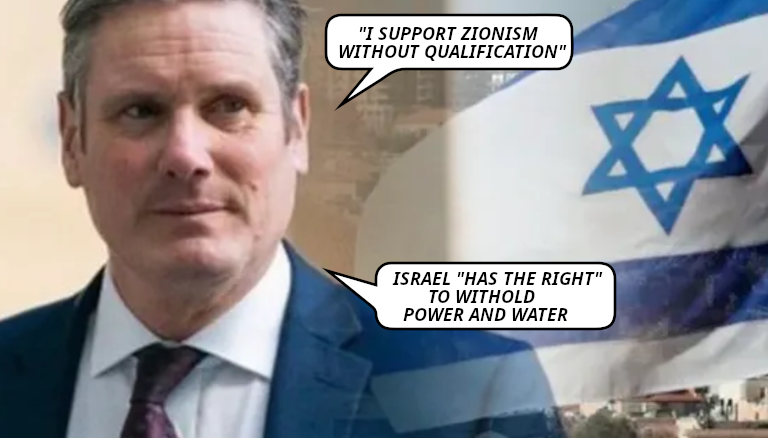
    Zionist Keir Starmer supports Israel's Gaza genocide.
    Zionist Keir Starmer supports Israel’s Gaza genocide.
    Zionist Keir Starmer supports Israel’s Gaza genocide.
  • Wife Says ‘Day X’ Hearing for Julian Assange ‘Will Determine if He Lives or Dies’

    Spread the love

    Original article by BRETT WILKINS reposted from Common Dreams under Creative Commons (CC BY-NC-ND 3.0). 

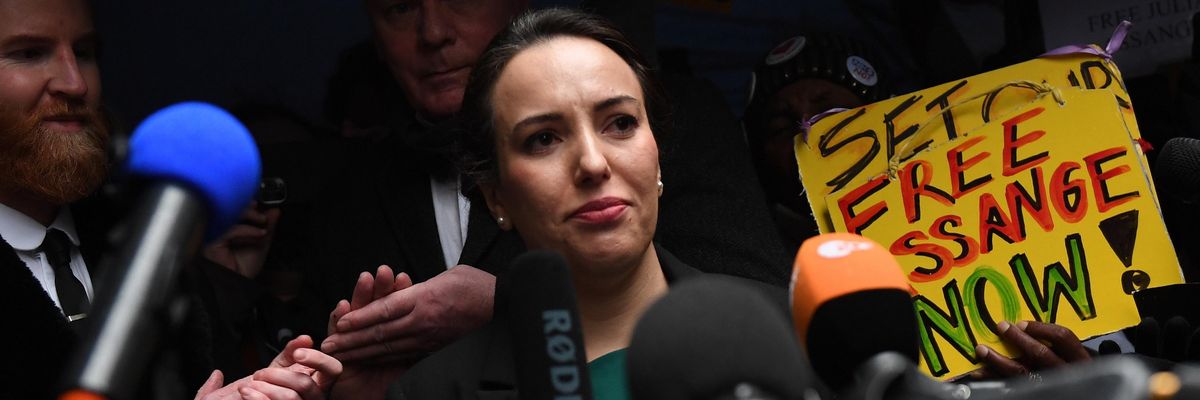
    Stella Assange speaks to the media outside the Old Bailey on January 4, 2021 in London.  (Photo: Chris J Ratcliffe/Getty Images)

    “This could very well be the final hearing for Julian,” said Stella Assange on the eve of the critical U.K. High Court session.

    Stella Assange, the wife of Julian Assange, said Monday that the jailed WikiLeaks founder will likely die if he is extradited from Britain to the United States, where he could imprisoned for the rest of his life for publishing classified documents including numerous files exposing U.S. war crimes.

    Assange’s final appeal is scheduled to be heard on Tuesday by the U.K. High Court. The Australian publisher’s supporters are calling it “Day X,” and his wife told the BBC that it “could very well be the final hearing for Julian.”

    “There’s no possibility for further appeal in this jurisdiction,” she explained, adding that Assange could still seek an emergency injunction from the European Court of Human Rights.

    Assange said her husband—who is 52 years old and suffers from physical and mental health problems including heart and respiratory issues—is very weak and “in a very difficult place.”

    Imprisoned in London’s notorious Belmarsh Prison since April 2019, Assange could be sentenced to as many as 175 years behind bars if convicted of all the Espionage Act and Computer Fraud and Abuse Act charges against him.

    WikiLeaks published a series of document dumps inculding “Collateral Murder” video—which shows a U.S. Army helicopter crew killing a group of Iraqi civilians—the Afghan War Diary, and the Iraq War Logs, which revealed American and allied war crimes.

    In 2016, The United Nations Working Group on Arbitrary Detention found that Assange had been arbitrarily deprived of his freedom since his first arrest on December 7, 2010, including house arrest, imprisonment in London, and nearly seven years of political asylum in the Ecuadorian Embassy in the British capital.

    Nils Melzer, the U.N.’s top torture official from 2016 to 2022, repeatedly said that Assange’s treatment amounted to torture.

    Alice Jill Edwards, the current U.N. special rapporteur on torture, is imploring the U.K. government to decline Assange’s transfer to the U.S. because she says his health is likely to be “irreparably damaged” by extradition. Edwards cited conditions in U.S. prisons including the use of prolonged solitary confinement and excessive sentences as causes for concern.

    Countless human rights defenders, press freedom advocates, and elected officials around the world have called on the U.S. to drop charges against Assange and for the U.K. to refuse his extradition.

    “All eyes are on the U.K. High Court during this fateful hearing, but it remains to be seen whether the British judiciary can deliver some form of justice by preventing Assange’s extradition at this late stage,” Rebecca Vincent, campaigns director at Reporters Without Borders, said in a statement Monday.

    “Regardless, none of this is inevitable—it remains within the U.S. government’s power to bring this judicial tragedy to an end by dropping its 13-year-old case against Assange and ceasing this endless persecution,” Vincent continued. “No one should face such treatment for publishing information in the public interest.”

    “It’s time to protect journalism, press freedom, and all of our right to know,” she added. “It’s time to free Assange now.”

    Original article by BRETT WILKINS reposted from Common Dreams under Creative Commons (CC BY-NC-ND 3.0). 

  • With Rafah Under Siege, ICJ Reiterates Israeli Obligations Under Genocide Convention

    Spread the love

    Original article by JESSICA CORBETT republished from Common Dreams under Creative Commons (CC BY-NC-ND 3.0).

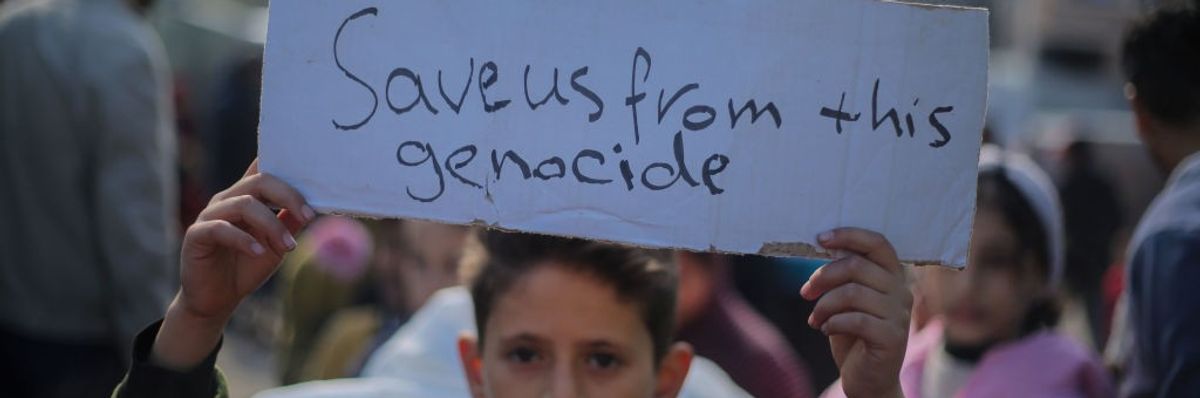
    Palestinian children hold placards during a march demanding an end to the war and their right to live, education, and play on February 14, 2024 in Rafah, Gaza.  (Photo: Ahmad Hasaballah/Getty Images.

    A South African leader welcomed the court’s affirmation that “the perilous situation demands immediate and effective implementation of the provisional measures” from its earlier ruling.

    As Israeli forces plan a full-scale assault on Rafah in the southern Gaza Strip, the International Court of Justice on Friday forcefully reminded Israel that it must comply with a January order to meet its obligations under the Genocide Convention.

    South Africa—which is leading the genocide case against Israel that led to six provisional measures from the ICJ last month—asked the World Court for emergency action on Tuesday in light of the Israeli plan to attack Rafah, whose population has surged to roughly 1.5 million as Palestinians have fled bombings and raids in northern Gaza.

    The ICJ, which is part of the United Nations, weighed in just a day after Israel submitted its response to South Africa’s request.

    “The court notes that the most recent developments in the Gaza Strip, and in Rafah in particular, ‘would exponentially increase what is already a humanitarian nightmare with untold regional consequences,’” the ICJ said Friday, quoting United Nations Secretary-General António Guterres’ remarks to the U.N. General Assembly last week.

    “This perilous situation demands immediate and effective implementation of the provisional measures indicated by the court in its order of 26 January 2024, which are applicable throughout the Gaza Strip, including in Rafah, and does not demand the indication of additional provisional measures,” the World Court continued.

    “The court emphasizes that the state of Israel remains bound to fully comply with its obligations under the Genocide Convention and with the said order, including by ensuring the safety and security of the Palestinians in the Gaza Strip,” the ICJ added.

    https://twitter.com/MollyQuell/status/1758580075992137801?ref_src=twsrc%5Etfw%7Ctwcamp%5Etweetembed%7Ctwterm%5E1758580075992137801%7Ctwgr%5E474f1f815d7484d425c8f262ce6155acb43a69f5%7Ctwcon%5Es1_c10&ref_url=https%3A%2F%2Fwww.commondreams.org%2Fnews%2Frafah-gaza

    Clayson Monyela of South Africa’s Department of International Relations and Cooperation said on social media that his country welcomes the development.

    “The court has affirmed our view that the perilous situation demands immediate and effective implementation of the provisional measures indicated by the court in its order of 26 January 2024 which are applicable throughout the Gaza Strip and has clarified that this includes Rafah,” he said.

    The ICJ’s decision comes as countries including South Africa prepare to participate in hearings before the Hague-based court next week about Israel’s 57-year occupation of Palestine. South African representatives are set to present second, after the Palestinians.

    Original article by JESSICA CORBETT republished from Common Dreams under Creative Commons (CC BY-NC-ND 3.0).

  • Israeli Assault Leaves Gaza’s Nasser Hospital ‘Not Functional’

    Spread the love

    Original article by JESSICA CORBETT republished from Common Dreams under Creative Commons (CC BY-NC-ND 3.0). 

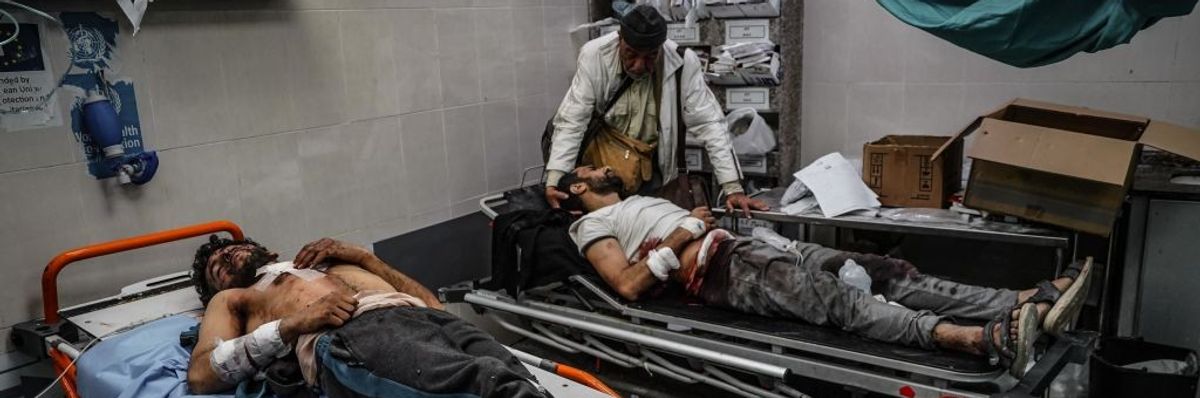
    Injured Palestinians are brought to Nasser Hospital in Khan Yunis, Gaza on January 22, 2024.  (Photo: Belal Khaled/Anadolu via Getty Images)

    The WHO “was not permitted to enter” the facility in recent days, said the agency chief, warning that “the cost of delays will be paid by patients’ lives.”

    World Health Organization Director-General Tedros Adhanom Ghebreyesus announced Sunday that the largest hospital in the southern Gaza Strip “is not functional anymore, after a weeklong siege followed by the ongoing raid” by Israeli forces.

    After claiming that Hamas was using Nasser Hospital in Khan Younis for “military activity” and some hostages’ bodies may be there, the Israel Defense Forces on Thursday began raiding the facility, where around 10,000 people had sought shelter. Sources there said the IDF bombed “a ward full of patients” and multiple people who were dependent on oxygen have died due to power outages.

    Tedros highlighted on Sunday that the WHO team “was not permitted to enter” the facility in recent days “to assess the conditions of the patients and critical medical needs, despite reaching the hospital compound to deliver fuel alongside partners.”

    “There are still about 200 patients in the hospital. At least 20 need to be urgently referred to other hospitals to receive healthcare; medical referral is every patient’s right,” he added. “The cost of delays will be paid by patients’ lives. Access to the patients and hospital should be facilitated.”

    Later Sunday, the Palestinian Ministry of Health in Gaza said that “150 patients who cannot move are piled inside the rooms and corridors of the old building at Nasser Medical Complex without medical care after the arrest of 70 of the complex’s management and medical staff.”

    “The occupation refuses to evacuate patients for treatment in other hospitals, which endangers their lives, including seven intensive care patients, five dialysis patients, [and] three newborns in the nursery, in addition to cases of burns, amputations, quadriplegia, childbirth, and others,” the ministry added.

    The IDF said on Telegram that in its operations around the facility, Israeli troops apprehended “hundreds of terrorists and other terror suspects who were hiding in the hospital, some of whom had posed as medical staff,” including alleged participants in the October 7 Hamas-led attack that led to the war.

    Noting IDF claims that soldiers aimed to recover the remains of hostages believed to be in the facility, The Washington Postreported that “Israeli forces have not yet found the bodies of any hostages but said on Sunday that they discovered medicine at the hospital bearing the names of Israelis who were abducted by Hamas.”

    The Israeli assault on the Hamas-governed enclave has killed nearly 29,000 Palestinians, injured over 68,800 others, devastated civilian infrastructure—including hospitals—and left most of Gaza’s 2.3 million residents displaced, hungry, and at risk of disease. Global experts and critics have accused Israel of genocide, including in a South Africa-led case before the International Court of Justice (ICJ).

    In response to IDF orders to leave northern Gaza, most residents are now crammed into the southern part of the strip. According toAl-Jazeera:

    Al-Amal Hospital, the only other major medical facility still operational in Khan Younis, continues to be a target of Israeli attacks. The Palestine Red Crescent Society (PRCS) on Sunday said Israeli forces targeted the third floor of the hospital with artillery fire.

    The Israeli military has expanded its siege on Khan Younis and its medical facilities as it pushed further south into Rafah on the border with Egypt.

    Throughout the week, people around the world including humanitarian and United Nations leaders have pressured Israel to refrain from a full-scale attack on Rafah. The ICJ on Friday echoed U.N. Secretary-General António Guterres’ warning that it “would exponentially increase what is already a humanitarian nightmare with untold regional consequences.”

    Original article by JESSICA CORBETT republished from Common Dreams under Creative Commons (CC BY-NC-ND 3.0). 

  • ‘Enough Is Enough’: Australia Says Free Assange

    Spread the love

    Original article by AMY GOODMAN DENIS MOYNIHAN republished from Common Dreams under Creative Commons (CC BY-NC-ND 3.0). 

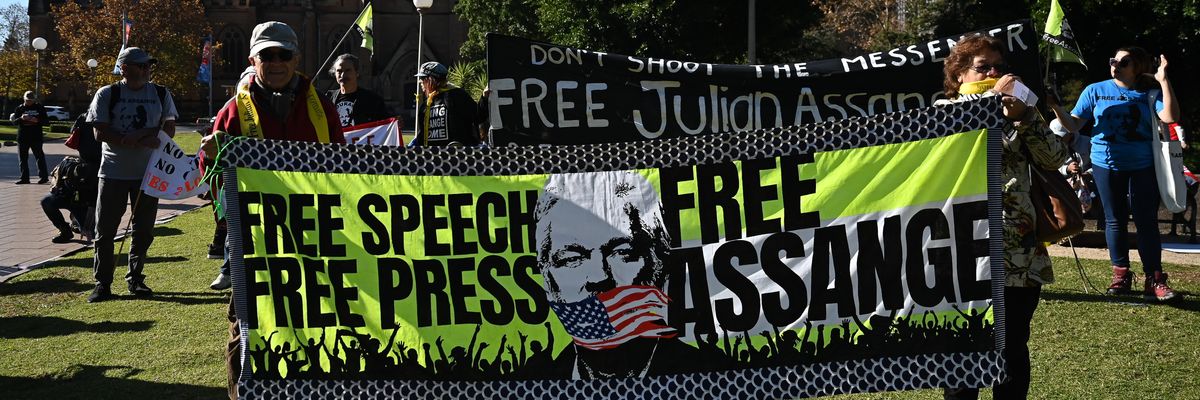
    People participate in a rally demanding freedom for imprisoned WikiLeaks founder Julian Assange in Sydney, Australia, on May 24, 2023.  (Photo: Steven Saphore/Anadolu Agency via Getty Images)

    U.S. and U.K. persecution of Assange has been continuous and severe.

    Australian Prime Minister Anthony Albanese said during Prime Minister’s Questions on February 15, “This thing cannot just go on and on and on, indefinitely.”

    The Prime Minister was addressing an action he took a day earlier, on Valentine’s Day. No, not his marriage proposal to his partner, Jodie Haydon (she said yes). He was explaining his support for a parliamentary motion that passed overwhelmingly, calling for the release of an Australian citizen, imprisoned WikiLeaks founder Julian Assange.

    Albanese’s support builds on a growing demand from Australians across the political spectrum that the United Kingdom not extradite Assange to the United States, and for the U.S. to drop its espionage and hacking charges against him. Assange, who has been imprisoned in London’s notorious maximum-security Belmarsh Prison since 2019, has a court hearing in the UK.

    Assange’s counsel, Jennifer Robinson, texted us on Thursday:

    “The appeal next week could be Julian’s final appeal against U.S. extradition. If permission to appeal is denied, there are no further appeals available to us in the U.K.” If extradited, Assange faces up to 175 years in prison in the United States. Said Prime Minister Albanese, “Enough is enough.”

    Prior to his imprisonment in Belmarsh, Julian Assange spent seven years cramped inside Ecuador’s small London embassy, where he’d been granted political asylum.

    Assange founded WikiLeaks, a website that publishes leaked material while protecting the identity of the whistleblowers. While it launched in 2006, it wasn’t until 2010 that the U.S. government forcefully and publicly targeted Wikileaks and Assange, after Wikileaks made several massive disclosures of leaked documents related to the U.S. invasions and occupations of Iraq and Afghanistan.

    On Monday, April 5, 2010, Julian Assange released a shocking video at the National Press Club in Washington, D.C. The video, which WikiLeaks titled “Collateral Murder,” was shot in 2007 from a U.S. military Apache helicopter flying over Baghdad, Iraq. The video shows in grainy black and white detail the gunship’s attack on a group of people on the ground. Twelve civilians, including two Reuters news employees, were mowed down by automatic fire from the helicopter. The voices of the crew were recorded, as they sought permission to “engage” with their targets, and as they laughed and cursed through the slaughter. It was a chilling video, documenting a war crime.

    The video’s release was followed by the publication on Wikileaks.org of hundreds of thousands of digital records from the U.S. military, dubbed the Iraq War Logs and the Afghan War Diary. These documents provided further proof that the U.S. was committing war crimes. Some elected officials in the U.S. called for Assange to be assassinated. Then-Vice President Joe Biden called him a “high-tech terrorist.”

    Not long after, the U.S. Justice Department convened a secret grand jury which issued a sealed indictment against Assange. Existence of that indictment itself was revealed on WikiLeaks, in a subsequent leak, in 2012. U.S. and U.K. persecution of Assange since then has been continuous and severe. In 2017, as revealed in 2021 by journalist Michael Isikoff and colleagues, the CIA hatched plans to either kidnap Assange from the Ecuadorian embassy or even to assassinate him.

    Andrew Wilkie, an independent member of the Australian Parliament from Tasmania, introduced the resolution in support of Assange this week, saying, “This House notes that on 20 and 21 February 2024, the High Court of Justice in the United Kingdom will hold a hearing into whether Walkley Award-winning journalist Julian Assange can appeal against his extradition to the United States of America… both the Australian Government and Opposition have publicly stated that this matter has gone on for too long; and underlines the importance of the U.K. and USA bringing the matter to a close so that Mr Assange can return home to his family in Australia.”

    The Australian government is not alone in calling for Assange’s release. In November, 2022, five major newspapers that collaborated with WikiLeaks—The New York Times, The Guardian, Le Monde, El Pais, and Der Spiegel—released a joint letter calling for an end to the prosecution. “Obtaining and disclosing sensitive information when necessary in the public interest is a core part of the daily work of journalists. If that work is criminalized, our public discourse and our democracies are made significantly weaker,” the letter read.

    Assange’s attorney Jennifer Robinson will be in the London court for the hearing. She told us, “We have been saying for years: This is a political case which requires a political solution. The unprecedented showing of political support in the Australian Parliament overnight shows that Julian’s case is a priority for the Australian government, our parliament, and the people. The U.S. should listen to the concerns of its ally—and drop the case.”

    Original article by AMY GOODMAN DENIS MOYNIHAN republished from Common Dreams under Creative Commons (CC BY-NC-ND 3.0).