GENEVA
The UN Human Rights Council held a general debate on the human rights situation in Palestine on Wednesday.
Palestine, speaking as an entity concerned, said it is “regretful that some politicized the work of the Council due to the wishes of the occupying power,” the Council said in a statement.
Noting that there are more than six million refugees from Palestine and thousands of people had been killed by Zionist gangs, it said the Israeli occupation’s practices which started in 1967 are becoming “more ferocious and barbaric.”
“This year commemorated 56 years of Israel as the occupying power. Civilians, journalists and health workers were being targeted, with 248 people killed this year and many administrative detention orders issued,” the country said, urging the international community to shoulder “its historic and legal responsibility” to put an end to the occupation.
During the debate, some speakers expressed serious concern over violations of international human rights law in the occupied Palestinian territory, including deprivation of the right to self-determination, extrajudicial killings, restrictions on freedom of movement and assembly, and illegal settlements.
…
Category: human rights violations
UN council holds general debate on human rights situation in Palestine
Exclusive: Braverman faces court challenge for forcing through anti-protest law
Original article by Anita Mureithi republoished from Open Democracy under a Creative Commons Attribution-NonCommercial 4.0 International licence.
Liberty is taking the home secretary to court for ‘unlawfully’ passing legislation Parliament had already rejected

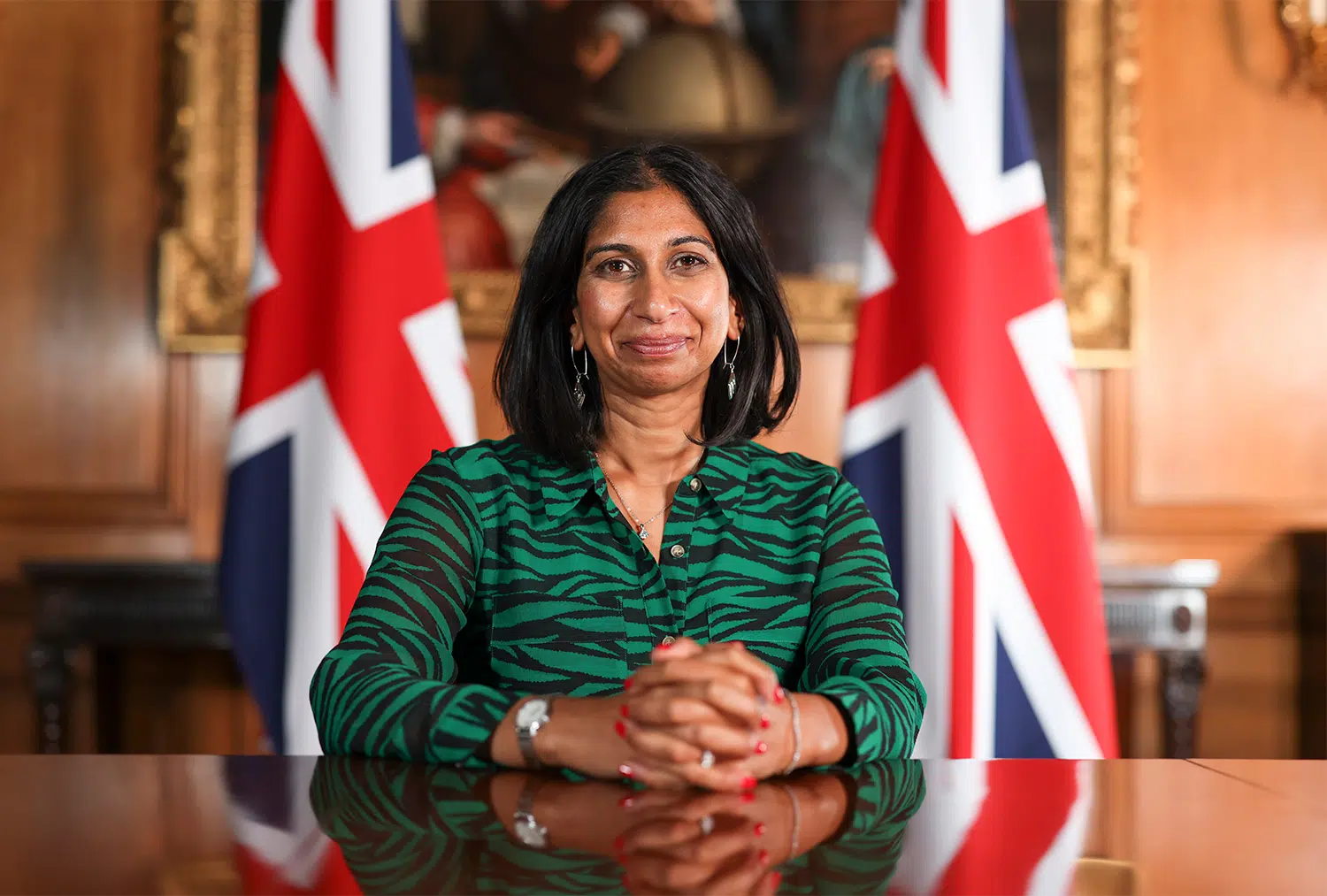
Image of Home Secretary Suella ‘Sue-Ellen’ Braverman A human rights campaign group is taking Suella Braverman to court for “unlawfully” forcing draconian anti-protest legislation through Parliament, openDemocracy can reveal.
Liberty has received permission from the High Court to sue the home secretary after she introduced new police powers that the House of Lords had already rejected months earlier.
In June, Braverman used secondary legislation – which is subject to less parliamentary scrutiny – to allow police to restrict or shut down any protest that they believe could cause “more than minor disruption to the life of the community”.
A cross-party parliamentary committee said this is the first time secondary legislation has been used to make changes to the law that have already been rejected by Parliament. Akiko Hart, interim director of Liberty, which launched initial legal action in June, described the move as “the latest power grab from this government”.
The government previously tried to insert the new powers into the Public Order Act 2023 in January, but was blocked by the Lords. Liberty’s lawyer, Katy Watts, accused Braverman of “sneak[ing] in new legislation via the back door, despite not having the power to do so”.
Hart said: “We all want to live in a society where our government respects the rules – but the home secretary has deliberately done the opposite. The home secretary’s actions have enabled the government to circumvent the will of Parliament.”
She continued: “This is just the latest power grab from this government, which has shown it is determined to erode the ways people can hold it to account, whether that’s in Parliament or on the streets. The home secretary’s actions give the police almost unlimited powers to stop any protest the government doesn’t agree with – and the way she has done it is unlawful.”
The home secretary has long called for more police powers to tackle peaceful methods of protests by climate activists, such as road blocking, ‘locking on’, and slow marching, which she said “bring misery and chaos to the law-abiding majority”.
One supporter of Insulate Britain previously told openDemocracy that protest is “our only legitimate means to achieve the changes needed within the time frame we have”.
Another of the group’s supporters said that the criminalisation of protest – in particular, of environmental protest – “is an example of attempting to shoot the messenger” and that elected politicians “obviously don’t really care about protecting people’s democratic rights”.
Watts, Liberty’s lawyer leading the case, said Braverman’s circumventing of the Lords’ rejection is “a flagrant breach of the separation of powers that exist in our constitution”.
She added: “The wording of the government’s new law is so vague that anything deemed by police to cause ‘more than a minor’ disturbance could have restrictions imposed upon it. This same rule was democratically rejected earlier this year, yet the home secretary has gone ahead and introduced it through other means regardless.
“It’s really important the government respects the law and that the home secretary’s decision is reversed immediately.”
Liberty has also claimed the new legislation was not consulted on fairly. It has accused the government of only consulting parties it knew would support the amendments, such as the police.
Original article by Anita Mureithi republoished from Open Democracy under a Creative Commons Attribution-NonCommercial 4.0 International licence.

Image quoting Suella ‘Sue’Ellen’ Braverman reads ‘Guardian-reading, tofu-eating wokerati’. Thousands march against Tories in Manchester
https://morningstaronline.co.uk/article/thousands-march-against-tories-in-manchester
Meanwhile, police officers criticised for searching campaigners’ coach and ‘undermining their right to protest’

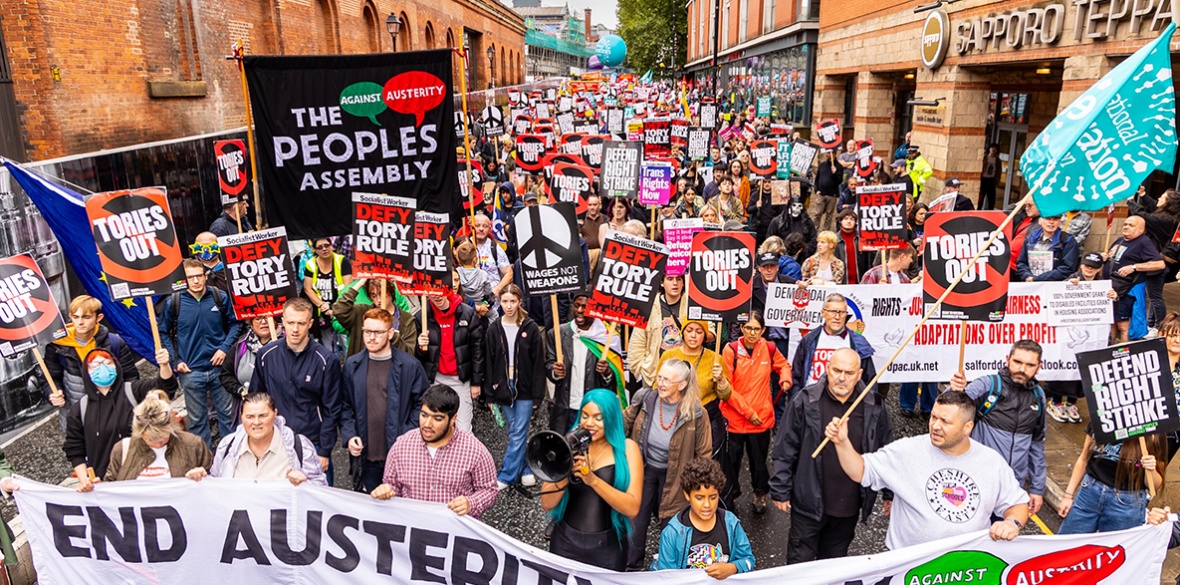
A huge protest against the Tories in Manchester, October 1, 2023 Photo: Neil Terry / Neil Terry Photography THOUSANDS of people marched through the streets of Manchester today telling delegates to the Tory Party conference there that they are not welcome.
Headed by the banner of the Manchester People’s Assembly, which organised the march with the national People’s Assembly, the protesters represented trade unions and a huge diversity of campaign groups expressing their anger at the destruction wrought across society by the Tories.
Disabled people, peace activists and dozens more groups marched noisily through the city centre.
…
Protesters from all across the country took coaches to attend the march.
One coach transporting protesters from London was stopped by the police, who signalled the bus to follow them to Knutsford in Cheshire where it was searched by around 30 officers.
The protesters were late as a result. Activists said it undermined their right to protest and was a waste of police time and money.
Lorraine Douglas, from the Communist Party, said: “The sergeant came on and said they’d received intelligence that there were people on the bus set on doing criminal damage and they were going to search the bus for equipment that could cause criminal damage.”
The police went on to read a section of the Public Order Act.
“They refused to say what the intelligence was, and they got us all off the bus and searched the bus, found one flare and it looked like they had some magic markers or pens,” Ms Douglas said.
https://morningstaronline.co.uk/article/thousands-march-against-tories-in-manchester
Are the police targeting Communists?
Youth Challenge 32 European Nations in ‘Truly Historic’ Climate Trial
Original article by Isabella Kaminski republished from De Smog.
Portuguese young people claim their human rights have been violated, while accused countries argue the lawsuit should be thrown out.

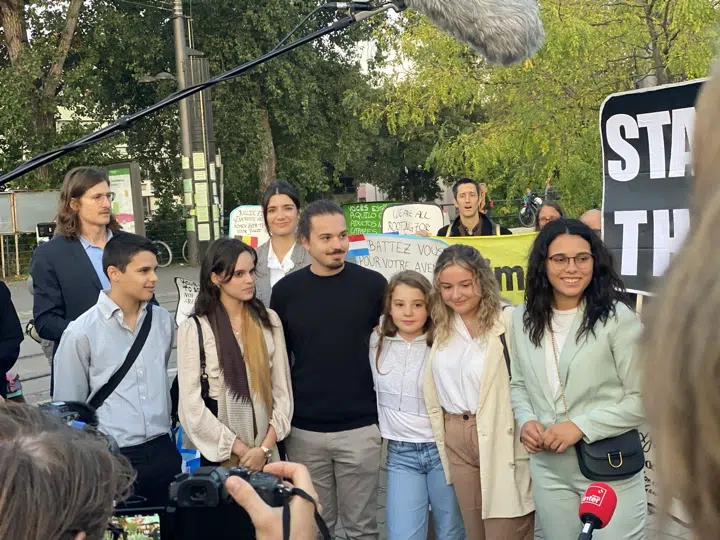
Portuguese youth, from left, André dos Santos Oliveira, Sofia dos Santos Oliveira, Martim Duarte Agostinho, Mariana Agostinho, Cláudia Duarte Agostinho and Catarina dos Santos Mota talk to the press before their landmark hearing in front of the European Court of Human Rights in Strasborg, France. Credit: Courtesy of the Global Legal Action Network (GLAN) After Portugal experienced massive wildfires and extreme heat waves this summer, six children and youth from the nation appeared in the European Court of Human Rights Wednesday for a landmark lawsuit against 32 European nations charged with violating their human rights due to the impacts of climate change.
At the hearing in Strasbourg, France, lawyers representing six Portuguese young people said the youth were being discriminated against by state inaction in cutting greenhouse gas emissions, the effects of which have been “foreseeable for decades.”
Inadequate action to curb global emissions, the lawyers argue, violates the youths’ rights to life, privacy and family life, and to be free from torture, inhuman or degrading treatment. Additionally, it violates their rights to be free from discrimination on grounds of their age, the lawyers said. All of these are enshrined in the European Convention on Human Rights, which the court is responsible for upholding.
This case is “truly historic,” said Sébastien Duyck, senior attorney at the Center for International Environmental Law. It forces the national governments in the suit “to lay out a legal defense justifying the gap between their climate policies and what science says is needed to avoid climate breakdown.”
Cláudia Duarte Agostinho, age 24, Catarina dos Santos Mota, 23, Martim Duarte Agostinho, 20, Sofia dos Santos Oliveira, 18, André dos Santos Oliveira, 15, and Mariana Agostinho, 11, are suing 32 countries, including all EU member states, the United Kingdom, Norway, Turkey, Switzerland and Russia, for failing to act on the climate crisis. It is unprecedented that so many governments have to defend themselves in front of any court in the world.
In 2017, damaging wildfires in Portugal, made worse by climate change, killed more than 100 people and sparked the youths to file the lawsuit, which began in 2020. Over the past three years, the young people’s legal team filed a number of supporting documents, including a detailed climate science briefing. The documents show that the current global trajectory for cutting greenhouse gas emissions falls far short of keeping the global temperature rise under the 1.5C threshold agreed by states at the COP27 climate talks last year.
Portugal hit hard by climate change
Portugal describes itself as the European country most affected by the adverse impact of climate change. Since 1976, it has seen a significant trend in heat waves and tropical nights, with high temperature records broken in 2018, 2019 and 2022. This summer, severe drought hit the country and wildfires blazed again.
The young people live in Lisbon and Leiria, parts of Portugal that are particularly at risk. And according to the Intergovernmental Panel on Climate Change, the country faces “hard limits” to its ability to adapt.
The young claimants in the lawsuit point to research by Climate Action Tracker, which calculates a “fair share” of emission cuts for the 32 countries at the center of the case, based on their levels of development, capacity and/or historic responsibility. Most of these cuts are higher than the states’ current goals for the year 2030.
To address this, they want all 32 states to increase their climate ambitions and meet these goals by cutting the production and export of fossil fuels, lowering their consumption emissions, and forcing companies domiciled within their territories to clean up their global supply chains.
The lawsuit describes the young people as both current and future victims of climate change, outlining the existing effects on their physical and mental health.
It notes the dangerous impacts of extreme heat, including heatstroke and the exacerbation of chronic conditions such as asthma and other respiratory problems experienced by Martim Duarte Agostinho, Catarina dos Santos Mota and André dos Santos Oliveira. During periods of extreme heat, some of the youth in the suit have had had to stop playing and exercising outdoors, while extremely hot nights have made it difficult to sleep, leaving them more tired and less able to study and work.
A psychological assessment showed they were all experiencing symptoms of anxiety or depression. The three also describe a form of mental suffering called “moral injury” caused by an awareness of the failure by those in authority to protect them.
The severity of all these impacts, the legal team concludes, will only get worse if nations can’t meet the 1.5C warming threshold. Although climate change affects everyone, lawyer Alison Macdonald argued in court that it will have a disproportionate impact on the young people at the heart of the case, “as they will have to live longer with the consequences of the respondents’ failures.”
This is the third climate case heard by the European Court of Human Rights this year. In March, a group of older Swiss women known as the KlimaSeniorinnen argued that they were disproportionately affected by the climate crisis and wanted the court to order Switzerland to do more to cut its emissions. This was followed the same day by a claim brought by a former French politician who also argued France was breaching his human rights.
The court wants to hear all three of these cases before making a final decision. There are a handful of other climate-related cases pending before it.
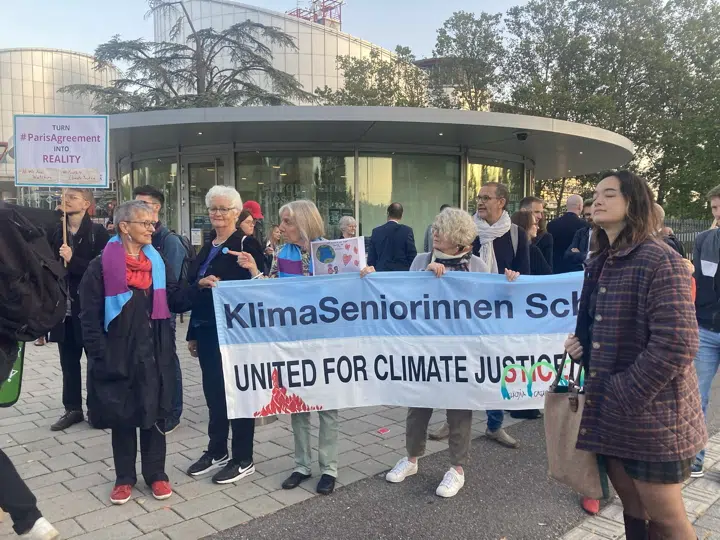
Swiss women involved in another European climate lawsuit support the Portuguese youth at the courthouse in Strasbourg. Credit: Courtesy of the Global Legal Action Network (GLAN) But the claimants in the Portuguese youth case have some big technical hurdles to overcome before judges even begin to consider the merits of their lawsuit.
The governments named in the lawsuit submitted individual responses to the court, and all except Russia and the Netherlands also submitted a joint statement, which says the states recognise the severity of the threat of climate change and the need for urgent action.
But it says the case should be thrown out for failing to meet the court’s basic rules on admissibility. These include the requirement to have exhausted all national legal options before filing a claim at the ECHR. Ignoring this, it says, would involve “radically overhauling” legal precedent.
The young people’s legal team argues that the rule should be lifted in their case because climate change is such an urgent issue and because it would be a practically and financially unreasonable burden, taking huge legal resources, time, and money, for the group.
All states. except Portugal, also argue they should not be held to account for harms in another country. The claimants contend that the impacts of greenhouse emissions do not respect national boundaries.
Representing 30 states in court, UK lawyer Sudhanshu Swaroop said the lawsuit requires the court to “exceed its mandate.”
“The applicants in reality are asking the court to build a new model of extra-territorial jurisdiction, contrary to legal principles and with the effect that any person on the planet that claims to be affected by climate change could claim,” he noted.
He added that these issues are being addressed through the UN Framework Convention on Climate Change (UNFCCC) and that the young people “are asking the courts to act as legislators rather than judges, and to legislate for a global challenge without having global jurisdiction.”
Ricardo Matos, a lawyer for Portugal, said the young people could not claim to be victims of the 2017 wildfires, and were effectively trying to bring an actio popularis – a claim on behalf of the wider public rather than themselves as individuals. The European Convention on Human Rights does not allow such claims.
The governments also argued that the young people are not ‘victims,’ pointing out they cannot prove that they suffer more than the general population by virtue of their age.
The young people’s legal team believes these hurdles can be overcome. “This court is uniquely well placed to address these legal issues in the transnational way that climate change requires,” Macdonald told the court. “Piecemeal regulation across Europe represents no effective remedy.”
According to Climate Action Network, which submitted a third-party intervention, a successful judgment in this case would be “like a new, legally binding treaty, directly obligating 32 European governments to act urgently on the climate crisis.”
It also wields “remarkable influence” in the broader context of global litigation, said Duyck, “given that the European Court of Human Rights holds a prominent role in setting legal precedents within Europe and beyond.”
Speaking outside the court after the hearing, the oldest claimant, Cláudia Duarte Agostinho, said what she had just heard was “very sad.”
“The governments have just said that what’s happening all around us is not important,” she added. “They are minimising the effects that climate change has on our human rights.
“Outside the courtroom they say all the right things about the climate emergency,” she continued. “But today they are denying the reality that what we are experiencing is getting worse and worse.”
Travel to report on this lawsuit was supported by a grant from the Foundation for International Law for the Environment.
Original article by Isabella Kaminski republished from De Smog.
Protests outside courts in England after activist charged over jury rights sign
Demonstrators hold placards in response to contempt of court action against Trudi Warner, 68

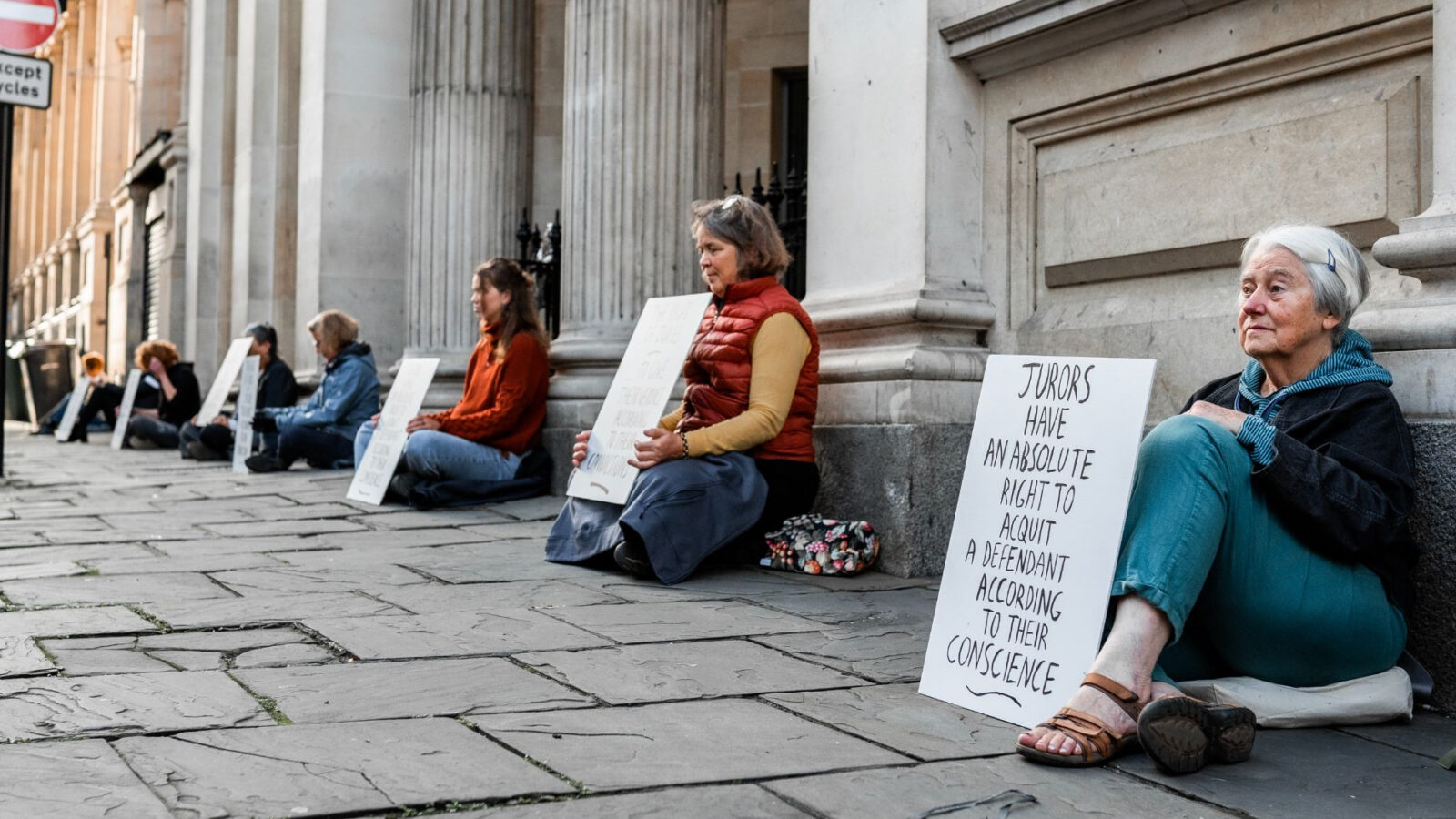
Juries protest Bristol Crown Court 25 Sept 2023. Image by Jamie Bellinger. Activists have protested outside crown courts in England against the contempt of court action being taken against a woman for holding up a placard on the rights of jurors.
In response to the decision by the solicitor general, a government law officer, to pursue Trudi Warner, 68, for contempt of court, scores of people gathered outside crown courts on Monday holding placards that pronounced on the rights of juries to acquit a defendant according to their consciences.
Abi Perrin, a scientist involved in the protest said: “In 2023 telling the truth is being treated as a criminal act, with people prosecuted for displaying facts in public, and imprisoned for explaining their motivations in their own defence in a court of law.
“I am deeply afraid of a world where truth, science and morality are not important, or where we are not free to fight for them.”
In Bristol three generations of one family held placards outside the crown court.
…
While Warner faces a possible jail sentence, a separate police investigation is taking place into allegations of attempting to pervert the course of justice relating to at least 12 people who also stood outside Inner London crown court in May holding similar placards.
…
Trudi Warner is a climate activist charged over holding the sign outside a hearing of Insulate Britain activists.
Fears over right to protest after woman with sign at climate trial prosecuted