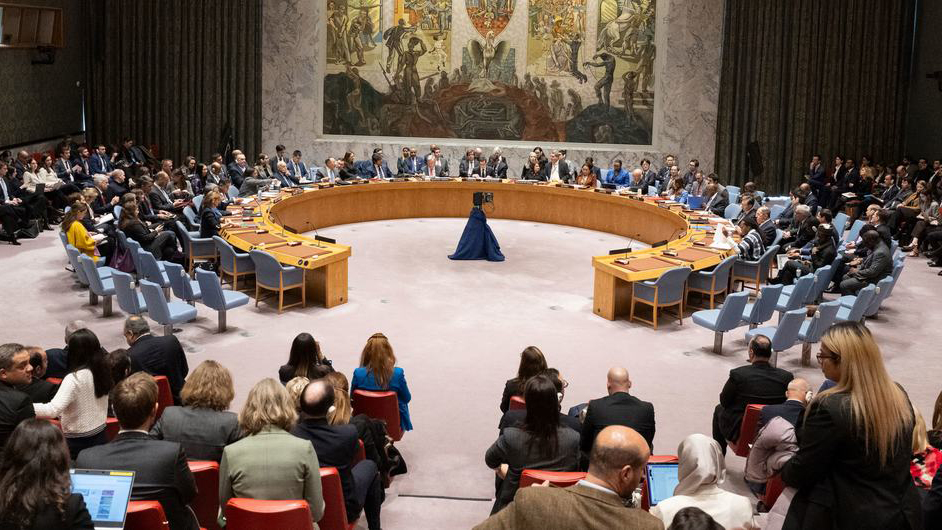
The UN Security Council meets on the situation in the Middle East, including Palestine (Photo via United Nations)
Participants in the UN Security Council highlighted need for a ceasefire in Gaza and a long term solution to the Palestinian question as necessary for peace
On January 23, speaking during the two day extended meeting of the UN Security Council on Palestine, UN Secretary General Antonio Guterres underlined that “Israel’s clear and repeated rejection” of a two-state solution is unacceptable. He also warned that this refusal and “denial of the right to statehood to the Palestinian people would indefinitely prolong a conflict that has become a major threat to global peace and security.”
Most of the countries which participated in the two day proceedings demanded an immediate humanitarian ceasefire and a two-state solution, claiming it necessary for regional and global peace.
Invoking ever deteriorating humanitarian conditions in Gaza, Guterres termed it “collective punishment” executed by Israeli forces, asserting that “nothing can justify it.”
More than 25,700 Palestinians have been killed, over 63,000 have been wounded, and nearly 90% of Gaza’s population has been displaced due to relentless bombings and ground offensives carried out by Israeli armed forces since October 7.
Israel has maintained that its war in Gaza is in response to Palestinian resistance forces, mainly Hamas, attacking inside its borders on October 7, in which nearly 1,200 people were killed and nearly 250 Israelis were taken as hostages.
Speaking in the meeting, Gilad Erdan, the Israeli ambassador to the UN, claimed that until persons involved in the October 7 attacks are handed over and hostages are released, war in Gaza will not end.
Most of the members of the UN Security Council repeated the call for an immediate ceasefire and called for better delivery of humanitarian aid to Gaza.
The Chinese ambassador to the UN, Zhang Jun, also noted that the Israeli leadership’s repeated rejection of a two-state solution is unacceptable, and demanded that it must be rejuvenated by granting Palestinians full membership to the UN.
Israeli Prime Minister Benjamin Netanyahu had, earlier this month, rejected the calls for a Palestinian state, calling it untenable and a threat to Israeli security.
The need for a two-state solution was raised by the Palestinian Foreign Minister Riyad Maliki, who denounced the war in Gaza as Israel’s “premeditated effort to inflict maximum pain on the Palestinian population.”
“No home, hospital, school, mosque, church or UNRWA shelter is safe from Israeli bombardments, 2,000 pound bombs dropped with no care whatsoever for civilian lives,” he noted.
South Africa, which has taken Israel to the International Court of Justice for its genocide of Palestinians, maintained that there cannot be selective implementation of international law and Israel must face consequences for its repeated violations of the same.
US positions provide a carte blanche to Israeli crimes
Speaking during the meeting, the US representative Uzra Zeya claimed the centrality of a two-state solution. She claimed that the US has been making efforts to prevent greater civilian casualties in the Israeli war in Gaza. However, US policies in Gaza were heavily criticized by both the permanent members of the UNSC and others as detrimental to peace.
Chinese ambassador Jun condemned the repeated use of veto by the US in earlier UNSC meetings on ceasefire resolutions, identifying them as impeding all efforts to peace.
The US had vetoed resolutions proposing a ceasefire in the UNSC in previous months and tried to excuse Israeli bombings in Gaza as the Zionist state’s right to self defense.
Jun hoped that all members of the international community must prioritize ceasefire in Gaza, and ways to stop the spread of the war in the region.
Russian Foreign Minister Sergei Lavrov asserted that the UNSC must take steps to prevent further destabilization in the region, which has been caused by US policies which vetoes ceasefire resolutions and provides carte blanche to Israeli acts of “collective punishment of Palestinians.”
Lavrov emphasized that until a ceasefire is implemented the talks about future solutions to the conflict are useless.
Iranian Foreign Minister Hussein Amir Abdollahian warned the US against violating Yemeni sovereignty by carrying out repeated air strikes against it. He alleged that it is a trap laid down by Israel with the objective of expanding the war in Gaza to the regional level.
Abdollahian proposed that a referendum among all Palestinians must be held to find a permanent solution to the Palestinian question.
Lebanese Foreign Minister Abdallah Bou Habib emphasized that all stakeholders, including the US, should see that Israel wants to expand the war across the region, and underlined that his country does not want war.
He emphasized that “what happened on October 7 did not happen in a vacuum” and if no attempts are made to secure a lasting solution “it will happen again,” as there is no peace in the region until there is justice for Palestinians.
Speaking in the meeting on Tuesday, the Saudi delegate Waleed El-Khereiji said that because of the “Israeli war machine,” tensions in the region, including in the Red Sea and Yemen, are increasing. He demanded that the Security Council make sure that Israel stops its violations of international law.
On Sunday, in an interview with CNN, Saudi Foreign Minister Faisal bin Farhad al-Saud denied any possibility of normalization of relations with Israel, as proposed by the US, until there is a road map for a two-state solution and an independent Palestinian state. “What we are seeing is Israelis crushing Gaza, the civilian population of Gaza. This is completely unnecessary, completely unacceptable, and has to stop.”
Across Argentina millions are participating in a national general strike to protest the Milei government’s widespread attacks on people’s rights
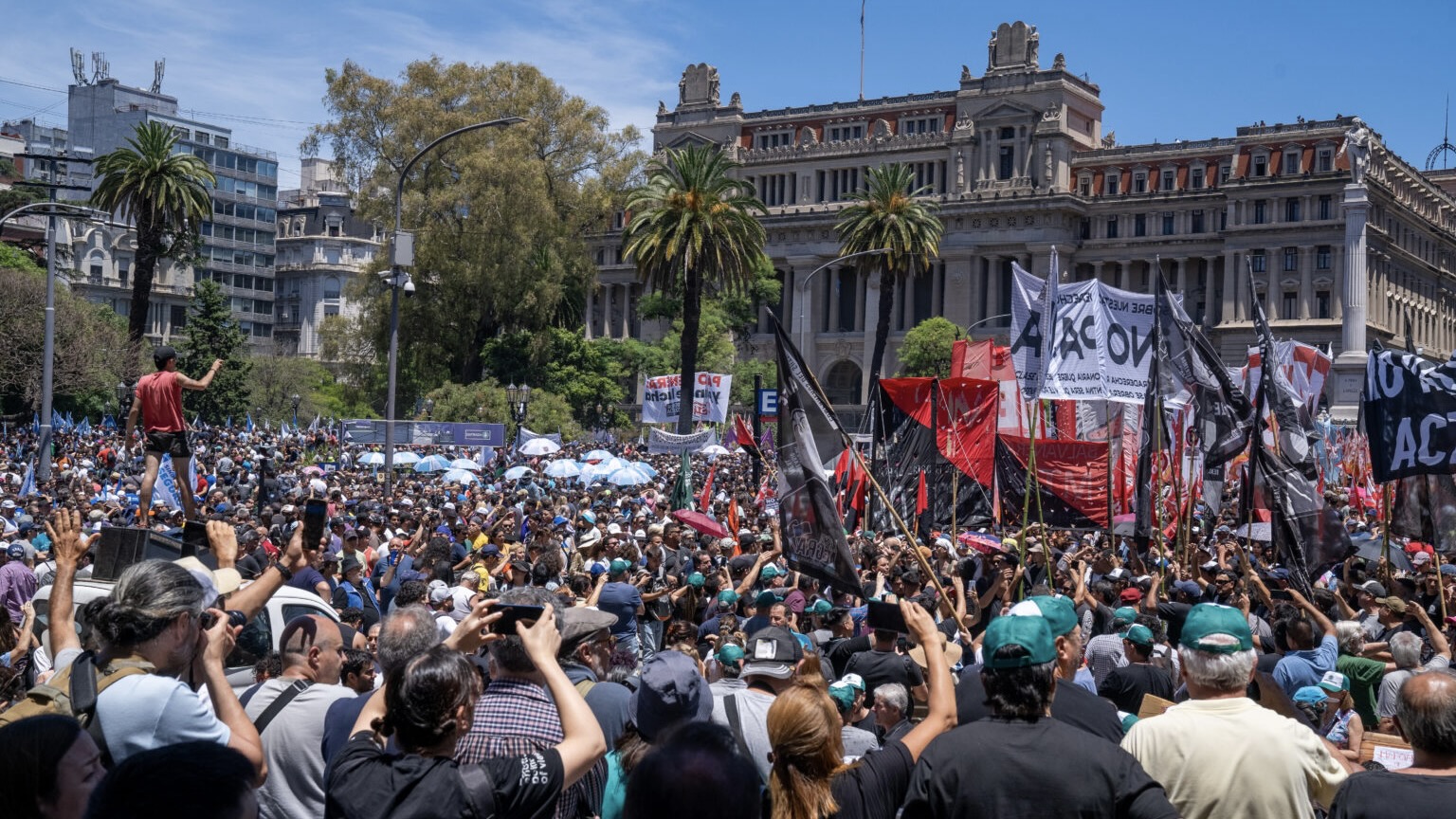
Mobilization against Milei on December 27, 2023. Photo: CELS
On January 24, across Argentina, millions of workers are participating in a national general strike against the anti-workers laws pushed forward by far-right libertarian president, Javier Milei.
Since he was inaugurated on December 10, 2023, Milei has worked quickly to draft legislation which threatens the hard-fought for rights of the Argentine people.
In response, Argentina’s trade unions, social movements, and human rights organizations have been on the streets to reject these measures, and called for a national general strike for January 24. For the last several weeks, hundreds of trade unions, neighborhood associations, cultural groups, left groups, community kitchens, and social movements have been organizing local and neighborhood assemblies and meetings to mobilize for the strike.
The largest concentration will be in Buenos Aires, Argentina’s capital, where hundreds of thousands are expected to congregate in the center of the city outside Congress. Mobilizations are also scheduled in dozens of other cities across the country like Córdoba, Rosario, San Miguel de Tucumán, Mendoza, Mar del Plata, Bahía Blanca, and others. While basic essential services will not be disrupted by the strike, the majority of the economy and daily life is set to be paralyzed due to the massive industrial action.
Who is participating?
The January 24 national strike is historic, as it is the first time in recent history that the country’s three major labor confederations are uniting for a joint industrial action. The General Confederation of Labor (CGT), the Argentine Workers’ Central Union, and the Argentine Workers’ Central Union (Autonomous) together represent millions of workers and have all called on their affiliated unions to participate in the day of mobilization.
The confederations are made up of dozens of unions representing workers in education, construction, civil service, food processing, healthcare, mining and metalwork, restaurants, commercial transportation (truck drivers, shipping, etc.), public transportation (buses, subway, and provincial trains), state workers, auto industry, textile, real estate, commercial, acting, national companies, the courts, music industry, communications and technology, among others. In other words, nearly the totality of the Argentine working class.
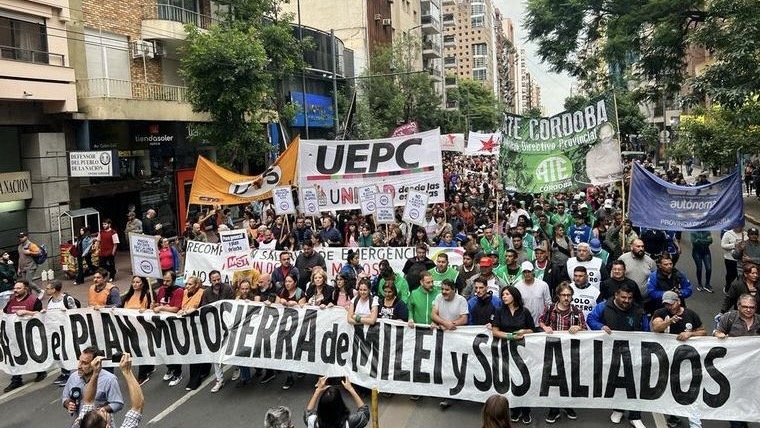
Mobilization against Milei in Córdoba in December 2023. Photo: CTA-A
Other unions such as the Union of Workers of the Popular Economy (UTEP) which represents street vendors, cooperatives, recyclers, agricultural workers, childcare workers, community kitchen workers, and others from the informal sector or “popular economy” have also pledged their participation in the mass mobilization.
Human rights organizations are also heeding the call for mobilizations such as the Grandmothers of the Plaza de Mayo, the Center of Legal and Social Studies (CELS), HIJOS (Sons and Daughters for Identity and Justice Against Forgetting and Silence), and others.
Several social and political forces that were part of the Union for the Homeland coalition which was defeated by Javier Milei in the presidential race in November, have also declared they will join the mobilization, such as Frente Patria Grande, La Campora, and Movimiento Evita.
Why are they mobilizing?
The strike has been called to reject Milei’s DNU and Omnibus Law, both pieces of legislation which trade unions say directly attack workers rights, impose brutal economic neoliberal austerity measures, and threaten the national sovereignty of the country. Organizations have called on the judiciary and the legislature to intervene to rule the DNU unconstitutional and revoke it in Congress, and to stop his Omnibus law from being passed. Both pieces of legislation have already met major legal roadblocks and have already undergone modifications from their first versions.
The Decree of Necessity and Urgency (DNU) 70/2023 was announced by Milei on December 20, 2023 (10 days after he took office). DNUs can be used by the executive to circumvent Congress and implement change immediately. Milei’s DNU titled “Bases to Rebuild the Argentine Economy” contains over 350 articles which would affect over 70 pieces of legislation, some completely overturned and others modified.
Milei and his cabinet announcing the DNU.
The DNU calls for the deregulation of major sectors of the Argentine economy such as energy, export, the credit card industry, transportation – including the aeronautic sector, healthcare, communications, tourism, and more. It also opens the door for the privatization of key state companies and the national bank and promotes foreign investment. It also impacts labor rights and rights of trade unions, such as the right to strike, the right to overtime pay, and other hard fought for rights of workers.
The Omnibus Law, officially called the Bases and Starting Points for the Liberty of Argentines, was sent to Congress by Milei on December 27, 2023. The 351-page bill contains more than 664 articles which will be debated in Congress. The Omnibus law attempts to take Milei’s “deregulation” approach a step further and expands it to all major areas of life in Argentina.
It includes a proposed reform to the Penal Code focused on “control of the streets” and calls for increasing sentences against protesters and in some cases eliminating the possibility of bail. It also initially stated that any meeting of three or more people in a public space must have the permission of the Minister of Security – this was later withdrawn.
It calls for the privatization of major state enterprises such as Argentine Airlines, ARSAT – a state telecommunications company, Argentine Trains, Public TV, the Water and Sewage Company (AySA), and the National Bank. Milei also included a list of another several dozen companies that have majority state participation such as Argentina Energy, military factories, the General Port Administration, Corredores Viales or the highway company, Argentine Mail, and Telam, the National News Agency.
The Omnibus law also calls for major reforms of the country’s public education system, notably taking away free higher education for foreigners. It also calls for major modifications of the entrance requirements and huge cuts to the overall budget. The country’s robust culture sector would also see major budget cuts under the law with a call to close historic artistic institutions of the country.
Environmental protections such as the Glacier Law, the Forest Law, and the Environmental Protection Law for the Control of Burning Activities would also undergo massive modifications.
The Omnibus also threatens retirees, emboldens police to use their full force, including gunfire, with little consequences, and transforms the electoral system.
The broad and expansive nature of the Omnibus and its outright attacks on so many sectors of society also helps explain why so many will be mobilizing in the strike.
The Secretary of Gender and Diversity of the Association of State Workers (ATE), Clarisa Gambera said, “This January 24, all of the union centers and social organizations of this country will be on the streets, to stop the ferocious advance of the right. Those who say that particular interests were generated over time, what they call particular interests are the rights that we won with struggle over more than 100 years and we are not willing to lose them. We continue to build unity, debates are taking place at the federal level. Comrades from all over the country participate in multi-sectoral meetings, assemblies, plenary sessions that are different ways to activate and add numbers of comrades on the streets this 24th.”
The CGT wrote in a statement rejecting Milei’s austerity measures and his claim that they only affect the “political caste”, not the people. CGT argues that, “The fiscal and exchange adjustment plan announced by the Government will generate a rapid acceleration of the inflationary process, which will destroy the purchasing power of the salaries of formal and informal workers, workers in the social and solidarity economy, self-employed workers, as well as of retirees and pensioners. This means that the announced adjustment does not adjust to the ‘so-called’ caste as promised in the campaign. Milei’s adjustment, once again, falls on the people.”
Repression
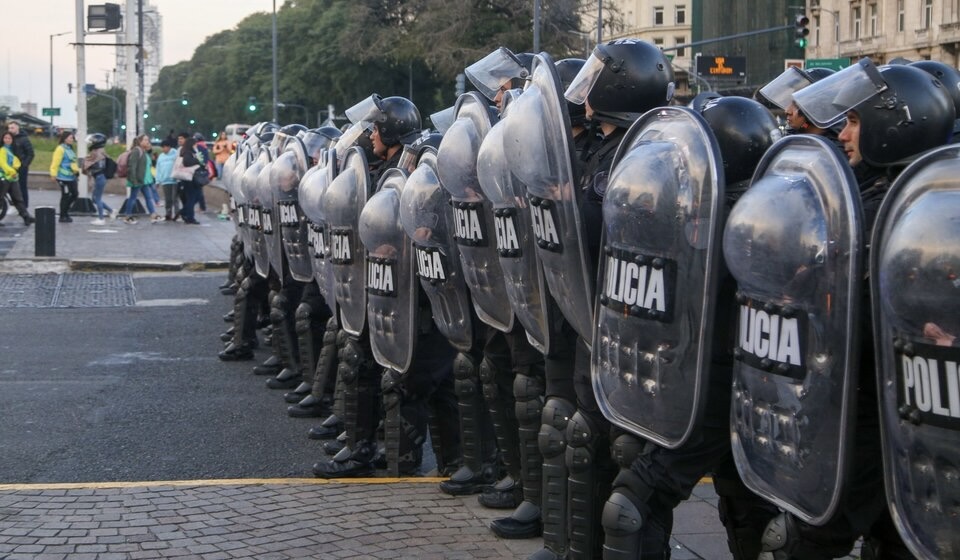
Another major point of contention for the Argentine people is the repressive policy imposed by the Minister of Security Patricia Bullrich, to dissuade mass participation in the inevitable mass mobilizations against Milei’s economic measures. Following the first protests against Javier Milei’s administration, Bullrich warned that it would use all “deterrent measures” to stop protests and on December 14 announced the “Public Order Protocol”.
Among other things, the protocol authorizes the police and security forces to intervene in response to any attempt to partially or totally block any national roads, transportation, or “free movement.” It has been dubbed the “anti-picket” protocol as it targets the historic picket and roadblock tactic of Argentine movements.
Another government “deterrence measure” is the threat from Bullrich that those who participate in protest actions and road blockades that are recipients of social programs will not receive this support: “he who blocks the street does not get paid,” she declared.
On January 10, 2024, Bullrich made good on her threats and, under the auspices of her protocol, sent letters to the major trade union centers of Argentina, unions, social, political and human rights organizations that had participated in protests on December 20, 22, and 27 of 2023 against Milei’s austerity measures and demanded they pay millions in fines for their participation in the allegedly “illegal activity”.
CELS wrote that in issuing these economic sanctions for participation in protests, the Ministry of National Security is “assuming powers that it does not have” and that it is also “trying to condition future action”. For the human rights research center, “This policy constitutes an infringement of the right to protest and demonstration and an act of state interference against freedom of association.”
International solidarity
The national general strike has gained widespread international support. Trade unions across Latin America and the Caribbean, as well as from Pakistan, Italy, Switzerland, Canada, the Netherlands, South Korea, Spain, and more, have pledged to mobilize on January 24 in solidarity with their Argentine comrades, with many calling for protests in front of their Argentine embassies or consulates.
The International Trade Union Confederation (ITUC), which brings together 191 million workers in 163 countries from all continents, released a statement expressing its support for its affiliated organizations in their call for the national general strike against “Milei’s shock therapy”. “Three major union federations, the CGT, the CTA-T, and the CTA-A, have united to stand against the serious threat to fundamental workers’ rights and civil liberties posed by Milei’s move to resurrect out-dated and debunked neo-liberal policies,” reads the statement.
ITUC General Secretary Luc Triangle said, “The actions of the Milei government aim to recreate the darkest days of dictatorship, and they require a strong, united response from the global union movement. We stand in full solidarity with the working people of Argentina in their defense of justice and democracy.”
The World Federation of Trade Unions (WFTU), which represents 105 million workers in 133 countries, expressed its support for its affiliate unions participation in the January 24 strike to “express their opposition to the measures of the ultra-liberal and neo-fascist government of Javier Milei”. It has called on its affiliates in other countries to mobilize in solidarity with the Argentine workers.
Trade Union Confederation of the Americas (TUCA-CSA) joined the other international confederation in standing with the struggle of Argentine workers, and calling on its affiliate organizations to mobilize in solidarity on January 24.
The PIT-CNT of Uruguay, Argentina’s northern neighbor, stated that “it is necessary to join forces and have as a horizon to advance Latin America on the path of struggle and hope towards a more just, free and equal society.”
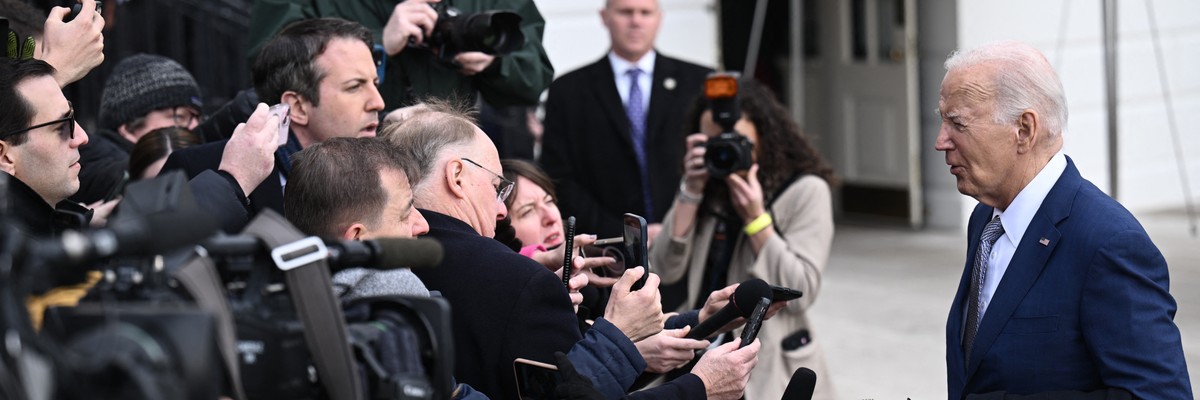
U.S. President Joe Biden speaks to reporters before boarding Marine One on the South Lawn of the White House in Washington, D.C. on January 18, 2024. (Photo: Brendan Smialowski/AFP via Getty Images)
If President Biden demanded an end to the bombardment of Gaza, it would stop. But he’s hasn’t demanded and the bombing and death and destruction continues.
In 1948, the newly-formed United Nations marked the signing of the Universal Declaration of Human Rights as well as The Convention on the Prevention and Punishment of the Crime of Genocide. The Genocide Convention was a response to WWII’s Holocaust, when six million European Jews where murdered by Nazi Germany. Raphael Lemkin, a Polish lawyer of Jewish descent, coined the term “genocide” during the war, as he developed legal arguments for prosecuting war criminals, leading to the Nuremberg Trials.
1948 was also the year Israel was founded. While many celebrated Israel as a safe refuge for the world’s Jews after the Holocaust, Palestinians call that period the ‘Nakba,’ Arabic for ‘catastrophe.’ Over 750,000 Palestinians were driven from their homes and villages, their property confiscated, and 15,000 were killed.
1948 was also when the white minority in South Africa imposed apartheid on the Black majority, creating an oppressive system of segregation that lasted close to half a century.
In the intervening 75 years, despite the Genocide Convention, genocides have still occurred – and too few perpetrators of genocide have faced prosecution. Last week, the eyes of the world were on the Hague, as South Africa brought a case accusing Israel of genocide in Gaza to the International Court of Justice (ICJ).
The ICJ, also referred to as the “World Court,” convened on January 11th, first hearing South Africa’s case, followed the next day by Israel’s defense. South African lawyer Adila Hassim opened, saying,
“For the past 96 days, Israel has subjected Gaza to what has been described as one of the heaviest conventional bombing campaigns in the history of modern warfare. Palestinians in Gaza are being killed by Israeli weaponry and bombs from air, land and sea. They are also at immediate risk of death by starvation, dehydration and disease as a result of the ongoing siege by Israel, the destruction of Palestinian towns, the insufficient aid being allowed through to the Palestinian population, and the impossibility of distributing this limited aid while bombs fall. This conduct renders essentials to life unobtainable.”
Another of South Africa’s legal team, Irish lawyer Blinne Ní Ghrálaigh, said,
“On average, 247 Palestinians are being killed and are at risk of being killed each day, many of them literally blown to pieces. They include 48 mothers each day. Two every hour. And over 117 children each day, leading Unicef to call Israel’s actions a war on children. Entire multigenerational families would be obliterated. And yet, more Palestinian children would become WCNSF. Wounded Child, No Surviving Family, the terrible new acronym born out of Israel’s genocidal assault on the Palestinian population in Gaza.”
Israel said its attack on Gaza was in self-defense, directed at Hamas’ military infrastructure, following its October 7th attack on Israel, in which over 1,000 people were killed and over 200 taken hostage.
Renowned Jewish Israeli journalist Gideon Levy said on the Democracy Now! news hour, “Does this give us Israelis the right to do anything we want after the 7th forever, without any limits, no legal limits, no moral limits? We can just go and kill and destroy as much as we wish? That’s the main question right now.”
Levy serves on the editorial board of the Israeli newspaper Haaretz. He recently wrote a column headlined, “If It Isn’t a Genocide in Gaza, Then What Is It?” In it, he writes, “Let us assume that Israel’s position at The Hague is right and just and Israel committed no genocide or anything close to it. So what is this? What do you call the mass killing, which continues even as these lines are being written, without discrimination, without restraint, on a scale that is difficult to imagine?”
Any measures ordered by the ICJ would have to be adopted by the United Nations Security Council, where the United States, Israel’s staunchest ally and weapons provider, regularly wields its veto to protect Israel.
The United States is quick to accuse others of genocide, from Serbia in the 1990s, to Burma in the last decade for its atrocities against its Rohingya minority, to the mass imprisonment of Uyghurs in China, to Russia’s invasion of Ukraine. The United States even acknowledged Turkey’s 1915 genocide against Armenians, albeit in 2021, more than 100 years late.
Yet, President Biden, in a statement marking the 100th day anniversary of Hamas’ attack on Israel, failed to even mention the more than 24,000 Palestinians killed by Israel in Gaza, 70% of whom were women and children. Secretary of State Antony Blinken in Davos, Switzerland said the situation is “gutwrenching” and asked “but what can be done?”
If President Biden demanded an end to the bombardment of Gaza, it would stop. Now is the time to heed the global calls for a ceasefire in Gaza.
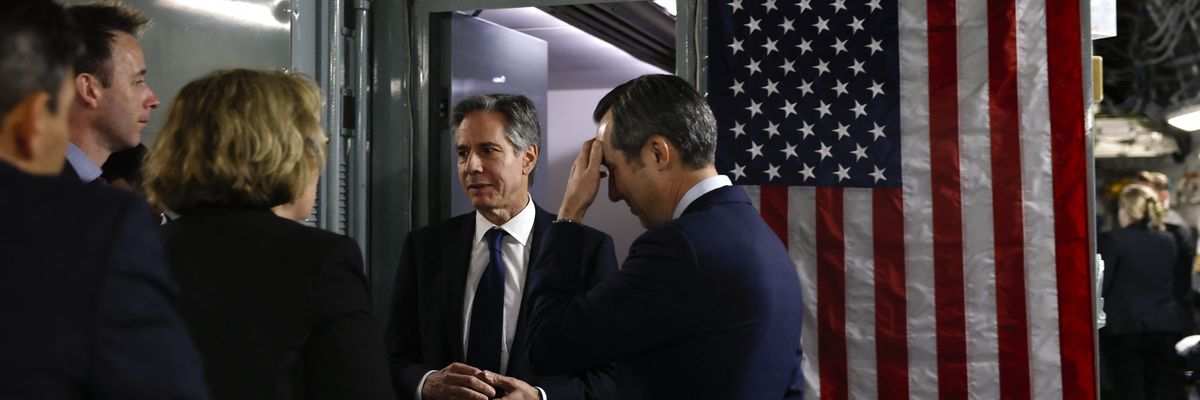
U.S. Secretary of State Antony Blinken talks with spokesperson Matthew Miller and others after he departed from Manama for Tel Aviv on January 10, 2024. (Photo: Evelyn Hockstein/Pool/AFP via Getty Images)
“I don’t think we need to offer any kind of pressure” on the Israelis to accept a Palestinian state, said a spokesperson for the U.S. State Department.
A U.S. State Department spokesperson signaled Thursday that American weaponry will continue to flow to the Israeli military even after the nation’s prime minister ruled out calls for a sovereign Palestinian state, openly defying the Biden administration’s push for a two-state solution to the crisis.
“Our support for Israel remains ironclad,” the State Department’s Matthew Miller said during a press briefing on Thursday in response to a question about how the U.S. intends to react to Israeli Prime Minister Benjamin Netanyahu’s position.
“I don’t think we need to offer any kind of pressure” on the Israelis to accept a Palestinian state, Miller said. “The pressure is reality. The pressure is the reality that I just laid out, that without a tangible path to the establishment of a Palestinian state, there are no other partners in the region who are going to step forward and help with the reconstruction of Gaza.”
Asked whether the U.S. will “continue to supply weapons and other support to an ally that is not listening to the warnings that you’re giving,” Miller acknowledged “differences with all of our allies” but said that “this is not a question of the United States pressuring them to do anything.”
“This is about the United States laying out for them the opportunity that they have,” Miller added. “There is a path for real security assurances—but again, we can’t make those choices for anyone. They have to make them for themselves.”
In the same briefing, Miller is asked about Netanyahu opposing a Palestinian state and if the US would offer any pressure if Israel doesn’t accept.
Miller: “I don’t think we need to offer any kind of pressure, the pressure is reality…”
In an indication of its unflagging support for Israel’s war assault on Gaza, the U.S. State Department has twice bypassed Congress to expedite weapons sales to the nation’s government since the Hamas-led attack on October 7. Earlier this week, the U.S. Senate rejected a resolution from Sen. Bernie Sanders (I-Vt.) that would have required the department to produce a report on Israel’s human rights practices in Gaza—which by virtually all accounts are atrocious.
The Biden administration, which could soon be facing a lawsuit at the International Court of Justice over its complicity in Israeli war crimes, opposed the Sanders resolution and has refused to formally assess whether Israel is adhering to international humanitarian law.
The Guardian reported Thursday that the State Department has “in effect been able to circumvent the U.S. law that is meant to prevent U.S. complicity in human rights violations by foreign military units—the 1990s-era Leahy law, named after the now retired Vermont senator Patrick Leahy—because, former officials say, extraordinary internal state department policies have been put in place that show extreme deference to the Israeli government.”
“No such special arrangements exist for any other U.S. ally,” the newspaper added.
The administration is currently working to exempt U.S. arms transfers to Israel from a “mandatory congressional notification process that applies to all other foreign arms sales,” The Washington Post reported last week.
Overall, the Biden administration has sent more than 10,000 tons of weaponry to Israel over the past three and a half months, declining to place conditions on the arms even as the Israeli military openly flouts U.S. officials’ entreaties to protect Gaza civilians, attacking homes, schools, bakeries, hospitals, and refugee camps.
“If Biden was truly as dissatisfied or impatient or whatever other terms are being fed to the media about his supposed handwringing over Bibi’s war, he could have acted. But he didn’t.”
Israel’s unrelenting bombing campaign and ground invasion have killed nearly 25,000 people in Gaza since October, and much of the territory is in the grip of famine as the Netanyahu government restricts the amount of aid allowed to enter the besieged territory.
Ajith Sunghay, head of the United Nations human rights office in the occupied Palestinian territory, expressed horror Friday at conditions on the ground in Gaza, calling the situation “a major, human-made, humanitarian disaster.”
“People continue to arrive in Rafah from various places in their thousands, in desperate situations, setting up makeshift shelters with any material they can get their hands on,” said Sunghay. “I’ve seen men and children digging for bricks to be able to hold in place tents made with plastic bags.”
“It is a pressure cooker environment here, in the midst of utter chaos, given the terrible humanitarian situation, shortages, and pervasive fear and anger,” he added. “The communications blackout has continued for a sixth consecutive day, adding to the confusion and fear, and preventing Gazans from accessing services and information on areas to evacuate.”
In a column on Thursday, The Intercept‘s Jeremy Scahill noted that “over the course of the past 100 days of Israel’s bloody rampage in Gaza, Biden has had an infinite series of events that each could have justified ceasing U.S. political and military support for Israel’s explicitly offensive war.”
“There is no nation on Earth that wields more influence over Israel and no politician who holds more sway than Biden. The U.S. is the arms dealer and defender of this entire enterprise,” Scahill wrote. “If Biden was truly as dissatisfied or impatient or whatever other terms are being fed to the media about his supposed handwringing over Bibi’s war, he could have acted. But he didn’t.”
“Instead, the White House made sure no cease-fire took hold, offered a public defense of Israel’s conduct in the face of clear evidence of its genocidal intent submitted before the world court, circumvented Congress to keep the arms flowing, and then publicly opposed a resolution that sought to uphold U.S. law aimed at ensuring U.S. weapons and other aid are not used to commit human rights abuses. Those are the relevant facts,” he continued. “There is no need for media outlets to serve as conveyor belts for the administration’s disingenuous posturing. Biden’s actions are the only evidence that matters. And that evidence is damning.”
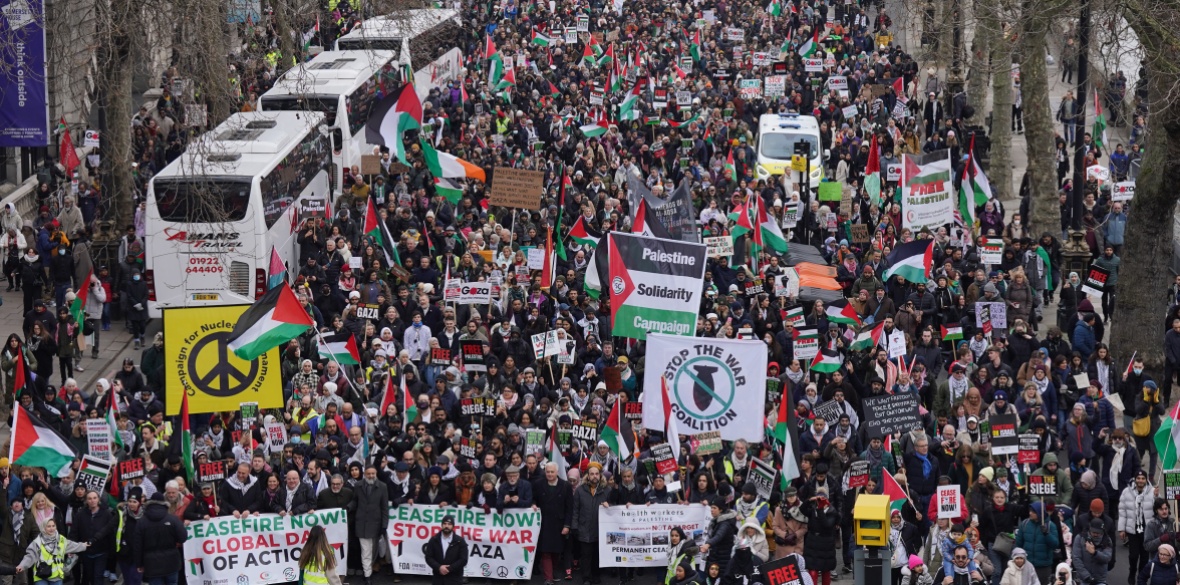
Protesters during a National March for Palestine in central London, January 13, 2024
THE government ignored “overwhelming evidence” that Israel was breaching international human rights laws in Palestine and continued to supply the murderous regime with weapons, including those being used in Gaza, legal documents have revealed.
A Foreign Office assessment unit reviewing UK arms sales to Israel in November raised “serious concerns” with Foreign Secretary David Cameron.
But the former PM recommended that arms sales continue, accepting Israel’s reasoning that it has a different interpretation of its international humanitarian law obligations.
The revelations are contained in a document in a case brought by the Global Legal Action Network (GLAN) and Palestinian human rights group Al Haq over UK arms sales to Israel.