US-Iran deal may be seen as ‘betrayal’ in Israel, ex-premier Olmert says

Spread the love

This work by Middle East Monitor is licensed under a Creative Commons Attribution-NonCommercial-ShareAlike 4.0 International License.

Former Israeli prime minister Ehud Olmert. [Photo by BRYAN R. SMITH/AFP via Getty Images]

A potential agreement between the US and Iran could be seen as a “betrayal” in Israel, a former Israeli prime minister told Irish public broadcaster RTE, Anadolu reports.

“I think that maybe from the point of view of the original position of Netanyahu, it may be interpreted as a betrayal,” Ehud Olmert said, referring to Israeli Prime Minister Benjamin Netanyahu.

He said Netanyahu would be unlikely to say so publicly because he is “entirely, completely dependent on the relations and support” of US President Donald Trump.

Though the details of the agreement were not yet fully known, Olmert argued that there appeared to be “a big margin” between the initial expectations of the US and Israel when military operations began and the current understanding between Washington and Tehran.

READ: Trump says Israel’s Netanyahu must be ‘more responsible’ on Lebanon

Olmert said he believed “the door is open” to an agreement between Israel and Lebanon, adding that Israel should withdraw from southern Lebanon as part of negotiations with the Lebanese government.

“We don’t need any territory in the south of Lebanon… we should pull out completely from the south of Lebanon and make all the necessary adjustments for territorial agreement, and we should try to make peace,” he added.

He said expectations that the Iranian regime would collapse were unrealistic, arguing that Tehran had endured significant challenges over decades and that such assumptions were “not serious.”

Both the US and Iran appeared to be seeking “a reasonable way to restore the situation to what it was before the war started,” he added.

“And the Iranians were very successful,” Olmert said.

READ: Ben Gvir attacks Trump-Iran deal: Israel ‘not bound by US agreement’

This work by Middle East Monitor is licensed under a Creative Commons Attribution-NonCommercial-ShareAlike 4.0 International License.

Keir Starmer explains that UK is actively supporting Israel's genocidal expansion and repeats his previous quotation that he supports Zionism "without qualification". Keir Starmer said “I said it loud and clear – and meant it – that I support Zionism without qualification.” here: https://www.jewishnews.co.uk/keir-starmer-interview-i-will-work-to-eradicate-antisemitism-from-day-one/
Keir Starmer explains that UK is actively supporting Israel’s genocidal expansion and repeats his previous quotation that he supports Zionism “without qualification”. Keir Starmer said “I said it loud and clear – and meant it – that I support Zionism without qualification.” here: https://www.jewishnews.co.uk/keir-starmer-interview-i-will-work-to-eradicate-antisemitism-from-day-one/

Orcas discuss Donald Trump and the killer apes' concept of democracy. Front Orca warns that Trump is crashing his country's economy and that everything he does he does for the fantastically wealthy.
Orcas discuss Donald Trump and the killer apes’ concept of democracy. Front Orca warns that Trump is crashing his country’s economy and that everything he does he does for the fantastically wealthy.

Continue ReadingUS-Iran deal may be seen as ‘betrayal’ in Israel, ex-premier Olmert says

Iran, Oman reaffirm commitment to ‘safe, free’ navigation through Hormuz after US deal

Spread the love

This work by Middle East Monitor is licensed under a Creative Commons Attribution-NonCommercial-ShareAlike 4.0 International License.

Omani Foreign Minister Sayyid Badr Hamad Al Busaidi meets with Iranian Foreign Minister Abbas Araghchi ahead of the US-Iran talks, in Muscat, the capital of Oman, on February 06, 2026. [Oman Foreign Ministry – Anadolu Agency]

Iran and Oman reaffirmed their commitment on Tuesday to ensuring safe and free maritime navigation through the Strait of Hormuz following a memorandum of understanding between Tehran and Washington, Anadolu reports.

During a phone call, Omani Foreign Minister Badr Albusaidi and his Iranian counterpart Abbas Araghchi reviewed bilateral ties and underscored their shared commitment to strengthening cooperation across various fields based on principles of good neighborliness and longstanding historical and cultural links, according to Oman’s state news agency ONA.

In light of the recent US-Iran understanding, the two ministers renewed their commitment to international law regarding “the safe and free passage of maritime traffic through the Strait of Hormuz,” the agency said.

They also expressed hope that all parties would undertake “serious efforts to foster a sustainable environment supportive of a constructive political and diplomatic process aimed at preserving regional security and stability,” it added.

READ: Switzerland confirms US-Iran memorandum signing set for Friday at Burgenstock

The call came days after Washington and Tehran announced that they had reached a memorandum of understanding intended to pave the way for ending the conflict that began with US and Israeli military operations against Iran on Feb. 28.

US President Donald Trump has said the understanding has already been signed and that the Strait of Hormuz would be “fully reopened by Friday.” Iranian officials, however, have said the memorandum is expected to be signed by the heads of the two negotiating delegations during a meeting in Switzerland on June 19.

The Strait of Hormuz, located between Iran and Oman, is one of the world’s most important energy transit routes, linking the Gulf to international waters through the Gulf of Oman and the Arabian Sea.

READ: Iranian ships cross US naval blockade area without obstruction for 1st time after deal: Report

This work by Middle East Monitor is licensed under a Creative Commons Attribution-NonCommercial-ShareAlike 4.0 International License.

Keir Starmer explains that UK is actively supporting Israel's genocidal expansion and repeats his previous quotation that he supports Zionism "without qualification". Keir Starmer said “I said it loud and clear – and meant it – that I support Zionism without qualification.” here: https://www.jewishnews.co.uk/keir-starmer-interview-i-will-work-to-eradicate-antisemitism-from-day-one/
Keir Starmer explains that UK is actively supporting Israel’s genocidal expansion and repeats his previous quotation that he supports Zionism “without qualification”. Keir Starmer said “I said it loud and clear – and meant it – that I support Zionism without qualification.” here: https://www.jewishnews.co.uk/keir-starmer-interview-i-will-work-to-eradicate-antisemitism-from-day-one/

Orcas discuss Donald Trump and the killer apes' concept of democracy. Front Orca warns that Trump is crashing his country's economy and that everything he does he does for the fantastically wealthy.
Orcas discuss Donald Trump and the killer apes’ concept of democracy. Front Orca warns that Trump is crashing his country’s economy and that everything he does he does for the fantastically wealthy.

Continue ReadingIran, Oman reaffirm commitment to ‘safe, free’ navigation through Hormuz after US deal

Iran threatens to halt US negotiations if Israeli attacks continue in Lebanon

Spread the love

This work by Middle East Monitor is licensed under a Creative Commons Attribution-NonCommercial-ShareAlike 4.0 International License.

A view of streets as daily life continues amid fragile ceasefire in Tehran, Iran on May 12, 2026, as geopolitical tensions rise following recent statements from the United States. [Fatemeh Bahrami – Anadolu Agency]

Iranian parliament speaker Mohammad Bagher Qalibaf warned on Sunday that negotiations for a peace deal with the US could be halted if Israeli attacks on Lebanon continue, Anadolu reports.

In a post on US social media company X, Qalibaf explained that the ongoing Israeli attacks on Lebanon reflect the US’ inability to fulfill its commitments.

“The Zionist attacks on the southern suburbs of Beirut once again demonstrate the United States’ lack of will or ability to fulfill its commitments,” he added.

The Israeli attacks on Lebanon “will not go unanswered,” Gen. Mohammad Jafar Asadi, deputy inspector brigadier general at Khatam al-Anbiya Central Headquarters of the Iranian Armed Forces, said in a statement, according to Fars News Agency.

Asadi added that the Israeli attacks targeting the southern suburbs of Beirut “will not go unanswered.”

At least three people were killed and 15 others injured when the Israeli army launched airstrikes on the southern suburbs of the Lebanese capital Beirut on Sunday despite an ongoing ceasefire, state news agency NNA reported.

READ: 3 killed as Israeli army launches airstrikes in Lebanese capital in new ceasefire violation

The Israeli army has continued a bombing campaign on Lebanon since March 2 and occupied several towns in the country’s south.

The attacks have killed over 3,700 people, wounded nearly 11,500, and displaced over 1.5 million since March 2, according to Lebanese officials.

While US President Donald Trump said the deal with Iran that will open the Strait of Hormuz will be signed on Sunday, Iran has disputed the timeline, and said a final decision is under consideration. After the Israeli strike in Beirut on Sunday, Trump said the attack “should not have happened … when we are so close” to the deal. He urged both Israel and Hezbollah to “stand down,” and hoped for a “long and beautiful peace.”

Pakistani Prime Minister Shehbaz Sharif, whose country has been mediating between the US and Iran, also said on Saturday that the deal could be finalized in the next 24 hours.

While Iran has called for ending the war on all fronts including Lebanon, release of its frozen assets and end of US blockade of its ports; the US is demanding that Tehran halt its nuclear program and fully reopen the Strait of Hormuz.

READ: Israeli ministers call for bombing Beirut despite ceasefire

This work by Middle East Monitor is licensed under a Creative Commons Attribution-NonCommercial-ShareAlike 4.0 International License.

Keir Starmer explains that UK is actively supporting Israel's genocidal expansion and repeats his previous quotation that he supports Zionism "without qualification". Keir Starmer said “I said it loud and clear – and meant it – that I support Zionism without qualification.” here: https://www.jewishnews.co.uk/keir-starmer-interview-i-will-work-to-eradicate-antisemitism-from-day-one/
Keir Starmer explains that UK is actively supporting Israel’s genocidal expansion and repeats his previous quotation that he supports Zionism “without qualification”. Keir Starmer said “I said it loud and clear – and meant it – that I support Zionism without qualification.” here: https://www.jewishnews.co.uk/keir-starmer-interview-i-will-work-to-eradicate-antisemitism-from-day-one/

Continue ReadingIran threatens to halt US negotiations if Israeli attacks continue in Lebanon

OPINION: Trump’s Strategic Mistakes in His War Against Iran

Spread the love

This work by Middle East Monitor is licensed under a Creative Commons Attribution-NonCommercial-ShareAlike 4.0 International License.

US President Donald J. Trump monitors U.S. military operations in Iran: Operation Epic Fury, February 28, 2026. [White House X Account – Anadolu Agency]

by Jasim Al-Azzawi

In January 2026, flushed with the swift, covert removal of Venezuelan President Nicolás Maduro, the Trump administration rolled the dice on a far more volatile and deeply rooted adversary. President Donald Trump operated under the seductive assumption that a high-tech, stealth excursion against the Islamic Republic of Iran would yield a parallel, cost-free triumph. Yet, months into the conflict sparked by the administration’s aggressive “Maximum Pressure 2.0” campaign and escalated via Operation Epic Fury, Washington finds itself trapped in a familiar, agonizing quagmire. Tactical brilliance has once again been mistaken for strategic victory. As Winston Churchill famously observed in the wake of early wartime triumphs, “Now this is not the end. It is not even the beginning of the end. But it is, perhaps, the end of the beginning.” By prioritizing spectacular kinetic displays over coherent political end states, the administration has committed critical strategic errors that echo America’s past blunders in the region, ultimately leaving the United States more vulnerable, its deterrence degraded, and the Middle East fundamentally destabilized.

The administration’s first and most glaring mistake was the illusion of the “quick win”—a fundamental misreading of Iranian resilience, nationalism, and asymmetric depth.

The opening salvos of the 2026 campaign achieved extraordinary tactical milestones, including the systematic destruction of Iran’s conventional naval assets and the stunning decapitation of Supreme Leader Ali Khamenei. Yet, as the Cato Institute observed shortly after the dust settled, “tactical successes cannot mask what has quickly become another strategic failure… the administration’s strategy is divorced from its ostensible aims.” Airpower and targeted assassinations did not trigger a domestic democratic uprising, nor did they erase decades of deeply entrenched institutional control. Instead, power quickly consolidated around an even harder-line, war-hardened faction of the Islamic Revolutionary Guard Corps (IRGC), proving General Omar Bradley’s timeless maxim that “amateurs talk about tactics, but professionals talk about logistics” and long-term sustainability.

Furthermore, the administration drastically underestimated Iran’s capacity for regional, asymmetric retaliation. For years, Washington’s defense establishment operated under the comfortable assumption that Tehran would limit its responses to localized attacks on U.S. assets or proxy skirmishes.

Instead, the conflict immediately metastasized into a multi-theatre conflagration. On day one, Iranian missiles and sophisticated loitering munitions struck across all six Gulf Arab states, completely shattering the regional security umbrella and exposing the fiction of impenetrable air defenses. Rather than dismantling Iran’s missile architecture, the war revealed that a staggering 70 percent of Iran’s ballistic missile stockpile and mobile launchers remained entirely intact, deeply buried in hardened underground “missile cities” and fully operational weeks into the fighting.

READ: Iran threatens to halt US negotiations if Israeli attacks continue in Lebanon

This massive miscalculation triggered the second strategic error: a failure to anticipate and mitigate crippling global economic blowback. The administration’s aggressive naval blockade was met with a brutal, symmetric counter-strategy in the maritime chokepoints. Tehran seized effective de facto control of the Strait of Hormuz—the vital artery through which 25 percent of the world’s oil transits—implementing a coercive toll and mining system that drove global crude prices past $100 a barrel. The economic ripples disrupted fragile global supply chains and sparked inflationary spikes across Western economies. In a supreme irony, the administration was forced to quietly ease certain oil sanctions and grant waivers to keep global energy markets afloat, giving Tehran unexpected economic leverage in the middle of a war meant to break its financial resolve.

This economic vulnerability recalls the warning of British Prime Minister Margaret Thatcher, who noted that defense cannot be sustained if it destroys the economic foundation upon which national power rests.

The deeper tragedy of this conflict lies in how it has perversely incentivized the very behavior Washington sought to deter. The administration’s stated rationale for military intervention was the total, permanent elimination of Iran’s nuclear program. However, by demanding what amounted to “unconditional surrender” while systematically dismantling the remaining diplomatic guardrails, the administration left Tehran with zero peaceful off-ramps. Before the outbreak of hostilities, regional intermediaries noted that Iran was willing to offer nuclear concessions that went well beyond the original international agreements. By replacing diplomacy with existential military threats, Washington has practically guaranteed that any post-war Iranian regime will view a functional nuclear deterrent not as a negotiable luxury, but as an absolute requirement for national survival. As the legendary strategist Carl von Clausewitz famously wrote, “War is the continuation of politics by other means.” When war loses its political objective and becomes merely punitive, it transforms into an engine of endless escalation.

READ: Trump agreed to release $24B in frozen Iranian assets without formal announcement: Report

Finally, the war has accelerated a structural shift toward an aggressively post-American global order, severely damaging U.S. credibility among allies and adversaries alike. Writing on the cascading geopolitical fallout of the conflict, foreign policy analyst Robert Kagan noted that the war has triggered an “accelerating global adjustment to a post-American world as a result of this massive miscalculation.” Far from isolating Iran, the conflict has bound Washington’s primary geopolitical rivals closer together. U.S. forces have faced an adversary heavily fortified by external collaboration, ranging from advanced Chinese semiconductor chips and real-time satellite imagery to shared tactical innovations in drone warfare.

The Trump administration entered this conflict under the hubristic assumption that it could unilaterally dictate the terms of a short, low-cost engagement. Instead, it has ignored the foundational rule of strategic statecraft: never launch a war without a clear, achievable definition of peace.

By chasing the mirage of an effortless regime collapse, the administration has degraded America’s conventional deterrence, exposed the global economy to severe energy shocks, and driven a resilient adversary deeper into the camp of our most formidable global competitors. If Washington does not pivot swiftly toward a realistic, diplomatically enforceable ceasefire, Operation Epic Fury will not be remembered as a historic triumph but as a textbook case of how tactical hubris breeds strategic disaster.

OPINION: The end of American forward presence in the Persian Gulf

The views expressed in this article belong to the author and do not necessarily reflect the editorial policy of Middle East Monitor.

This work by Middle East Monitor is licensed under a Creative Commons Attribution-NonCommercial-ShareAlike 4.0 International License.

Keir Starmer explains that UK is actively supporting Israel's genocidal expansion and repeats his previous quotation that he supports Zionism "without qualification". Keir Starmer said “I said it loud and clear – and meant it – that I support Zionism without qualification.” here: https://www.jewishnews.co.uk/keir-starmer-interview-i-will-work-to-eradicate-antisemitism-from-day-one/
Keir Starmer explains that UK is actively supporting Israel’s genocidal expansion and repeats his previous quotation that he supports Zionism “without qualification”. Keir Starmer said “I said it loud and clear – and meant it – that I support Zionism without qualification.” here: https://www.jewishnews.co.uk/keir-starmer-interview-i-will-work-to-eradicate-antisemitism-from-day-one/

Continue ReadingOPINION: Trump’s Strategic Mistakes in His War Against Iran

Zia Yusuf Cosying Up to Group Behind ‘Authoritarian’ Project 2025 Agenda

Spread the love

Article by Sam Bright republished from DeSmog. [Article was published 10 June 2026]

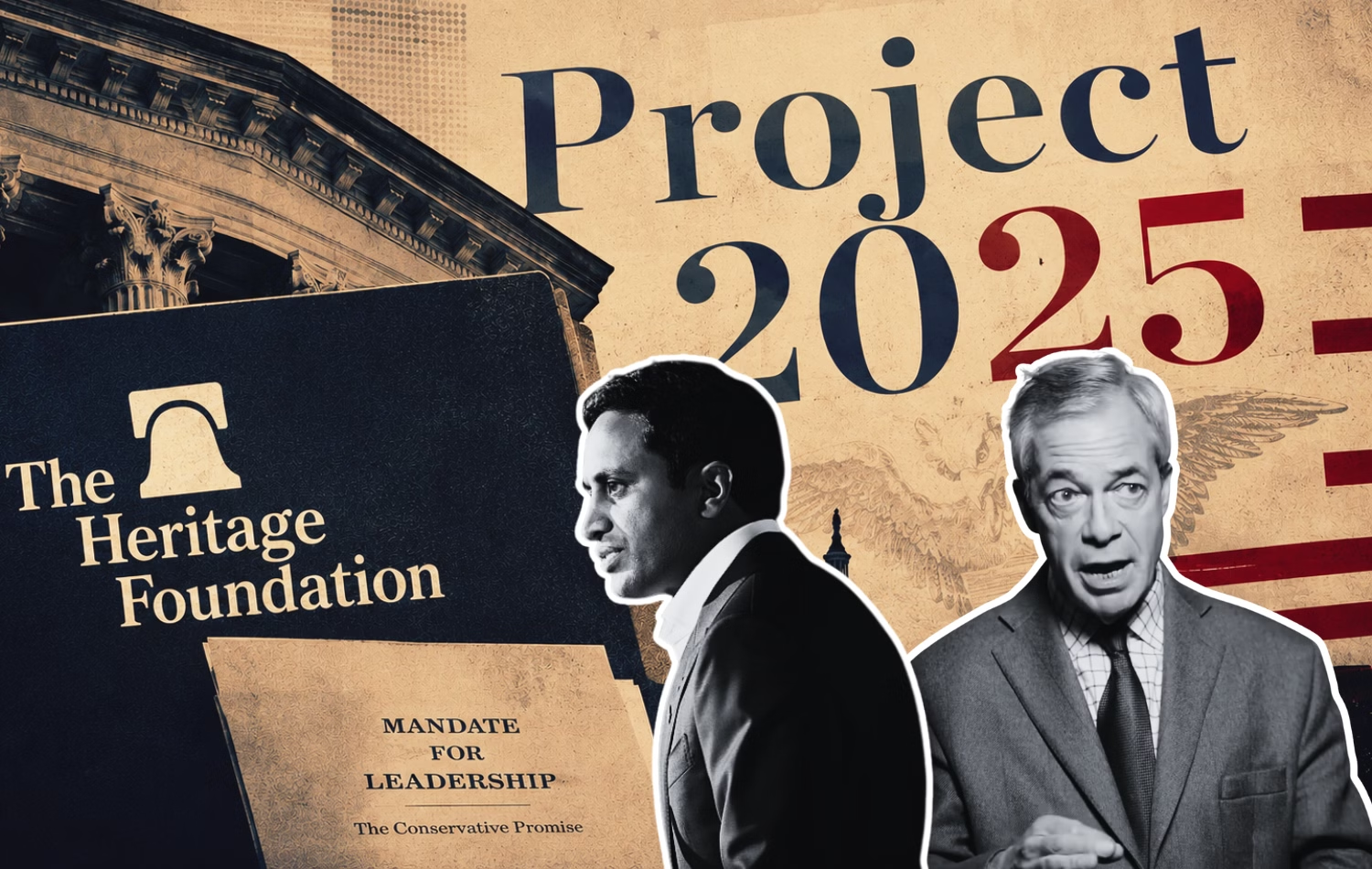
A DeSmog collage of Reform UK leader Nigel Farage and the party’s home affairs spokesman Zia Yusuf. Credit: Reform UK / YouTube (Farage), Yusuf (Z979)

Reform has been chasing even closer ties to Trump’s allies.

Reform UK’s Zia Yusuf is set to speak tomorrow at the Heritage Foundation, the group behind the “extreme” ‘Project 2025’ playbook for Donald Trump’s second term.

Yusuf, Reform’s home affairs spokesperson, is jetting to Washington, D.C., for an event with Nile Gardiner, director of the Heritage Foundation’s ‘Thatcher Center’.

The event description states that the pair will be discussing “key transatlantic priorities, including mass migration, border security, deportation policy, and the broader challenge of safeguarding Western institutions and values.”

The Heritage Foundation organised Project 2025, the 900-page document which proposed a series of radical, ultra-conservative policies that have served as a blueprint for Trump’s second-term agenda.

The dossier recommended banning abortion pills, restricting access to contraceptives, and removing federal funding for groups providing abortion services. “Conservatives in the states and in Washington, including in the next conservative administration, should push as hard as possible to protect the unborn in every jurisdiction in America,” it stated.

It also proposed bulldozing U.S. climate policies – slashing restrictions on fossil fuel extraction, scrapping state investment in renewable energy, and gutting the Environmental Protection Agency. 

The Heritage Foundation said that the federal government should “eradicate climate change references from absolutely everywhere” – a policy carried out by Trump, who has called climate science a “hoax”.

A core recommendation of Project 2025 was to “dismantle the administrative state” by centralising power with the president, slashing government funding, and replacing career civil servants with ideological loyalists. Russell Vought, a Heritage Foundation alumni and one of the main co-authors of Project 2025, now serves as Trump’s director of Office of Management and Budget – wielding significant power in restructuring the federal government.

Much of this agenda is shared by Reform and its leader Nigel Farage. After years of silence on abortion, Farage recently called for the UK’s abortion limit to be reduced, labelling the current 24-week limit “utterly ludicrous”. The Reform leader has been forging alliances with U.S. anti-abortion groups, while appointing anti-abortion figures to key positions in the party – including its head of policy James Orr, who doesn’t think abortion should be allowed at any stage of foetal development, even in pregnancies resulting from rape.

“Zia Yusuf should be ashamed to share a platform with the Heritage Foundation,” said Abortion Rights chair Kerry Abel. “The architects of Project 2025 are a global threat to abortion rights, climate action and democracy.

“You cannot flirt with the far right in Washington and pretend it has no consequences here. Anyone giving credibility to this extreme agenda must be called out.”

Reform is a pro-oil party that calls for the UK’s climate targets to be scrapped. Farage has said it’s “nuts” for CO2 to be considered a pollutant. The party has also launched a ‘Department of Government Efficiency’ (DOGE) to identify public spending cuts in local authorities – mirroring Trump’s agency with the same name, which has overseen billions in cuts to vital public services.

“Advocates of this brand of right-wing politics, championed by Donald Trump and embraced by Reform UK politicians, are aiming to spread their divisive rhetoric and regressive policies, from opposing abortion to actively undoing climate progress,” said Cary Mitchell, executive director of operations at Best for Britain, which campaigns against populism. “Brits have been clear that they don’t trust Trump – and a knock-off version of his authoritarian approach here in the UK would only risk all our rights.”

Farage has received £52,000 in speaking fees and £12,500 in flights and accommodation for addressing pro-Trump, MAGA events since being elected to Parliament in July 2024.

In recent days, Farage announced that he would be making a keynote address to CPAC GB, a pro-Trump conference being held in London in July. The British spin-off is being organised by disgraced former Conservative prime minister Liz Truss, and Farage initially indicated that he would be “steering well clear” of the event, only to now reverse his decision.

version of this article was published by The New World.

Farage, a longstanding Trump supporter, has recently been attempting to put some distance between his party and the U.S. government, following the president’s unpopular war in Iran, which Farage has supported.

However, Yusuf’s appearance at the Heritage Foundation – and Farage’s at CPAC GB – underscores Reform’s MAGA loyalty. According to The Spectator, key figures behind Project 2025 have been “shuttling between London and Washington” to bestow their wisdom on Farage, while Gardiner has reportedly been acting as a bridge between the White House and Reform.

Reform politician Matthew Goodwin and its economic spokesperson Robert Jenrick have also made speeches to the Heritage Foundation in recent years.

Gardiner and the Heritage Foundation have regularly been given a platform on the right-wing media channel GB News, Farage’s largest income source since becoming an MP in July 2024.

Gardiner, who served as a foreign policy researcher and aide to former prime minister Margaret Thatcher, has made dozens of appearances on GB News. During those appearances, he has called for the UK to reintroduce the death penalty, labelled the UK government “a bunch of cowardly appeasers” for not supporting Trump’s military intervention in Iran, and called for pro-Palestine protestors to be deported if they have been arrested and are foreign nationals.

Reform has been forging close ties to a number of pro-Trump groups for a number of years. In December 2024, Farage helped to launch the Heartland Institute, a co-author of Project 2025, in the UK and is now being advised by the climate science denial group.

As reported by DeSmog, two thirds of the party’s funding has come from those with financial interests in fossil fuels.

“Reform make out like they’re your mate down the pub, standing up for everyday people. But they’re actually working closely with the establishment think tanks that helped put Trump into power, and raking in millions in donations from billionaires,” said Green Party peer Natalie Bennett. “We can see who’s pulling the strings and who they’re really working for.”

Reform and the Heritage Foundation were approached for comment.

Article by Sam Bright republished from DeSmog.

Nigel Farage explains the politics of Reform UK: Racism, Fake anti-establishmentism, Deregulation, Corporatism, Climate Change Denial, Mysogyny and Transphobia.
Nigel Farage urges you to ignore facts and reality and be a climate science denier like him and his Deputy Richard Tice. He says that Reform UK has received £Millions and £Millions from the fossil fuel industry to promote climate denial and destroy the planet.
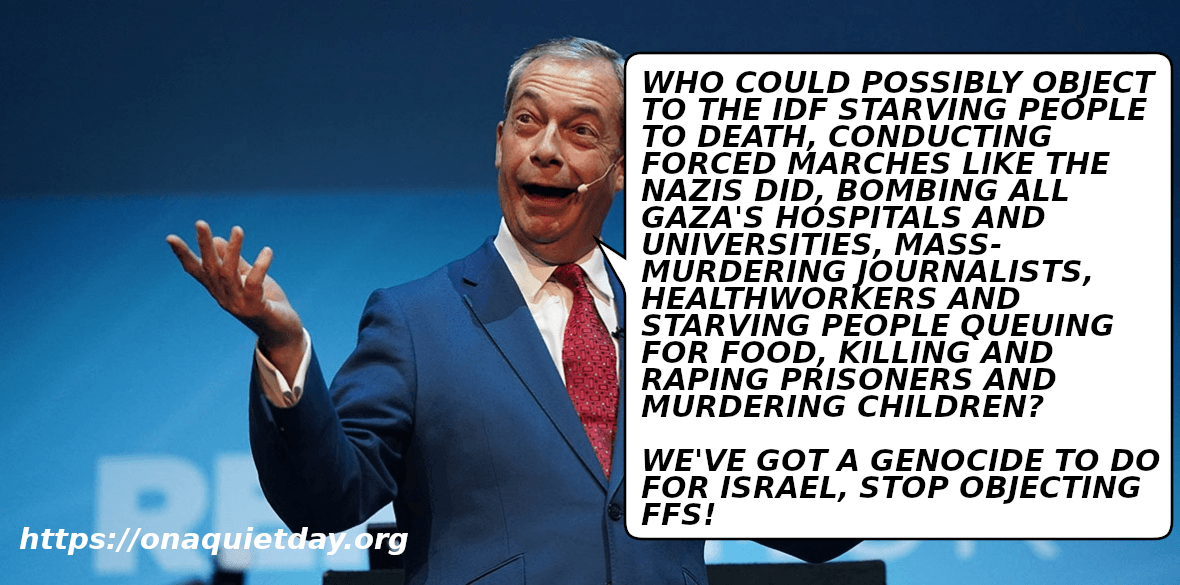
Nigel Farage objects to criticism of the IDF. He asks how could anyone object to them starving people to death, forced marches like the Nazis did, bombing Gaza's hospitals and universities, mass-murdering journalists, healthworkers and starving people queuing for food, killing and raping prisoners and murdering children. He calls for people to stop obstructing his genocide for Israel.
Nigel Farage objects to criticism of the IDF. He asks how could anyone object to them starving people to death, forced marches like the Nazis did, bombing Gaza’s hospitals and universities, mass-murdering journalists, healthworkers and starving people queuing for food, killing and raping prisoners and murdering children. He calls for people to stop obstructing his genocide for Israel.
Continue ReadingZia Yusuf Cosying Up to Group Behind ‘Authoritarian’ Project 2025 Agenda