Keir Starmer gives a keynote speech marking the four-year anniversary of the 2019 election, at Silverstone Technology Park, near Milton Keynes, Buckinghamshire, December 12, 2023
LABOUR will recognise a Palestinian state when it gets permission from Israel to do so, Sir Keir Starmer has announced in his latest abandonment of progressive international commitments.
Ditching a policy dating back a decade to Ed Miliband’s leadership, the Labour leader has announced that the party in government will no longer join nearly 140 other countries around the world in recognising the state of Palestine.
According to a report in the Jewish Chronicle, Sir Keir said at the weekend that “recognition has to be part of a process, and an appropriate part of the process.”
What that meant was spelt out by shadow foreign office minister Wayne David, who said Labour would “recognise the state of Palestine at a point which will help the peace process once negotiations between Israel and Palestine and the others are taking place.”
Calling Labour’s previous position of recognition of Palestine independently of any supposed peace process “T-shirt politics,” Mr David elaborated that recognition had to come to “fruition in a way which is acceptable to the state of Israel.
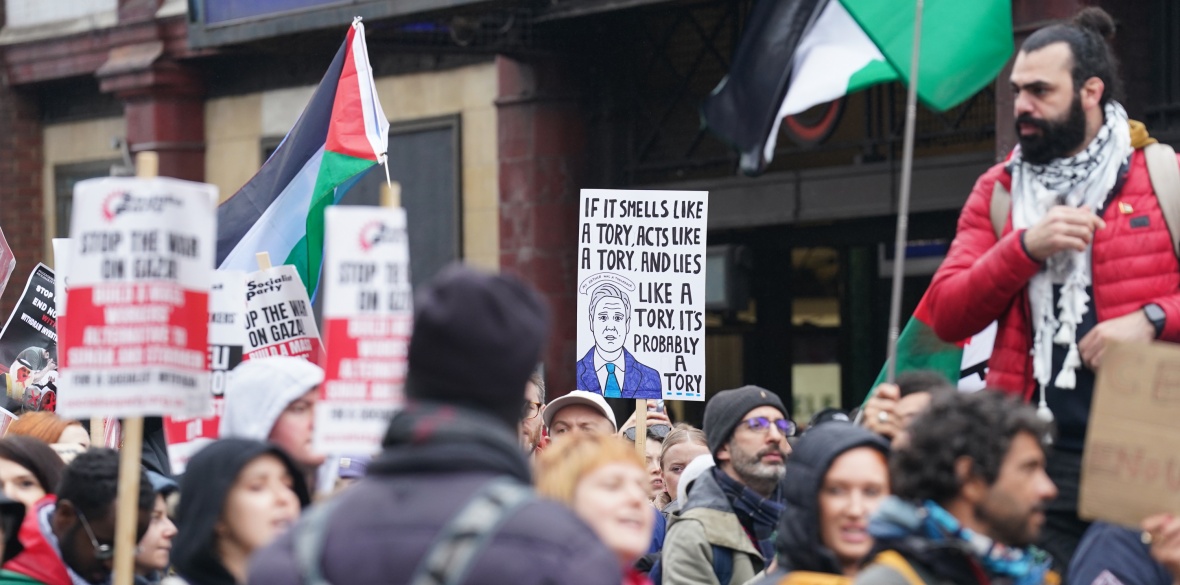
People demonstrate outside the constituency office of Labour Party leader Keir Starmer, in north west London, during a Palestine Day of Action demonstration, November 18, 2023
THAT there is a sense of inevitability about Keir Starmer’s abandonment of Labour’s commitment to recognise a Palestinian state should not diminish outrage at the move.
Ditching the pledge, first made under Ed Miliband’s leadership of Labour, is all of a piece with the party’s unequivocal support for imperialism under Starmer’s leadership.
It comes as other policies — to stop arms sales to Saudi Arabia or to give MPs a vote before Britain undertakes military action — are also junked in a bonfire of progressive demands.
But the abandonment of a commitment to join 139 other countries around the world in recognising the state of Palestine is particularly brutal and cynical.
…
In this situation to abandon a policy Labour has championed for a decade is not to assist the cause of peace, it is to green-light Israeli aggression.
Individuals, including 4 government ministers, 9 UK citizens fighting for IDF and others, accused in criminal complaint of complicity in war crimes against Gaza
The International Centre of Justice for Palestinians (ICJP) has announced that it has presented the Metropolitan Police with a dossier of evidence against UK citizens accused of collusion in Israel’s war crimes in Gaza. The ICJP announced in October that it would be prosecuting both Tory ministers and Labour MPs who have supported Israel’s genocide, or incited war crimes, against Palestinians. Israel has so far killed almost thirty-three thousand Palestinian civilians, mostly women and children.
One of a number of outstanding Irish MEPs, Clare Daly tells Biden to take the name of Ireland out of his mouth
Clare Daly, an outspoken and courageous left-wing Irish MEP, has an outstanding track record of taking the right side of global issues – and she has let US president Joe Biden and European Commission president Ursula von der Leyen have both truth-barrels for their complicity in Israel’s genocide and array of other war crimes against the innocent Palestinian civilians of Gaza.
Redbridge Community Action Group (RCAG) has selected local Palestinian woman Leanne Mohamad to stand against arch-Labour right-winger Wes Streeting in Ilford North at the next parliamentary election. Ms Mohamad won selection among three potential candidates, by a vote of RACG members.
A man mourns as he holds the wrapped body of a Palestinian child who was killed overnight by Israeli bombing at a hospital in Rafah in the southern Gaza Strip on December 19, 2023. (Photo: Mohammed Abed/AFP via Getty Images)
Israel’s bombardment and invasion of Gaza have also killed more than 10,000 children in nearly 100 days, or 1% of the 1.1 million children in the besieged enclave.
Israel has killed more people per day in its attack on Gaza than were killed daily in any other major conflict during the 21st century.
Oxfam reported Thursday that Israel has killed an average of 250 Palestinians in Gaza each day since October 7, compared to 96.5 killed daily in Syria, 51.6 in Sudan, 50.8 in Iraq, 43.9 in Ukraine, 23.8 in Afghanistan, and 15.8 in Yemen.
“The scale and atrocities that Israel is visiting upon Gaza are truly shocking,” Oxfam Middle East director Sally Abi Khalil said in a statement. “For 100 days the people of Gaza have endured a living hell. Nowhere is safe, and the entire population is at risk of famine.”
“The situation in Gaza is monstrous and a blight on our common humanity.”
Also on Thursday, Save the Children reported that Israel’s bombardment and invasion of Gaza had killed more than 10,000 children in nearly 100 days, or 1% of the 1.1 million children living in Gaza before the war began. More than 40% of the total number killed in Gaza were children.
“There can never be any justification for killing children,” Jason Lee, Save the Children’s country director for the occupied Palestinian territory, said in a statement. “The situation in Gaza is monstrous and a blight on our common humanity.”
More than 10K children have been killed by Israeli airstrikes and ground operations with thousands more missing, presumed buried under rubble.
On October 7, Hamas launched an attack on southern Israel that killed around 1,100 people and took around 240 hostages. Israel then launched its assault on Gaza in retaliation. Before Hamas’ attack, however, Israel had blockaded Gaza for 16 years and occupied the Palestinian West Bank for 56 years. Since October 7, Israel has killed 330 Palestinians in the West Bank, according to Oxfam.
Both Oxfam and Save the Children’s statements came the same day that a South African legal team appeared before the International Court of Justice to argue that Israel is committing genocide in Gaza. It is asking the court to take “provisional measures” to stop the violence. Several other countries, including Brazil, Bolivia, and Pakistan, have supported South Africa’s efforts, but the United States dismissed its case as “meritless.”
Oxfam and Save the Children criticized the wider international community for failing to stop the bloodshed.
“It is unimaginable that the international community is watching the deadliest rate of conflict of the 21st century unfold, while continuously blocking calls for a cease-fire,” Khalil said.
Lee stated: “Despite the record number of children killed and maimed, the international community has failed to act again and again. One grave violation committed against children is one too many. For the last three months, children in Gaza have faced grave violations every day, while conditions to provide them with the humanitarian assistance they need are simply not there. All parties must agree to a definitive cease-fire now.”
— Oxfam International Media Team (@newsfromoxfam) January 11, 2024
The two non-governmental organizations also emphasized the danger civilians in Gaza now face not only from military action, but also from hunger and disease. Israel only allows 10% of the necessary food aid to enter Gaza’s borders, according to Oxfam. The colder weather increases the risk of illness, especially as people displaced by the conflict are forced to shelter in smaller and smaller spaces. More than 1 million people are now crowded together in Rafah, and Oxfam partner Palestinian Agricultural Relief Committees said conditions for people living in tents was “worse than anything you could imagine.”
“The rain was going down from all sides of the tent,” displaced engineer named Mutaz told Oxfam. “We had to sleep lying over the bag of flour to protect it from the rain. My wife and three of my daughters use one blanket at night. There are only enough blankets for four people to share. We have nothing.”
Save the Children pointed out that these hardships took a toll on children especially.
“For children who have survived, the mental harm inflicted and the utter devastation of infrastructure including homes, schools, and hospitals has decimated their futures,” Lee said.
The organization counted a record number of violations against children by both Israel and Hamas, including the destruction or damaging of 370 schools in Gaza, the attacking of 94 hospitals and healthcare facilities, the denial of humanitarian aid to all of Gaza’s 1.1 million children, and Hamas’ taking of children as hostages and killing of 33 children in Israel.
“The war has affected us so badly,” Lana, an 11-year-old girl living in Rafah, told Save the Children. “We had to leave our homes and couldn’t do anything. We learned many things during the war, like how important it is to save water. I hope the war ends, and we live in peace and safety.”
In a statement on Sunday, Save the Children said that, each day of the conflict, more than 10 children in Gaza had lost one or both of their legs. Amputations are also often performed without anesthetic, as Gaza’s hospitals and healthcare system are overwhelmed by the violence, with a shortage of doctors and nurses and only 13 out of 36 hospitals partially functioning.
“Unless action is taken by the international community to uphold their responsibilities under international humanitarian law and prevent the most serious crimes of international concern, history will and should judge us all,” Lee said Sunday. “We must heed the lessons from the past and must prevent ‘atrocity crimes’ from unfolding.”
Keir “I support Zionism without qualification” Starmer and other Labour party support of Israel’s genocide. We can’t elect these complicit in genocide cnuts.
Since October 7, the day the escalation in Israel/Palestine began (FAIR.org, 10/13/23), American media outlets have persistently described the fighting as an “Israel-Hamas war.” From October 7 through midday on December 1, the New York Times, Wall Street Journal and Washington Post have combined to run 565 pieces that use the phrase “Israel-Hamas war.”
This paradigm has been a dominant way of covering the violence, even though Israel has been clear from the start that its assault has not been narrowly aimed at Hamas. At the outset of the Israeli onslaught, Israeli Defense Minister Yoav Gallant (Times of Israel, 10/9/23) said: “I have ordered a complete siege on the Gaza Strip. There will be no electricity, no food, no fuel, everything is closed.” Oxfam later said that such restrictions on Palestinians’ ability to eat—which left 2.2 million people “in urgent need of food”—mean that Israel is deploying a policy wherein “starvation is being used as a weapon of war against Gaza civilians.”
A day later, Israeli military spokesperson Adm. Daniel Hagari (Guardian, 10/10/23) said that “hundreds of tons of bombs” had already been dropped on the Gaza Strip, and admitted that “the emphasis is on damage and not on accuracy.”
The New York Times‘ label (12/2/23) encourages readers to view Israel’s attacks on a population as really being aimed at a distinct group.
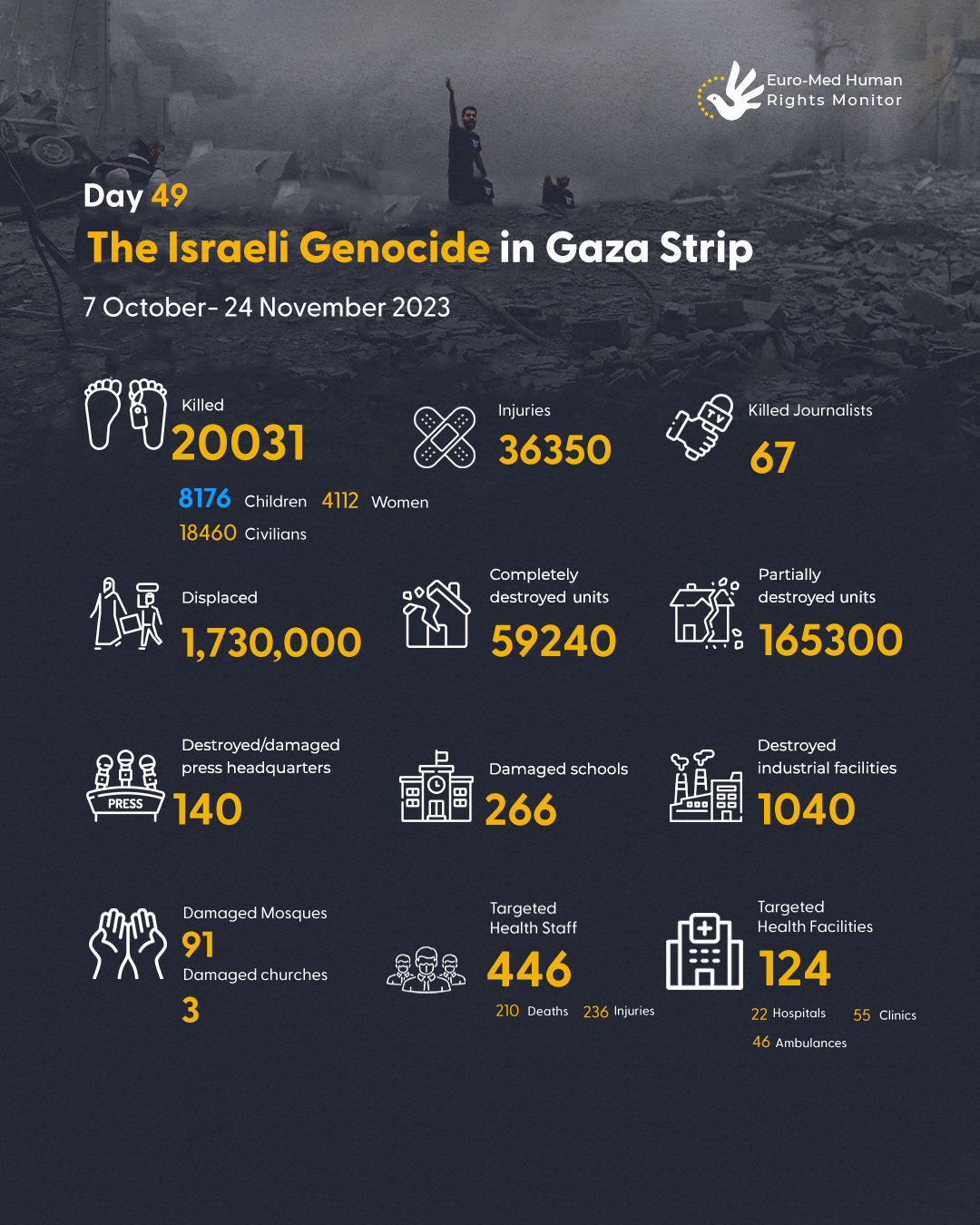
The indiscriminate nature of Israel’s assault is clear. The United Nations Office for the Coordination of Humanitarian Affairs reported on November 24 that “over 1.7 million people in Gaza, or nearly 80% of the population, are estimated to be internally displaced.” On November 25, the Swiss-based Euro-Mediterranean Human Rights Monitor reported that Israel had killed 20,031 Palestinians in Gaza, 18,460 of whom (or 92%) were civilians, since October 7.
Thus, while Israel has openly acknowledged that it is carrying out indiscriminate violence against Palestinians, US media outlets do Israel the favor of presenting its campaign as if it were only aimed at combatants. “Israel-Gaza war” comes closer to capturing the reality that Israel’s offensive is effectively against everyone living in Gaza. Yet “Israel-Gaza war” appears in 265 pieces in the three papers, exactly 300 fewer than the obfuscatory “Israel-Hamas war.”
Consider also the Euro-Mediterranean Human Rights Monitor finding that Israel has slaughtered 8,176 children. If 41% of all the Palestinians Israel has killed in the first seven weeks of its rampage have been children, and 8% have been combatants, then it is less an “Israel-Hamas war” than an Israeli war on Palestinian children.
Characterizing what has happened since October 7 as an “Israel-Hamas war” fails to adequately capture the scope and the character of Israel’s violence. Describing the bloodbath in Palestine this way obscures that grave violence is being visited upon virtually all Palestinians, whatever their political allegiances and whatever their relation to the fighting.
Cognitive dissonance
Contrary to the implication of NBC‘s headline (12/2/23), the divide in Hollywood is not between supporters of Israel and Hamas, but over the issue of Palestinian human rights.
Corporate media have often stuck to the “Israel-Hamas war” approach even when the information the outlets are reporting shows how inadequate it is to conceive of Israel’s attacks in that way. For instance, the New York Times (10/20/23) ran a story about Israel ordering 1.2 million Gaza residents to evacuate their homes, and still classified the evacuation as part of the “Israel-Hamas war.” The Izz ad-Din al-Qassam Brigades, Hamas’ armed wing, is estimated to have 30,000–40,000 fighters (Axios, 10/21/23).
The Wall Street Journal published a short piece (11/6/23) that noted:
The United Nations said that the Israel-Hamas war has killed the highest number of UN workers in any single conflict. The UN said that over 88 workers in its Relief and Works Agency [UNRWA], the largest humanitarian organization in the Gaza Strip, have been killed since October 7.
But UNRWA did not itself use the “Israel-Hamas war” narrative in the report to which the Journal referred, instead opting for “escalation in the Gaza Strip.” Indeed, Israel killing UN workers at a rate of almost three each day would seem to fall outside the bounds of an “Israel-Hamas war,” but that’s how the paper categorizes the violence. (“Israel’s war on the UN” falls well outside the bounds of the ideologically permissible in the corporate media.)
A WashingtonPost article (11/7/23) titled “Israel’s War in Gaza and the Specter of ‘Genocide’” quoted several experts and political leaders making a credible case that, in the words of Craig Mokhiber, former director of the United Nations’ New York office on human rights, “the term ‘genocide’ needs to be applied” to what Israel is doing in Gaza.
Nevertheless, the article’s author, Ishaan Tharoor, attributed such statements to “critics of Israel’s offensive against the Islamist group Hamas,” and described the violence as “Israel’s overwhelming campaign against Hamas.” Genocide as defined by the UN requires “the intent to destroy a national, ethnic, racial or religious group, in whole or in part.” So saying that Israel’s attacks are directed “against Hamas” twice in an article pointing to authorities on genocide invoking the term with reference to Israel’s actions in Gaza ought to generate cognitive dissonance.
Violence on the West Bank
In the first two weeks of fighting, the BBC (10/22/23) reported, Israel killed 89 Palestinians on the West Bank.
Another problem with classifying the bloodshed of the last seven weeks as an “Israel-Hamas war” is that Israel has also enacted brutal violence and repression on the West Bank, which is governed by the Palestinian Authority, Hamas’ arch rivals; Hamas is mostly confined to Gaza (Electronic Intifada, 10/28/23).
Between October 7 and November 26, Israeli forces killed 222 Palestinians in the West Bank, and Israel’s government-backed settlers killed eight more. In that period, Israel has also repeatedly carried out airstrikes in the West Bank, hitting such targets as the Balata refugee camp (Reuters, 11/18/23) and a mosque in the Jenin refugee camp (BBC, 10/22/23).
Israel has also arrested hundreds of West Bank Palestinians since October 7 (AP, 11/26/23) and attacked a hospital in Jenin, shooting a paramedic while they were inside an ambulance and using military vehicles to block ambulances from entering hospitals.
It would therefore make more sense to speak of an “Israel-Palestine war” than an “Israel-Hamas war,” but the former has been used in just two articles in my dataset.