Al Awda Association and the People’s Health Movement launched a campaign for the release of Dr. Ahmed Muhanna, director of Al-Awda Hospital in northern Gaza
Dr. Ahmed Muhanna appeared on numerous international news stations calling for an end to Israel’s attacks on health workers. Photo: Screenshot
Al Awda Health and Community Association and the People’s Health Movement (PHM) have launched a campaign calling for the release of Dr. Ahmed Muhanna, the director of Al Awda’s hospital in the area of Tal Al-Zaatar in Jabalya, northern Gaza. PHM has also called for an end to Israeli attacks on health workers in Palestine, warning that the “deliberate targeting of the healthcare system by Israel is a blatant war crime.”
Dr. Muhanna was detained by Israeli Occupying Forces (IOF) following a raid on Al-Awda Hospital in Jabalya that began on December 17. While other staff members were detained by Israeli soldiers, they were released after several hours of questioning. On the other hand, Dr. Muhanna was not released, and his current status remains unknown.
The director of Al-Awda Hospital in Jabalya became an unofficial spokesperson for health workers in Palestine since Israel started its latest round of attacks on October 7. From the very beginning of the Israeli war on Gaza, Dr. Muhanna kept contact with regional and international organizations, sharing situation reports to illustrate the dire state of hospitals in the Gaza Strip.
Along with other members of the staff, Dr. Muhanna was also one of the health workers who refused to abandon the hospital after receiving evacuation orders from the Israeli occupation in the earlier phases of the war. At the time, Dr. Muhanna said the evacuation “is not possible,” given the serious conditions of several patients. “The hospital staff is determined to stay and provide health care to patients,” he asserted at the time.
Shortly before his arrest, Dr. Muhanna sent a new message to Al Awda’s network of contacts, saying: “No one can move in the hospital because of the [Israeli] sniper. The situation in the hospital is terrible. We have 38 patients, some of them lacking medicine. We have no oxygen and only very little fuel for a small generator. We have food for 2 to 3 days tops. The situation is critical.”
Al Awda Association and PHM have called on health workers and activists around the world to denounce Dr. Muhanna’s arrest and apply pressure on their governments to push Israeli authorities to free him. The organizations are also inviting health workers to organize actions in support of Dr. Muhanna and his comrades in the Gaza Strip, making their struggle visible in their workplaces.
People’s Health Dispatchis a fortnightly bulletin published by thePeople’s Health Movementand Peoples Dispatch. For more articles and subscription to People’s Health Dispatch, clickhere.
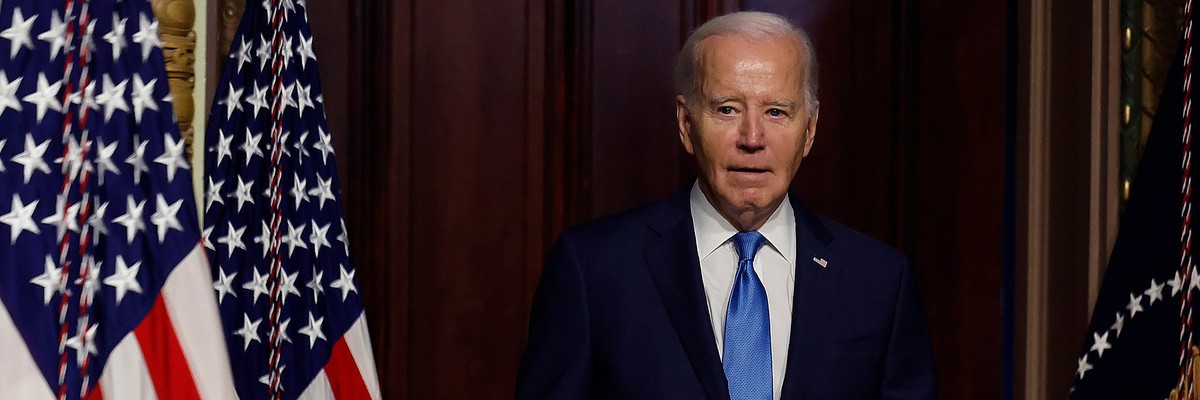
U.S. President Joe Biden arrives for a meeting at the White House on December 13, 2023 in Washington, D.C. (Photo: Chip Somodevilla/Getty Images)
A New York Times/Sienna College survey found that the U.S. president’s handling of the Gaza crisis is unpopular with voters across the political spectrum.
The New York Times suggested Tuesday that U.S. President Joe Biden has “few politically palatable options” after a survey the newspaper conducted with Siena College showed that his handling of Israel’s war on the Gaza Strip is broadly unpopular with the American electorate.
Matt Duss, a former foreign policy adviser to Sen. Bernie Sanders (I-Vt.), responded that Biden’s choice is clear.
“He should choose the option that upholds human rights and international law, which is what he promised during his campaign,” wrote Duss, executive vice president of the Center for International Policy. “Support a cease-fire.”
The Times/Siena College poll of U.S. voters found that Biden’s current approach—which has consisted of unconditional military support for Israel accompanied by mild calls for the protection of Gaza civilians and opposition to a lasting cease-fire—has just 33% support and 57% opposition.
Among young voters who were critical to Biden’s 2020 victory over former President Donald Trump, the opposition is even more pronounced, with 73% of those between the ages of 18 and 29 saying they disapprove, according to the new survey. Forty-seven percent of young voters said they believe Biden is too supportive of Israel, while just 6% said he’s too supportive of the Palestinians.
The survey’s findings amplified concerns that, in addition to rendering himself complicit in genocide, Biden is alienating key elements of the Democratic base by arming the Israeli military as it carries out mass atrocities in the Gaza Strip.
“Yet another major poll finds that Biden is killing his own reelection bid with his inhumane and strategically nonsensical Gaza policy,” Trita Parsi, executive vice president of the Quincy Institute for Responsible Statecraft, wrote on social media.
Yet another major poll finds that Biden is killing his own re-election bid with his inhumane and strategically non-sensical Gaza policy.
The survey was released ahead of an expected United Nations Security Council vote on a resolution calling for a “suspension of hostilities.” A previous version of the resolution called for a “cessation of hostilities,” but the text was reportedly watered down in an effort to prevent the U.S. from once again wielding its veto power.
As the Biden administration’s opposition to a sustained cease-fire leaves the U.S. increasingly isolated on the world stage, the Times/Siena College poll found that 44% of U.S. voters—including 59% of Democrats—believe Israel should “stop its military campaign in order to protect against civilian casualties, even if not all Israeli hostages have been released.”
Sixty-five percent of Democratic voters believe Israel should stop its assault on Gaza to prevent additional civilian deaths “even if Hamas has not been fully eliminated” in line with the Israeli government’s stated objective.
During a meeting last week with Israeli Prime Minister Benjamin Netanyahu, Biden national security adviser Jake Sullivan reportedly urged the far-right leader to transition to a “lower intensity” form of warfare in Gaza “in a matter of weeks, not months,” the latest signal that the Biden administration is feeling domestic and international pressure as the humanitarian catastrophe worsens and the death toll climbs.
“I don’t want to see any baby die. So, first of all, we’ve got to take that on. We’ve got to get a cease-fire. This has to stop.”
Shira Lurie, assistant professor of American History at Saint Mary’s University, warned in an op-ed for the Toronto Star on Monday that Biden’s continued arming of Israel and opposition to a permanent cease-fire “could have severe ramifications in the electoral college” in 2024 “as several key states, including Arizona, Georgia, Michigan, Minnesota, and Wisconsin, have significant Muslim populations.”
A lawmaker from one of those states, Rep. Debbie Dingell (D-Mich.), said in an NBC News interview on Sunday that “there’s a lot that has to be done” for Biden to win back the votes of those who are furious over his support for Israel’s decimation of Gaza.
“All of us in this country need to understand what’s happening in Gaza right now. You can fight about how many thousands of people have been killed, but 6,000 to 8,000 children have been killed,” said Dingell. “Eighty-five percent of the people in Gaza have had to leave their homes. They’re living in shelters. Disease is going up. There’s one toilet for 220 people, one shower for 4,500 people. They don’t have food. They don’t have medicine. They don’t have utilities.”
“I can’t tell you the number of families that I’ve spoken to who’ve lost entire families,” she continued. “We’ve got to show some empathy and compassion. A Jewish baby and a Palestinian baby are babies. I don’t want to see any baby die. So, first of all, we’ve got to take that on. We’ve got to get a cease-fire. This has to stop.”
Demonstrators demanding a Gaza cease-fire protest outside Penn Station in New York City on December 18, 2023. (Photo: caren/X)
“We must stand up and not be silent to this injustice,” said one rabbi taking part in the demonstration.
A coordinated wave of demonstrations against what activists called Israel’s genocidal war on Gaza targeted New York City transit hubs Monday afternoon, with protesters demanding an immediate cease-fire as heavy Israeli bombardment of the besieged strip pushed the death toll from 73 days of attacks to nearly 20,000.
Protesters marched from Grand Central Station to the Port Authority Bus Terminal and then on to Penn Station, where at least hundreds of activists gave police the slip and occupied Moynihan Hall. Many participants prayed for peace before leaving the station.
“We must stand up and not be silent to this injustice,” Rabbi Yisroel Dovid Weiss toldamNewYork Metro outside Grand Central Station. “We hurt and cry with the people who are dying and suffering under the stranglehold of the Zionist occupation. We want the world to know that we hurt because we are Jews, we will not be silent because we are Jews.”
#BREAKING Pro-Palestinian Protesters rushed the entrance of Penn Station as cops ran closely behind them, they are now occupying Moynihan Hall inside.
Independent photojournalist Katie Smith followed the entire demonstration—which was coordinated by the group Within Our Lifetime—documenting incidents including police “violently engaging with protesters” and a confrontation between the actor Alec Baldwin and activists.
According to Smith, activists later marched to a building in Greenwich Village where a fundraiser for the Israel Defense Forces was reportedly being held.
Monday’s actions followed recent protests in New York, including a Manhattan march led by artists remembering the life and work of Refaat Alareer—a Gaza poet and professor killed last week in an Israeli airstrike—and calling on Israel to free political prisoners including the members of Freedom Theater recently arrested in Jenin in the illegally occupied West Bank.
In recent days, large protests for Gaza have also taken place in U.S. cities including Houston, Los Angeles, and Washington, D.C., as well as in cities in countries including the U.K., Canada, France, Belgium, Norway, and Germany.
In California, workers at Google and allies held a Thursday die-in at the tech giant’s San Francisco office “to demand the company stop powering Israel’s genocide of Palestinians in Gaza” through the $1.2 billion Project Nimbus cloud computing contract.
More protests are planned for this week, including a nationwide action by Mennonites on Tuesday and a rally by over 80 groups on Capitol Hill in Washington, D.C. that same day.
Sponsored by the Action Center on Race and Economy, Adalah Justice Project, Grassroots Global Justice Alliance, and the U.S. Campaign for Palestinian Rights, Tuesday’s D.C. event is being held to “demand a permanent cease-fire in Gaza and oppose the Biden administration’s proposed military aid package sending billions of taxpayer dollars to Israel, U.S. southern border militarization, and immigration enforcement.”
The Biden administration announced plans for three offshore fossil fuel lease sales for the Gulf of Mexico in 2025, 2027, and 2029. (Photo: nightman1965/Getty Images)
“Offshore oil and gas drilling is not only dirty and dangerous, but it also supercharges the existing climate crisis,” said one campaigner.
The Biden administration on Friday finalized a five-year plan for offshore fossil fuel leasing that was initially released in September and sharply condemned as a “climate nightmare.”
The Department of the Interior (DOI) highlighted in a statement Friday that the 2024-29 National Outer Continental Shelf (OCS) Oil and Gas Leasing Program has the fewest sales in history, with just three for the Gulf of Mexico set to be held in 2025, 2027, and 2029.
The DOI also stressed that the Inflation Reduction Act (IRA) signed last year by President Joe Biden “prohibits the Bureau of Ocean Energy Management (BOEM) from issuing a lease for offshore wind development unless the agency has offered at least 60 million acres for oil and gas leasing on the OCS in the previous year.”
“BOEM continues to treat the Gulf as a region where community health and well-being can be sacrificed to allow continued oil and gas production.”
That part of the IRA is one of the key reasons it has been criticized by climate campaigners, who continue to warn that the landmark package is far from enough to meet the U.S. goal of halving planet-heating emissions by the end of this decade.
The DOI’s plan outraged the American Petroleum Institute and U.S. House Committee on Natural Resources Chairman Bruce Westerman (R-Ark.) for not being friendly enough to the fossil fuel industry while advocates for the planet warned that it’s not bold enough given the worsening climate emergency.
“Offshore oil and gas drilling is not only dirty and dangerous, but it also supercharges the existing climate crisis,” Beth Lowell, Oceana’s vice president for the United States, declared in a Friday statement about the finalized program. She pointed out that the process actually began under former President Donald Trump, who proposed 47 leasing sales.
“This five-year plan started with President Trump proposing to open nearly all U.S. waters to offshore oil drilling and ends with President Biden’s final plan that is the smallest to date,” she said. “The footprint of offshore drilling was not expanded, but the dangerous cycle of drilling and spilling must end.”
After the Biden administration released its proposal in September, Natural Resources Defense Council senior attorney Irene Gutierrez wrote the following month that “BOEM continues to treat the Gulf as a region where community health and well-being can be sacrificed to allow continued oil and gas production.”
“BOEM also fails to account for the severe risks from additional oil and gas leasing to the Gulf ecosystem and species like the critically endangered Rice’s whale,” Gutierrez charged. “BOEM’s analysis also treats catastrophic oil spills like the Deepwater Horizon disaster as events that are speculative and unlikely to repeat again, and the program excludes such spills from its analysis.”
“In our comments to the proposed program and in other advocacy, we urged BOEM to issue a program with no new lease sales. The agency has ample authority to do so,” she noted. “Further, declining fossil fuel demand and existing energy reserves mean that no new offshore leasing is needed for at least the next 30 years to meet national energy needs. BOEM could have issued a zero-lease sale plan, but declined to do so, despite calls from a wide range of community and environmental groups for no new leasing in the Gulf.”
Last month, another large, disastrous and preventable oil spill hit the Gulf of Mexico. This spill serves as a reminder of the risks that ongoing offshore drilling poses to coastal communities and marine ecosystems. https://t.co/4xOa8YF4Qt
The DOI plan comes near the end of what experts have said will be the hottest year on record. It also comes on the heels of United Nations climate talks that scientists called “a tragedy for the planet,” given that the final deal out of COP28 called for “transitioning away from fossil fuels,” but did not endorse the “phaseout” demanded by civil society and most participating countries.
Biden—who is seeking reelection next year and may face off against Trump—has previously come under fire from frontline communities and climate organizations for skipping that U.N. summit, supporting the Willow oil project and Mountain Valley Pipeline, enabling the expansion of liquefied natural gas exports, and refusing to declare a national climate emergency.
On Thursday, the Biden administration released new proposed guidance on clean energy tax credits from the IRA.
“President Biden must do so much more if he wants to be taken seriously by young voters,” Michele Weindling, political director of the youth-led Sunrise Movement, said in response to the guidance. “He is overseeing an explosion in oil and gas production that has resulted in the U.S. producing more fossil fuels than ever before.”
A view of empty shelves are seen at a supermarket amidst Israel’s bombardments as Palestinians have trouble finding necessary food in Khan Yunis, Gaza on November 11, 2023. (Photo: Mustafa Hassona/Anadolu via Getty Images)
“It’s critical to understand this is not simply a byproduct of the conflict, an unfortunate result of a terrible situation,” said one campaigner. “It is Israeli government policy.”
From bombing food production hubs and systematically razing crop fields to halting aid deliveries, Israel is waging a multi-pronged effort to starve the people of Gaza amid the Israel Defense Forces’ bombardment of the enclave, Human Rights Watch said in a report Monday—with evidence drawn from the Israeli government’s own statements as well as survivors’ accounts.
The group demanded that countries such as the United States, United Kingdom, Canada, and others that have provided Israel with military aid and other support since the country began its latest escalation against Gaza in October speak out against the use of starvation as a weapon of warfare—a war crime under the Rome Statute of the International Criminal Court.
“For over two months, Israel has been depriving Gaza’s population of food and water, a policy spurred on or endorsed by high-ranking Israeli officials and reflecting an intent to starve civilians as a method of warfare,” said Omar Shakir, Israel and Palestine director at Human Rights Watch (HRW). “World leaders should be speaking out against this abhorrent war crime, which has devastating effects on Gaza’s population.”
The Israeli government is using starvation of civilians as a method of warfare in the Gaza Strip.
HRW pointed to satellite imagery it has collected in northern Gaza since the IDF began its air and ground assault in retaliation for an attack by Hamas on southern Israel on October 7.
The images have shown orchards, greenhouses, and farmland that have been razed over the last two months, “apparently by Israeli forces, compounding concerns of dire food insecurity.”
Only sand and dirt have been left behind where farmers in northeastern Gaza grew citrus, potatoes, dragon fruit, and prickly pear since Israeli forces took control of the area in mid-November and “systematically razed” the fields, said the group.
🚨The 🇮🇱Israeli government is using starvation of civilians as a method of warfare in the occupied Gaza Strip.
Palestinians in Gaza, home to about 2.3 million people, have lost the ability to grow their own food as Israel has refused to allow food, water, and fuel deliveries into the enclave, leaving bakeries and grocery store shelves empty.
Before the Israeli bombardment began, about 500 aid trucks filled with food and other goods entered Gaza on a daily basis to provide sustenance amid Israel’s unlawful occupation and its land, air, and sea blockade that began 16 years ago. Israel has allowed only 100 aid trucks to cross through Egypt’s Rafah crossing since October 7. The U.N. humanitarian coordinator for the Occupied Palestinian Territory, Lynn Hastings, said earlier this month that fuel deliveries—needed for farming, cooking, water desalination, healthcare operations, and other necessities—have been “utterly insufficient.”
Prior to the current escalation, about half of Gaza’s population was facing acute food insecurity and 80% were reliant on humanitarian aid.
The World Food Program (WFP) at the U.N. said earlier this month that 9 in 10 households in northern Gaza and 2 in 3 homes in the south had been without food for at least one full day and night since Israel’s assault. It also warned that 38% of families who had been displaced from their homes in northern Gaza were experiencing “severe levels of hunger” and that the enclave faces a “high risk of famine.”
“It’s critical to understand this is not simply a byproduct of the conflict, an unfortunate result of a terrible situation. It is Israeli government policy,” said Andrew Stroehlein, European media and editorial director for HRW.
In addition to the halting of aid and the destruction of Gaza’s agricultural sector, the last operational wheat mill was bombed on November 15 ensureing “that locally produced flour will be unavailable in Gaza for the foreseeable future,” said HRW.
The group interviewed 11 civilians who described their struggles with finding sufficient food in recent weeks.
A man identified as Taher said that after his family fled south to Gaza City in November, they resorted to eating “just once a day to survive.”
“The city was out of everything, of food and water,” he told HRW. “If you find canned food, the prices were so high… We were running out of money. We decided to just have the necessities, to have less of everything.”
Majed, who left his home in the north after his house was bombed, killing his six-year-old son, said he, his wife, and their four surviving children had no way of making bread for more than a month when they temporarily stayed in Gaza City.
“In those 33 days we didn’t have bread because there was no flour,” he said. “There was no water—we were buying water, sometimes for $10 a cup. It wasn’t always drinkable. Sometimes, [the water we drank] was from the bathroom and sometimes from the sea. The markets around the area were empty. There wasn’t even canned food.”
HRW noted that the Israeli government itself has made numerous statements in recent weeks pointing to the deliberate destruction of Gaza’s food access and the starvation of civilians.
Defense Minister Yoav Gallant infamously called Palestinians in Gaza “human animals” when he announced the “complete siege” and cutting off of aid into the enclave on October 9.
“No electricity, no food, no water, no fuel—everything is closed,” Gallant said.
Col. Yogev Bar-Shesht, deputy head of the Civil Administration, said in an interview that eliminating Palestinians’ ability to grow food is a deliberate tactic.
“Whoever returns here, if they return here after, will find scorched earth,” he said. “No houses, no agriculture, no nothing. They have no future.”
HRW’s report came as the death toll in Gaza hit at least 19,453, with more than 50,800 injured and thousands believed to be buried underneath rubble.
Article 54(1) of the First Additional Protocol to the Geneva Conventions and Article 14 of the Second Additional Protocol both prohibit starvation of civilians as a method of warfare.
“Although Israel is not a party to Protocols I or II, the prohibition is recognized as reflective of customary international humanitarian law in both international and noninternational armed conflicts,” said HRW.
The worsening humanitarian catastrophe, and Israel’s refusal to operate within the bounds of international law, “calls for an urgent and effective response from the international community,” said Shakir.
“The Israeli government is compounding its collective punishment of Palestinian civilians and the blocking of humanitarian aid,” he said, “by its cruel use of starvation as a weapon of war.”