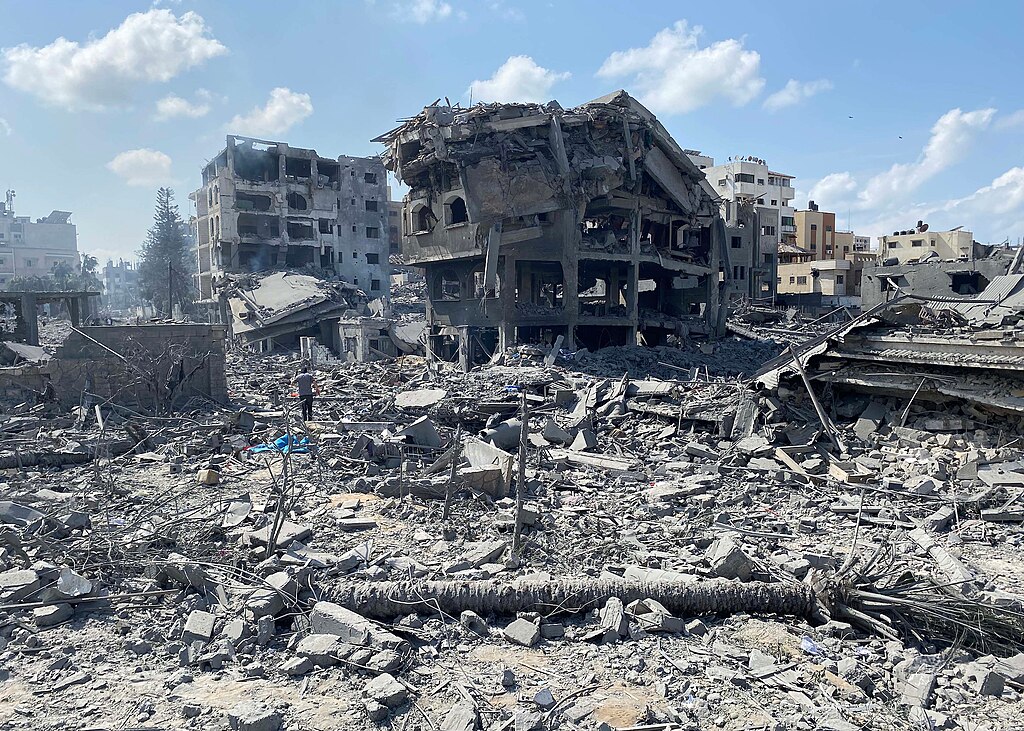
Palestinians inspect the damage following an Israeli airstrike on the El-Remal aera in Gaza City on October 9, 2023. Israel continued to battle Hamas fighters on October 10 and massed tens of thousands of troops and heavy armour around the Gaza Strip after vowing a massive blow over the Palestinian militants’ surprise attack. Photo by Naaman Omar apaimages. licensed under the Creative Commons Attribution-Share Alike 3.0 Unported license.
The UN’s top aid official has said the Israeli military campaign in southern Gaza has been just as devastating as in the north, creating “apocalyptic” conditions and ending any possibility of meaningful humanitarian operations.
Martin Griffiths, the UN emergency relief coordinator, said he was speaking on behalf of the entire international aid community in saying the continuing offensive had robbed aid workers of any significant means of helping the 2.3 million people of Gaza, other than to call for an immediate end to the fighting.
His comments came as the Israeli military said it had stormed southern Gaza’s main city in the most intense day of fighting so far, and hospitals struggled to cope with scores of dead and wounded Palestinians.
“What we’re saying today is: that’s enough now. It has to stop,” Griffiths said in an interview with the Guardian, adding that the small amount of aid being allowed into Gaza could no longer be distributed, since the Israeli ground offensive had spread to southern Gaza and the city of Khan Younis, bringing the humanitarian operation effectively to an end.
“It isn’t really a statistically significant operation any more,” said Griffiths, who is also UN undersecretary general for humanitarian affairs. “It’s a bit of a patch on a wound and it doesn’t do the job, and it would be an illusion for the world to think that the people in Gaza can be helped by the humanitarian operation under these conditions.
“This is an apocalyptic situation now, because these are the remnants of a nation being driven into a pocket in the south.”
“HELL on Earth” returned to Gaza today in the words of a UN official, as Israel resumed its murderous bombing campaign with dozens of air strikes on the southern Gaza city of Khan Younis.
Over 100 solidarity actions will take place for Palestine across Britain on Saturday as peace campaigners demand an end to the killing.
After almost a week’s truce which saw Hamas release 78 hostages seized in its October 7 raid on Israel, and Israel free 240 Palestinian prisoners of the thousands in its jails, Israeli Defence Forces (IDF) unleashed another wave of bombing which had killed at least 109 people today when the Morning Star went to press, bringing the total death toll from its war above 15,000.
…
The Stop the War Coalition’s Lindsey German told the Morning Star that Gaza faced the “hideous prospect [of] winter cold, disease and food shortages and now renewed bombardment by Israel.
“The West Bank is also seeing increasing violence with many young Palestinians being shot and arrested every day.”
A window on the horror was exposed by the Unite union, which has a twinning arrangement with Shu’fat refugee camp which borders East Jerusalem and houses more than 16,000 refugees.
Colin Lomas, secretary of the twinning group, said: “The Shu’fat checkpoint [into Jerusalem] is frequently closed, making the camp an open prison subject to frequent incursions by the Israeli army.
“The United Nations health centre in the camp, already desperately overstretched, has experienced extensive damage.
“The Shu’fat youth centre has been raided on several occasions, resulting in the arrest of many young people.
“Homes have also been raided, with people being summarily arrested and imprisoned, mostly without charge or trial.
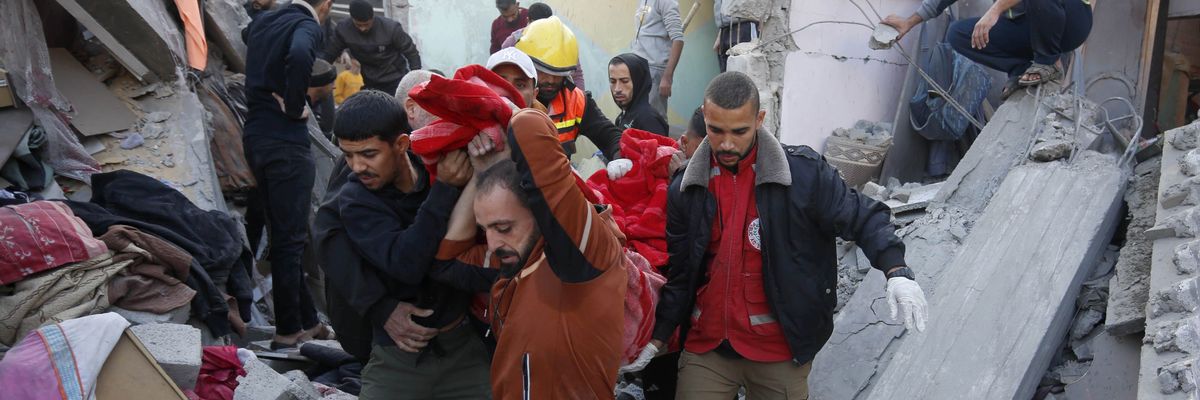
Search and rescue teams and civilians gather among the rubble of buildings in Deir Al Balah, Gaza on December 1, 2023. (Photo: Ashraf Amra/Anadolu via Getty Images)
“Anything other than sustained peace and at-scale emergency aid will mean catastrophe for the children of Gaza,” said a UNICEF spokesperson.
Israel resumed its assault on the Gaza Strip Friday morning just minutes after the pause with Hamas officially expired, ending a fragile seven-day truce that created conditions for the release of hundreds of Israeli and Palestinian captives and allowed additional—but still inadequate—humanitarian aid to enter the besieged territory.
Gaza’s health ministry said that Israel’s post-pause airstrikes killed more than 30 people and wounded dozens more, hitting a multi-story residential building and other civilian infrastructure in the southern part of the strip, where many Gazans sought refuge as Israeli forces targeted the north in earlier stages of its attack.
The Associated Press reported that Israeli forces “dropped leaflets over parts of southern Gaza urging people to leave their homes, suggesting it was preparing to widen its offensive.”
“The Israeli military also released a map carving up the Gaza Strip into hundreds of numbered parcels, and asked residents to learn the number associated with their location in case of an eventual evacuation,” AP added. “It said the map would eventually be interactive, but it was not immediately clear how Palestinians would be updated on their designated parcel numbers and calls for evacuation.”
Our aid workers in Gaza are again ordered to flee from the bombardments. Now from Khan Yunis to overcrowded Rafah. Once again, nowhere in Gaza is safe for the 2.3 million civilians who are trapped there https://t.co/NXuLyUyrYS
Robert Mardini, director general of the International Committee of the Red Cross, toldAgence France-Presse that the resumption of bombing drags Gazans “back to the nightmarish situation they were in before the truce took place,” with millions of people in desperate need of food, medicine, clean water, and sanitary living conditions.
“People are at a breaking point, hospitals are at a breaking point, the whole Gaza Strip is in a very precarious state,” said Mardini. “There is nowhere safe to go for civilians. We have seen in the hospitals where our teams have been working, that over the past days, hundreds of severely injured people have arrived. The influx of severely wounded outpaced the real capacity of hospitals to absorb and treat the wounded, so there is a massive challenge.”
James Elder, spokesperson for the United Nations International Children’s Emergency Fund (UNICEF), warned Friday that “the humanitarian situation in Gaza is so perilous that anything other than sustained peace and at-scale emergency aid will mean catastrophe for the children of Gaza.”
“To accept the sacrifice of the children in Gaza is humanity giving up,” said Elder. “This is our last chance, before we delve into seeking to explain yet another utterly avoidable tragedy.”
Israeli Prime Minister Benjamin Netanyahu, who is clinging to his job amid plummeting approval ratings, had pledged to continue assailing Gaza following the end of the truce, which marked the first pause in fighting since the war began in the wake of a Hamas-led attack on southern Israel in early October.
The Financial Times reported Friday that Israel’s government is preparing for a war that “will stretch for a year or more, with the most intensive phase of the ground offensive continuing into early 2024.”
“The multi-phase strategy envisages Israeli forces, who are garrisoned inside north Gaza, making an imminent push deep into the south of the besieged Palestinian enclave,” FT reported, citing unnamed sources familiar with the planning. “The goals include killing the three top Hamas leaders—Yahya Sinwar, Mohammed Deif, and Marwan Issa—while securing ‘a decisive’ military victory against the group’s 24 battalions and underground tunnel network and destroying its ‘governing capability in Gaza.’”
An investigation published Thursday by +972 Magazine and Local Call found that Israeli forces have used “expanded authorization for bombing non-military targets” and “the loosening of constraints regarding expected civilian casualties,” as well as “an artificial intelligence system to generate more potential targets than ever,” to wage its devastating war on Gaza, killing more than 14,500 people in less than two months and displacing 70% of the territory’s population.
In one case that anonymous Israeli sources described to the two outlets, Israel’s military command “knowingly approved the killing of hundreds of Palestinian civilians in an attempt to assassinate a single top Hamas military commander.”
“Another reason for the large number of targets, and the extensive harm to civilian life in Gaza, is the widespread use of a system called ‘Habsora’ (‘The Gospel’), which is largely built on artificial intelligence and can ‘generate’ targets almost automatically at a rate that far exceeds what was previously possible,” +972 and Local Call found. “This AI system, as described by a former intelligence officer, essentially facilitates a ‘mass assassination factory.’”
U.S. Secretary of State Antony Blinken reportedly urged Israel to do more to protect civilians in Gaza during a meeting with the nation’s leaders on Thursday, but the Israeli government has repeatedly brushed aside public and private concerns expressed by the Biden administration, which continues to provide unconditional support for the assault.
“Blinken suggested that his call for protecting Palestinian civilians had reached receptive ears, at least in general terms,” The New York Times reported. “He did not cite any specific commitments by Israel, however.”
Zionist president Joe Biden. 27 July 2021 image by Official White House Photo by Adam Schultz. Original public domain image from Flickr
The request would remove most conditions on Israel’s use of a U.S. weapons stash, including a requirement that it only use surplus or obsolete weapons and a cap on how much the U.S. can spend resupplying the stash.
President Joe Biden has requested that Congress to lift most of the restrictions on Israel’s access to a U.S. stockpile of weapons in the country, The Intercept reported Saturday.
The request came in the administration’s supplemental budget request to the U.S. Senate, sent October 20. It concerns the War Reserve Stockpile Allies-Israel (WRSA-I) that the U.S. has stored in Israel since the 1980s for its own use in a potential conflict in the region. The U.S. allows Israel to access the stockpile under certain conditions, but Biden’s request would remove most of these conditions, including a requirement that Israel only use surplus or obsolete weapons and a cap on how much the U.S. can spend resupplying the stash.
“The President’s emergency supplemental funding request would essentially create a free-flowing pipeline to provide any defense articles to Israel by the simple act of placing them in the WRSA-I stockpile, or other stockpiles intended for Israel,” Josh Paul, a former State Department official who resigned over U.S. arm transfers to Israel in the midst of its bombardment of Gaza, told The Intercept.
“The Biden administration’s supplemental budget request would further undermine oversight and accountability even as U.S. support enables an Israeli campaign that has killed thousands of children.”
The news comes in the midst of a four-day cease-fire between Israel and Hamas, which has given journalists and humanitarian organizations a moment to assess the extent of the death and destruction unleashed by Israel in Gaza since October 7, when Hamas attacked Israel, killing 1,200 and taking around 240 hostages. In retaliation, the Israeli military has killed more than 14,800 people in Gaza, around 10,000 of them women and children. That means the number of women and children killed in Gaza in less than two months is more than double the number confirmed killed in Ukraine in two years of fighting with Russia, The New York Times concluded Saturday. One of the reasons for the high civilian toll, the Times said, is Israel’s use of 2,000-pound, U.S.-made bombs in a densely populated Gaza Strip.
Despite this, Biden’s request would allow Israel to access all weapons from the WRSA-I, not just excess or obsolete ones, something that could hurt U.S. preparedness, Paul told The Intercept. The request would also remove a requirement that Israel provide concessions to the U.S. in exchange for accessing the weapons, lift the $200 million per year restocking cap, and shorten a requirement that the government inform Congress 30 days ahead of a weapons transfer under “extraordinary” circumstances.
“The Biden administration’s supplemental budget request would further undermine oversight and accountability even as U.S. support enables an Israeli campaign that has killed thousands of children,” John Ramming Chappell, a legal fellow with the Center for Civilians in Conflict, told The Intercept.
The U.S. typically provides Israel with $3.8 billion in military aid every year, more than it sends to any other nation, according to Al Jazeera. The House has already approved additional aid this year to the tune of $14.3 billion.
The Intercept story came the day after Biden seemed open to the idea of putting conditions on military aid to Israel while answering questions from reporters in Nantucket.
“I think that’s a worthwhile thought, but I don’t think if I started off with that we would have gotten where we are today,” Biden said, as HuffPost reported. “We have to take this a piece at a time.”
On the campaign trail in 2020, Biden said the idea of putting conditions on aid to Israel was “absolutely outrageous.” But the administration’s seemingly unconditional support for Israel as it carried out its siege, bombardment, and invasion of Gaza has led to backlash among progressives, who have marched for a cease-fire and carried out direct actions in several major cities. A Reuters/Ipsos poll released on November 15 found that 68% of the U.S. public backed a cease-fire.
In an appearance on NBC’s Meet the Press on Sunday, National Security Adviser Jake Sullivan did not rule out the idea that Biden would sign legislation putting conditions on military aid to Israel, though he said currently what was proving effective was behind-doors diplomacy with Israel and Arab nations.
“He is going to continue to focus on what is going to generate results,” Sullivan said.
“Oxfam is urgently calling for a full cease-fire and unimpeded humanitarian access,” said the group, explaining that a four-day pause in fighting is not sufficient.
Humanitarian workers in Gaza on Thursday said their daily experiences struggling to take care of pregnant people and babies demonstrate why a four-day pause in fighting is far from sufficient to save the lives of the blockaded enclave’s most vulnerable residents, including newborns who have begun to die from preventable causes.
As Israel’s blockade continues to keep Gaza authorities from providing clean water, food, sanitation, and heat to homes and hospitals, babies aged three months and younger “are dying of diarrhea, hypothermia, dehydration, and infection,” said Oxfam International.
Juzoor, an organization partnering with Oxfam in northern Gaza, said premature births have increased by 25-30% since October 7 when Israel began its bombardment of Gaza in retaliation for an attack by Hamas.
More premature babies born in #Gaza due to stress, trauma.
Some displaced mothers have had to give birth without basic hygiene.
The group has been supporting about 500 pregnant women in 13 shelters—where a total of 35,000 people are living—and many have gone into labor prematurely as they have the ongoing trauma of “walking long distances in search of safety, running away from bombs, and being crowded into shelters with squalid conditions.”
Humanitarian workers are struggling to adequately care for thousands of people who have taken refuge in shelters, with waste piling up due to a lack of sanitation services and up to 600 people sharing one toilet.
Sally Abi Khalil, Middle East regional director for Oxfam, said the fact that the crisis has reached a stage where babies are dying of preventable illnesses is “abhorrent.”
“Last month we lost at least one baby in every shelter, it’s heartbreaking,” said Umaiyeh Khammash, director of Juzoor. “Access to hospitals is extremely dangerous and virtually impossible, so many women are having to give birth with little or no maternity support in shelters.”
As Common Dreams has reported, more than 50,000 Gaza residents are facing Israel’s onslaught while pregnant, and more than 5,500 are expected to give birth within a month. Juzoor estimates that 30% of women will face pregnancy complications that require extra medical attention, putting their babies at greater risk—particularly in the first 28 days of life, when newborns are most vulnerable.
Khammash expressed fear that the group will soon be entirely out of food for residents.
“The absence of fuel has affected hospitals in the north and the shelters where we operate,” he said. “There is no light, there is no heat. Now winter is coming and it’s cold. It is really a disaster for everyone, but especially for expectant mothers.”
Some women have given birth in recent weeks in repurposed classrooms surrounded by dozens of refugees, without qualified medical personnel present or any capacity for providing “basic hygiene,” Khalil said.
“I don’t think there is anyone anywhere in the world that would disagree that is simply inhumane,” she added.
Oxfam is working to provide the Juzoor shelters with hygiene kits and food, while 60 health professionals have been mobilized to work with thousands of displaced people.
“But the ongoing violence, siege, and acute shortages of fuel and clean water severely hinder these efforts,” said Oxfam as it called on officials to go further than negotiating only a four-day “humanitarian pause.”
“Oxfam is urgently calling for a full cease-fire and unimpeded humanitarian access in order to restore vital services and provide desperately needed medical support particularly to pregnant women and newborn babies,” said the group.