Category: Joe Biden

  • Local Governments and Grassroots Activists Stop Spate of US Carbon Capture Pipelines

    Spread the love

    Original article by Taylor Noakes republished from DeSmog
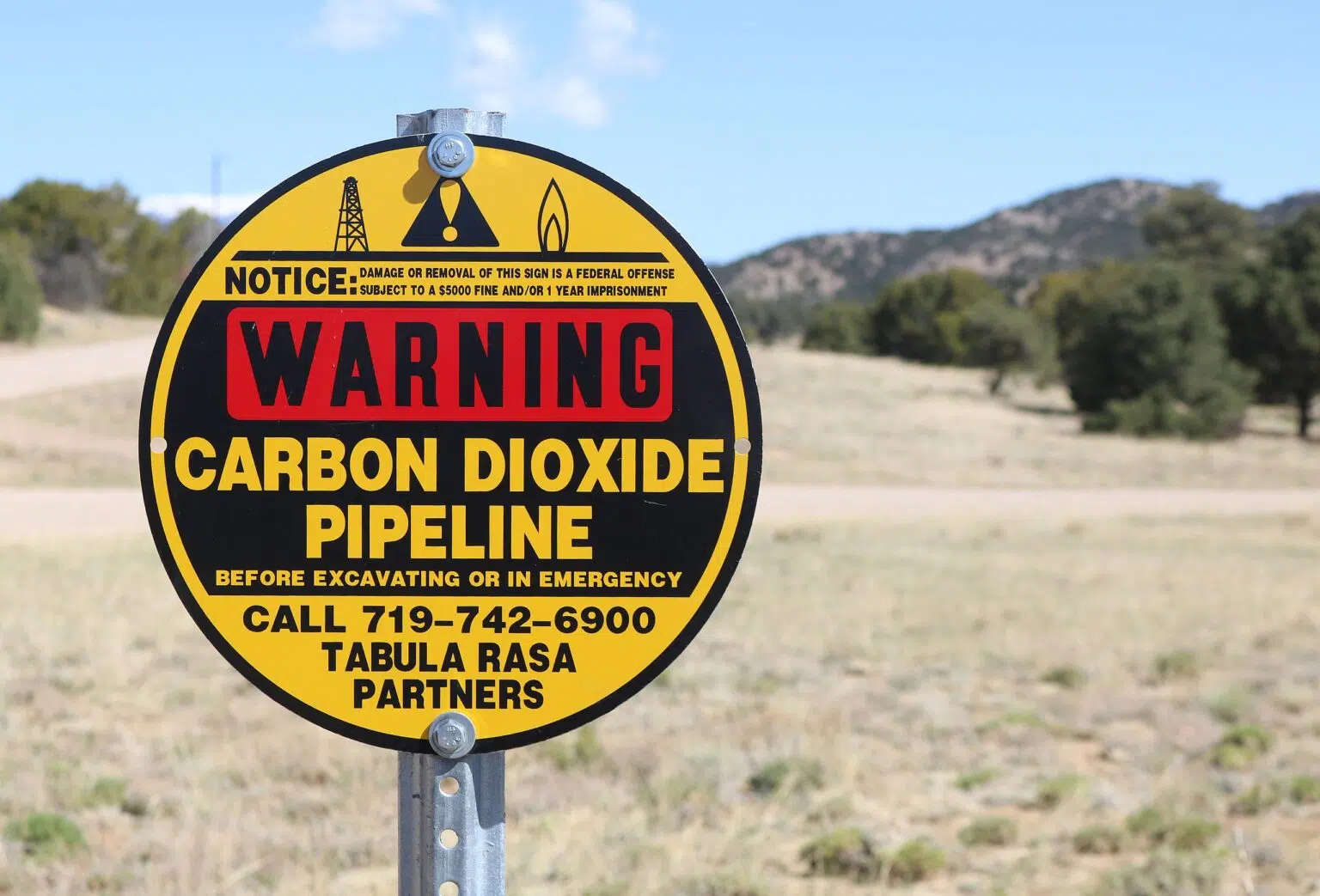
    A metal sign warning of a buried carbon dioxide pipeline in Huerfano County, Colorado. Credit: Jeffre Beall, CC BY 4.0
    A metal sign warning of a buried carbon dioxide pipeline in Huerfano County, Colorado. Credit: Jeffre Beall, CC BY 4.0

    Players in the carbon dioxide pipeline industry canceled major pipeline projects in recent weeks, marking an inauspicious start to President Biden’s ambitious plans to develop carbon capture infrastructure as a key emissions mitigation tool.

    It is welcome news to CO2 pipeline opponents, however, which have included a wide spectrum of interest groups united in their concerns over pipeline safety.

    “I think what the cancellation shows is that people have had enough of fossil fuel infrastructure being forced upon them,” said Lorne Stockman, research co-director with Oil Change International. “It doesn’t surprise me that communities are standing up to these projects and occasionally winning.”

    Stockman pointed out that the U.S. oil and gas industry has built millions of miles of pipelines, and hundreds of thousands of miles were installed in the last decade and a half as a result of the fracking boom. “There is a general awareness that the age of fossil fuels needs to end and that we need to transition to genuinely clean energy, and not dangerous distractions like carbon capture,” he added.

    Navigator CO2 Ventures ended their “Heartland Greenway” carbon dioxide pipeline project on October 20, citing “the unpredictable nature of the regulatory and government processes involved.” The project aimed to capture 15 million metric tons of carbon dioxide from ethanol plants in the U.S. Midwest to be injected and stored underground. Much like the fossil fuel industry — which seeks to use carbon capture and storage (CCS) because they allege it will assist in decarbonizing continued oil production — carbon capture is the primary emissions mitigation tool preferred by the ethanol industry as well.

    However, experts point to significant problems with the CCS process, particularly that it has historically been used primarily to pump more oil out of the earth. Burning that oil emits much more CO2 than what is captured, which means the technology wouldn’t represent a feasible solution to address climate change.

    Both local and national reporting indicate that the Navigator pipeline proposal attracted the attention of diverse groups of citizens often portrayed as being on opposite ends of the political spectrum. Yet they stood undivided in voicing shared concerns over pipeline safety and possible expropriations via eminent domain.

    Navigator’s $3.5 billion Heartland Greenway project called for 1,300 miles of pipeline across five states, with carbon dioxide storage to have taken place in Illinois. Residents in that state were resolutely opposed to the project, largely because of fears related to a pipeline rupture, like the one in Satartia, Mississippi, in February 2020. Nearly 50 people were hospitalized in that disaster, and continue to suffer from adverse health effects. 

    The disaster also forced the evacuation of 300 people, after the rupture spewed the odorless, colorless gas into the air for several hours. Carbon dioxide is an asphyxiant, and CO2 poisoning can leave victims disoriented and appearing to be drugged. Left untreated it can eventually lead to cardiac and pulmonary problems. More problematic is the relative rarity of mass CO2 poisoning events, meaning first responders might be unfamiliar with how to treat the symptoms. In addition, first responders — such as those responding to the disaster in Satartia — could be hampered by the engines of their vehicles shutting off in the oxygen deprived environment.

    These critical health, safety, and disaster-response issues notwithstanding, it was regulatory and bureaucratic processes that have so far stymied carbon dioxide pipeline and capture projects in the Midwest.

    South Dakota regulators denied Navigator’s application to build a section of the pipeline in that state in September. 

    The CCS company’s decision to cancel the project is significant for several reasons. 

    First, Navigator sought to use eminent domain to force landowners to give up their property, and was unsuccessful. Had these been oil or gas pipelines, the landowners might not have been as successful, because fossil fuel pipelines have generally been considered so fundamentally important to the public good that oil and gas companies can get around the Public Use Clause in the U.S. Constitution’s Fifth Amendment. 

    The company also has some serious financial backers, including Texas-based oil refiner Valero Energy Corp., and the world’s largest asset management company, BlackRock.

    Iowa-based Summit Carbon Solutions is also proposing the Midwest Carbon Express, a $5.5 billion, 2,000-mile pipeline network across five states, to sequester carbon dioxide emissions from 34 ethanol plants. The CO2 was to be stored in North Dakota, but state regulators denied Summit Carbon a siting permit in August. Then the South Dakota Public Utilities Commission voted unanimously to strike down the company’s application to build a section of the pipeline network through that state as well. Though other pipeline projects have faced stiff public opposition, authorities denied the application to build this pipeline segment because it would violate county ordinances relating to setbacks and other aspects of the pipeline’s route. Summit has accepted the decision and indicated it would “refine their proposal and refile” for the necessary permits.

    The Biden administration promised $251 million for CCS projects in seven states in May, from an estimated $12 billion fund from the Bipartisan Infrastructure Law for carbon management in the United States. Reporting from the Associated Press indicated that the funding announcement was a vote of confidence for what is expected to be a largely industry-driven initiative. The same article revealed that most of the funds have been dedicated to nine existing carbon capture projects, with an aim to sequester 50 million metric tons of carbon dioxide. Though this may seem impressive at first glance, it’s negligible when compared with the 5.5 to 6.3 billion metric tons of CO2 emitted annually in the United States alone. It’s especially insignificant given that most, if not all, of these projects are used for enhanced oil recovery — the injection of carbon dioxide into wells to extract the last remaining amounts of oil for production. 

    “Instead of incentivizing a CO2 reduction, the Inflation Reduction Act, along with the Infrastructure Investment and Jobs Act, through their funding of carbon capture, actually incentivize net increases in CO2, air pollution, land use and consumer costs,” said Mark Z. Jacobson, in an editorial published by The Messenger. Jacobson is a  professor of civil and environmental engineering and director of Stanford University’s Atmosphere/Energy Program.

    Jacobson identified the Summit project as one that is a direct beneficiary of Biden administration incentives for carbon capture. Noting that no study had determined whether this was an effective or efficient use of public money, Jacobson conducted a study to find out, which was recently published in Environmental Science and Technology. Jacobson compared the anticipated emissions savings and cost of the Summit project, which was intended to provide decarbonized ethanol for use in flex-fuel vehicles, with spending an equal amount on wind farms. The comparison also used two 2023 Ford F-150 pickup trucks for the modeling, as the F-150 is available in both electric and flex-fuel powered variants.

    The results were impressive: Compared with the flex fuel-powered F-150, the fully electric version, powered by renewable wind energy, reduced CO2 emissions by 2.4 to four times, and could save drivers tens of billions of dollars – even accounting for the higher cost of the electrically powered F-150. Using wind power would also use 1/400,000 of the land footprint, and would lower air pollution levels, too.

    Not only is this better for consumers, the wind and electric vehicle model virtually eliminates CO2 emissions, negating any need for carbon capture, while the ethanol and flex fuel model, even with carbon capture, would still result in a net CO2 increase.

    Watchdogs argue carbon capture is being presented to the public as part of the government’s decarbonization efforts, despite being consistently proven to be incapable of reducing CO2 at the scope and scale necessary for climate change mitigation.

    “Carbon capture started as a means to enhance oil production,” said Stockman. “It was not developed to address climate change.”

    He pointed out that CO2 must be separated from methane in gas processing plants to meet market requirements for gas, and in most cases, it is vented into the atmosphere. In 1972, a plant at the Sharon Ridge oilfield in Texas was designed to capture CO2 from a particularly CO2-rich source of gas. Engineers wanted to see if pumping it into declining oil wells would help squeeze more oil out and make more money, Stockman said. “It worked, and that has been the model for CCS ever since.”

    Stockman said that most attempts to use carbon capture and storage to reduce emissions from power plants have failed or been found to be too costly to pursue. 

    “The most notable success that CCS can claim is how successfully it has been used to convince politicians that it will one day be able to reduce emissions and, therefore, should be supported with public money,” he noted. 

    “It’s been very successful in capturing public money, which is a testimony to the long history of ‘state capture’ that the oil and gas industry has enjoyed in the U.S.,” he added, referring to Big Oil’s pressure on governments to secure public funding for their projects.

    “Large budgets for lobbying and campaign finance have helped the industry maintain subsidies and tax credits, some of which have been around for many decades,” Stockman said. “The 45Q tax credit for carbon capture and EOR [enhanced oil recovery] is just the latest in this long history.”

    The ethanol industry is expecting demand to decline in coming years, as recently reported by S&P Commodity Insights. Producing ethanol with CCS would meet some government and industry standards for lowering carbon intensity fuels. 

    However, experts and analysts routinely point out the capturing and transport process is itself carbon intensive, to the point of negating whatever positive effects sequestration might provide. Jurisdictions like California, Washington state, and the Canadian province of British Columbia could still be viable markets for low carbon intensity ethanol. There is also the possibility of using ethanol as a sustainable aviation fuel, but it all hinges on developing the infrastructure to sequester the carbon dioxide emitted during production. 

    Even if current pipeline projects have been canceled or shelved, there’s still considerable industry interest and incentive in finding a way to make the projects work.

    Stockman urges caution before activists take a victory lap.

    “I think folks need to be aware that while they have succeeded in the Midwest, communities in Texas and Louisiana are facing an overwhelming surge in gas, LNG, and CO2 infrastructure,” he said. “Both states have very oppressive legislation in place against protest and opposition to fossil fuel infrastructure, and these communities need our support, as their fight is much harder.” 

    Original article by Taylor Noakes republished from DeSmog

  • ‘No More Genocide in Gaza!’: 50+ Arrested Blocking Bay Bridge

    Spread the love

    Original article by BRETT WILKINS republished from Common Dreams under Creative Commons (CC BY-NC-ND 3.0).

    Police officers work to separate protesters who locked themselves together during a November 16, 2023 demonstration for a cease-fire in Gaza, on the Bay Bridge between Oakland and San Francisco. (Photo: Arab Resource and Organizing Center)

    “We refuse to stand by as our elected officials pay for and cheer on the genocide of Palestinians,” said one protester. “Biden must call for a cease-fire now.”

    Dozens of demonstrators demanding a cease-fire in Israel’s war on Gaza were arrested Thursday after protesters blocked San Francisco-bound traffic on the Bay Bridge during morning rush hour and the ongoing Asia-Pacific Economic Cooperation Summit.

    Members of activist groups including Palestinian Youth Movement, Arab Resource and Organizing Center, Jewish Voice for Peace (JVP) Bay Area, and others blocked westbound lanes of the bridge with their vehicles before getting out of their cars and unfurling banners reading “Stop the Genocide” and “No U.S. Military Aid to Israel.”

    “We are beyond grief watching thousands of our loved ones murdered by the Israeli military. There is a genocide happening in Gaza, and President [Joe] Biden is hosting cocktail parties in San Francisco right now,” Palestinian Youth Movement’s Aisha Nizar said in a statement.

    “We refuse to stand by as our elected officials pay for and cheer on the genocide of Palestinians. Biden must call for a cease-fire now,” Nizar added.

    Many protesters held signs or wore banners reading “The People Demand a Cease-Fire.” Some staged a “die-in” on the roadway, while others locked themselves together and through open vehicle windows in what’s known as a “sleeping dragon” maneuver as traffic on Interstate 80 and other area freeways stayed snarled for hours.

    JVP said “at least” 50 people were arrested, a number corroborated by the California Highway Patrol.

    “The Bay Area will not stop shutting things down until there is an immediate END to the bombing in Gaza,” JVP Bay Area said on social media.

    Ariel Koren, a leader of the #NoTechForApartheid movement, posted that “Biden will not get away with genocide, Biden will not get away with staying in San Francisco without EVERYONE knowing he is supporting the slaughter in Gaza.”

    Several protests against Israel’s war on Gaza have taken place in the Bay Area in recent weeks, including marches and a Jewish-led takeover of a federal building in Oakland on Monday.

    Multiple people detained by police said they had nothing to do with the demonstration. Among those claiming wrongful arrests were Stanford University physics professor Lauren Tompkins and Masoud Barukzai, a worker at San Francisco International Airport.

    “As a citizen, this is absolutely disgusting, to be stripped of my rights,” Barukzai—who says he believes he was arrested due to his appearance—told The San Francisco Chronicle.

    Israel’s relentless assault on Gaza has killed, maimed, or displaced nearly 40,000 Palestinians, with over 2,700 others missing—many of them presumed dead under the rubble. Half the homes in the besieged strip have been damaged or destroyed, while as many as 1.7 million people—around 70% of Gaza’s population—have been forcibly displaced.

    Biden—who spoke at the Asia-Pacific Economic Cooperation (APEC) Leader’s Meeting in San Francisco Thursday morning—has rejected calls for a cease-fire while requesting $14.3 billion in additional military aid for Israel, atop the nearly $4 billion it already gets each year.

    Biden—who has proclaimed his “unwavering” support for Israel—has also been accused of genocide denial for casting aspersions on Palestinian officials’ Gaza casualty reports, even though his own administration has cited figures from the same agencies in recent reports.

    A similar protest took place Thursday morning in Massachusetts, where the Jewish-led group IfNotNow Boston spearheaded a rush-hour blockage of Boston University Bridge.

    “Every day brings more death, more starvation, more children losing limbs, more babies becoming orphans,” the group said in an open letter demanding a Gaza cease-fire. “It is unbearable, our souls cry out against it.”

    Original article by BRETT WILKINS republished from Common Dreams under Creative Commons (CC BY-NC-ND 3.0).

  • Protesters Take Over Strategic Sites in D.C., Los Angeles, Oakland to Call for End to Gaza Assault

    Spread the love

    Original article republished from DEMOCRACY NOW! under a Creative Commons Attribution-Noncommercial-No Derivative Works 3.0 United States License. 

    Daily protests against Israel’s attack on Gaza continue. In Washington, D.C., human rights activists gathered in front of the White House for a vigil calling on President Biden to back an immediate ceasefire. Body bags were laid out on the ground to represent the more than 11,500 Palestinians killed by the U.S.-backed Israeli assault.

    Later in the evening, activists blocked the entrance of the Democratic National Committee’s headquarters before police violently removed them. Lawmakers, including House Minority Leader Hakeem Jeffries, were gathered for a campaign event. This is Eva Borgwardt of the Jewish peace group IfNotNow. 

    Eva Borgwardt: “We’re outside the Democratic Party headquarters because this party claims to be on the side of life and peace and equality, and we’re saying that we want them to live up to their values and oppose this horrific war and call for a ceasefire now. And we’re being responded to by the police shoving antiwar activists down the stairs, shoving peaceful protesters back with their bikes. And because our party, our party that 80% of us want a ceasefire, would rather beat up protesters than” —

    Chuck Modi: “Hold on. To be continued. One second. One second. One second.”

    The interview was interrupted when police resumed beating protesters, spraying them with chemical agents and arresting them. 

    In Los Angeles, over 1,000 American Jews and others held an emergency sit-in on one of Hollywood’s busiest streets to demand an immediate ceasefire. Earlier this week, over 700 Jewish activists and their allies shut down Oakland’s federal building. Hundreds of people were arrested in the action.

    Original article republished from DEMOCRACY NOW! under a Creative Commons Attribution-Noncommercial-No Derivative Works 3.0 United States License. 

  • ‘Baby Steps’ Will Not Avert Climate Catastrophe, UN Warns

    Spread the love

    Original article by JESSICA CORBETT republished from Common Dreams under Creative Commons (CC BY-NC-ND 3.0).

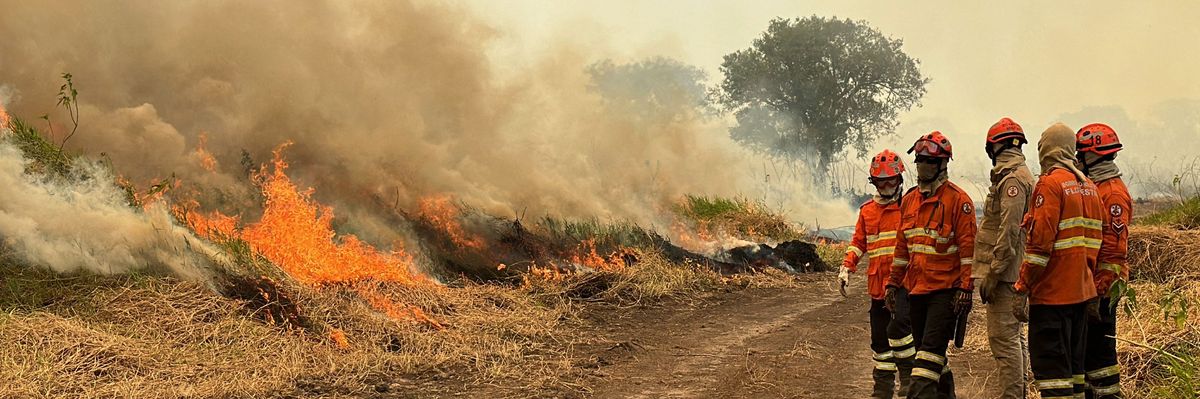
    Firefighters tackle forest fires near Porto Jofre, Mato Grosso State, Brazil, on November 13, 2023.  (Photo: Rogerio Florentino/AFP via Getty Images)

    The United Nations assessment coincided with the release of “the world’s most comprehensive roadmap of how to close the global gap in climate action across sectors.”

    That’s how United Nations Secretary-General António Guterres began his Tuesday remarks about a new U.N. Framework Convention on Climate Change (UNFCCC) report on nationally determined contributions (NDCs), or countries’ plans to meet the goals of the Paris agreement, including its 1.5°C temperature target.

    The UNFCCC analysis “provides yet more evidence that the world remains massively off track to limiting global warming to 1.5°C and avoiding the worst of climate catastrophe,” said Guterres. “As the report shows, global ambition stagnated over the past year and national climate plans are strikingly misaligned with the science.”

    “COP28 must be the place to urgently close the climate ambition gap.”

    Under current NDCs from the 195 Paris agreement parties, global greenhouse gas emissions are set to rise by nearly 9% by 2030, compared with 2010 levels, according to the analysis. While that’s a slight improvement on the 10.6% increase from last year’s assessment, it’s still nowhere near the cuts that experts say are needed.

    The analysis of NDCs comes as scientists project that 2023 will be the hottest year in 125,000 years and just over two weeks before the U.N. Climate Change Conference (COP28) in Dubai, United Arab Emirates, a summit controversially led by Sultan Ahmed Al Jaber, CEO of the Abu Dhabi National Oil Company.

    “As the reality of climate chaos pounds communities around the world—with ever fiercer floods, fires, and droughts—the chasm between need and action is more menacing than ever,” Guterres declared. “COP28 must be the place to urgently close the climate ambition gap.”

    U.N. Climate Change Executive-Secretary Simon Stiell echoed Guterres’ call to action, stressing in a statement that the new assessment makes clear governments are merely “taking baby steps to avert the climate crisis.”

    “It shows why governments must make bold strides forward at COP28 in Dubai, to get on track,” Stiell said. “This means COP28 must be a clear turning point. Governments must not only agree what stronger climate actions will be taken but also start showing exactly how to deliver them.”

    The UNFCCC document was released on the same day as State of Climate Action 2023, which its crafters called “the world’s most comprehensive roadmap of how to close the global gap in climate action across sectors.”

    Published under Systems Change Lab, the latter report highlights that only one of the dozens of indicators assessed, the share of electric vehicles in passenger car sales, is on track to meet its 2030 target.

    As the publication details:

    Recent rates of change for 41 of the 42 indicators across power, buildings, industry transport, forests and land, food and agriculture, technological carbon removal, and climate finance are not on track to reach their 1.5°C-aligned targets for 2030. Worryingly, 24 of those indicators are well off track, such that at least a twofold acceleration in recent rates of change will be required to achieve their 2030 targets. Another six indicators are heading in the wrong direction entirely. Within this subset of lagging indicators, the most recent year of data represents a concerning worsening relative to recent trends for three indicators, with significant setbacks in efforts to eliminate public financing for fossil fuels, dramatically reduce deforestation, and expand carbon pricing systems.

    To get back on track, the international community must “dramatically increase growth in solar and wind power” while also phasing out “coal in electricity generation seven times faster—which is equivalent to retiring roughly 240 average-sized coal-fired power plants each year through 2030,” the report warns.

    The publication also emphasizes the need for shifting to healthier, more sustainable diets eight times faster, increasing the coverage of rapid transit six times faster, reducing the annual rate of deforestation four times faster, and scaling up global climate finance by nearly $500 billion annually until 2030.

    “Despite decades of dire warnings and wake-up calls, our leaders have largely failed to mobilize climate action anywhere near the pace and scale needed,” declared the report’s lead author, Sophie Boehm of the World Resources Institute (WRI). “Such delays leave us with very few routes to secure a livable future for all. There’s no time left to tinker at the edges. Instead, we need immediate, transformational changes across every single sector this decade.”

    Every world leader is under pressure to ramp up efforts to cut emissions, including U.S. President Joe Biden, who on Tuesday received a letter from hundreds of scientists urging him to “increase the ambition of domestic climate action—including through accelerating a just and equitable clean energy transition, rejecting the expansion of new long-lived fossil fuel infrastructure, investing in climate resilience, and ramping up climate finance—while working toward the strongest possible agreement at COP28.”

    The United States now ranks behind China as the top emitting country but still leads the world in cumulative planet-heating emissions. According to a U.S. government assessment released Tuesday, the nation is “warming faster than the global average,” and “the effects of human-caused climate change are already far-reaching and worsening across every region.”

    Original article by JESSICA CORBETT republished from Common Dreams under Creative Commons (CC BY-NC-ND 3.0).

  • 100 US Officials Sign Memo Decrying Biden’s Backing of Israeli ‘War Crimes’ in Gaza

    Spread the love
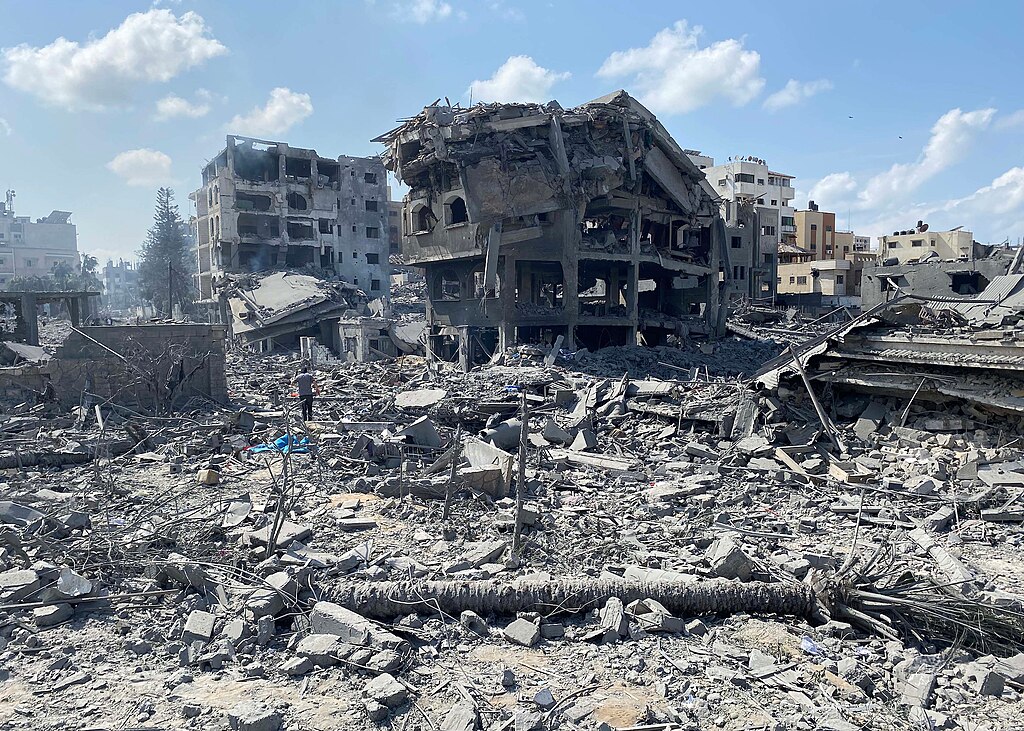
    Palestinians inspect the damage following an Israeli airstrike on the El-Remal aera in Gaza City on October 9, 2023. Israel continued to battle Hamas fighters on October 10 and massed tens of thousands of troops and heavy armour around the Gaza Strip after vowing a massive blow over the Palestinian militants' surprise attack. Photo by Naaman Omar apaimages. licensed under the Creative Commons Attribution-Share Alike 3.0 Unported license.
    Palestinians inspect the damage following an Israeli airstrike on the El-Remal aera in Gaza City on October 9, 2023. Israel continued to battle Hamas fighters on October 10 and massed tens of thousands of troops and heavy armour around the Gaza Strip after vowing a massive blow over the Palestinian militants’ surprise attack. Photo by Naaman Omar apaimages. licensed under the Creative Commons Attribution-Share Alike 3.0 Unported license.

    Original article by BRETT WILKINS republished from Common Dreams under Creative Commons (CC BY-NC-ND 3.0). 

    The State Department and USAID staffers denounced the president’s “unwillingness to de-escalate” Israel’s relentless attacks on Gaza, which have killed more than 11,000 Palestinians.

    One hundred U.S. foreign service officials have signed a “scathing” internal memo blasting President Joe Biden’s “unwillingness to de-escalate” Israel’s assault on Gaza and his failure to stop Israeli “war crimes and/or crimes against humanity” in the embattled Palestinian enclave.

    Axios reported Monday that the five-pageinternal dissent memo was signed by officials at the State Department and the U.S. Agency for International Development (USAID). The memo was reportedly organized by Sylvia Yacoub, a foreign affairs officer in the State Department’s Bureau of Middle East Affairs who earlier this month accused Biden of being “complicit in genocide” as Israeli forces indiscriminately bombarded the Gaza strip by air, land, and sea—killing thousands of Palestinians, mostly women and children.

    “Members of the White House and [the U.S. National Security Council] displayed a clear disregard for the lives of Palestinians, a documented unwillingness to de-escalate, and, even prior to October 7, a reckless lack of strategic foresight,” the memo states.

    The missive accuses Biden of “disregarding the lives of Palestinians,” over 40,000 of whom have been killed, wounded, or gone missing since Israel launched its retaliatory war that has also displaced over 1.5 million of Gaza’s 2.3 million people.

    Israel’s relentless attacks and its cutting off of electricity, food, and fuel supplies to the already besieged territory “all constitute war crimes and/or crimes against humanity under international law,” the memo asserts. “Yet we have failed to reassess our posture towards Israel. We doubled down on our unwavering military assistance to the [Israeli government] without clear or actionable red lines.”

    Responding to the October 7 Hamas-led attacks on Israel that killed around 1,200 people, Biden has repeatedly proclaimed his “unwavering” support for Israel and requested another $14 billion in U.S. armed assistance to the key Middle East ally—which already receives nearly $4 billion from Washington annually.

    The president has dismissed calls to cut or place conditions on U.S. aid, while Biden administration officials have been derided for claiming they have no leverage over Israel.

    Biden has also rebuffed widespread and growing calls for a cease-fire in Gaza, instead advocating for a so-called “humanitarian pause” to allow civilians to flee and aid to enter the strip.

    The signers of the memo denounce Biden for “questioning the number of deaths” in Gaza by saying he had “no confidence” in Palestinian health officials’ casualty reports—figures deemed reliable by United Nations agencies, human rights groups, international and Israeli mainstream media, and even the State Department.

    Biden was accused of “genocidal denial” following his remarks. Directly contradicting the president, U.S. Assistant Secretary of State for Near Eastern Affairs Barbara Leaf warned last week that the death toll in Gaza may be “even higher” than reported, as thousands of bodies lie unrecovered beneath the rubble of bombed buildings.

    The memo’s signers also accused the president of “spreading misinformation” about the war.

    Axios said the memo was sent to the State Department’s policy office on November 3 through the official dissent channel established during the Vietnam War era to allow diplomats to express their disapproval of U.S. policies and practices. Dissent memos are meant to stay within the agency, but are sometimes leaked to the public.

    Multiple dissent memos about the Gaza war are currently being circulated within the State Department, according toPolitico.

    A State Department spokesperson told Axios that the agency “is proud there is an established procedure for employees to articulate policy disagreements directly to the attention of senior department leaders without fear of retribution.”

    “We understand—we expect, we appreciate—that different people working in this department have different beliefs about what United States policy should be,” the spokesperson added.

    Original article by BRETT WILKINS republished from Common Dreams under Creative Commons (CC BY-NC-ND 3.0).