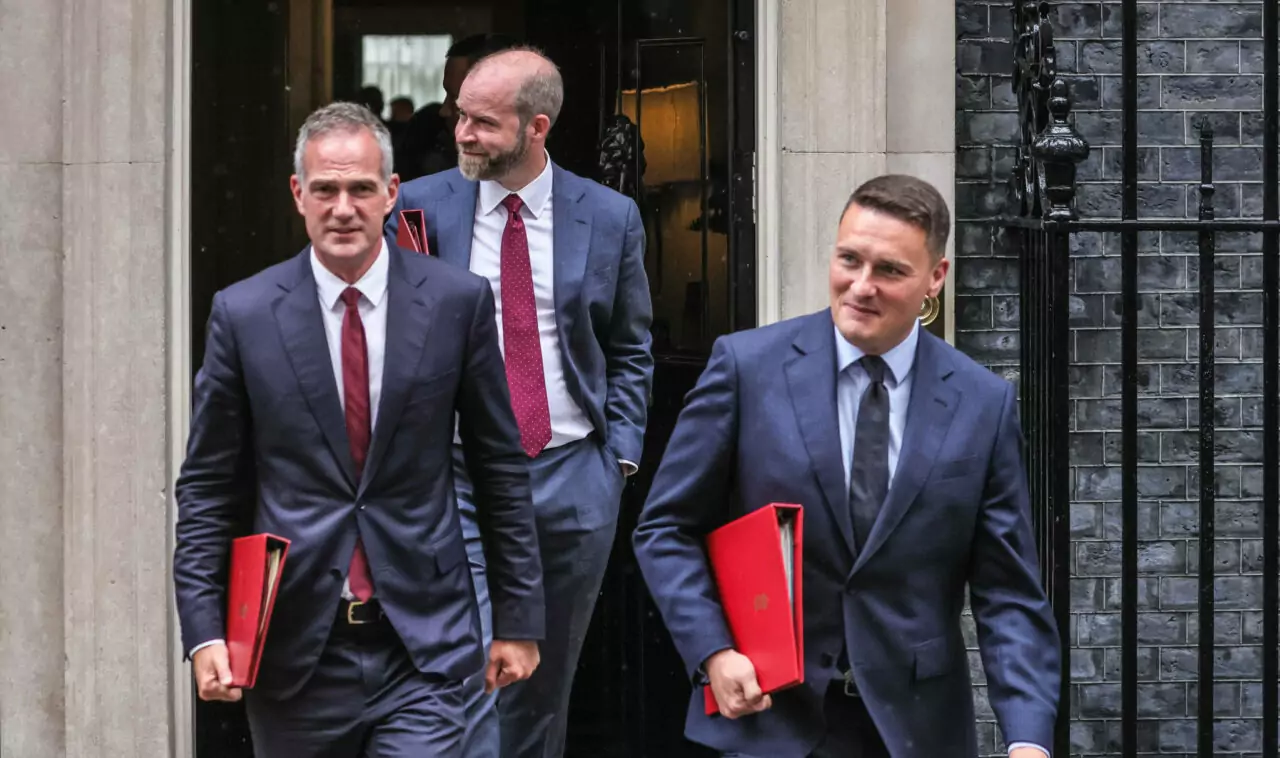
Wes Streeting, Peter Kyle and Jonathan Reynolds leave Starmer’s first cabinet meeting. (Photo: Alamy)
Declassified Exclusive: Labour’s top team has accepted over £600,000 from pro-Israel funders.
Pro-Israel lobbyists have donated to 13 out of Labour’s 25 cabinet members since they were first elected to parliament, Declassified can reveal.
The list of recipients includes prime minister Keir Starmer, his deputy Angela Rayner, chancellor Rachel Reeves, foreign secretary David Lammy and home secretary Yvette Cooper.
Jonathan Reynolds, who will oversee arms exports to Israel as UK trade secretary, is another beneficiary, alongside Labour’s election mastermind Pat McFadden, whose responsibilities now include national security.
Some of the donations were provided by Labour Friends of Israel (LFI), a lobby group which takes MPs on “fact-finding” missions to the region.
Reeves, McFadden, Reynolds and technology secretary Peter Kyle were recently listed as vice-chairs of LFI.
Other major funders include pro-Israel businessmen Gary Lubner, Trevor Chinn, and Stuart Roden.
The total value of the donations amounts to over £600,000.
…
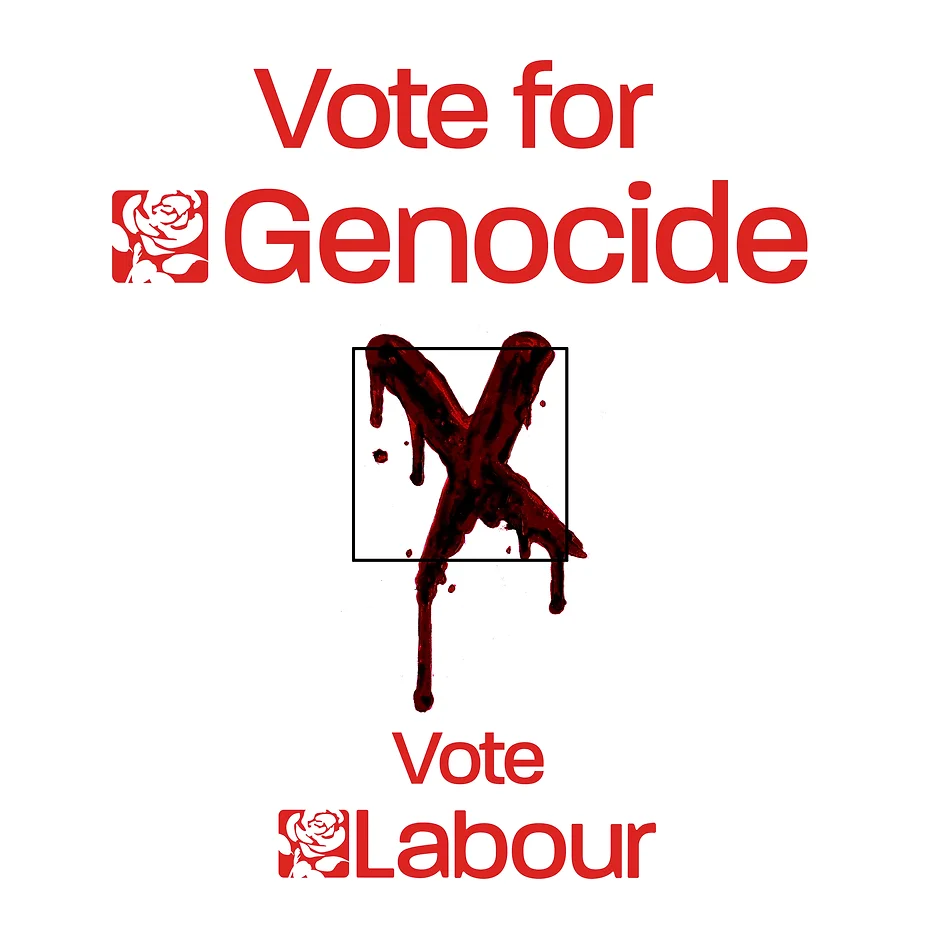
Vote For Genocide Vote Labour.Zionist Keir Starmer is quoted “I support Zionism without qualification.” He’s asked whether that means that he supports Zionism under all circumstances, whatever Zionists do.
Green Party’s Carla Denyer arrives at the count (Image: PAUL GILLIS / Reach PLC) [Ani Stafford-Townsend is immediately to the right of Carla Denyer.]
As well as Bristol’s first-ever MP, the party finished second everywhere else
A Green surge right across Bristol not only saw the party’s first-ever MP in the city, but also saw voters put them in second place in every single other constituency.
The Green Party are now officially the main challengers to Labour in all five of Bristol’s constituencies – after Carla Denyer’s victory in Bristol Central was followed by strong support right across the city. A total of 65,762 people voted Green in the five Bristol constituencies.
In Bristol East, the Green Party candidate Ani Stafford-Townsend won more than 30 per cent of the vote to cut Labour’s majority down to just 6,606, while in Bristol South and Bristol North West, the Greens leapt from fourth place last time around to second.
Victorious Green MP Carla Denyer, the party’s co-leader, showed that her success – which was matched by Green wins in three other constituencies around the country – meant that people could vote Green and potentially get a Green MP.
The article is from a Bristol newspaper. The “the party finished second everywhere else” refers to everywhere else in Bristol.
Comments by dizzy: These comments may get extended and elaborated.
This article highlights a recurring theme in many analyses of the 2024 General Election: That the Green Party are the ruling Labour Party’s main threat.
The Green Party were mistaken in restricting their ambitions i.e. targetting only 4 seats. This article suggests that another 4 were within reach and to succeed in your goals suggests that those goals were too lax.
The rest of these comments is difficult because there are so many unknowns.
I would expect the Greens to do extremely well at the next General election. That’s assuming that general elections in the same way will be held in 4 or 5 years time.
The World is warming at a seriously alarming rate. Climate change is now and needs immediate action. The action needed is to stop burning fossil fuels and transition to renewable energy that doesn’t damage the climate. There are also other necessary measures: basically stop the rich trashing the planet with their ridiculously climate expensive lifestyles.
People are going to get very angry when they realise how their climate and future has been destroyed by a few rich cnuts.
later: The next few years are going to be extremely demanding, certainly beyond the capabilities of prospective presidential candidates.
Green and independent candidates inflicted a series of blows against the Labour Party
Keir Starmer’s election victory has given Labour a firm grip on power – but a closer look at the results shows a party facing stiff opposition from the left. Many candidates standing on anti-austerity and pro-Palestine platforms have achieved impressive results, which could spark a wider political movement.
Across most of Great Britain, support for the Labour Party did not actually increase. It is thanks only to the UK’s First Past the Post electoral system that such a big landslide was possible.
With two seats still left to declare, Labour has won 9.6 million votes – around 33.7% of all votes cast. This is far less than the 12.8 million votes (40%) the party secured in 2017, when Jeremy Corbyn was leader.
Since the last election in 2019, Labour has increased its overall share of the vote by less than two points. Polling expert John Curtice says this was “entirely as a result of a 17-point increase in support in Scotland”, following a collapse in SNP support.
Starmer’s victory, Curtis explains, was not so much due to a rise in support for the party, but “largely on the back of a dramatic 20-point decline in Conservative support”.
The Labour leader’s allies will, no doubt, use the result to show that the party can win elections only from the centre ground – and will continue to push out any opposition from the left. But yesterday’s vote also represents a major shift in support for left-wing candidates.
At the last election, no independent candidates won a seat. This time around, independents secured an impressive share of the vote and inflicted a series of major blows to Labour, winning in five constituencies in England. Many such candidates had stood on pro-Palestine platforms, highlighting Starmer’s support for Israeli atrocities in Gaza.
Independent Shockat Adam defeated Labour shadow cabinet minister Jon Ashworth in Leicester South, which was meant to be a safe seat; Ashworth had won by more than 22,000 votes in 2019. After the result was announced, Adam said: “This is for the people of Gaza.”
Elsewhere, IT consultant Iqbal Mohamed, pulled off a landslide victory against Labour in the constituency of Dewsbury and Batley in West Yorkshire, winning by almost 7,000 votes.
A solicitor called Adnan Hussein, who stood as an independent candidate in Blackburn, secured a narrow win over Labour, in what the BBC described as a “stunning victory”.
And another pro-Palestine independent candidate, Ayoub Khan, beat Labour in the constituency of Birmingham Perry Barr.
Meanwhile, Corbyn – who also stood as an independent after being forced out of the party – won his seat in Islington North by more than 7,200 votes. This was despite Labour pouring significant support into the constituency, including visits from party grandees like Tony Blair’s former chief adviser, Peter Mandelson, and former deputy leader Tom Watson.
Corbyn, of course, benefited from being so well-known and having served the constituency for more than 40 years. But the scale of his victory was certainly not guaranteed. Shortly before the election, the constituency was described in the media as “marginal”.
Other independents came a close second or third. They include 23-year-old Liane Mohamed, who was within touching distance of kicking Labour’s shadow health secretary, Wes Streeting, out of his seat in Ilford North. She lost by just 528 votes.
In Chingford and Woodford Green, the Labour Party scored a spectacular own-goal by ditching its popular local candidate, Faiza Shaheen, in a last-minute deselection that split the left-wing vote and allowed former Conservative leader Iain Duncan Smith to retain the seat with 17,000 votes. Shaheen – whom Starmer previously campaigned with and described as “a fantastic candidate” – stood as an independent and won almost 12,500 votes – only 79 less than Labour.
Even in Starmer’s ultra-safe central London seat of Holborn and St Pancras, an independent candidate emerged out of nowhere to land a considerable blow. The Labour leader lost nearly 18,000 votes (more than 17%) from the last election, falling from 36,641 to 18,884. His rival, the anti-apartheid campaigner Andrew Feinstein, came second with 7,312.
All of these wins should worry Labour. Although its victory is clear, the party faces a significant electoral and political threat from left-wing and pro-Palestine opponents. If it wants to secure another victory at the next election, it must think very carefully about its stance on issues like Gaza, the NHS and the cost of living crisis.
There are reasons independent candidates often struggle to win seats at a general election. They receive little airtime from the media and lack the big financial donations that larger parties rely on.
The First Past the Post system also greatly benefited Labour in this election, when compared to the Green Party and others. This will reignite calls for proportional representation.
But despite these systemic obstacles, this time around, many independent candidates succeeded. Their message resonated with the public. So what would have happened if they had worked together on a left-wing platform of fighting injustices, both in the UK and further afield? The results today could well be very different in many areas.
If there was ever a good time for them to consider a new party, it’s now. Nigel Farage’s Reform UK has shown that a new party can burst onto the stage and win seats in Parliament. Given the success of many left-wing independent candidates, and the purge of left-wingers from the Labour Party, could the left learn something from this in time for the next election?
Zionist Keir Starmer is quoted “I support Zionism without qualification.” He’s asked whether that means that he supports Zionism under all circumstances, whatever Zionists do.
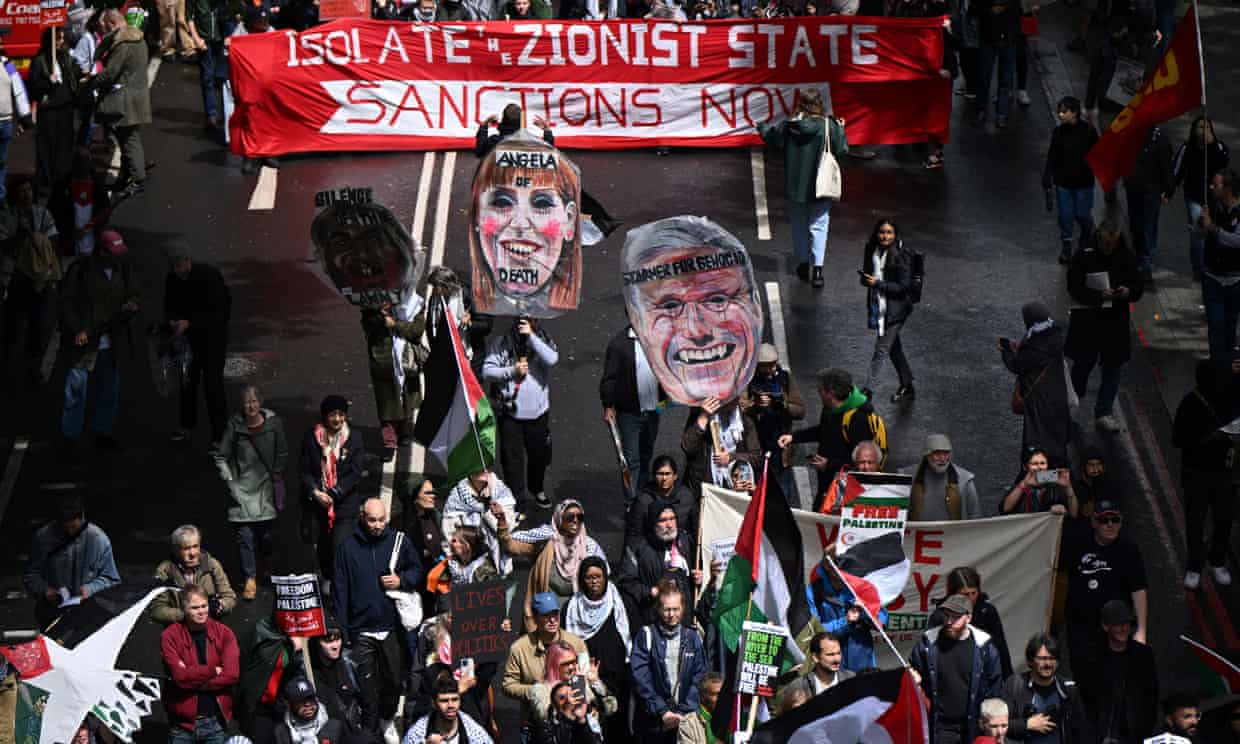
Met police confirm protesters held on suspicion of public order offences, including one related to placard
Four people were arrested on Saturday on suspicion of public order offences while attending a pro-Palestinian march in central London, including one relating to a placard.
The Metropolitan police confirmed on X that three people were held on suspicion of breaching Public Order Act conditions imposed on the march, with a fourth man detained on suspicion of a racially aggravated public order offence relating to a placard.
Organised by the Palestine Solidarity Campaign, tens of thousands of protesters took to the streets on the first day of a new Labour government to call for an immediate ceasefire in Gaza.
…
This latest protest comes after the health ministry in Gaza confirmed that at least 38,098 Palestinians have been killed and 87,705 others injured since Israel’s military offensive in Gaza began on 7 October.
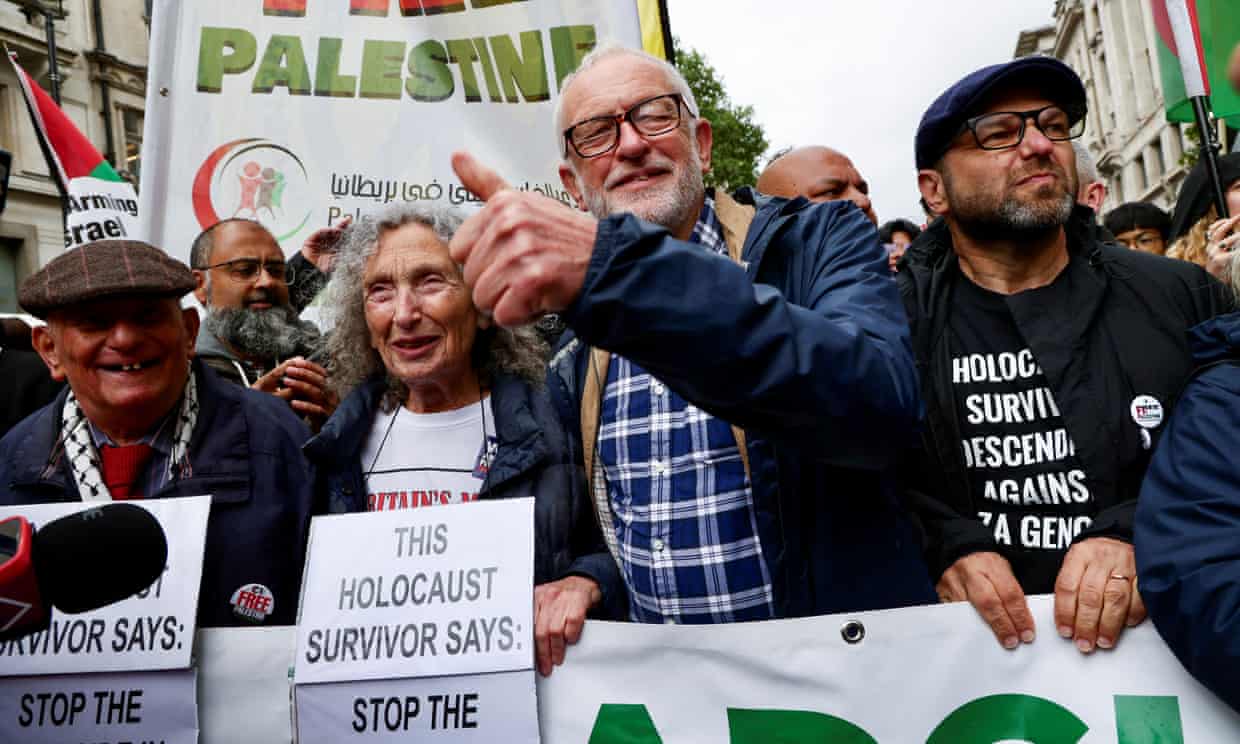
Jeremy Corbyn, the independent MP for Islington North, joined pro-Palestine march in London. Photograph: Yann Tessier/Reuters [Jeremy Corbyn 2nd from right is joined by Andrew Feinstein, far right, former ANC Member of the National Assembly of South Africa who stood as an independent candidate against Starmer because of Starmer’s support for Israel’s Gaza genocide.]
In attendance was the re-elected independent MP for Islington North, Jeremy Corbyn, who told protesters that “a change in government doesn’t change the facts that the people of Gaza are still being murdered in their sleep”.
“We said it to the Tories, and now we will say it to Labour: a government that sells arms to Israel is a government that is complicit in crimes against humanity.”
Zionist Keir Starmer is quoted “I support Zionism without qualification.” He’s asked whether that means that he supports Zionism under all circumstances, whatever Zionists do.