Category: Keir Starmer

  • Getting shorter and going hungrier: how children in the UK live today

    Spread the love
    Keir Starmer says pensioners can freeze to death and poor children can starve and be condemned to failure and misery all their lives.
    Keir Starmer says pensioners can freeze to death and poor children can starve and be condemned to failure and misery all their lives. The child poverty and neglect discussed in this article occurred previously to Keir Starmer and the Labour Party being in office. They polices are however certainly continuing and reproducing child poverty and destitution.

    Danny Dorling, University of Oxford

    Children’s lives in the UK are changing.

    They are becoming shorter in height. More of them are going hungry than they were a few years ago. Recently, more have died each year than they did a few years ago. Increased poverty, more destitution and the effects of ongoing austerity are the clear culprits.

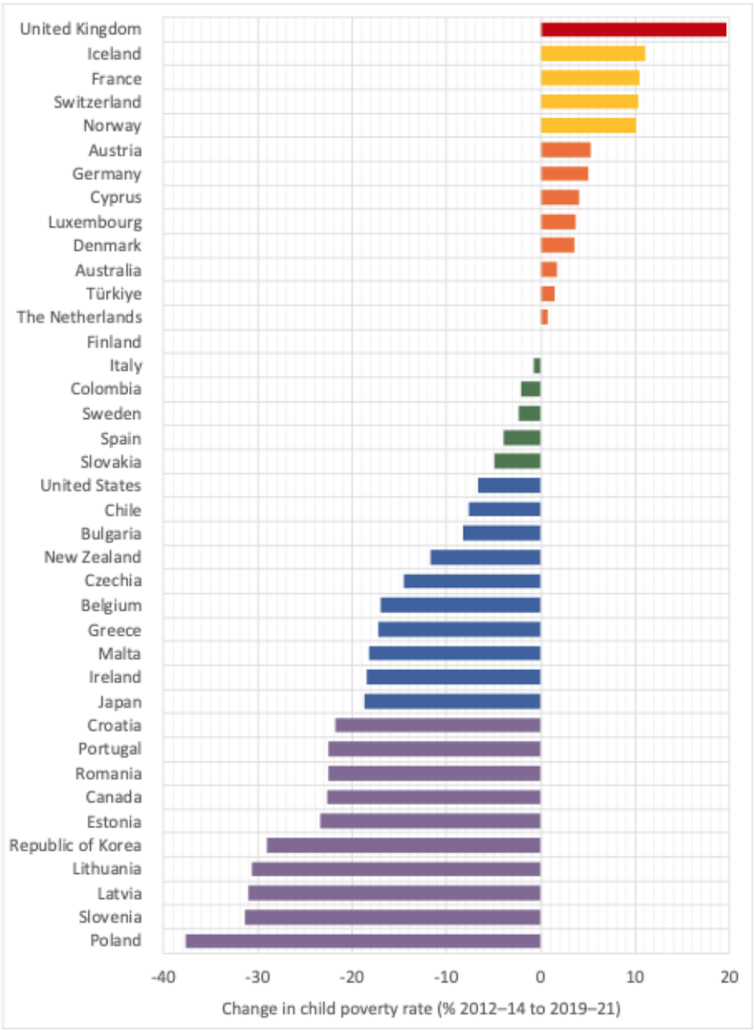
    But why did this happen to our children? This rise in child poverty is a change that has not been found to have occurred to the same extent anywhere else in the world, among all the places that the United Nations measures in the same way.

    Change in child poverty, 2012–14 to 2019–21
    Bar chart
    UNICEF Innocenti—Global Office of Research and Foresight (2023) ‘Innocenti Report Card 18: Child poverty in the midst of wealth’, CC BY-NC-ND


    This graph tells a story of hope and success. In much of Eastern Europe, child poverty has fallen by between as much as a third – and often at least a quarter – in a mere seven years.

    But it also shows that child poverty has risen the most in the UK. The poorest fifth of households in the UK are poorer than the poorest fifth in most of Eastern Europe. For many people in the UK, this will come as a surprise. Some will refuse to believe it can be this bad.

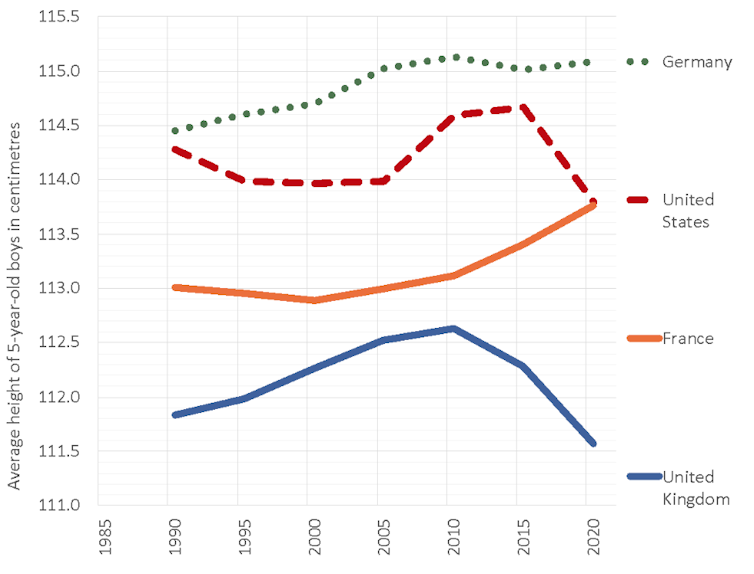
    The evidence for this poverty is seen in the declining heights of five-year-olds since 2010.

    Average height of five-year-old boys, 1985–2020
    Line graph
    Average height of 5-year-old boys, 1985–2020. Redrawn by the author from data in Press Association (2023) ‘British children shorter than other five-year-olds in Europe’, ITV News, 21 June., CC BY-NC-ND


    A 5-year-old in 1990 would have been born in 1985 and their height influenced mostly by nutrition in the years 1985–1990. Those were hard years for the UK: mass poverty resulting from over three million people being out of work in the early 1980s. But the average height of children was still increasing.

    It was not until 2010, for those children who had lived between 2005 and 2010, that we first saw heights plateau and then fall, coinciding with the post-2010 austerity years.

    My forthcoming book attempts to make sense of what has happened to the UK: why, in 2024, it is not merely one of the countries in Europe with a high rate of child poverty, but the one country above all others that the UN has singled out as having had the greatest rises in child poverty among all those it surveyed.

    Seven children

    To try to understand more about children’s lives in the UK, I constructed seven typical children. I divided all 14 million children living in the UK into seven groups of 2 million, according to the income of their families in 2018 and 2019. I then chose the middle child of each 2 million. I next looked at what had happened to those families between 2018 and 2024.

    The graph below shows the annual income of each of the seven households the children were drawn from.

    Annual household incomes after tax, benefits and housing costs in the UK, families with children 2019/20
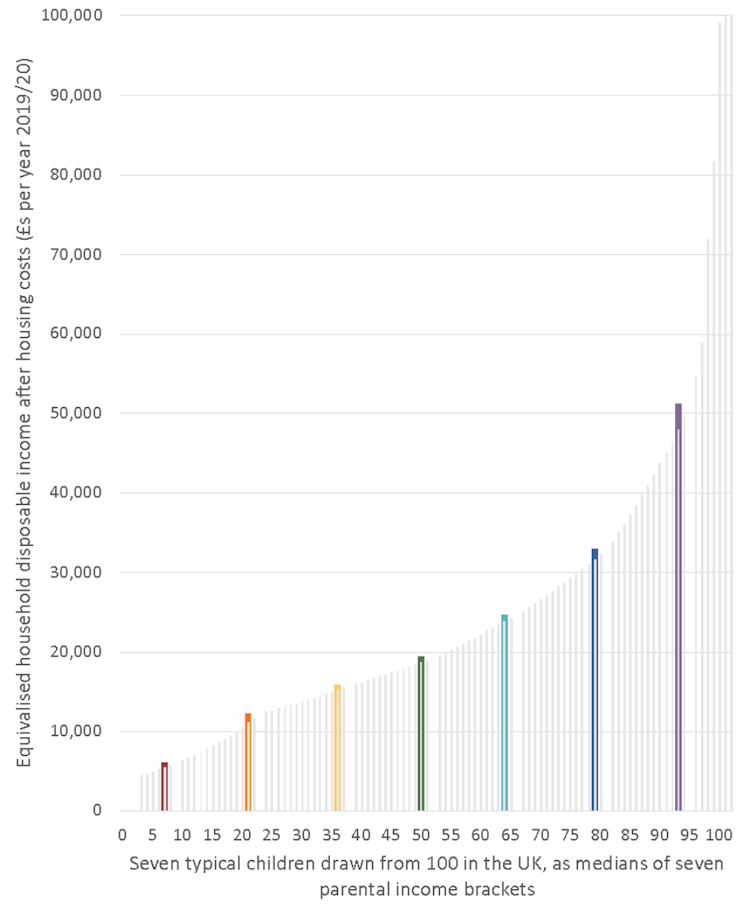
    Annual household incomes after tax, benefits and housing costs in the UK, families with children 2019/20: seven typical children marked in colour. Danny Dorling, CC BY-NC-ND


    The first thing to note is just how incredibly well-off the children are who are better-off than our seven typical children.

    Some 6% of all children in the UK live in households richer than the best-off typical child in my analysis. Those 6% of children, the best-off children of all, live in families that each year receive and spend a third of all the income in the UK.


    Want more politics coverage from academic experts? Every week, we bring you informed analysis of developments in government and fact check the claims being made.

    Sign up for our weekly politics newsletter, delivered every Friday.


    These 6% are not typical, and neither are the 6% poorest: those most destitute, those whose families are most likely to use food banks. If you pick seven typical children, equally spaced out across the income scale, then these extremes are not part of what you see.

    But four of our typical seven children now live lives that most better-off people would consider to be in poverty. The other three are hardly well-off.

    The least well-off are in families struggling to pay bills and making sacrifices others do not have to think about. For instance, whether to save £10 a month, or have insurance against the effects of flood, fire or theft. Increasingly often they cannot afford both.

    But even the most well-off of our seven children lives in a family that worries about paying for an annual holiday. That is rare among the most affluent two million families, but possible.

    The UK in 2024 demonstrates to the world what living with high inequality means in a once affluent country. It means a few using up far more resources than the vast majority of other children, such as having access to many more school teachers – per child – as compared to the rest, better food, better shelter, more warmth, more toys, better material everything; often more than you might think any child needed.

    In future, almost all our children will tell their stories of growing up in the UK of the 2020s and – hopefully – what changed to make things better. It is hard to imagine them becoming much worse.

    Danny Dorling, Halford Mackinder Professor of Geography, University of Oxford

    This article is republished from The Conversation under a Creative Commons license. Read the original article.
  • Coming Soon :: UK Labour Party Conference 2024

    Spread the love
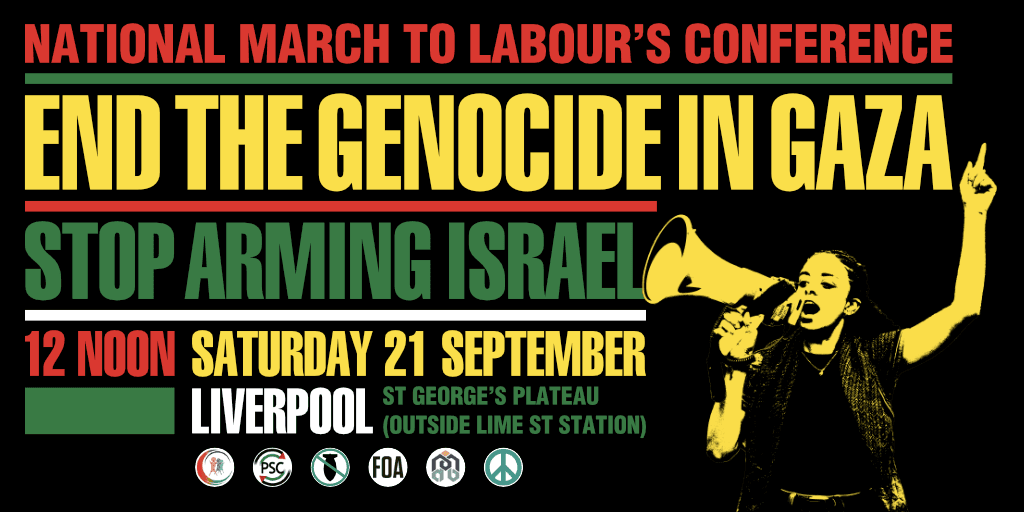
    End the genocide in Gaza protest at Labour Party Conference, Liverpool 21 September 2024.
    End the genocide in Gaza protest at Labour Party Conference, Liverpool 21 September 2024.

    UK Labour Party Conference is starting on Sunday 22 September 2024. A protest has been announced on the 21st protesting the Labour party’s support for Israel’s genocide in Gaza.

    I oppose Keir Starmer and the UK Labour Party for many reasons: their complicity in and support for Israel’s Zionist genocide in Gaza and the West Bank and attacks on the poor and disabled e.g. denying winter fuel payment benefits from poor and disabled pensioners likely to result in many deaths and the refusals to repeal the two-child benefit cap and the bedroom tax. Essentially the Labour Party are Zionist scum Blue Tories pretending to be Socialists. They are part of a global agenda to diminish international law to facilitate and support Israel’s racist, Fascist, genocide in Gaza and the West Bank.

    I object to Labour Party Deputy Angela Rayner’s efforts to attack me while hiding – actually very typical of New Labour sihts in my experience.

    Deputy Labour Party Leader Angela Rayner calls for police to kill and harass innocent people.
    Deputy Labour Party Leader Angela Rayner calls for police to kill and harass innocent people.

    May be elaborated and extended.

    Keir Starmer says pensioners can freeze to death and poor children can starve and be condemned to failure and misery all their lives.
    Keir Starmer says pensioners can freeze to death and poor children can starve and be condemned to failure and misery all their lives.
  • Charities demand to meet UK ministers as 1.6m disabled OAPs set to lose winter fuel payments

    Spread the love

    https://www.theguardian.com/society/2024/sep/15/charities-demand-to-meet-uk-ministers-as-16m-disabled-oaps-set-to-lose-winter-fuel-payments

    A pensioner struggles to keep warm at home. Photograph: Studio Romantic/Shutterstock

    Call comes after government forced to reveal that 71% of pensioners with disabilities will lose entitlement despite dependence on warmer homes

    Groups representing disabled people are demanding urgent meetings with ministers after it was revealed that 1.6 million pensioners with disabilities will lose their winter fuel payments because of government cuts.

    The figures were released by the Department for Work and Pensions on Friday evening, in answer to a freedom of information request, despite the government having said it had done no official impact assessment on the policy. The internal DWP analysis also suggested that nine in 10 pensioners aged between 66 and 79, and eight out of 10 over-80s would lose their allowance.

    Since those over 80 receive a higher payment – £300 as opposed to £200 – they would take the greatest financial hit, the document said.

    The analysis revealed that although people with disabilities were more likely to retain the payment, 71% – 1.6 million – would still lose their entitlement, despite their greater dependence on heating their homes.

    The analysis also estimated that of the 880,000 pensioners entitled to pension credit but who do not claim the benefit, only 100,000 are expected to sign up to it as a result of a government campaign now under way, meaning about 780,000 pensioners on low incomes would continue to miss out.

    …

    https://www.theguardian.com/society/2024/sep/15/charities-demand-to-meet-uk-ministers-as-16m-disabled-oaps-set-to-lose-winter-fuel-payments

    Keir Starmer says pensioners can freeze to death and poor children can starve and be condemned to failure and misery all their lives.
    Keir Starmer says pensioners can freeze to death and poor children can starve and be condemned to failure and misery all their lives.
  • Gaza war: countries selling Israel weapons are violating international law – legal expert

    Spread the love

    [dizzy: This article was published  April 4, 2024 and refers to the United Kingdom’s previous Conservative government. Since then UK has a new Labour government under UK Prime Minister Keir Starmer. UK violating International law will not have changed since April 2024 and Keir Starmer should be well-aware of legal requirements since he is often referred to as a human rights legal expert.]

    EPA-EFE/Abir Sultan

    Lawrence Hill-Cawthorne, University of Bristol

    The UK government has received internal legal advice that Israel has broken international humanitarian law in its current war on Gaza. The advice was revealed by Alicia Kearns, the Conservative chair of the House of Commons foreign affairs select committee, in a speech to a fundraising event on March 13 and leaked to the UK’s Observer newspaper.

    The paper quoted British barrister and war crimes prosecutor Sir Geoffrey Nice as saying: “Countries supplying arms to Israel may now be complicit in criminal warfare. The public should be told what the advice says.”

    The Guardian has now revealed that the prime minister, Rishi Sunak, has since received a letter signed by 600 lawyers and academics, including three former supreme court justices – among them Baroness Hale, the court’s former president – as well as former court of appeal judges and more than 60 KCs, warning that UK arms sales to Israel are also illegal under international law.

    But what does international law actually say on this issue, and what are the UK’s (and other nations’) legal obligations in relation to the ongoing assault on Gaza?

    In recent months, a number of countries have announced they are suspending arms exports to Israel. These include Canada, Belgium, Italy, Spain and the Netherlands, as well as the Japanese company Itochu Corporation. Germany and the US – by far the biggest suppliers of arms to Israel – have not as yet signalled intentions to follow suit.

    Neither has the UK. But with arms exports amounting to £42 million in 2022, it is not one of Israel’s major suppliers.

    Suspending arms exports to Israel indicates not only political concerns, but also fear over the legality of continuing to support Israel militarily in its assault on Gaza. The Netherlands court of appeal ruled in February that the Dutch government must discontinue its sales of F35 fighter jet parts on the basis of its obligations under the UN arms trade treaty. A similar lawsuit is currently pending in Denmark which exports F35 parts to the US, which then sells the finished jets to Israel.

    In the UK, the high court dismissed an attempt to challenge the government’s continued licensing of arms exports to Israel. But this was because the particular procedural hurdle that applicants in such cases have to get over is notoriously high. The judgment said nothing definitive as to Israel’s (or the UK’s) compliance with international law.

    Following this, 130 MPs and peers from across party lines recently signed a letter to the foreign secretary calling on the government to suspend arms exports to Israel.

    Arms trade treaty

    So what is the position under international law of countries, such as the UK, that support Israel militarily? There are many specific and general rules of international law that are relevant here.

    The most obvious, and the one emphasised in the British MPs’ letter, is found in the UN arms trade treaty, to which the UK is a party. Article 7 requires a risk assessment for all weapons transfers, and prohibits exports where there is an overriding risk that the weapons could be used to commit serious violations of international humanitarian law (the law of armed conflict).

    The only objective test we have for determining risk of future violations is to examine whether there is evidence of a pattern of past violations by Israel. UN reporting of past serious violations is one of the key considerations that the UK’s own policy points to in determining future risk. In 2019, the UK court of appeal suspended arms exports to Saudi Arabia based on the government’s failure to assess whether past violations of international law had likely been committed in Yemen.

    The available evidence suggests there have been countless examples of Israeli actions in Gaza that appear, on their face, to be inconsistent with international humanitarian law. Among the most recent examples are the Israeli attack on an aid convoy on April 1, the destruction of Gaza’s hospitals, and the well-documented famine that now engulfs the territory.

    The Hague court of appeal that ordered the Dutch government to suspend arms exports to Israel relied on reports from Amnesty International and the UN when it listed multiple examples of apparent violations of the law of armed conflict in Gaza.

    And in the long-awaited UN security council resolution adopted on March 25, with the US abstaining, the security council condemned “all attacks against civilians and civilian objects, as well as all violence and hostilities against civilians”, and demanded the flow of humanitarian assistance into Gaza, in line with international humanitarian law.

    This suggests a pattern of past serious violations and thus a clear risk of continuing violations. So, signatories to the arms trade treaty continuing to supply weapons to Israel likely do so in breach of article 7.

    Geneva conventions

    Yet all nations have other obligations that take on particular importance in relation to Gaza. One of these is the obligation to prevent genocide under article 1 of the Genocide convention (which was the focus of the letter to the prime minister referred to above).

    This is especially relevant since the International Court of Justice (ICJ) determined in January that there is an imminent risk of irreparable harm to the rights of Palestinians in Gaza under the Genocide Convention.

    But it also includes article 1 of the 1949 Geneva conventions, which requires states to “ensure respect” for international humanitarian law. There is overwhelming support for the view that this requires all states not only to avoid aiding or assisting violations (for example, through arms exports) but to take proactive steps to ensure warring parties comply with their obligations under international law. They can do so via diplomatic channels or by imposing sanctions.

    On March 1, Nicaragua instituted proceedings before the ICJ against Germany (the second-biggest arms exporter to Israel), in part alleging that it is violating article 1 of the Geneva conventions due to its support for Israel.

    In this way, all countries are legally obliged to ensure that others comply with international humanitarian law. If the catastrophic destruction, massive civilian death toll and immense suffering of those still alive in Gaza is not enough to pull Israel’s allies into line over their continuing arms sales, it is difficult to conceive of any situation that ever could.

    Lawrence Hill-Cawthorne, Associate Professor of Law, University of Bristol

    This article is republished from The Conversation under a Creative Commons license. Read the original article.

  • Morning Star Editorial: Change or die: Starmer must abandon Treasury orthodoxy or face oblivion

    Spread the love

    https://morningstaronline.co.uk/article/change-or-die-starmer-must-abandon-treasury-orthodoxy-or-face-oblivion

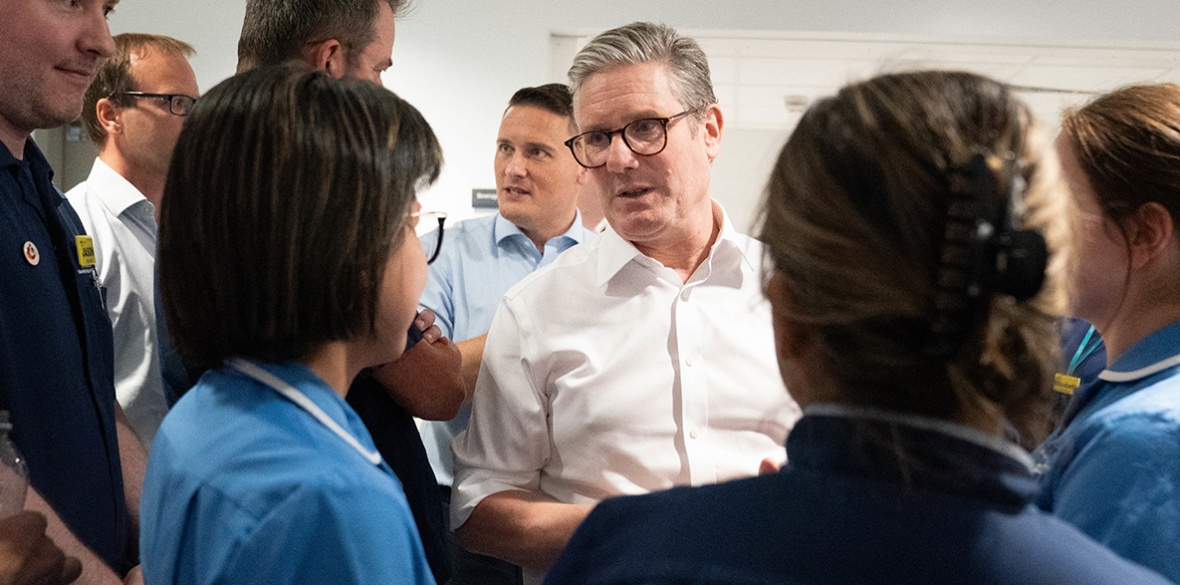
    Prime Minister Sir Keir Starmer (left) and Health Secretary, Wes Streeting during a visit to the University College London Hospital (UCLH), September 11, 2024

    “CHANGE or die” was Keir Starmer’s message to the National Health Service.

    But it could as well apply to his own government, which already appears locked in a downward spiral.

    …

    Labour secured the election with the smallest share of the vote for a new government in history and on a low turnout to boot. Barely one eligible voter in five chose Labour on July 4.

    Starmer himself, moreover, saw half of his 2019 vote — and that was not a good year for Labour — disappear in his north London constituency.

    But the only conclusion he has apparently drawn is that more misery must be piled on the public.

    First, he maintained the cruel two-child benefit cap, and suspended from the Parliamentary Labour Party those MPs who had the temerity to vote to lift children out of poverty.

    Then he appeared in the Downing Street garden to announce that things were only going to get worse for the foreseeable future, preparing the way for that new round of austerity he had pledged to avoid during the election campaign.

    His pretence is that “tough choices” are needed because of an unexpected “black hole” left behind in the public finances by the Tories.

    But the choices made by Chancellor Rachel Reeves and Starmer are always “tough” at the expense of the poorest.

    …

    In 2017 Labour estimated that means-testing the winter fuel allowance would lead to nearly 4,000 extra fatalities. Today, following exactly that policy, the government conceals the possible consequences, having either not commissioned an assessment of the policy’s impact, or determined to hide it.

    It is said that you only get one chance to make a first impression. The first impression of this government is now set in stone — it is of callous cost-consciousness compounded by concealment.

    This is not “fixing the foundations” as Starmer claims. It is fracturing them, and many Labour MPs know it.

    …

    https://morningstaronline.co.uk/article/change-or-die-starmer-must-abandon-treasury-orthodoxy-or-face-oblivion

    Keir Starmer says pensioners can freeze to death and poor children can starve and be condemned to failure and misery all their lives.
    Keir Starmer says pensioners can freeze to death and poor children can starve and be condemned to failure and misery all their lives.