Category: Keir Starmer

  • What does Starmer’s victory mean for the left?

    Spread the love

    Original article by Martin Williams republished from OpenDemocracy under a Creative Commons Attribution-NonCommercial 4.0 International licence. The article was published on 5 July 2024 and refers to 2 outstanding 2024 UK general election results.

    Keir Starmer outside Downing Street.   HENRY NICHOLLS / Contributor / Getty

    Green and independent candidates inflicted a series of blows against the Labour Party

    Keir Starmer’s election victory has given Labour a firm grip on power – but a closer look at the results shows a party facing stiff opposition from the left. Many candidates standing on anti-austerity and pro-Palestine platforms have achieved impressive results, which could spark a wider political movement.

    Across most of Great Britain, support for the Labour Party did not actually increase. It is thanks only to the UK’s First Past the Post electoral system that such a big landslide was possible.

    With two seats still left to declare, Labour has won 9.6 million votes – around 33.7% of all votes cast. This is far less than the 12.8 million votes (40%) the party secured in 2017, when Jeremy Corbyn was leader.

    Since the last election in 2019, Labour has increased its overall share of the vote by less than two points. Polling expert John Curtice says this was “entirely as a result of a 17-point increase in support in Scotland”, following a collapse in SNP support.

    Starmer’s victory, Curtis explains, was not so much due to a rise in support for the party, but “largely on the back of a dramatic 20-point decline in Conservative support”.

    The Labour leader’s allies will, no doubt, use the result to show that the party can win elections only from the centre ground – and will continue to push out any opposition from the left. But yesterday’s vote also represents a major shift in support for left-wing candidates.

    At the last election, no independent candidates won a seat. This time around, independents secured an impressive share of the vote and inflicted a series of major blows to Labour, winning in five constituencies in England. Many such candidates had stood on pro-Palestine platforms, highlighting Starmer’s support for Israeli atrocities in Gaza.

    Independent Shockat Adam defeated Labour shadow cabinet minister Jon Ashworth in Leicester South, which was meant to be a safe seat; Ashworth had won by more than 22,000 votes in 2019. After the result was announced, Adam said: “This is for the people of Gaza.”

    Elsewhere, IT consultant Iqbal Mohamed, pulled off a landslide victory against Labour in the constituency of Dewsbury and Batley in West Yorkshire, winning by almost 7,000 votes.

    A solicitor called Adnan Hussein, who stood as an independent candidate in Blackburn, secured a narrow win over Labour, in what the BBC described as a “stunning victory”.

    And another pro-Palestine independent candidate, Ayoub Khan, beat Labour in the constituency of Birmingham Perry Barr.

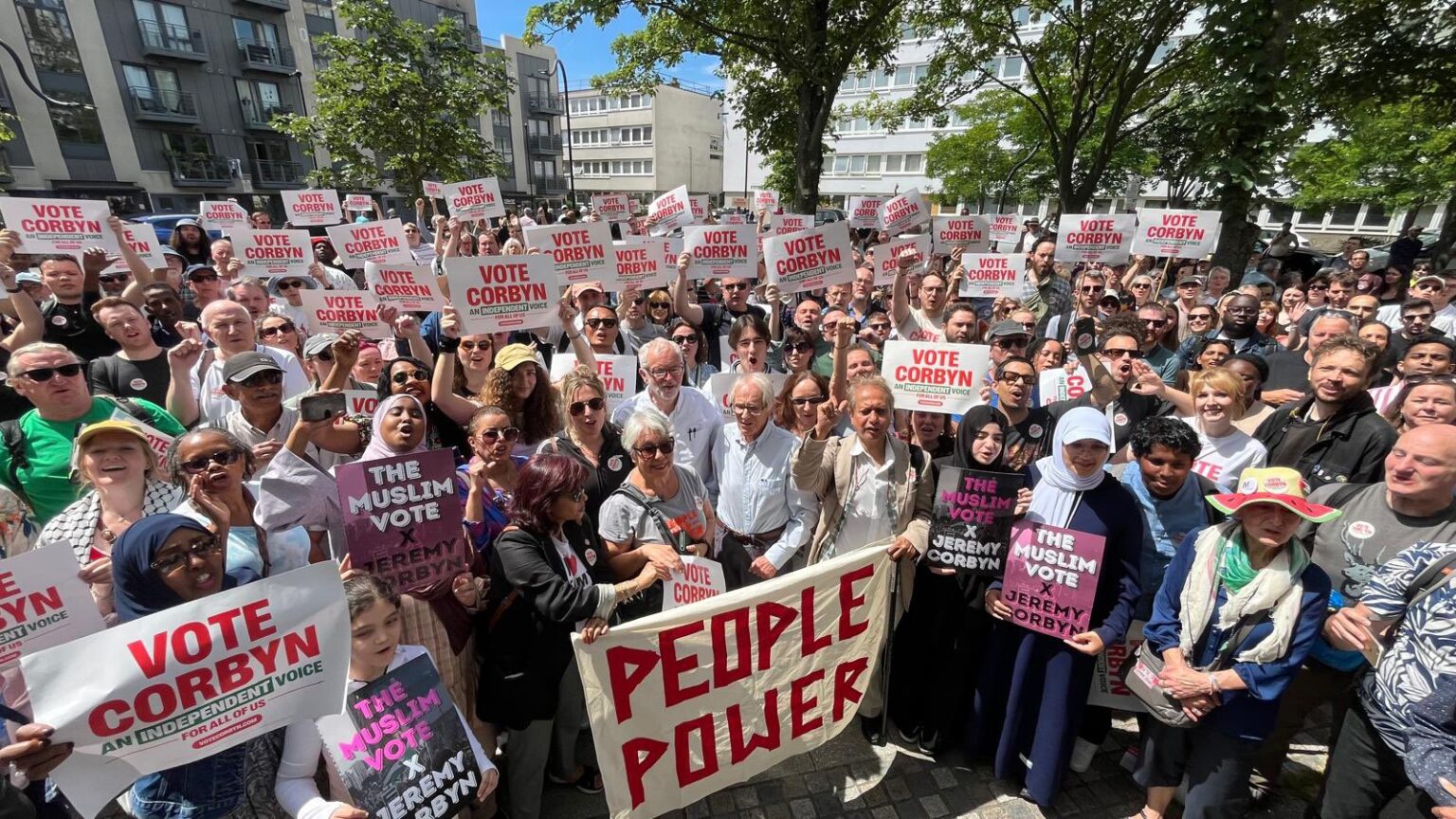
    Meanwhile, Corbyn – who also stood as an independent after being forced out of the party – won his seat in Islington North by more than 7,200 votes. This was despite Labour pouring significant support into the constituency, including visits from party grandees like Tony Blair’s former chief adviser, Peter Mandelson, and former deputy leader Tom Watson.

    Corbyn, of course, benefited from being so well-known and having served the constituency for more than 40 years. But the scale of his victory was certainly not guaranteed. Shortly before the election, the constituency was described in the media as “marginal”.

    Other independents came a close second or third. They include 23-year-old Liane Mohamed, who was within touching distance of kicking Labour’s shadow health secretary, Wes Streeting, out of his seat in Ilford North. She lost by just 528 votes.

    In Chingford and Woodford Green, the Labour Party scored a spectacular own-goal by ditching its popular local candidate, Faiza Shaheen, in a last-minute deselection that split the left-wing vote and allowed former Conservative leader Iain Duncan Smith to retain the seat with 17,000 votes. Shaheen – whom Starmer previously campaigned with and described as “a fantastic candidate” – stood as an independent and won almost 12,500 votes – only 79 less than Labour.

    Even in Starmer’s ultra-safe central London seat of Holborn and St Pancras, an independent candidate emerged out of nowhere to land a considerable blow. The Labour leader lost nearly 18,000 votes (more than 17%) from the last election, falling from 36,641 to 18,884. His rival, the anti-apartheid campaigner Andrew Feinstein, came second with 7,312.

    All of these wins should worry Labour. Although its victory is clear, the party faces a significant electoral and political threat from left-wing and pro-Palestine opponents. If it wants to secure another victory at the next election, it must think very carefully about its stance on issues like Gaza, the NHS and the cost of living crisis.

    There are reasons independent candidates often struggle to win seats at a general election. They receive little airtime from the media and lack the big financial donations that larger parties rely on.

    The First Past the Post system also greatly benefited Labour in this election, when compared to the Green Party and others. This will reignite calls for proportional representation.

    But despite these systemic obstacles, this time around, many independent candidates succeeded. Their message resonated with the public. So what would have happened if they had worked together on a left-wing platform of fighting injustices, both in the UK and further afield? The results today could well be very different in many areas.

    If there was ever a good time for them to consider a new party, it’s now. Nigel Farage’s Reform UK has shown that a new party can burst onto the stage and win seats in Parliament. Given the success of many left-wing independent candidates, and the purge of left-wingers from the Labour Party, could the left learn something from this in time for the next election?

    Original article by Martin Williams republished from OpenDemocracy under a Creative Commons Attribution-NonCommercial 4.0 International licence. The article was published on 5 July 2024 and refers to 2 outstanding 2024 UK general election results.

    Zionist Keir Starmer is quoted "I support Zionism without qualification." He's asked whether that means that he supports Zionism under all circumstances, whatever Zionists do.
    Zionist Keir Starmer is quoted “I support Zionism without qualification.” He’s asked whether that means that he supports Zionism under all circumstances, whatever Zionists do.
  • Four arrests at Gaza protest in London

    Spread the love

    https://www.theguardian.com/uk-news/article/2024/jul/06/pro-palestinian-protest-march-london-arrests

    Met police confirm protesters held on suspicion of public order offences, including one related to placard

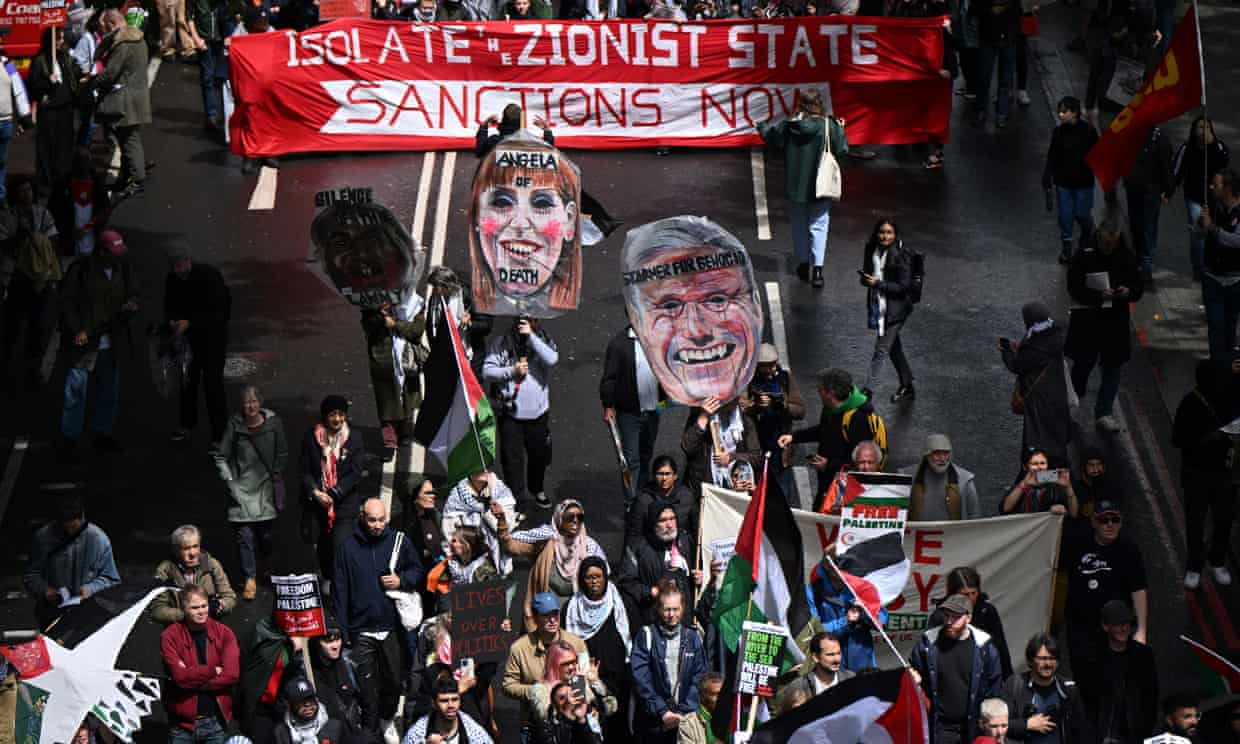
    Four people were arrested on Saturday on suspicion of public order offences while attending a pro-Palestinian march in central London, including one relating to a placard.

    The Metropolitan police confirmed on X that three people were held on suspicion of breaching Public Order Act conditions imposed on the march, with a fourth man detained on suspicion of a racially aggravated public order offence relating to a placard.

    Organised by the Palestine Solidarity Campaign, tens of thousands of protesters took to the streets on the first day of a new Labour government to call for an immediate ceasefire in Gaza.

    …

    This latest protest comes after the health ministry in Gaza confirmed that at least 38,098 Palestinians have been killed and 87,705 others injured since Israel’s military offensive in Gaza began on 7 October.

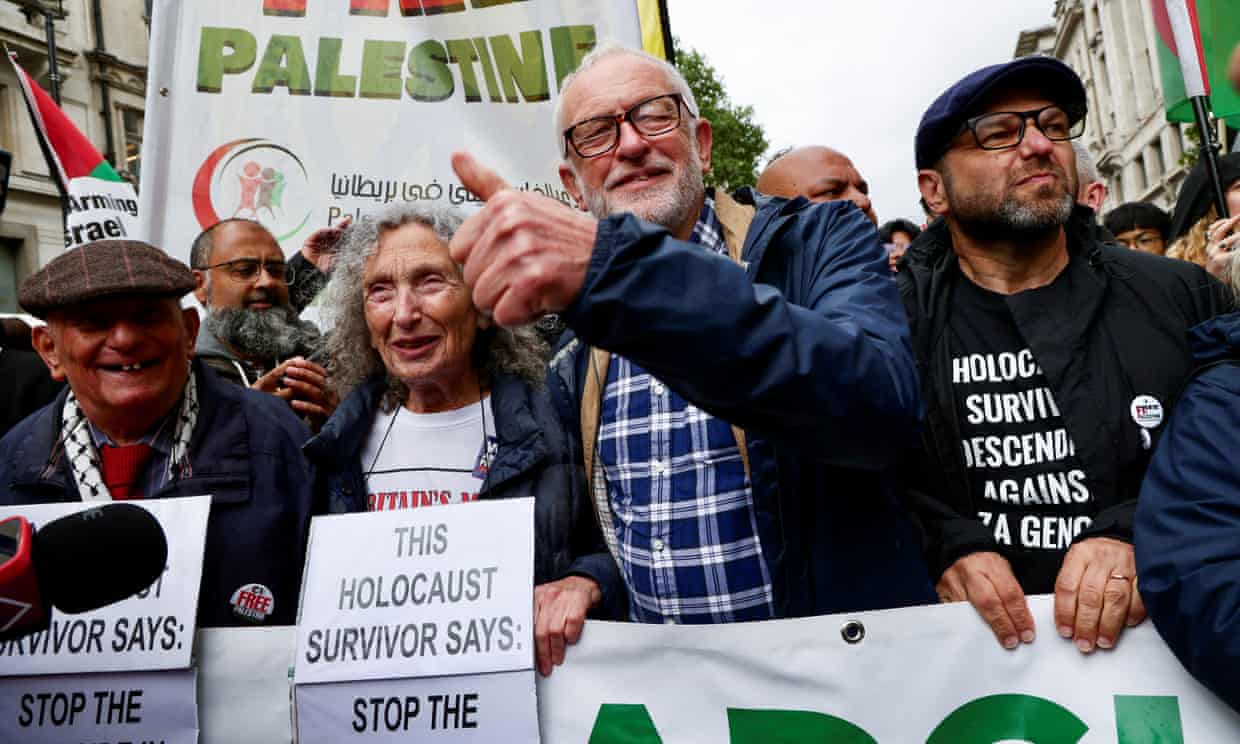
    Jeremy Corbyn, the independent MP for Islington North, joined pro-Palestine march in London. Photograph: Yann Tessier/Reuters [Jeremy Corbyn 2nd from right is joined by Andrew Feinstein, far right, former ANC Member of the National Assembly of South Africa who stood as an independent candidate against Starmer because of Starmer’s support for Israel’s Gaza genocide.]

    In attendance was the re-elected independent MP for Islington North, Jeremy Corbyn, who told protesters that “a change in government doesn’t change the facts that the people of Gaza are still being murdered in their sleep”.

    “We said it to the Tories, and now we will say it to Labour: a government that sells arms to Israel is a government that is complicit in crimes against humanity.”

    …

    https://www.theguardian.com/uk-news/article/2024/jul/06/pro-palestinian-protest-march-london-arrests

    Zionist Keir Starmes is quoted "I support Zionism without qualification." He's asked whether that means that he supports Zionism under all circumstances, whatever Zionists do.
    Zionist Keir Starmer is quoted “I support Zionism without qualification.” He’s asked whether that means that he supports Zionism under all circumstances, whatever Zionists do.
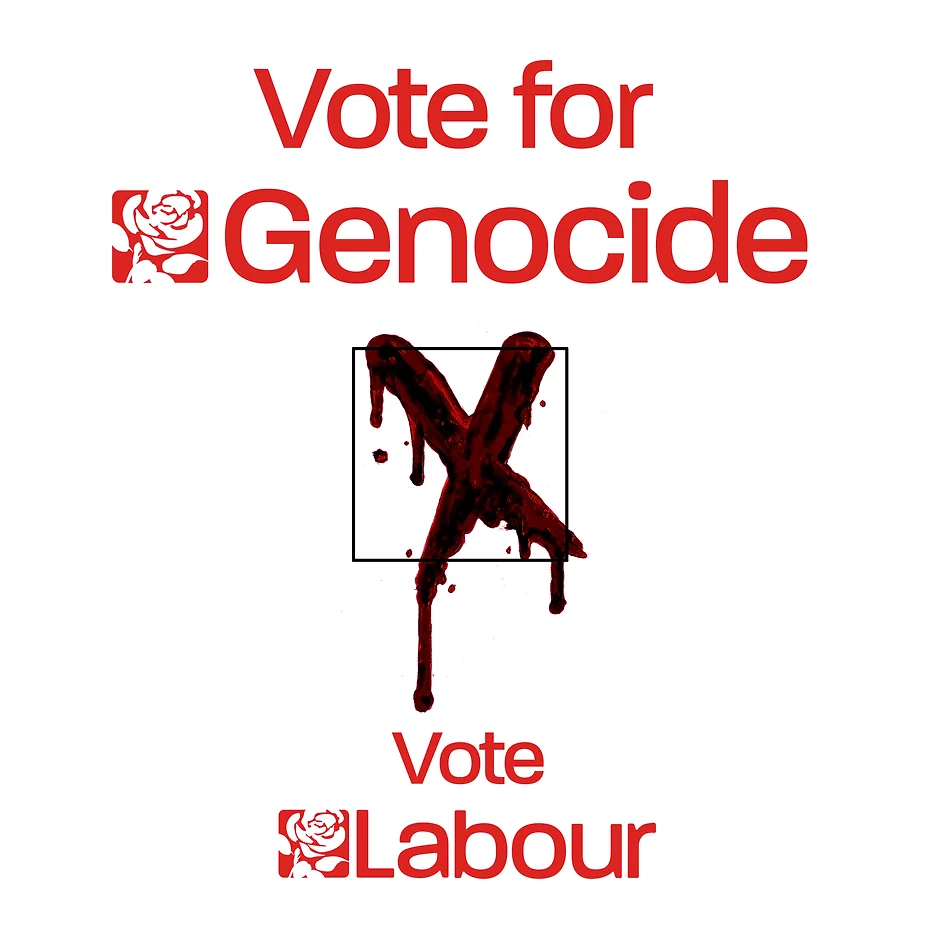
    Vote For Genocide Vote Labour.
    Vote For Genocide Vote Labour.
  • Jeremy Corbyn wins Islington North as independent; Labour secures victory in general election

    Spread the love

    Original article republished from peoples dispatch under a Creative Commons Attribution-ShareAlike 4.0 (CC BY-SA) license.

    Labour secures landslide victory in UK general election, but triumph marred by centrist program and stance on Gaza

    Jeremy Corbyn has been re-elected to the British Parliament, this time as an independent candidate. Corbyn won in his long-standing constituency of Islington North with a margin of over 7,000 votes over Labour candidate Praful Nargund. According to Corbyn, the result in Islington North is “a warning to the incoming government that dissent cannot be crushed without consequences. That ideas of equality, justice, and peace are eternal.”

    Labour leadership blocked Corbyn from standing as a party candidate in this election following years of a campaign against him within party structures and in corporate media. Like other Labour members leaning explicitly towards the left, Corbyn faced extreme pressure and attacks against his policies, even during his tenure as Labour leader, despite receiving widespread support among the public.

    The incoming government Corbyn referred to will be a Labour one. Keir Starmer is set to become the next prime minister after the party secured one of its biggest electoral victories in history, winning 412 seats. In comparison, the Conservatives, who held power for almost 15 years, struggled to reach 121 seats. These results align with pre-election polls, which predicted that former prime minister Rishi Sunak and his party would be punished for failing to address crucial issues such as the cost of living crisis, struggling public services, including the National Health Service (NHS), and more.

    Election night brought some surprises, even for the triumphant Labour. The party lost to independent candidates running on an explicitly pro-Palestine platform in several constituencies in addition to Islington North. Starmer’s stance on Israel’s attacks on the Gaza Strip since October last year, as well as Labour’s unwillingness to adopt a decisive call for a ceasefire early in the war on Gaza, alienated a significant part of the Labour voting base. Despite their eagerness to oust the Tories, thousands of voters made clear that the next government would be held accountable for its international alliances, including support for Israel.

    Gains were recorded by the Green Party, which secured four seats in Parliament, and Nigel Farage’s right-wing Reform UK, which obtained the same number of representatives despite joining the campaign at the last minute. The Liberal Democrats increased their representation to over 70 seats, while the Scottish National Party (SNP) suffered a major blow, keeping only 9 seats, down by 37 from the last election.

    Despite widespread relief being reported at the Tories being ousted from power, many voters remain uncertain about what to expect from Starmer’s new cabinet. Labour’s campaign manifesto was described by many on the left as insufficient to represent a decisive break from the path set by the Tories, including the continued commodification of essential services such as healthcare. Speaking after the announcement of election results, Corbyn described the Labour manifesto as “thin, to put it mildly,” and emphasized that public demands for improvements will be huge.

    Although the measures currently proposed by Labour are far from enough to get the UK on the right track, the presence of Corbyn and other progressive voices like Diane Abbott, who is likely to be re-elected as a Labour MP, will ensure the new administration is held accountable for its decisions.

    “Tonight’s results in Islington North give us a glimpse of a different future, which puts the interests of the many ahead of those of the few,” Corbyn said in his post-election statement. “Tonight, we celebrate. Tomorrow, we organize. The energy we have unleashed will not go to waste.”

    Original article republished from peoples dispatch under a Creative Commons Attribution-ShareAlike 4.0 (CC BY-SA) license.

    Additional comments by dizzy dissident: I regard Keir Starmer as a thoroughly dishonest politician of the Tony Blair and Boris Johnson tradition. He has claimed to be a Socialist while intending to pursue a thoroughly conventional NeoLiberal and Zionist agenda. Despite campaigning on the inane slogan of “change” the reality is no change. Diss ent cannot be crushed without consequences.

  • Israel Is Using Starvation as a Weapon of War in Gaza and the World Has Failed to Stop It

    Spread the love

    Original article by RAMZY BAROUD republished from Common Dreams under Creative Commons (CC BY-NC-ND 3.0). 

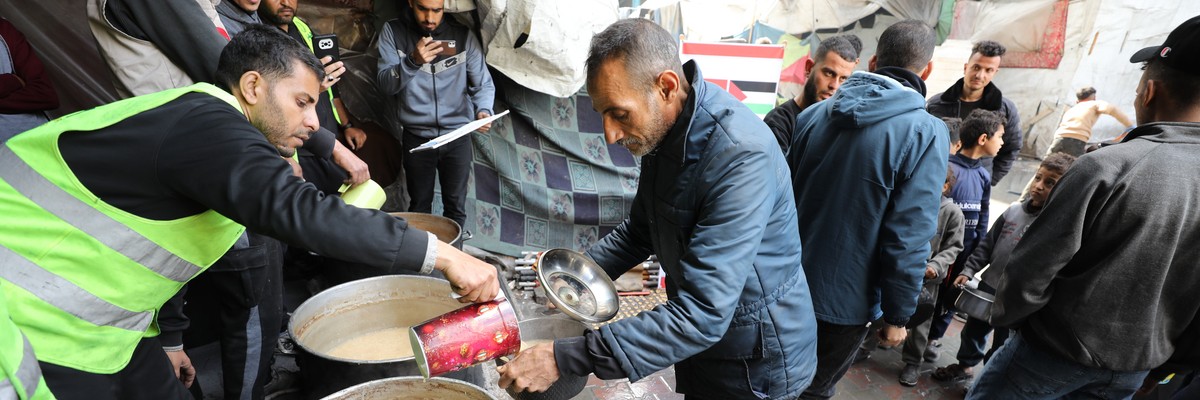
    Relief workers distribute food in Gaza City, Gaza on March 14, 2024. (Photo: Dawoud Abo Alkas/Anadolu via Getty Images)

    Providing aid to Gaza and ensuring the reconstruction of the strip must not be a political item for negotiations. It is a basic human right that must be honored under any circumstance.

    Humanitarian aid should never be politicized though, quite often, the very survival of nations is used as political bargaining chips.

    Sadly, Gaza remains a prime example. Even before the current war, the Gaza Strip suffered under a 17-year hermetic blockade, which has rendered the impoverished area virtually “unlivable.”

    That very term, “unlivable” was used by the then-United Nations Special Rapporteur for the Situation of Palestine, Michael Lynk, in 2018.

    Scenes and images of thousands of starving Palestinians chasing after boxes of aid parachuted into Gaza will remain etched in the collective memory of humanity as an example of our failed morality.

    As of mid-December of last year, “nearly 70% of Gaza’s 439,000 homes and about half of its buildings have been damaged or destroyed,” The Wall Street Journal reported, citing experts who conducted a thorough analysis of satellite data.

    As tragic as the situation was in December, now it is far worse.

    Sixty-seven percent of Gaza’s water, sanitation facilities, and infrastructure have been destroyed or damaged, according to a statement by the United Nations Agency for Palestinian Refugees, UNRWA, on June 19, leading to the spreading of infectious diseases, which has ravaged the beleaguered population for months.

    The spread of disease is also linked to the accumulation of garbage everywhere in Gaza. Earlier, the refugees agency reported that “as of June 9, over 330,000 tons of waste have accumulated in or near populated areas across Gaza, posing catastrophic environmental (and) health risks.”

    The situation was already disastrous. Indeed, three years before the war, the Global Institute for Water, Environment, and Health (GIWEH) said, in a joint statement with the Euro-Mediterranean Human Rights Monitor, that 97% of Gaza water was undrinkable and unfit for human consumption.

    Yet, so far, any conversation on allowing aid to Gaza, or the rebuilding of Gaza after the war, has been placed largely within political contexts.

    By shutting down all border crossings, including the Egypt-Gaza Rafah Crossing—which, on June 17, was set ablaze—Israel has politicized food, fuel, and medicine as tools in its war in the strip.

    This is not a mere inference, but the actual statement made by Israeli Minister of Defense Yoav Gallant, who on October 9 declared that he had ordered a “complete siege” and that “there will be no electricity, no food, no fuel, no water” entering Gaza.

    The timing of the statement, which has indeed been put into action from the first day of the war, suggests that Israel did not apply the strategy as a last resort. It was one of the most important pieces in the war stratagem, which remains in effect to this day.

    Instead of pressuring Israel, Washington tried to obtain its own political leverage, also by politicizing aid. On March 2, the U.S. Air Force started airdropping aid into northern Gaza. A far more conducive and less humiliating option for Palestinians, however, would have been direct U.S. pressure on Israel to allow access to aid trucks arriving through Rafah, Karem Abu Salem Crossing, or any other.

    Scenes and images of thousands of starving Palestinians chasing after boxes of aid parachuted into Gaza will remain etched in the collective memory of humanity as an example of our failed morality.

    News reports spoke of people who were killed under the weight of the dropped “aid,” much of which had fallen in the Mediterranean, never to be retrieved.

    Even the Gaza pier, constructed by the U.S. military on the Gaza shore in May, did little to alleviate the situation. It merely transported 137 aid trucks, according to the U.S.’ own estimation, enough to cover Gaza’s need for food for a few hours only.

    During the years of siege, an average of 500 trucks arriving daily in Gaza has kept the 2.3 million population of the strip alive, though malnourished.

    To deal with the outcome of the war, and to stave off current starvation, especially in the north, the number of aid trucks would have to be much higher. Yet, whole days would pass without a single truck making its way to the suffering population. This is unacceptable.

    Not only did the international community fail at ending the war, it has also failed in delinking humanitarian aid from political and military objectives.

    The problem with politicizing aid is that innocent civilians become a bargaining chip for politicians and military men. This goes against the very foundation of international humanitarian law.

    According to the International Committee of the Red Cross, citing the Hague Regulations, “international humanitarian law is the branch of international law that seeks to impose limits on the destruction and suffering caused by armed conflict.” In Gaza, no such “limits” have been “imposed” by anyone.

    Providing aid to Gaza and ensuring the reconstruction of the strip must not be a political item for negotiations. It is a basic human right that must be honored under any circumstance.

    Meaningful pressure must be placed on Israel to end the Gaza siege, and urgent plans must be drafted, starting today, by representatives of U.N. humanitarian institutions, the Arab League, and Palestinian and Gaza authorities to be the entities responsible for delivering aid to Gaza.

    Humanitarian aid to Gaza must not be used as political leverage, or a tool in a cruel war, whose primary victims are millions of Palestinian civilians.

    Original article by RAMZY BAROUD republished from Common Dreams under Creative Commons (CC BY-NC-ND 3.0). 

    Vote For Genocide Vote Labour.
    Vote For Genocide Vote Labour.
    Zionist Keir Starmes is quoted "I support Zionism without qualification." He's asked whether that means that he supports Zionism under all circumstances, whatever Zionists do.
    Zionist Keir Starmes is quoted “I support Zionism without qualification.” He’s asked whether that means that he supports Zionism under all circumstances, whatever Zionists do.