New study published in Nature says period was as destructive as record 2016 El Niño drought and heatwave
The first half of Jair Bolsonaro’s presidency was so destructive for the Amazon that it was comparable to the record 2016 El Niño drought and heatwave in terms of carbon emissions, according to scientists.
Annual emissions from the world’s largest rainforest roughly doubled in 2019 and 2020, compared with the 2010 to 2018 average, according to a new study published in Nature, as swaths of forest were deliberately cleared and burned for cattle ranching and farming during the first two years of the far-right leader’s time in office.
While the amount of carbon that the Amazon absorbs and emits changes with weather cycles, generally sucking in more in wet years and less in dry periods, the study found that the rise in emissions under Bolsonaro had little to do with natural processes, but was instead caused by the systematic removal and downgrading of environmental law enforcement in Brazil.
Under Bolsonaro, the number and severity of fines for illegal deforestation by Brazilian authorities fell dramatically while fires and land-clearing soared, the study found. Carbon emissions increased from an annual average of 0.24 gigatonnes from 2010-18 to 0.44GtC in 2019 and 0.55GtC respectively.
In effect, he has become the chief annihilator of democracy.
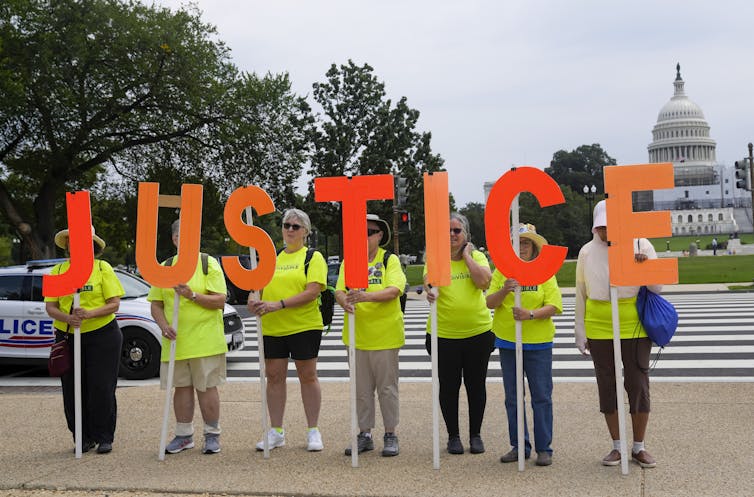
Anti-Donald Trump protesters hold letters that spell out ‘justice’ in Washington, D.C., on Aug. 3 as former president Donald Trump was set to appear in federal court on charges that he sought to overturn the results of the 2020 presidential election. (AP Photo/Jess Rapfogel)
“He has trafficked in racism and xenophobia. He has incited violence. He has kowtowed to dictators and trashed our alliances. He has welcomed Russian attacks on our elections. He has locked children in cages. He has called for his opponents to be locked up.”
Put differently, Trump has criminalized both social problems and politics itself.
Trump and his allies have long created a culture of lies, illusions, cruelty and misrepresentation. He has waged an incessant attack on reason, critical thinking, informed judgment and social responsibility. His distaste for Black people, migrants and others he considers disposable is matched by his support for the financial and corporate elite.
Yet, despite the damage Trump has done to democracy, he has almost complete support of the Republican Party and a majority of Republican voters — slightly more than 58 per cent say they still plan to vote for him in the 2024 presidential election if he wins the Republican nomination. He appears poised to clinch that nomination.
Even more troubling are recent polls indicating he’s in a dead heat with U.S. President Joe Biden if they’re the presidential nominees in 2024.
Donald Trump and Joe Biden participate in a presidential debate in Nashville, Tenn., in October 2020. (Jim Bourg/Pool via AP)
What explains Trump’s appeal?
Most of media is focused on Trump’s legal troubles. But too little has been written about the conditions that have given rise to his authoritarian politics or why Trump is a national disgrace still backed by millions of Americans.
Trump’s grip on power is a collective nightmare that can only be understood in terms of the historical, economic, political and cultural conditions of which he is the endpoint.
“Odious as he may be, Trump is less the cause of America’s decline than a product of its descent.”
Trump embodies a society that has been in crisis for decades, but especially since the 1980s. This was a period when the right-wing counter-revolution emerged with the election of Ronald Reagan.
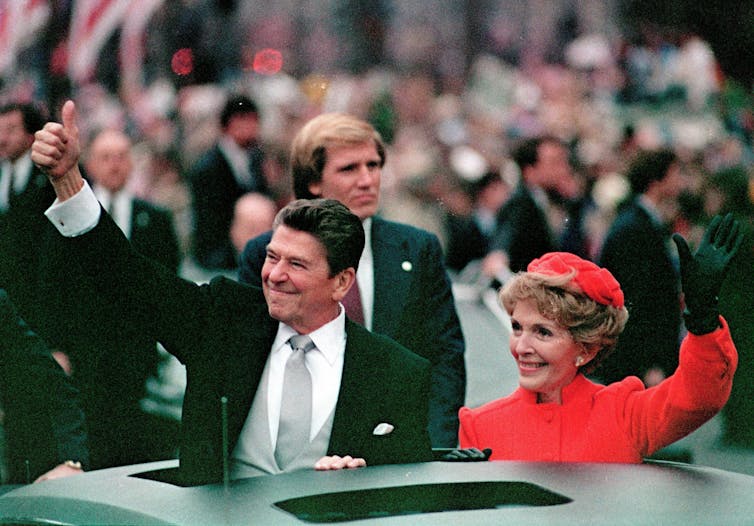
Ronald Reagan gives a thumbs up to the crowd while his wife, first lady Nancy Reagan, waves from a limousine during the inaugural parade in Washington following Reagan’s swearing in as the 40th president of the United States in January 1981. (AP Photo/File)
Since that time, the democratic values that informed the social contract and common good have been increasingly displaced by market values that stress self-interest, privatization, commodification, deregulation and the accumulation of profit and celebration of greed. Civic culture came under attack along with the erosion of the values of shared citizenship.
The market became a template for controlling not just the economy, but all of society. The language of rabid individualism replaced the notion of the common good and gave way to a disdain for community.
Government was discredited as a force for good, its public infrastructure was eroded and replaced by a culture of cruelty in which matters of compassion, care, and ethical responsibility began to disappear.
What emerged was society marked by precarity, loneliness and mass anxiety. The rising cult of individualism made it difficult for the public to translate private troubles into systemic considerations, weakening the public imagination. The rise of a media environment where politics becomes a form of entertainment helped silence any resistance to a growing culture of lies and greed.
Staggering levels of economic inequality also emerged, setting the ground for dark money shaping politics. This neoliberal poison helped to create a society of political monsters, immune to the virtues and conditions of democracy.
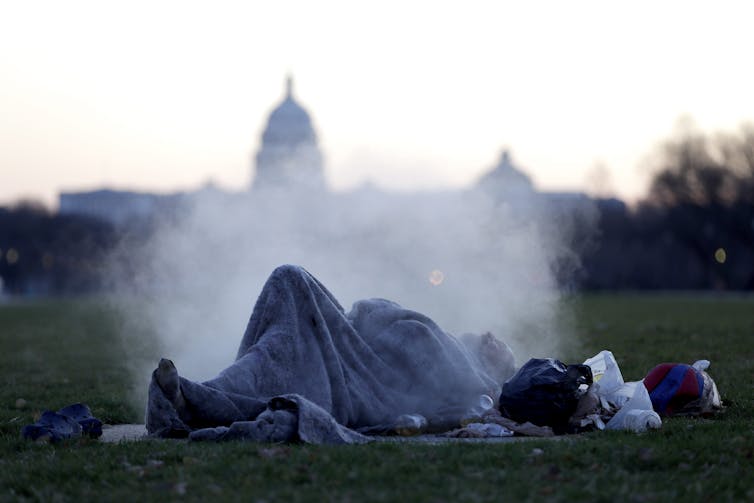
A homeless man resting on a steam vent on the National Mall in 2019 in Washington. (AP Photo/Julio Cortez)
Harnessed to exclusion and bigotry, the language of freedom was invoked eventually by Trump and other Republican Party politicians to produce policies that have banned books, crushed dissent, limited classroom and workplace discussions about race, whitewashed African American history and justified a virulent anti-democratic politics that echo the ghosts of a fascist past.
America at a crossroads
The most important issues Americans face today are not solely about Trump’s corruption, lawlessness or open authoritarianism — it’s about learning from history.
We must rethink the lies that neoliberal capitalism have told us about how American society defines itself while rethinking what it will take to challenge and overcome the anti-democratic forces that gave rise to Trump.
The 2024 election should be about more than Trump’s ongoing legal travails. It should be a directive for what kind of society Americans want and what kind of future they desire for their children. They should regard the election as a choice between democracy and the further criminalization of American politics.
Henry Giroux, Chaired professor for Scholarship in the Public Interest in the Department of English and Cultural Studies, McMaster University
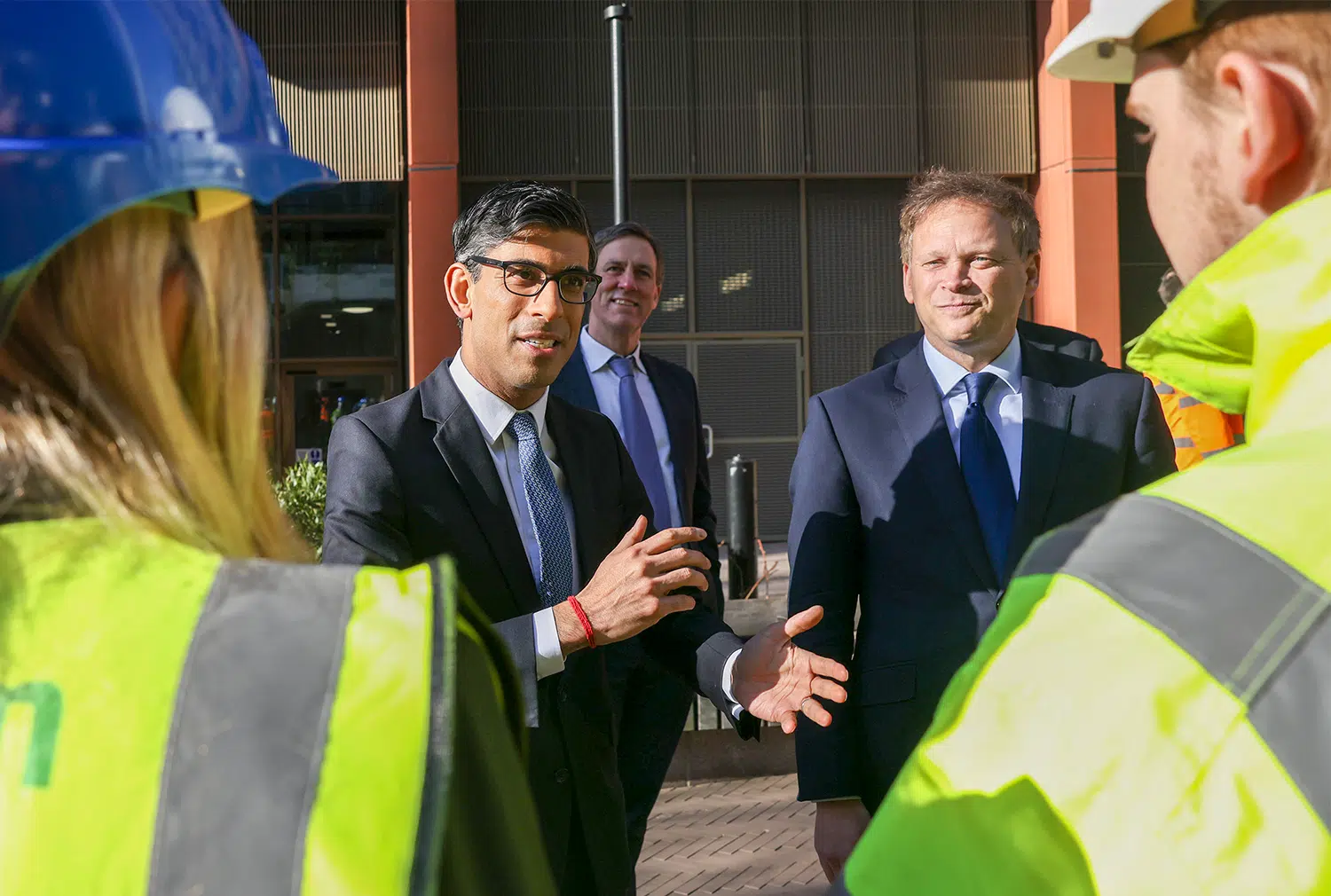
PRIME MINISTER Rishi Sunak jetted into Scotland today [Monday] to announce a cash bonanza for the oil majors, just days after the United Nations announced that “the era of global boiling has arrived.”
Companies such as Shell and BP, which coined £3 billion each in just the last three months, continue to enjoy the Prime Minister’s generosity.
Having already doled out billions of pounds worth of windfall tax breaks to fossil fuel majors in the North Sea, Mr Sunak has said he will back the granting of over 100 new oil and gas licences and provide up to £20bn in state handouts to carbon capture and storage.
Despite the proposed fields not likely to come on stream for over a decade, Mr Sunak and ministers such as Energy Secretary Grant Shapps claim that the supply would ensure energy security and aid in “safeguarding bills for British families.”
Mr Sunak argued his policy to prolong production of oil and gas by decades “is entirely consistent with our plans to get to net zero” — a target due to be met in just seven years.
The Prime Minister’s remarks united climate activists, anti-poverty campaigners, trade unionists and opposition politicians in their condemnation of a policy they argue ditches international commitments on climate change, fails to deliver a fair transition for workers, and will not help those struggling to pay heating bills this winter.
In a statement, climate activists Just Stop Oil branded the 100 new licences expected to be granted this autumn as “100 new crimes against humanity,” adding: “Rishi Sunak and his fossil fuel backers are taking us all for fools.
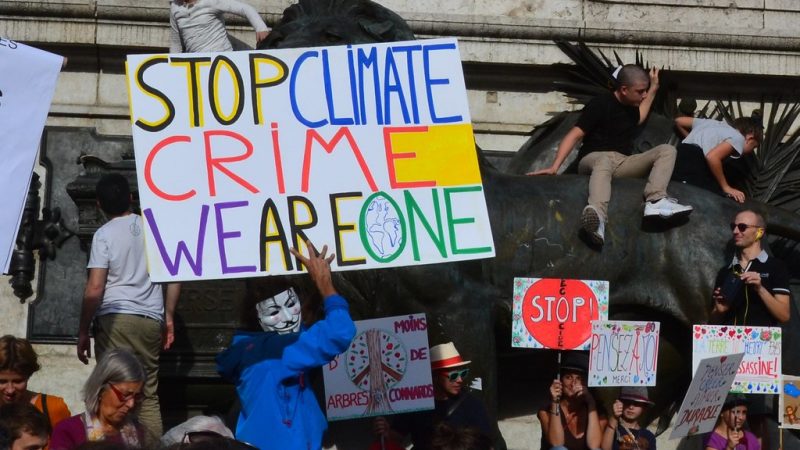
Protest banner reads Stop Climate Crime. We are One.
Radical action is essential to stop the transition from global warming to global boiling
Extreme weather events have increased in frequency and intensity over the past decade, with the last month seeing a rare combination of problems across North America, the Mediterranean and Middle East, northern China and South Korea. For the British, there has been the separate added shock of seeing tourists fleeing wildfires, especially in Greece.
These events are all part of the early stages of climate breakdown, which will get progressively worse unless the world makes a revolutionary and rapid transition to a low carbon economy, yet there is little evidence that political leaderships are even remotely prepared for this. At least UN secretary general António Guterres is using different language, not least his use of “global boiling” rather than “global warming” for his warnings of what is to come.
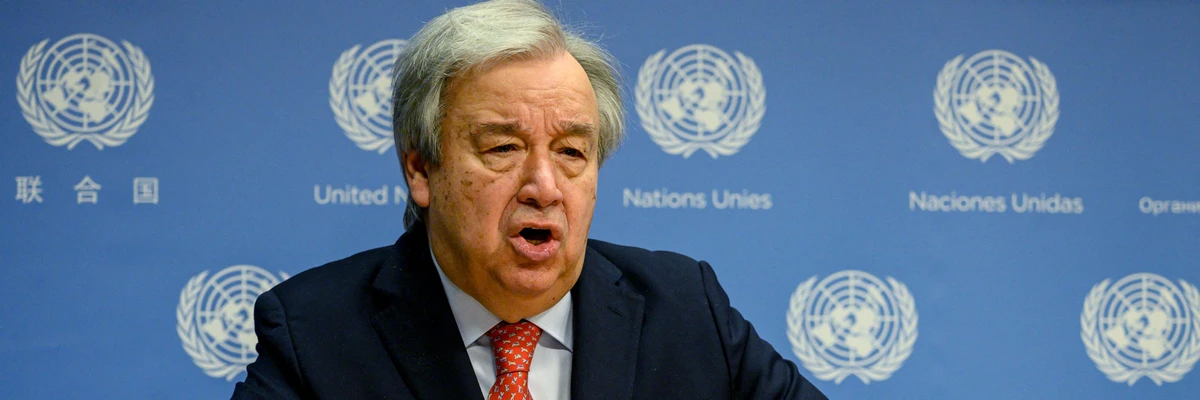
United Nations Secretary-General António Guterres discusses climate change at U.N. headquarters in New York City on July 27, 2023.
He is an exception, and public opinion overall is still not aware of the huge changes required. All the warnings from climate scientists, coupled with the evidence of our own eyes, seems to count for little as we move towards an unstable, chaotic and overheating planet.
Why is this? More importantly, why is it that radical decarbonisation isn’t happening, even though we know it’s possible? And, most important of all, how can things be turned round in time?
Let’s start with the inaction. Here, three elements interact. First, we are talking about fundamental changes in how we live, not just in the UK or western Europe but across the whole world. The result would be a cleaner, safer and healthier world, but it would involve years of huge change – which is a lot for ordinary people to take in. We shouldn’t underestimate this. Poorer communities, in particular, will find it very difficult to cope with the changes, while richer elites everywhere in the world will likely maintain the naive belief that their wealth will keep them secure.
Second, what must be done runs directly counter to the way the economy currently works. The market fundamentalist system is rooted in competition and the false belief that the millions of people left behind will benefit from trickle-down from the rich and be content. It believes that while central government, in partnership with wealth, may hold the ultimate levers of control, it should have a minimal role in how the market works. Cooperation is anathema to this way of thinking, but cooperation is essential to prevent global boiling.
Neoliberals see this market fundamentalist approach as necessary for an ordered and stable society, and believe that if the millions of marginalised people do not upset the apple cart, all will be well. At root is a belief that the elite knows best.
In Britain, there was the unexpected risk of a seriously radical Labour government taking over in 2017. Fortunately for the neoliberals, that was narrowly avoided and since then the threat from the Labour left has been well and truly suppressed.
Despite this, the system still has wider concerns over potentially violent responses from the margins. In many countries, and especially Britain, new laws have been brought in and others strengthened, and police and security forces are much better equipped and trained to handle public dissent. Heavy prison sentences for even small acts of nonviolent direct action are now there to be used.
The problem is that a market economy system simply cannot act fast enough to handle climate breakdown. The system knows this, so finds it preferable to support the view of any “experts”– of whom there are plenty – who still deny there is a problem.
The anti-climate breakdown forces are exceptionally well entrenched in society and have the easy job of convincing people that no action is required
This brings us to the third point: the relentless propaganda from the fossil fuel industry and associated think tanks over half a century to deny the problem, even when their own scientists are saying otherwise. In a fairer world there would be an offence of global corporate manslaughter, but in the real world there isn’t.
Overall, the anti-climate breakdown forces are exceptionally well entrenched in society and have the easy job of convincing people that no action is required – just when they are being told that action will be personally costly. Politicians will play on this, especially when elections are in the offing. This can even reap electoral favour. The current behaviour of Britain’s Sunak government is a case in point, with Sunak declaring that climate policy must be “proportional and pragmatic”, following a by-election win in a constituency where the Tory candidate had opposed extension of the ULEZ low-emissions scheme.
So where do we go from here? One way to look at it is to view the current issue as two very broad global trends that are on course to converge, and when they finally meet there will be a chance of radical change because there will be no alternative.
One of these trends, as we have seen, is a system set in its ways and highly unlikely to change. Carbon emissions will continue rising, temperatures will head well above 1.5°C and those with the power will reap the rewards, at least in the short term.
The other trend is much more positive and has three elements.
Climate science has come on by leaps and bounds in the past half century. The science community is far more confident of its expectations of climate breakdown and is, at last, saying so bluntly. That welcome change also has greater force because of the manner in which the beginnings of climate breakdown are frequently exceeding the warnings of predictive models.
The second trend is, at last, a growing public awareness that things must change, and change quickly. The power of the movements in many countries is remarkable, so much so that far more people are willing to risk prison for the sake of the future.
Finally, numerous impressive developments in renewable energy technology have brought down the cost of electricity by huge margins, bringing it well below grid parity in price with fossil fuels.
That leaves just two huge questions, on which so many futures depend, particularly for our children and grandchildren. When will the convergence happen, and how quickly can changes then be made?
If it takes another 20 years to the early 2040s, then the task will be almost insurmountable, with action only happening after numerous appalling catastrophes, and bitter anger from the marginalised billions. If change comes before the mid-1930s then prospects will be brighter, but the later the convergence the greater the challenge.
It is therefore a matter of the sooner the better, so the rest of the 2020s has to be a time of intense activism whenever and wherever possible. Whether it is by persuasion, argument, nonviolent direct action or other means, it might then be possible to convince enough people that radical action is essential before the transition from global warming to global boiling risks becoming irreversible.
Whatever you’re interested in, there’s a free openDemocracy newsletter for you. HAVE A LOOK