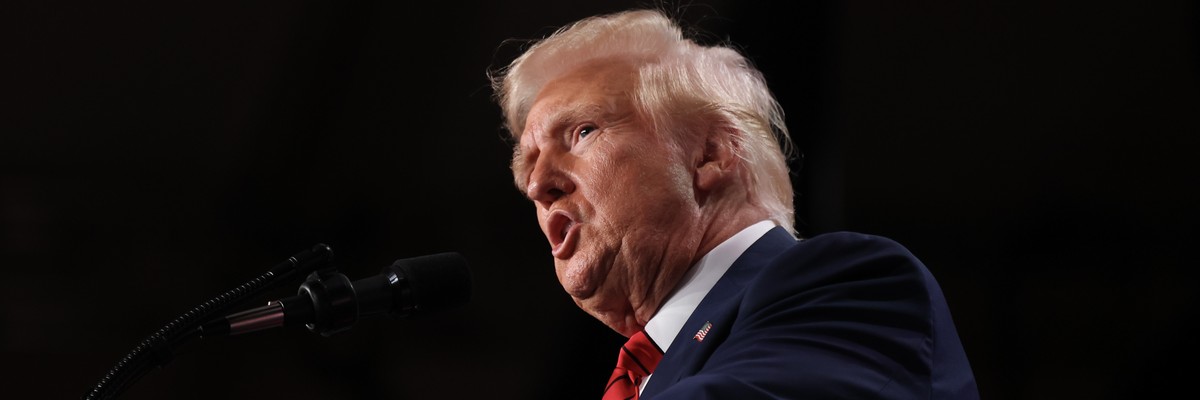
U.S. President Donald Trump addresses the 2025 Republican Issues Conference at the Trump National Doral Miami on January 27, 2025 in Doral, Florida. The three-day planning session was expected to lay out Trump’s ambitious legislative agenda. (Photo: Joe Raedle/Getty Images)
“The overwhelming support for impeachment shows that the American public is not willing to accept King Trump,” said Alexandra Flores-Quilty, Free Speech for People campaign director.
The nonprofit Free Speech for People is leading a new nonpartisan campaign to drum up support for U.S. President Donald Trump’s removal—“Impeach Trump Again”—and reported Thursday that the effort has already garnered over 100,000 petition signatures.
The campaign is calling on Congress to launch an impeachment investigation into Trump and says that the signature numbers signal “widespread support” for a probe.
“The overwhelming support for impeachment shows that the American public is not willing to accept King Trump,” said Alexandra Flores-Quilty, Free Speech for People campaign director, in a Thursday statement. “We need bold leaders in Congress willing to stand up and hold Trump accountable for his abuses of power and initiate an impeachment inquiry.”
The petition, which was launched on Inauguration Day, calls on Congress to initiate an impeachment investigation into Trump based on potential violations of the U.S. Constitution’s emoluments clauses, his pardoning of insurrectionists who took part in the January 6, 2021 riot at the Capitol, and his “unlawful” and “corrupt” campaign practices.
Free Speech for People also launched a campaign to build public support for Trump’s impeachment on the day of his inauguration back in 2017.
The emoluments clauses require that Trump “fully divest himself from any businesses receiving profits, gains, or advantages, beyond his official compensation, from the federal government or the individual states,” according to the watchdog group Citizens for Responsibility and Ethics in Washington. Trump’s business empire—which, as far as the public knows, he has not divested from—now includes not only real estate, but also a social media platform and a cryptocurrency token.
The campaign also lists other alleged impeachable offenses.
Trump was impeached twice by the House of Representatives during his first term, but in both cases he was acquitted by the Senate. Both chambers of Congress are now controlled by Trump’s Republican Party.
I am only able to quote small sections of this copyrighted article by George Monbiot published in the Guardian. The whole article is here.
A plane comes into land at Heathrow airport, London. Photograph: Avpics/Alamy
Our rivers, our wildlife, the air we breathe: the government is sacrificing all to the insatiable god of GDP – and mocking our objections
I can scarcely believe I’m writing this, but it’s hard to dodge the conclusion. After 14 years of environmental vandalism, it might have seemed impossible for Labour to offer anything but improvement. But on green issues, this government is worse than the Tories.
The last prime minister to insist that growth should override every other consideration, and to fling insults at anyone who disagreed, was Liz Truss. She called those of us seeking to defend the living world an “anti-growth coalition”, “voices of decline” and “enemies of enterprise” who “don’t understand aspiration”.
Now Keir Starmer has picked up her theme and run with it. Those who challenge government policies that might promote GDP growth, however destructive and irrational, such as the planned expansion of Heathrow, Gatwick, Luton and Doncaster Sheffieldairports, are “time-wasting nimbys”, “zealots” and “blockers”, engaged in “self-righteous virtue-signalling”.
After all, these are the kind of people who might send “congratulations to the climate campaigners” whose legal challenge stopped plans to build a third Heathrow runway at the court of appeal. Or who insist that Heathrow expansion should be blocked because “there is no more important challenge than the climate emergency”. Oh, hang on, that was Starmer, writing in 2020. You know, the one you voted for, not the new model, channelling the worst Tory prime minister of modern times.
Now his chancellor, Rachel Reeves, insists that growth “trumps other things”, including the government’s environmental commitments. The verb is unfortunate. The government’s new rhetoric is horribly reminiscent of the convicted felon: monomania, slogans and insults take the place of nuanced and complex policy.
…
I am only able to quote small sections of this copyrighted article by George Monbiot published in the Guardian. The whole article is here.
Orcas comment on killer apes destroying the planet by continuing to burn fossil fuels.
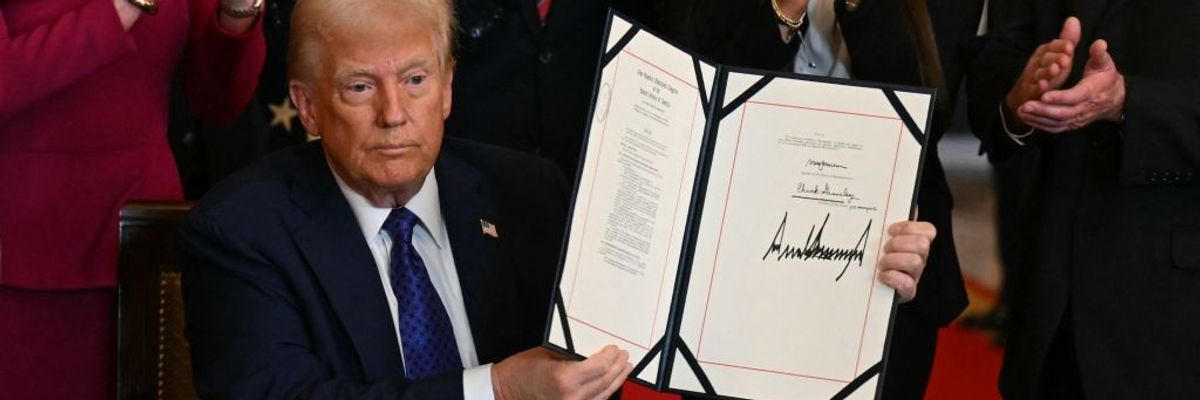
U.S. President Donald Trump holds up a signed copy of the Laken Riley Act in Washington, D.C. on January 29, 2025. (Photo: Pedro Ugarte/AFP via Getty Images)
“The Laken Riley Act capitalizes on a horrible tragedy in order to advance President Trump’s anti-immigrant agenda by scapegoating people seeking safety,” said one campaigner.
Human rights defenders decried U.S. President Donald Trump’s signing of legislation Wednesday that critics warn will strip due process rights from millions of people while harming some of the most vulnerable members of society, including migrant children, victims of sexual violence, and survivors of domestic abuse.
Trump signed the Laken Riley Act—named after a young woman murdered last year by a Venezuelan man who, according to U.S. Immigration and Customs Enforcement (ICE), entered the United States illegally—calling it a “landmark law” that “will save countless innocent American lives.”
“The Laken Riley Act is based upon false, xenophobic narratives that dehumanize and criminalize an entire group of people due to the actions of one person.”
However, Amy Fischer, director of the ACLU’s Refugee and Migrant Rights Program, said in a statement Wednesday that “the Laken Riley Act capitalizes on a horrible tragedy in order to advance President Trump’s anti-immigrant agenda by scapegoating people seeking safety and stripping away their right to due process.”
“This legislation mandates the arrest and detention of our undocumented neighbors for being convicted or charged of any theft, shoplifting, burglary, or larceny offense,” Fischer noted. “Mandatory detention solely for being accused of theft strips people of their right to due process and constitutes arbitrary detention under international human rights law.”
“The Laken Riley Act is based upon false, xenophobic narratives that dehumanize and criminalize an entire group of people due to the actions of one person,” Fischer added. “It will separate families and make our communities less safe. It is simply unconscionable for Congress to create a new mechanism that gives people the power to falsely accuse immigrants of theft knowing their detention is mandatory.”
As the Lawyers’ Committee for Civil Rights of the Bay Area, which called the law “shameful and unconstitutional,” noted Wednesday: “This bill does not require a conviction—simply being accused of a crime is enough to force individuals into mandatory detention without review by any judge. In doing so, the law strips due process protections and allows for discrimination against vulnerable immigrant communities.”
The group continued:
The federal government already has the power to detain and deport individuals who commit criminal acts. But in our legal system, judges act as a constitutionally required check on police actions. This new law removes that check. It is a direct attack on the constitutional rights of immigrants and communities of color, and it erodes the civil liberties of American society at large. It will incentivize racial profiling and divert law enforcement resources away from real threats, making our communities less safe.
“Lawyers’ Committee and our partners vow to challenge this unconstitutional law in court,” Bianca Sierra Wolff, the group’s executive director, said in a statement. “We will not stand by while the rights of immigrants and communities of color are trampled for political gain.”
Writing for Common Dreams Wednesday, National Center for Youth Law senior director Neha Desai and NCYL attorney Melissa Adamson lamented the Laken Riley Act’s passage and urged Congress, both chambers of which passed the law with bipartisan support, to “do the right thing” by introducing “new legislation to protect children from this draconian law.”
“Policymakers on both sides of the political aisle seem all too eager to support legislation that ignores that immigrant children are human beings, worthy of the same care and protections that their own children enjoy,” Desai and Adamson contended. “It is deeply disheartening to see lawmakers shift with the political winds rather than hold true to fundamental values. Congress must not acquiesce to a country in which the rejection of children’s rights is the norm.”
Shares in private prison companies have skyrocketed since Trump won last November’s election, partly in anticipation of a boom in business due to the Laken Riley Act and the broader campaign of mass deportations now underway.
On Wednesday, Trump also said he would instruct the Pentagon and Department of Homeland Security to prepare a detention facility—some critics called it a “concentration camp“—capable of holding 30,000 migrants at the notorious offshore Guantánamo Bay prison run by the U.S. military in Cuba.
US president Donald Trump is surrounded by a new cohort of politicians and officials. While one of his campaign promises was to overthrow the “corrupt elites” he accuses of flooding the American political arena, his second term in office has elevated elites chosen, above all, for their political loyalty to him.
The media’s focus on Trump’s comments on making Canada the 51st US state and annexing Greenland and billionaire Elon Musk’s support for some far-right parties in Europe has obscured the ambitious programme to transform the federal government that the new political elite intends to implement.
In the wake of Trump’s inauguration on January 20, the Republican elites most loyal to the MAGA (“Make America Great Again”) leader, who staunchly oppose Democratic elites and their policies, are operating amid their party’s control over the executive and legislative branches (at least until the midterm elections in 2026), a conservative-dominated Supreme Court that includes three Trump-appointed justices, and a federal judiciary that shifted right during his first term.
However, the political project of the Trumpist camp consists less of challenging elitism in general than attacking a specific elite: one particular to liberal democracies.
Castigating democratic elitism
Typical anti-elite political propaganda, along the lines of “I speak for you, the people, against the elites who betray and deceive you,” claims that a populist leader would be able to exercise power for and on behalf of the people without the mediation of an elite disconnected from their needs.
Political theorist John Higley sees behind this form of anti-elite discourse an association between so-called “forceful leaders” and “leonine elites” (who take advantage of the former and their political success): a phenomenon that threatens the future of Western democracies.
Since the Second World War, there has been a consensus in US politics on the idea of democratic elitism. According to this principle, elitist mediation is inevitable in mass democracies and must be based on two criteria: respect for the results of elections (which must be free and competitive); and the relative autonomy of political institutions.
The challenge to this consensus has been growing since the 1990s with the increased polarization of American politics. It gained new momentum during and after the 2016 presidential campaign, which was marked by anti-elite rhetoric from both Republicans and Democrats (such as senators Bernie Sanders and Elizabeth Warren). At the heart of some of their diatribes was an aversion to “the Establishment” on the east and west coasts of the United States, where many prestigious financial, political and academic institutions are based, and the conspiracy notion of the “deep state”.
Trump’s populism from above: a revolt of the elites
The idea that democracy could be betrayed by “the revolt of the elites”, put forward by the US historian Christopher Lasch (1932-1994), is not new. For the anthropologist Arjun Appadurai, it is a particular feature of contemporary populism, which comes “from above.” Indeed, if the 20th century was the era of the “revolt of the masses”, the 21st century, according to Appadurai, “is characterized by the ‘revolt of the elites’.” This would explain the rise of populist autocracies (such as those currently led by Viktor Orban in Hungary, Recep Tayyip Erdogan in Turkey and Narendra Modi in India, and formerly led by Jair Bolsonaro in Brazil), but also the election successes of populist leaders in consolidated democracies (including those of Trump in the US, Giorgia Meloni in Italy, and Geert Wilders in the Netherlands, for example).
As Appadurai explains, the success of Trumpian populism, which represents a revolt by ordinary Americans against the elites, casts a veil over the fact that, following Trump’s victory in November, “it is a new elite that has ousted from power the despised Democratic elite that had occupied the White House for nearly four years.”
The aim of this “alter elite” is to replace the “regular” Democrat elites, but also the moderate Republicans, by deeply discrediting their values (such as liberalism and so-called “wokeism”) and their supposedly corrupt political practices. As a result, this populism “from above” carried out by the President’s supporters constitutes an alternative elite configuration, the effects of which on American democratic life could be more significant than those observed during Trump’s first term.
Beyond the idea of a ‘Muskoligarchy’
The idea that we are witnessing the formation of a “Muskoligarchy” –in other words, an economic elite (including tech barons such as Jeff Bezos, Mark Zuckerberg and Marc Andreessen) rallying around the figurehead of Elon Musk, whom Trump asked to lead what the president has called a “Department of Government Efficiency” (DOGE) –is seductive. It perfectly combines the vision of an alliance between a “conspiratorial, coherent, conscious” ruling class and an oligarchy made up of the “ultra-rich”. For the Financial Times columnist Martin Wolf, it is even a sign of the development of “pluto-populism”. (It is also worth noting that former president Joe Biden, in his farewell speech, referred to “an oligarchy… of extreme wealth” and “the potential rise of a tech-industrial complex.”)
However, some observers are cautious about the advent of a “Muskoligarchy.” They point to the sociological eclecticism of the new Trumpian elite, whose facade of unity is held together above all by a political loyalty, for the time being unfailing, to the MAGA leader. The fact remains, however, that the various factions of this new “anti-elite” elite are converging around a common agenda: to rid the federal government of the supposed stranglehold of Democratic “insiders.”
An ‘anti-elite’ elite against the ‘deep state’
In his presidential inauguration speech in 1981, Ronald Reagan said: “Government is not the solution to our problem; government is the problem.” The anti-elitism of the Trump elite is inspired by this diagnosis, and defends a simple political programme: rid democracy of the “deep state.”
This conspiracy theory has been taken to the extreme by Kash Patel, the candidate being considered to head the FBI. In his book, Government Gangsters, a veritable manifesto against the federal administration, the former lawyer writes about the need to resort to “purges” in order to bring elite Democrats to justice. He lists around 60 people, including Biden, ex-secretary of state Hillary Clinton and ex-vice president Kamala Harris.
Government Gangsters, Kash Patel’s controversial book. Google Books
The appointment of Russell Vought as head of the Office of Management and Budget at the White House, a person who is known for having sought to obstruct the transition to the Biden Administration in 2021, also highlights the hard turn that the Trump administration is likely to take.
Reshaping the state around political loyalty
To “deconstruct the administrative state”, the “anti-elite” elites are relying on Project 2025, a 900-plus page programme report that the conservative think-tank The Heritage Foundation, which published it, says was produced by “more than 400 scholars and policy experts.” According to former Project 2025 director Paul Dans, “never before has the entire movement… banded together to construct a comprehensive plan” for this purpose. On this basis, the “anti-elite” elite want to impose loyalty to Project 2025 on federal civil servants.
But this idea is not new. At the end of his first term, Trump issued an executive order facilitating the dismissal of statutory federal civil servants occupying “policy-related positions” and considered to be “disloyal”. The decree was rescinded by president Biden, but Trump on his first day back in office signed an executive order that seeks to void Biden’s rescindment. As President, Trump is also able to allocate senior positions within the federal administration to his supporters.
The “anti-elite” elite not only want to reduce the size of the state, as was the case under Reagan’s “neoliberalism”, but to deconstruct and rebuild it in their own image. Their real aim is a more lasting victory: the transformation of democratic elitism into populist elitism.
THE top 10 per cent of Britain’s population has more wealth than the other 90 per cent combined, according to TUC analysis of official Office for National Statistics (ONS) figures released today.
The huge inequality between rich and poor has widened under 14 years of Tory rule, which saw an “explosion” in insecure work and a decline in living standards.
Under the Conservatives, real wages grew by just 0.3 per cent a year — compared with 1.5 per cent from 1997 to 2010 under Labour.
The TUC estimates that the average worker would be £117 a week better off had pay increased since 2010 at the same pace as between 1997 and 2010.
Pay growth during Conservative-led governments from 2010-2024 was worse than for any other period of government since the 1920s.
The Tories also oversaw the worst fall in living standards since records began in 1955, the TUC said.