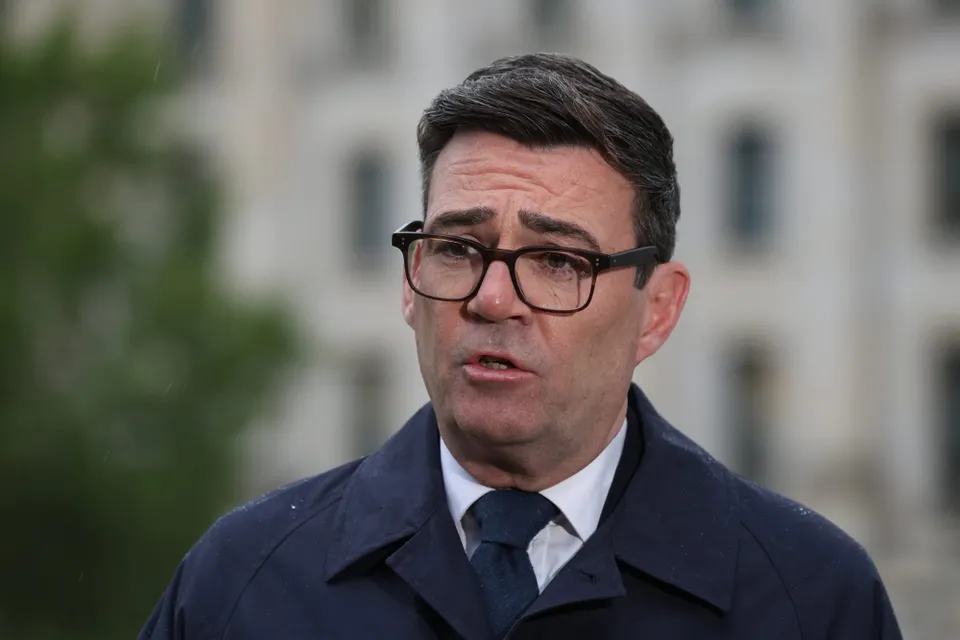
Prime Minister Andy Burnham during a meeting with Scottish swimmer Archie Goodburn, 25, at No 10 Downing Street, London, October 14, 202
LEFT MPs have urged Andy Burnham to stick to his pledge to reverse neoliberalism as signs multiplied that the upcoming Budget will be tailored to business demands.
They spoke out after reports that Mr Burnham had told bosses at a Downing Street meeting that he wanted to run “the most pro-business government in the world.”
Hemsworth Labour MP Jon Trickett urged the Prime Minister to live up to his pledge to address the “40-year wrong turn” he has campaigned against.
“He promised an end to neoliberalism. I am not convinced meeting banks and big business indicates we are going to see the economic rupture with the policies of the last 40 years or so to get this country back on track,” he said.
UK Prime Minister Andy Burnham admits to blatently lying and engaging in deception to become leader of the UK Labour Party and Prime Minister.
dizzy: Don’t U-turn on neoliberalism? I’ve reached the conclusion that it should be disregarded as totally disposable if it comes from Andy Burnham’s Neo-Liberal mouth …
This work by Middle East Monitor is licensed under a Creative Commons Attribution-NonCommercial-ShareAlike 4.0 International License.
Israeli soldiers are deployed at Erez border with heavy weapons and military vehicles in Erez, Israel on February 29, 2024. [Mostafa Alkharouf – Anadolu Agency]
A former head of Israeli military intelligence has said that since 7 October 2023, Israel has been run by an unwritten security doctrine that writes off the US as a declining power, rejects peace as a strategic goal and makes war a permanent feature of national life.
Hayman says the new concept has never been written down or presented to the public. Even so, it now “inform[s] decision-making and dictate[s] Israel’s approach to security”. He argues the shift goes beyond military planning and points to “a change in Israel’s national identity”.
The most striking principle is the doctrine’s view of Washington. Hayman says it treats the US as a “declining power” and holds that “excessive adherence to restrictions imposed on Israel by a US administration is dangerous”.
Under this thinking, the US, “given its ongoing social and political shifts, will soon abandon Israel in any event”. Dependence on Washington is also seen as exposing Israel “to the influence of a progressive American value system that is incompatible with Israel’s Jewish character”. Cutting ties with the US is therefore “not only inevitable, but essential to Israel’s independence and the resilience of its Jewish national identity”.
Hayman rejects that view. He points out that Israel is a small country with few natural resources and depends heavily on trade with the rest of the world. For that reason, he says, the country’s security chiefs have always believed it needs a major power on its side, because Israel “cannot sustain an autarkic defence economy isolated from the world”. In other words, Israel is incapable of producing everything it needs for its own defence.
Hayman questions whether a relationship with Washington based only on mutual interest would be enough to protect Israel. He also asks whether cutting Israeli science and arms industries off from international partnerships, such as the EU’s Horizon research programme, would leave Israel facing “technological stagnation and diplomatic isolation”.
Hayman identifies four other major principles behind the new doctrine. Taken together, they describe a state that puts ethnic identity before democracy, sees peace as a trap and treats war as normal.
The first is that Israel’s Jewish identity comes before its democracy. Under the doctrine, the state must stay Jewish “even at the cost of eroding its democratic values”. Hayman asks whether Israel can still call itself “Jewish and democratic” if it pursues a policy of curbing the civil rights of its Palestinian citizens, who make up about a fifth of the population.
The second principle rejects peace altogether. The doctrine holds that “a meaningful peace agreement is unattainable in the Middle East” and assumes that “any arrangement with Arab actors is temporary and deceptive”.
The doctrine treats peace deals as “merely technical and temporary arrangements”. Peace has no value of its own and is only “a means of achieving other policy objectives”. Peace itself is dismissed as “a naive concept” belonging to the left-wing “peace camp”, and set against “security”, which belongs to the right.
The third is contempt for Israel’s Arab neighbours as states. The doctrine views most of them as “not genuine nation-states, but collections of tribes and ethnic groups lacking a shared history”. It therefore sees their collapse as “a natural process” that Israel can manage and “should even encourage”.
The fourth is that war is Israel’s normal condition, not an exception. Preventive war is preferred, and the “constant presence” of war is considered “an asset to national security”. The paper quotes the slogan “Silence is filth” to sum up the view that seeking peace is a sign of weakness.
The doctrine goes further on territory. It calls for “forward defence” zones and civilian settlements in the occupied West Bank and in security zones inside Syria, Lebanon and the Gaza Strip. It rules out a Palestinian state and dismisses the Palestinian national movement as “an inauthentic Western narrative”.
Hayman says the doctrine draws its power from never being stated openly. It works “as an unwritten concept revealed through practice, rather than as a government’s declared policy”. He calls for a public debate on whether it is “a necessary adaptation” to Israel’s security situation or “an expression of a fundamental, unchecked shift in the state’s identity”.
Keir Starmer objects to criticism of the IDF. He asks how could anyone object to them starving people to death, forced marches like the Nazis did, bombing Gaza’s hospitals and universities, mass-murdering journalists, healthworkers and starving people queuing for food, killing and raping prisoners and murdering children. He calls for people to stop obstructing his genocide for Israel. New Labour UK Prime Minister Andy Burnham continues Labour party policy of active support and complicity in Israel’s genocide.UK Prime Minister Andy Burnham admits to blatently lying and engaging in deception to become leader of the UK Labour Party and Prime Minister.Ed Miliband says that he and the Labour Party are full of shit criminalising people holding signs as terrorists despite anything he says.
This work by Middle East Monitor is licensed under a Creative Commons Attribution-NonCommercial-ShareAlike 4.0 International License.
U.S. President Donald Trump meets Israeli Prime Minister Benjamin Netanyahu at White House in Washington DC, United States on July 28, 2026. [Ma’ayan Toaf (GPO)/Handout – Anadolu Agency]
Israeli Prime Minister Benjamin Netanyahu briefed US President Donald Trump on what he described as dangerous recent developments in Iran’s nuclear programme, amid rising tensions between Washington and Tehran, the US news website Axios reported, citing informed sources.
Trump and Netanyahu discussed the possibility of launching a joint military strike on Iran before Israel’s election, according to the sources. The US and Israeli militaries have also stepped up their alert levels and military preparations in recent weeks.
The developments come as uncertainty continues over Washington’s next move towards Iran, amid reports of military preparations for a possible resumption of operations.
It remains unclear whether Trump and Netanyahu have made a final decision to launch a joint attack or set a date for any such operation.
The reported discussions point to closer security and military coordination between Washington and Tel Aviv over Iran, while the next steps will depend on political decisions and developments on the ground.
Keir Starmer objects to criticism of the IDF. He asks how could anyone object to them starving people to death, forced marches like the Nazis did, bombing Gaza’s hospitals and universities, mass-murdering journalists, healthworkers and starving people queuing for food, killing and raping prisoners and murdering children. He calls for people to stop obstructing his genocide for Israel. New Labour UK Prime Minister Andy Burnham continues Labour party policy of active support and complicity in Israel’s genocide.UK Prime Minister Andy Burnham admits to blatently lying and engaging in deception to become leader of the UK Labour Party and Prime Minister.Ed Miliband says that he and the Labour Party are full of shit criminalising people holding signs as terrorists despite anything he says.
This government and the last have failed to publish key climate information. Sean Gallup / Pool / AFP via Getty Images
The British government is short-changing the public on our right to access information on the climate crisis, wildlife destruction and river pollution. That’s why I am taking it to court.
This Thursday, 15 October, my lawyers will tell London’s High Court that ministers in this government and the last have breached their legal duty by failing to publish vital environmental information under the 1998 Aarhus Convention, which aims to protect everyone’s right to live in an environment suitable for their health and wellbeing.
The UK was one of 38 initial signatories to the Aarhus Convention, described in 2000 by then UN secretary-general Kofi Annan as “the most ambitious venture in the area of environmental democracy so far undertaken under the auspices of the United Nations”.
The treaty gives all of us a legal right to access environmental information and participate in environmental decisions – and to take the government to court if it breaches those rights, which is exactly what I am now attempting to do.
Exclusive: Staff wrongly tell our reporter hydrogen will replace gas and that new boilers can burn it.
I had been tipped off that on an expected strategic policy decision on the future of heating homes, the Department for Business, Energy & Industrial Strategy (BEIS) was leaning towards the gas industry’s preferred solution of hydrogen boilers, despite an overwhelming majority of independent scientists believing they are a false solution.
I’m seeking a judicial review over ministers’ failure to release information on the climate crisis and river pollution
To find out if this was true, I asked BEIS for any reports on the potential future availability and cost of hydrogen for home heating. My request was submitted under the Environmental Information Regulations, which is underpinned by the Aarhus Convention.
The department admitted it held four reports but refused to release them to me, even after it was ordered to do so by the Information Commissioner’s Office (ICO), the watchdog that polices information laws. BEIS, and then its replacement, the Department for Energy Security and Net Zero (DESNZ), fought for two years to keep these reports secret.
In June last year, on the eve of an information tribunal hearing into the case, DESNZ released three of the four reports without explanation for its change of mind on publication.
It is still refusing to release the fourth report, which is potentially the most significant because it drew conclusions based on analysis in the other three.
The department claims the fourth report is “material in the course of completion” because ministers have yet to make up their minds what role hydrogen will play in home heating.
The absence of a strategic policy decision on hydrogen for home heating is helping the gas industry sell 1.5 million new gas boilers a year, keeping homes locked into burning gas and paying for gas pipelines for decades to come.
My frustrating experience with DESNZ made me wonder what other reports on key environmental issues are being kept hidden by public bodies. A quick search revealed that government departments and agencies frequently ignore their proactive publication duty under the Aarhus Convention.
For example, a report for the Environment Agency revealed that “forever chemicals”, known as PFAS, are contaminating up to 10,000 sites in England and cleaning them up could cost as much as £121bn. The government had no effective plan for dealing with this problem, so it sat on the report for 14 months – publishing it only after an Environmental Information Regulations request by the ENDS report, an environmental magazine.
The government also tried to hide a national security assessment on ecosystem collapse.
I sent Defra and DESNZ a series of requests to find out what they were doing to comply with their proactive publication duty.
Amazingly, neither department could produce any evidence that any official had even discussed the duty in the past two years. Neither had any policy on how it should comply with the duty.
Government lawyers responded to a pre-action letter admitting that more “awareness” of the duty was needed across government. However, they adopted a very narrow interpretation of that duty in order to claim compliance.
My legal team and I think their interpretation is wrong and are seeking permission to bring a claim for judicial review to force the government to adopt an active publication policy on vital environmental issues.
The ICO has joined the case because it believes it could establish legal clarity as the first case to reach court concerning the proper interpretation of the government’s proactive publication duty.
If we succeed, the government will be forced to be more open with what it knows about the interlinked environmental crises we face and how to solve them. Armed with that information, the public could then put more pressure on ministers to act – the whole reason that the framers of the Aarhus Convention gave us these rights to access environmental information nearly 30 years ago.
Ben Webster would be grateful for any donations to his crowdfunder to help pay the legal fees to fight this case. Help pay Ben’s legal fees
Ben Webster was named Environment Journalist of the Year at the 2024 UK Press Awards for his investigations published by openDemocracy which exposed greenwashing by the gas industry.
He was Environment Editor of The Times for 11 years until 2022. His 24-year career at The Times included serving as Media Editor reporting on the Leveson Inquiry; Transport Correspondent and Night News Editor. Prior to joining The Times, he worked on the Scotsman, the Irish News and the Nottingham Evening Post.
Ben now campaigns in a voluntary capacity on sustainable transport issues and, separately, information rights.
Article by Industry insider republished from TBIJ under a Creative Commons Attribution-NonCommercial-NoDerivs 3.0 Unported License.
Our refusal to confront reality could prove catastrophic for homes, communities … and the entire economy
This is the first in our Secret Source series, a regular column from industry whistleblowers.
The world is facing greater risk than ever from extreme weather. We are not prepared – and that could have profound consequences for the global financial system.
I work for a major insurer, assessing the risk posed by natural disasters on properties around the world, from family homes to schools, government offices and multibillion-dollar commercial centres.
In the face of ever more dire and unpredictable climate risks, I am coming under pressure to cut my forecasts for the losses that disasters will cause in order to make insurance more affordable – and get my employer more business. In some instances, the questioning of my numbers and models is justified. But too often it is not being done to produce more accurate predictions, but to artificially lower prices. If this is happening at my firm, which is struggling to compete with rivals’ prices, it’s happening elsewhere.
Our sector is carrying more risk than we realise. The warming global climate has caused more high-intensity storms, rising sea levels, flooding, wildfires and drought.
While the immediate impact of these events is plain to see, the long-term effects will be compounded as insurers withdraw from entire regions, leaving the economy in freefall and people’s day-to-day lives in ruins.
For example, if subsidence – which is made worse by drought – damages a number of homes in your area, insurers may exclude this from your policy. If subsidence then damages or destroys your house, you won’t be covered.
When that happens to an entire community, businesses leave, investment dries up and the local economy tanks. Now imagine that happening in towns all around the country, all at the same time. And subsidence is only one such issue, alongside wildfires, coastal erosion, wind and floods. And that’s just the UK.
As a modeller it is my job to look scientifically at the data and calculate an expected loss from a natural disaster, which in turn affects the price of the premium for a given policy. As my analysis shows higher and more volatile risk, the price rises with it and we lose customers.
Our industry says it holds modellers’ numbers as sacrosanct, but in reality we are coming under pressure to reduce our projected losses. In the most basic terms, we are collectively fudging the numbers and taking on more risk than we should for a lower price than the expected loss demands.
Sometimes I will forecast losses that would normally be seen as much too risky for us to insure but we offer the policies anyway.
This will eventually lead to a sector built on “competitively-priced” contracts that underestimate risk, leaving gaping holes in the safety net that insurance is supposed to provide.
I have respect for underwriters who are just doing their jobs, and I know that no single individual is responsible. My concern lies with the attitude of the industry as a whole towards modellers, actuaries and researchers: there is a sense that we are an inconvenience to the deal-making process rather than an essential part of risk management. We are the failsafe that stops our industry from reckless gambling.
At the largest scale, misquoted insurance can damage insurers, companies, their employees and entire communities. The upshot is that our customers are likely much more exposed to climate-related risks than they realise. People are not budgeting for a major increase in their insurance premiums or planning for their homes becoming uninsurable, but many of them absolutely should be.
If the worst happens, the insurance industry may not have the money to pay every claim when a major disaster hits. That would have profound consequences for the economy as a whole – businesses could go bankrupt, the housing market will seize up. If people can’t pay their mortgages, banks could collapse.
As natural catastrophes continue to become less predictable and more severe, the foundations of our entire economy will only become more fragile. Our customers deserve to know.
Article by Anonymous republished from TBIJ under a Creative Commons Attribution-NonCommercial-NoDerivs 3.0 Unported License.
Elon Musk urges you to be a Fascist like him, says that you can ignore facts and reality then.Donald Trump urges you to ignore facts and reality and be a Climate Science denier like him. He says that he makes millions and millions for destroying the planet, Burn, Baby, Burn and Flood, Baby, Flood.Nigel Farage urges you to ignore facts and reality and be a climate science denier like him and his Deputy Richard Tice. He says that Reform UK has received £Millions and £Millions from the fossil fuel industry to promote climate denial and destroy the planet.

 Prime Minister Andy Burnham during a meeting with Scottish swimmer Archie Goodburn, 25, at No 10 Downing Street, London, October 14, 202