Organizers hold flags and a photo of labor martyr Febe Elizabeth Velasquéz during a press conference on the commemoration of the Day of the Salvadoran Trade Unionist. Photo: BRRP/X
The October 31 commemoration links past revolutionary struggles with today’s fight for labor rights and democracy
October 31 in El Salvador is recognized as the Day of the Salvadoran Trade Unionist.
This year’s commemoration event brought together veteran organizers and a new generation of grassroots leaders, bridging past and present struggles for workers’ rights and social change.
“This date brings us back to the origin of labor organizing in our country,” asserted Marisela Ramírez, a leader of the Popular Resistance and Rebellion Bloc, at the rally at Cuscatlán Park in San Salvador, organized by the group.
“We remember with dignity, the history of struggle, resistance, and sacrifice, of the labor movement in El Salvador.”
A few hundred people gathered with placards, flags, and banners representing various organizations, like the Salvadoran Social and Labor Front (FSS), the Permanent Roundtable for Labor Justice, the Movement of Victims of the Regime (MOVIR), and others.
Ramírez outlined the legacy that the day is tied to: the historic strikes of the 40s and 50s, the struggles for the 8-hour workday, for fair wages, and for the right to unionize. The event also paid tribute to “the thousands of women and men who, during the repression of the 70s and 80s, sacrificed their lives to defend justice and the dignity of the working class” against the US-backed Salvadoran government.
The Day of the Salvadoran Trade Unionist was established by Legislative Decree 589 (1990). It specifically honors the leaders of the National Union Federation of Salvadoran Workers (FENASTRAS) that were bombed by government forces on October 31, 1989.
Friday’s commemoration paid homage to prominent labor figure Febe Elizabeth Velasquéz and the nine other leaders martyred in the attack on the country’s principal organized labor front at the time.
A legacy of revolutionary struggle
The country’s trade groups have a long history of tying labor organizing to social change. These connections can be traced back to the formation of the Communist Party in 1930. Similarly, many of the 1989 FENASTRAS martyrs were affiliated with the National Unity of Salvadoran Workers (UNTS), the main federation tied to the popular movement aligned with the left guerilla force, the Farabundo Martí National Liberation Front (FMLN).
Legislative Decree 589 (1990) came two years before the 1992 Peace Accords, which officially ended the 12-year war between the FMLN (Farabundo Martí National Liberation Front) and the US-backed Salvadoran state.
By 1990, faced with continued armed opposition and a popular movement (made up of unions, student groups, and peasant associations) that had endured heavy repression, the Salvadoran government was under tremendous pressure to negotiate and recognize the legitimacy of the country’s social movements.
The deadly attack on FENASTRAS’ headquarters was a major factor in this outcome. Less than two weeks after the massacre, the FMLN would launch their historic final offensive, named in honor of the martyred union leader: “To the Limit, Period. Febe Elizabeth Lives”.
The Salvadoran military responded with intense fighting and indiscriminate aerial bombardment of residential neighborhoods, allegedly to dislodge the guerilla fighters. One US-trained Atlacatl Battalion unit stormed the Central American University (UCA) campus and murdered six Jesuit priests. The priests were known to advocate for a negotiated settlement to the conflict and spoke out against the military’s human rights abuses. The government and military claimed they were the “brain of the guerilla”.
International condemnation of the Salvadoran government grew louder than ever.
The FMLN was ultimately forced to retreat from the cities, but not before making it clear that a decisive military victory for the government was impossible. Negotiations became inevitable.
Decree 589 (1990) represented one of the first concessions by the state. It opened democratic space and acknowledged the sacrifices of trade unionists persecuted, imprisoned, or killed over the previous decade for their association with the revolutionary left. The FENASTRAS bombing and the martyrdom of Febe Elizabeth Velásquez was etched in history as the Day of the Salvadoran Trade Unionist.
Following these events, the power of the revolutionary movement and organized labor in El Salvador would completely restructure politics in the country through key democratic reforms signed into law in the 1992 Peace Accords.
Historical continuity and labor setbacks under Bukele
At the rally at Cuscatlán Park, the Bloc emphasized that this day is not only about remembrance, but also historical continuity: “the defense of labor rights today is part of the same battle for social justice that those martyrs defended with their lives,” Marisela Ramírez proclaimed.
The event’s organizers asserted that today, the Salvadoran trade unionist faces a new wave of “persecution and criminalization” by the “authoritarian regime of Nayib Bukele”.
“This regime has imposed a neoliberal and anti-union model that intends to eliminate all forms of independent organizing that defends labor rights,” says the Bloc leader.
The group has consistently denounced a systematic weakening of union structures by the Bukele regime. They claim that recently, dozens of union members have suffered arbitrary arrests, threats, and terminations without justification. Over 200 unions have been denied credentials.
Despite the increasing attacks, Ramírez tells Peoples Dispatch that the historic spirit of resistance in the Salvadoran labor movement is still alive.
“Just as before, today we see unionism as a collective and solidarity-based struggle, not only for economic improvements, but also for social transformation and justice,” she says.
Several Palestine flags were visible throughout the crowd, as well as placards that read “Respect our rights!” and “Freedom for political prisoners!” Some had photos of young men imprisoned or disappeared, asserting their innocence. Several placards displayed the image of Febe Elizabeth Velasquéz. Others, the image of Óscar Romero, the Archbishop of San Salvador, assassinated by government forces in 1980 after calling on the soldiers to disobey their orders amid escalating violence and massacres of civilians.
Commemoration event for the Day of the Salvadoran Trade Unionist. Photo: BRRP
“The impunity of yesterday is the impunity of today,” she declared.
“The only way to resist the impunity, the social injustice that we’re living under is through social struggle. We have to continue taking the streets and raising our voices.”
Rebuilding the labor movement in Bukele’s El Salvador
Ramírez says that what is lacking in the Salvadoran left is a political instrument that can “capture the discontent of the popular sectors and channel their demands towards a strategic commitment to social transformation.”
Amid Bukele’s “state of exception”, the challenge the new generation faces, she argues, is that of rebuilding and revitalizing Salvadoran trade unionism. Not just the infrastructure itself but the values and culture of historic movements. The new generation must promote “the active participation of women and young people in a process of organizational and ethical renewal that can re-articulate the labor struggles with broader social causes,” Ramírez says.
The Popular Resistance and Rebellion Bloc recently held a mass march on September 15, El Salvador’s Independence Day. It mobilized its various affiliated organizations, trade unions, civil society groups, and the general public against the human rights violations of the Bukele government.
September 15 mass march in El Salvador. Photo: BRRP
A new generation may be doing just that: revitalizing the historic struggles of the Central American country.
As resistance grows once again, organizers across generations maintain that commemorations like the Day of the Salvadoran Trade Unionist are crucial in giving shape, identity, and historical memory to the social movements of today.
The labor leaders targeted in the October 31, 1989 FRENASTRAS bombing are the following:
Febe Elizabeth Velásquez – General Secretary of FENASTRAS and member of the National Unity of Workers (UNTS); killed.
Ricardo Humberto Cestoni – Recording Secretary of the ANDA Workers’ Company Union (SETA); killed.
Rosa Hilda Saravia de Elías – Member of the Union of Workers of the Cotton, Synthetic, Textile Finishing and Related Industries (STITAS); killed.
Julia Tatiana Mendoza Aguirre – Member of the Gastronomic Union (STITGASC); killed.
Vicente Melgar – Secretary of Social Assistance of SETA; killed.
José Daniel López Meléndez – Member of SETA and Secretary of Conflicts of FENASTRAS; killed.
Luis Gerardo Vásquez – Member of the General Union of Bank Employees (SIGEBAN); killed.
María Magdalena Sánchez – FENASTRAS member; killed.
Carmen Hernández – FENASTRAS member; killed
Unidentified male worker – Died later from injuries sustained in the explosion
In this photo illustration, the age-restriction warning screen of the website PornHub is displayed on two digital screens, in London, England [Leon Neal/Getty Images]
The Online Safety Act, sold as child protection, now hides Gaza’s suffering, silences dissent and exports censorship to the world.
The United Kingdom’s Online Safety Act was meant to keep children safe. Instead, it is keeping the public uninformed. Within days of the law taking effect in late July 2025, X (formerly Twitter) started hiding videos of Israel’s atrocities in Gaza from UK timelines behind content warnings and age barriers. A law sold as safeguarding has become one of the most effective censorship tools Britain has ever built. What is unfolding is no accident. It is the result of legislation that weaponises child-protection rhetoric to normalise censorship, identity verification and online surveillance.
The roots of Britain’s online censorship crisis go back almost a decade, to MindGeek, now rebranded as Aylo, the scandal-ridden company behind Pornhub. This tax-dodging, exploitative porn empire worked closely with the UK government to develop an age-verification system called AgeID, a plan that would have effectively handed Aylo a monopoly over legal adult content by making smaller competitors pay or perish. Public backlash killed AgeID in 2019, but the idea survived. Once one democracy entertained the notion that access to online content should be gated by identity checks, the precedent was set. The Digital Economy Act 2017 laid the groundwork, and the Online Safety Act 2023 made it law. Today, several European Union states, including France and Germany, are exploring similar legislation, each cloaked in the same rhetoric of “protecting children”. This is not conspiracy; it is the natural convergence of corporate capture and state control, wrapped in the moral language of child safety.
The Online Safety Act empowers Ofcom to police almost every corner of the internet, from social media and search engines to adult content platforms, under threat of fines of up to 18 million pounds ($24m) or 10 percent of global revenue. Platforms can be designated as “Category 1” services, triggering the harshest rules, including mandatory age verification, identity checks for contributors and the removal of vaguely defined “harmful” material. Wikipedia now faces this exact threat. In August 2025, the High Court dismissed the Wikimedia Foundation’s challenge to the categorisation rules, clearing the way for Ofcom to treat it as a high-risk platform. The foundation has warned that compliance would force it to censor vital information and endanger volunteer editors by linking their real identities to their writing. If it refuses, the UK could, in theory, be legally empowered to block access altogether, a breathtaking example of how “child protection” becomes a tool for information control. Already, Ofcom has opened multiple investigations into major porn sites and social networks over alleged non-compliance. The law’s chilling effect is no longer hypothetical; it is operational.
Age-verification systems are fundamentally incompatible with privacy and security, in fact, any id-verification system should immediately raise suspicion. The July 25 breach of the Tea dating app, with thousands of photos and over 13,000 sensitive ID documents leaked and circulated on 4chan, or the even more recent Discord data breach exposing over 70 thousand government ID documents after a third-part service was hacked, proved the point.
…
Strip away the child-protection rhetoric, and the Online Safety Act’s true function becomes clear: it builds the infrastructure for mass content control and population surveillance. Once these systems exist, expanding them is easy. We have seen this logic before. Anti-terror laws morphed into instruments for policing dissent; now “child safety” provides cover for the same authoritarian creep. The EU is already entertaining proposals that would mandate chat-scanning and weaken encryption, promising such measures will be used only against abusers, until, inevitably, they are not. The immediate consequences in the UK – restricted Gaza footage, threatened access to Wikipedia, censored protest videos- are not glitches. They are previews of a digital order built on control. What is at stake is not just privacy but democracy itself, the right to speak, to know and to dissent without being verified first.
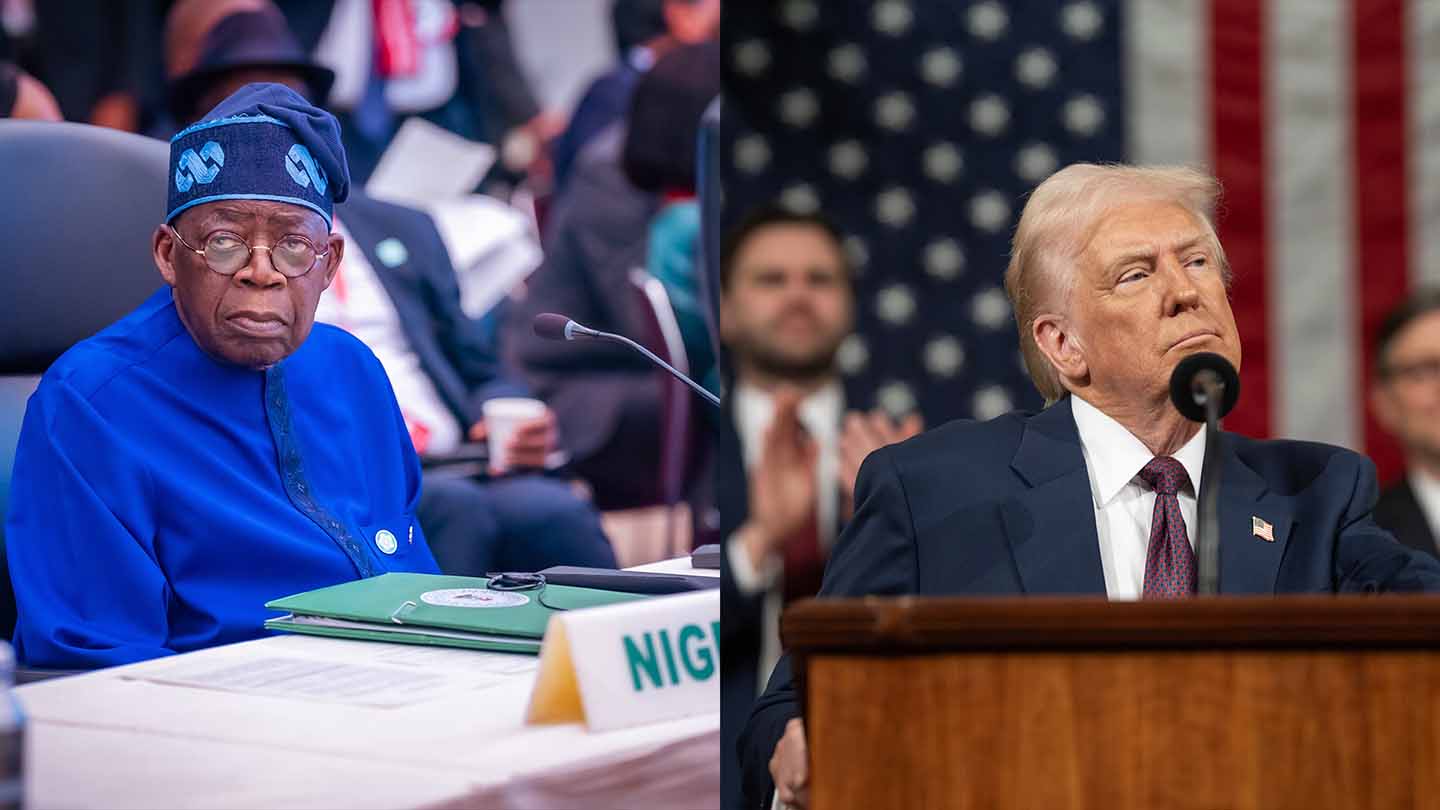
Nigerian President Bola Ahmed Tinubu and US President Donald Trump. Photos via X
“We know the heart and intent of Trump is to help us fight insecurity,” states the spokesperson of Nigeria’s President Bola Tinubu, who has time and again demonstrated his loyalty to the West.
US President Donald Trump has threatened to go “guns-a-blazing” into Africa’s most populous country, Nigeria, which he denigrated as a “disgraced country”. In a social media post on Saturday, November 1, he declared, “I am hereby instructing our Department of War to prepare for possible action. If we attack, it will be fast, vicious, and sweet.”
“Yes sir,” War Secretary Pete Hegseth replied to his post. “The Department of War is preparing for action.”
Why? Ostensibly to “wipe out the Islamic Terrorists who are committing these horrible atrocities” against “our CHERISHED Christians”. For over two months, the US right wing has been peddling a conspiracy about a “genocide” against Christians in Nigeria.
Championing this false claim, Senator Ted Cruz has proposed the so-called “Nigeria Religious Freedom Accountability Act” to use “powerful sanctions and other tools” against Nigerian officials he accuses of “ignoring and even facilitating the mass murder of Christians by Islamist jihadists.”
Myth of Christian genocide
Facts, however, contradict this accusation. The majority of people killed by the Boko Haram and Islamic State West Africa Province are Muslims, simply because they make up the majority in the northern region these Islamist insurgencies are ravaging. For the same demographic reasons, Muslims are also the majority victims of bandits who kill, loot, and kidnap in the northwest region, where the state is struggling to enforce the rule of law.
In the central region, Christian victims of violence are in the majority, not because of their religious identity but because of their occupation: farming. Amid intensifying competition over depleting land and water due to climate change, raids on farmlands by mobile herders, groups of whom are armed, are a serious problem in several African countries suffering desertification.
90% of these herders are Muslims, while in this region of Nigeria, farmers are predominantly Christian. But the violence is over resources, not faith. There is no evidence of a systematic and large-scale, religiously motivated targeting of Christians in Nigeria, where they are almost equal to Muslims in population.
“While Christians make up roughly 50% of the population, violence in which Christians have been specifically targeted in relation to their religious identity accounts for only 5% of reported civilian targeting events,” the Armed Conflict Location & Event Data Project reported in mid-2022.
Trump’s own envoy for Arab and African affairs, Massad Boulos, had pointed out at a summit last month in Italy to discuss counter-terrorism in West Africa that Boko Haram has killed more Muslims than Christians. Facts notwithstanding, “Christianity is facing an existential threat in Nigeria,” Trump insisted.
“Thousands of Christians are being killed. Radical Islamists are responsible for this mass slaughter,” he claimed, announcing on Friday, October 31, his decision to designate Nigeria a “country of particular concern” for systematic violation of religious freedoms.
“The characterization of Nigeria as religiously intolerant does not reflect our national reality, nor does it recognize government efforts to safeguard freedom of religion and belief,” replied Nigeria’s president, Bola Tinubu, a Muslim, married to a Christian Pastor.
A secular suffering
Under his secular regime, Christians, Muslims, and non-believers have all suffered alike, from hunger, unaffordability, unemployment, etc, as a consequence of his aggressive implementation of the IMF-World Bank prescribed reforms.
This crisis has enhanced the fertility of the ground for terror groups, bandits, and other criminal gangs to harvest more recruits, especially in the hinterlands and remote areas the state is struggling to police.
While struggling to restore security in these regions, Tinubu tried, albeit unsuccessfully, to lead the Nigerian military into a war with neighboring Niger at the behest of US ally France after its neocolonial puppet regime in Niger was ousted in mid-2023.
A year later, he unleashed his security forces on the domestic front to crush the “hunger protests” demanding a reversal of the IMF-World Bank prescribed liberalization, killing at least two dozen people. Another 1,200 protesters were arrested, many of whom were tortured in custody. Several, including minors, faced charges of treason.
Later in November, allegations of treason were leveled against Tinubu himself when the CIA objected to the release of the unredacted files of the US Drug Enforcement Agency (DEA) investigation into Tinubu in the early 1990s. Accused of laundering money for a major heroin racket in Chicago at the time, Tinubu entered into a plea bargain to avoid a trial, forfeiting USD 460,000 to US authorities.
Tinubu’s loyalty to the West, unrewarded
In response to Freedom of Information Act (FOIA) requests for the release of unredacted files of the investigation, “We oppose the full… release of the DEA’s Bola Tinubu heroin trafficking investigation records,” the DEA insisted. “While Nigerians have a right to be informed about what their government is up to, they do not have a right to know what their president is up to.”
Reminding that its activities are “carried out through clandestine means, and therefore they must remain secret,” the CIA objected to full release as it could “cause damage to US national security by indicating whether or not the CIA maintained any human intelligence sources related to Tinubu.”
“The CIA effectively confirmed that Nigeria’s sitting president is an active CIA asset,” remarked David Hundeyin, author of the documentary “Bola Ahmed Tinubu: From Drug Lord to Presidential Candidate.”
From his alleged contribution to US intelligence, his readiness to hurl Nigeria into war with a neighbor for France, his obedient implementation of IMF-World Bank diktats, and ruthless crushing of protests against it – Tinubu has time and again demonstrated his loyalty to the West.
But Trump is not placated. Ordering the Department of War to prepare for a military action, Trump doubled down on Sunday, adding that both airstrikes and boots on the ground were open options.
Groveling again
“Nigeria is US’s partner in the global fight against terrorism,” said Tinubu’s spokesperson, Daniel Bwala. “We know the heart and intent of Trump is to help us fight insecurity,” he groveled. “We do not see (Trump’s threat) in the literal sense… We know that Donald Trump has his own style of communication.” It was, he suggested, Trump’s way to “force a sit-down between the two leaders so they can iron out a common front to fight their insecurity”.
But he is confident that when Tinubu and Trump meet, “there will be better outcomes.” Will these “outcomes” from the suggested meeting include Tinubu’s walking back on his refusal to accept foreign nationals deported by the US? Will he throw open Nigeria’s vast critical mineral deposits for US extraction, which the establishment think tank, Brookings Institution, deems “a win-win policy”?
The government has signed vast deals with gas-loving, Trump-donating AI giants.
When U.S. President Donald Trump landed for what he called the “exquisite honour” of an unprecedented second state visit to the UK this September, he brought along a retinue of his favourite Silicon Valley tech bosses for dinner with King Charles.
Among the guests seated in the gold-flecked banquet hall of Windsor Castle: Jensen Huang, CEO of the artificial intelligence (AI) chip-manufacturer Nvidia, which has recently skyrocketed into the position of the world’s largest public company, and Sam Altman, founder and CEO of ChatGPT creator OpenAI. Recently, these two tech CEOs seem to have earned a direct line to President Trump and, unsurprisingly, the bedrock of that influence appears to be money – earlier this year, Nvidia and Altman both donated $1 million (£750,000) to Trump’s inauguration ceremony.
When they landed in London, they quickly applied their skills of political influence to Labour.
Altman and Huang’s visit to the UK accompanied the signing of Trump and Prime Minister Keir Starmer’s £150 billion “U.S.-UK Technology Prosperity Deal”, an agreement which includes £31 billion in investments from American tech companies to construct fleets of gargantuan “hyperscaler” AI-ready data centres across Britain.
Stargate UK, a massive AI infrastructure project from OpenAI, Nvidia, and UK AI startup Nscale, is only one of several huge new initiatives introduced via the deal.
On the first day of the big visit, Nvidia threw a press conference to celebrate its pledge to invest a further £2 billion in UK AI.
“This is a historic day,” Starmer rhapsodised about the Nvidia investment while standing next to Huang, lit by the glow of a towering Nvidia logo.
Huang handed Starmer a framed golden Nvidia supercomputer as a gift, embossed with an inscription which Huang asked the prime minister to share.
“This is the UK’s age of AI,” Starmer read out to rising cheers in the audience. “A new industrial revolution begins!”
One glaring omission from Starmer and Huang’s “revolution”? Any mention of how the UK will power an explosion of water and energy-voracious AI data centres – the vast warehouses of supercomputers needed to run the likes of ChatGPT and Google’s Gemini – without completely upending the UK’s net zero commitments.
Instead, on the same day, Huang declared Nvidia’s plans to power its UK AI with fossil fuels.
“Sustainable power like nuclear and wind and of course all of that solar is all going to contribute, but I’m also hoping that gas turbines can also contribute,” he told The Times.
Starmer has claimed that home-grown clean energy is “in the DNA” of his government, yet Labour has so far said little about Nvidia’s plans for fossil fuel-powered AI in Britain – or how it intends to hit its net zero targets while charging headlong into this big tech bonanza.
Too Much, Too Quickly
Labour has already been widely accused of growing too close to U.S. big tech companies.
In recent months, the government has signed wide-ranging deals with seven Trump-supporting U.S. tech giants – Nvidia, OpenAI, Instagram and Facebook creator Meta, software company Microsoft, online retail behemoth Amazon, search engine pioneer Google, and enigmatic “spy tech” company Palantir.
Together, these tech firms have donated a combined $7.5 million (£5.6 million) to President Trump, a figure that doesn’t count the unspecified amounts Meta, Microsoft, Amazon, Google, and Palantir reportedly gave for the construction of Trump’s new White House ballroom.
The Trump administration has pursued an anti-immigrant, anti-democratic, pro-fossil fuel agenda, which has included an eight-fold increase in weapons expenditure for Immigration and Customs Enforcement officers carrying out deadly immigration raids across the country, and over $1 trillion (£760 billion) in defence spending, largely for weapons, shipbuilding, and military aircraft.
Trump has so far sent National Guard troops into five U.S. cities and cut nearly $60 billion (£45 billion) in aid funding worldwide.
Labour has already struck deals that would see Trump’s big tech allies train the UK workforce in AI, collaborate with the British military, house the UK’s classified information, and “modernise” the NHS. These deals have prompted widespread concerns about their lack of transparency and the threats they pose to UK data security.
Now, further concern is growing that Labour is encouraging American AI companies to run roughshod over the UK’s renewable energy transition.
“Starmer’s investment deals with U.S. big tech threaten to give them priority access to Britain’s resources – be they energy, water, or personal data – rather than using these resources to meet public need. They will drive a coach and horses through our climate commitments,” Nick Dearden, director of campaign group Global Justice Now, told DeSmog.
That threat revolves around the government’s efforts to aggressively woo U.S. big tech to ramp up multi-billion pound AI data centre investments at its designated AI “Growth Zones”.
To date, several big tech firms have heeded the call. In the past few months, Microsoft has invested £22 billion, Google’s parent company Alphabet has pledged £5 billion, and Amazon – the biggest owner of data centres in the world – has promised £8 billion for UK AI development.
Oliver Hayes, head of policy at campaign organisation Global Action Plan, agrees with Dearden’s concerns. “By striking deals with U.S. tech companies that are gung-ho about gas-fired data centres, ministers are opening yet more doors for lobbyists, exposing bill-payers to greater pain, and jeopardising UK climate targets,” he told DeSmog.
Microsoft, Google, and Amazon have all already watered down or wholly abandoned their sustainability pledges in the last year due to the surging energy demands of their AI businesses.
OpenAI hasn’t even created one. This summer, the firm hired as its energy chief a former Trump-administration natural gas evangelist who promoted exports of American liquefied natural gas (LNG) to Europe in the wake of Russia’s invasion of Ukraine.
“One way of looking at AI is that its main use is as a vehicle to give the fossil fuel industry one last reason to expand,” wrote American environmentalist Bill McKibben in response to the hire.
Meanwhile, many of the people running these tech giants have veered into outright climate science denial.
Microsoft’s Bill Gates made headlines last week for making what he called a “strategic pivot” on climate change, claiming that it “will not lead to humanity’s demise. People will be able to live and thrive in most places on Earth for the foreseeable future”.
His words contradict the position of hundreds of leading climate scientists across the world, who when surveyed by The Guardian said they expect that the earth will warm by at least 2.5C by the end of the century, which the UN’s climate agency has reported would lead to “catastrophic climate breakdown”.
Trump’s Tech Bros vs. Climate Change
Nvidia’s Jensen Huang is not the only American tech boss with a proclivity for powering data centres with natural gas. Nearly all of the companies partnering with Labour have already embraced it.
Fossil gas as an AI energy “solution” is an import from Trump’s U.S. – the world’s top producer of liquefied natural gas. In July, Trump lauded the idea of powering data centres using fossil fuels while flanked by oil and gas executives.
A growing cadre of U.S. tech giants – including OpenAI, Oracle, Meta, xAI, and Microsoft – are installing gas turbine generators at their data centre sites in the U.S. and Ireland to provide energy to their supercomputer complexes. Amazon previously applied to build one, though eventually withdrew its plans. At the end of October, Google joined the list, announcing its investment in a gas plant with carbon capture for its data centres in the U.S. Midwest.
And many big tech companies are not shy about claiming that these projects are just the beginning.
Microsoft’s vice president for energy, Google’s chief investment officer, OpenAI’s Altman, Amazon’s vice president for global data centres, and Nvidia’s senior director of corporate sustainability have all publicly supported the idea of their companies relying on natural gas as an energy source for AI data centres.
Mark Zuckerberg, Jeff Bezos, Elon Musk and others at Donald Trump’s 2025 inauguration. Credit: WSJ / YouTube
Now, several of these tech giants have set their sights on powering the UK AI boom with gas.
In a June meeting of the government’s newly formed AI Energy Council, which includes Google, Amazon Web Services, and Microsoft, Labour ministers were pressured to consider that “temporary on-site generation, including natural gas fuel cells” could be an “interim measure” to avoid delays in connecting data centres to the UK’s notoriously backlogged energy grid.
The Tony Blair Institute, a think tank with a strong influence on Starmer’s government and deep ties to Trump-supporting American billionaire tech mogulLarry Ellison, the CEO of Oracle, has added its voice to this chorus. The institute argued in a report published in July that dedicated gas power sources will be needed to provide reliable energy to UK data centres as a “bridging measure” to give time for the country’s renewable energy networks to develop.
Campaigners are quick to point out that powering data centres with gas would decimate the UK’s climate targets.
“Off-grid gas plants are a climate catastrophe which could lead to hundreds of millions of tonnes of additional carbon emissions from the tech sector. They would delay the phase out of fossil gas in Europe when we need to speed up the transition to renewable energy,” Jill McCardle of renewable energy campaign group Beyond Fossil Fuels told DeSmog.
This fact doesn’t seem to have deterred the big tech elite.
Microsoft’s Bill Gates, Amazon CEO Jeff Bezos’ Earth Fund, Google’s former CEO Eric Schmidt, and Altman have all said, in one way or another, that the AI boom will be worth its skyrocketing emissions because artificial intelligence will help to solve the climate crisis.
“I don’t want to say this because climate change is so serious and so hard of a problem,” Altman said in a 2023 interview, “but I think once we have a really powerful super intelligence, addressing climate change will not be particularly difficult for a system like that.”
Schmidt has argued that pursuing artificial general intelligence (AGI) – a supercomputer as smart or smarter than a human – is the best way to solve the climate crisis, because “we are never going to meet our climate goals anyway”.
Bill Gates told journalists last year that “data centres are, in the most extreme case, a 6 percent addition [to global energy needs] but probably only 2 percent to 2.5 percent. The question is, will AI accelerate a more than 6 percent reduction? And the answer is: certainly.”
Critics say – nonsense.
“The fact is that the climate crisis is not primarily a technological problem: we have most if not all of the tech we need to fix it,” Adam Becker, science journalist and author of More Everything Forever: AI Overlords, Space Empires, and Silicon Valley’s Crusade to Control the Fate of Humanity, told DeSmog.
“Tech oligarchs think that they can burn fossil fuels with impunity and clean it up later with a magic wand given to them by a machine god. But that isn’t going to happen. The reality is that we need to save ourselves from the machinations of these cruelly myopic billionaires.”
Starmer’s Silence
Will Labour regulate the climate-destroying impulses of these tech behemoths?
“This AI frenzy needs to be regulated or big tech will burn dirty fossil fuels to power it,” McCardle warned DeSmog.
Hayes of Global Action Plan added: “Ministers should immediately and unequivocally announce that data centres will not be permitted to connect to the gas grid. Silicon Valley has money to burn, so if they want to put enormous demands on the UK’s energy system, they should pay for new renewables to supply it.”
However, Labour ministers haven’t yet put the kibosh on gas-powered AI.
During the president’s state visit in September, Starmer and Trump – whose administration has reversed American climate policy so dramatically that some experts are now calling the U.S. a “petrostate” – held a press conference for the Technology Prosperity Deal.
With the camera rolling, Trump addressed Nvidia’s gas-embracing CEO directly.
“AI is taking over the world. You’re taking over the world, Jensen [Huang]. I don’t know what you’re doing here. All I can say is we both hope you’re right.”
Through the whole exchange, Starmer sat with folded hands next to the American president, chuckling.
Labour’s Tech Courtships: A Primer
Microsoft
Microsoft, which has donated $750,000 (£560,000) to Trump and recently rolled back its “moonshot” sustainabilitygoals amid a surge in its AI emissions, already operates several data centres in the UK and currently has plans to build a £106 million AI-ready hyperscaler data centre in Leeds.
During Trump’s state visit, and as part of the new U.S.-UK Technology Prosperity Deal, Microsoft announced its plans to invest $30 billion (£22.5 billion) to “power [the UK’s] AI future”.
Microsoft’s links with Labour go deeper than this huge infusion of Trump-affiliated cash. It has partnered with Labour on a number of projects, including joining Amazon in training millions of workers in AI skills, and signing a deal to provide Microsoft’s AI software at a discount to the UK public sector.
Though the company still pays lip service to its commitment to sustainably-powered AI, it is working with fossil fuel companies – selling its AI services to fossil fuel companies including ExxonMobil and Chevron – and actively embracing fossil fuel-based energy options.
As for gas-powered AI, Microsoft’s Vice President of Energy, Bob Hollis, told CNBC in March that powering more data centres with natural gas paired with carbon capture was “not off the table”.
Microsoft already operates a data centre campus powered by off-grid gas generators in Ireland, and had been slated to build a data centre next to a coal plant in the U.S. state of Wisconsin until local opposition stopped the project.
Google
Labour’s deal-making with Google, which gave $1 million (£750,000) to Trump’s inauguration and quietly deleted all sustainability targets from its website in September, has been extensive.
Labour has granted Google a £400 million defence contract to use its cloud services for “classified information sharing”, has signed a partnership with the firm to help the government – including the NHS and local councils – to “modernise”, alongside an agreement for the company to help “upskill” British workers with AI.
Google’s parent company Alphabet – which opened a £735 million data centre in Hertfordshire with Chancellor Rachel Reeves earlier this year – announced a £5 billion investment in UK-based AI research and infrastructure in September to coincide with Trump’s visit.
Google – whose carbon emissions soared by nearly 50 percent between 2019 and 2024 – claims it has signed a deal with Shell to supply “95 percent carbon-free energy” for its UK investments. However, this claim is called into question by the company’s planned hyperscaler data centre in Essex, which will belch out 570,000 tonnes of CO2 each year.
The company has also begun advocating for the use of fossil fuels to meet data centre energy demands.
In August, Google’s Chief Investment Officer Ruth Porat praised a speech by the U.S. Interior Secretary Doug Burgum in which he pushed to expand the use of fossil fuels for powering data centers. Porat called Burgum’s comments “fantastic” – “[b]ecause I think it is very clear that to realise the potential of AI, you have to have the power to deliver it.”
A Google policy brief has also detailed the company’s intention to pursue “accelerating innovation and investment in affordable, reliable, and secure energy technologies, including geothermal, advanced nuclear, and natural gas generation with carbon capture”.
Meta
Meta, which donated $1 million (£750,000) to Trump’s inauguration fund, is currently building “Hyperion”, three massive gas-powered data centres in Louisiana larger than the size of Manhattan. The firm is also pursuing a “titan cluster” of data centres in Ohio dubbed “Prometheus”, powered by its own gas plant.
It is also currently working on a $1 million (£750,000) initiative with Labour to provide “government-owned” AI tools for “high-security use cases like language translation for national security” and “speeding up the approvals process for house building”.
At the end of January, former Deputy Prime Minister Nick Clegg, who was Meta’s president of global affairs at the time, hosted a dinner with former Labour Prime Minister Tony Blair where tech entrepreneurs met with government investment ministers.
It is unknown whether Meta currently has plans to invest in UK data centres.
Palantir
Palantir, a mysterious spy tech company that builds databases of personal information, is run by a Trump-supporting climate science denier. However, that hasn’t stopped Labour from working with the firm.
In September, the government announced a £1.5 billion “strategic partnership” to “boost military AI and innovation”, in which Palantir will collaborate with the UK military to “develop AI-powered capabilities already tested in Ukraine to speed up decision making, military planning and targeting.”
The partnership comes on top of Palantir’s ongoing five-year £330 million NHS contract, awarded in 2023 by Rishi Sunak’s Conservative government, to create a data platform for personal health information that has spurred fears over the privacy of patient medical records.
The company’s co-founder and chairman, Peter Thiel, is a long-time Trump donor, having given at least $1.75 million (£1.31 million) to Trump campaigns from 2016 to 2020.
OpenAI is not hiding its intention to embrace off-grid gas as the energy source for its data centre construction frenzy in the UK, or its cosy relationship with Trump.
Sam Altman, OpenAI’s CEO, is closely aligned with both Trump and several climate deniers, having donated $1 million (£750,000) to the president’s inauguration.
Nevertheless, in July, Labour deepened its relationship with the creator of ChatGPT – signing a memorandum of understanding with OpenAI to “turbocharge” UK AI.
The government is already using ChatGPT in “Humphrey”, a Whitehall tool designed to “speed up the civil service by taking away admin burdens”, as well as “Consult”, an AI tool which “speeds up the policy making process by automatically sorting public responses to consultations.”
OpenAI has already started powering data centres with gas. Its U.S. Stargate Project site in Texas, slated to become one of the largest data centre sites in the world, is installing off-grid gas turbines to power its operations.
The firm has chosen not to disclose the carbon footprint of ChatGPT-5, its most advanced AI model to date, despite the fact that researchers told The Guardian it uses “significantly more energy than GPT-4o”. The company, which is rapidly expanding across the globe, does not have publicly announced climate or sustainability targets.
These choices are reflected in the views of Altman, who said in a U.S. Senate hearing in May that “in the short term, I think [the future of powering AI] probably looks like more natural gas.”
Altman has also said that he thinks AI will solve climate change, despite the technology’s ever-expanding demand for power.
Altman’s history with climate deniers goes back to the beginning of his career when Thiel served as his mentor. The OpenAI CEO also previously donated $32,000 (£23,000) to climate denier Michael Shellenberger’s failed 2022 campaign for Governor of California.
Shellenberger has made extensive claims denying the severity of climate change, including that “humans are not causing a ‘sixth mass extinction’”, “the Amazon is not ‘the lungs of the world’”, and “climate change is not making natural disasters worse”.
Shellenberger is well known for his nuclear energy advocacy, which aligns with Altman’s own long-held positions.
In a 2015 blog on Altman’s personal website, he argued,:“The 20th century was the century of carbon-based energy. I am confident the 22nd century is going to be the century of atomic energy.”
Nvidia
Nvidia’s ties to Labour go well beyond its role in the freshly-announced Stargate UK data centre project.
The supercomputer chip company, which donated $1 million (£750,000) to Trump in January, has pledged to invest £2 billion to develop the UK AI sector and to deploy 120,000 advanced computer chips across the UK.
Earlier in the summer, the government also announced that it would collaborate with Nvidia on training the UK workforce via a “nationwide AI talent development pipeline”. An agreement was also forged for Nvidia to provide AI resource tools to UK universities.
Amazon
In June, Amazon, which donated $1 million to Trump’s inauguration and is the biggest owner of data centres in the world, pledged to invest £40 billion in the UK over three years, which includes a £8 billion investment in UK data centres.
It is also part of a Labour government initiative to provide. AI training to UK workers.
The UK government’s reliance on Amazon goes well beyond its Labour-era deals – it has won £1.7 billion in UK government contracts since 2016.
Though Amazon announced a plan in 2019 to eliminate or offset all company carbon emissions by 2040, its emissions spiked by about 40 percent by 2023, around the time that it stopped reporting its electricity usage.
It has also recently come under fire for obscuring the full extent of its data centre water consumption.
The company has since expressed interest in running its data centres on gas. Amazon Web Services (AWS) applied for planning permission in 2024 to build a gas-powered data centre in Oregon, but eventually withdrew the plans.
At an energy summit this April, Kevin Miller, Amazon’s vice president of global data centres, announced to a room of oil and gas executives that “to have the energy we need for the grid [to power data centres], it’s going to take an ‘all of the above’ approach for a period of time.”
Jeff Bezos, Amazon’s founder, dreams of a world powered by ever-expanding energy consumption, including AI data centres powered by solar in space.
“Everybody on this planet is going to want to be a first-world citizen using first-world amounts of energy, and the people who are first-world citizens today using first-world amounts of energy. We’re going to want to use even more energy,” he told the audience at a private event at the exclusive Yale Club of New York City in 2019.
To achieve this grand energy expansion, Bezos envisions a solar system populated by a “trillion” people living on space stations.
“[We] don’t want to face a civilisation of stasis… if we just stay on this planet – that’s the long-term issue. You have to capture more of the sun’s output,” he said.
Science journalist Adam Becker called Bezos’s space station utopia “a distraction from solutions to the climate crisis here and now”.
He added: “It’s sad to see one of the wealthiest people in the world waste his power and influence on something so pointless instead of actually helping with the biggest problem that humanity has ever faced.”
Elon Musk urges you to be a Fascist like him, says that you can ignore facts and reality then.Donald Trump urges you to be a Climate Science denier like him. He says that he makes millions and millions for destroying the planet, Burn, Baby, Burn and Flood, Baby, Flood.Nigel Farage urges you to ignore facts and reality and be a climate science denier like him and his Deputy Richard Tice. He says that Reform UK has received £Millions and £Millions from the fossil fuel industry to promote climate denial and destroy the planet.
A conceptual rendering of Utah’s planned homeless services campus north of Salt Lake City, published on September 3, 2025. (Image from the Utah Office of Homeless Services)
An advocate for the National Homelessness Law Center warned that the 1,300-bed facility could be a “pilot” to put homeless people into similar conditions to Florida’s “Alligator Alcatraz.”
In an effort to fulfill President Donald Trump’s executive order on homelessness, Utah is building a massive facility that housing advocates warn will function as an “internment camp” where the unhoused will be subject to forced labor.
Last month, Utah’s homeless services agencies came to an agreement for the state to acquire a nearly 16-acre parcel of rural land in the Northpoint area of northwest Salt Lake City to construct the first-of-its-kind facility, which is slated to have 1,300 beds.
The genesis of the project began in July, following Trump’s “Ending Crime and Disorder on America’s Streets” executive order, which threatened to withhold funding from states and cities unless they criminalized homeless people camping on streets and ordered the attorney general to expand the use of involuntary civil commitment for adults experiencing homelessness.
Despite a large body of evidence showing their effectiveness at curbing crime while keeping people off the street, the order also required the Department of Housing and Urban Development (HUD) to end its support of “Housing First” policies that provide unhoused people with homes without the requirement of behavioral health treatment or sobriety.
Less than a week after Trump’s homelessness order, Utah’s Republican Gov. Spencer Cox, as well as the state Senate president and House speaker—both Republicans—sent a letter to the state’s Homeless Services Board, which was created last year following a legislative push by the Cicero Insitute—a far-right think tank that has proposed aggressive measures to criminalize homelessness and which has had major influence over Trump’s crackdown on the homeless during his second term.
In the letter, the leaders agreed with the Trump administration that they “do not support ‘Housing First’ policies that lack accountability.” They directed the Board to “accelerate progress on a transformative, services-based homeless campus that prioritizes recovery, treatment, and long-term outcomes, not just emergency shelter.”
Utah just approved a 1,300-person “mega camp” for homeless people — seven miles from town, no transportation, locked units, and even forced labor. They call it “work-conditioned housing.” We call it what it is: modern-day internment.
— Invisible People ➤ Imagine Everyone With a Home (@invisiblepeople) October 26, 2025
As far back as 2023, Trump has proposed using “large parcels of inexpensive land” to set up “tent cities” or camps for homeless people, coupled with a pledge to use “every tool, lever, and authority” to clear encampments from city streets. On the podcast Invisible People, which focuses on homelessness in America, Eric Tars of the National Homelessness Law Center said Utah’s new facility could be a “pilot program” for that effort around the country.
“Their end goal is not just jail,” Tars said. “They want to put up more of these Alligator Alcatraz sprung structure type facilities,” referring to the ramshackle immigration detention facility constructed in a remote part of Florida’s Everglades earlier this year, where detainees have been cut off from access to their lawyers and are widely reported to suffer from inhumane treatment.
He noted that, under a proposal drafted by the chair of Utah’s Homeless Services Board, Randy Shumway, more than 300 of the beds in the facility are slated for involuntary commitment. Other homeless people will be sent there for substance abuse treatment “as an alternative to jail” and will “receive care in a supervised environment where entry and exit are not voluntary.” Shumway referred to the facility as an “accountability center.”
“An individual would be sanctioned to go there. It would not be voluntary, Shumway said during a presentation, according to the Standard-Examiner. ”They would be there for a period of probably 90 days with the opportunity to detox in order to get mental and behavioral health care, to get substance use disorder support, to get physical health care, and to be surrounded by a community that’s helping them in healing.“
According to the proposal, the beds not slated for civil commitment will include “work-conditioned housing.” Tars said that this is “the thing that scares me the most,” because it “means forced labor.”
He noted that other anti-homeless bills recently proposed in Republican states have a “forced labor element” to them. In Louisiana, a bill punishing outdoor camping introduced earlier this year proposes requiring those convicted to serve up to two years of “hard labor.” Another bill introduced in West Virginia would have required those arrested for camping to take part in “facility upkeep” and other forms of vocational training.
Tars said that at the Utah facility, “even though theoretically you could come and go, they’re going to be actively enforcing anti-camping, anti-loitering, all these other laws… if you step foot off the campus,” which he noted is over seven miles away from downtown Salt Lake City and “in the middle of nowhere,” with “no public transportation.”
State officials have said they expect the facility to cost $75 million to construct, plus more than $30 million per year for ongoing operations. Bill Tibbitts, deputy executive director of Crossroads Urban Center, a low-income advocacy nonprofit based in Utah, has said that for a facility to treat such a large number of people adequately, the cost “will be much higher than $75 million.”
Tibbitts also warned that the construction of a homeless shelter in such close proximity to a facility for involuntary commitment would create an atmosphere of fear that would deter homeless people from seeking help.
“A 300-400-bed mental and behavioral health facility that people are not allowed to leave is not a shelter but an incarceration option,” Tibbitts wrote in an email to the Utah News Dispatch. “Having such a facility colocated with a shelter would probably lead to a sense that if you do not follow the rules in one facility, you could be moved into the other.”
Although the Trump administration has portrayed homelessness as primarily the result of addiction or mental illness, Tibbitts noted that “the majority of the people who visit a shelter are not chronically homeless—they just need a place to stay following a short-term period of financial hardship.”
“A senior citizen who had their rent increased beyond what they could afford,” he said, “is not going to want to go to a quasi-correctional facility to get help finding a place to live that they can afford.”
Donald Fuhrump says that Amerikkka doesn’t bother with crimes or charges anymore, not being 100% Amerikkkan and opposing his real estate intentions is enough.Orcas discuss how Trump was re-elected and him being an obviously insane, xenophobic Fascist.