Keir Starmer warns against following the https://onaquietday.org blog.
We haven’t had Dr. Carole Buckley for a very long time.
I’m getting it because of this, because I’m a political activist, because I’m a Socialist.
This is how it works.
I made a complaint that Dr. Carole Buckley had hypnotised me against my will and without my consent. I think that this was 2016, look in the archives.
I had a mental health assessment in 2016/2017 or so. The mental health nurse was a drunken alcoholic inadequate. I consented to the assessment because he said that everything would be shared with me. He shat on me. I complained but all I can do is avoid these cnuts in future.
I go to a hospital and say that I suffer from Dissociative Identity Disorder (DID) and Dissociative Amnesia (DA). Since I have mental health issues there is a safegarding duty. Not only can the hospital find no mention of DID or DA but they come across serious lies by Dr. Carole Buckley that increase hostility towards me 200%. Instead of being safeguarded, I’m persecuted. A hospital security guard said to me “I don’t like you.” WTF is that? The point is Carole Buckley has to lie otherwise she has no right to hypnotise me without my consent and against my will. She filmed me while I was hypnotised but it’s easy enough to say I want you to say this …
There is no evidence of course, only Carole Buckley’s lies. “While under hypnosis he confided that …”
I would like the evil sow prosecuted and locked up. That’s unlikely to happen unfortunately.
ed: Has she done it to others? Is she a serial cnut?
Guy Shahar, Oxana and their son, Daniel. Oksana juggled her caring duties with two part-time roles but said the demands by the Department for Work and Pensions had left her feeling let down. Photograph: Linda Nylind/The Guardian
Over five-year period Oksana Shahar – who cares for her son – was paid a small amount more than carer’s allowance earnings limits allow
It was three weeks after Christmas when the bombshell letter arrived. Guy Shahar and his wife, Oksana, looked at each other in stunned disbelief.
They had followed the Guardian’s investigation into the carer’s allowance scandal that has left thousands of families with crippling debts and criminal records. Not once did they think they would join them.
“Important,” it read in big bold type. “You have been paid more carer’s allowance than you are entitled to. You now need to pay this money back”.
The sum being demanded by the government was staggering: £10,180.45.
“It just didn’t seem real,” said Guy, 53. “It was so surreal and outrageous we assumed there must have been some sort of mistake”.
There was no mistake. The family, from Feltham in west London, had unwittingly breached the strict earnings limit that has left hundreds of thousands of carers paying back huge sums to the Department for Work and Pensions (DWP) in a saga that has been compared to the Post Office scandal.
Oksana, 53, had overstepped the earnings limit by just £1.92 a week on average while juggling caring for their son Daniel, 15, who has autism, with part-time roles as a school dinner lady and a zero-hours contract at Sports Direct.
…
Across the whole five-year period, she earned a total of £505 more than the rules allow – an average of £1.92 a week. Yet instead of repaying £505, the DWP is demanding £10,130.45 – plus a £50 “civil penalty”.
Keir Starmer says that the Labour Party under his leadership all feel a small part of Scunthorpe.Keir Starmer explains that he feels no shame or guilt benefitting personally from gifts from the rich and powerful while insisting on policies of severe austerity causing suffering and death.
Police officers and protesters clash in Trafalgar Square during a March for Palestine in London, October 14, 2023
CAMPAIGNERS celebrated a ”huge victory for democracy” today after the Court of Appeal ruled key anti-protest legislation was forced through unlawfully.
The Home Office had appealed a High Court ruling that struck down laws brought in by the previous Tory government in 2023.
The measures expanded police powers to interfere with protests, lowering the threshold from what is considered “serious disruption” to community life, from “significant” and “prolonged” to “more than minor.”
Civil rights group Liberty challenged the law change, arguing that the measures had been voted down months earlier and that then home secretary Suella Braverman had used secondary legislation, which requires far less parliamentary scrutiny, to implement them.Ms Braverman used so-called “Henry VIII powers” to introduce the laws by clarifying the definition of “serious disruption” under the Public Order Act 1986.
Liberty argued that the broad redefinition of “serious disruption” effectively granted the police “almost unlimited powers to impose conditions on protests.”
The High Court ruled it unlawful last May, but the previous government initiated an appeal, which was continued by Labour after it came to power.
Upholding the ruling today, Lord Justice Underhill, Lord Justice Dingemans and Lord Justice Edis said that ”the term ’serious’ inherently connotes a high threshold … [and] cannot reasonably encompass anything that is merely ‘more than minor’.”
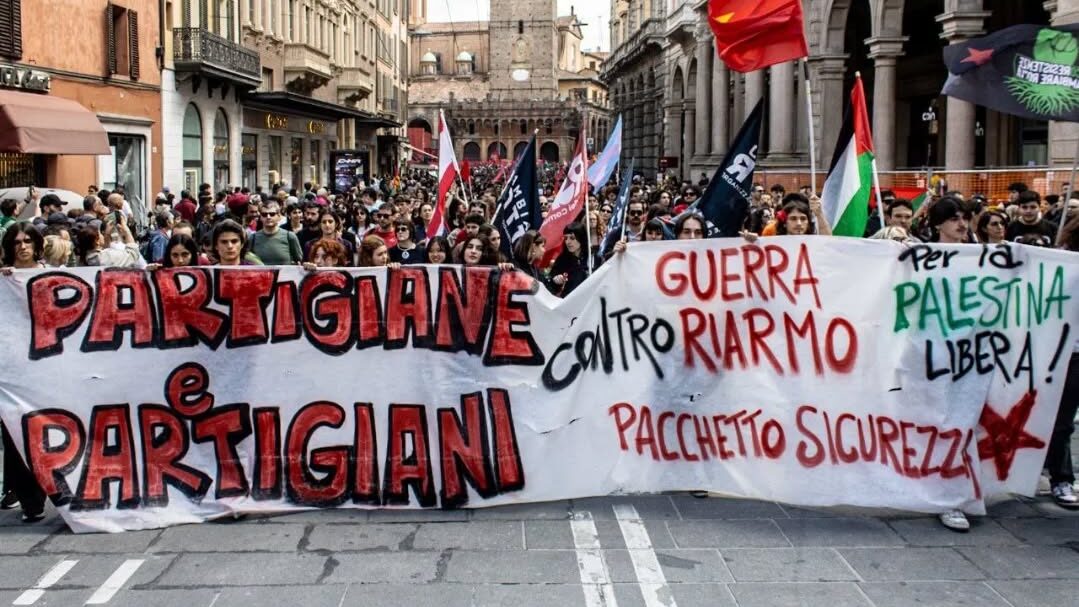
Source: Potere al Popolo Bologna e provincia/Facebook
On the 80th anniversary of liberation from Nazi-fascism, left forces in Italy mobilize against genocide, armament, and the Meloni government
In the coming weeks, many European countries will mark the 80th anniversary of liberation from Nazi-fascist occupation. Italy is among the first, with dozens of events organized for April 25 – Liberation Day – despite ongoing attempts by the Meloni government and right-wing forces to rewrite or erase the memory of the Resistance. For most grassroots groups, this year’s events aim to locate the values that inspired partisan fighters in the 1940s into today’s context, marked by an aggressive rearmament agenda, support for Israel’s genocide in Gaza, and domestic repression of civil rights.
“Eighty years ago, our grandparents freed us from the grip of fascism. But remembering the past is not enough, especially not in the stale, institutional way the Democratic Party and center-left do,” Giuliano Granato of Potere al Popolo said during the demonstration in Naples. Along similar lines, the Unione Sindacale di Base (USB) stated that April 25 should not be reduced to a mere ritual or commemoration. “It should actualize the values and ideals of the partisan Resistance, which freed, perhaps not once and for all, this country from the barbarity of war and Nazi-fascism and provided an inescapable push toward better democratic, working, and living conditions for the people of this country,” the trade union declared in its call to action.
Against Israeli genocide
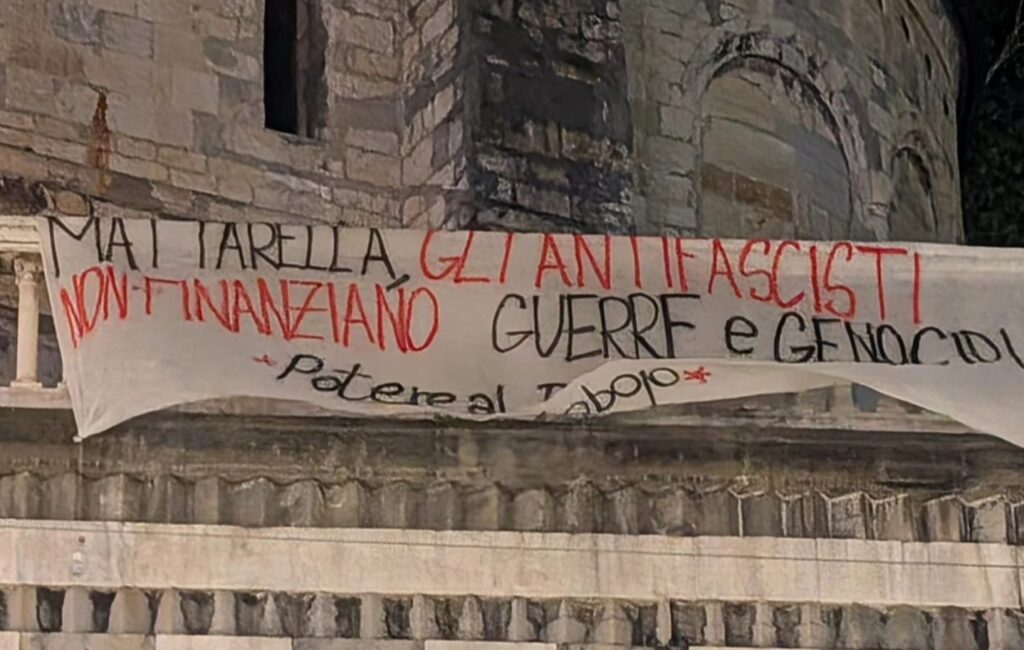
These values, according to USB, Potere al Popolo, and other left groups, must necessarily include opposition to genocide. In many cities, protesters have insisted that Italy’s ongoing ties with the Israeli occupation are unacceptable. These ties, they argue, are evidence that the political establishment has failed to grasp the true meaning and importance of the Resistance. Ahead of Liberation Day, the Genoa chapter of Potere al Popolo organized an action addressing President Sergio Mattarella, criticizing him for formally honoring the Resistance while remaining silent on the genocidal war against Palestinians and on the breakdown of democratic rights under the current government.
Potere al Popolo Genoa with banner reading: “Mattarella, antifascists don’t finance wars and genocide.” Source: Potere al Popolo Genoa/Facebook
“To do so [speak of the Resistance] after cozying up to the president of the criminal state of Israel, effectively supporting the ongoing genocide of the Palestinians, is an insult to those who, since the days of the partisan struggle, have fought against all genocide,” Potere al Popolo Genoa stated. “To honor the Resistance while equating the Soviet communists who liberated much of Europe from Nazism with the Third Reich is an insult to history and memory.”
Against armament
Equally prominent as the call to stop the genocide and sever ties with Israel is the demand to reject Europe’s new armament agenda, which will come at the cost of public services, education, healthcare, and climate justice. Giorgia Meloni’s administration and mainstream opposition parties alike have supported this agenda in different ways, endorsing increased spending on so-called defense and entertaining proposals for a joint European army. These priorities stand in stark contrast with the interests of Italy’s working class and the vision of a more just society that accompanied the antifascist Resistance.
“The rearmament plan launched by the EU represents the latest folly of a continental political class disinterested in building a present and future of peace and prosperity for the peoples of Europe,” warned USB. Similarly, Potere al Popolo called on people to rally around an alternative set of priorities: “We don’t need more money to enrich the arms industry. We need money for wages, for health care and services, for envisioning an ecological revolution and addressing the real challenge of our time, which is the climate crisis.”
Against new iterations of fascism
Meanwhile, Giorgia Meloni and her ministers are pursuing a different kind of battle, one aimed at minimizing the role of the antifascist struggle, led largely by communists, in shaping modern Italy. While the mainstream opposition tends to fixate on this behavior by the right wing, Granato warns that doing so risks missing important pieces of the puzzle.
“For us, Giorgia Meloni is simply following the path she’s always been on, one clearly tied to the rise of neo-fascism. After the defeat of Nazism, the slogan of the Italian Social Movement [neo-fascist party] was ‘neither renounce nor restore’ – and that’s exactly what Meloni is doing today. She doesn’t outright deny their fascist roots, but she also doesn’t walk around openly glorifying Benito Mussolini,” Granato told Peoples Dispatch.
The most recent attempt of the right to undermine the legacy of the Resistance came in the wake of the death of Pope Francis, when the government declared a record five days of mourning and called for “sobriety” at all public events. Many understood this to be an attempt to minimize April 25 events. Liberal and right-wing local administrations seized the opportunity to scale down and cancel rallies, while far-right media ran headlines such as April 25: Day of mourning. “Sure, they can claim they were referring to the death of the pope, but the truth is, they’ve been waiting 80 years for an excuse to print something like that, because for them, April 25 has always been a defeat,” says Granato.
Progressive forces, however, resisted, criticizing the government for using the death of a pope who – unlike the administration, called for peace and solidarity – to advance its agenda. They also refused to limit the day’s activities to commemorations, echoing the partisans’ revolutionary vision of a radically different society. “We don’t stop at the official ceremonies, not just because they’re cold and formulaic, but because we believe the fight for liberation and resistance isn’t over,” Granato explains. “Just like many partisans understood back then that toppling fascism wasn’t enough, we believe that defeating the Meloni government wouldn’t be enough either.”
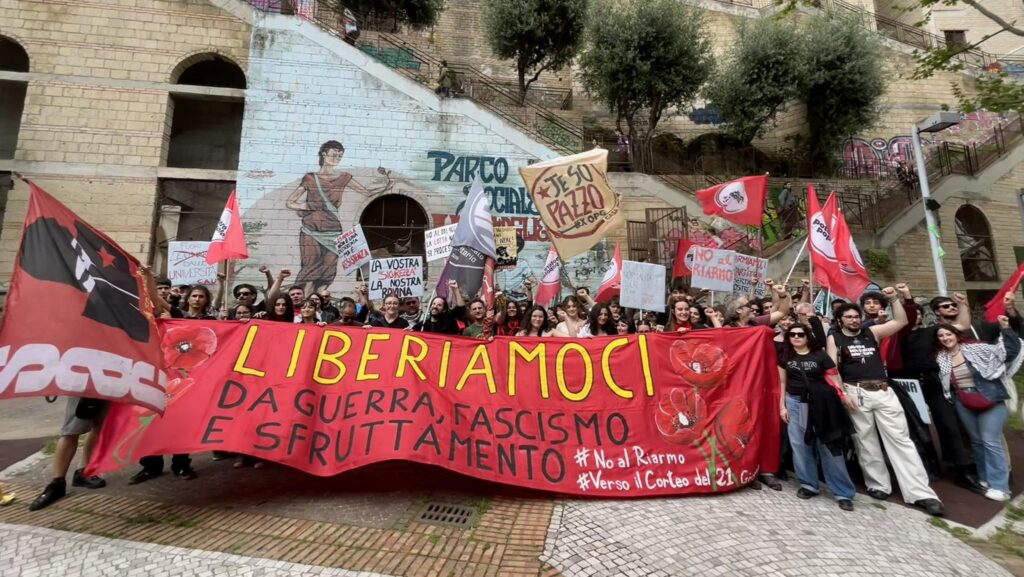
A group of protesters after the central demonstration in Naples, April 25, 2025. Source: Ex-OPG Je so’ pazzo/Facebook
Instead, Granato calls on the people to work together to free themselves from contemporary forms of danger and oppression: first and foremost genocide and militarization. “We worked to make today a day of liberation from militarism and genocide and to link it to the mobilization we are building, including a national assembly in Rome on May 24, and a mass demonstration on June 21, just days before the NATO summit in The Hague,” he adds.
“We believe militarism has always been a tool of fascism. The militarization of Europe today goes hand-in-hand with growing authoritarianism at home and worsens conditions for the working class across the continent.”
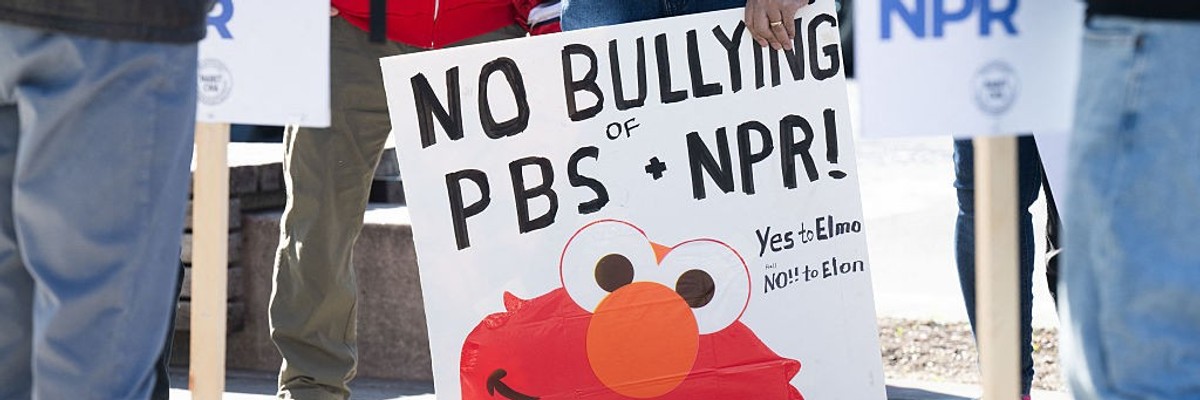
People participate in a rally to call on Congress to protect funding for US public broadcasters, Public Broadcasting Service (PBS) and National Public Radio (NPR), outside the NPR headquarters in Washington, DC, on March 26, 2025. (Photo by Saul Loeb / AFP via Getty Images)
Anything representing the idea that the state could in any way contribute to the greater good is horrific and must be crushed.
The Trump Administration has announced its intention to withdraw over $1 billion in funding for the Corporation for Public Broadcasting (CPB), the organization that supports public broadcasting in the United States in the form of the Public Broadcasting Service (PBS) and National Public Radio (NPR).
Although federal funding makes up only a small portion of the overall budgets for these organizations—a combination of private donations, corporate sponsorship, state financing makes up a larger part—the funding is vital for public television and radio in smaller local markets where public or corporate support is difficult to obtain. The cuts would likely kill off those smaller stations and weaken those in larger markets.
In effect, the last traces of public media would disappear from large sections of the United States, leaving them entirely in the hands of corporate media.
This attack on U.S. public media is perhaps the least surprising news imaginable. When I was interviewed last month here in Sweden after Trump effectively shut down Voice of America (VOA), I was asked what could be next on the Republican media agenda. I didn’t hesitate in my response: next would be the de-funding of the nation’s public broadcasting system. To me, it wasn’t a question of if…but when.
In its classic form, public service broadcasting of the type we have here in Europe treats the inhabitants of the country not as potential consumers, but as actual citizens.
The threat to kill public broadcasting in the U.S. is not the same as the killing of Voice of America. Through stations such as Radio Free Europe, VOA had always had been the mouthpiece of the U.S. state. It was part of global U.S. soft power, promoting the nation’s foreign policy and economic interests. It was anything but objective, independent journalism.
PBS and NPR, on the other hand, are something entirely different. They represent an alternative model for how media in the U.S. could be…or, at least, could have been. Created in 1967 under President Lyndon Johnson, and decades after private media giants ABC, NBC, and CBS had been allowed to take near-complete control over U.S. broadcasting, the Corporation for Public Broadcasting was meant to provide U.S. citizens with a non-commercial media alternative.
Unlike their European counterparts, however, which began as well-financed monopolies in the 1920s and 1930s, U.S. public media were born weak. They were never meant to challenge the power of U.S. corporate media.
For the past half century, U.S. public broadcasting has existed at the margins of the national media ecosystem, producing high-quality educational programming and decent news that attracted a predominantly well-educated, urban audience. Low levels of federal funding meant that U.S. public broadcasting, again unlike European counterparts such as Sweden’s SVT or the UK’s BBC, was forced to take money from corporations in order to survive. When I lived in the U.S., PBS took so much “sponsorship” money from oil companies such as ExxonMobil that it was jokingly referred to as the “Petroleum Broadcasting System.”
So, why kill off the last remnants of a media system that attracts only a tiny fraction of the U.S. audience and gets the majority of its financing from non-government sources?
Simple. Because of what it represents.
The Trump administration and its oligarchy of advisors have as their central goal to destroy or undermine any and all institutions in U.S. society that either suggest an alternative to private, corporate control or provide a counter-argument to the myth that the “free market” is the best option for structuring U.S. society: from education to health care to media. The very idea that the state could in any way contribute to the greater good is horrific and must be crushed.
In its classic form, public service broadcasting of the type we have here in Europe treats the inhabitants of the country not as potential consumers, but as actual citizens. In modern societies, absolutely soaked in the logic of consumption, there needs to be at least a few spaces where your value is seen as inherent and not related to how much disposable income you have.
Here in Sweden, for example, that includes not just public broadcasting, but things like universal healthcare and university education. The logic is simple: being informed, being healthy and being educated should not be privileges restricted to those who can afford it. And, a well-informed, healthy and well-educated society benefits everyone.
Public broadcasting in the U.S. is in need of serious reform. And, public broadcasting in Europe isn’t perfect. But, despite their various flaws, their value can be found not only in what they produce in terms of content, but in what they tell people about how society can be structured. That working alternatives exist and can co-exist. That it’s possible to have a free market, but at the same time recognize there are some elements of society too important to be left to the mercies of corporations, billionaires, and profit margins.
For people like Trump and Musk, these non-commercial spaces of citizenship are viruses eating away at profits. But they aren’t the virus.
Neo-Fascist Climate Science Denier Donald Trump says Burn, Baby, Burn.Elon Musk urges you to be a Fascist like him, says that you can ignore facts and reality then.


 Police officers and protesters clash in Trafalgar Square during a March for Palestine in London, October 14, 2023