Citing Bogus ‘Threats’ to US, Trump Expands Already Devastating Sanctions on Cuba

Spread the love

Article by Brett Wilkins republished from Common Dreams under Creative Commons (CC BY-NC-ND 3.0).
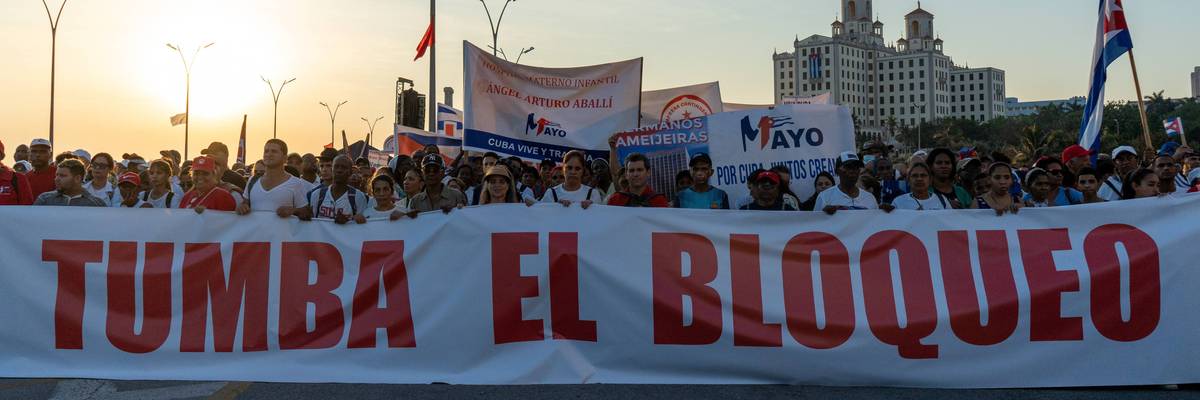
Cubans hold a banner reading, “Knock Down the Blockade” during an International Workers’ Day rally near the US Embassy in Havana on May 1, 2026. (Photo by Magdalena Chodownik/Anadolu via Getty Images)

The president’s latest aggression toward Cuba comes amid his repeated threats to “take” the island.

Citing Cuba’s ties with its ally Iran, President Donald Trump on Friday signed an executive order expanding the already crippling US sanctions regime against Cuban officials, as the US administration has the island in its crosshairs after ousting Venezuela’s socialist leader.

Trump’s executive order cites highly dubious “national security threats posed by the communist Cuban regime,” including Havana’s alignment “with countries and malign actors hostile to the United States.”

RECOMMENDED…
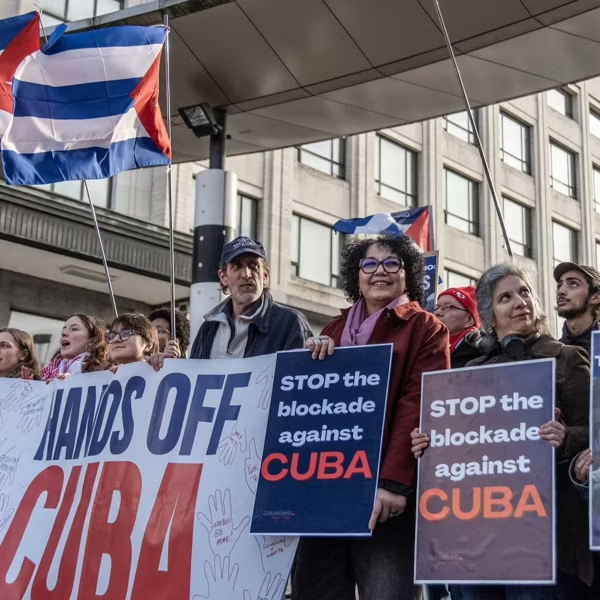
People protest against Trump aggression against Cuba with signs reading "Stop the Blockade Against Cuba"

‘This Is Insane’: Alarm Bells Follow New Report of Looming US Plan to Attack Cuba
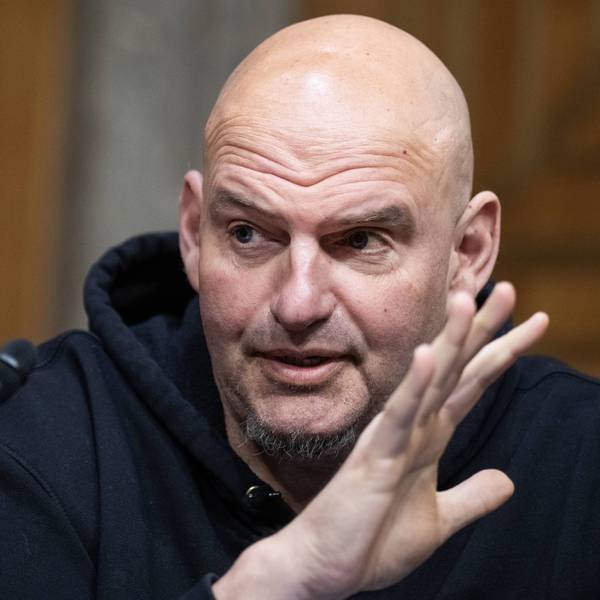
US Sen. John Fetterman in his hoodie in the Senate

Fetterman Helps GOP Senators Sink Democrat Effort to Block Trump War on Cuba

The directive “imposes new sanctions on entities, persons, or affiliates that support the Cuban regime’s security apparatus, are complicit in government corruption or serious human rights violations, or are agents, officials, or material supporters of the Cuban government,” without identifying any of the affected groups or individuals.

For 65 years, the US has imposed an economic embargo on Cuba that has adversely affected all sectors of the socialist island’s economy and severely limited Cubans’ access to basic necessities including food, fuel, healthcare, and medicines—with disastrous results. The Cuban government claims the blockade cost the country’s economy nearly $5 billion in just one 11-month period in 2022-23 alone. United Nations member states have perennially—and overwhelmingly—condemned the embargo.

The Trump administration also imposed a fuel blockade and reinstated Cuba on the US State Sponsors of Terrorism list, from which former President Joe Biden removed the country before leaving office in 2021. Cuba was initially added to the list during the Reagan administration amid a decadeslong campaign of US-backed Cuban exile terrorismfailed assassination attemptseconomic warfare, and covert operations large and small in a futile effort to overthrow the revolutionary government of longtime leader Fidel Castro.

Cuba says US-backed terrorism has killed or wounded more than 5,000 Cubans and cost its economy billions of dollars.

The Cuban government—which was celebrating International Workers’ Day on Friday—did not immediately respond to the expanded sanctions.

Experts warned that the new sanctions are worryingly broad, with Georgetown Law visiting scholar Peter Harrell writing on X that “basically any non-US person or company doing any business in/with Cuba could be sanctioned.”

Harrell noted that the edict “gives the Trump administration a fair amount of easy-to-deploy firepower to drive remaining international businesses out of Cuba.”

“The questions will be in implementation,” he added. “For example, will Trump sanction a Chinese firm installing renewable energy in Cuba?”

Trump’s edict comes months after the president ordered the invasion of Venezuela and abduction of socialist President Nicolás Maduro and amid the ongoing US-Israeli war on Iran, the 10th country bombed during the course of Trump’s two terms in office.

Trump last month declared that “we may stop by Cuba after we’re finished with this,” referring to war on Iran that’s left thousands of people dead or wounded, including hundreds of children. The president has also said that he believes he’ll “be having the honor of taking Cuba,” language echoing the 19th century US imperialists who conquered the island along with Puerto Rico, Guam, and the Philippines from Spain in another war waged on dubious pretense.

“Whether I free it, take it—I think I can do anything I want,” Trump said of the island and its 11 million inhabitants.

Article by Brett Wilkins republished from Common Dreams under Creative Commons (CC BY-NC-ND 3.0).

Orcas discuss how Trump was re-elected and him being an obviously insane, xenophobic Fascist.
Donald Fuhrump says that Amerikkka doesn't bother with crimes or charges anymore, not being 100% Amerikkkan and opposing his real estate intentions is enough.
Donald Fuhrump says that Amerikkka doesn’t bother with crimes or charges anymore, not being 100% Amerikkkan and opposing his real estate intentions is enough.
Donald Trump sings and dances, says that it's fun to kill everyone ...
Donald Trump sings and dances, says that it’s fun to kill everyone …

Continue ReadingCiting Bogus ‘Threats’ to US, Trump Expands Already Devastating Sanctions on Cuba

‘A Moment of Reckoning’: 4,000+ May Day Demonstrations Across US

Spread the love

Article by Stephen Prager republished from Common Dreams under Creative Commons (CC BY-NC-ND 3.0).

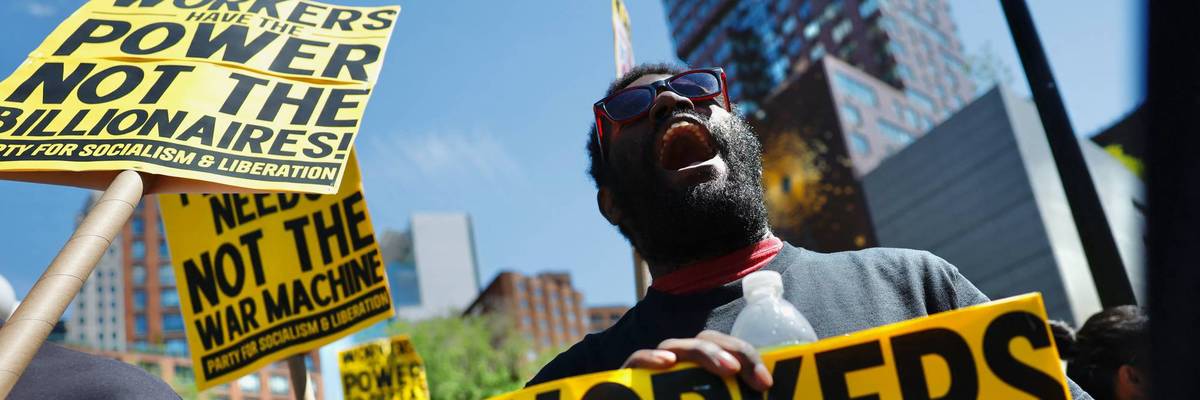
Demonstrators attend a May Day rally marking International Workers’ Day in New York, on May 1, 2026. (Photo by Kena Betancur/AFP via Getty Images)

“During the ‘No Kings’ demonstrations, we showed what we’re against. May Day is the day we’re making clear what we are fighting for,” said one organizer.

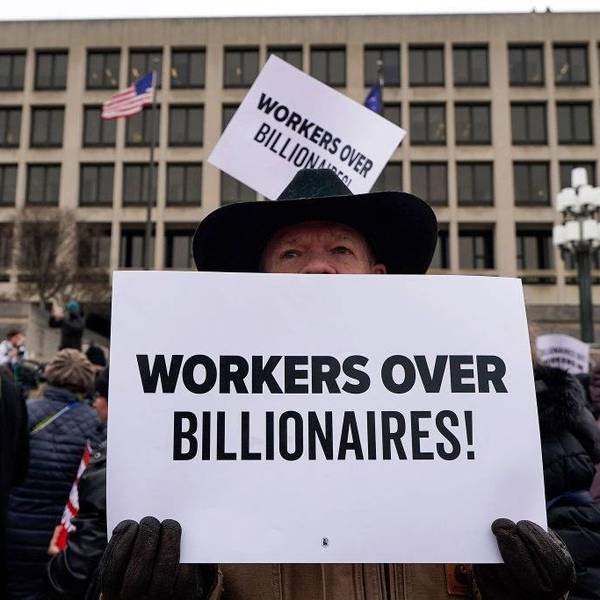
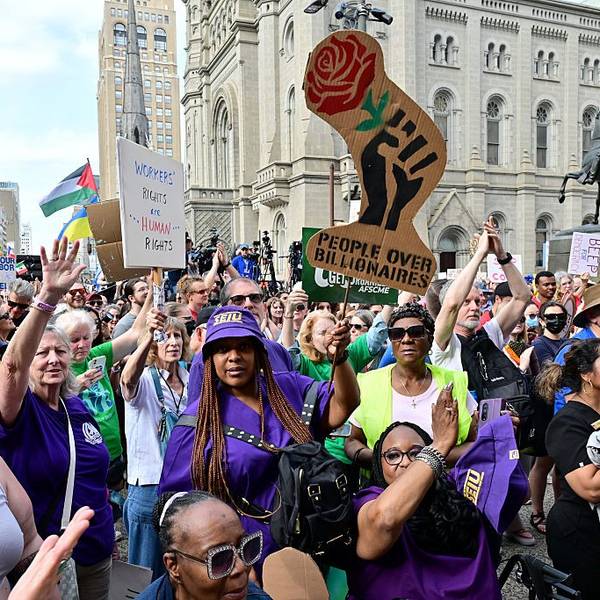
In thousands of locations across the United Statesworkers and students are taking off from work and school and swearing off shopping on Friday as part of a national May Day protest.

May Day Strong, a coalition of activist groups and unions organizing the events, said more than 4,000 actions, from marches to pickets to displays of peaceful civil disobedience, were underway.

RECOMMENDED…

'Workers Over Billionaires': Over 3,000 Events Planned for May Day Across US

‘Workers Over Billionaires’: Over 3,000 Events Planned for May Day Across US

Nationwide May Day Strong Rally - Workers Stand Up to Billionaires- Philadelphia

US Working Class Mobilizes Ahead of Nationwide ‘May Day Strong’ Rallies

It is yet another nationwide display of coordinated resistance to the Trump administration’s agenda, including its war in Iran and its use of US Immigration and Customs Enforcement (ICE) to attack immigrant communities, issues that were at the forefront of March’s “No Kings” protests.

Six young protesters with the Sunrise Movement were taken into custody after blocking a bridge in Minneapolis in what they said was an act of “nonviolent noncooperation” to “stand up to the war in Iran and against ICE terrorizing our neighbors and our cities.”

Dozens more Sunrise protesters in Portland held a sit-in in the lobby of a Hilton hotel that was housing top officials with the Department of Homeland Security, leading to eight arrests.

“It’s May 1st, it’s workers’ day,” one of the protesters was recorded saying while being led away by police. “Don’t forget that you have power.”

In New York, over 100 activists lined up outside every entrance to the New York Stock Exchange in downtown Manhattan, banging drums and chanting “No ICE, no war!” where they were met by a flood of cops.

In the spirit of May Day, a global day of solidarity among workers, Sulma Arias, the executive director of the social justice organization People’s Action, said Friday’s “Workers Over Billionaires” protests are just as much about confronting injustices as about building an alternative.

“During the ‘No Kings’ demonstrations, we showed what we’re against. May Day is the day we’re making clear what we are fighting for,” Arias said. “We are for affordable housing for low-income people. We are for free healthcare for all. We are for utility laws that ensure every home stays warm in the winter and cool in the summer at costs that a person on a fixed income can afford. We are for the right to a fair and equal vote for Americans from every race and in every state. May Day is our day to assert and defend our rights.”

“They want us afraid. They want us divided. But on May 1, we refuse.”

Despite claims by President Donald Trump that the US is entering an economic “golden age” under his leadership, a Gallup poll released this week found that 55% of Americans said their finances were getting worse, the highest number ever recorded in more than 20 years of polling, and even higher than in the doldrums of the Great Recession.

A coalition of labor unions across several major cities, including Philadelphia, Chicago, and Los Angeles, has coordinated what has been called an “economic blackout,” which includes avoiding buying from private sector retailers.

“When we say ‘workers over billionaires,’ ‘billionaires’ is not just this amorphous figure, right? They’re real people,” said Jana Korn, the chief of staff for the Philadelphia Council AFL-CIO, in an interview with The Real News Network. “In Philadelphia, we’re kind of a poor city. We don’t have that many billionaires, but we have one. The CEO of Comcast is the only billionaire that lives in the city.”

“So why should we, as a city, accept that they take and take from us? And then with that money, what do they do? They donate to Trump’s ballroom project,” she continued. “People in Philadelphia are struggling… Our transportation system barely works. We’re at risk of having 17 schools close down this year.”

Some labor organizers have described economic boycotts, undertaken as part of prior mass protest movements against the second Trump administration, as an act of building strength for something larger, such as a future general strike.

“I think really for us in the labor movement,” Korn said, “[the boycott is] about how do we build the capacity to really disrupt, to strike when necessary, to shut things down when we have to. And that’s something that we have not been called to do as a labor movement in a very long time.”

Other unions have used May Day to confront their own employers directly. In New Orleans, hundreds of nurses at University Medical Center announced that they were beginning a five-day strike after attempting to negotiate a contract for more than two years.

In New York City, Amazon workers unionized with the Teamsters assembled on the steps of the public library before marching to Amazon’s corporate offices to demand the company cut its contracts with ICE, which has used its cloud computing services to target immigrants, including some Amazon workers and contractors.

Matt Multari, who has worked as an Amazon driver for a year and a half, told Mother Jones that he joined the protest to “demand the one thing that’s worth fighting for in this life: respect.”

Masih Fouladi, executive director of the California Immigrant Policy Center, said, “May Day is a moment of reckoning.”

“Immigrant communities—from farmworkers in our fields to nurses in our hospitals, from refugees fleeing war to families who have built their lives here for generations—are under siege,” she said. “They want us afraid. They want us divided. But on May 1, we refuse.”

“Workers and immigrants—documented and undocumented, native-born and newly arrived,” she said, “will stand together in the streets because we know the truth: there is no workers’ rights without immigrant rights, and there is no justice for working people here while our tax dollars fund devastation abroad.”

Article by Stephen Prager republished from Common Dreams under Creative Commons (CC BY-NC-ND 3.0).

Orcas discuss how Trump was re-elected and him being an obviously insane, xenophobic Fascist.
Donald Trump warns against following the Onaquietday.org blog, says that he's heard that she's a which with a black cat and a dangerous kitchen.
Donald Trump warns against following the Onaquietday.org blog, says that he’s heard that she’s a which with a black cat and a dangerous kitchen.

Continue Reading‘A Moment of Reckoning’: 4,000+ May Day Demonstrations Across US

61% of Americans See Trump’s Iran War as ‘Mistake’, Far Outpacing Disapproval of Vietnam and Iraq: Poll

Spread the love

Article by Stephen Prager republished from Common Dreams under Creative Commons (CC BY-NC-ND 3.0).

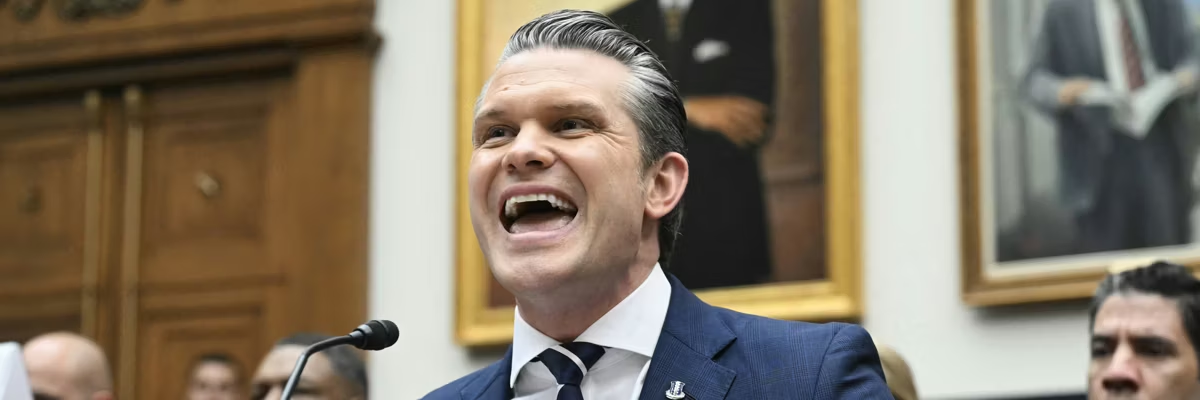
US Secretary of Defense Pete Hegseth testifies before a US House Armed Services Committee hearing on April 29, 2026. (Photo by Saul Loeb/AFP via Getty Images)

“In Iraq, it took more than three years to reach that high. In Vietnam, it took six years.”

More than 6 in 10 Americans now say President Donald Trump’s war in Iran was a “mistake,” according to a poll out Friday from the Washington Post/ABC News/Ipsos.

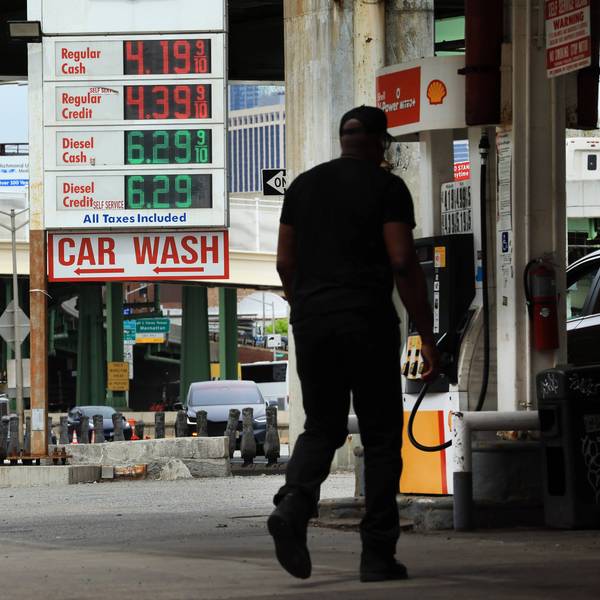
Within two months, the war—which has inflicted thousands of civilian deaths and caused gas prices to spike worldwide with little tangible gain—has reached levels of unpopularity that previous wars now seen as historic boondoggles took years to reach.

RECOMMENDED…

Gas Prices Rise To Highest Level In 4 Years As War With Iran Continues

New Federal Data Confirms: Trump’s War of Choice in Iran Is a ‘Disaster’ for US Economy

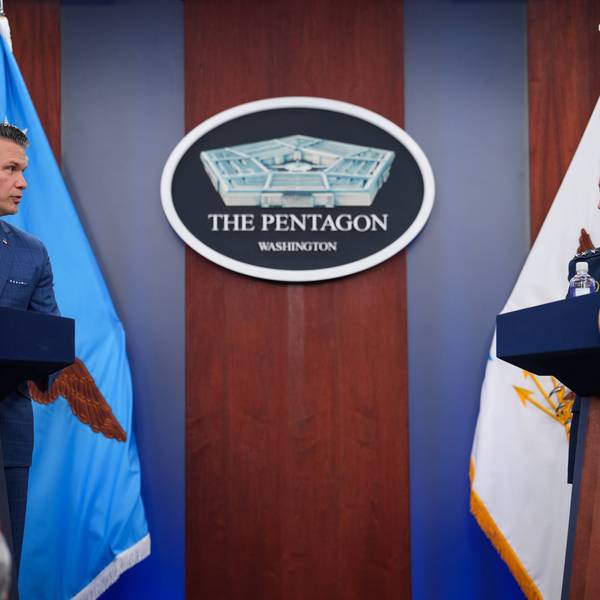
Pete Hegseth And Dan Caine Hold Pentagon Press Briefing On War In Iran

Hegseth Impeachment Articles Land as Thousands More US Troops Deploy for Iran War

The Post has asked the “mistake” for other major wars. But CNN senior political reporter Aaron Blake explained: “In Iraq, it took more than three years to reach that high. In Vietnam, it took six years.”

Despite a massive protest movement, voters overwhelmingly supported President George W. Bush’s decision to invade Iraq, with 81% believing it was the “right thing” in April 2003 and just 16% believing it was a mistake.

But the occupation turned into a long, deadly, and costly disaster, and the administration’s pretexts for the war were revealed to be lies. Public opinion steadily eroded to the point where 64% viewed it as a mistake by January 2007.

Vietnam never had the overwhelming support of Iraq, but 60% of Americans still supported President Lyndon Johnson’s decision to begin direct US military involvement in 1965, while just 24% said it was a mistake.

While the protest movement against the war is as present in Americans’ memories today as the conflict itself, public opinion was still split until 1968 and only reached a high of 61% in May 1971, after more than 50,000 US soldiers had been killed in battle.

Trump’s war in Iran is unique in history in that it never enjoyed even a moment of consensus support. In a Reuters/Ipsos poll just days after the opening salvo of what the Trump administration dubbed “Operation Epic Fury,” just 27% said they approved of the strikes, which killed 555 Iranians, including Supreme Leader Ayatollah Ali Khamenei and several other top Iranian officials.

At this point, 43% of Americans already said they disapproved of the strikes, far eclipsing Iraq and Vietnam. But 30% still said they had not yet made up their minds.

In the coming months, they would. It was revealed that an airstrike on a school, which killed at least 155 people, including 120 children, was a double-tap attack by the United States. Iran retaliated by blocking oil shipments through the Strait of Hormuz, which sent US gas prices hurtling above $4 per gallon. And Trump took on an increasingly erratic and at times outright genocidal posture toward Iran that made any peaceful resolution appear increasingly impossible, even with the current fragile ceasefire.

Friday’s poll shows that while the war still maintains a core base of support—36% of Americans who say it was the right decision, nearly all of them Republicans—it is dwarfed by the 61% who say it was a mistake.

Majorities of respondents across all demographics show that they believe the war has increased the risks of “terrorism against Americans” (61%), “the US economy going into a recession” (60%), and “weakening relationships with US allies.” (56%)

Looking beneath the surface shows an even more worrying sign for Trump: The war has almost no constituency outside of his biggest fans. Self-identified Democrats (91%) overwhelmingly say the war was a mistake. But 71% of independents—many of whom were undecided at the war’s outset—now disapprove too, with just 24% in support.

Even within the GOP, there is a decisive split: 86% of those who self-identify as “MAGA Republicans” are still baying for blood. But “non-MAGA Republicans” have grown uncertain—50% still say war was the right decision, while 49% say it was a mistake.

They were particularly rattled by Trump’s threat last month that “a whole civilization will die tonight” if Iran did not negotiate a deal to his liking. The threat of genocide was too much even for the majority of Republicans, 53% of whom said they viewed it negatively.

What remains to be seen is whether even Trump’s most faithful backers will turn against the war as it drags on. If Defense Secretary Pete Hegseth’s appearance in Congress on Thursday is any guide, the country may soon find out.

On Thursday, when Sen. Kirsten Gillibrand (D-NY) pressed Hegseth about why he has “not sought the support of the American people” and added that “3 out of 5 Americans are against this war today,” he appeared in abject denial about the war’s unpopularity.

“I believe we do have the support of the American people,” he said. “I would remind you and this group that we’re two months in to an effort, and many congressional Democrats want to declare defeat two months in.”

He specifically invoked lengthy past conflicts, repeatedly emphasizing that this one had only lasted “two months,” as if to urge patience with a war Trump had previously said was intended to last only “four to five weeks.”

“Iraq took how many years? Afghanistan took how many years? And they were nebulous missions that people went along with,” he said.

“This is different,” he said of a war that has—depending on the day—been described as one aimed at regime change in Iran, defending protesters, destroying its nuclear program, eliminating its ballistic missile supplytaking its oildefending Israel, and reopening the Strait of Hormuz, among other objectives.

Article by Stephen Prager republished from Common Dreams under Creative Commons (CC BY-NC-ND 3.0).

Keir Starmer explains that UK is actively supporting Israel's genocidal expansion and repeats his previous quotation that he supports Zionism "without qualification". Keir Starmer said “I said it loud and clear – and meant it – that I support Zionism without qualification.” here: https://www.jewishnews.co.uk/keir-starmer-interview-i-will-work-to-eradicate-antisemitism-from-day-one/
Keir Starmer explains that UK is actively supporting Israel’s genocidal expansion and repeats his previous quotation that he supports Zionism “without qualification”. Keir Starmer said “I said it loud and clear – and meant it – that I support Zionism without qualification.” here: https://www.jewishnews.co.uk/keir-starmer-interview-i-will-work-to-eradicate-antisemitism-from-day-one/
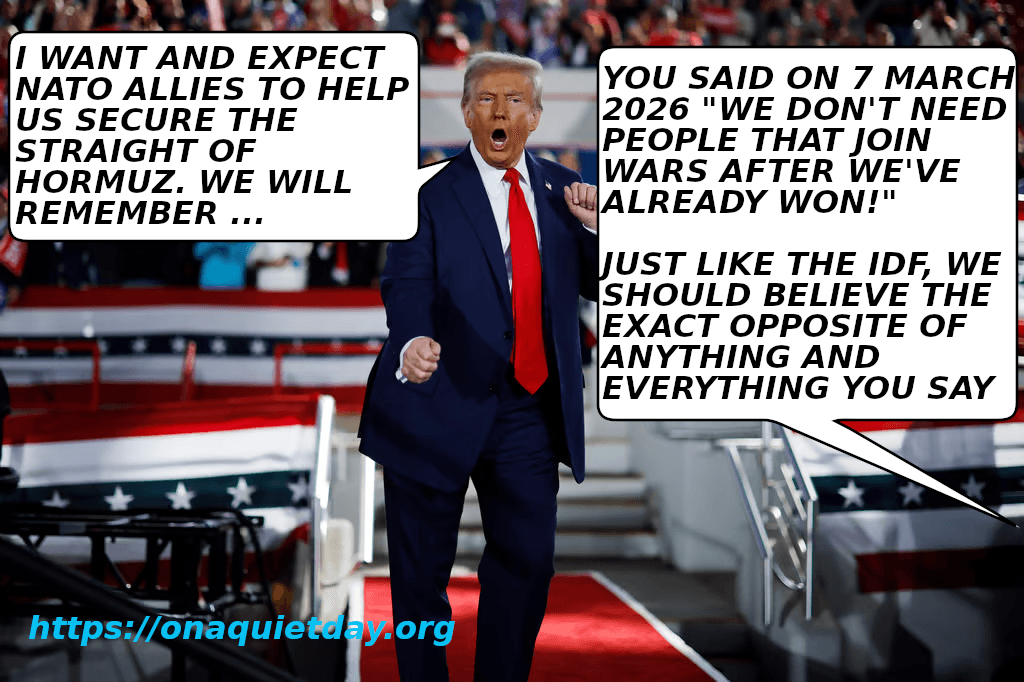
Donald Trump calls for help from NATO allies in securing the Strait of Hormuz despite saying on 7 March 2026 that they don't need people to join wars after they've already won. He's challenged with the claim that he lies as much as the IDF.
Donald Trump calls for help from NATO allies in securing the Strait of Hormuz despite saying on 7 March 2026 that they don’t need people to join wars after they’ve already won. He’s challenged with the claim that he lies as much as the IDF.
Continue Reading61% of Americans See Trump’s Iran War as ‘Mistake’, Far Outpacing Disapproval of Vietnam and Iraq: Poll