Ther’s been another long weekend with a bank holiday on either side – some rich people got married on Friday.
The main NHS news is that NHS cuts – ‘savings’ as the Conservatives and Liberal-Democrats like to call them – are going to be far more severe than previously expected. Andrew Lansley, David Cameron and the Con-Dem coalition government repeatedly claim that there are no cuts to the NHS. Look at this small selection of news articles – cuts to capacity and cuts to staff. Earlier NHS news details routine operations that have been cut to save money. What are they if not cuts?
There have been many May Day events highlighting privatisation and cuts to the NHS. I’ve only mentioned one or two.
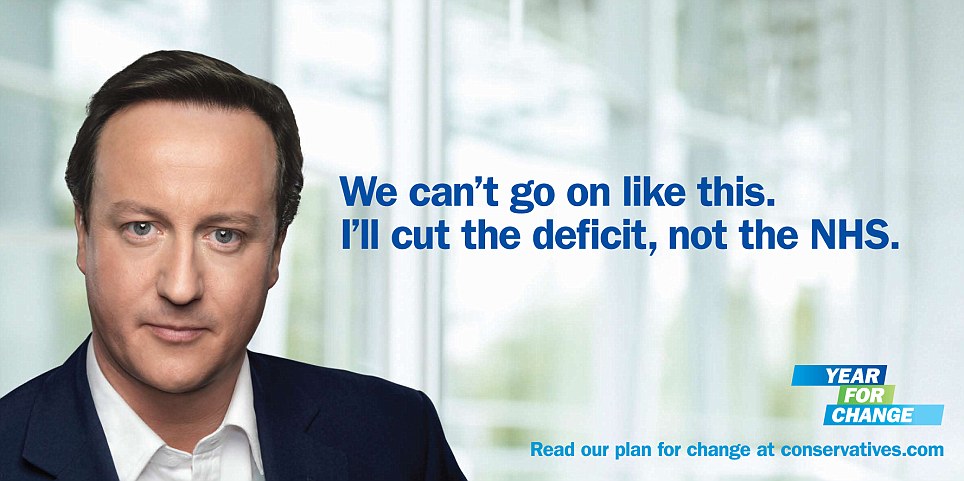
- Conservative election poster 2010
A few recent news articles concerning the UK’s Conservative and Liberal-Democrat coalition government – the ConDem’s – brutal attack on the National Health Service.
THE number of beds in the Bristol Royal Infirmary is set to be reduced by a quarter within five years.
An £80.7 million redevelopment of the hospital was approved by its directors yesterday, setting out how services will be overhauled between now and 2016. It includes the approval of a new ward block behind the accident and emergency department.
…
Currently there are 503 beds in the BRI, which can be pushed up to 531 in times of pressure.
The plan is for a reduction to 408 by 2014/15 and a further decrease to 379 by 2015/16 – a reduction of 124 on the current figure.
…
Move to axe 300 beds at hospitals – Main Section – Yorkshire Post
AS many as 300 hospital beds in 10 wards are set to close in Hull and the East Riding over the next five years as part of efforts to save £95m.
Hull and East Yorkshire Hospitals NHS Trust chief executive Phil Morley said the figures were based on a regular census which showed 300 people were in hospital beds when they did not need to be.
The closures, which would affect both Hull Royal Infirmary and Castle Hill Hospital, would be phased, starting with an old ward on the Castle Hill site which needed around three-quarters of a million pounds spending on it.
…
HEALTH bosses have said their “preferred option” for the future of an under-threat specialist unit for the elderly is to keep it open.
Fears have been raised about the Connaught Day Hospital centre, which is based at Whipps Cross Hospital in Leytonstone, after it emerged that management were considering closing it down.
The unit provides specialist rehabilitation and outpatient support for pensioners, such as physiotherapy for those injured in falls.
…
Health Secretary Andrew Lansley has just one practising nurse on the 50-strong “listening panel” set up to save his controversial reforms.
And all five GPs serving on the panel – including Professor Steve Field, former President of the Royal College of GPs – are already supporters of Mr Lansley’s plan.
The embattled Health Secretary set up his Futures Forum after nurses’ leaders gave him a humiliating no-confidence vote at their conference last month. But now Mr Lansley is facing angry criticism that he has shunned the views of frontline NHS workers by packing the forum with “yes men and women”.
…
Mr Lansley and the PM David Cameron created the panel – largely made up of health service bureaucrats – after the public outcry over plans to give GPs more control of the budget of the NHS and open it up to more private firms. The forum has been asked to seek the views of patients and health experts then report back to the Government.
But Dr John Lister, of pressure group Health Emergency, said: “This is all a stunt to convince the public that Lansley is listening.”
…
May Day protesters march against job cuts | Manchester Evening News – menmedia.co.uk
Scores of protesters took part in Manchester’s traditional May Day rally to condemn public spending cuts.
The march, organised by the Trades Union Congress (TUC), commemorated International Worker’s Day.
Participants protested against spending cuts, privatisation and the government’s NHS reforms. Marchers met outside All Saints’ Park on Oxford Road and walked down Peter Street, Deansgate, John Dalton Street and Cross Street to Urbis. Afterwards, food and entertainment was put on at the Friends Meeting House in Mount Street.
…
NHS reform: GP group gets control of £100m (From The Bolton News)
A GP group has been handed control of more than £100 million of the primary care trust’s (PCT) budget this year.
Bolton Health Consortium (BHC), originally known as Bolton GP Commissioning Consortium, is made up of 40 of the town’s 50 practices.
It is one of two groups who will take over buying health services when PCTs are scrapped in 2013.
NHS Bolton will cease to exist from April that year, with GP consortia or groups, replacing them to commission services.
…
Nursing union hits out at Teesside NHS trust ‘cuts’ – Gazette Communities – Gazette Live
A NURSING union has hit out at what it claims are proposed cuts to frontline services at Two Teesside hospital trusts.
The Royal College of Nursing (RCN) aims to highlight how health reforms could result in cuts to jobs and frontline services.
Its website Frontline First outlined how South Tees NHS Foundation Trust, which manages James Cook University Hospital in Middlesbrough and The Friarage in Northallerton, “cut” 14 cardiology beds and a 30-bed surgical ward containing specialities including ear nose and throat, and ophthalmology.
The RCN also stated the trust had to save £20m over four years. However, the trust said the process of removing cardiology beds was completed last year with no redundancies, although some nursing staff were redeployed to other wards.
…
BBC News – NHS hospitals told to seek 50% more savings
A regulator has warned hospitals in England they could face having to make savings about 50% higher than those already demanded by ministers.
Monitor, which oversees NHS foundation trusts and assesses applications for foundation status, blamed factors such as greater-than-expected inflation.
It has written to local health chiefs after significantly revising its financial assumptions.
Ministers said the warning was based on Monitor’s most “pessimistic” scenario.
The regulator said hospitals could have to make average savings of up to 6% or 7% a year, compared with the annual 4% set out by the previous Labour government, as part of efforts to cut £20bn from running costs.
…
Worsened cuts ‘risk the NHS’ / Britain / Home – Morning Star
…
Monitor, which oversees NHS foundation trusts and assesses applications for foundation status, has written to local health chiefs after significantly revising its financial assumptions.
It suggested average savings of between 6 and 7 per cent a year may be necessary, compared with the annual 4 per cent called for by the Department of Health (DoH) as part of plans to slash £20 billion from running costs.
In the letter, Monitor said it had changed its figures after taking into account the government’s spending review, inflation expectations set out by the Office of Budget Responsibility and new NHS operating rules.
Despite being spared the deep budget cuts imposed on other government departments, the NHS still faced a “substantial challenge” in meeting rising demand for health services while making substantial efficiencies, it cautioned.
…
Labour cries foul as NHS regulator predicts deeper hospital cuts | Society | The Guardian
Labour has accused health bosses of burying bad news on royal wedding day when it emerged that the health regulator Monitor had predicted hospitals would have to make efficiency savings up to 50% higher than previously envisaged.
Monitor, in a letter to NHS foundation trusts dated 27 April and released on Thursday, said the higher efficiency savings were partly due to inflation rising above predicted levels.
…
Private company to care for pregnant women in Wirral, instead of NHS – Wirral News
PREGNANT women in Wirral are to be cared for by a private company instead of the NHS.
The borough’s primary care trust (PCT) has approved an application from a company called One to One to provide a “community midwifery service”.
But the move has been criticised by Labour as “sinister” and privatision “by the back door”.
Wirral’s Labour group leader Steve Foulkes said he was shocked by the move and added: “There has been little or no consultation about moving from the pilot to a full blown service. It looks like the forerunner to many other services going out to private partners. The NHS is a public service and should be publicly accountable to public scrutiny.
…
THE NHS has spent more than £17 million on procedures at an Emersons Green centre run by the private sector in the past 18 months.
Since the centre opened in November 2009, almost 15,000 procedures have been carried out on patients from the wider Bristol area on behalf of the local NHS.
The centre, run by UK Specialist Hospitals carries out diagnostic tests and procedures including dental surgery, ear, nose and throat, gynaecology and joint replacements.
Unlike general hospitals the independent sector treatment centres do not provide emergency care for patients and they do not deal with more complex cases.
…
NHS reforms at heart of Norwich protest event – Politics – Eastern Daily Press
Norwich and District Trades Union Council organised the event on Monday in Chapelfield Gardens as a traditional May Day International Workers’ Day celebration.
However, given the cuts faced by many frontline public services, the day was also a chance to raise awareness of these and in particular focus on the plans to overhaul the NHS, which critics fear will lead to the privatisation of healthcare.
While musicians entertained the public from the bandstand and there was a bouncy slide for children, a host of unions and organisations were in attendance to get across the message that the proposals could be disastrous for the NHS.
…