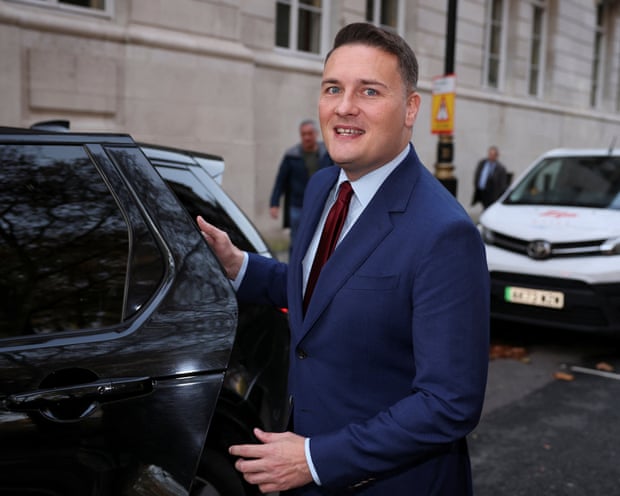
The Institute for Government report says positive steps by Wes Streeting had been undermined by his attempts to reform the health service. Photograph: Phil Noble/Reuters
Exclusive: thinktank report finds health secretary has failed to improve productivity and the health service is unlikely to meet its targets
Wes Streeting has been accused of taking a “chaotic and incoherent approach” to reforming the NHS, which makes it unlikely the government will hit its own targets, according to a damning report by the Institute for Government (IfG).
The report praises elements of how the health secretary has managed the health service in his first year in office, including improving performance and staff retention in hospitals. The pay settlement he reached with resident doctors last year avoided a winter plagued by NHS strikes
But it also criticises significant aspects of his performance, including the way he handled the abolition of NHS England and his lack of action to stem the exodus of senior GPs.
…
Stuart Hoddinott, the IfG’s associate director and the author of the report, said: “There have been some positive steps: performance is trending slowly upwards in hospitals, there’s been a genuinely large increase in GPs and the rate at which hospital staff are leaving their jobs is the lowest on record outside the pandemic.
“But that has been undermined by a chaotic and incoherent approach to reforming the service. The announcement of NHS England’s abolition was abysmally handled and management cuts in integrated care boards have been a needless distraction.”
Junior doctors and members of the British Medical Association (BMA) on the picket line outside Cheltenham General Hospital during their continuing dispute over pay, January 8, 2024
HEALTH SECRETARY Wes Streeting ranted on live radio today as thousands of resident doctors began their five-day strike in England.
He unleashed a tirade on LBC after north London doctor Niraj told him that “we all care about patient safety, none of us wants to be on strike, I would rather be at work today.”
The British Medical Association (BMA) called the 13th strike by doctors since March 2023, having long called for their pay to be restored to pre-austerity rates.
Despite rises by Labour, it remains about a fifth down on its real-terms value in 2008.
Mr Streeting clashed angrily after Niraj raised his union’s concerns over a lack of training places and other workforce issues.
He accused doctors of “inflicting pain and misery” on patients and holding them to ransom by its “extremely irresponsible” action.
The Health Secretary claimed the “extremely unnecessary” strikes were shocking given patients receive “a substandard service” and that the BMA was speaking for its “activists” rather than their members.
CORRIDOR care is a “crisis in plain sight” with elderly patients watching others die while themselves waiting to be helped for days on end, a leading charity warned today.
A patient gave a first-hand account likening hospital corridor care to war films with “queues of stretchers and people suffering” in a new report by Age UK.
The charity raised concerns that poor quality care “is now almost expected” in some A&E departments.
It warned the situation could get worse as the NHS heads into winter and urged ministers to produce a plan to end long A&E waits and corridor care, with specific deadlines and milestones.
Royal College of Nursing general secretary Professor Nicola Ranger said: “Corridor care is a moral stain on our health service and this report is yet more evidence of its devastating consequences.
“The reality is nursing staff and patients are being set up to fail by a system that simply isn’t working.”
Chancellor Rachel Reeves and the rest of the Labour cabinet have been captured by corporate interests | Joe Giddens – WPA Pool/Getty Images
The party is steamrolling ahead with deregulation that will benefit big businesses at the expense of consumers. Why?
It’s no secret that Keir Starmer, Rachel Reeves, and the rest of the Labour cabinet have been captured by corporate interests.
Health secretary Wes Streeting has received at least £372,000 in donations from sources with links to private healthcare since 2015, equivalent to around £10,000 per month. The international lobbying and PR firm FGS Global, which is owned by the private equity firm that pulled out of buying Thames Water in June, sent a member of staff to work in Reeves’ office during the election campaign. And the party has received over £1m in donations from firms tied to the gambling industry in the past two years.
Labour’s links to big business and wealthy donors are concerning in themselves, but we now have direct evidence that they are being used to influence policy.
As openDemocracy reported this week, the party has defanged the Competition and Markets Authority, the regulator responsible for enforcing competition law, to appease business interests – at the expense of consumers.
The government’s deregulatory efforts began back in January, when it ousted Marcus Bokkerink as the CMA’s chair and replaced him with Doug Gurr, Amazon’s former UK boss. Appointing a former executive of one of the world’s most powerful monopolies as the head of a competition authority is so on the nose it defies satire; unions referred to the move as a “slap in the face”.
If this wasn’t enough, the business secretary, Jonathan Reynolds, instructed Gurr to deliver “pro-business decisions” in the role. The message from Labour is clear: we will not stand in the way of anti-competitive behaviour, regardless of the impact on people and planet.
Then, in May, the government issued a new “strategic steer to the CMA”, ordering the watchdog to prioritise “growth and investment” – a barely veiled instruction to wave through mergers and acquisitions that consolidate corporate power.
And just this week, the Financial Times reported that the chancellor plans to pursue a “blitz on bureaucracy” at the CMA by changing the way it reviews anti-competition investigations, which would likely make it easier for ministers to nudge outcomes in favour of big business. The move may come from Reeves, but its intellectual and political architect is reportedly Varun Chandra, one of Starmer’s most powerful advisers.
Chandra is a former managing partner at Hakluyt, the shadowy corporate intelligence firm founded by ex-MI6 officers, which counts among its clients many of the world’s biggest corporations and private equity funds. He retains a multimillion-pound stake in the company and deep relationships across the City and Silicon Valley. In government, he has pushed for a “pro-growth” deregulatory agenda.
This is how corporate capture works in the Labour Party today. There is a revolving door between corporate boardrooms and the highest offices of state. Ministers fall over themselves in their desperate attempts to gain the approval of the City and the Confederation of British Industry, an influential business lobby group. The party has demonstrated it is willing to take donations and gifts from almost anyone, and that it will happily return the favour by amending legislation or cutting regulation.
Ulterior motives
This corporate capture is, in part, a structural problem.
The state is not some neutral tool that political parties can pick up and use as they wish when they enter power. As Marxist theorist Nicos Poulantzas argued back in the 1970s, it is a social relation: a set of institutions that crystallise the balance of class power in society. In capitalist societies, capital is both better resourced and more organised than labour, and this imbalance of power is reflected within state institutions.
When a party severs its links with the working-class organisations that once anchored it in social struggle – from trade unions, to protest movements, to community organisers – it doesn’t float above class conflict; instead, it must fill the gap left by the mass base by deepening its links to capital. This reorganisation of the relationship between party and base is exactly what’s happened to Starmer’s Labour. Absent a mass movement capable of holding politicians to account, his government takes its cues from the boardroom rather than workers and communities.
But there’s also a more cynical dynamic at play, too. Everyone knows this government’s days are numbered, including Starmer himself. Nigel Farage’s Reform UK has cannibalised the Conservative Party and is now tearing ahead in the polls. Labour was probably hoping to rely on haranguing its disgruntled left-wing voters over the need to stop the rise of Reform, but with Starmer increasingly echoing Farage’s talking points, the Greens now seem like a more natural home for those people.
In short, Labour is toast – and it knows it. Ministers and advisers are already looking beyond government to the well-paid, cushy corporate positions they all want to take up when they leave office.
For the Tories who lost their seats at the last election, this transition was pretty easy thanks to the long-standing links between their party and big business and finance. Labour politicians have had to work harder to cultivate strong relationships with the private sector. In this context, the push for ‘pro-business’ policies isn’t just ideological – it’s personal.
Keir Starmer explains that he feels no shame or guilt benefitting personally from gifts from the rich and powerful while insisting on policies of severe austerity causing suffering and death.Keir Starmer says that the Labour Party under his leadership all feel a small part of Scunthorpe.

 Junior doctors and members of the British Medical Association (BMA) on the picket line outside Cheltenham General Hospital during their continuing dispute over pay, January 8, 2024


