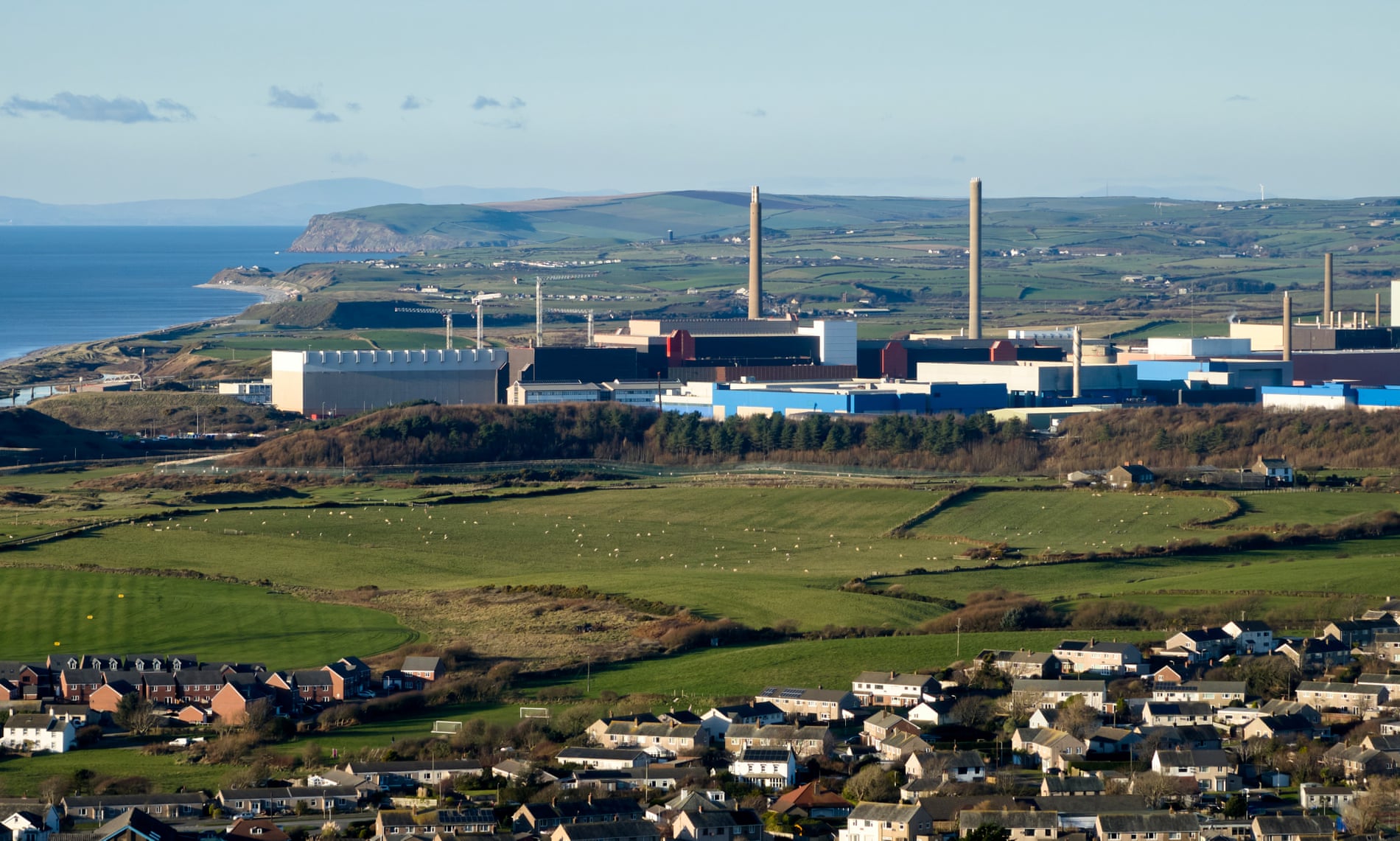
Sellafield is Europe’s most toxic nuclear site. Photograph: David Levene/The Guardian
Britain’s public spending watchdog has launched an investigation into risks and costs at Sellafield, the UK’s biggest nuclear waste dump.
The National Audit Office (NAO), which scrutinises the use of public funds, has announced it will examine whether the Cumbria site is managing and prioritising the risks and hazards of the site effectively as well as deploying resources appropriately and continuing to improve its project management.
The findings of its investigation are expected to be published this autumn.
Sellafield is Europe’s most toxic nuclear site and also one of the UK’s most expensive infrastructure projects, with the NAO estimating it could cost £84bn to maintain the site into the next century.
Predictions of the ultimate bill for the site, which holds about 85% of the UK’s nuclear waste, vary. It cost £2.5bn to run the site last year, and the government estimates it could ultimately take £263bn to manage the country’s ageing nuclear sites, of which Sellafield accounts for the largest portion.
The UK’s most hazardous nuclear site, Sellafield, has been hacked into by cyber groups … the Guardian can reveal.
The astonishing disclosure and its potential effects have been consistently covered up by senior staff at the vast nuclear waste and decommissioning site, the investigation has found.
The Guardian has discovered that the authorities do not know exactly when the IT systems were first compromised. But sources said breaches were first detected as far back as 2015, when experts realised sleeper malware – software that can lurk and be used to spy or attack systems – had been embedded in Sellafield’s computer networks.
…
The full extent of any data loss and any ongoing risks to systems was made harder to quantify by Sellafield’s failure to alert nuclear regulators for several years, sources said.
The revelations have emerged in Nuclear Leaks, a year-long Guardian investigation into cyber hacking, radioactive contamination and toxic workplace culture at Sellafield.
The site has the largest store of plutonium on the planet and is a sprawling rubbish dump for nuclear waste from weapons programmes and decades of atomic power generation.
…
In one highly embarrassing incident last July, login details and passwords for secure IT systems were inadvertently broadcast on national TV by the BBC One nature series Countryfile, after crews were invited into the secure site for a piece on rural communities and the nuclear industry.
“The policy of the Japanese government to dump nuclear waste into the Pacific Ocean is not based on scientific or environmental protection principles and has no justification.”by Andrea Germanos, staff writer
Storage tanks for radioactive water stand at Tokyo Electric Power Co.’s (TEPCO) Fukushima Dai-ichi nuclear power plant on Jan. 29, 2020 in Okuma, Fukushima Prefecture, Japan. (Photo: Tomohiro Ohsumi/Getty Images)
Greenpeace sounded alarm Friday over the Japanese government’s plan to release stored water from the ill-fated Fukushima nuclear plant into the Pacific Ocean, releasing a new report warning about the presence of carbon-14, which the group says “has the potential to damage human DNA.”
The warning laid out in a new report says the government and plant operator TEPCO’s controversial plan—which has been under consideration for some time—is founded on “a series of myths” and pursues the cheapest option to get rid of the water over what is best for human and ecological health.
The plan allows “the government [to] create the impression that substantial progress is being made in the early decommissioning of the Fukushima Daiichi reactors,” Greenpeace says.
Entitled Stemming the tide 2020: The reality of the Fukushima radioactive water crisis, the publication argues that the planned release of the water “will have serious, long-term consequences for communities and the environment, locally and much further afield.”
“Nearly 10 years after the start of the disaster, TEPCO and the Japanese government are still covering up the scale of the crisis at Fukushima Daiichi,” said Shaun Burnie, author of the report and senior nuclear specialist with Greenpeace Germany. He further accused the entities of having “deliberately held back for years detailed information on the radioactive material in the contaminated water.”
Beyond the remaining radioactive material tritium in the water, an additional problem is the presence of high levels of carbon-14, which belies the government’s assertion that the water is not “contaminated,” said Greenpeace.
According to the report,
If the contaminated water is discharged to the Pacific Ocean, all of the carbon-14 will be released to the environment. With a half-life of 5,730 years, carbon-14 is a major contributor to global human collective dose; once introduced into the environment carbon-14 will be delivered to local, regional, and global populations for many generations. […]
Contrary to the understanding of the Japanese government, water that contains large quantities of radioactive carbon-14 (as well as the other radioactive isotopes including strontium-90 and tritium) can only be described as contaminated.
Burnie said that TEPCO and the Japanese government “have failed to explain to the citizens of Fukushima, wider Japan, and to neighboring countries such as South Korea and China that the contaminated water to be dumped into the Pacific Ocean contains dangerous levels of carbon-14. These, together with other radionuclides in the water will remain hazardous for thousands of years with the potential to cause genetic damage.”
“It’s one more reason why these plans have to be abandoned,” said Burnie.
The report puts some of the blame on TEPCO’s decision to rely on technology known as ALPS that the operator should have known was incapable of bringing concentrations of radionuclides down to acceptable levels.
Rather than quickly moving to dump the water into the ocean, the Greenpeace report says the government should pursue “continued long-term storage and processing of the contaminated water.”
“There is no technical, engineering, or legal barrier to securing additional storage space for ALPS-treated contaminated water. It is a matter of political will,” said Burnie.
“The policy of the Japanese government to dump nuclear waste into the Pacific Ocean is not based on scientific or environmental n principles,” he said, “and has no justification.”
Poor little snowflake Donny’s been super busy throwing tantrums after one of those mean girl reporters hurt his feelings again. When 60 Minutes’ Leslie Stahl started her interview with, “Are you ready for tough questions?” – and then asked some – he was so mad he left in a huff and posted it all to expose her “bias, hatred and rudeness,” aka her competence as he lied, dodged, stumbled. And earlier he even gave her a big book of all the health care things he’s done! It was blank, but still. Read More… More Further
Our work is licensed under a Creative Commons Attribution-Share Alike 3.0 License. Feel free to republish and share widely.