Fate of Palestinian health workers kidnapped by Israeli forces remains uncertain

Spread the love

Original article by Ana Vračar republished from peoples dispatch under a Creative Commons Attribution-ShareAlike 4.0 (CC BY-SA) license.
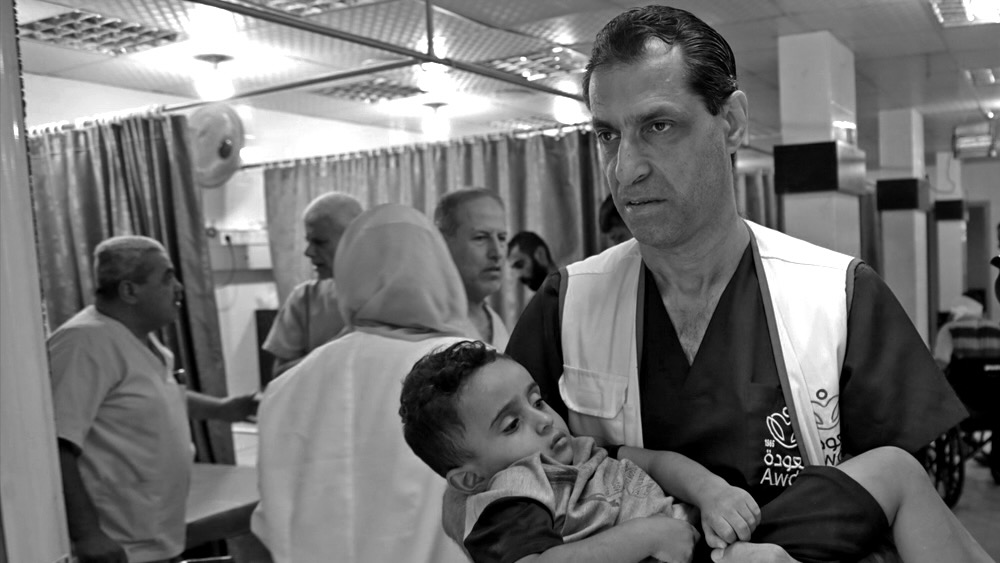
Al-Awda Hospital Manager Dr. Ahmed Muhanna was arrested by Israeli Forces on December 17, 2023 and his whereabouts are unknown. Photo: People’s Health Movement

The status of health workers arrested by Israeli Occupying Forces in northern Gaza remains uncertain as attacks on health infrastructure continue

One month ago, Ahmed Muhanna, the director of Al-Awda Hospital in Jabalya, northern Gaza, was detained by the Israeli Occupation Forces (IOF). According to the most recent information made available to Awda Association, the anesthetist is currently being held in Naqab prison in the Negev desert, with other details about his status remaining unknown.

Dr. Muhanna’s fate is shared by many other health workers who were arrested during the ongoing Israeli war on the Gaza Strip. Mohammed Al-Ran, a surgeon who worked at the Indonesian, Kamal Adwan, and Al-Ahli hospitals since October 7, is currently also imprisoned by the Israeli authorities, although he had been granted permission to leave for Bosnia.

Sparse information about his health conditions and location, much like that of Dr. Muhanna, is communicated through friends and relatives who have either witnessed the arrest or met Dr. Al-Ran while in prison. The IOF has remained silent unless faced with pressure, usually from abroad.

The arrest of several directors of Gaza’s hospitals has mostly been interpreted as a sign of the next phase of Israel’s attacks on healthcare in the Strip. Some, like surgeon Ghassan Abu-Sittah, predict that this will lead to a series of show trials to further the criminalization and persecution of the sector. Others, including sources close to Awda, consider it possible that the doctors will be held in prison for a prolonged period of time, with their post-war destiny unknown.

Different interpretations converge on one point, though. They all note that the health workers taken by the IOF were strong voices speaking from northern Gaza and had refused to leave the area and abandon their patients. In other words, they constituted a thorn in the side of the army that breaks international law every time it targets health infrastructure in Palestine.

While arresting and targeting health workers to silence them, Israeli soldiers continue to attack hospitals and health centers in Gaza. As a result of the ongoing attacks, many international organizations have been forced to abandon their operations for good or move to the southern regions. Among them were the Medical Aid for Palestinians (MAP) and Médecins Sans Frontières (MSF) teams.

“Drone strikes, sniper fire and bombardments in the close vicinity of the hospital made the space too unsafe to work in. The volatile conditions leave us feeling incapacitated; there’s virtually no secure space to provide even minimal medical care to people,” said Enrico Vallaperta, MSF Project Medical Referent, commenting on the organization shifting its operations from Al-Aqsa Hospital.

Yet, health workers are not giving up on protecting health infrastructure in Gaza, including in Al-Awda centers in Nuseirat and Rafah. In fact, safeguarding and reactivating the local health system remains a priority for international organizations, including the World Health Organization (WHO).

The WHO also continues to conduct visits to the remaining hospitals in Gaza. Although the situation can change in a matter of hours – with hospitals going from partially operational at 10 am to completely out of function by 2 pm – generally they are all working multiple times over their capacity as well as trying to shelter thousands of forcibly displaced people.

During a visit conducted on January 13, the WHO team found Al-Aqsa Hospital and Nasser Medical Complex short-staffed and crowded. In Al-Aqsa, there were only 12 health workers remaining, providing care to 140 people and sharing space with over 1,000 displaced people. Nasser held twice the number of patients it was supposed to accommodate. “The hospital continues to receive a high volume of trauma and burn cases but the ICU and burns unit are severely understaffed, delaying lifesaving treatment for many,” the WHO team reported back.

Read more: Israel is destroying Gaza’s food system and weaponizing food, say UN experts

Unsurprisingly, the situation continues to be ripe for the spread of communicable diseases. Before October 7, “immunization levels in Gaza were among the best globally,” according to Rana Ahmad Hajjeh from the WHO Eastern Mediterranean office. Now, without coolers and fuel to operate them, there is little hope in rolling out vaccination campaigns that could help curb major outbreaks.

Even when the WHO and other international organizations are able to get vaccines into Gaza, the IOF does not allow them to distribute them in the northern areas. Multiple missions over the past weeks had to be canceled due to the lack of security guarantees on the Israeli side. This has meant that medicines, as well as fuel needed to operate generators, are simply not where they should be.

“In the 21st century, most medical equipment operates on electricity. Unfortunately, electricity has become a scarce commodity [in Gaza],” observed Ayadil Saparbekov from WHO’s Health Emergencies program.

Amid ongoing communication blackouts, it is not only electricity that has become a scarce commodity. The same is true for information coming directly from health workers in Gaza; without that information, the fate of Dr. Muhanna, Dr. Al-Ran, and others remains difficult to predict.

Original article by Ana Vračar republished from peoples dispatch under a Creative Commons Attribution-ShareAlike 4.0 (CC BY-SA) license.
Continue ReadingFate of Palestinian health workers kidnapped by Israeli forces remains uncertain

EU Gaza Resolution Slammed as ‘Green Light for Butchery to Continue’

Spread the love

Original article by at Common Dreams republished under Creative Commons (CC BY-NC-ND 3.0). 

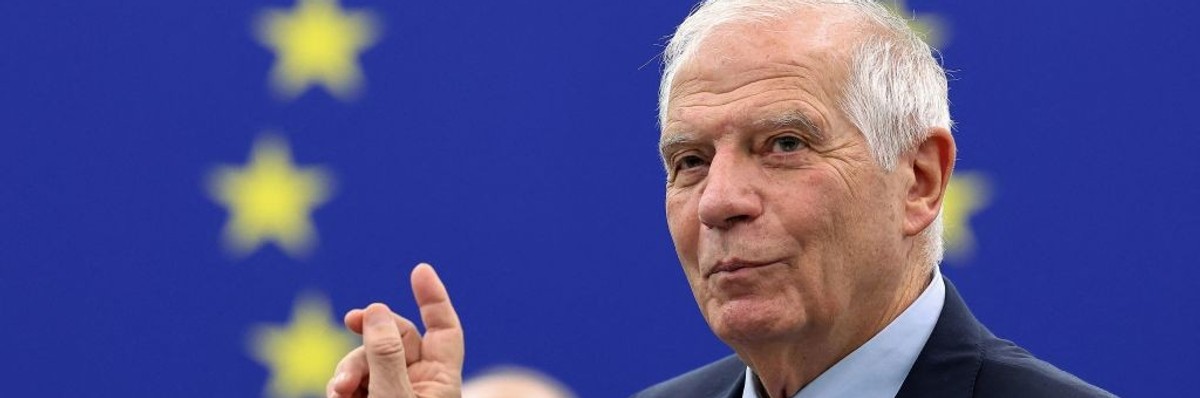
European Union High Representative for Foreign Affairs and Security Policy Josep Borrell gestures as he speaks during a debate on the humanitarian situation in Gaza, at the European Parliament in Strasbourg, eastern France on November 22, 2023.  (Photo by Frederick Florin/AFP via Getty Images)

The final text advocated for a “permanent cease-fire and to restart efforts towards a political solution provided that all hostages are immediately and unconditionally released and the terrorist organisation Hamas is dismantled.”

For the first time since Israel’s assault on Gaza began on October 7, the European Parliament called for a cease-fire Thursday—but not without significant conditions that critics said strip the resolution of all meaning.

The measure passed 312 to 131, with 72 abstaining.

Instead of endorsing an unconditional cease-fire, the text backed “a permanent cease-fire and to restart efforts towards a political solution provided that all hostages are immediately and unconditionally released and the terrorist organisation Hamas is dismantled,” as Agence France-Pressereported

“It is not a call for a cease-fire. It is an open-ended license for genocide, and will be understood by Israel as such.”

The Members of European Parliament (MEPs) expressed sorrow over all civilian deaths.

“While condemning in the strongest possible terms the despicable terrorist attacks committed by Hamas against Israel, they also denounce the disproportionate Israeli military response, which has caused a civilian death toll on an unprecedented scale,” the parliament said in a statement.

Hamas’ October 7 attack on southern Israel killed about 1,100 people and resulted in the taking of 240 hostages. Israel’s bombardment and invasion of Gaza has now killed 24,620 people and wounded 61,830, according to Thursday’s update from Gaza’s Ministry of Health.

The resolution also called for humanitarian access to the Gaza Strip, restarting the peace process with a goal of implementing a two-state solution, ending Israel’s occupation of the Palestinian territories, and accountability for all who carried out terrorist attacks or violated international law.

The vote comes the week after South Africa presented a case to the International Court of Justice (ICJ) arguing that Israel is committing genocide in Gaza. The text reiterates the E.U.’s support for the work of both the ICJ and the International Criminal Court.

The resolution was the result of a compromise between different parties in the parliament. The socialist, centrist, and green parties had all supported a resolution calling for a cease-fire, a political solution to the conflict, the release of the hostages, and the dismantling of Hamas, Reuters explained. However, the largest party in the body—the European People’s Party (EPP)—hesitated to join them and added an amendment that conditioned the cease-fire and restarting of the peace process on the release of hostages and the dismantling of Hamas.

“Sustainable peace cannot exist as long as Hamas and other terrorist groups hijack the Palestinian cause and threaten the existence of Israel, the only democracy in the region,” EPP MEP Antonio López-Istúriz told the body on Tuesday, as Euronews reported.

However, Manus Carlisle, the policy and press officer for Green MEP Grace O’Sullivan, said on social media that EPP had “sabotaged” the resolution by making the cease-fire conditional on the ending of Hamas, “which arguably makes the call entirely meaningless.”

O’Sullivan herself wrote on social media that EPP’s amendment “hands Israel a blank cheque to continue the massacre for as long as they want.”

“We need a braver E.U. than this,” she said.

Independents 4 Change MEPs Mick Wallace and Clare Daly denounced the text of the resolution.

“Reporting characterizing it as ‘the European Parliament calls for a permanent ceasefire’ is a misrepresentation of the text that has actually been passed,” they wrote in a statement. “Under no circumstances should it be allowed to go unchallenged.”

The MEPs pointed out that the parliament’s conditions for a cease-fire were the same as Israeli Prime Minister Benjamin Netanyahu’s.

“This is Israel’s repeatedly stated pretext for genocide, plain and simple, adopted by the European Parliament,” Wallace and Daly wrote in a statement. “It is not a call for a cease-fire. It is an open-ended license for genocide, and will be understood by Israel as such. The people of Gaza who are being murdered in their thousands by Israel are not responsible for the actions of Hamas.”

“In every respect, this resolution is the opposite of what is needed,” they added. “While the text claims to be a call for a cease-fire, it is a green light for butchery to continue.”

The resolution as a whole is non-binding, Reuters explained, though European Parliament resolutions can sometimes have an influence on foreign governments. The final text will be sent to other E.U. institutions, E.U. members, Israel, Palestinian officials, Egypt, and the United Nations.

Previously, the parliament had called for a humanitarian pause to allow aid into Gaza, but had not gone further and demanded a cease-fire, according to Euronews. The leaders of E.U. member states have not agreed to call for a cease-fire as a bloc and still endorse “humanitarian pauses and corridors.”

Original article by at Common Dreams republished under Creative Commons (CC BY-NC-ND 3.0). 

Continue ReadingEU Gaza Resolution Slammed as ‘Green Light for Butchery to Continue’

‘This Is Not Self-Defense… This Is Ethnic Cleansing’: Israel Blows Up Gaza University

Spread the love

Original article by JULIA CONLEY republished from Common Dreams under Creative Commons (CC BY-NC-ND 3.0).

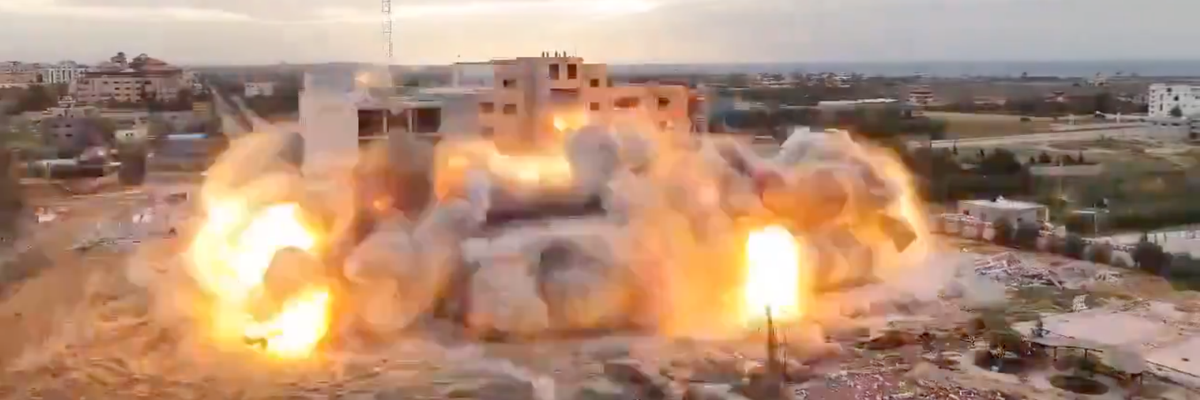
The Israeli military used hundreds of mines to blow up Israa University in Gaza on January 17, 2024.  (Photo: Screengrab)

“All the universities in Gaza have been damaged or destroyed,” said one international relations expert.

The Israel Defense Forces’ detonation of more than 300 mines planted at Israa University in Gaza on Wednesday provided the latest evidence that Israel’s objective in its bombardment of the enclave is not self-defense, rights advocates said.

“This is not self-defense,” said Chris Hazzard, an Irish member of the United Kingdom’s Parliament. “This is not counter-insurgency. This is ethnic-cleansing.”

The International Middle East Media Center (IMEMC) called the destruction of Israa University Israel’s latest attempt to carry out a “cultural genocide” along with the slaughter of at least 24,620 people in just over three months—people who Israeli officials have claimed are legitimate military targets despite the fact that roughly half of those killed have been children.

The wiping out of cultural landmarks was included in South Africa’s International Court of Justice case accusing Israel of genocidal acts in Gaza last week, with the complaint noting that “Israel has damaged and destroyed numerous centers of Palestinian learning and culture,” including libraries, one of the world’s oldest Christian monasteries, and the Great Omari Mosque, where an ancient collection of manuscripts was kept before the building was destroyed in an airstrike last month.

“The crime of targeting and destroying archaeological sites should spur the world and UNESCO into action to preserve this great civilizational and cultural heritage,” Gaza’s Ministry of Tourism and Antiquities said after the mosque was bombed.

Now, international relations professor Nicola Perugini of the University of Edinburgh said, “all the universities in Gaza have been damaged or destroyed.”

On its Facebook page, the university said the IDF had occupied the campus for about 70 days before planting 315 mines and detonating the institution’s main building, its museum, a university hospital, and other buildings.

The IDF occupied Israa University, said administrators, “and used it as a military base for its mechanisms and a center for [the] snatching of isolated civilians in the areas of Rashid, Maghraqa, and Zahraa streets, and temporarily detained [them] to investigate with citizens before moving them.”

Mitchell Plitnick, president of Rethinking Foreign Policy, said the fact that 315 mines were detonated meant that “by definition… it was not a legitimate military target.”

“Israel would have to have full control to plant so many mines,” said Plitnick. “This is a clear example of a war crime and destruction for the fun of it.”

Eight universities in Gaza have now been targeted since the IDF began its bombardment on October 7, according to the IMEMC.

Birzeit University, in the occupied West Bank, condemned the destruction of the school and accused Israel of stealing 3,000 rare artifacts from Israa’s museum.

“Birzeit University reaffirms the fact that this crime is part of the Israeli occupation’s onslaught against the Palestinians,” said the school on social media. “It’s all a part of the Israeli occupation’s goal to make Gaza uninhabitable; a continuation of the genocide being carried out in Gaza Strip.”

Original article by JULIA CONLEY republished from Common Dreams under Creative Commons (CC BY-NC-ND 3.0).

Continue Reading‘This Is Not Self-Defense… This Is Ethnic Cleansing’: Israel Blows Up Gaza University

400,000 marched in Washington DC against Biden’s complicity in Israel’s genocide

Spread the love

Original article by Natalia Marques republished from peoples dispatch under a Creative Commons Attribution-ShareAlike 4.0 (CC BY-SA) license.
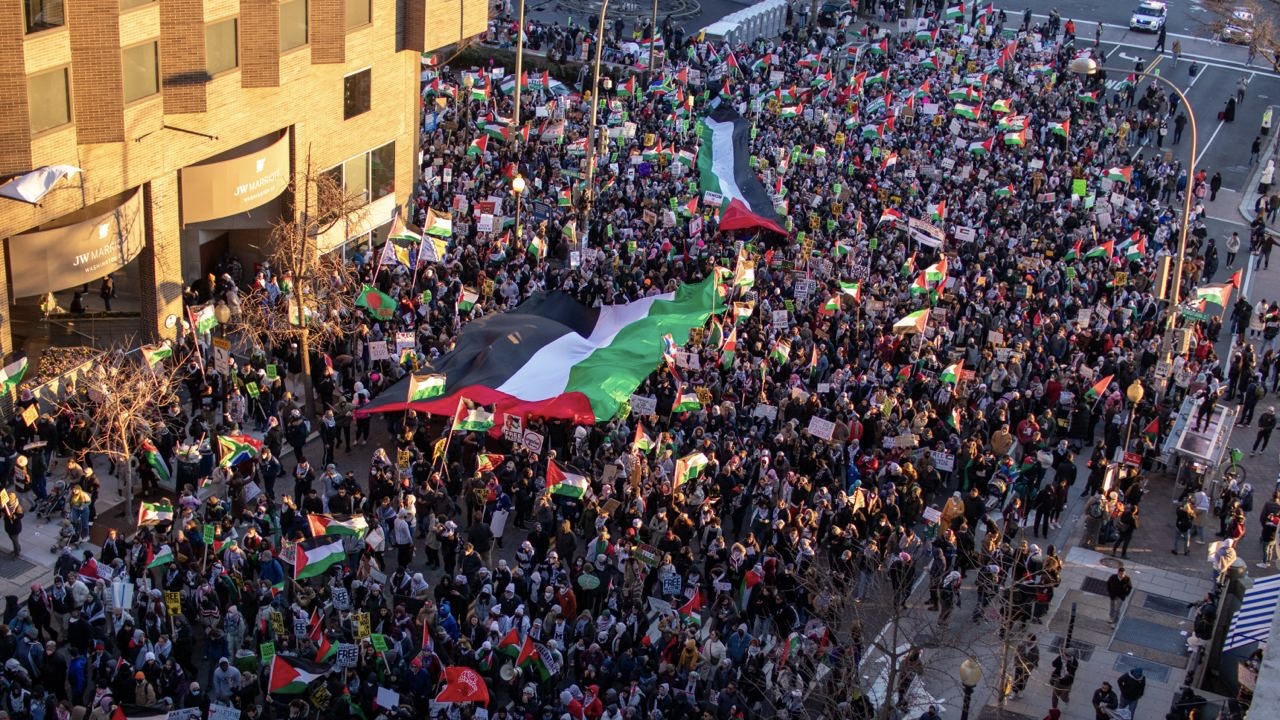
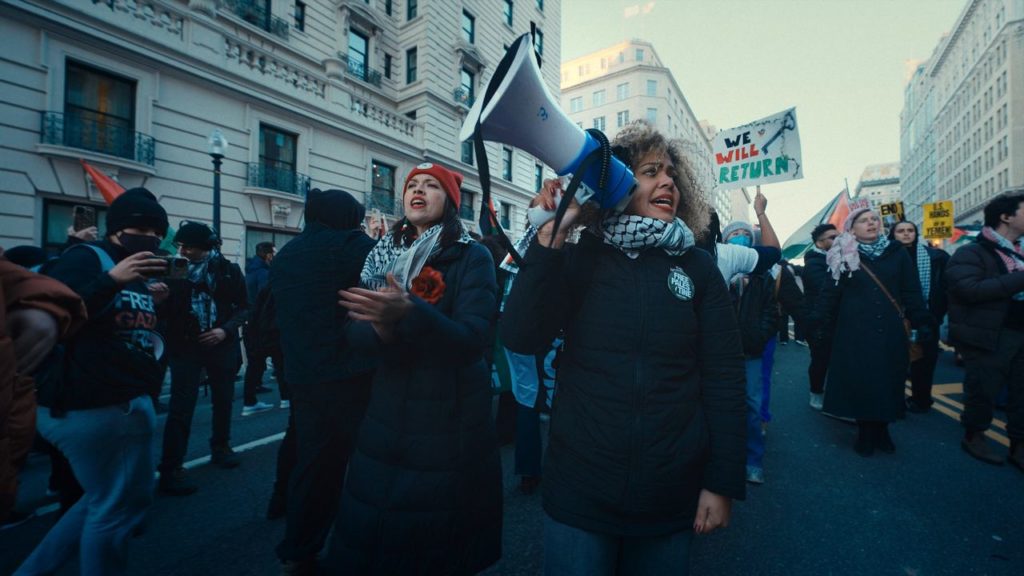
Hundreds of thousands marched in Washington, DC to demand an immediate ceasefire and protest Israel’s ongoing genocide in Gaza

Hundreds of thousands marched in Washington DC to protest Israel’s genocidal war on Gaza. Photo: Adrian Antonioli / ANSWER Coalition

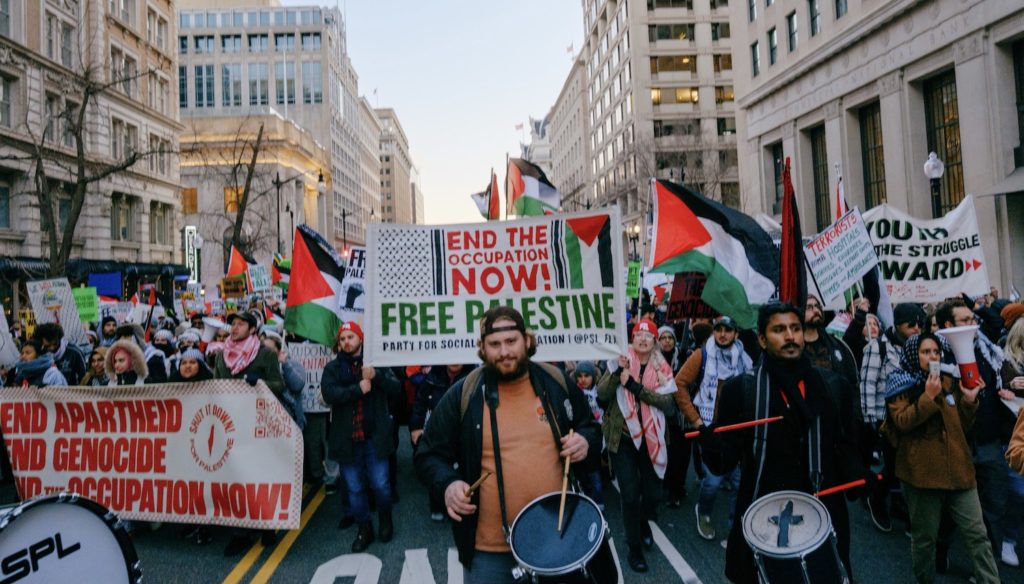
On January 13, a crowd of 400,000 gathered in Washington, DC’s Freedom Plaza to take the Palestine solidarity movement straight to Biden’s doorstep. Hundreds of thousands then marched, holding Palestinian, Yemeni, South African, and Puerto Rican flags, through DC and straight to the gates of the White House.

The mobilization was organized by the American Muslim Task Force on Palestine, which includes American Muslims for Palestine, Council on American-Islamic Relations, Islamic Circle of North America, Muslim American Society, Muslim Student Association-National, Muslim Legal Fund of America, Muslim Ummah of North America, and Young Muslims, and the ANSWER Coalition.

Frustrated with Biden’s support and bankrolling of Israel’s genocide in Gaza, protesters surrounded the President’s residence and chanted “Hands off Yemen!” and “Yemen, Yemen, make us proud, turn this invasion around!” in reference to the US-UK bombing campaign against Yemen in response to the country’s blockade of Israel-bound ships. Protesters also left bloody baby dolls at the gates of the White House to condemn the genocide in Gaza and the over 10,000 children that have been killed to date. As the crowd demonstrated, several snipers were seen on the roof of the White House.

The hundreds of thousands who showed up in DC were joined by millions across the world who participated in a global day of action in solidarity with Palestine to mark nearly 100 days of Israel’s genocide in Gaza. Rallies, strikes, and mass mobilizations were held in major cities of South Africa, Japan, Turkey, the UK, South Korea, Indonesia, Ireland, New Zealand, Ivory Coast, Sweden, Italy, Germany, Austria, Australia, Finland, as well as throughout the United States. Thousands shut down the Port of Oakland in California at 5 am on Saturday morning.

Before marching, the crowd of hundreds of thousands in Freedom Plaza heard from a diverse array of speakers from the US Muslim community and anti-imperialist organizations. “So long as the genocide in Gaza is being funded by this administration,” said Ismahan Abdullahi of the Muslim American Society, “we will not relent in our efforts to demand justice and the liberation of the Palestinian people.”

“Just as South Africa courageously rose to rightfully charge Israel with genocide, we the people of the United States of America will rise and continue these efforts,” she continued.

“You Genocide Joe, you Blinken the butcher, and your Secretary of Defense Lloyd Austin. You will be haunted by the screams of the children in Gaza,” said Taher Herzallah of American Muslims for Palestine, who, like many other speakers, placed the blame for the ongoing Gaza genocide directly onto the United States government. “You will be haunted by the prayers, the agonizing prayers of the elderly and the women of Gaza. And we, this new generation, will be the answer to their prayers.”

Protesters demanded an end to all US funding of Israel. Photo: Wyatt Souers / ANSWER Coalition

2024 is an election year, and Biden, who is running for reelection, has been hounded by Pro-Palestine demonstrators at several campaign events already. Mainstream media outlets openly worry about Biden’s chances in 2024, with the aging President losing key demographics of Democratic Party support such as young people and Arab-Americans.

“Instead of focusing on the American people, our tax money is being used to spread hatred, to spread warfare, to support criminal activity, frankly speaking, to support a genocide,” Mohamed Sabri, who traveled from Chicago to attend the march in DC, told Peoples Dispatch about why he will not be voting for Biden.

As a result of Biden’s unpopularity, third party candidates running for president in 2024 have gained new prominence. Both Jill Stein and Cornel West, running platforms to the left of the ruling Democratic Party, spoke at the March for Gaza.

Peoples Dispatch spoke to presidential and vice presidential candidates Claudia De La Cruz and Karina Garcia, who were on the ground, marching among the crowd of hundreds of thousands, and are running jointly on an explicitly socialist platform. “We know it’s significantly important for any presidential candidate running for the 2024 election to prioritize the freedom, liberation of Palestine. Anyone who does not do that is standing in support of genocide,” said De La Cruz, the presidential candidate for the Party for Socialism and Liberation.

“Democratic politicians, they like to pay a lot of lip service during the year, especially around domestic issues, and they never want to talk about imperialism, which is at the center, it’s the core of all of the problems faced by the entire world,” added Garcia.

The PSL presidential ticket of Claudia de la Cruz and Karina Garcia participating in the March for Gaza in Washington DC. Photo: Craig Birchfield / ANSWER Coalition

Original article by Natalia Marques republished from peoples dispatch under a Creative Commons Attribution-ShareAlike 4.0 (CC BY-SA) license.
Continue Reading400,000 marched in Washington DC against Biden’s complicity in Israel’s genocide

‘Israel-Hamas War’ Label Obscures Israel’s War on Palestinians

Spread the love

Original article by GREGORY SHUPAK republished from FAIR. This work is licensed under a Creative Commons Attribution-NonCommercial-NoDerivs 3.0 Unported License.

Since October 7, the day the escalation in Israel/Palestine began (FAIR.org10/13/23), American media outlets have persistently described the fighting as an “Israel-Hamas war.” From October 7 through midday on December 1, the New York TimesWall Street Journal and Washington Post have combined to run 565 pieces that use the phrase “Israel-Hamas war.”

This paradigm has been a dominant way of covering the violence, even though Israel has been clear from the start that its assault has not been narrowly aimed at Hamas. At the outset of the Israeli onslaught, Israeli Defense Minister Yoav Gallant (Times of Israel10/9/23) said: “I have ordered a complete siege on the Gaza Strip. There will be no electricity, no food, no fuel, everything is closed.” Oxfam later said that such restrictions on Palestinians’ ability to eat—which left 2.2 million people “in urgent need of food”—mean that Israel is deploying a policy wherein “starvation is being used as a weapon of war against Gaza civilians.”

A day later, Israeli military spokesperson Adm. Daniel Hagari (Guardian10/10/23) said that “hundreds of tons of bombs” had already been dropped on the Gaza Strip, and admitted that “the emphasis is on damage and not on accuracy.”

The New York Times‘ label (12/2/23) encourages readers to view Israel’s attacks on a population as really being aimed at a distinct group.

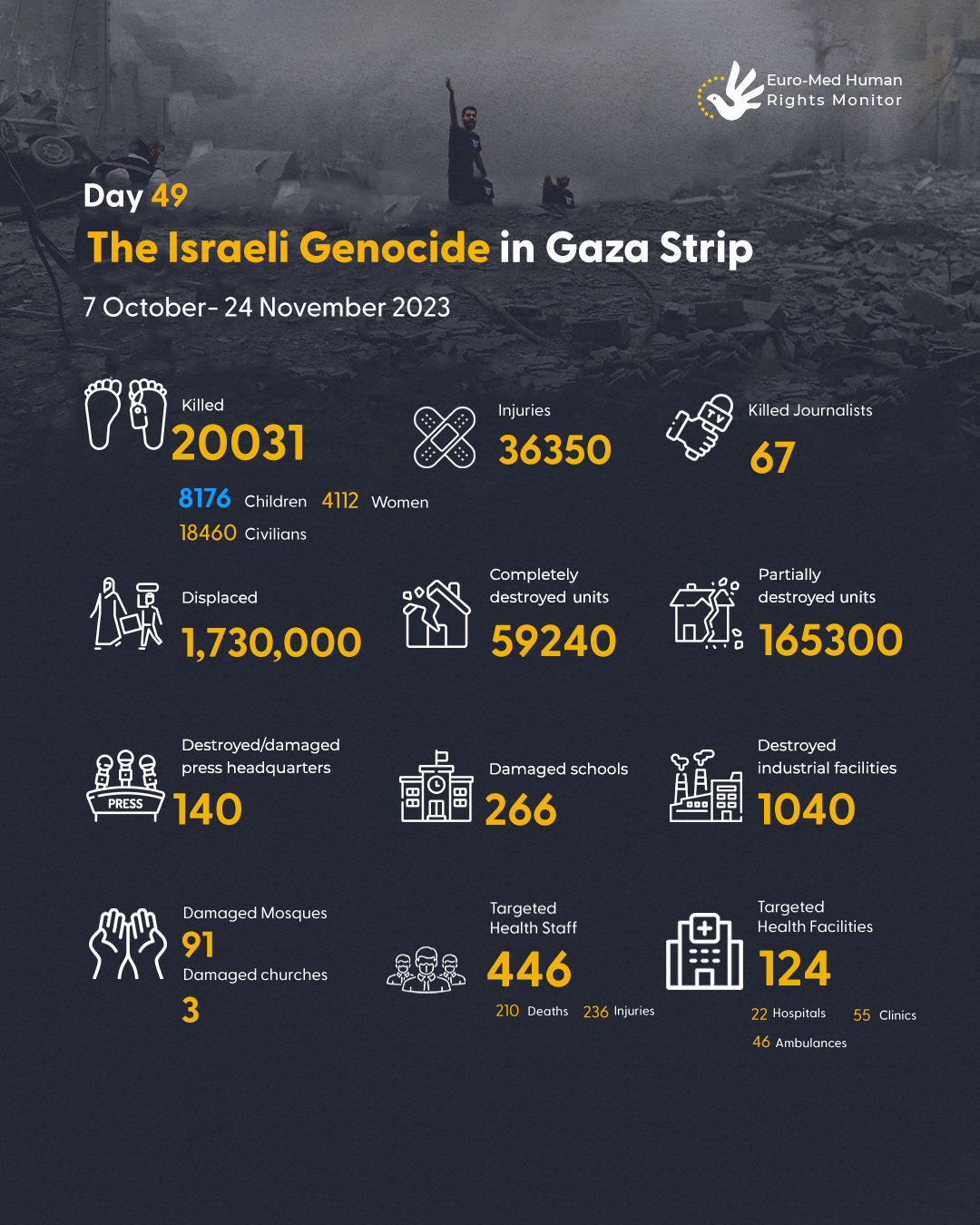
The indiscriminate nature of Israel’s assault is clear. The United Nations Office for the Coordination of Humanitarian Affairs reported on November 24 that “over 1.7 million people in Gaza, or nearly 80% of the population, are estimated to be internally displaced.” On November 25, the Swiss-based Euro-Mediterranean Human Rights Monitor reported that Israel had killed 20,031 Palestinians in Gaza, 18,460 of whom (or 92%) were civilians, since October 7.

Thus, while Israel has openly acknowledged that it is carrying out indiscriminate violence against Palestinians, US media outlets do Israel the favor of presenting its campaign as if it were only aimed at combatants. “Israel-Gaza war” comes closer to capturing the reality that Israel’s offensive is effectively against everyone living in Gaza. Yet “Israel-Gaza war” appears in 265 pieces in the three papers, exactly 300 fewer than the obfuscatory “Israel-Hamas war.”

Consider also the Euro-Mediterranean Human Rights Monitor finding that Israel has slaughtered 8,176 children. If 41% of all the Palestinians Israel has killed in the first seven weeks of its rampage have been children, and 8% have been combatants, then it is less an “Israel-Hamas war” than an Israeli war on Palestinian children.

Characterizing what has happened since October 7 as an “Israel-Hamas war” fails to adequately capture the scope and the character of Israel’s violence. Describing the bloodbath in Palestine this way obscures that grave violence is being visited upon virtually all Palestinians, whatever their political allegiances and whatever their relation to the fighting.

Cognitive dissonance

Contrary to the implication of NBC‘s headline (12/2/23), the divide in Hollywood is not between supporters of Israel and Hamas, but over the issue of Palestinian human rights.

Corporate media have often stuck to the “Israel-Hamas war” approach even when the information the outlets are reporting shows how inadequate it is to conceive of Israel’s attacks in that way. For instance, the New York Times (10/20/23) ran a story about Israel ordering 1.2 million Gaza residents to evacuate their homes, and still classified the evacuation as part of the “Israel-Hamas war.” The Izz ad-Din al-Qassam Brigades, Hamas’ armed wing, is estimated to have 30,000–40,000 fighters (Axios10/21/23).

The Wall Street Journal published a short piece (11/6/23) that noted:

The United Nations said that the Israel-Hamas war has killed the highest number of UN workers in any single conflict. The UN said that over 88 workers in its Relief and Works Agency [UNRWA], the largest humanitarian organization in the Gaza Strip, have been killed since October 7.

But UNRWA did not itself use the “Israel-Hamas war” narrative in the report to which the Journal referred, instead opting for “escalation in the Gaza Strip.” Indeed, Israel killing UN workers at a rate of almost three each day would seem to fall outside the bounds of an “Israel-Hamas war,” but that’s how the paper categorizes the violence. (“Israel’s war on the UN” falls well outside the bounds of the ideologically permissible in the corporate media.)

Washington Post article (11/7/23) titled “Israel’s War in Gaza and the Specter of ‘Genocide’” quoted several experts and political leaders making a credible case that, in the words of Craig Mokhiber, former director of the United Nations’ New York office on human rights, “the term ‘genocide’ needs to be applied” to what Israel is doing in Gaza.

Nevertheless, the article’s author, Ishaan Tharoor, attributed such statements to “critics of Israel’s offensive against the Islamist group Hamas,” and described the violence as “Israel’s overwhelming campaign against Hamas.” Genocide as defined by the UN requires “the intent to destroy a national, ethnic, racial or religious group, in whole or in part.” So saying that Israel’s attacks are directed “against Hamas” twice in an article pointing to authorities on genocide invoking the term with reference to Israel’s actions in Gaza ought to generate cognitive dissonance.

Violence on the West Bank

In the first two weeks of fighting, the BBC (10/22/23) reported, Israel killed 89 Palestinians on the West Bank.

Another problem with classifying the bloodshed of the last seven weeks as an “Israel-Hamas war” is that Israel has also enacted brutal violence and repression on the West Bank, which is governed by the Palestinian Authority, Hamas’ arch rivals; Hamas is mostly confined to Gaza (Electronic Intifada10/28/23).

Between October 7 and November 26, Israeli forces killed 222 Palestinians in the West Bank, and Israel’s government-backed settlers killed eight more. In that period, Israel has also repeatedly carried out airstrikes in the West Bank, hitting such targets as the Balata refugee camp (Reuters11/18/23) and a mosque in the Jenin refugee camp (BBC10/22/23).

Israel has also arrested hundreds of West Bank Palestinians since October 7 (AP11/26/23) and attacked a hospital in Jenin, shooting a paramedic while they were inside an ambulance and using military vehicles to block ambulances from entering hospitals.

It would therefore make more sense to speak of an “Israel-Palestine war” than an “Israel-Hamas war,” but the former has been used in just two articles in my dataset.

What the media presents as a war between Israel and an armed Palestinian resistance group is in reality an Israeli war on Palestinians’ physical survival, on their food and clean water supplies, on their homes, healthcareschoolschildren and places of worship—a war, in other words, on the Palestinians as a people.

Original article by GREGORY SHUPAK republished from FAIR. This work is licensed under a Creative Commons Attribution-NonCommercial-NoDerivs 3.0 Unported License.

Continue Reading‘Israel-Hamas War’ Label Obscures Israel’s War on Palestinians