Category: plutocracy

  • The Caribbean on a knife’s edge: Trump’s military buildup threatens Venezuela

    Spread the love

    Original article by Manolo De Los Santos republished from peoples dispatch under  a Creative Commons Attribution-ShareAlike 4.0 (CC BY-SA) license.

    US President Donald Trump, Venezuelan President Nicolás Maduro. Photos via Presidential Press

    The war drums beating in Washington are not just a threat to a distant nation; they are a symptom of a political system that thrives on the distraction of war abroad to cover its internal crises.

    The sun glints off the gray hull of the USS Iwo Jima, a massive amphibious assault ship cutting through the Caribbean Sea. Secretary of War Pete Hegseth, a key architect of the Trump administration’s “maximum pressure” policies, stands on deck before a group of sailors and marines. His voice, amplified by the ship’s public address system, is a low, serious rumble that carries across the choppy waters. “What you’re doing right now is NOT training,” he says, in a scene reminiscent of George W. Bush’s staged landing to declare victory in Iraq. “This is a REAL-WORLD EXERCISE on behalf of the vital national interests of the United States of America, to end the POISONING of the American people.” His words hang heavy in the air, a dramatic prelude to what some suspect is an impending invasion of Venezuela.

    The history of the Caribbean is a bloody one, stained by the imperial ambitions of European powers and the United States. The region now sits on the verge of another bloody chapter. As the great writer and historian Juan Bosch once observed, this region of Latin America is a battleground where empires have fought to seize the rich lands of its peoples and to claim what other empires had already conquered.

    Today, the Caribbean is again being transformed into a stage for imperial aggression.

    In a dangerous and dramatic escalation, the government of the United States, through its aptly renamed Department of War, has amassed a formidable naval force and deployed advanced fighter jets to the waters off Venezuela. This military buildup, consisting of at least eight warships, 4,000 sailors and marines along with P-8 spy planes and at least one nuclear submarine, is a clear threat to Venezuelan sovereignty and a blatant crime against international law. Washington is hiding behind a well-worn, cynical pretext: the “war on drugs”.

    A sordid history of manufactured pretexts

    The latest act of lawlessness came on September 2, when US forces in the Caribbean allegedly interdicted a “drug trafficking” vessel. Instead of following international protocols, the US Coast Guard and DEA agents opened fire, destroying the boat and killing all 11 people on board. This extrajudicial execution at sea is a clear violation of international law, which mandates that law enforcement actions must prioritize arrest and the preservation of life. The use of lethal force is only permitted as a last resort in cases of immediate self-defense. Though the US is not a signatory to the United Nations Convention on the Law of the Sea, the US military’s legal advisors have previously said that the US should “act in a manner consistent with its provisions”. To destroy a vessel and summarily execute its occupants without due process is not law enforcement; it is a state-sanctioned massacre, a crime that echoes other massacres in American military missions abroad. Recently, Professor Michael Becker of Trinity College in Dublin told the BBC that the US action “stretches the meaning of the term beyond its breaking point”.

    This act of violence is not an anomaly but part of a deliberate pattern of provocation. The US Southern Command (SOUTHCOM) has significantly bolstered its presence with additional destroyers and littoral combat ships. Meanwhile, the US Air Force has sent F-35 fighter jets, aircraft designed for air dominance and striking high-value targets – not for intercepting drug runners – to its base in Puerto Rico, an island under US colonial domination. This military posture has nothing to do with curbing narcotics flow and everything to do with encircling and intimidating a nation that has defiantly resisted Washington’s hegemony for over two decades.

    The historical context is inescapable. The United States has a long and sordid history of fabricating justifications for military action to achieve its political ends. The sinking of the USS Maine, the Gulf of Tonkin incident, and the non-existent “Weapons of Mass Destruction” used to justify the invasion of Iraq are all well-worn chapters in the same playbook. The current administration, with its bellicose rhetoric, is drafting a new one. Key architect of Trump-era maximum pressure policies, Secretary of State Marco Rubio, has consistently agitated for regime change, framing the Venezuelan government as a “narco-state”.

    Exposing the “narco-state” smokescreen

    The “narco-state” narrative collapses under the weight of its own fiction. According to the United Nations Office on Drugs and Crime (UNODC) and the US State Department’s own annual reports, the vast majority of cocaine leaving South America originates from and passes through US-allied nations like Colombia, Ecuador, and Peru. Venezuela is not a significant producer of cocaine. The narrative is a convenient smokescreen, a lie sold to the public to manufacture consent for aggression. The hypocrisy is further exposed by Rubio’s recent tour of Ecuador, a nation with extremely high levels of collaboration with US anti-drug agencies. Despite this collaboration, Ecuador has been plunged into a devastating crisis of drug trafficking and gang violence, proving that US intervention solves nothing and only fuels instability.

    Read more: Noboa opens door to US military bases, backs Rubio’s FTO designation for Ecuadorian gangs

    The true goal of this military buildup is clearly the overthrow of Venezuela’s government and the seizure of its vast oil reserves. The threats emanating from Washington are not veiled. They range from scenarios of massive bombing campaigns to the outright kidnapping or assassination of President Maduro. Donald Trump’s past musings about a “military option” for Venezuela are now being operationalized.

    The Venezuelan people prepare for resistance

    In the face of this existential threat, the Venezuelan people are preparing to defend their homeland. President Maduro has called for a “people in arms”, and an estimated 8 million Venezuelans have joined citizen militias. Across the country, young people, students, workers, and retirees are training in basic combat, emergency response, and civil defense. Their resolve is a powerful testament to the spirit of resistance.

    Read more: Venezuela mobilizes 4.5 million militia members as US deploys troops to the Caribbean

    “We are not an army for aggression, but an army for peace, for the defense of our sacred land,” said Maria Delgado*, a 20-year-old university student and new militia member in Caracas. “They think that because we are young or because we are not professional soldiers, we will be afraid. They are wrong. We know what is at stake: our sovereignty, our future, and the project of justice that our parents built.”

    President Maduro has framed this mobilization in stark terms: “Venezuela is facing its greatest threat in 100 years. Having defeated all forms of hybrid warfare, they [United States] have opted for the worst mistake.”

    The war drums beating in Washington are not just a threat to a distant nation; they are a symptom of a political system that thrives on the distraction of war abroad to cover its internal crises. The billions spent on deploying F-35s and destroyers to the Caribbean are billions stolen from the right to healthcare, education, and housing of ordinary Americans at home.

    *Name changed

    Manolo De Los Santos is Executive Director of The People’s Forum and a researcher at Tricontinental: Institute for Social Research. His writing appears regularly in Monthly Review, Peoples Dispatch, CounterPunch, La Jornada, and other progressive media. He coedited, most recently, Viviremos: Venezuela vs. Hybrid War (LeftWord, 2020), Comrade of the Revolution: Selected Speeches of Fidel Castro (LeftWord, 2021), and Our Own Path to Socialism: Selected Speeches of Hugo Chávez (LeftWord, 2023).

    Original article by Manolo De Los Santos republished from peoples dispatch under  a Creative Commons Attribution-ShareAlike 4.0 (CC BY-SA) license.

    Orcas discuss how Trump was re-elected and him being an insane, xenophobic Fascist.
    Orcas discuss how Trump was re-elected and him being an insane, xenophobic Fascist.
  • Here’s Trump’s Birthday Letter to Epstein—With His Signature on It

    Spread the love

    https://newrepublic.com/post/200153/trump-birthday-letter-jeffrey-epstein-signature

    Davidoff Studios/Getty Images

    Remember that letter Trump swore doesn’t exist? Well, the Epstein estate just released it.

    At the height of Donald Trump’s scandal surrounding notorious late sex criminal Jeffrey Epstein, the Wall Street Journal in July reported that the president had written a cryptic message wishing Epstein a happy 50th birthday in 2003. The note was reportedly contained within a marker drawing of a woman’s naked torso.

    Trump insisted this was a “fake thing.” “I never wrote a picture in my life. I don’t draw pictures of women,” he told the Journal. “It’s not my language. It’s not my words.” Vice President JD Vance called it “complete and utter bullshit.”

    The president filed a lawsuit against the newspaper in hopes of, in his words, suing owner Rupert Murdoch’s “ass off, and that of his third rate paper.”

    Murdoch and the Journal’s asses may live to see another day, as the paper on Monday released a photo of the letter.

    …

    Article continues at https://newrepublic.com/post/200153/trump-birthday-letter-jeffrey-epstein-signature

    Orcas discuss how Trump was re-elected and him being an insane, xenophobic Fascist.
    Orcas discuss how Trump was re-elected and him being an insane, xenophobic Fascist.
    Donald Trump urges you to be a Climate Science denier like him. He says that he makes millions and millions for destroying the planet, Burn, Baby, Burn and Flood, Baby, Flood.
    Donald Trump urges you to be a Climate Science denier like him. He says that he makes millions and millions for destroying the planet, Burn, Baby, Burn and Flood, Baby, Flood.
    Donald Trump decrees forbidden terms denying sexual diversity
    Donald Trump decrees forbidden terms denying sexual diversity
  • Plans to ‘maximise extraction’ of North Sea oil and gas would soon run into geological limits

    Spread the love
    North Sea oil is in its geological twilight. James Jones Jr / shutterstock

    Mark Ireland, Newcastle University

    “We are going to get all our oil and gas out of the North Sea”, Conservative Party leader Kemi Badenoch said recently. Her promise to “maximise extraction” sets up a clash between political ambitions, economic reality and geological limits.

    Reform UK has also said drilling for more oil and gas in the North Sea would be a “day one” priority. But even if the Conservatives or Reform were to be elected and lifted the current moratorium on new exploration licenses, there might not be the promised prizes of oil and gas under the seabed – or enough appetite from investors – to deliver on that promise.

    BP, in those days British Petroleum, first extracted gas from under the North Sea in 1967. It marked the start of what was to become, for decades, one of the most valuable sectors of the UK economy, with more than 400 separate oil and gas fields developed to date.

    But production peaked in 1999 and the North Sea now produces less than half as much as in its heyday.

    It is now a “mature” basin: most of the biggest and easiest-to-develop fields have already been discovered and depleted. What remains are smaller, sometimes more remote, and often more technically challenging or expensive resources and reserves.

    This is typical of ageing oil and gas provinces, where production declines even as operating costs rise. New projects must compete with oil and gas extracted from other parts of the world where it is easier and cheaper and more appealing to investors.

    Finding oil and gas

    Historically, only one in eight exploration wells in the North Sea led to a field producing oil and gas. That ratio has improved: between 2008 and 2017, a bit more than one in four wells led to a commercial success.

    But far fewer wells are being drilled today. Even with the advances in technology, such as improved geophysical imaging which allows us to better define opportunities ahead of drilling, the big discoveries were probably made decades ago.

    UK exploration wells vs offshore fields by year:

    Graph showing wells and oil fields by year
    The number of exploration wells is down hugely from its peak in the 1980s and early 90s. Mark Ireland / NSTA

    The UK government’s North Sea Transition Authority estimates there could still be around 3.5 billion barrels of oil equivalent in more than 400 undeveloped prospects. But most of these potential fields are small, isolated or technically complex. Developing them will require high oil and gas prices, fiscal stability, and a lot of investor confidence.

    Politics vs geology

    Even if a future government relaxes exploration licensing rules, geology will remain the bigger constraint. The North Sea is simply not as cheap as it was, and global fossil fuel giants have many other options. It is currently far cheaper to produce oil and gas in other regions, the Middle East or North Africa for example. Projects in these countries are all competing for the same capital.

    Volatility in the energy sector will continue to make investors cautious. The 2015 oil price crash cut activity in the UK sector to its lowest level in decades, and it has never fully recovered. As fossil fuels are sold on the global market, political volatility, international and national, can lead to rapid shifts in investor confidence.

    In the UK the introduction of a windfall tax in 2023 and changing requirements for environmental impact assessments are all making decision making on long-term projects riskier. And while the UK still needs considerable volumes of gas in future (and more modest amounts of oil) both are declining as our energy system evolves and renewable energy expand.

    The UK’s mix of economic uncertainty, mature geology and smaller discoveries will make it harder to attract major international energy firms.

    The future of the North Sea

    That doesn’t mean the North Sea has finished as a source of oil and gas. For instance, undeveloped discoveries – where oil or gas has been confirmed but not yet produced – represent a lower-risk opportunity. But returns may be modest as many are relatively small and isolated from existing infrastructure.

    New exploration licenses, if issued, might extend production modestly, but they are unlikely to deliver another game-changing discovery.

    Some analysts argue that future licensing should be highly strategic, limited to projects with clear economic importance or climate compatibility. That approach could reduce reliance on imported gas, which tends to be more carbon-intensive than gas produced domestically. This would certainly make more sense than restarting fracking. But it would still not recreate the industry’s heyday.

    Easy oil is over

    The North Sea will still produce oil and gas for years to come, but its role will shrink. Even with friendlier policies, the era of big discoveries and rapid growth isn’t coming back.

    Maximising extraction may sound appealing to politicians, but geology, economics and climate commitments all point to the North Sea’s best oil and gas days being behind it. The real challenge now is managing the investment during decline while investing in the cleaner solutions that will replace it.


    Don’t have time to read about climate change as much as you’d like?
    Get a weekly roundup in your inbox instead. Every Wednesday, The Conversation’s environment editor writes Imagine, a short email that goes a little deeper into just one climate issue. Join the 45,000+ readers who’ve subscribed so far.

    Mark Ireland, Senior Lecturer in Energy Geoscience, Newcastle University

    This article is republished from The Conversation under a Creative Commons license. Read the original article.

    UK Conservative Party leader Kemi Badenoch explains her reality that the Earth is flat, the Moon is made of cheese and that she was born from Unicorn horn dust
    UK Conservative Party leader Kemi ‘not a genocide’ Badenoch explains her reality that the Earth is flat, the Moon is made of cheese and that she was born from Unicorn horn dust
  • Trump Won’t Stop With Venezuela: Rubio Indicates Broader Campaign of Lawless Executions

    Spread the love

    Original article by Julia Conley republished from Common Dreams under Creative Commons (CC BY-NC-ND 3.0).

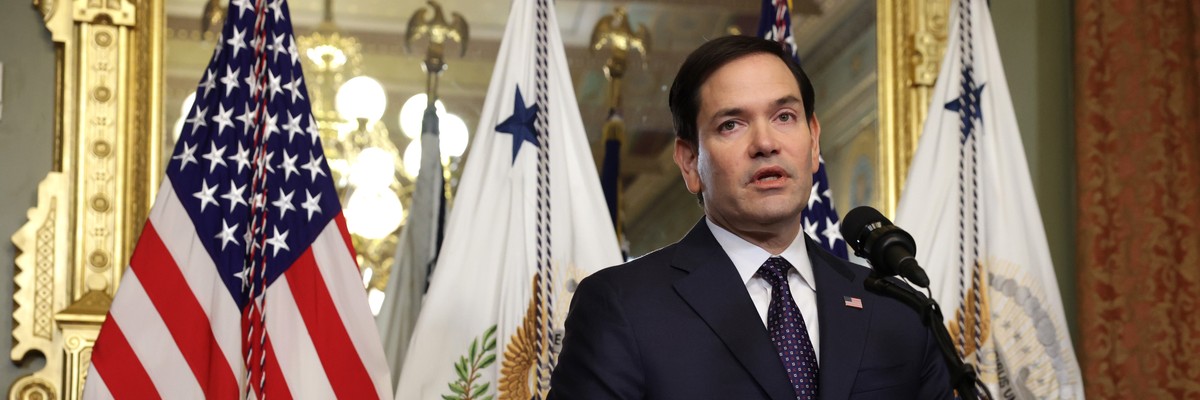
    U.S. Secretary of State Marco Rubio speaks on January 21, 2025 in Washington, DC. (Photo by Alex Wong/Getty Images)

    “There is no military solution to the overdose crisis, but there is a political solution to a president with authoritarian ambitions,” said one peace advocate. “Congress must act now to end unauthorized military action.”

    As rights groups and Democratic lawmakers condemned the Trump administration’s bombing of a boat it claims—without evidence—was carrying drugs off the coast of Venezuela, Secretary of State Marco Rubio made clear on Thursday that targeting vessels linked to drug smuggling in Latin America, and possibly elsewhere, will be part of the White House’s ongoing policy.

    At a news conference in Quito, Ecuador, Rubio suggested Latin American governments have a choice: Work with the Trump administration to crack down on drug trafficking or see the US kill more citizens suspected of trying to smuggle illegal substances.

    “For cooperative governments, there’s no need because those governments are going to help us,” said Rubio. “They’re going to help us find these people and blow them up, if that’s what it takes.”

    Some governments in the region have avoided criticizing this week’s bombing of a boat off the coast of Venezuela, which the US has said killed 11 people it had identified at “narco-terorrists” connected to Tren de Aragua, and which was conducted under the 2001 Authorization for the Use of Military Force.

    The White House has not provided evidence of the suspected drug smuggling or that the victims were connected to the gang. US intelligence agencies have also called into question President Donald Trump’s claims that Tren de Aragua is a high-level gang that terrorist organization working with the Venezuelan government.

    Ecuador’s government said Thursday it intends to revise its extradition agreement with the US, and President Daniel Noboa praised the US for its efforts to “actually eliminate any terrorist threat.” On the same day, Rubio announced $20 million in new security assistance for Ecuador.

    “Under Trump, if the president declares you a terrorist, the U.S. military will apparently execute you on his behalf, no questions asked.”

    The White House has also turned its attention to two Ecuadorian gangs, Los Lobos and Los Choneros, with Rubio announcing they have been designated as terrorist groups. The designation gives the Trump administration “all sorts of options,” Rubio claimed, for cracking down on the gangs’ activities, including potentially killing those suspected of being leaders or traffickers for the groups.

    “This time, we’re not just going to hunt for drug dealers in the little fast boats and say, ‘Let’s try to arrest them,’” Rubio said. “No, the president has said he wants to wage war on these groups because they’ve been waging war on us for 30 years and no one has responded.”

    As Rubio spoke in Quito, Defense Secretary Pete Hegseth said at Fort Benning in Georgia on Thursday that while Trump said he ordered the strike on the boat in the Caribbean this week, low-ranking military officers will soon be empowered to make final decisions on such attacks—strikes which international law experts have decried as nothing less than extrajudicial murder.

    “The understanding is that those authorities are better made, those decisions are better made, by men and women in the professional arms,” Hegseth said.

    Despite the administration’s use of the military to attack the boat near Venezuela this week and Rubio’s rhetoric about being at “war” with groups involved in the drug trade, human rights advocates and other Latin American leaders have stressed in recent days that drug trafficking is a crime that must be confronted by law enforcement—not an entity that the US can defeat through military action.

    “We have been capturing civilians transporting drugs for decades without killing them. Those who transport drugs are not the big drug traffickers, but the very poor young people of the Caribbean and the Pacific,” said Colombian President Gustavo Petro.

    Adam Isacson of the Washington Office on Latin America told The Washington Post that “you don’t just simply blow boats out of the water. You follow law enforcement procedures.”

    Sara Haghdoosti, executive director of Win Without War, said that with this week’s deadly attack—and plans to conduct more strikes—Trump has brought former President George W. Bush’s “dream to full fruition.”

    “Under Trump, if the president declares you a terrorist, the U.S. military will apparently execute you on his behalf, no questions asked,” said Haghdoosti. “That should deeply alarm us all, especially at a time when the president thinks nothing of labeling anyone from a USAID worker to a college student as a terrorist.”

    The killing of 11 suspected Venezuelan gang members, added Haghdoosti, will make “no difference whatsoever in the lives of people struggling with their own or a loved one’s addiction,” particularly as the Republican Party’s budget cuts have “ravaged” funding for substance use disorder treatment and overdose prevention.

    “There is no military solution to the overdose crisis, but there is a political solution to a president with authoritarian ambitions,” said Haghdoosti. “Congress must act now to end unauthorized military action in the Caribbean, investigate these apparently lawless killings, and restore the proven health and harm reduction programs that people struggling with the scourge of fentanyl desperately need.”

    Original article by Julia Conley republished from Common Dreams under Creative Commons (CC BY-NC-ND 3.0).

    Donald Fuhrump says that Amerikkka doesn't bother with crimes or charges anymore, not being 100% Amerikkkan and opposing his real estate intentions is enough.
    Donald Fuhrump says that Amerikkka doesn’t bother with crimes or charges anymore, not being 100% Amerikkkan and opposing his real estate intentions is enough.
    Donald Trump urges you to be a Climate Science denier like him. He says that he makes millions and millions for destroying the planet, Burn, Baby, Burn and Flood, Baby, Flood.
    Donald Trump urges you to be a Climate Science denier like him. He says that he makes millions and millions for destroying the planet, Burn, Baby, Burn and Flood, Baby, Flood.
    Elon Musk urges you to be a Fascist like him, says that you can ignore facts and reality then.
    Elon Musk urges you to be a Fascist like him, says that you can ignore facts and reality then.