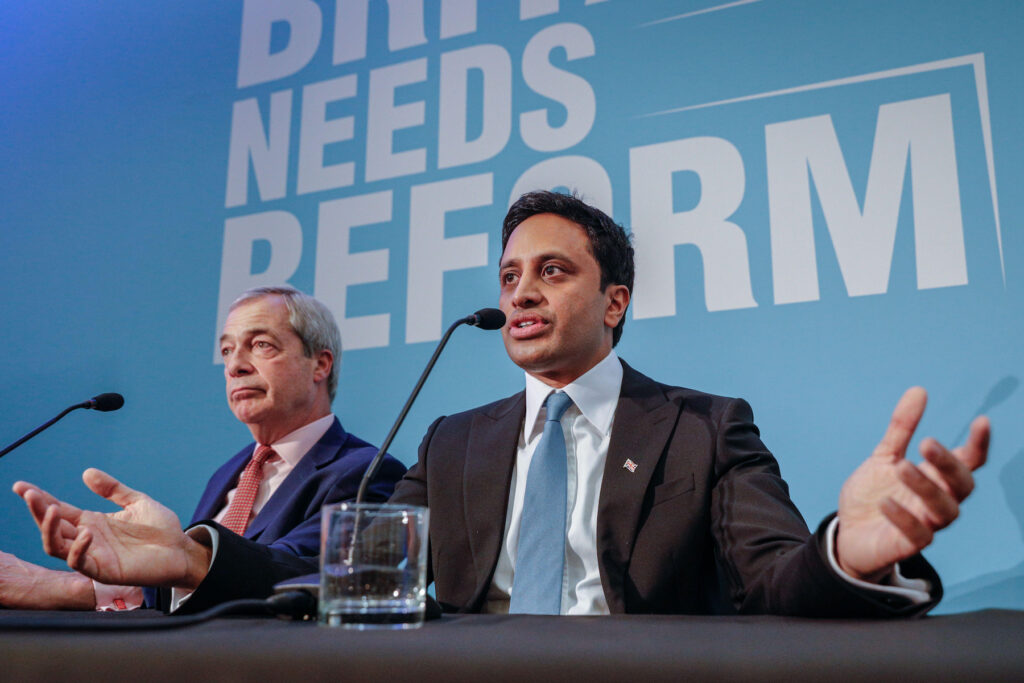
Reform UK leader Nigel Farage at the party’s 2024 annual conference in Birmingham. Credit: Reform UK / YouTube
DeSmog and the New World have been blacklisted by Nigel Farage’s party.
A leading press freedom group has accused Reform UK of drawing from the “authoritarian playbook” by blocking media outlets from attending its annual conference this weekend.
The party informed DeSmog and the New World yesterday that its journalists would not be accredited for this year’s event. It did not offer an explanation.
The New World (formerly the New European) is a weekly newspaper with 35,000 subscribers whose contributors and editors include former New Labour communications chief Alastair Campbell, former global editor of the Bureau of Investigative Journalism James Ball, and former Spectator editor Matthew d’Ancona.
DeSmog is one of the UK’s leading climate investigations platforms. This year alone it has published stories in partnership with the likes of the BBC, The Guardian, the Financial Times, Private Eye, and The Mirror.
“It is shocking to see UK political parties seeking to pick and choose who can report on them,” said Fiona O’Brien, UK director of Reporters Without Borders (RSF).
“For democracy to work, journalists must be free to cover political events like party conferences and hold those in power to account, on behalf of the public.
“Reform UK’s actions in recent weeks – which include banning councillors from speaking to local journalists and falsely accusing journalists of activism – are straight out of the authoritarian playbook and should immediately be reversed.”
Reform’s leader of Nottinghamshire County Council, Mick Barton, has banned his councillors from speaking to local press outlet the Nottinghamshire Post and its online arm Nottinghamshire Live. The ban followed critical coverage of Reform by the publication, whose journalists were accused of acting “as activists” by the party’s deputy leader Richard Tice.
Reform’s leader Nigel Farage is paid more than £300,000 a year as a presenter on the anti-climate media outlet GB News, while Tice was formerly employed by GB News and its Murdoch-owned rival TalkTV.
Farage sported a GB News badge in Congress yesterday as he testified to U.S. lawmakers about supposed “free speech” issues in the UK.
The Reform leader used the session to compare Britain to North Korea, and to urge the U.S. to punish the UK for its alleged free speech infringements.
However, Farage was also held to account for his own questionable free speech record. Democrat Jamie Raskin asked the Reform leader: “Why do you ban journalists who oppose your views from coming to your events?”
“I don’t,” Farage responded. “I can’t think, if I go back over the past 25 years, of banning anybody.”
That statement is contradicted by Reform’s decision to ban DeSmog and the New World from this year’s conference.
Byline Times also announced today that it has been banned from attending this year’s Conservative Party conference. DeSmog and a number of other independent outlets were banned from last year’s Tory conference.
Reform Conference 2025
As reported by DeSmog yesterday, Reform’s conference in Birmingham will feature climate science deniers, anti-vaccine conspiracy theorists, and dark money campaign groups.
They include the Heartland Institute, a group close to Donald Trump’s administration that has called human-induced climate change a “delusion”, and Net Zero Watch – the campaign arm of the Global Warming Policy Foundation, which has claimed that carbon dioxide has been “mercilessly demonised”.
By giving them a platform, Reform is “showing open contempt for the British public already living with the realities of climate breakdown,” said Tessa Khan, executive director of the research and campaign group Uplift.
A recent report by the New Economics Foundation found that Reform’s climate policies – which include scrapping clean energy investment and drilling for more fossil fuels – would cost more than 60,000 jobs and wipe £92 billion off the UK economy.
DeSmog previously revealed that Reform is offering access to Farage during the conference in exchange for hefty donations. A sum of £250,000 buys 10 seats at a champagne breakfast with the Reform leader during the two-day event, as well as “chauffeur-driven travel”, a personal assistant, and the sponsor’s logo on the main conference stage and battle bus.
DeSmog asked Reform to explain why it had been banned from the event, but did not receive a response.
Nigel Farage explains the politics of Reform UK: Racism, Fake anti-establishmentism, Deregulation, Corporatism, Climate Change Denial, Mysogyny and Transphobia.Nigel Farage urges you to ignore facts and reality and be a climate science denier like him. He says that Reform UK has received millions and millions from the fossil fuel industry to promote climate denial and destroy the planet.Nigel Farage reminds you that he’s the man that brought you Brexit and asks what could possibly go wrong.
A “rogue” government could seize sensitive information on UK residents, data privacy experts fear.
Labour’s new data access law would allow the UK government to replicate an Elon Musk-style DOGE data-grab, experts and campaigners have warned.
They believe the new law is “ripe for abuse” and could be weaponised by a future Reform UK administration to further its anti-climate, anti-asylum, anti-government agenda.
The Data (Use and Access) Act, which will come into effect next year, empowers ministers to use ‘Henry VIII powers’ – named after the instruments the medieval King used in 1539 to bypass Parliament and rule by decree – to legally access massive quantities of government data with little parliamentary scrutiny.
“The bill has provided any government from this time onward with powers which are ripe for abuse. It gives any future government a blank cheque they can use to legalise the use, sharing and reuse of personal data for whatever purpose they see fit,” Mariano delli Santi, legal and policy officer at the data privacy campaign Open Rights Group, told DeSmog.
The passing of the act comes amid a flurry of concern over Labour’s growing ties to big tech companies, including recent deals with OpenAI and Google to provide artificial intelligence support for UK government initiatives.
“The Labour government has purposefully chosen to ignore risks and prioritise the commercial interests of U.S. and Chinese tech giants over the protection of UK residents’ data and their rights,” said delli Santi.
Technology Secretary Peter Kyle says the new law will “finally unleash” a “goldmine of data” to “help families juggle food costs, slash tedious life admin, and make our NHS and police work smarter”. The government claims it will “inject” the economy with £10 billion in the next 10 years.
The U.S. Department of Government Efficiency (DOGE), originally led by tech mogul Elon Musk and established by President Donald Trump, has sent teams of engineers into federal government departments to access vast amounts of highly sensitive personal data on U.S. residents in what has been widely dubbed a “digital coup”.
U.S. DOGE is now using those datasets, which include information on immigration status, healthcare, and social services, to collate a “master database” to surveil and track immigrants. The department has also overseen extreme cuts to vital, life-saving services, with a recent study by the Lancet medical journal estimating that Musk’s cuts to the U.S. international aid budget could lead to 14 million deaths by 2030.
Critics fear that Labour’s new data bill will make this sort of data-gathering legal in the UK.
Imitating Trump’s administration, Reform leader Nigel Farage has already established a secretive ‘UK DOGE’ unit intent on gaining access to council data in Reform-led areas.
Reform’s DOGE unit is led by former party chairman Zia Yusuf, a multi-millionaire tech entrepreneur who has not been shy about his desire to emulate Musk’s ideas in the UK.
The party is currently polling to win the next UK general election with 28 percent of the vote – seven points ahead of Labour.
If Reform gains power in 2029, campaigners say it could use Labour’s data access law to carry out its policies, which include a crackdown on immigration, the radical downsizing of the civil service, eliminating “government waste”, and decimating the UK’s net zero projects.
“Labour is handing over the means for a future Reform government to legalise DOGE-style data grabs. In as little as 28 days, a future Reform government could make it legal for a local council or any other public body to share personal data about you with their DOGE consultants,” delli Santi told DeSmog.
A Data Grab?
The Data (Use and Access) Act, which amends existing General Data Protection Regulation (GDPR) laws, expands the government’s ability to use personal data.
Currently, the UK’s GDPR laws require a risk assessment to establish a “balance” between the value of accessing data against the rights of those whose data is accessed.
However, under the new law, the secretary of state can dodge this process by declaring that the data is needed for a “recognised legitimate interest”, which the law says can include “crime prevention”, “safeguarding vulnerable people”, “responding to emergencies”, and “safeguarding national security”.
The categories are vague, and they could feasibly include controlling immigration or making cuts to the administrative state.
Data privacy experts have also expressed concerns – disputed by the government – that the new law provides a loophole allowing ministers to water down protection for “special categories” of data, which are designed to guard against intrusion in relation to the likes of religious beliefs, political opinions, and sexual orientation.
“Ultimately I remain worried that a bad faith actor could come in and abuse the Henry VIII powers – which were intended to make it easier to add protections to GDPR – to undermine the special category data protections,” Duncan McCann, the technology and data lead at the Good Law Project campaign group, told DeSmog. “The importance of special category data means that it should only be amended by Parliament”.
However, even if a government was successful in watering down special category protections, campaigners have warned that diverging from the status quo would seriously compromise the UK’s ability to transfer data with other countries, including the EU, and would have negative economic consequences.
McCann believes this would stop most governments from taking action. “This cost has ensured that governments don’t drastically alter the fundamentals of data protection legislation,” he said.
Despite this, McCann added that “a potential Reform government may be less interested or susceptible to rational economic arguments, making radical divergence from GDPR, if they won, more likely”.
Moreover, even if a Reform government maintained protections against sharing special category data, personal information including tax details, criminal convictions, and immigration status data are not protected in the same way and could be harvested by a Farage government.
Reform’s Council Crusade
Battles have ensued since Reform won control of 10 councils in May’s local elections, with Farage’s party attempting to wrest control of potentially sensitive data for its DOGE operation.
Kent County Council, the first to receive a visit from Yusuf’s unit and a letter from Reform demanding “all council-held documents, reports, and records”, has so far resisted the efforts, hiring external lawyers to challenge the plan.
West Northamptonshire Council agreed in July to allow Yusuf’s largely anonymous team of analysts to access council data and ostensibly reduce local “fraud and waste” – a move that has been labelled an “assault on local democracy” by critics.
Reform claims that it has already saved £100 million since May, although many of the projects cut by the party would have involved introducing clean heating technology that would have saved councils money.
Reform UK chair Zia Yusuf and leader Nigel Farage. Credit: Imageplotter / Alamy Stock Photo
‘Project Chainsaw’
Labour has also used utopian language about the benefits of deploying data analysis and artificial intelligence to cut the size of the state.
“If we push forward with digital reform of government – and we are going to do that, we can make massive savings, £45 billion savings in efficiency. AI is a golden opportunity,” Prime Minister Keir Starmer said in March.
Starmer promised to “send teams into every government department with a clear mission from me to make the state more innovative and efficient”.
The initiative – which The Guardian reported was at one time referred to as “Project Chainsaw” – was seemingly influenced by a proposal from the Labour Together think tank. The name references Javier Milei, the President of Argentina, who gifted Elon Musk a chainsaw as a symbol for dismantling the U.S. state.
Milei has cut 50,000 public sector jobs and slashed Argentina’s health care budget by 48 percent in real terms since he took office in December 2023.
Labour Together told The Guardian that its initiative would have “’Milei’s energy but with a radical centre-left purpose”.
Data privacy experts have also cautioned that the data access law could “threaten democracy” by potentially compromising the integrity of elections. Campaigners warn the act will allow governments, including the current Labour government, to alter rules about how a political party can use data in the months leading up to an election, which could be used in a ruling party’s favour.
The government told DeSmog that “the Data (Use and Access) Act will not only allow us to harness the power of data to improve public services as part of our Plan for Change, but to do so in a way which also maintains our world-leading data protection standards.”
Despite these reassurances, delli Santi of Open Rights Group remains concerned. This law, he said, “lacks meaningful safeguards that would prevent it being used to enable disproportionate surveillance, discrimination, and creepy invasions into our private life”.
Nigel Farage explains the politics of Reform UK: Racism, Fake anti-establishmentism, Deregulation, Corporatism, Climate Change Denial, Mysogyny and Transphobia.Nigel Farage urges you to ignore facts and reality and be a climate science denier like him. He says that Reform UK has received millions and millions from the fossil fuel industry to promote climate denial and destroy the planet.Nigel Farage reminds you that he’s the man that brought you Brexit and asks what could possibly go wrong.
German Chancellor Friedrich Merz, U.S. President Donald Trump, and French President Emmanuel Macron. DeSmog collage. Credit: Faces of the World / Flickr (Macron), Steffen Prößdorf (Merz), Gage Skidmore / Flickr (Trump)
European leaders are bending to the demands of U.S. climate science deniers.
“The CSDDD is the greatest threat to America’s sovereignty since the fall of the Soviet Union,” the Heartland Institute, a pro-Trump U.S. think tank, tweeted on 31 March.
The Heartland Institute is one of the world’s leading climate science denial groups. It has helped to draft Donald Trump’s anti-climate policies, which have seen the president pledge to “drill baby drill” for more fossil fuels and once again pull the U.S. out of the flagship 2015 Paris Agreement.
Over recent months – along with a host of other Trump allies – the Heartland Institute has set its sights on a new target: the EU’s Corporate Sustainability Due Diligence Directive (CSDDD).
This vague acronym belies the potentially transformative impact of the new law. In its original form, the CSDDD sought to require large companies – and those in “high risk” sectors – trading in the EU to address human rights and environmental issues in their own operations and in their supply chains. High turnover companies would also have been forced to adopt a plan to align with the Paris Agreement, including setting emissions reduction targets.
The Heartland Institute and its anti-climate, anti-regulation peers are vocal opponents of the law – and launched an aggressive campaign to water it down, or even to see it scrapped entirely.
These groups, which are all part of the ‘Make America Great Again’ (MAGA) ecosystem, view the CSDDD as symbolic of the way in which “woke” governments are attempting to force citizens and global corporations to conform to a pro-diversity, pro-environment agenda.
Following Trump’s election in November, these MAGA groups wasted no time in formulating their plans to oppose this perceived agenda.
They focused in particular on diversity, equity and inclusion (DEI) initiatives, which attempt to create workplaces free from bias – and environmental, social and governance (ESG) schemes, which try to ensure that organisations are guided by responsible and sustainable practices, not just profit.
In December, barely a month after Trump’s victory, the Heritage Foundation – the group that wrote the key ‘Project 2025’ blueprint for the president’s second term – published a report entitled: “ESG, DEI, and What to Do About Them”.
In the report, the Heritage Foundation described ESG and DEI as “pernicious”, and called the CSDDD “a serious problem”.
Two months later, the State Financial Officers Foundation – an influential network of Republican finance officials – wrote an open letter calling on the new administration to “investigate” the CSDDD, claiming that the EU’s directives are based on “unscientific assumptions about the nature of climate change impacts” and “will force companies to incriminate themselves”.
This quickly filtered through to Trump’s Cabinet. On 12 February, Howard Lutnick, the president’s pick for commerce secretary, told a Senate committee that the CSDDD threatened to place “significant burdens” on U.S. companies, and that the Trump administration was exploring the use of “commercial tools” to mount a counter-attack against the EU’s environmental regulations.
Soon this rhetoric made its way to the White House. In March, as part of the worldwide tariffs implemented by the Trump administration, the president called the EU “one of the most hostile and abusive taxing and tariffing authorities in the world”.
But the EU hasn’t stood firm in the face of Trump’s war of words.
The EU has already announced that it will be scaling back the CSDDD and delaying its implementation. The number of companies within scope has been reduced by 80 percent. The firms in question will only be required to file due diligence reports every five years, and won’t be required to investigate the ESG operations of their indirect business partners. The implementation of the law has also been postponed until 2028.
But Trump’s MAGA hardliners are still not satisfied. In April, the Heartland Institute released an open letter signed by 31 other groups, calling for Congress and the Trump administration to “take immediate steps to counter the CSDDD’s implementation”, including “if necessary, imposing retaliatory trade policies that punish EU nations for eroding America’s sovereignty, freedoms, and prosperity.”
This backlash is now influencing European leaders. In late May, French President Emmanuel Macron and German Chancellor Friedrich Merz called for the CSDDD to be scrapped entirely. They claim it must be abandoned in order to defend the “competitiveness” of European corporations, with Macron stating that Europe must “synchronise with the U.S. and the rest of the world.”
This judgement signifies the appeasement of anti-climate pressure groups that are ideologically opposed to clean energy and climate science.
The Heartland Institute has denied that humans are driving climate change, which it has called a “delusion”, while the Heritage Foundation’s Project 2025 document urged Trump to “dismantle the administrative state”, reverse policies on climate action, slash restrictions on fossil fuel extraction, scrap state investment in renewable energy, and gut the Environmental Protection Agency.
If the EU waters down its climate policies in response to Trump’s pressure, it will have helped to send Project 2025 global.
The ‘Climate Cartel’
It’s unclear whether these MAGA groups – and the Trump administration – will ease up on the EU if the CSDDD is ditched entirely. They may simply use it as evidence that European lawmakers will buckle under enough pressure.
Indeed, MAGA’s opposition to the CSDDD is part of a multi-pronged campaign that seeks to dismantle global climate initiatives pioneered by both governments and corporations.
Much of the original groundwork for this campaign was undertaken by the U.S. House Judiciary Committee and its chair Jim Jordan, a leading Trump supporter.
Last year, Jordan’s committee produced reports – and demanded evidence from major corporations – on a supposed “climate cartel” of “left-wing activists and major financial institutions”.
The committee alleged that some of the world’s biggest asset managers – that have questionable climate commitments – are conspiring to force American companies to decarbonise against their wishes.
As part of its “investigation”, the committee demanded information from more than 130 U.S.-based companies, retirement and pension programmes, as well as 60 U.S.-based asset managers.
In November, 11 Republican-led states sued BlackRock, Vanguard, and State Street – three of the world’s biggest asset managers – over their ESG policies. In West Virginia and Oklahoma, nearly two dozen banks have been barred from public contracts for trying to divest from fossil fuels.
These actions, along with the anti-climate rhetoric of Donald Trump, have had a chilling effect. In February last year, BlackRock, State Street, and JP Morgan Asset Management withdrew from Climate Action 100+, an investor-led initiative that works to ensure the world’s largest greenhouse gas emitters take action on climate change.
Fast forward a year, and a growing list of major U.S. corporations are either cancelling or delaying their sustainability reports – designed to show how they are meeting their climate commitments.
And a new story from the investigative outlet CORRECTIV today reports that German insurance giants and investment firms are withdrawing from climate agreements, while companies are quietly shelving their sustainability policies, amid the anti-ESG backlash orchestrated by Trump and his acolytes.
As one sustainability expert at a financial firm told CORRECTIV: “We have to be careful not to harm the cause by sticking our necks out and becoming a target in the U.S.”
This article was produced with support from the European Media and Information Fund, managed by the Calouste Gulbenkian Foundation. The sole responsibility for any content supported by the European Media and Information Fund lies with the author(s) and it may not necessarily reflect the positions of the EMIF and the Fund Partners, the Calouste Gulbenkian Foundation and the European University Institute.
Memorials for some of the more than 100 people killed in July 2025’s catastrophic flash flooding in central Texas, which was intensified by climate change. Credit: source/credit info: World Central Kitchen (CC BY 4.0)
A 435-page review found the authors used standard climate denier tropes to produce a report riddled with errors.
A group of more than 85 climate experts today released a scathing review of the Trump administration’s “Climate Working Group” report on climate change science, condemning it as “biased, full of errors, and not fit to inform policymaking.”
The reviewers include MacArthur “Genius” Fellows, a half-dozen members of the National Academy of Sciences, Royal Society fellows, and fellows from other prominent scientific organizations including the American Meteorological Society, which issued its own separate statement criticizing the Climate Working Group report.
They found that the federal report “exhibits pervasive problems with misrepresentation and selective citation of the scientific literature, cherry-picking of data, and faulty or absent statistics” in order “to downplay the risks of record-breaking heat, intense rainfall, worsening wildfires, rising sea levels, and widespread health harms – all well-established by decades of peer-reviewed science.”
The Trump administration’s report was authored by five longtime climate deniers — Steve Koonin, John Christy, Ross McKitrick, Judith Curry, and Roy Spencer —as part of its effort to gut federal powers to regulate climate-heating pollution from cars, power plants, and other major sources. The Department of Energy (DOE) released it on July 29.
On the same day the Trump report was released, Environmental Protection Agency Administrator Lee Zeldin announced the agency’s proposal to rescind the foundation of those regulations: its scientific “endangerment finding” affirming that carbon pollution threatens human health and welfare by creating dangerous planetary warming.
Texas A&M climate scientist Andrew Dessler organized the volunteer effort to review the report, which is being submitted to the Department of Energy during the public comment period that closes on September 2. The public comment period on the EPA’s proposal is open through September 22.
Announcing the release of the review this morning on his personal blog, Dessler termed the Trump report “a show trial for climate science.
“Like any good Soviet trial, the outcome of this exercise by the Dept. of Energy is already known: climate science will be judged too uncertain to justify the endangerment finding,” Dessler said. “Once you understand that, everything about the DOE report makes total sense. You understand why the five contrarian authors were selected: The only way to get this report was to pick these authors. If any other writing team had been chosen, the report would have been 180° different.”
The Trump report’s authors have previously defended their work, telling the journal Nature that they are “committed to a transparent and fact-based dialogue on climate science and know from long experience that scientific criticism and rebuttal are essential to that process.”
In response to a request for comment, Curry referred reporters to her blog, where she described the Dessler review as “comprehensive” and a “laudable effort,” noting that it “was prepared in 30 days (sort of weakens the argument that the DOE report was written too quickly, ha ha).”
The Energy Department’s public comment period on the report was set for 30 days, rather than a more typical 60 days. The agency has not announced an extension.
After “skimming” the review, Curry said, she “didn’t spot anything in this report that would lead to changing any of the conclusions in the DOE Report.”
The four other members of the Climate Working Group, as well as the Energy Department, did not immediately respond to a request for comment.
“A Wonderful Example of Junk Science”
The Trump report “is a travesty for U.S. scientific integrity,” said Ryan Katz-Rosene of the University of Ottawa, an expert on climate and sustainability policies and politics, in a statement. “It reads like a list of common climate skeptic tropes — long ago rebutted by the scientific community — being rehashed by a group of disgruntled scientists.”
The 435-page expert review found that the Trump climate report exhibited a pattern of questionable reasoning, as well as dozens of factual and structural flaws — such as relying on “verifiably flawed and unrepresentative [scientific] literature.”
It was also riddled with typos, scrambled citations, unsupported claims about climate science, and references to research or data that the reviewers could not find, along with at least one manufactured quote.
These sorts of errors have become associated with AI slop, though the reviewers didn’t speculate whether the report’s five authors — who the expert reviewers described in a statement as a “tiny team of hand-picked contrarians” — used AI to write their report.
“I always like to find a silver lining,” climate scientist Andy Miller, a 33-year EPA veteran, said in a statement. “In this case the silver lining is that this document is a wonderful example of junk science that can be used as an example for years to come.”
Koonin, Curry, and their co-authors used several climate disinformation tactics in their report. Here are just a few.
Omitting Evidence
The review found many instances where the Trump report left out vital details — sometimes entire fields of study — that would undercut the administration’s case for deregulation.
“The only mention of the oceans throughout the entire report is in the context of ocean acidification, coral reefs, and sea level rise,” the review noted. “The glaring omission of the myriad impacts of climate change on the ocean — marine heat waves, changing species distributions, changes in ocean circulation, increased harmful algal blooms, coastal erosion, and economic impacts on commercially valuable fisheries to name a few — is a significant problem with the report.”
The report also has a bad case of “selection bias,” by elevating minor issues or weak science over well-established and strong science, or issues vital to climate action.
In one instance, the Trump team heavily downplayed the scientific research at the heart of the Paris Agreement’s nitty-gritty methodologies for measuring carbon emissions, and put a more marginal approach at the center instead.
“For a report claiming to be a ‘Critical Review’ of greenhouse gas impacts to entirely ignore the primary scientific framework for international and national climate policy is an inexplicable and scientifically unjustifiable omission,” the review concluded.
In sections where Trump’s climate team claimed that there were no long-term extreme weather trends associated with climate change — such as more frequent and destructive floods and hurricanes — the review found that they left out key findings that contradicted their conclusion, cherry-picked studies, quoted research out of context, and used outdated materials instead of the best available science.
The five authors used similar tactics to slant sections on tornadoes and wildfires.
Zombie Arguments
The Trump administration report raises questions about climate change that have been asked and answered — repeatedly. Rehashing these long-settled scientific debates created an opportunity for the report’s authors to deny the fundamental cause of the climate crisis: burning fossil fuels.
“Those sorts of back-from-the-dead arguments [create] a ‘zombie argument’ that is inconsistent with the state of the best available science,” the expert review concluded.
One such resurrected claim pointed to record-breaking high temperatures in the 1930s to dismiss climate change as a factor in recent heat waves. However, many of these records have fallen since 2000. “[I]n our calculation, the most recent few years have had as many record-breaking high temperatures as the 1930s,” the review notes. “In fact, the year with the most record-breaking hot days is 2023.”
The federal report sometimes griped about the absence of their claims from recent Intergovernmental Panel on Climate Change surveys of the best-available science, without acknowledging that climate scientists have moved on from those questions for good reasons.
“So much literature has been produced to refute the claims of the [Climate Working Group] report authors, and over so long a time period,” the review pointed out, “that these claims are no longer part of the active scientific debate.”
Echo Chambers
The Trump administration’s five authors relied heavily on citations to their own climate-related research and analyses, the review found.
Overall, 11 percent of the report’s citations were self-citations, according to the review — roughly two to four times more than the self-citations in the climate science overview released by the Intergovernmental Panel on Climate Change in 2021.
In a couple of chapters, the self-citations numbered more than one out of every four.
This echo chamber of self-citations pushes out other, peer-reviewed and published science on the same topics, “of which there is plenty,” according to the expert review.
Word Games
The expert review found that conclusions reached by the Trump team sometimes relied on incorrect uses of scientific terms in ways that favored climate denial.
In one example, reviewers explained that the term ocean acidification “is not used in a way to indicate that the ocean is becoming an acid,” but “the more commonly used term for the phenomena of ocean carbonate chemistry changes because it provides a straightforward terminology to describing the declining pH of the ocean.”
Elsewhere, the Trump team uses the term “greening” in a misleading way that “implies ‘greening’ is an expansion of vegetation into areas that were previously non-vegetated,“ the review found. This is a key mistake because the report “thus incorrectly interprets the literature on ‘greening’ throughout this section.”
The Endangerment Finding, Endangered
Opponents of greenhouse gas cuts have worked for decades to block or overturn the federal government’s power to regulate them.
The legal basis for this authority is the EPA endangerment finding that — despite being credited to the Obama-Biden administration by Trump officials — dates back to George W. Bush’s second term as president.
In 2007, the U.S. Supreme Court ruled, in lawsuit brought by Massachusetts and several other states, that CO2, methane, and four other greenhouse gases are pollutants under the Clean Air Act. In the ruling the court also found that under the Clean Air Act, the EPA had a duty under to analyze whether they endanger public health or welfare and — if so — to regulate sources of carbon pollution.
In response to this decision, the EPA produced its endangerment finding. Rather than regulate carbon pollution, however, the Bush White House suppressed the document.
In 2009 the Obama White House released the finding, and began establishing rules under the Clean Air Act to cap and cut carbon pollution from motor vehicles as well as power plants and other industrial sources.
Since then, as DeSmog has previously reported, a powerful anti-climate coalition of politicians, oil companies, trade groups, and right-wing networks has been trying to overturn the endangerment finding, culminating in Project 2025 — the extreme-right blueprint for transforming the federal government.
Project 2025’s chapter on the EPA, which mentions “updating” the 2009 endangerment finding, was written in part by Aaron Szabo, now a high-level Trump appointee to the agency.
The director of the White House Office of Management and Budget, Russ Vought, was one of the main architects of Project 2025, and has publicly supported rescinding the endangerment finding.
Some members of the Trump climate working group were also part of his first administration. Steve Koonin, a physicist, advised the government on climate change during Trump’s first term, and atmospheric scientist John Christy was on the EPA’s Science Advisory Board.
Another Trump report co-author, climatologist Judith Curry, was a paid witness for the state of Montana during a 2023 trial on whether the state’s promotion of fossil fuels violated its constitution. The 16 young Montana residents who sued the state won that case.
UPDATE Sept. 2, 2025: This story has been updated to include a statement from Judith Curry, and to correct the end date of the public comment period for the EPA’s proposal to rescind the endangerment finding.
Donald Trump urges you to be a Climate Science denier like him. He says that he makes millions and millions for destroying the planet, Burn, Baby, Burn and Flood, Baby, Flood.Elon Musk urges you to be a Fascist like him, says that you can ignore facts and reality then.Orcas discuss Donald Trump and the killer apes’ concept of democracy. Front Orca warns that Trump is crashing his country’s economy and that everything he does he does for the fantastically wealthy.
This image was posted on social media by President Donald Trump and shows a boat that was allegedly transporting cocaine off the coast of Venezuela when it was destroyed by US forces on September 2, 2025. (Photo: President Donald Trump/Truth Social)
“Drug trafficking is a crime, not an act of war,” noted one critic. “Traffickers must be arrested, not summarily executed.”
Legal and human rights experts said that Tuesday’s deadly US attack on a boat the Trump administration claimed was transporting cocaine off the coast of Venezuela violated international law.
“Drug trafficking is a crime, not an act of war,” former Human Rights Watch director Kenneth Roth said on social media following the strike, which US President Donald Trumpsaid killed 11 people. “Traffickers must be arrested, not summarily executed, which US forces just illegally did.”
“Trump admits he ordered a summary execution—the crime of murder,” Roth added. “Drug traffickers are not combatants who can be shot on sight. They are criminal suspects who must be arrested and prosecuted.”
Declassified video showing the U.S. committing a war crime when it fired on a civilian vessel near Venezuela.Being suspected of carrying drugs does not carry a death sentence and certainly not without due process.
Michael Becker, an associate professor of international law at Trinity College, Dublin in Ireland, told the BBC Wednesday that the Trump administration’s designation of the Venezuela-based Tren de Aragua and other drug trafficking groups as terrorist organizations “stretches the meaning of the term beyond its breaking point.”
“The fact that US officials describe the individuals killed by the US strike as narcoterrorists does not transform them into lawful military targets,” Becker said. “The US is not engaged in an armed conflict with Venezuela or the Tren de Aragua criminal organization.”
“Not only does the strike appear to have violated the prohibition on the use of force, it also runs afoul of the right to life under international human rights law,” Becker added.
Luke Moffett, a professor of international law at Queens University Belfast in Northern Ireland, told the BBC that while “force can be used to stop a boat,” this should generally be accomplished using “nonlethal measures.”
Such action, said Moffett, must be “reasonable and necessary in self-defense where there is immediate threat of serious injury or loss of life to enforcement officials,” and the US attack was likely “unlawful under the law of the sea.”
“It reflects the worst of US militarism—secretive, unilateral, and contemptuous of due process, human rights, and the rule of law.”
The peace group CodePink said Wednesday that “even if Washington’s claims are accurate, drug trafficking does not justify a death sentence delivered by missile.”
“International law is clear: The use of force is only lawful in self-defense or with explicit UN Security Council authorization,” the group continued. “This strike had neither. It reflects the worst of US militarism—secretive, unilateral, and contemptuous of due process, human rights, and the rule of law.”
“Under US law, it’s equally indefensible,” CodePink argued. “The Constitution gives Congress, not the president, the power to authorize war. Unilateral action may only be used in emergencies or self-defense, and this strike meets neither.”
CodePink continued:
With the US Southern Command assets already deployed in the region, why blow up a vessel instead of capturing and interrogating the crew? If the goal were really to uncover evidence of [Venezuelan President Nicolás] Maduro’s alleged involvement, this reckless approach raises only two possibilities: Either the narrative is fabricated and Washington used it as a pretext for a deadly show of force or it’s real, and the US chose extrajudicial killing over law, evidence, and humanity.
CodePink called on Congressional Progressive Caucus Chair Greg Casar (D-Texas) “to lead the fight in Congress to stop this escalation,” urging him to “introduce legislation to block unauthorized military force, hold hearings to expose the dangers of border militarization, insist on transparency of all relevant directives, and rally Congress to cut off funding for these reckless operations.”
Tuesday’s attack came amid Trump’s deployment of an armada of naval warships off the coast of Venezuela, whose socialist government has long endured US threats of regime change—and sometimes more.
Infused with the notion that it has the right to meddle anywhere in the hemisphere under the Monroe Doctrine, the US has attacked, invaded, occupied, and otherwise intervened in Latin American and Caribbean nations well over 100 times since the dubious declaration was issued by President James Monroe in 1823.
Since the late 19th century, oil-rich Venezuela has seen US interventions including involvement in border disputes, help with military coups, support for dictators, and attempts to subvert the Bolivarian Revolution—including by officially recognizing opposition figures claiming to be the legitimate presidents of the country.
Critics of US imperialism highlighted Washington’s hypocritical policies and practices toward Venezuela.
Former Philippine President Duterte is in custody in The Hague, having been charged by the International Criminal Court for ordering the summary execution of alleged drug traffickers. Trump just ordered the summary execution of 11 alleged drug traffickers. https://t.co/T4tjhVNNeh
“Venezuela produces no cocaine, but US warships patrol its coastline under the banner of a ‘drug war,’” New Hampshire Peace Action organizing director Michael “Lefty” Morrill wrote Wednesday.
Meanwhile, neighboring Colombia and nearby Peru—the world’s two leading cocaine producers—get no such treatment. Nor does Ecuador, which has emerged as one of the world’s leading trafficking hubs.
Morrill also briefly explored bits of the long US history of supporting narcotraffickers when strategically expedient, noting that former Panamanian President Manuel Noriega “was first a CIA asset, then branded a narco-dictator and dragged to a US prison.”
“The Taliban was once a strategic partner in Afghanistan’s opium trade, before being cast as the world’s largest trafficker,” he added. “‘Drugs’ are not simply powders; they are pretexts, shaped to fit the contours of empire.”
Orcas discuss how Trump was re-elected and him being an insane, xenophobic Fascist.Elon Musk urges you to be a Fascist like him, says that you can ignore facts and reality then.Donald Fuhrump says that Amerikkka doesn’t bother with crimes or charges anymore, not being 100% Amerikkkan and opposing his real estate intentions is enough.