The media mogul Rupert Murdoch met Rishi Sunak five times over a 12-month period before he stepped down as the chair of News Corp in September last year, according to government records.
Official records of government meetings, analysed by the campaign group Hacked Off, show that the former head of News Corp – which owns the Times and the Sun newspapers in the UK – personally met government representatives 12 times between October 2022 and September 2023, including five meetings with the prime minister.
These include a dinner in December 2022 and a meeting the following day with Robert Thomson, the CEO of News Corp, Rebekah Brooks, the CEO of News UK, the Times editor Tony Gallagher, former Sunday Times editor Emma Tucker and Sun editor Victoria Newton to “discuss the PM’s priorities”.
The two men then met again in May 2023 for a “politician discussion” and again in June for the Times CEO summit and subsequent party, and in September last year for a “social meeting”. There are no publicly available minutes of the meetings.
…
The actor and Hacked Off campaigner Hugh Grant, whose damages claim against the Sun publisher News Group Newspapers (a subsidiary of News Corp) is expected to go to trial next year, called for an end to “secretive” meetings between media barons and the government, after the records showed that there were 534 meetings between the press and the government over a 12-month period.
Image of InBedWithBigOil by Not Here To Be Liked + Hex Prints from Just Stop Oil’s You May Find Yourself… art auction. Featuring Rishi Sunak, Fossil Fuels and Rupert Murdoch.
Palestinians receiving dialysis treatment are pictured at the Al-Aqsa Martyrs Hospital in Deir Al Balah, Gaza on February 8, 2024. (Photo: Ali Jadallah/Anadolu via Getty Images)
“There is a particularly cruel circular logic at play here: Israeli forces, as they bomb and besiege Gaza, are creating an urgent need for medical care among civilians while simultaneously denying them access to it.”
A pair of human rights experts on Friday urged the International Criminal Court to prosecute any Israelis who have played a part in the assault on Gaza’s healthcare system, which is in tatters after months of relentless airstrikes, shelling, and a suffocating blockade.
“Since Hamas’ horrific October 7 attack, Israel has repeatedly targetedhealthcare facilities, ambulances, and access roads,” Annie Sparrow, a practicing clinician in war zones, and Kenneth Roth, former executive director of Human Rights Watch, wrote in an op-ed for Foreign Policy.
“It has arrested healthcare workers, blockaded fuel needed for generators, and withheld critical medical and surgical supplies—all of which are intended to undermine Gaza’s healthcare system,” they added. “There is a particularly cruel circular logic at play here: Israeli forces, as they bomb and besiege Gaza, are creating an urgent need for medical care among civilians while simultaneously denying them access to it.”
Sparrow and Roth called on the International Criminal Court (ICC), which is currently investigating alleged war crimes in the occupied Palestinian territories and Israel, to “prosecute Israelis responsible for bombing hospitals, denying access to medicines and vaccines, and causing excessive civilian harm.”
“These attacks could be part of a plan to make Gaza uninhabitable and drive Palestinians out, an outcome that senior Israeli ministers—whose support Israeli Prime Minister Benjamin Netanyahu needs to remain in power—continue to promote,” they wrote.
The near-total collapse of Gaza’s healthcare system under Israel’s assault, combined with the scarcity of clean water and other necessities, has left millions of Gazans at growing risk of disease. There is no longer a single fully functional hospital in the Gaza Strip, according to the United Nations.
“Israel’s destruction of Gaza’s healthcare system is not only an important part of the genocide charges [brought by South Africa]—it is also a blatant war crime that should be prosecuted outright by the International Criminal Court,” Sparrow and Roth wrote Friday, noting that while the International Court of Justice “resolves disputes between states, the ICC adjudicates criminal prosecutions of individuals.”
“Targeting healthcare achieves little militarily while amplifying the death toll and suffering caused by indiscriminate bombardment,” the pair continued. “Such attacks flout the core purpose of international humanitarian law—to relieve civilian suffering—and are thus often an omen of broader atrocities to come.”
Destroying Gaza’s Healthcare system is a war crime.
The ICC should prosecute Israelis responsible for bombing hospitals, denying access to medicines and vaccines, and causing excessive civilian harm @ForeignPolicy
The World Health Organization (WHO) said Friday that it has documented more than 350 attacks on healthcare in the Gaza Strip since October 7. The attacks killed at least 645 people and injured 818 more, according to newly released WHO data.
“These attacks have affected 98 healthcare facilities, including 27 hospitals damaged out of 36, and affected 90 ambulances, including 50 which sustained damage,” WHO spokesperson Tarik Jasarevic told reporters in Geneva.
The WHO’s new figures came shortly before Israeli Prime Minister Benjamin Netanyahu instructed Israel’s military to craft a plan to forcibly “evacuate” civilians from Rafah, a densely crowded city whose hospitals are overwhelmed with injured patients and displaced people.
Netanyahu’s order intensified concerns that an Israeli ground invasion of Rafah is imminent.
Catherine Russell, head of the United Nations International Children’s Emergency Fund (UNICEF), warned that a Rafah assault could be catastrophic for the enclave’s already starving and desperate population.
“We need Gaza’s last remaining hospitals, shelters, markets, and water systems to stay functional,” Russell told The Associated Press. “Without them, hunger and disease will skyrocket, taking more child lives.”
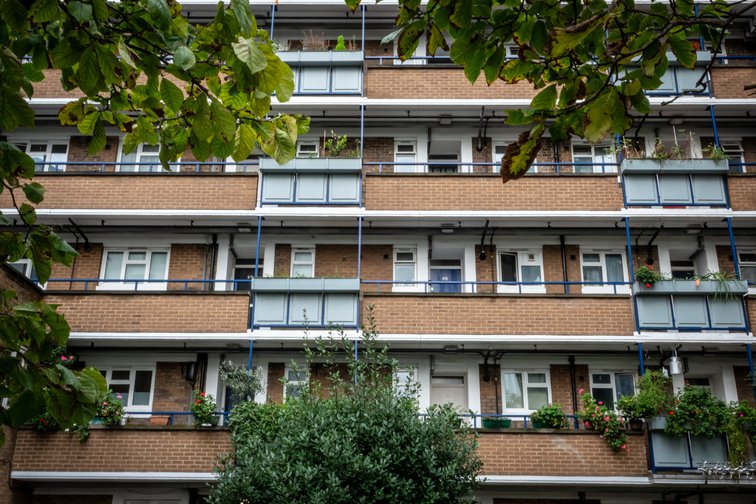
Flats originally built for social housing | Photo by Matt Cardy/Getty Images
More social rent homes were sold or demolished than built last year, new government figures show
The number of social rent homes in England continues to plummet with almost 10,000 lost last year, according to new government statistics.
The country’s housing crisis continues to deepen amid a lack of supply and soaring rents, with evictions and homelessness surging.
According to figures released yesterday by the Department of Levelling Up, Housing, and Communities (DLUHC), a net 9,379 homes for social rent were lost in 2022/23.
Social rent homes – historically known as council houses, though they are no longer solely provided through councils – are already massively oversubscribed. There are 1.2 million people on housing waiting lists across the country and people can languish on these for decades before being offered a home. Last year openDemocracy revealed that in 2022 2,300 people had died while on the waiting list.
Labour MP Nadia Whittome, who sits on parliament’s housing select committee, told openDemocracy: “I see the devastating impact of the lack of social housing in my inbox and my advice surgeries every week. Without social homes, too many people simply have nowhere else to go – they cannot afford to rent privately.
“At a time when we desperately need to increase the number of social homes, it’s outrageous that government policy means we’re losing them instead. The homelessness crisis is being fuelled by Right to Buy and the failure to build social housing.”
The latest figures show 18,799 social homes in the “low-cost rental” category were sold last year, while another 3,224 were demolished – totalling 22,023. According to the government, 86% (about 18,940) of these losses were social rent homes, with the remainder classed as so-called “affordable” rent, “intermediate” rent or “London affordable” rent.
With just 9,561 social rent homes completed in the same year, that brings the total losses to 9,379.
Social housing used to be the second most common type of home in the UK after home ownership. But following Margaret Thatcher’s Right to Buy policy introduced in 1980, the country has seen a huge sell-off of homes into private ownership. Councils sold 10,896 through Right to Buy last year.
These statistics come as the supposed landmark private renters bill, the Renters Reform Bill, has been delayed again, with no update on when one of its key tenets, banning ‘no-fault’ section 21 evictions, will come in. News of the delay coincided with the publication of damning statistics that show the number of these evictions has rocketed by a third in 12 months.
Section 21 evictions are the number one cause of homelessness in the UK and figures released by the Ministry of Justice show 30,230 landlords began section 21 court proceedings in 2023 – a 28% rise on 2022. There was also a surge in the number of these evictions where bailiffs were involved.
Housing minister Lee Rowley was recently criticised for a misleading boast about a “significant increase” in all types of social housing under the Conservative government, while being questioned about a policy that only affected social rented homes.
Rowley is yet to correct his statements.
Separate statistics from the government’s own Regulator of Social Housing shows there has been a decrease of 225,102 genuine social rented homes since 2012, though this is offset by the addition of 361,560 so-called “affordable” rent homes.
“Affordable” rent homes are rented for up to 80% of market rates and remain out of reach for many of the people on housing wait lists. Poverty campaigners, the Chartered Institute of Housing, and even a Conservative MP have criticised the government’s use of “affordable” homes figures to massage the dire state of social rented stock.
Conservative MP Bob Blackman told openDemocracy that building more social homes at social rents was essential.
“I feel disappointed,” he told openDemocracy. “I’m not worried about the number of homes sold, or the numbers demolished. What I’m concerned about is that we’re not replacing them. That’s the problem.”
Blackman insisted the Conservative government had not failed on social housing, but added: “I agree that we haven’t built enough whatsoever.”
A spokesperson fro DLUHC told openDemocracy: “Our £11.5 billion Affordable Homes Programme is delivering thousands more affordable homes to rent and buy right across the country.
“Last year also saw the highest levels of completions of social rent since 2013. The total stock of [all types of affordable housing] has grown by 151,000 since 2010, whereas in the previous 13 years it fell by 420,000. Despite the economic climate we remain on track to build one million homes this parliament and our long-term plan for housing will allow us to go even further to deliver the homes we need.”
Labour leader Sir Keir Starmer speaks at the Labour Business Conference on 1 February 2024 | Dan Kitwood/Getty Images
Party accused of breaching Electoral Commission rules by failing to publish value of staffer seconded from banking giant
The Electoral Commission has been urged to investigate Labour over its year-long failure to declare the value of a donation from banking giant HSBC.
HSBC seconded one of its staff members to Keir Starmer’s party in February 2023, in an arrangement that sees the bank continue to pay the staffer’s wages while they carry out work for Labour.
More than a year later, the party has still not published the value of this in-kind donation – an apparent breach of the Electoral Commission’s rules.
The former chair of the Committee on Standards in Public Life warned it is “absolutely crucial” that Labour follows the rules around declarations, and said the commission “should be looking at this”.
The HSBC staffer, whom openDemocracy is choosing not to name, works in shadow business secretary Jonathan Reynolds’ office in a part-time role focused on engaging with businesses.
They have appeared on every edition of the official register of MPs’ staff and researchers, which is updated monthly, since February 2023.
The register lists people who have parliamentary passes through their work for MPs, as well as any outside interests they may have, or benefits they have received over a certain value.
Prior to joining HSBC in October 2021, the staffer was previously a consultant at Westminster lobbying firm Portland Communications. They joined Portland in January 2020 from Labour, where they held a number of senior roles over 15 years, most recently working in the party’s HQ as the head of policy development and engagement.
Labour has accepted many in-kind donations of seconded staff members from banks, lobbyists and consultancies in recent years, but this is the first time it has failed to declare the value of such an arrangement.
Before Starmer took over the party’s leadership in 2020, Labour had banned such secondments over concerns that they amounted to “institutional corruption”, according to James Schneider, who was director of strategic communications for former Labour leader Jeremy Corbyn.
Schneider, now communications director at campaign group Progressive International, told openDemocracy: “If Labour policy is written by people who were, are or expect to be corporate lobbyists in the future, it will represent those corporate interests, not its members, unions or the public.
“In this way, the revolving door between corporate lobbying and Westminster is a form of legalised corruption that insulates the rich and powerful from democratic demands.”
He added: “With this seedy revolving door fully reinstated in Labour HQ, it’s no surprise that the party is busy rejecting policies that would benefit the many not the few.”
Political parties complete quarterly returns detailing all their donations received, with Electoral Commission rules stipulating that in-kind donations of staff time must be declared in the quarter that the arrangement began.
When openDemocracy contacted Labour about this story, the party said it had declared the donation and it would be published in the next set of returns, which relate to quarter four of 2023.
Sir Alistair Graham, who chaired the Committee on Standards in Public Life between 2004 and 2007, told openDemocracy “the Electoral Commission should be looking at this”.
Graham continued: “In the run-up to a general election when the leader of the Labour Party has stressed how he wants to demonstrate that the party will have the highest ethical standards of any government, it is absolutely crucial that they are seen to follow the rules.
“If the bank is facilitating the secondment then it is a donation which should be declared to the Electoral Commission, and the member of parliament who is supervising this secondment should really have declared it on the MPs’ register of interests.
“They’ve now got as their [chief of staff] Sue Gray, who used to be in charge of ethical standards in the Cabinet Office, so she should be overseeing that the rules are abided with and there’s full disclosure to the Electoral Commission.”
Last week openDemocracy revealed that Labour has accepted cash and in-kind donations worth £2m from banks, financiers and firms linked to the City of London since 2022.
Natwest and the lobbying firm Lowick seconded members of staff to Reynolds’ office in 2022 while he was the shadow City minister, and Reynolds’ successor in the role, Tulip Siddiq, currently has a financial services specialist seconded to her office from lobbying firm Global Counsel.
Tom Brake, director of democratic standards campaign organisation Unlock Democracy, said: “Any party receiving multi-million-pound donations from a particular industry, whether it is banking or building, has to be hyper-vigilant both about the transparency of any donations and the risk that that sector is unduly influencing Party policy.
“The Electoral Commission needs to examine whether the Labour Party has failed the first test, and the Labour Party needs to prove how it has avoided falling foul of the second.”
A HSBC spokesperson said “We are apolitical. We work with different political parties to advocate for our customers and build their understanding of the issues facing financial services. We have constructive conversations with both the government and the opposition in the UK.”
Labour declined to offer a comment or provide further details about the arrangement.
That’s a funny-looking bus, it’s Boris’s lying anti-EU bus promoting money for the NHS when all the anti-EU shites are anti-NHS Neo-Liberal shites.
Sunak’s pledge to bring down the NHS waiting lists wasn’t an off-hand pledge, an off-the-cuff remark, or a long-term policy proposal
Dr Julia Patterson is Chief Executive of EveryDoctor, a doctor-led campaign organisation fighting to save the NHS
We’ve been hearing Rishi Sunak blaming the length of the NHS waiting lists on striking NHS staff for many months now. Despite recent analysis from The Health Foundation which showed that industrial action from consultants and junior doctors had only contributed to 3% of the overall size of the waiting list, he has repeated his rhetoric again and again.
Several days ago, Sunak admitted for the first time (to Piers Morgan during an interview) that he had failed his pledge to bring down the NHS waiting lists. This received a huge amount of attention in the national media, and for good reason. Sunak’s pledge to bring down the NHS waiting lists wasn’t an off-hand pledge, an off-the-cuff remark, or a long-term policy proposal. It was one of the 5 key pledges he made as Prime Minister in January 2023, and it was made in the midst of the worst NHS winter crisis that we have ever experienced.
Several days before Sunak’s pledge was made, Dr Adrian Boyle (president of the Royal College of Emergency Medicine) had publicly stated that up to 500 people could be dying each week because of their inability to access urgent care within the NHS. The situation was incredibly stark. I run the organisation EveryDoctor (www.everydoctor.org.uk) and we were hearing from both NHS staff and patients who were experiencing terrifying situations. Patients were calling for ambulances which simply never arrived. GPs were driving emergency patients to hospital in their own cars, because they had no other option. When patients arrived at A and E departments, they were met often with chaos. Beds had been removed from A and E cubicles to make way for 6 patients to sit on chairs. Patients were receiving life-saving treatment in non-clinical areas, in corridors, even on the floor, as staff held up sheets to try to preserve their dignity.