A Palestinian flag flies near the Peace Tower during a rally on Parliament Hill in Ottawa on Nov. 4, 2023. | Spencer Colby / The Canadian Press via AP
TORONTO—Peace and solidarity activists across Canada were pleased to see the government support the United Nations vote on Dec. 12 calling for a ceasefire in Gaza. They should be pleased—it was their efforts which helped make it happen.
Without the continuing mass mobilizations against Israel’s war in communities large and small, the Liberal government of Prime Minister Justin Trudeau would surely not have felt compelled to shift from its two-month-long refusal to support a ceasefire.
At the same time, the same activists are rightfully disgusted that the government took so long to take even a modest stand against a bloody siege that many rightfully recognize as a genocide.
In the time it took for Ottawa to decide that a ceasefire was worth supporting, over 18,000 Palestinian people have been killed and nearly 50,000 wounded. The majority of the people killed and wounded are women and children. Eighty-five percent of the people in Gaza have been displaced by the siege, according to the U.N.—this would be like having over 32 million of Canada’s 38 million people displaced.
The government’s public statements on the ceasefire vote have been contradictory, leaving many people concerned that the Liberals will quickly weasel their way out of any commitment to action. When Trudeau has used the word “ceasefire” (which is not very often), he has stressed that it must be “sustainable” but has avoided saying it must be permanent.
His government took great pains to amend the previous U.N. resolution for a ceasefire, on Oct. 27, to make it explicitly condemn Hamas. When the amendment failed, Canada abstained from voting on the resolution. Trudeau’s current qualified call for a “sustainable ceasefire” suggests that the government is still guided by the same thinking.
The Canadian government needs to issue a clear, public call for an immediate and permanent ceasefire, beginning with and focused on Israel’s vicious offensive against the people of Gaza. Imposing conditions through an assumed moral equivalency between Israel’s violence and that of Hamas will only stall a ceasefire before it can even begin.
Ottawa also needs to back up a real call for a ceasefire by ending its military support for the genocidal siege itself. Canada can and should immediately halt shipments of arms to Israel. Where the government has so far failed to do this, protesters have tried by blockading arms manufacturers like L3Harris and Lockheed Martin.
Certainly, it is positive that Canada has finally been pushed to support a ceasefire. But this only makes the work of the peace and solidarity movements more urgent and more important. Over the past nine weeks, millions of people in this country have protested and petitioned the government, and that wave of mobilization needs to continue—and grow—if Ottawa is to be pushed from words to real action.
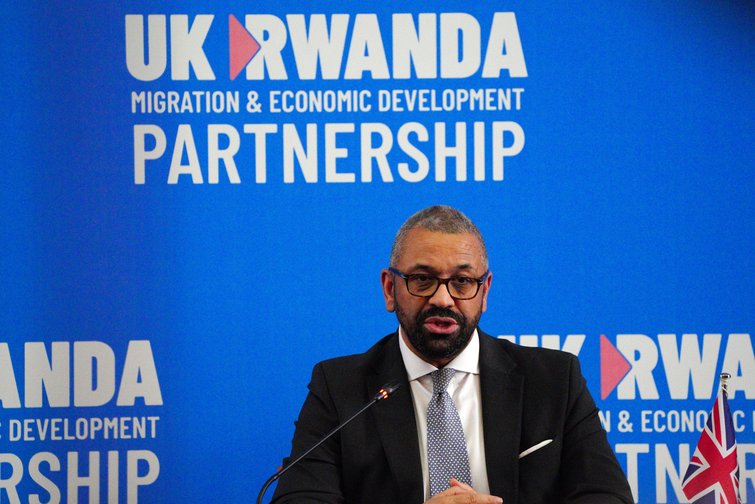
Government criticised for spending £400m on Rwanda scheme while more than 1.2m wait for social housing
A housing charity accused the government of “pandering to dog-whistle politics” with the deal. Getty Images
The government could have increased the number of social homes built across England last year by more than a fifth using the money it has committed to its Rwanda asylum scheme.
Home secretary James Cleverly confirmed on Wednesday that the government’s agreement to deport asylum seekers who enter the UK irregularly to the African country will have cost almost £400m by 2027.
The total sum would be enough to completely fund an estimated 2,131 new social homes, which is more than 22% of the 9,561 completed in England in the year to April 2023. The average government grant required to build a new home for social rent in England is £183,000, according to estimates by the National Housing Federation.
More than 1.2 million households were waiting for social housing in England as of March 2023, statistics published by the Department for Levelling Up, Housing and Communities (DLUHC) show.
The figures also show 7,620 social homes were completed in the year to April 2022, but a much higher number, 27,849, either sold or demolished – a net loss of more than 20,000. No figures have yet been published for social homes lost in the most recent year.
The government gave £140m to Rwanda in 2022 as part of its deal with the county and last week the Home Office’s most senior civil servant confirmed that a further £100m was given to the country in 2023. They added that a further payment of £50m is “anticipated” in 2024.
Cleverly, this week, told Parliament that the UK plans to give a further £50m to Rwanda annually in 2026 and 2027.
The overall costs of the Rwanda scheme could reach far higher that the £390m already committed by the government. An earlier economic impact assessment of the Illegal Migration Bill said that it would cost £63,000 more to remove a person to a third country, such as Rwanda, than having their asylum claim processed in the UK.
Rishi Sunak claimed in November that the policy “will literally save us billions in the long run”, but has not provided any figures to back this up.
On Tuesday, the National Audit Office confirmed that it would publish a report assessing the costs of the Rwanda scheme in 2024.
The inquiry was prompted by criticism from Labour MPs Meg Hillier and Diana Johnson, the chairs of the Public Accounts Committee and the Home Office Select Committee respectively, who said that there has been a “lack of clarity around value for money”.
Robina Qureshi, the CEO of Positive Action in Housing, said openDemocracy’s findings show that the government has put “pandering to dog-whistle politics” and “giving asylum contractors huge profits” over people’s futures.
“They haven’t been providing for society,” she said. “Instead they are sitting on their social media accounts trying to promote their own careers, and giving multi-million-pound contracts to asylum contractors. But nothing’s been done to help anyone that really needs it.
“When you build social homes, it increases the pool of houses that are available for anyone who’s in need.”
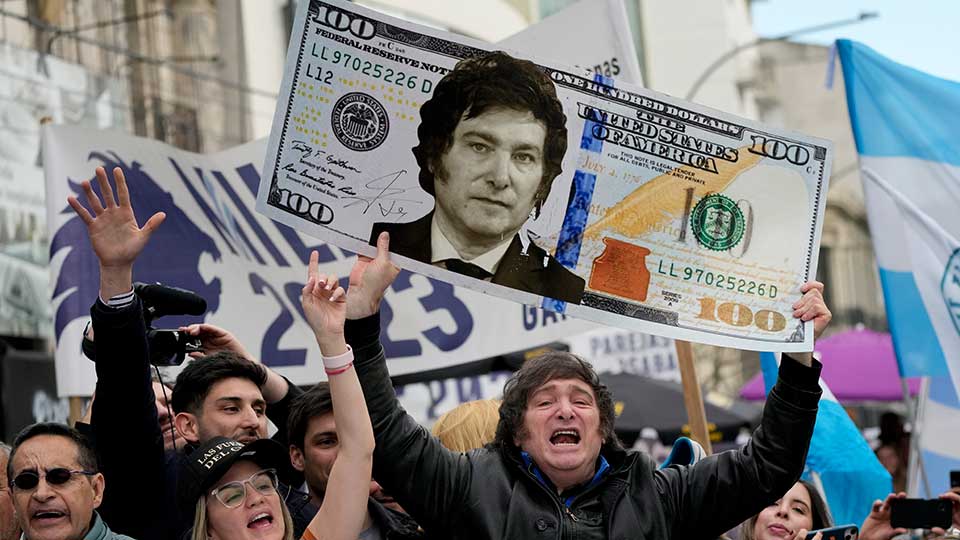
Dollarization: Javier Milei holds up a giant cardboard sign depicting a U.S. $100 banknote emblazoned with an image of his face during a rally in La Plata, Sept. 12, 2023. Milei wants to replace the peso with the U.S. dollar as Argentina’s currency and says that the country’s Central Bank should be abolished. He’s got a new financial challenge, though: China just cut his line of credit. | Natacha Pisarenko / AP
The Chinese government may have pulled the plug on far-right “anarcho-capitalist” President of Argentina Javier Milei, just weeks after his shock election win.
In a spectacular demonstration of how the lines of geopolitical power are shifting, the People’s Bank of China has withdrawn its “swapline” to the Argentinian central bank, depriving it of a vital source of cheap funding.
This leaves debt-ridden Argentina without ready access to funding to meet its promises to pay creditors. These international creditors include the IMF, to whom Argentina owes a world-record $43 billion. China provided the Argentinian government with funds for its $2.7 billion IMF repayment over the summer, lending it ultra-cheap foreign currency through its swapline arrangement.
Milei, a fanatical free marketeer, was elected with 55% of the vote in November from a population desperate for a break with the failed political Establishment. Developing his public profile through TV appearances and his 1.4 million followers on TikTok, Milei was able to present his program of ferocious spending cuts and the abolition of the Argentinian currency, the peso, as the bitter medicine the country needed to end its economic crisis. Younger voters, in particular, flocked to him in droves.
This was a product of desperation. Two-fifths of Argentinians live below the poverty line, and close to 60% of children. Inflation was over 140% when the election campaign ended, meaning prices doubling roughly every six months.
Since the government defaulted—halted payments—on its debts at the end of 2001, the two decades since have seen governments both pro and anti-neoliberal attempts to negotiate agreements with Argentina’s creditors and break the cycle of crises.
The latest round of these was a colossal 2018 loan from the IMF, attached to conditions on cutting government spending over the following three years.
But what tipped the country over the edge into its latest round of crisis has been the catastrophic drought that began in 2019. This ongoing drought is the worst for over 60 years, hammering farmers and severely cutting harvests—soybean production fell to its lowest level for a century.
For a country dependent on agricultural exports for foreign exchange earnings, it has been a disaster. Its trade deficit ballooned, taxes fell and government spending mushroomed. Government borrowing swelled and the Argentina central bank resorted to issuing more money to cover spending costs. Climate change almost certainly worsened the drought.
Milei’s program offered nothing on this—he is a climate change denier, claiming that those who “blame the human race” for climate change are “fake…only looking to raise funds for socialist bums who write for fourth-rate newspapers.”
The colorful language is very much part of his appeal, along with waving a chainsaw at his public appearances, to symbolize what he planned for government spending, and smashing a piñata of the central bank on live TV.
But cartoonish posing shouldn’t kid us: Milei’s program is neoliberalism on steroids. He campaigned on a promise to cut government spending by 15% of Argentina’s GDP.
His plan to abolish the peso and “dollarize” the economy was arguably even more radical, claiming this would prevent Argentinian bureaucrats and politicians from printing money. Although two other Latin American countries, Ecuador and Panama, use the dollar as their official currency, neither is the size of Argentina, the continent’s second-largest economy.
And while many Argentinians already use the dollar, with $246 billion in dollar savings, the government has no dollars to hand, and would have to either buy them to replace pesos, or perhaps seize them from those mostly middle-class savings.
The plan is a non-starter. Confronted with the economic realities, Milei has rapidly defaulted to conservative type, appointing a former president of the central bank, Luis Caputo, as his economy minister, and appointing a close associate of Caputo as the new central bank head. So much for “burning it down.”
The ferocious spending cuts are still planned, along with a 54% devaluation of the peso as part of a program approved by the IMF.
Far from a radical break, Milei is a stooge for the maintenance of Argentina’s failed elite—including even the rehabilitation of the dictatorship, with his running mate for Vice President, Victoria Villaruel, claiming the figure of 30,000 “disappearances” under the regime is a “myth.”
This is a familiar pattern. Across the world, supposed populists from the radical right have taken power, often with the promise of taking on corrupt local elites. They don’t follow through.
Italy’s radical right government, for example, in August threatened a windfall tax on banks that were profiteering from interest rate rises. But they rapidly backed down after howls of protests from the banks themselves.
Milei has almost certainly bitten off more than he can chew. Expecting protests, harsh new guidelines for police and military, including the criminalization of the parents of younger protests have been rushed through—“prison or bullet,” as one pro-government MP described them. Inflation has accelerated, to 3,678% a year, which the government are now using to justify their “shock therapy.”
However, it is anti-China posturing that could prove his undoing. China is Argentina’s second-biggest market for exports, and loans from China make up over 42 per cent of Argentina’s foreign exchange reserves.
Yet Milei called China an “assassin” during his election campaign, promising to sever ties and instead reorienting Argentina towards full-throated support for Israel and the U.S. Argentina’s foreign minister has confirmed that the country would not be joining the China-led BRICS coalition, as pledged by the last government.
This was treated as a “slap in the face” by China: Cutting loan support to Argentina is the inevitable response. As Milei himself might put it: Fuck around and find out.
Labour accuses government of holding back data on use of official alcohol stock between March 2020 and 2022
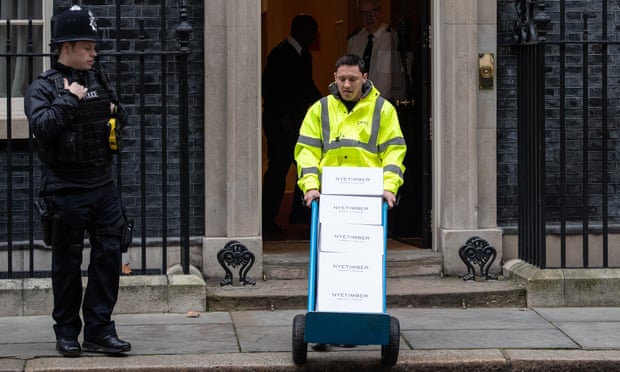
Crates of wine being delivered to No 10 in January 2020. The last official statement on the ‘usage, value, costs and stock levels of the wine cellar’ was made in July 2021. Photograph: Leon Neal/Getty Images
Ministers have been asked to explain why a report on the UK government’s consumption of wine during the Covid pandemic has been delayed four times over the last year.
Labour said the Foreign Office, which holds the government’s wine collection, should publish the data on its stocks for 2020 to 2022 immediately, as the delay was causing suspicion about how much had been used.
The stock list was originally meant to be published in “early 2023”, was subsequently scheduled for July and then ministers later said it would appear in the autumn.
The last update was from Andrew Mitchell, a Foreign Office minister, who answered a parliamentary question saying it would be published “before the Christmas recess” – but it never materialised by the end of the parliamentary term.
The delays mean it is now two and a half years since the last official statement on the “usage, value, costs and stock levels of the wine cellar” was made in July 2021.
The yet-to-be-published data should cover the period March 2020 to March 2022 – the whole course of the pandemic. Given the cellar is supposed to be used only “to provide guests of the government, from home and overseas, with wines of appropriate quality at reasonable cost”, the report would be expected to show a decline in consumption, given the curbs on indoor gatherings and international travel caused by the Covid pandemic.
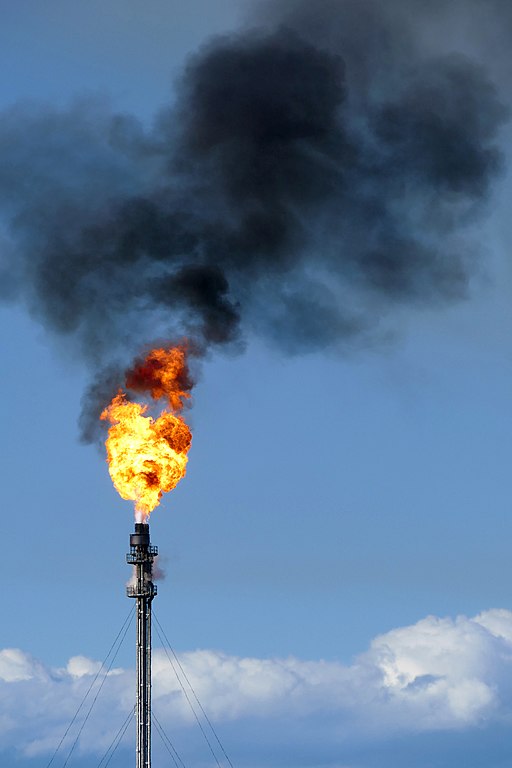
Global efforts to slow a runaway climate catastrophe may have reached a critical milestone in the last year with the peak of global carbon emissions from energy use, according to experts.
A growing number of climate analysts believe that 2023 may be recorded as the year in which annual emissions reached a pinnacle before the global fossil fuel economy begins a terminal decline.
The milestone is considered a crucial tipping point in the race to drive emissions to net zero. But for many climate experts it’s an inflexion point that was due years ago and which, although encouraging, falls far short of the rapid reduction the world needs.
The world’s leading climate scientists have consistently warned that the buildup of carbon dioxide in the Earth’s atmosphere means it is critical to drive down emissions before 2030 if leaders hope to keep global heating to a maximum of 1.5C above pre-industrialised levels. The rate at which emissions would need to be reduced will require, most experts agree, global transformation on a scale not yet in the pipeline.
“We can take a small pause to celebrate this tipping point,” said Dave Jones, a director at the climate thinktank Ember. “But in a way it’s worrying that we are still talking about when emissions might peak. The reality of the situation is that we need deep and fast reductions in emissions if we hope to stay within the vanishingly small budget for carbon which remains.”
The International Energy Agency (IEA) raised hopes earlier this year of an end to the fossil fuel era when it predicted for the first time that the consumption of oil, gas and coal would peak before 2030 and begin to fall as climate policies took effect.
“It’s not a question of ‘if’, it’s just a matter of ‘how soon’ – and the sooner the better for all of us,” said Fatih Birol, the head of the IEA.
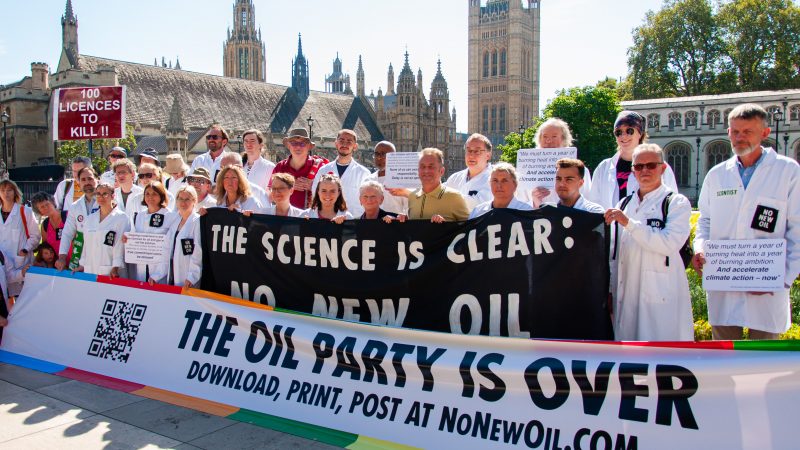
Scientists protest at UK Parliament 5 September 2023.
dizzy: I’m expecting huge disinvestment and consequent disempowerment of the fossil fuel sector. The longer investors stay in fossil fuels, the larger their lossses will be. later elaboration: Plutocrats are losing control of the narrative, activists are aware of and highlighting huge fossil fuel subsidies and fossil fuel lies like CCS, renewables becoming much cheaper, court cases, greater acceptance and recognition of role of fossil fuels in destroying the planet, green parties achieving much higher vote share, it’ll hit the fan. later still elaboration: All the increasingly extreme and more often weather events that we’re experiencing attributed to fossil fuels caused climate crisis.