Category: politics

  • UN Condemns Israel’s ‘Unlawful Killings’ and Settler Violence in West Bank

    Spread the love

    Original article by JAKE JOHNSON republished from Common Dreams under Creative Commons (CC BY-NC-ND 3.0). 

    A Palestinian child stands next to a damaged building following a three-day Israeli army raid on the Jenin refugee camp in the occupied West Bank on December 14, 2023.  (Photo: Zain Jaafar/AFP via Getty Images)

    The U.N. high commissioner for human rights called surging settler attacks on Palestinians “very disturbing.”

    A United Nations report released Thursday warned that conditions in the occupied West Bank have worsened rapidly since October, with Israeli settlers and soldiers ramping up violent attacks on the Palestinian population and subjecting people across the territory to frequent abuse, movement restrictions, arbitrary detention, and “unlawful killings.”

    The report by the Office of the U.N. High Commissioner for Human Rights found that since October 7, settler attacks—including shootings and the burning of homes—have surged to an average of six per day, up from three per day previously. The report notes that in many cases, the settlers were “accompanied” by Israeli forces, wearing Israeli military uniforms, and carrying weapons supplied by the army.

    Between October 7 and December 27, Israeli forces and settlers killed at least 300 Palestinians in the West Bank, according to the U.N. Israeli soldiers arrested more than 4,700 Palestinians during that period, holding many of them in so-called administrative detention without charge or trial.

    Palestinian detainees have faced grotesque abuse and torture at the hands of Israeli soldiers, who have raided West Bank homes and refugee camps with increased frequency in recent weeks. Six Palestinian men died in Israeli detention between October 7 and November 20, the U.N. found. One of the men was reportedly insulin-dependent; he, along with others detained at the same time, was physically assaulted by Israeli soldiers.

    The new report notes that members of the Israel Defense Forces (IDF) have filmed and photographed themselves “abusing, degrading, and humiliating Palestinians apprehended in the West Bank, including pictures of detainees stripped naked or half-naked, blindfolded and handcuffed, and screaming in pain while physically abused and humiliated including by being forced to pose with the Israeli flag, sing songs in Hebrew or forced to dance with soldiers.”

    “In one of the videos, a Palestinian man, subsequently identified through monitoring as having been arrested on 31 October, is seen kneeling, blindfolded, and with hands tied behind his back, being kicked several times in the stomach by a soldier who spits on him and insults him,” the report continues. “On 1 November, IDF reportedly stated they would investigate the abuses and that one reserve soldier had been dismissed from reserve service.”

    “The intensity of the violence and repression is something that has not been seen in years.”

    Volker Türk, the U.N. high commissioner for human rights, said in a statement Thursday that “the violations documented in this report repeat the pattern and nature of violations reported in the past in the context of the longstanding Israeli occupation of the West Bank.”

    “However,” Türk added, “the intensity of the violence and repression is something that has not been seen in years.”

    Since October 7—when Hamas launched a deadly attack on southern Israel and the IDF responded with a catastrophic bombing campaign—violence by Israeli settlers in the West Bank has surged. Israeli officials have tallied at least 120 hate crimes committed in the occupied West Bank, but no charges have been brought in any of the cases, the U.N. said.

    The report observed that Israeli settlers—with the support of the far-right government of Prime Minister Benjamin Netanyahu—are “taking advantage of a generally permissive environment to accelerate displacement of Palestinians from their land, raising concerns of forcible transfer seeking to create facts on the ground making the existence of a viable Palestinian state almost impossible.”

    “According to Israeli organizations monitoring settlement expansion, settlers have built at least four new outposts since 7 October and at least nine new roads leading to settlements, marking a growth in illegal construction by settlers unprecedented since the second Intifada,” the U.N. report says.

    Türk called settlers’ “dehumanization” of Palestinians “very disturbing” and said the attacks and illegal settlement expansions “must cease immediately.”

    “Israeli authorities should strongly censure and prevent settler violence and prosecute both its instigators and perpetrators,” said Türk.

    The U.N.’s findings were published as Al Jazeera reported that Israeli forces have “launched their most intense raids yet on cities in the occupied West Bank as they pressed on with one of the largest incursions in the territory since Israel’s war on Gaza began in October.”

    “At least one person was killed after Israeli troops launched a coordinated overnight assault on 10 cities including Hebron, Halhul, Nablus, Jenin, Tulkarem, el-Bireh, Jericho, and notably the center of Ramallah, which is the administrative headquarters of the Palestinian Authority,” the outlet reported. “Israeli forces used tear gas and stun grenades to clear a street and then blocked off the area, before using a ‘controlled explosion’ to enter a money exchange shop. The soldiers seized documents and arrested business owners.”

    An Al Jazeera correspondent said that Israeli soldiers seized around $2.5 million in the raids.

    Original article by JAKE JOHNSON republished from Common Dreams under Creative Commons (CC BY-NC-ND 3.0). 
  • Wind turbines are already skyscraper-sized – is there any limit to how big they will get?

    Spread the love

    Fokke Baarssen / Shutterstock

    Simon Hogg, Durham University

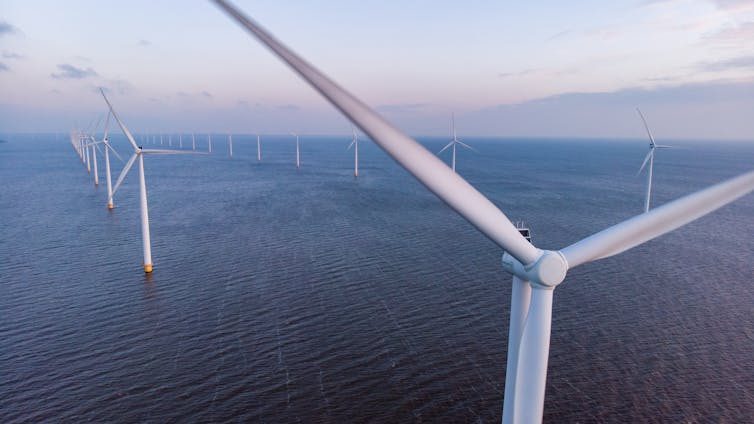
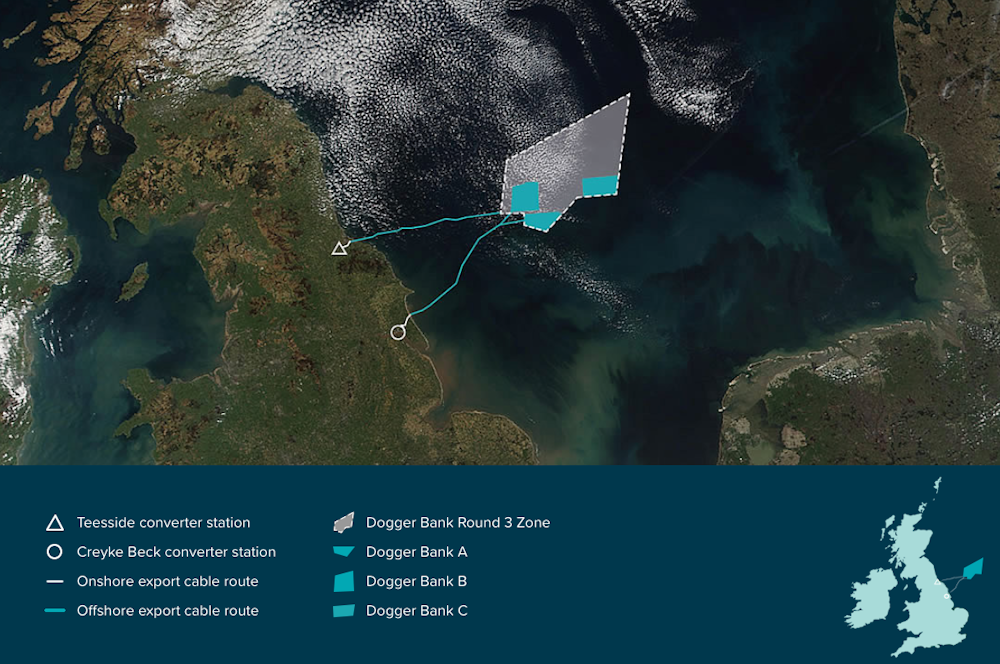
    In 2023, some 100 miles off the coast of north-east England, the world’s largest wind turbines will start generating electricity. This first phase of the Dogger Bank offshore wind farm development uses General Electric’s Haliade X, a turbine that stands more than a quarter of a kilometre high from the surface of the sea to the highest point of the blade tip.

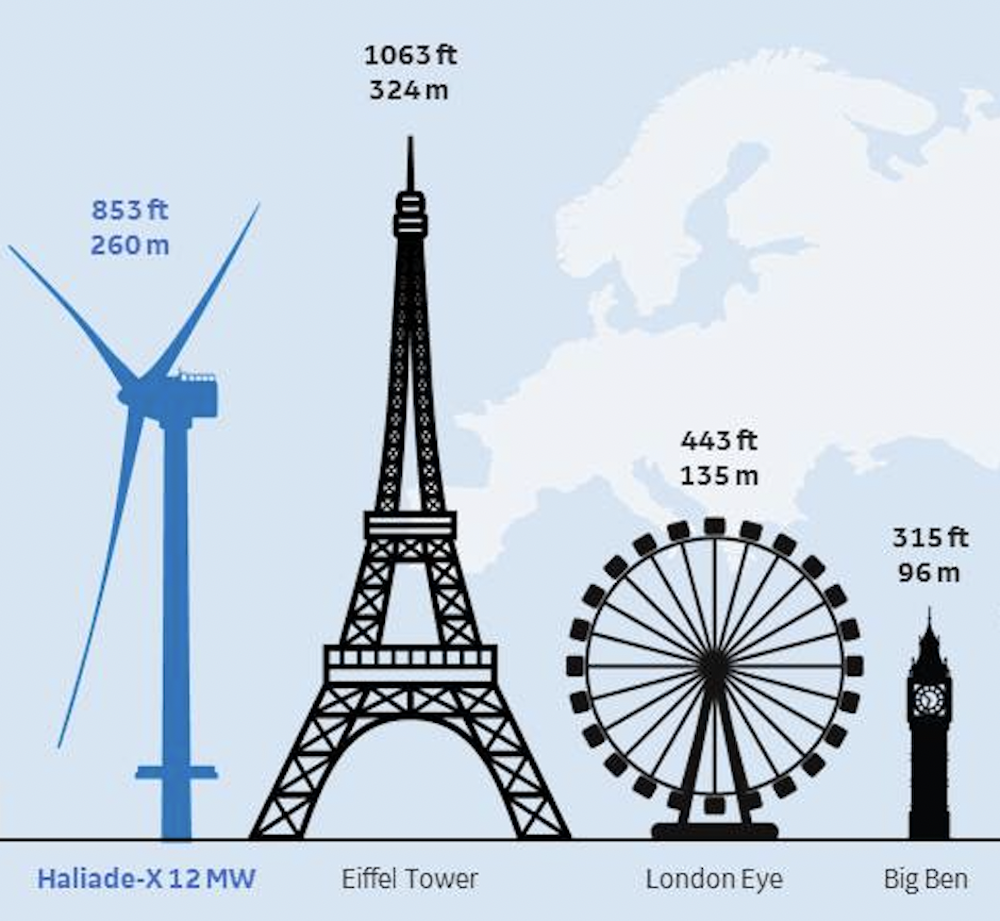
    If you placed one in London, it would be the third-tallest structure in the city, taller than One Canada Square in Canary Wharf and just 50 metres shorter than the Shard. Each of its three blades would be longer than Big Ben’s clock tower is tall. And Dogger Bank will eventually have nearly 300 of these giants.

    Comparison of large wind turbine and famous buildings
    Next up: an Eiffel-sized turbine?
    GE Renewable Energy / Facebook

    Just two decades have passed since the UK’s first proper offshore wind farm was built off the coast of north Wales. Its turbines were each able to produce 2 megawatts (MW) of electricity in ideal conditions – considered huge at the time. In contrast, the Haliade X is able to produce 13MW of electricity, and 15MW turbines are only another year or two away.

    So why are turbines increasing in size at such a rapid rate, and is there a limit to how big they can go? In short, the first answer is to reduce the cost of energy and the second is that there must be a limit – but nobody has put a number on it yet.

    Big turbines, cheap electricity

    Just five years ago, the offshore wind industry hoped to reduce its energy pricing to below £100 per megawatt-hour by 2020 from new projects in UK waters. Even at that level, projects would still have relied on government subsidies to make them economically viable, compared with other types of electricity generation.

    But in fact, costs quickly reduced to the extent that offshore wind farm developers were soon committing to selling their electricity at much lower prices. Today, developers are building wind farms such as Dogger Bank where they have committed to prices below £50 per megawatt-hour. This makes offshore wind competitive with other forms of power generation, effectively removing the need for subsidy.

    The major factor in reducing these costs was turbine size. Ever-larger turbines came to market faster than virtually everybody in the sector had expected.

    Map of Dogger Bank offshore wind
    Dogger Bank is ideal for offshore wind as the water is very shallow. When complete, the project will power 6 million UK homes.
    Dogger Bank Wind Farm

    Blades cannot spin too fast

    In theory, turbines can keep getting bigger. After all, a bigger blade extracts energy from the wind over a greater area as it rotates, which generates more electricity.

    But there are some engineering constraints. One concerns erosion of the blades caused by them colliding with raindrops and sea spray. For current designs, the speed of the blade tips must be limited to 90 metres per second (which works out at just under 200mph) in order to avoid erosion. Therefore, as turbines get bigger and blades get longer, their rotors have to turn more slowly.

    A consequence of having to slow the rotor down is that, to produce the same amount of power, the blades must deflect the wind to a greater extent. This results in greatly increased forces on the whole turbine. We can address these high forces, but only by increasing both turbine weight and cost. And that means the point at which the turbine becomes unprofitable – the point at which the extra cost is no longer worth it for the value of extra electricity generated – is reached much sooner than if the blade tips were allowed to go faster.

    Also, as blades get longer they become more flexible. This makes it more difficult to keep the aerodynamics of the wind flow around them fully under control, and harder to ensure the blades do not strike the turbine tower under extreme wind conditions.

    Logistical constraints

    Engineering challenges like these can perhaps be solved in the longer term, though. This will mean that wind turbines are more likely to be limited in size by manufacturing, installation and operational issues, rather than any physical limit on the design of the turbine.

    Just transporting blades and towers from factory to site and assembling the turbine when you get there presents huge challenges. Each of those Big Ben-sized blades must be shipped in one piece. This requires huge ports, giant vessels, and cranes that can operate safely and reliably far offshore. This is where the limit is most likely to come from.

    Wind farm under construction
    Needed: huge ships, ports and cranes. DJ Mattaar / Shutterstock

    You can see these limits in practice in the UK, which is surrounded by windy and shallow seas that are perfect for generating energy. Despite this, the UK is likely to miss its ambitious target to more than treble its offshore wind capacity by 2030.

    This is not because of technology or lack of offshore sites. Rather, the industry will not be able to manufacture turbines quickly enough, and the port infrastructure and number of installation vessels, suitable cranes and workers with requisite skills is unlikely to be sufficient.

    So if the UK is to maximise the benefit to its economy from what is, so far, a fantastic success story, the focus now needs to switch from pure cost reduction to developing workers’ skills and the offshore wind supply chain.

    Turbines will get bigger, I am sure, but I suspect at a slower rate than we have seen in recent years. And if the turbines are deployed 100 miles offshore, will anybody care? After all, the public will not be there to see them.


    Imagine weekly climate newsletter

    Don’t have time to read about climate change as much as you’d like?

    Get a weekly roundup in your inbox instead. Every Wednesday, The Conversation’s environment editor writes Imagine, a short email that goes a little deeper into just one climate issue. Join the 10,000+ readers who’ve subscribed so far. The Conversation


    Simon Hogg, Executive Director of the Durham Energy Institute, Durham University

    This article is republished from The Conversation under a Creative Commons license. Read the original article.

  • Britain likely to generate more electricity from wind, solar and hydro than fossil fuels for the first year ever in 2023

    Spread the love
    Solar now provides about 5% of Britain’s electricity.
    StudioFI / shutterstock

    Grant Wilson, University of Birmingham; Joseph Day, University of Birmingham, and Katarina Pegg

    There are many milestones to pass in the transition from a high to low-carbon sustainable energy system. There is the first hour without coal, or oil, or gas generation (or all of them together) and the point when the last coal, oil or gas power plant (or all of them together) are finally retired.

    Another milestone that feels important is the first year when renewables generate more electricity than fossil fuels. For the past three months we have been tracking the data for Great Britain (not Northern Ireland, which shares an electricity grid with the Republic of Ireland) and we believe it is on track to pass this milestone in 2023, but it will be very close.

    Using the broadest definition, renewables actually first overtook fossil fuels in the odd, COVID-affected year of 2020 (although not in the subsequent years of 2021 and 2022). However, that includes 5% or so of Britain’s electricity that is generated through “biomass” plants (which burn wood pellets, often imported from forests in America).

    Trees can of course be regrown, so biomass counts as renewable. But the industry has its critics and it’s not globally scalable in the same way as the “weather-dependent” renewables: wind, solar and to a certain degree hydro power.

    When we use this narrower, weather-dependent definition that is more appropriate for a global transition, then there is a very good chance these renewables will overtake fossil fuels for the first time ever in 2023. Once this milestone has been passed, we also think it is unlikely (though not impossible) that gas and coal will ever again generate more of Britain’s electricity than wind, solar and hydro over a full year.

    Whether Britain passes the milestone in 2023 will come down to the final few days of the year (from here on we’ll use “renewables” to refer to the tighter, biomass-excluding definition).

    The chart above can be used to track progress and will update with the latest data each day. The lines show the running total of the difference between how much electricity has been generated by renewables and fossil fuels.

    When the line is increasing, this shows more renewables than fossil fuels for that period. The horizontal axis shows the day of the year, so, if at any point the line is above the zero axis, that indicates that the year so far has had more renewable than fossil fuel generation. If the red line ends the year above zero, then Britain will have achieved the milestone.

    (One caveat is that we know from the official statistics published later that there are some differences from “missing” and estimates for embedded generation; this typically only accounts for around 1%-2% of the final total.)

    It depends on the weather

    As we write this, with ten days of data left in 2023, renewables are very slightly ahead (by just over 1000 GWh – about the same level as a peak day of electrical demand). However if they are to stay ahead it will depend on the weather – especially the wind.

    The reasoning here is that Britain uses less electricity over the holiday period due to less industrial and commercial demand. As wind power is clean and has become cheaper, it tends to be used first, meaning when demand is low or it is sufficiently windy there is less need to generate electricity with fossil fuels.

    There are nuances around this such as where the generation is located, and the amount of electricity imported from other countries, but the general principle of renewables taking market share away from fossil fuels is a factor of Britain’s electrical market.

    An important area to also highlight is the continued drop in electrical demand. 2023 is on track to have a lower demand than 2022, which itself was lower than the COVID-impacted year of 2020 (against our predictions) due to record prices. The drop in electrical demand means that additional generation was not needed, much of it inevitably from fossil fuels.

    Additional milestone also likely to be passed

    However 2023 could be the first year where renewable generation exceeds domestic electricity demand (homes comprise 36% of total electrical demand). This means the annual electricity generated by Britain’s wind turbines, solar panels and hydro resource will now be greater than that consumed over the year by its 29 million households.

    The above bar chart demonstrates the trend towards this point since 2009. In the first half of 2023, renewable output was less than domestic electrical demand by 1.5 TWh (1500 GWh), but strong renewable performance since then means it is likely to end the year with total generation in excess of household demand.

    If either of the milestones described here do not happen for 2023, then they will almost certainly occur in 2024, during which another 1.7 GW of offshore wind capacity will begin generating and Britain’s last coal-fired power station is scheduled to cease producing electricity altogether. The Conversation

    Grant Wilson, Associate Professor, Energy Systems and Data Group, Birmingham Energy Institute, University of Birmingham; Joseph Day, Postdoctoral Research Assistant, Energy Systems and Data Group, University of Birmingham, and Katarina Pegg, PhD Student, Energy Systems and Data Group, University of Birmingham

    This article is republished from The Conversation under a Creative Commons license. Read the original article.

  • Dozens of Pro-Palestinian Rights Protesters Arrested for Blocking JFK Airport Entrance

    Spread the love

    Original article by JULIA CONLEY republished from Common Dreams under Creative Commons (CC BY-NC-ND 3.0). 
    Airplanes are seen on a tarmac.  (Photo: Afif Ramdhasuma on Unsplash)

    Organizers demonstrated to call attention to the ongoing forced displacement of Palestinians and the denial of their right to return home.

    More than two dozen human rights campaigners were arrested on Wednesday for blocking Interstate 678, the Van Wyck Expressway, in New York—the road that leads to John F. Kennedy International Airport—in one of the latest highway protests demanding justice for Palestinians.

    The protesters blocked the road at about 11:30 am and continued the action for about 20 minutes, The Messenger reported, displaying banners that read, “Right to Return, Right to Remain” and “Divest From Genocide.”

    Independent journalist Talia Jane reported that the protesters aimed to call attention to the Israeli government’s denial of the Palestinian people’s right to return to their homes, which they were forced to flee in 1948 when the state of Israel was created.

    The protest was held on the 81st day of Israel’s U.S.-backed bombardment of Gaza, which has killed at least 21,110 people and injured more than 55,000, as well as displacing more than 80% of the blockaded enclave’s population.

    The campaigners linked arms and blocked the expressway days after Israeli Prime Minister Benjamin Netanyahu publicly said the government’s objective is the so-called “voluntary” migration of Gaza’s 2.3 million people—another mass displacement of Palestinians nearly 75 years after they were driven from what is now Israel.

    Some travelers headed for JFK on the busy holiday travel day exited their vehicles and walked to the airport with their luggage.

    At least one told the demonstrators, “Good luck,” as she climbed over a highway barricade to get to the airport.

    The Port Authority of New York told The Messenger that 26 people were arrested “for disorderly conduct and impeding vehicular traffic” and that officials dispatched two buses to offer rides to travelers.

    The outlet reported that protesters carrying signs that read, “Land Back” also assembled outside Los Angeles International Airport, blocking travelers from entering.

    National Jewish-led Palestinian rights groups Jewish Voice for Peace and IfNotNow have blocked bridges and highways and organized mass protests in other travel hubs since Israel began its total blockade and air and ground assault in Gaza, which has threatened the population with starvation and disease as well as bombings.

    Neither group had claimed responsibility for Wednesday’s protests at press time.

    Original article by JULIA CONLEY republished from Common Dreams under Creative Commons (CC BY-NC-ND 3.0). 
  • Israel is brutally torturing Palestinian detainees in Gaza

    Spread the love

    Original article by Abdul Rahman republished from peoples dispatch under a Creative Commons Attribution-ShareAlike 4.0 (CC BY-SA) license.

    Reports show that Israeli forces are executing Palestinian civilians in Gaza in front of their families and keeping detainees in open air concentration camps in violation of international laws on warfare

    Photo: Euro-Med Human Rights Monitor

    A new video has emerged showing occupying Israeli forces using different forms of torture against scores of Palestinian detainees from Gaza in complete violation of established rules of warfare and human rights norms.

    The video footage, released this past week by several media channels, showed Israeli forces stripping dozens of Palestinian detainees in an open field (apparently a stadium) and making them sit in a single file line. Some of the Palestinian detainees were blindfolded with their hands tied behind their backs and it is clear that there were children and toddlers among the detainees.

    This was second such incident in less than a month where Israeli forces have been found clearly violating norms of warfare, laws related to prisoners of war, and laws prohibiting torture.

    On December 7, a similar set of videos and photos were broadcasted on an Israeli TV channel in which dozens of men stripped to their underwear were seen sitting in the middle of a street or taken away in a truck by Israeli forces. The report had claimed these were men affiliated to Palestinian resistance group, Hamas. Israelis also circulated a video wherein some of the detainees appear to surrender weapons.

    Following the publication of those photos and videos, individuals on social media had questioned the claims of Israeli forces and identified their relatives, friends, and colleagues among those detained. They alleged that most of those in the video had nothing to do with Hamas and they were detained, humiliated and tortured by the invading Israeli forces. Many have also claimed that the Israeli forces who had filmed the Palestinian detainees, staged a fake surrender.

    Al-Jazeera reported later that most of the men in the video were kidnapped by the Israelis from Khalifa Bin Zayed and New Aleppo schools used by the UNRWA to shelter some of the nearly 2 million displaced Palestinians, forced out of their homes because of Israeli bombings.

    Urgent and impartial investigation in Israeli crimes is required 

    Mustafa Barghouti, head of the Palestinian National Initiative Party wrote on X (formerly Twitter), on December 20, that more than a thousand detainees, including the director of Al-Shifa hospital, are being subjected to brutal torture and severe beatings by the Israeli forces.  

    Euro-Med Human Rights Monitor, a Geneva-based human rights organization, has been gathering the testimonies of the Palestinians tortured under Israeli detention, and has called for an urgent and impartial investigation into those allegations of human rights violations and war crimes. 

    Some of the Palestinians released from Israeli detention narrated their harrowing experience to the media saying that they were drugged and beaten by the Israeli forces to force them to admit they were Hamas fighters. 

    Some of them had visible marks of torture on their bodies. The released detainees also said that some of their fellow prisoners have not been released and have probably been killed. 

    Two such former detainees, 22-year-old Nayef Ali and 55-year-old Khamis al-Bardini were quoted by the AFP saying that Israeli forces, after arresting them from eastern Gaza’s Zaitun suburb, tied their hands behind their backs for two full days.  

    “We were not allowed to eat or drink, neither we were…allowed to use toilets” Nayef Ali had stated. He also added that during the entire time of their detention they were beaten up by the Israeli troops who also “threw cold water on us before transferring us to a prison.” They were beaten up and tortured in the prison as well.   

    Israeli soldiers have also been accused of killing Palestinians detainees in Gaza at point blank range on several occasions since October 7. Some of these killings have been acknowledged by the United Nations. 

    The UN Office of the High Commissioner for Human Rights (OHCHR) issued a statement on December 20 confirming the news of 11 Palestinians killed in cold blood, in front of their family members, by the Israeli armed forces in Al-Remel neighborhood in Gaza on December 19.   

    The Euro-Med Human Rights Monitor has also documented that one of the camps run by the Israeli forces to keep the Palestinian detainees, Sde Teman, is like a new Guantanamo Bay, the infamous US detention center created during the so-called war on terror on occupied Cuban land used to torture hundreds of detainees allegedly involved in terrorist activities.

    Original article by Abdul Rahman republished from peoples dispatch under a Creative Commons Attribution-ShareAlike 4.0 (CC BY-SA) license.

    As Israel’s war on Gaza completes 82 days, it continues to torture, …

    Khalida Jarrar arrested in West Bank as Israel continues its genocidal …

    US attacks multiple sites in Iraq as it faces backlash for backing Israeli genocide in Gaza

    Normalization with Israel has been ended by its brutal war on Gaza