Left Foot Forward has an exclusive with Caroline Lucas. She is set to resign as an MP at the next general election.
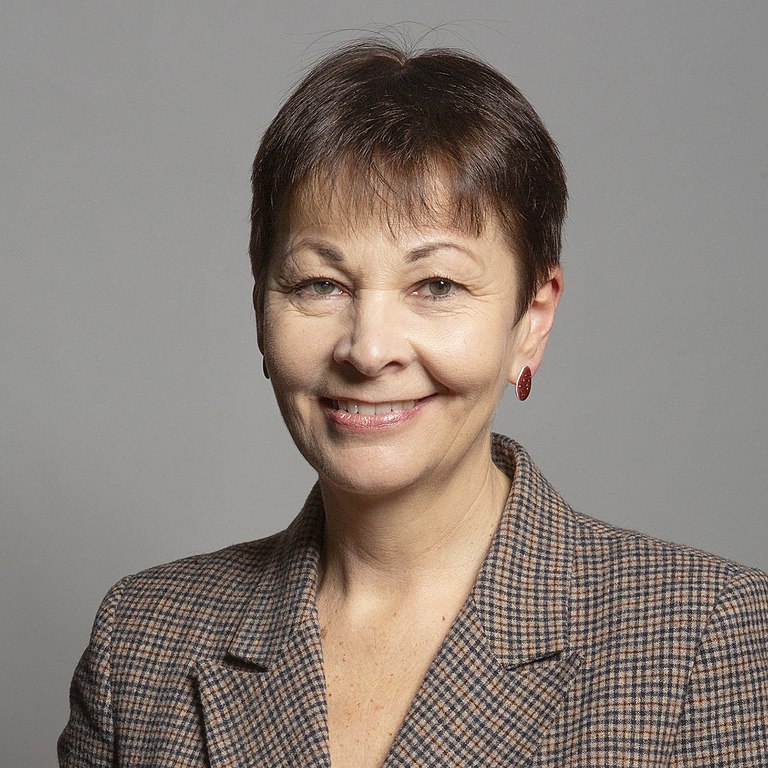
Caroline Lucas Green Party MP for Brighton Pavilion. Official image by David Woolfall Creative Commons Attribution 3.0 Unported license.
…
While she is unsurprisingly damning about the prime ministers who have been in office over her 13 years in the House of Commons, Lucas has had to work closely with MPs from other parties. By virtue of being the only MP for her party, working cross-party has been central to much of her work. As a result, she offers strong praise for MPs on the opposition benches who she has worked with over the years.
She tells Left Foot Forward: “I work really closely with people like Nadia Whittome and Clive Lewis on the Green New Deal, and we have an all party group on the Green New Deal and we work very closely together on that. I enjoy working with Barry Gardiner actually on the Environmental Audit Committee just because he’s such a terrier when it comes to cross-questioning ministers. From the Liberal Democrats I work very closely with Wera Hobhouse on environmental issues, green issues. Plaid [Cymru] are very good on social issues and I’m probably closest to them of all the parties in Westminster.”
However, such praise is definitely absent from her assessment of the likely next prime minister – the Labour leader Keir Starmer. She starts by acknowledging that she and the Green Party would “prefer to see a Labour government than a Tory government”, but goes on to ask “what kind of Labour government” we are likely to get.
“I think there are real concerns over the U-turns that Keir Starmer has been performing – whether that is on what was originally a £28 billion commitment for green investment, he was going to scrap tuition fees, things like the two child benefit cap which is a really, really obscene policy and his own frontbench have said its obscene yet he has now said that he is not going to reverse that.
“He’s better on oil and gas to the extent that he’s said he won’t give licenses to new oil and gas. But then there’s a totally incoherent position of saying that he will allow Rosebank to go ahead. Whereas if he had said were he to get into government he would have tried to roll back that decision it would never have been taken in the first place, because the signal that would have given to Equinor, the Norwegian investor who is going to go ahead with Rosebank would have thought twice. So on oil and gas, there’s a problem there.”
Lucas says that on the economy and other issues, Starmer is operating with a “lack of ambition” which is “so desperately disappointing because he seems to think that if he just plays it incredibly safe, then he can tip-toe into Downing Street”, before going on to say “I think he needs to worry as well about the number of people he simply won’t be inspiring to get off their chairs and down to the polling station at all – and right now it is incredibly hard to say what Keir Starmer stands for”.
Given that Lucas spoke to Left Foot Forward the day after the major vote in parliament on whether the government should call for a ceasefire in Gaza, she also criticises Labour for failing to vote to support a ceasefire. “I think it was incredibly disappointing that Labour is on the wrong side of history on this”, she says.
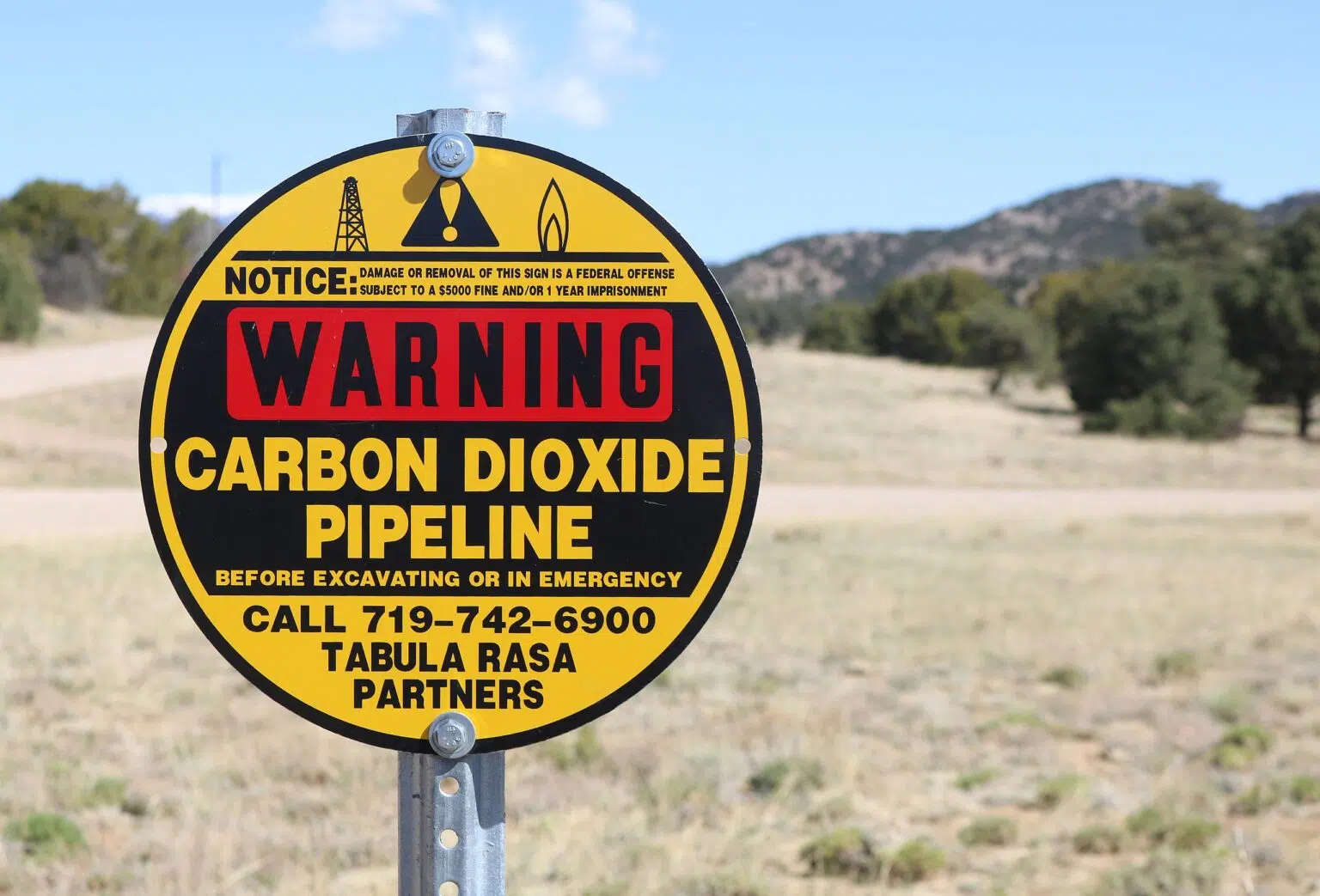
A metal sign warning of a buried carbon dioxide pipeline in Huerfano County, Colorado. Credit: Jeffre Beall, CC BY 4.0
Players in the carbon dioxide pipeline industry canceled major pipeline projects in recent weeks, marking an inauspicious start to President Biden’s ambitious plans to develop carbon capture infrastructure as a key emissions mitigation tool.
“I think what the cancellation shows is that people have had enough of fossil fuel infrastructure being forced upon them,” said Lorne Stockman, research co-director with Oil Change International. “It doesn’t surprise me that communities are standing up to these projects and occasionally winning.”
Stockman pointed out that the U.S. oil and gas industry has built millions of miles of pipelines, and hundreds of thousands of miles were installed in the last decade and a half as a result of the fracking boom. “There is a general awareness that the age of fossil fuels needs to end and that we need to transition to genuinely clean energy, and not dangerous distractions like carbon capture,” he added.
Navigator CO2 Ventures ended their “Heartland Greenway” carbon dioxide pipeline project on October 20, citing “the unpredictable nature of the regulatory and government processes involved.” The project aimed to capture 15 million metric tons of carbon dioxide from ethanol plants in the U.S. Midwest to be injected and stored underground. Much like the fossil fuel industry — which seeks to use carbon capture and storage (CCS) because they allege it will assist in decarbonizing continued oil production — carbon capture is the primary emissions mitigation tool preferred by the ethanol industry as well.
However, experts point to significant problems with the CCS process, particularly that it has historically been used primarily to pump more oil out of the earth. Burning that oil emits much more CO2 than what is captured, which means the technology wouldn’t represent a feasible solution to address climate change.
The disaster also forced the evacuation of 300 people, after the rupture spewed the odorless, colorless gas into the air for several hours. Carbon dioxide is an asphyxiant, and CO2 poisoning can leave victims disoriented and appearing to be drugged. Left untreated it can eventually lead to cardiac and pulmonary problems. More problematic is the relative rarity of mass CO2 poisoning events, meaning first responders might be unfamiliar with how to treat the symptoms. In addition, first responders — such as those responding to the disaster in Satartia — could be hampered by the engines of their vehicles shutting off in the oxygen deprived environment.
These critical health, safety, and disaster-response issues notwithstanding, it was regulatory and bureaucratic processes that have so far stymied carbon dioxide pipeline and capture projects in the Midwest.
The CCS company’s decision to cancel the project is significant for several reasons.
First, Navigator sought to use eminent domain to force landowners to give up their property, and was unsuccessful. Had these been oil or gas pipelines, the landowners might not have been as successful, because fossil fuel pipelines have generally been considered so fundamentally important to the public good that oil and gas companies can get around the Public Use Clause in the U.S. Constitution’s Fifth Amendment.
Iowa-based Summit Carbon Solutions is also proposing the Midwest Carbon Express, a $5.5 billion, 2,000-mile pipeline network across five states, to sequester carbon dioxide emissions from 34 ethanol plants. The CO2 was to be stored in North Dakota, but state regulators denied Summit Carbon a siting permit in August. Then the South Dakota Public Utilities Commission voted unanimously to strike down the company’s application to build a section of the pipeline network through that state as well. Though other pipeline projects have faced stiff public opposition, authorities denied the application to build this pipeline segment because it would violate county ordinances relating to setbacks and other aspects of the pipeline’s route. Summit has accepted the decision and indicated it would “refine their proposal and refile” for the necessary permits.
The Biden administration promised $251 million for CCS projects in seven states in May, from an estimated $12 billion fund from the Bipartisan Infrastructure Law for carbon management in the United States. Reporting from the Associated Press indicated that the funding announcement was a vote of confidence for what is expected to be a largely industry-driven initiative. The same article revealed that most of the funds have been dedicated to nine existing carbon capture projects, with an aim to sequester 50 million metric tons of carbon dioxide. Though this may seem impressive at first glance, it’s negligible when compared with the 5.5 to 6.3 billion metric tons of CO2 emitted annually in the United States alone. It’s especially insignificant given that most, if not all, of these projects are used for enhanced oil recovery — the injection of carbon dioxide into wells to extract the last remaining amounts of oil for production.
“Instead of incentivizing a CO2 reduction, the Inflation Reduction Act, along with the Infrastructure Investment and Jobs Act, through their funding of carbon capture, actually incentivize net increases in CO2, air pollution, land use and consumer costs,” said Mark Z. Jacobson, in an editorial published by The Messenger. Jacobson is a professor of civil and environmental engineering and director of Stanford University’s Atmosphere/Energy Program.
Jacobson identified the Summit project as one that is a direct beneficiary of Biden administration incentives for carbon capture. Noting that no study had determined whether this was an effective or efficient use of public money, Jacobson conducted a study to find out, which was recently published in Environmental Science and Technology. Jacobson compared the anticipated emissions savings and cost of the Summit project, which was intended to provide decarbonized ethanol for use in flex-fuel vehicles, with spending an equal amount on wind farms. The comparison also used two 2023 Ford F-150 pickup trucks for the modeling, as the F-150 is available in both electric and flex-fuel powered variants.
The results were impressive: Compared with the flex fuel-powered F-150, the fully electric version, powered by renewable wind energy, reduced CO2 emissions by 2.4 to four times, and could save drivers tens of billions of dollars – even accounting for the higher cost of the electrically powered F-150. Using wind power would also use 1/400,000 of the land footprint, and would lower air pollution levels, too.
Not only is this better for consumers, the wind and electric vehicle model virtually eliminates CO2 emissions, negating any need for carbon capture, while the ethanol and flex fuel model, even with carbon capture, would still result in a net CO2 increase.
Watchdogs argue carbon capture is being presented to the public as part of the government’s decarbonization efforts, despite being consistently proven to be incapable of reducing CO2 at the scope and scale necessary for climate change mitigation.
“Carbon capture started as a means to enhance oil production,” said Stockman. “It was not developed to address climate change.”
He pointed out that CO2 must be separated from methane in gas processing plants to meet market requirements for gas, and in most cases, it is vented into the atmosphere. In 1972, a plant at the Sharon Ridge oilfield in Texas was designed to capture CO2 from a particularly CO2-rich source of gas. Engineers wanted to see if pumping it into declining oil wells would help squeeze more oil out and make more money, Stockman said. “It worked, and that has been the model for CCS ever since.”
Stockman said that most attempts to use carbon capture and storage to reduce emissions from power plants have failed or been found to be too costly to pursue.
“The most notable success that CCS can claim is how successfully it has been used to convince politicians that it will one day be able to reduce emissions and, therefore, should be supported with public money,” he noted.
“It’s been very successful in capturing public money, which is a testimony to the long history of ‘state capture’ that the oil and gas industry has enjoyed in the U.S.,” he added, referring to Big Oil’s pressure on governments to secure public funding for their projects.
“Large budgets for lobbying and campaign finance have helped the industry maintain subsidies and tax credits, some of which have been around for many decades,” Stockman said. “The 45Q tax credit for carbon capture and EOR [enhanced oil recovery] is just the latest in this long history.”
The ethanol industry is expecting demand to decline in coming years, as recently reported by S&P Commodity Insights. Producing ethanol with CCS would meet some government and industry standards for lowering carbon intensity fuels.
However, experts and analysts routinely point out the capturing and transport process is itself carbon intensive, to the point of negating whatever positive effects sequestration might provide. Jurisdictions like California, Washington state, and the Canadian province of British Columbia could still be viable markets for low carbon intensity ethanol. There is also the possibility of using ethanol as a sustainable aviation fuel, but it all hinges on developing the infrastructure to sequester the carbon dioxide emitted during production.
Even if current pipeline projects have been canceled or shelved, there’s still considerable industry interest and incentive in finding a way to make the projects work.
Stockman urges caution before activists take a victory lap.
“I think folks need to be aware that while they have succeeded in the Midwest, communities in Texas and Louisiana are facing an overwhelming surge in gas, LNG, and CO2 infrastructure,” he said. “Both states have very oppressive legislation in place against protest and opposition to fossil fuel infrastructure, and these communities need our support, as their fight is much harder.”
The bodies of victims of the October 31, 2023 Israeli bombing of the Jabalia refugee camp in the Gaza Strip are lined up outside the Indonesian Hospital in Gaza City. (Photo: Fadi Alwhidi/Anadolu via Getty Images)
Airwars noted that this is “the most named victims we have ever monitored in a single event.”
Israel’s war on Gaza has killed more than 11,000 Palestinians, including over 100 civilian victims of a single Israeli bombing in the densely populated Jabalia refugee camp on October 31 who were publicly identified on Thursday by the U.K.-based watchdog Airwars.
The group identified 116 names of civilians killed in the strike—including 10 cases with the death of multiple family members, three of which reportedly involved entire families being wiped out. The estimated civilian death toll is 126-136, including 69 children.
Airwars noted on social media that this is “the most named victims we have ever monitored in a single event,” and “almost every named victim we found died along with at least one other family member.” The analysis is just for the Israeli attack on October 31, but the group is separately reviewing a strike from the following day. The Israel Defense Forces (IDF) confirmed both bombings and claimed to be targeting “a very senior Hamas commander.”
A spokesperson for the Israeli military said the attack had been authorized to assassinate a senior Hamas commander and destroy his base. IDF spokesperson Daniel Hagari named the target as Ibrahim Biari, commander of Central Jabaliya Battalion, who he said had been leading fighting in northern Gaza from a network of tunnels under the camp.
Hagari declined to comment on how many munitions, or which types, were used to target the camp, or identify which craters were caused by tunnel collapses. He said Israel would provide some of these details at a later date.
But a visual analysis by The Guardian has identified at least five craters in the densely populated refugee camp, which weapons experts said were left by the use of multiple JDAMs—joint direct attack munitions—in the airstrike.
“Hamas spokesperson Hazem Qassem denied any senior commander there and called the claim an Israeli pretext for killing civilians,” according toReuters.
Ahmad al-Kahlout, a spokesperson for the Hamas-controlled Gaza Interior Ministry in Gaza, told reporters at the time that “these buildings house hundreds of citizens. The occupation’s air force destroyed this district with six U.S.-made bombs. It is the latest massacre caused by Israeli aggression on the Gaza Strip.”
Hagari claimed the IDF killed “scores” of militants alongside Biari.
“With ambiguity around the exact number of militants killed, Airwars has applied a 12-24 combatant casualty range to account for comments such as ‘dozens’ of targets killed,” the watchdog said.
Those in the camp remain at risk. Middle East Eye reported Wednesday that “renewed heavy Israeli shelling has targeted residential homes in the Jabalia refugee camp. Footage showed blocks falling to the ground and survivors digging in the rubble with their hands to retrieve dead bodies.”
After the airstrikes on a block of houses in the Jabalia refugee camp a couple of hours ago, another airstrike on a house in the Nuseirat refugee camp (south of Gaza). Around 40 ppl thought to have been sheltering in that house. https://t.co/2HpjvMIbAl
The IDF strikes on Jabalia have been globally condemned as war crimes—as have various other Israeli actions since October 7, when the nation launched what experts are calling a “genocidal” war in response to a Hamas-led attack.
Throughout Israel’s bombing campaign and ground operations in Gaza—which along with killing and wounding thousands of civilians have destroyed civilian infrastructure and displaced around three-quarters of the population—global calls for a cease-fire have mounted.
There have also been growing demands for International Criminal Court action. Rutgers Law School professor and Just Security executive editor Adil Haque tagged the ICC prosecutor, Karim A. A. Khan, in a social media post about the Airwars analysis.
Khan last month asked civil society groups “to send us any and all evidence that underpins their reports or their communiques or their notices that they issue” on Gaza, explaining that “reports by themselves are, of course, not evidence and I cannot and will not act pursuant to my oath of office without reliable evidence that we can validate that can stand up in a court of law.”
Police officers work to separate protesters who locked themselves together during a November 16, 2023 demonstration for a cease-fire in Gaza, on the Bay Bridge between Oakland and San Francisco. (Photo: Arab Resource and Organizing Center)
“We refuse to stand by as our elected officials pay for and cheer on the genocide of Palestinians,” said one protester. “Biden must call for a cease-fire now.”
Dozens of demonstrators demanding a cease-fire in Israel’s war on Gaza were arrested Thursday after protesters blocked San Francisco-bound traffic on the Bay Bridge during morning rush hour and the ongoing Asia-Pacific Economic Cooperation Summit.
Members of activist groups including Palestinian Youth Movement, Arab Resource and Organizing Center, Jewish Voice for Peace (JVP) Bay Area, and others blocked westbound lanes of the bridge with their vehicles before getting out of their cars and unfurling banners reading “Stop the Genocide” and “No U.S. Military Aid to Israel.”
“We are beyond grief watching thousands of our loved ones murdered by the Israeli military. There is a genocide happening in Gaza, and President [Joe] Biden is hosting cocktail parties in San Francisco right now,” Palestinian Youth Movement’s Aisha Nizar said in a statement.
“We refuse to stand by as our elected officials pay for and cheer on the genocide of Palestinians. Biden must call for a cease-fire now,” Nizar added.
Many protesters held signs or wore banners reading “The People Demand a Cease-Fire.” Some staged a “die-in” on the roadway, while others locked themselves together and through open vehicle windows in what’s known as a “sleeping dragon” maneuver as traffic on Interstate 80 and other area freeways stayed snarled for hours.
JVP said “at least” 50 people were arrested, a number corroborated by the California Highway Patrol.
“The Bay Area will not stop shutting things down until there is an immediate END to the bombing in Gaza,” JVP Bay Area said on social media.
Ariel Koren, a leader of the #NoTechForApartheid movement, posted that “Biden will not get away with genocide, Biden will not get away with staying in San Francisco without EVERYONE knowing he is supporting the slaughter in Gaza.”
There are OVER A HUNDRED riot police here clearing us out, arresting dozens demanding an immediate ceasefire
How many tens of thousands have to come out to the streets, shut down roads & bridges, get arrested, until @JoeBiden starts taking us seriously.
Several protests against Israel’s war on Gaza have taken place in the Bay Area in recent weeks, including marches and a Jewish-led takeover of a federal building in Oakland on Monday.
Multiple people detained by police said they had nothing to do with the demonstration. Among those claiming wrongful arrests were Stanford University physics professor Lauren Tompkins and Masoud Barukzai, a worker at San Francisco International Airport.
“As a citizen, this is absolutely disgusting, to be stripped of my rights,” Barukzai—who says he believes he was arrested due to his appearance—told The San Francisco Chronicle.
Arrests currently happening on the bay bridge. It’s important to remember that every time police show up to arrest anti-war/pro-Palestinian protestors, American police are acting in solidarity with their training partners in the IDF. #FreePalestinepic.twitter.com/KQ0esYvcUxhttps://t.co/wbbyUFDb67
Israel’s relentless assault on Gaza has killed, maimed, or displaced nearly 40,000 Palestinians, with over 2,700 others missing—many of them presumed dead under the rubble. Half the homes in the besieged strip have been damaged or destroyed, while as many as 1.7 million people—around 70% of Gaza’s population—have been forcibly displaced.
Biden—who spoke at the Asia-Pacific Economic Cooperation (APEC) Leader’s Meeting in San Francisco Thursday morning—has rejected calls for a cease-fire while requesting $14.3 billion in additional military aid for Israel, atop the nearly $4 billion it already gets each year.
Biden—who has proclaimed his “unwavering” support for Israel—has also been accused of genocide denial for casting aspersions on Palestinian officials’ Gaza casualty reports, even though his own administration has cited figures from the same agencies in recent reports.
A similar protest took place Thursday morning in Massachusetts, where the Jewish-led group IfNotNow Boston spearheaded a rush-hour blockage of Boston University Bridge.
“Every day brings more death, more starvation, more children losing limbs, more babies becoming orphans,” the group said in an open letter demanding a Gaza cease-fire. “It is unbearable, our souls cry out against it.”
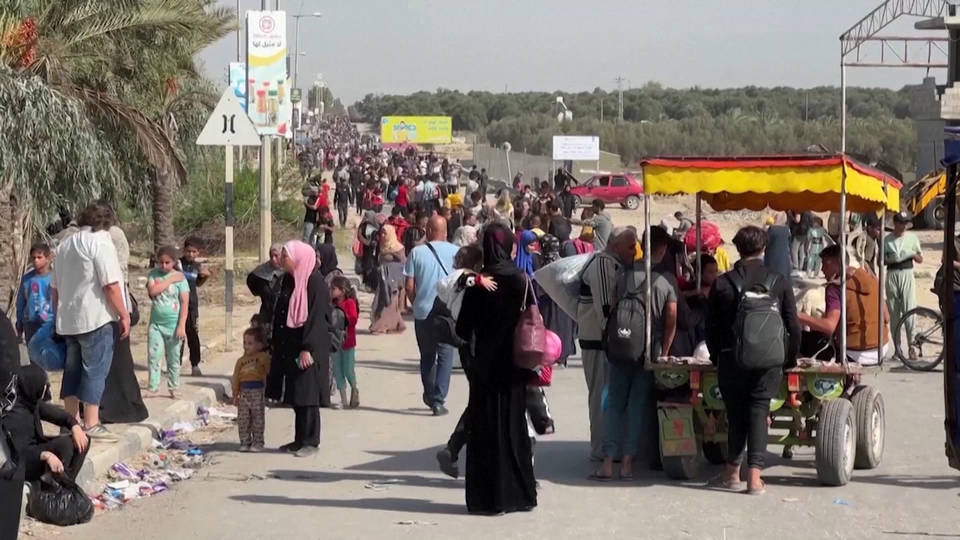
Dozens of Palestinians have been killed in a 41st consecutive day of unrelenting attacks by Israel’s military on the Gaza Strip. Overnight, Israel’s Air Force dropped leaflets over parts of the southern city of Khan Younis ordering people to leave their homes and shelters “for their own safety.” Many are being expelled for a second time, after Israel last month ordered more than a million Palestinians to leave their homes in northern Gaza.
On Wednesday, Israeli authorities allowed the first shipment of fuel into the Gaza Strip since early October. The U.N.’s agency for Palestinian refugees, UNRWA, says just over 6,000 gallons of fuel — half a tanker truck’s worth — was allowed to cross from Egypt. That’s just 9% of what UNRWA says is needed daily to sustain life-saving activities. Israel is not allowing the fuel to be used in hospitals or to power water and sewage pumps.
The U.N.’s human rights chief, Volker Türk, said outbreaks of disease and hunger in Gaza now appear “inevitable.” His remarks came amid a worsening humanitarian catastrophe at Gaza’s largest hospital, the Al-Shifa medical complex, which is being occupied by Israel’s army. Thousands of patients, medical workers and displaced Palestinians remain trapped inside the hospital and unable to leave. Medical workers report Israeli attacks have severely damaged Al-Shifa’s main surgery building, and about 200 people were reportedly blindfolded by Israeli troops and led away to interrogations. The World Health Organization’s Dr. Tedros Adhanom Ghebreyesus says 26 out of Gaza’s 36 hospitals are now closed due to damage from Israeli strikes or because they have run out of fuel.
Tedros Adhanom Ghebreyesus: “Israel’s military incursion into Al-Shifa Hospital in Gaza City is totally unacceptable. Hospitals are not battlegrounds.”