Category: politics

  • Gaza Assault Exposes True Face of Israel’s Ugly Apartheid Regime

    Spread the love
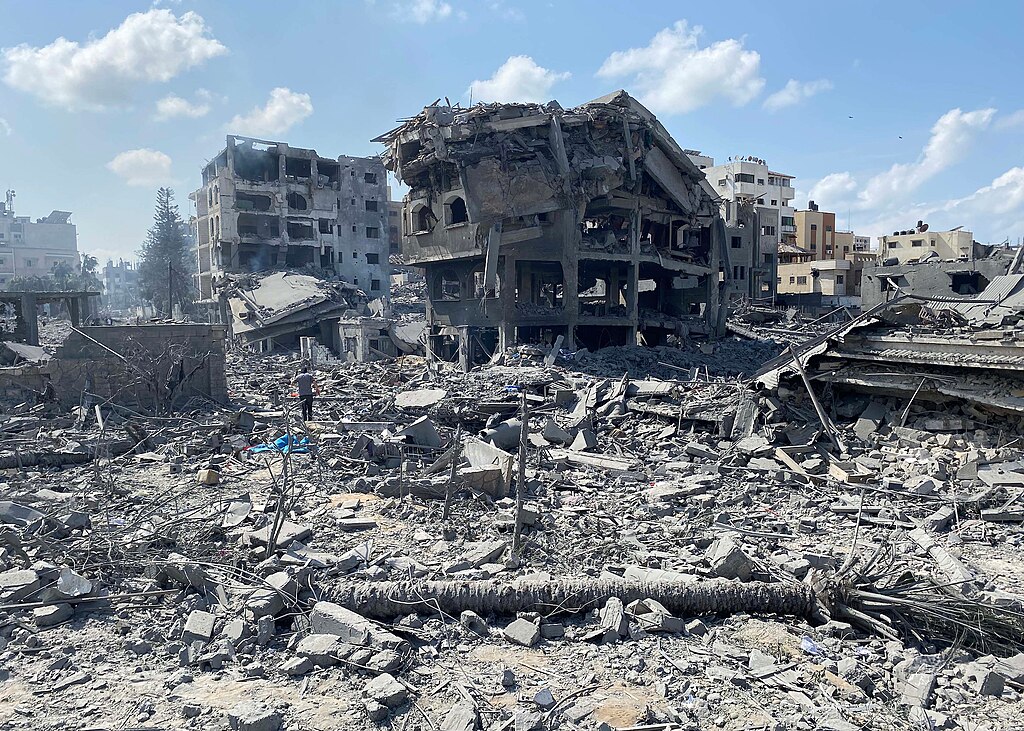
    Palestinians inspect the damage following an Israeli airstrike on the El-Remal aera in Gaza City on October 9, 2023. Israel continued to battle Hamas fighters on October 10 and massed tens of thousands of troops and heavy armour around the Gaza Strip after vowing a massive blow over the Palestinian militants' surprise attack. Photo by Naaman Omar apaimages. licensed under the Creative Commons Attribution-Share Alike 3.0 Unported license.
    Palestinians inspect the damage following an Israeli airstrike on the El-Remal aera in Gaza City on October 9, 2023. Israel continued to battle Hamas fighters on October 10 and massed tens of thousands of troops and heavy armour around the Gaza Strip after vowing a massive blow over the Palestinian militants’ surprise attack. Photo by Naaman Omar apaimages. licensed under the Creative Commons Attribution-Share Alike 3.0 Unported license.

    Original article by RAMZY BAROUD republished from Common Dreams under Creative Commons (CC BY-NC-ND 3.0). 

    A whole generation, if not more, has already built a perception of Israel as a genocidal regime and no number of future lies, Hollywood movies or Maxim Magazine spreads will ever lessen that in any way.

    On Saturday, November 11, Israeli military spokesman Daniel Hagari claimed in a press conference that Israel had killed a “terrorist” who had prevented 1,000 civilians from escaping the Shifa Hospital.

    The allegations made little sense. Even by the standards of Israeli propaganda, falsifying such a piece of information while providing no context and no evidence, further contributes to the deteriorating credibility of Israel in international media and image worldwide.

    Just one day earlier, an unnamed US official was cited by CNN as saying, in a diplomatic cable, “we are losing badly on the messaging battlespace”.

    Damage in Gaza Strip during the October 2023 - 27

    The diplomat was referring to American reputation in the Middle East—in fact, worldwide—which now lies in tatters due to blind American support for Israel.

    Roles Reversed

    This credibility deficit can be witnessed in Israel itself. Not only is Israeli Prime Minister Benjamin Netanyahu losing credibility among Israelis, according to various public opinion polls, but the entire Israeli political establishment seems to be losing the trust of ordinary Israelis as well.

    A common joke among Palestinians these days is that Israeli leaders are emulating Arab leaders in previous Arab-Israeli wars, in terms of language, phony victories and unsubstantiated gains on the military front.

    For example, while Israel was quickly pushing Arab militaries back on all fronts in June 1967, with full US-Western backing, of course, the leadership of Arab armies were declaring through radio that they had arrived at the ‘gates of Tel Aviv’.

    Fortunes seem to have been reversed. Abu Obeida and Abu Hamza, military spokesmen for the Al-Qassam Brigades and the Al-Quds Brigades respectively, provide very careful accounts of the nature of the battle and the losses of advancing Israeli military forces in their regular, much-anticipated statements.

    The Israeli military, on the other hand, speaks of impending victories, killing of unnamed ‘terrorists’, and the destruction of countless tunnels, while rarely providing any evidence. The only ‘evidence’ provided is the intentional targeting of hospitals, schools, and civilian homes.

    And, while Abu Obeida’s statements are almost always followed by well-produced videos, documenting the systematic destruction of Israeli tanks, no such documentation substantiates Israeli military claims.

    Beyond the Battlefield

    But the issue of Israeli credibility, or rather, the lack of credibility, is not only taking place on the battlefield.

    From the first day of the war, Palestinian doctors, civil defense workers, journalists, bloggers, and even ordinary people filmed or recorded every Israeli war crime anywhere and everywhere in the besieged Strip. And, despite the continuous shutting down of the internet and electricity in Gaza by the Israeli military, somehow, Palestinians kept track of every aspect of the ongoing Israeli genocide.

    The precision of the Palestinian narrative even forced US officials, who initially doubted Palestinian numbers, to finally admit that Palestinians were telling the truth, after all.

    Barbara Leaf, assistant Secretary of State for Near Eastern Affairs, told a US House panel on November 9 that those killed by Israel in the war are likely “higher than is being cited.”

    Indeed, every day, Israel loses credibility to the point that the initial Israeli lies of what had taken place on October 7, eventually proved disastrous to Israel’s overall image and credibility on the international stage.

    Damage in Gaza Strip during the October 2023 - 30

    Rape, ISIS, and Mein Kampf

    In the euphoria of demonizing the Palestinian Resistance—as a way to justify Israel’s forthcoming genocide in Gaza—the Israeli government and military, then journalists and even ordinary people, were all recruited in an unprecedented hasbara campaign aimed at painting Palestinians as “human animals”—per the words of Israeli Defense Minister Yoav Gallant.

    Within hours of the events and, before any investigation was conducted, Netanyahu spoke of “decapitated babies,” supposedly mutilated at the hands of the Resistance; Gallant claimed that “young girls were raped violently”; even former military chief rabbi, Israel Weiss, said he had “seen a pregnant woman with her belly torn open and the baby cut out.”

    Even the supposedly ‘moderate’ Israeli President Isaac Herzog made ludicrous statements on the BBC on November 12. When asked about Israeli airstrikes on Gaza, Herzog claimed that the book Mein Kampf, written by Adolf Hitler in 1925, was found “in a children’s living room” in northern Gaza.

    And, of course, there were the repeated references to the ISIS flags that, for some reason, were carried by Hamas fighters as they entered southern Israel on October 7, among other fairy tales.

    The fact that ISIS is a sworn enemy of Hamas and that the Palestinian Movement has done everything in its power to eradicate any possibility for ISIS to extend its roots in the besieged Gaza Strip seemed irrelevant to Israel’s unhinged propaganda.

    Expectedly, Israeli, US and European media repeated the claim of the Hamas-ISIS connection, with no rational discussion or the minimally-required fact-checking.

    But, with time, Israeli lies were no longer able to withstand the pressure of the truth emanating from Gaza, documenting every atrocity and every battle, and obfuscating any drummed-up Israeli allegations.

    Perhaps, the turning point of the relentless series of Israeli lies was the attack on the Al-Ahli Baptist Hospital in Gaza City on October 17. Though many adopted, and still, sadly, defend the Israeli lie—that a Resistance rocket fell on the hospital—the sheer bloodiness of that massacre, which killed hundreds, was, for many, a wake-up call.

    One of the many questions that arose following the Baptist Hospital massacre is: If Israel was, indeed, honest about its version of events regarding what took place at the hospital, why did it bomb every other hospital in Gaza and continues to do so for weeks?

    Israeli Hasbara Canceled

    There are reasons why Israeli propaganda is no longer able to effectively influence public opinion even though mainstream media continues to side with Israel, even when the latter is committing a genocide.

    Firstly, is that Palestinians and their supporters have managed to ‘cancel’ Israel using social media which, for the first time, overwhelmed the organized propaganda campaigns often engineered on behalf of Israel in corporate media.

    An analysis of online content on popular social media platforms was conducted by the Israeli influencer marketing platform, Humanz. The study, published in November, admitted that “while 7.39 billion posts with pro-Israeli tags were published on Instagram and TikTok last month, in the same period 109.61 billion posts with pro-Palestinian tags were published on the platforms.” This, according to the company, means that pro-Palestinian views are 15 times more popular than pro-Israeli views.

    Secondly, independent media, Palestinian and others, offered alternatives to those seeking a different version of events to what is taking place in Gaza.

    A single Palestinian freelance journalist in Gaza, Motaz Azaiza, has managed to acquire more than 14 million followers on Instagram over the course of a single month because of his reporting from the ground.

    Thirdly, the ‘surprise attack’ of October 7 has deprived Israel of the initiative, not only regarding the war itself, but also the justification for the war. Indeed, their genocidal war on Gaza has no specific objectives, but also has no precise media campaign to defend or rationalize these unspecified objectives. Therefore, the Israeli media narrative appears disconnected, haphazard and, at times, even self-damaging.

    And, finally, the sheer brutality of the Israeli genocide in Gaza. If one is to juxtapose Israeli media lies with the horrific Israeli crimes committed in Gaza, one would find no plausible logic that could convincingly justify mass murder, displacement, starvation and genocide of a defenseless population.

    Never has Israeli propaganda failed so astoundingly and never has the mainstream media failed to shield Israel from the global anger—in fact, seething hatred—for Israel’s ugly apartheid regime.

    The repercussions of all of this will most certainly impact the way that history will remember the Israeli war on Gaza, which has, so far, killed, and wounded tens of thousands of innocent civilians.

    A whole generation, if not more, has already built a perception of Israel as a genocidal regime and no number of future lies, Hollywood movies or Maxim Magazine spreads will ever lessen that in any way.

    More importantly, this new perception is likely to compel people, not only to re-examine their views of Israel’s present and future, but of the past as well – the very foundation of the Zionist regime, itself predicated on nothing but lies.

    Original article by RAMZY BAROUD republished from Common Dreams under Creative Commons (CC BY-NC-ND 3.0). 

  • Keir Starmer loses eight frontbenchers in major rebellion over Gaza ceasefire

    Spread the love
    Keir Starmer sucking up to the rich and powerful at World Economic Forum, Davos.
    Keir Starmer sucking up to the rich and powerful at World Economic Forum, Davos.

    https://leftfootforward.org/2023/11/keir-starmer-loses-eight-frontbenchers-in-major-rebellion-over-gaza-ceasefire/

    Eight frontbenchers quit the Labour Party last night, in a major blow to Labour leader Keir Starmer over the party’s stance on a ceasefire in Gaza.

    The major rebellion occurred as more than a quarter of Labour’s MPs defied Starmer to support an immediate cessation in the fighting. Among the most high profile names choosing to defy the Labour leadership was Jess Phillips, who joined colleagues including Yasmin Qureshi, Afzal Khan and Paula Barker in quitting on Wednesday evening after deciding to support the SNP amendment to the King’s Speech backing a ceasefire.

    Four other frontbenchers: Rachel Hopkins, Sarah Owen, Naz Shah and Andy Slaughter, have also left the front bench after breaking the party whip to back the amendment. Mary Foy, Angela Rayner’s parliamentary private secretary (PPS), and Dan Carden, another PPS, have also left the frontbench.

    Overall, 56 Labour MPs voted in favour of a ceasefire.

    …

    https://leftfootforward.org/2023/11/keir-starmer-loses-eight-frontbenchers-in-major-rebellion-over-gaza-ceasefire/

  • Supreme court rules Rwanda plan unlawful: a legal expert explains the judgment, and what happens next

    Spread the love
    The Rwanda deal was signed when Priti Patel was home secretary. Rwanda visit April 14, 2022. Image: UK Home Office.
    The Rwanda deal was signed when Priti Patel was home secretary. Rwanda visit April 14, 2022. Image: UK Home Office.

    Before publishing this article unaltered, I draw your attention to these excerpts:

    …

    It is important to note that the supreme court’s decision is not a comment on the political viability of the Rwanda plan, or on the concept of offshoring asylum processes generally. The ruling focused only on the legal principle of non-refoulement, and determined that in this respect, Rwanda is not a “safe third country” to send asylum seekers.


    …


    This ruling is likely to revive discussion about the UK leaving the European convention on human rights (ECHR), which holds the UK to the non-refoulement obligation. Some Conservatives, including the former home secretary Suella Braverman, have argued that leaving the convention would make it easier to pass stronger immigration laws.

    But while handing down the supreme court judgment, Lord Reed emphasised that there are obligations towards asylum seekers that go beyond the ECHR. The duty of non-refoulement is part of many other international conventions, and domestic law as well. In other words, exiting the ECHR would not automatically make the Rwanda plan lawful or easier to implement.

    …

    So it would appear that UK is not going to be sending refugees to Rwanda despite Rishi Sunak and Conservative claims that it will.

    Supreme court rules Rwanda plan unlawful: a legal expert explains the judgment, and what happens next

    Devyani Prabhat, University of Bristol

    The UK supreme court has unanimously ruled that the government’s plan to send asylum seekers to Rwanda is unlawful.

    Upholding an earlier decision by the court of appeal, the supreme court found that asylum seekers sent to Rwanda may be at risk of refoulement – being sent back to a country where they may be persecuted, tortured or killed.

    The courts cited extensive evidence from the UN refugee agency (UNHCR) that Rwanda does not respect the principle of non-refoulement – a legal obligation. The UNHCR’s evidence questioned the ability of Rwandan authorities to fairly assess asylum claims. It also raised concerns about human rights violations by Rwandan authorities, including not respecting non-refoulement with other asylum seekers.

    It is important to note that the supreme court’s decision is not a comment on the political viability of the Rwanda plan, or on the concept of offshoring asylum processes generally. The ruling focused only on the legal principle of non-refoulement, and determined that in this respect, Rwanda is not a “safe third country” to send asylum seekers.

    The ruling is another blow to the government’s promise to “stop the boats”. And since the Rwanda plan is at the heart of its new Illegal Migration Act, the government will need to reconsider its asylum policies. This is further complicated by Conservative party infighting and the firing of home secretary Suella Braverman, just two days before the ruling.

    How did we get here?

    For years, the UK government has been seeking to reduce small boat arrivals to the UK. In April 2022, the UK and Rwanda signed an agreement making it possible for the UK to deport some people seeking asylum in Britain to Rwanda, without their cases being heard in the UK. Instead, they would have their cases decided by Rwandan authorities, to be granted (or rejected) asylum in Rwanda.

    While the Rwanda plan specifically was found to be unlawful, the government could, in theory, replicate this in other countries so long as they are considered “safe” for asylum seekers.

    The government has not yet sent anyone to Rwanda. The first flight was prevented from taking off by the European court of human rights in June 2022, which said that British courts needed to consider all human rights issues before starting deportations.

    A UK high court then decided in December 2022 that the Rwanda plan was lawful.


    Catch up on our other coverage of the Rwanda plan:

    • Why UK court ruled Rwanda isn’t a safe place to send refugees – and what this means for the government’s immigration plans

    • Rwanda deportations: what is the European Court of Human Rights, and why did it stop the UK flight from taking off?

    • Suella Braverman is wrong about the UN refugee convention being ‘not fit for purpose’ – here’s why

    • The government passed a major immigration law last year – so why is it trying to pass another one?

    • ‘A toxic policy with little returns’ – lessons for the UK-Rwanda deal from Australia and the US


    Ten asylum seekers from Syria, Iraq, Iran, Vietnam, Sudan and Albania challenged the high court ruling, with the support of the charity Asylum Aid. Their claim was about whether Rwanda meets the legal threshold for being a safe country for asylum seekers.

    The court of appeal said it was not and that asylum seekers risked being sent back to their home countries (where they could face persecution), when in fact they may have a good claim for asylum.

    The government has since passed the Illegal Migration Act. The law now states that all asylum seekers arriving irregularly (for example, in small boats) must be removed to a safe third country. But now that the Rwanda deal has been ruled unlawful, there are no other countries that have said they would take asylum seekers from the UK.

    What happens next?

    Former Home Secretary Suella 'Sue-Ellen' Braverman
    Former Home Secretary Suella ‘Sue-Ellen’ Braverman continued with the Rwanda policy.

    It is clear that the government’s asylum policies will need rethinking. Should another country now be designated as a safe country and different arrangements put in place, these will probably be subject to further legal challenges, including in the European court of human rights and in British courts.

    This ruling is likely to revive discussion about the UK leaving the European convention on human rights (ECHR), which holds the UK to the non-refoulement obligation. Some Conservatives, including the former home secretary Suella Braverman, have argued that leaving the convention would make it easier to pass stronger immigration laws.

    But while handing down the supreme court judgment, Lord Reed emphasised that there are obligations towards asylum seekers that go beyond the ECHR. The duty of non-refoulement is part of many other international conventions, and domestic law as well. In other words, exiting the ECHR would not automatically make the Rwanda plan lawful or easier to implement.

    The prime minister, Rishi Sunak, has said that he is working on a new treaty with Rwanda and is prepared to change domestic laws to “do whatever it takes to stop the boats”.

    The UK is not the only country to attempt to off-shore asylum processing. Germany and Italy have recently been considering finding new safe third countries to accept asylum seekers as well.

    But ensuring these measures comply with human rights obligations is complicated. International law requires states to provide sanctuary to those fleeing persecution or risk to their lives. As this ruling shows, the UK is not going to find an easy way out of these obligations. The Conversation

    Devyani Prabhat, Professor of Law, University of Bristol

    This article is republished from The Conversation under a Creative Commons license. Read the original article.

  • Supreme court sinks shameful Rwanda scheme

    Spread the love

    https://www.morningstaronline.co.uk/article/b/supreme-court-sinks-shameful-rwanda-scheme

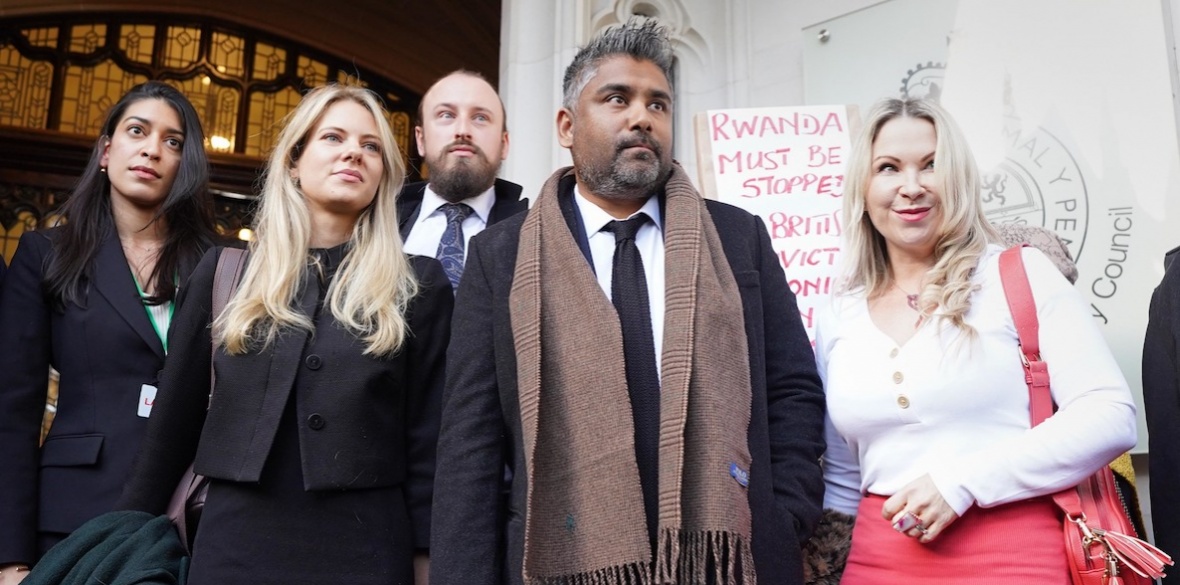
    Toufique Hossain, director of public law and immigration at Duncan Lewis Solicitors, (centre) with his legal team outside the Supreme Court in London. Picture date: Wednesday November 15, 2023.

    PITILESS Tory plans to deport refugees to Rwanda were ruled illegal by the Supreme Court today, plunging Rishi Sunak’s government deeper into chaos.

    The court determined that Rwanda was not a safe destination for asylum-seekers and that there was a high risk of them being returned to their country of origin to be tortured or worse, thus torpedoing what is a flagship Tory policy.

    The defiant Prime Minister pledged to fight on to stop destitute refugees crossing the Channel, responding to the judgement by asserting that “illegal migration destroys lives and costs British taxpayers millions of pounds a year. We need to end it and we will do whatever it takes to do so.”

    He later claimed that the judges had agreed that the “principle of removing asylum-seekers to a safe third country is lawful” and told MPs he was ready to “revisit” UK laws to block migration if necessary and to seek a fresh treaty with Rwanda.

    …

    Labour ducked the moral issues raised by the policy, with leader Sir Keir Starmer and shadow home secretary Yvette Cooper focusing instead on the waste of money and time involved in the failed Rwanda policy.

    The judges’ decision was, however, welcomed by a wide range of human rights campaigners.

    Amnesty International’s Sacha Deshmukh said: “The government must now draw a line under a disgraceful chapter in the UK’s political history.

    …

    https://www.morningstaronline.co.uk/article/b/supreme-court-sinks-shameful-rwanda-scheme

  • Allowing Cumbria coalmine was ‘disaster’ for climate diplomacy, says Lord Turner

    Spread the love

    https://www.theguardian.com/environment/2023/nov/16/allowing-cumbria-coalmine-was-disaster-for-climate-diplomacy-says-lord-turner

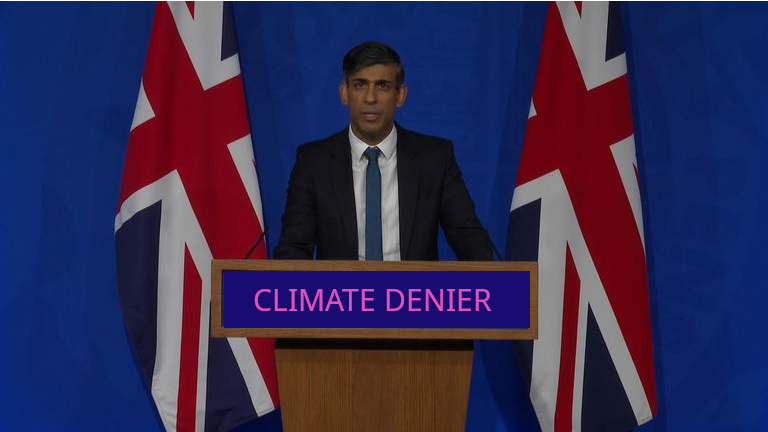
    Rishi Sunak podium reads CLIMATE DENIER

    Former chair of climate change committee says UK’s decision has encouraged other countries to keep exploiting fossil fuels

    The UK’s decision to open a new coalmine in Cumbria was a “disaster” that encouraged other countries to press ahead with fossil fuels, and the continued expansion of North Sea oil and gas is likely to continue the harm, a former chief adviser to the government has said.

    Other countries are using the UK as an excuse for pressing ahead with fossil fuel projects despite their climate commitments, according to Adair Turner, the first chair of the Committee on Climate Change and a former head of the CBI.

    Lord Turner told the Guardian that he had “literally been involved in discussions” in China and India where UK decisions had been given as a reason for not moving faster on the climate.

    “I can tell you that [the Cumbrian coalmine] was a disaster globally, and in China and India, where I was engaged in debates [on reducing greenhouse gas emissions], I have had people say ‘yeah, but you’re building a new coalmine in the UK’,” he said.

    “So that was a disaster for our reputation, and it provides arguments for the people within government or within interest groups in China and India to say ‘oh look, the UK is supposedly committed to net zero, but it’s not serious, it’s building a new coalmine’. And the same occurs with new oil and gas fields in the North Sea.”

    Turner is now chair of the Energy Transitions Commission (ETC), a thinktank that on Thursday published a report that says the production of and demand for fossil fuels must be reduced rapidly, and that this is achievable. “Unabated” fossil fuel use must be phased out, and there is only limited scope for the use of carbon capture and storage (CCS), the report finds.

    …

    https://www.theguardian.com/environment/2023/nov/16/allowing-cumbria-coalmine-was-disaster-for-climate-diplomacy-says-lord-turner