Category: politics

  • El Niño could push global warming past 1.5℃ – but what is it and how does it affect the weather in Europe?

    Spread the love
    A natural weather event known as El Niño is underway in the Pacific Ocean.
    jon sullivan/Shutterstock

    Manoj Joshi, University of East Anglia

    Scientists have warned that 2024 could mark the year when global warming exceeds 1.5℃ above pre-industrial levels. They attribute these predictions, at least in part, to the emergence of an El Niño event.

    An El Niño is declared when the sea surface temperature in large parts of the central or eastern equatorial regions of the Pacific Ocean warms significantly – sometimes by as much as 2℃. This additional heat in turn warms the atmosphere. During El Niño years, this warming contributes to a temporary rise in the global temperature by a fraction of a degree.


    You can listen to more articles from The Conversation, narrated by Noa, here.


    El Niño primarily affects weather in the tropics. Intense downpours that would usually fall on parts of south-east Asia or eastern Australia instead fall on the west coast of South America. This change can cause major drought and flooding on different continents, affecting food production and even weather-dependent sports like cricket.

    But changes to the weather in these regions can have knock-on effects all over the world. Even thousands of kilometres away in northern Europe, El Niño tends to cause colder and drier winter weather.

    Yet many factors affect European weather, especially during winter. So care is needed when linking unusual weather events in Europe to El Niño.
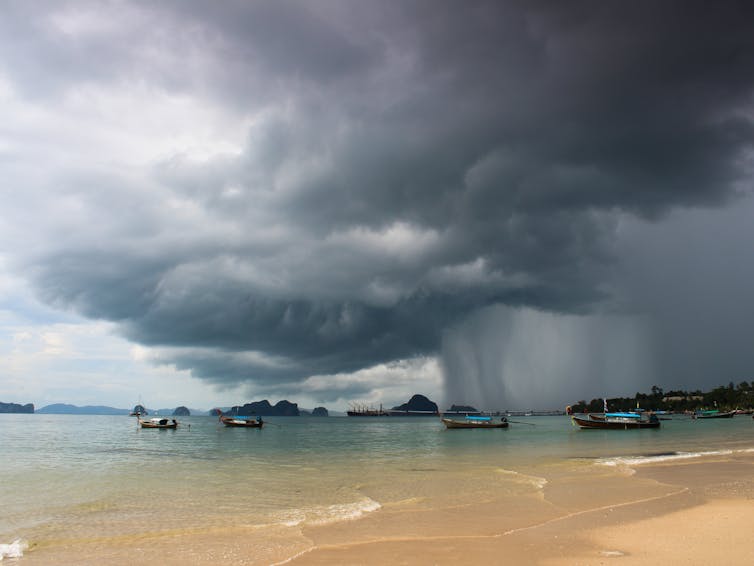
    Storm clouds over the Andaman Sea.
    Storm clouds over the Andaman Sea, Thailand.
    Ian Murdoch/Shutterstock

    What is El Niño?

    The Pacific Ocean spans over 13,000 kilometres from its eastern edge on the South American coast to its western margins near Indonesia. The sea surface temperature changes considerably over this vast distance.

    Normally, the eastern edge of the Pacific Ocean is more than 5℃ colder on average than the western Pacific. This is primarily due to the upwelling of cold water near South America, a process in which colder water is pulled up from deeper down in the ocean.

    However, this temperature contrast flattens or steepens every few years in a natural cycle called the El Niño southern oscillation (Enso). During this cycle, the strength of trade winds that blow westwards across the Pacific can strengthen or weaken, causing more or less cold water to upwell and flow along the equator.

    We’re currently entering a period where the eastern Pacific will be warmer than it usually is – an El Niño event. Forecasts suggest that a part of the equatorial Pacific, regarded as a key indicator of Enso, has a 50% chance of warming by over 1.5℃ by the start of 2024.

    How Pacific Ocean temperatures change during an El Niño event.

    La Niña is the opposite phase of the cycle. It is instead characterised by cooler sea surface temperatures in these waters. This year brought an end to three successive La Niña years.

    The western tropical Pacific region has some of the warmest ocean temperatures on Earth. Humid air tends to converge here, creating unstable conditions characterised by turbulent rising air known as convection by meteorologists. The result of this is towering clouds and intense rainfall.

    The region with the highest ocean temperature tends to experience the greatest amount of rainfall. As the warmest ocean temperatures shift eastward during El Niño, so too does the location of maximum cloud cover and rainfall.

    Each El Niño event is different. Some mainly warm the eastern Pacific Ocean, such as the 1997-98 event. Others cause more warming in the central Pacific, like in 2009-10.

    How does it affect Europe’s climate?

    Towering clouds and intense rains in the western Pacific create atmospheric waves known as Rossby waves. These waves extend over thousands of kilometres and travel into and along the eastward-flowing jet streams that encircle the planet’s mid-latitude regions. When the Rossby waves interact with the jet streams, they cause them to undulate.

    As unsettled weather in the Pacific moves eastwards during an El Niño event, it influences the location of the peaks and troughs of these Rossby waves. This results in subtle changes in the positions of the jet streams. These alterations in the jet streams, which play a significant role in shaping weather patterns, can have notable effects on weather conditions worldwide.

    Depending on the specific movement of the jet stream in a particular area, the effect can either lead to warmer or cooler weather, despite El Niño warming the global climate as a whole. El Niño tends to slightly warm Europe in summer and slightly cool northern Europe in winter.

    External noise

    However, a colder-than-average winter in Europe is not guaranteed during an El Niño event. Europe’s winter climate is affected by various factors beyond El Niño, including conditions in the Atlantic, the amount of Arctic sea ice and the state of the stratosphere 15-40km above us (which is itself affected by El Niño).

    For instance, the quasi-biennial oscillation – a regular reversal of winds that blow high above the equator – can alter wind patterns in the stratosphere. This can subsequently affect the position of the North Atlantic storm track, which influences Europe’s winter weather.

    But even then, the underlying warming trend caused by climate change is making higher temperatures more probable in all seasons. Together, these other factors make any climatic signals from El Niño harder to detect and forecast. Caution must therefore be exercised before attributing anomalies in European winter weather to El Niño alone.


    Imagine weekly climate newsletter

    Don’t have time to read about climate change as much as you’d like?

    Get a weekly roundup in your inbox instead. Every Wednesday, The Conversation’s environment editor writes Imagine, a short email that goes a little deeper into just one climate issue. Join the 20,000+ readers who’ve subscribed so far. The Conversation


    Manoj Joshi, Professor of Climate Dynamics, University of East Anglia

    This article is republished from The Conversation under a Creative Commons license. Read the original article.


  • Gaza freedom boat arrives in Liverpool this weekend to raise awareness of Israeli blockade

    Spread the love

    Original article republished from the Skwawkbox for non-commercial use.

    Freedom Flotilla will attempt to break sea blockade to deliver medicines and urgent supplies to besieged Palestinians

    Palestine Solidarity Campaign’s ‘Freedom Flotilla Coalition’s boat ‘Handala’ will arrive in Liverpool this weekend as part of its European tour to raise awareness of Israel’s ongoing land, air, and sea blockade of the Gaza Strip

    The Palestine Solidarity Campaign’s ‘Freedom Flotilla Coalition’s boat ‘Handala’ will arrive in Liverpool this weekend as part of its European tour to raise awareness of Israel’s ongoing land, air, and sea blockade of the Gaza Strip. The boat’s tour aims to draw particular attention to the conditions faced by children in Gaza, who make up more than half of its residents. The boat is named Handala after the famous cartoon image of a refugee Palestinian child.

    The boat will arrive in Liverpool late on Sunday 2 July and the crew will meet journalists and residents on Monday. The crew includes Zohar Chamberlain Regev, an Israeli citizen who has been part of previous attempts to break the blockade of Gaza, and Musheir El Farra, a Gazan who lives in Sheffield and has lost many family members in Israeli attacks, to tell his personal story of life for families under the siege.

    Later on Monday, the crew will visit a local mosque and will spend their evening at St Bride’s church in Liverpool, where they will take questions from members of the public. Eddie Scraggs will talk about an inspiring project in Gaza where a Liverpool medical team from Liverpool has been performing kidney transplants free of charge and there will also be a short film about a youth project in Gaza called “We are Not Numbers.”

    The Handala will leave Liverpool for Cardiff on Wednesday.

    The 16-year blockade of Gaza has had devastating effects on the local population of the territory, many of whom are refugees. Water consumption is well below the internationally recommended minimum, while electricity is often only available for a few hours a day. The blockade is aggravated by Israel’s regular bombing of the Gaza Strip and attacks on Gazan fishermen. Earlier this year, Israel’s bombardment of Gaza killed 49 Palestinians, including 17 children.

    The UN and human rights monitoring bodies have repeatedly condemned the blockade as illegal, drawing attention to its disastrous effects on services like essential healthcare, education and sanitation and access to food, as well as the crippling impact on Gaza’s economy. Children have been particularly hard hit by the blockade, with Save the Children reporting that four out of five children in the Gaza Strip live with depression, grief and fear.

    After finishing its tour of Europe, the Freedom Flotilla Coalition has announced its intention to sail to the Gaza Strip next year, despite the blockade. A 2010 attempt by the Gaza Freedom Flotilla to break the blockade saw a brutal attack by Israeli commandos – while the boats were still in international waters – that killed nine passengers and wounded dozens.

    Helen Marks, Secretary of Liverpool Friends of Palestine, said:

    The blockade of Gaza is illegal, immoral and barbaric. It is designed to punish and control an entire population by limiting their access to the resources required to live fulfilled lives. It needs to be brought to an end alongside Israel’s wider system of apartheid exercised over all Palestinians.

    The flotilla’s visit to Liverpool is an important means of raising awareness of these injustices and building the pressure on our Government to take meaningful action to hold Israel to account for its violation of Palestinian rights and of international law.

    Original article republished from the Skwawkbox for non-commercial use.

  • Current heatwave across US south made five times more likely by climate crisis

    Spread the love

    https://www.theguardian.com/environment/2023/jun/27/heatwave-human-caused-climate-crisis-texas-louisiana-mexico

    Latest ‘heat dome’ event over Texas and Louisiana, plus much of Mexico, driven by human-cause climate change, scientists find

    Texas Longhorn bull. Image Sheila Brown CC0 Public Domain

    The record heatwave roiling parts of Texas, Louisiana and Mexico was made at least five times more likely due to human-caused climate change, scientists have found, marking the latest in a series of recent extreme “heat dome” events that have scorched various parts of the world.

    …

    More than 40 million people in the US, including those living in the Texas cities of Houston, San Antonio and Austin, have been placed under excessive heat warnings, raising fears over the health of people vulnerable to the heat and placing Texas’s energy grid under strain from surging air conditioner use.

    The heating of the Earth’s atmosphere and oceans by the burning of fossil fuels made the extreme heatwave at least five times more likely, according to a recent analysis by Climate Central, a climate science non-profit. The punishing heat, which is forecast to linger further throughout the week in Texas, is creating “stressful conditions for millions of people”, according to Andrew Pershing, vice-president for science at Climate Central.

    …

    https://www.theguardian.com/environment/2023/jun/27/heatwave-human-caused-climate-crisis-texas-louisiana-mexico

  • Public Pension Funds Have Lost Billions on Their Fossil Fuel Investments: New Analysis

    Spread the love

    Orifginal article by Dana Drugmand republished from DeSmog

    Six major US retirement funds would be worth a combined $21 billion more today if they had divested a decade ago, University of Waterloo researchers find.

    US public pension funds would be worth billions more if they divested from fossil fuels, researchers have found. Credit: Climate Clock

    For U.S. public pension funds, divesting from oil, coal, and gas would result in overall higher financial value.

    That is the key takeaway from a new study examining the past decade’s portfolio performance for several of the largest public pension funds in the country. The analysis by researchers at the University of Waterloo, published today in partnership with the organization Stand.earth, has found that the total cumulative value of six major U.S. public pension funds would have been about 13 percent higher had they divested from fossil fuel holdings ten years ago – equivalent to around $21 million in earnings.

    Using Bloomberg Terminal data, the researchers looked at the actual portfolio performance between December 31, 2012 and December 31, 2022 of six funds: the Alaska Permanent Fund Corporation, California Public Employees’ Retirement System, California State Teachers’ Retirement System, New York State Teachers’ Retirement System, Oregon Public Employees’ Retirement Fund, and the State of Wisconsin Investment Board.

    Then they analyzed how the funds would have done over the same time period if the fossil fuel investments had been divested, and their value spread evenly among the remaining holdings.

    The analysis found that while the total actual value of the six funds was $402.8 billion at the end of 2022, they would have been worth $424.6 without the fossil fuel holdings. 

    “Financially it doesn’t make sense to stay invested [in fossil fuels],” Olaf Weber, a University of Waterloo sustainable finance professor and co-author of the study, told DeSmog.

    He said the findings are consistent with other similar studies, such as a 2019 analysis which found that California and Colorado’s public pension funds would have been a combined $19 billion richer had they divested from fossil fuel holdings in 2009.

    Although major fossil fuel companies have reported record profits over the past year, this growing body of research suggests that it has not significantly boosted the value of pension funds that remain invested in these companies. 

    Experts have pointed out that in addition to the great volatility of the fossil fuel industry’s value,  the sector appears to be bound for long-term, perhaps even permanent, decline.

    “Today the oil and gas sector is in a pitched battle for last place in the stock market,” said Tom Sanzillo, director of financial analysis at the Institute for Energy Economics and Financial Analysis, during an April webinar timed to the release of a report calling for major hospital systems to divest from the industry. 

    While the fossil fuel sector commanded about 28 percent of the stock market in 1980, it now accounts for about 5 percent or less of the market, Sanzillo said during the event.

    Oil and gas sector profits “are unsustainable,” he said, “and their future is on shaky ground.”

    Fossil Fuel Divestment ‘a Win-Win Situation’

    One often-used argument for staying invested in fossil fuels is that it allows investors to try influencing companies through shareholder engagement. The problem with this argument is that shareholder engagement has not been very effective at compelling big polluters to take serious climate action. 

    “The results show there is not really an effect of engagement because if [investors] put pressure on the fossil fuel companies to reduce production, it will have a negative impact on the share price as well,” Weber said. “So that’s kind of a conflict.”  

    Weber and his colleagues also looked at the greenhouse gas emissions associated with the public equity investments of eight U.S. pension funds: the same six plus the Colorado Public Employees’ Retirement Association and the Alaska Retirement Management Board. They found that if the funds had divested from fossil fuel holdings ten years ago, their cumulative carbon spew would have been about 16.6 percent or nearly 280 million tons lower  – the equivalent of the annual energy use of 35 million homes.  

    “[Fossil fuel] divestments are able to create a win-win situation with higher financial returns and lower carbon footprints,” the researchers concluded.

    Orifginal article by Dana Drugmand republished from DeSmog

  • What is a heat dome? An atmospheric scientist explains the weather phenomenon baking Texas and forecast to expand

    Spread the love
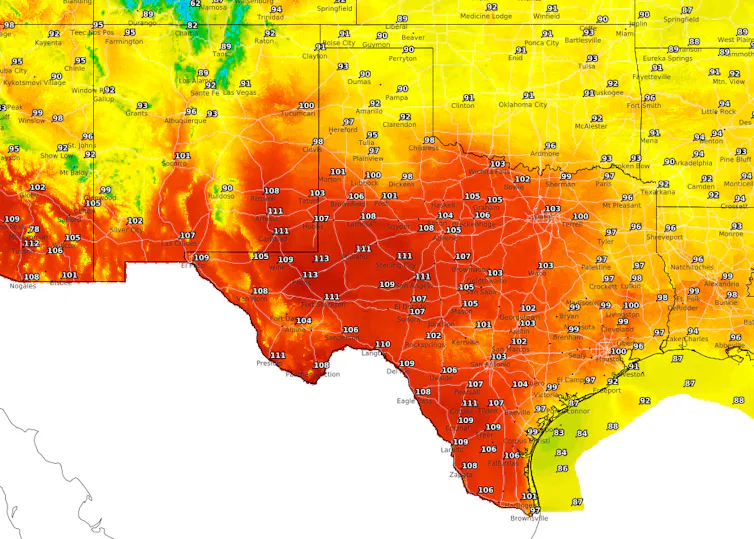
    A heat dome began sizzling Texas and its neighbors in mid-June 2023, with warm nights providing little relief. National Weather Service

    William Gallus, Iowa State University

    A heat dome occurs when a persistent region of high pressure traps heat over an area. The heat dome can stretch over several states and linger for days to weeks, leaving the people, crops and animals below to suffer through stagnant, hot air that can feel like an oven.

    Typically, heat domes are tied to the behavior of the jet stream, a band of fast winds high in the atmosphere that generally runs west to east.

    Normally, the jet stream has a wavelike pattern, meandering north and then south and then north again. When these meanders in the jet stream become bigger, they move slower and can become stationary. That’s when heat domes can occur.

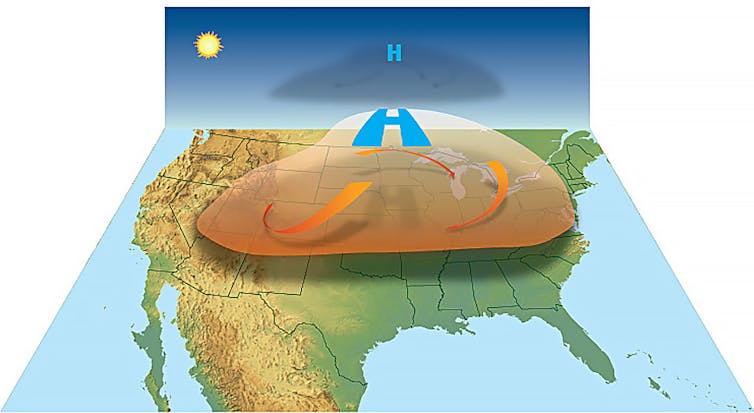
    Map of U.S. with a bubble over the Midwest showing arrows moving, with the ridge air sinking
    Heat domes involve high-pressure areas that trap and heat up the air below. NOAA

    When the jet stream swings far to the north, air piles up and sinks. The air warms as it sinks, and the sinking air also keeps skies clear since it lowers humidity. That allows the sun to create hotter and hotter conditions near the ground.

    If the air near the ground passes over mountains and descends, it can warm even more. This downslope warming played a large role in the extremely hot temperatures in the Pacific Northwest during a heat dome event in 2021, when Washington set a state record with 120 degrees Fahrenheit (49 Celsius), and temperatures reached 121 F in British Columbia in Canada, surpassing the previous Canadian record by 8 degrees F (4 C).

    The human impact

    Heat domes normally persist for several days in any one location, but they can last longer. They can also move, influencing neighboring areas over a week or two. The heat dome involved in the June 2023 heat wave in Texas and Mexico was forecast to expand deeper into the Southwest and South Central U.S.

    On rare occasions, the heat dome can be more persistent. That happened in the southern Plains in 1980, when as many as 10,000 people died during weeks of high summer heat. It also happened over much of the United States during the Dust Bowl years of the 1930s.

    A heat dome can have serious impacts on people, because the stagnant weather pattern that allows it to exist usually results in weak winds and an increase in humidity. Both factors make the heat feel worse – and become more dangerous – because the human body is not cooled as much by sweating.

    The heat index, a combination of heat and humidity, is often used to convey this danger by indicating what the temperature will feel like to most people. The high humidity also reduces the amount of cooling at night. Warm nights can leave people without air conditioners unable to cool off, which increases the risk of heat illnesses and deaths. With global warming, temperatures are already higher, too.

    One of the worst recent examples of the impacts from a heat dome with high temperatures and humidity in the U.S. occurred in the summer of 1995, when an estimated 739 people died in the Chicago area over five days.

    This article was updated June 26, 2023, with the heat dome in Texas.

    William Gallus, Professor of Atmospheric Science, Iowa State University

    This article is republished from The Conversation under a Creative Commons license. Read the original article.