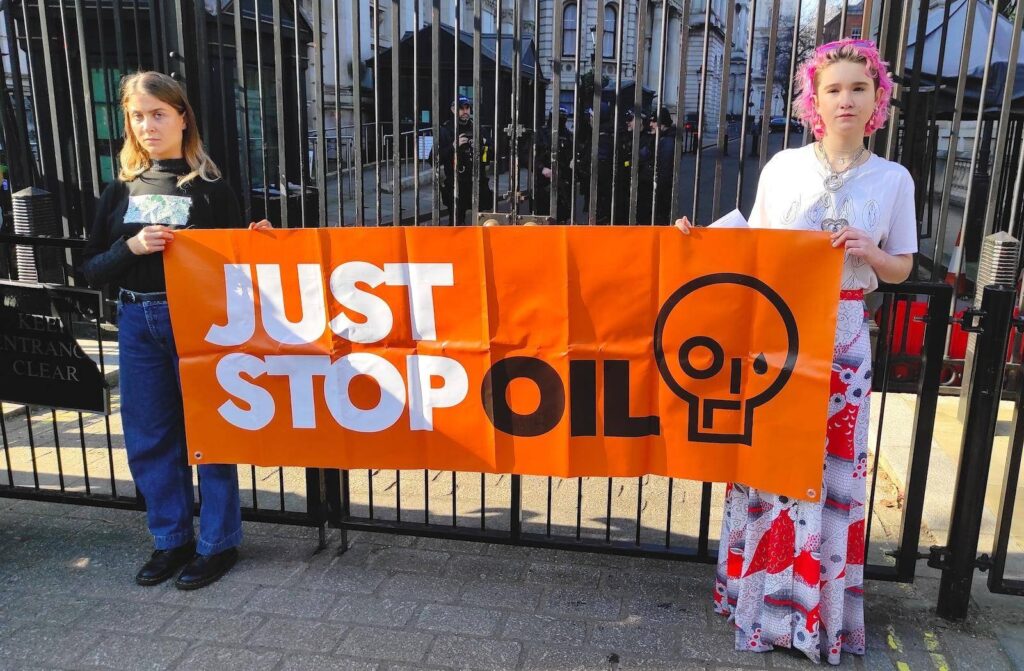
Two young supporters of Just Stop Oil, a one year old campaign demanding that the government stops granting licences for new fossil fuel projects, delivered an ultimatum letter to 10 Downing Street this morning.
Just Stop Oil youth campaigners deliver ultimatum to Rishi Sunak 14 February 2023. Image: Just Stop Oil
Hannah Hunt, 23, from Brighton announcing the delivery of the letter, made a brief speech to assembled reporters. She said:
“A year on from delivering Just Stop Oil’s Saint Valentine’s Day letter, along with hundreds of others, I face multiple trials and the loss of my freedom because we refused to stand by while our government planned the destruction of everything we love.
“We may not succeed, and we may yet bequeath a poisoned bleak inheritance – but I make this promise to those I love: for the government to win, it will have to defeat the youth of this country for we will put our bodies on the line.
“Now I am asking you to pick a side, to join me, to stand with those future generations and with all the ordinary people willing to sacrifice their freedom to protect our future. We must stop the harm that is new oil and gas.”
Phoebe Plummer, 21, from London read out the contents of the letter to the Prime Minister. It points out that according to the International Energy Agency in order to have an even chance of limiting the global temperature rise to 1.5°C in line with the Paris Agreement, there can be no new investments in fossil fuel supply projects. [3] She said:
“One year ago our letter stressed that the government, of which you were a part, knew that breaching 1.5˚C could be the death sentence for our children and for whole countries and regions of the world.
“Since then, we have been warned by the United Nations that not only will we hurtle over 1.5˚C but also that there is “no credible pathway to 1.5˚C in place”.
“Accelerating the granting of North Sea oil and gas licences … is to knowingly plan for the death of countless millions, for the loss of entire nation states. It is an act of genocide, for which you will be held accountable.”
She went on to deliver the following ultimatum:
“Just Stop Oil is demanding that: The UK government makes a statement that it will immediately halt all future licensing and consents for the exploration, development and production of fossil fuels in the UK.
“If you do not provide such assurance by 10th April 2023, we will be forced to escalate our campaign – to prevent the ultimate crime against our country, humanity and life on earth..”
OPINION: An activist is in jail for mentioning the climate crisis in court. Our judicial system is enabling the state
This week we were delivered the strongest evidence yet that the court cases of Insulate Britain members are little more than show trials – in which the defendant’s guilt has already been determined.
David Nixon, a fellow Insulate Britain supporter, was handed an eight-week sentence for merely mentioning the climate crisis during his trial for participating in a roadblock in 2021.
Judge Silas Reid had ordered Nixon to avoid talking about the climate and ecological emergency. He said, “This is not a trial about climate change, fuel poverty, etc. Matters relating to that are not relevant.”
Nixon disagreed, and used his closing speech to tell jurors: “We are on a highway to climate hell with our foot on the accelerator. That is why we sat in the road, to tell the truth about the direction we are heading in and prompt action before it’s too late.”
That this was enough to warrant his imprisonment is absurd – and raises serious questions about this country’s judicial system.
A life-changing experience
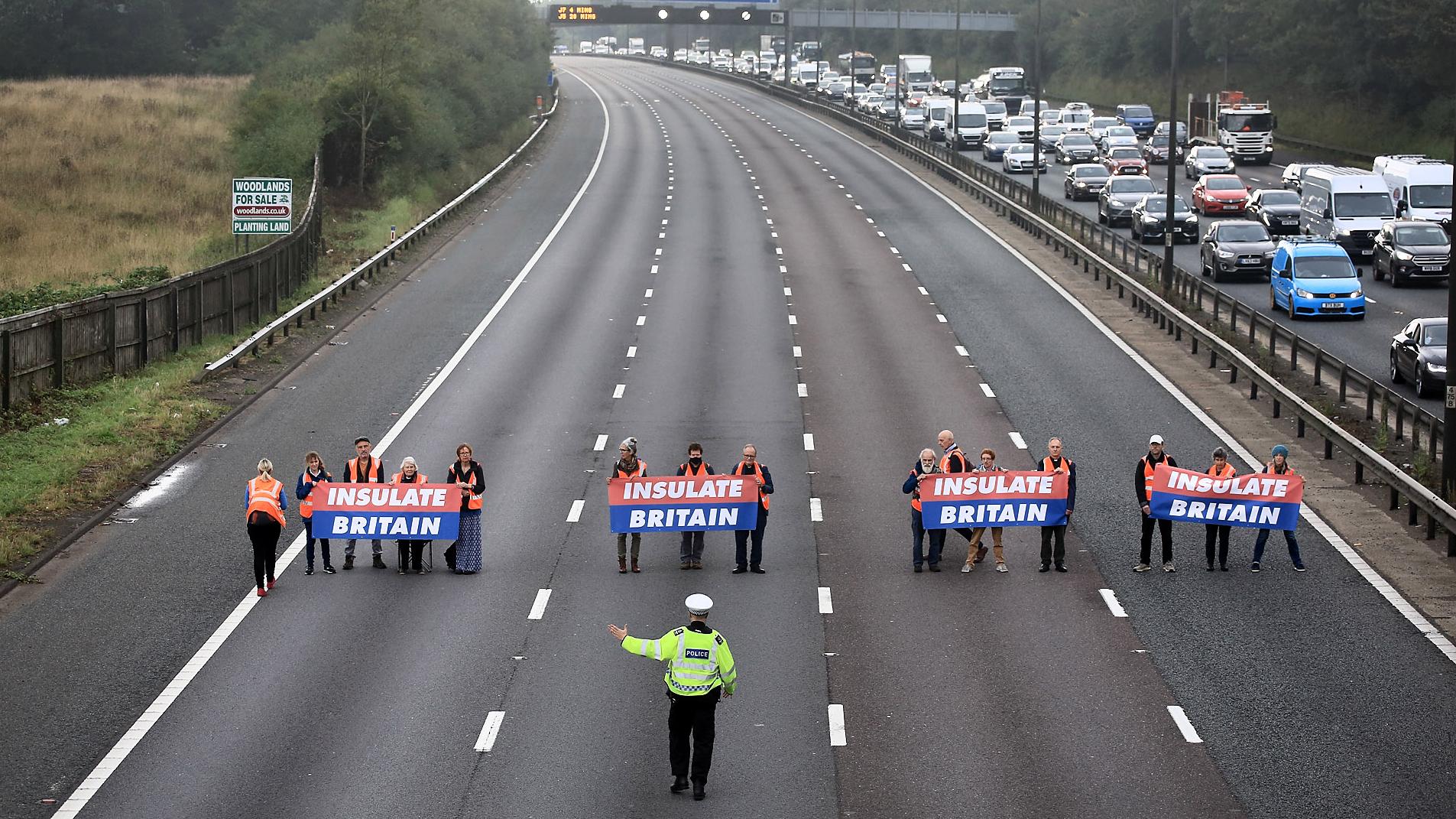
In October 2021, I also took action with Insulate Britain. We brought large sections of the M25 and other major roads to a standstill in order to raise awareness of fuel poverty and the climate and ecological emergency.
I now have three separate charges relating to these actions. I am due to stand trial in May, June and one last time in November. By then, two full years will have passed since I sat down in the road in defence of people and planet.
As a first time defendant, this has been a life-changing experience. I had never been in trouble with the law before 2019, and I acknowledge now that I have lived a relatively privileged life in that regard. As a white, middle-class man, I regret not recognising sooner the suffering of others less fortunate than me at the hands of the state.
My faith in the legal and judicial system of this country has been severely shaken. I have felt harassed and persecuted by the state as both my reputation and my livelihood have been unduly threatened. My name and address has been published online by the authorities, endangering not only myself but my family as well. Of course, my mental health has suffered.
Those who advocate for change now face even greater challenges than ever before as they risk prosecution under the draconian Police, Crime, Sentencing and Courts Act. As if that were not enough, the regime is now trying to push through its equally notorious Public Order Bill, which will give police officers even more power to crack down on protests.
If jurors can’t hear why a ‘crime’ was committed, are they there just to rubber-stamp the state’s decision?
Though neither bill had come into law at the time of my arrest, I could have reasonably expected a statutory charge of wilful obstruction under the Highways Act or an injunction under the Anti-social Behaviour Act. But neither was invoked against me.
Instead, the prosecution chose to break with legal tradition by pursuing the archaic common law offence of causing a public nuisance. This is worrying – if a charge is not defined in statute, there are no prosecution guidelines to follow.
The decision had abhorrent consequences. According to the judiciary, public nuisance is interested only in the consequences of an action, i.e. whether we supporters of Insulate Britain had caused a nuisance to the public. There is no consideration at all of the circumstances of the action, i.e. our motivations for doing what we did.
Insulate Britain supporters are not arguing that we did not cause any inconvenience or disruption to the public – that would be completely disingenuous. We are arguing that we did what we believed was necessary to sound the alarm on fuel poverty and the climate and ecological emergency. We hoped the UK government would heed our demands.
Let us be clear, it is not a lack of popular demand or technological solutions that keeps rich nations such as the UK from addressing the climate and ecological emergency. We could solve this problem if there was the political will to do so.
By denying the circumstances of our actions, I believe Judge Reid and his associates knew that we defendants would not be able to defend ourselves. We cannot minimise our actions (and neither would we want to) and yet we cannot explain ourselves either, without risking contempt of court. The scales of justice seem distinctly one-sided.
If the diverse range of legal and moral arguments in an (alleged) crime of conscience cannot be presented in front of a jury, one must ask what purpose a jury serves. Are jurors there simply to rubber stamp a guilty verdict that has already been decided since before the defendant’s arrest?
A lack of transparency
Last week another Insulate Britain supporter, Stephanie Aylett, narrowly avoided a custodial sentence after also being charged with contempt. Afterwards, she said: “It horrified me that Judge Reid deliberately stripped away all our legal defences and told us that we would be in contempt of court if we spoke about our motivations, strategy or aims.”
Aylett continued: “He prevented us from mentioning climate change or talking about any scientific evidence. It is incredibly difficult to explain the actions we took without being allowed to mention why we did such a bizarre thing.”
I am concerned about a lack of transparency over who had the authority to determine that we would be charged with public nuisance and what process, if any, was followed in reaching this decision.
The government appears to be investing more energy into silencing climate activists than implementing climate solutions
I have learned that many important decisions are made behind closed doors in secretive ‘case management hearings’ up and down the country. The existence of these hearings is not common knowledge, I am aware of them because I have been required to attend several over the past year. In my opinion they are wide open to abuse.
If there was any justice, I would not be facing charges. It would not have been necessary for me to sit down in the road to raise awareness of the climate and ecological emergency. The individuals who place profit before people and the planet would already be behind bars.
Instead, the current regime appears to be investing more energy into silencing climate activists than implementing climate solutions, such as decent home insulation that would benefit millions of ordinary people during the cost of living crisis.
This government does not represent the people, but rather the CEOs and shareholders of big business. They rule by fear, intimidation and coercion.
A few years ago, it would have been completely unheard of for a defendant to be handed a prison sentence for simply mentioning the climate crisis in a court of law. And yet here we are. As children we were warned to remain vigilant to the threat of fascism. It is time to heed those warnings.
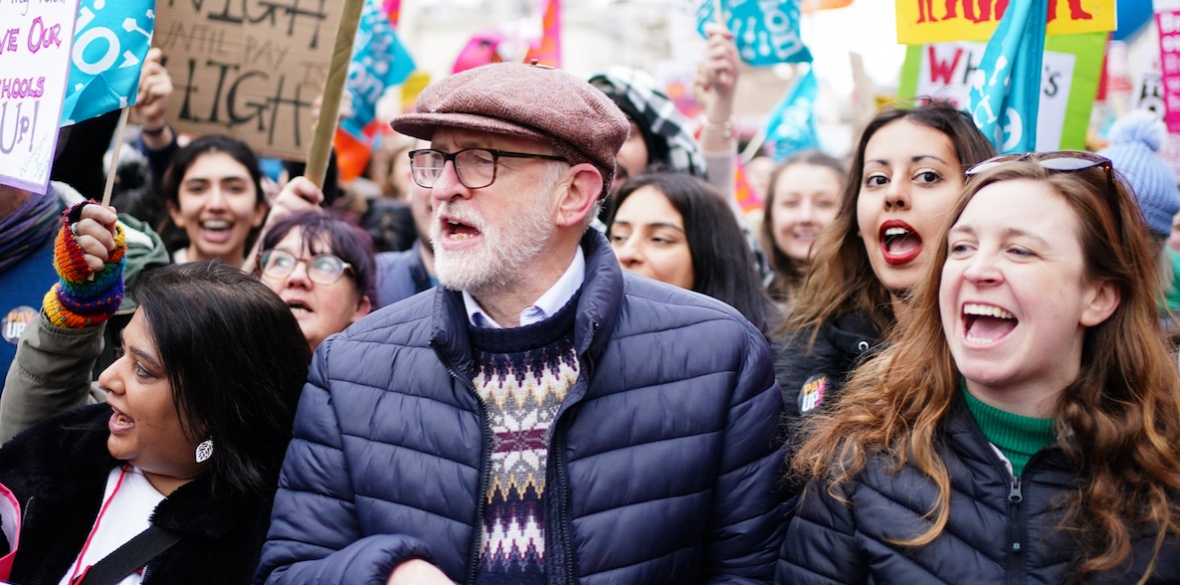
Former Labour party leader Jeremy Corbyn joins members of the National Education Union (NEU) on a march through Westminster where they are gathering for rally against the Government’s controversial plans for a new law on minimum service levels during strikes. Picture date: Wednesday February 1, 2023.
APACKED Conway Hall saw the British launch of The Big Lie, a film depicting the Establishment campaign to destroy Jeremy Corbyn, on Thursday night.
The Platform Films production directed by Chris Reeves covers the rise of the Corbyn movement, its 2017 high point when it won Labour’s largest vote share increase since 1945, and the forces which eventually brought it crashing down.
In a post-screening discussion with Mr Reeves and Platform Films’ Norman Thomas, Morning Star editor Ben Chacko said the film was an important exposé of the direction of the current Labour Party, and the character assassination of Corbyn was ongoing — being used to prevent him from standing for Labour in the constituency he has represented since 1983.
“The shift to a low-carbon economy is not just inevitable, it’s already happening. Yet the board is persisting with a transition strategy that is fundamentally flawed.”
A group of activist investors sued Shell’s board of directors on Wednesday for failing to “deliver the reduction in emissions that is needed to keep global climate goals within reach.”
ClientEarth, an environmental law charity and institutional investor in Shell, described the case as the first time a company board is facing a shareholder lawsuit for inadequately preparing to transition away from fossil fuels.
“Shell may be making record profits now due to the turmoil of the global energy market, but the writing is on the wall for fossil fuels long term,” Paul Benson, a senior lawyer at ClientEarth, said in a statement. “The shift to a low-carbon economy is not just inevitable, it’s already happening. Yet the board is persisting with a transition strategy that is fundamentally flawed, leaving the company seriously exposed to the risks that climate change poses to Shell’s future success—despite the board’s legal duty to manage those risks.”
The lawsuit, which is backed by large institutional investors that collectively hold 12 million shares of Shell, alleges that the oil giant’s 11 directors are violating the Companies Act, a U.K. law that requires corporate boards to “promote the success” of the business.
By failing to sufficiently manage climate risks and implement “an energy transition strategy that aligns with the Paris Agreement,” Shell is flouting its legal obligations, the lawsuit contends.
“Shell’s Board on the other hand maintains that its ‘Energy Transition Strategy’—including its plan to be a net-zero emissions business by 2050—is consistent with the 1.5°C temperature goal of the Paris Agreement,” ClientEarth notes. “It also claims that its plan to halve emissions from its global operations by 2030 is ‘industry-leading,’ however this covers less than 10% of its overall emissions.”
“It is in the best interests of the company, its employees, and its shareholders—as well as the planet—for Shell to reduce its emissions harder and faster than the board is currently planning.”
ClientEarth and its backers are asking the High Court of Justice in London to force Shell’s board to “adopt a strategy to manage climate risk in line with its duties under the Companies Act” and in compliance with a 2021 Dutch court ruling ordering the oil giant to cut its total carbon emissions by 45% by 2030.
“Long term, it is in the best interests of the company, its employees, and its shareholders—as well as the planet—for Shell to reduce its emissions harder and faster than the board is currently planning,” Benson said.
Jacqueline Amy Jackson, the head of responsible investment at London CIV—one of the institutional backers of ClientEarth’s lawsuit—said that “we do not believe the board has adopted a reasonable or effective strategy to manage the risks associated with climate change affecting Shell.”
“In our view,” Jackson added, “a board of directors of a high-emitting company has a fiduciary duty to manage climate risk, and in so doing, consider the impacts of its decisions on climate change, and to reduce its contribution to it.”
Shell said in response that ClientEarth’s suit “has no merit.”
ClientEarth filed its complaint a week after Shell announced that its profits doubled in 2022, surging to a record $40 billion as households across Europe and around the world struggled with high energy costs. The company said it returned $26 billion to shareholders last year through dividends and stock buybacks.
Earlier this month, the advocacy group Global Witness filed a complaint with the U.S. Securities and Exchange Commission accusing Shell of “lumping together some of its gas-related investments with its spending on renewables to inflate its overall investment in renewable sources of energy,” misleading investors and authorities.
“Shell’s so-called renewable and energy solutions category is pure fiction,” said Zorka Milin, a senior adviser at Global Witness. “The company is living in fantasy land if it thinks fossil gas has any place in the much-needed energy transition. Shell’s business model has always been, and continues to be, overwhelmingly based on climate-polluting fossil fuels.”
Shell is also facing lawsuits from nearly 14,000 Nigerians whose communities have been devastated by the company’s pollution and oil spills.