A “no-fly zone” is another oxymoron, a total contradiction in terms. It means that Colonel Gaddafi’s “brutal, savage and unacceptable treatment”, has been replaced by our “brutal, savage and unacceptable treatment”, using depleted uranium (i.e., nuclear waste) weapons and blowing Libyan people to bits in their uncounted numbers. (“It is not productive” to count coalition deaths as US Generals, led by General Mark Kimmit, have reiterated.)
The region and peoples will become another Fallujah, with the yet-to-be-conceived, even, born with deformities, often making them unrecognisable as human infants. Headless, limbless, organs on the outside of the body, one cyclops eye, no eyes, no brain — a reality witnessed by the writer over many years.
…
Libya has the ninth largest oil reserves on earth. As Iraq, and as the desire for the vital resources through Afghanistan, no one with half a brain believes your concern for humanity is the real reason. There were no calls from your Party, or the Conservatives, for “no fly zones” of any hue, or for restraint, in “Operation Cast Lead” (Christmas-New Year 2008-2009) as Israel bombarded the people of Gaza, caught, like “fish in a barrel”, to use a term about wanton slaughter, from another US General. That certainly looked like “brutal, savage and unacceptable” treatment, to most observers.
Last July, when you became acting Prime Minister when David Cameron was away, you said, in an exchange with Jack Straw, the previous Labour Foreign Secretary:
Perhaps one day you could account for your role in the most disastrous decision of all, which is the illegal invasion of Iraq.3
This is written on the eighth anniversary of the beginning of that illegal invasion. The invasion George W. Bush declared a “Crusade.” As you embark on the course of decimating another ancient Islamic land for oil – one with an even smaller population than Iraq – another “Crusade” to install another compliant puppet regime, I can only say shame on you all.
The Unions are promoting their anti-cuts March for an Alternative event next weekend. There will be a march topped with a rally at Hyde Park. There are rumours that Labour Party leader Ed Miliband will address the rally. It’s disappointing that the unions are still so subservient to the Labour Party after all these years.
Andrew Lansley and the Department of Health are accused of manipulating the presentation – spinning – of the proposed abolition of the NHS by supressing evidence that there is widespread satisfaction with the NHS.
The BMA have published an open letter after their special meeting called for the Destruction of the NHS bill to be withdrawn.
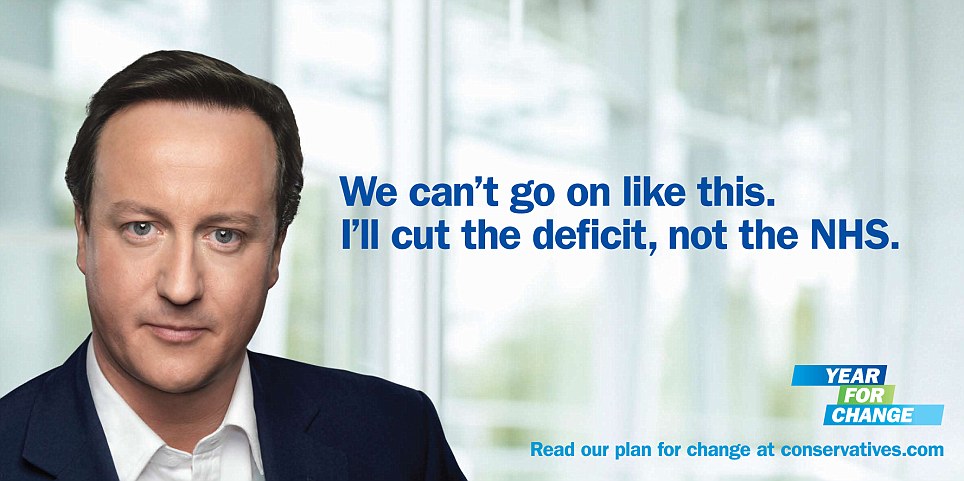
Conservative election poster 2010
A few recent news articles concerning the UK’s Conservative and Liberal-Democrat coalition government – the ConDem’s – brutal attack on the National Health Service.
Union leaders are to target Liberal Democrats in a campaign to slow down the speed and scale of public spending cuts as the TUC prepares for the biggest protest yet against the coalition’s economic programme.
Brendan Barber, the TUC’s general secretary, hopes to exploit unrest in Lib Dem ranks to step up pressure on a party leadership which he believes is increasingly isolated from its activists.
In an interview with The Independent on Sunday before next weekend’s anti-cuts rally in central London, Mr Barber attacked the Lib Dems for abandoning their pre-election pledge to delay cuts until the economy was growing. Stressing that the campaign will be a “long haul”, he vowed to step up the political pressure on ministers and coalition MPs to “realise quite how out of touch they are with the wider public”.
Andrew Lansley is preparing himself for another bad week at the Department of Health after two new crises hit his plans for NHS reform.
The health secretary was accused of “burying good news” after reports emerged that his department sat on reports showing unprecedented satisfaction with the health service.
Meanwhile, a Tory MP and doctor laid into the reforms in the Daily Telegraph, saying they could change the NHS “beyond recognition”.
The developments follow a tough week for the health secretary, whose reforms have been criticised by health experts, unions, Labour MPs and some Tory backbenchers.
The NHS risks being changed beyond recognition by the Coalition’s health reforms, a Conservative doctor claimed yesterday.
Sarah Wollaston, MP for Totnes and a practising GP, branded the reorganisation a ‘Trojan horse’.
In the most scathing attack yet on the plans of Conservative Health Secretary Andrew Lansley, she said that key elements of the shake-up – the biggest in the Health Service’s 60-year history – were ‘doomed to fail’.
I consider this posting to comply with copyright laws since
a. Only a small portion of the original article has been quoted satisfying the fair use criteria, and / or
b. This posting satisfies the requirements of a derivative work.
Please be assured that this blog is a non-commercial blog (weblog) which does not feature advertising and has not ever produced any income.
I find the second featured article interesting. The article recognises the importance that Lansley was formerly Cameron’s boss and suggests that Cameron was not interested or aware of the extent of Lansley’s ‘reforms’.
In a related exercise, I have been trying to nail down the origin of this movement to destroy the NHS. I suspect that it may be criticism of the National Health Service by American politicians in 2008 / 2009. These criticisms were made in response to Hillary Clinton’s manouvers concerning health care reform for the poor. Clinton’s proposals were only ever posturings – there was never any serious intentions.
It is disappointing that UK Neo-Cons suck up so much to their insane US masters. USUK.
Conservative election poster 2010
A few recent news articles concerning the UK’s Conservative and Liberal-Democrat coalition government – the ConDem’s – brutal attack on the National Health Service.
CAMPAIGNERS will today hand over a petition signed by more than 150,000 people to MP John Pugh opposing plans to radically reform the NHS.
Members of campaign group 38 Degrees will tell the Lib Dem health spokesman of the dangers of the proposed Health and Social Bill.
The proposed Coalition legislation will hand 80% of the NHS budget to consortia of GPs, who will buy services from providers in the public, private and charity sectors.
But there are fears that NHS hospitals will go bust if private firms grab large chunks of their revenue by cherry-picking the easiest treatments.
The great NHS storm that has beset politics was one that few saw coming. There were voices, and I hope a touch of self-congratulation on the part of the Guardian might be forgiven here, who warned before the election that Andrew Lansley was quietly drawing up plans that might explode the moment they met daylight. And so it has come to pass.
In part, of course, the calm before the storm arose because of what the Conservatives did not say. Lansley’s shock therapy was referred to in only the most oblique terms in the Tory manifesto, while the coalition agreement described an entirely different package, which involved democratising primary care trusts instead of abolishing them. In part, however, it has to do with the measured personal style of Lansley himself.
A former civil servant, who in the distant past worked for Norman Tebbit, he retains something of the mandarin’s technocratic manner. That is only reinforced by his extraordinary tenure over the health portfolio, which has been in his grasp since Iain Duncan Smith’s day, some seven years ago. Sure of his terrain, he avoided all the obvious elephant traps on the cusp of the 2010 election, and he made the shrewd choice to hug the doctors close, even querying Gordon Brown’s plans to extend GP opening hours, to ensure that the trusted voice of the profession would not rail against him in opposition.
…
The reaction against the health bill is rapidly moving from silent to violent, as the world wakes up to what it will mean. After those air-brushed election posters about “cutting the deficit, not the NHS” David Cameron’s personal reputation is very much at risk. Only when the memoirs are written will we discover whether he ever intended to allow the mild-mannered Lansley to gamble with a service that he once described as “a wonderful fact of British life”.
The founding principles of the NHS are in danger of being wiped out by Government plans to overhaul the health service, an MP has warned.
Oldham East and Saddleworth MP Debbie Abrahams said the health reforms had no mandate from the British people and no support from health professionals nor the Lib-Dems who are in coalition with the Tories.
Mrs Abrahams said: “Not only are the founding principles of the NHS in danger of being wiped out, but its culture — the reason that most of its employees work for the NHS — will go as well.
“The whole ethos of the NHS will change. It will now be driven by competition and consumer interests.”
Health union Unison warned today against the government’s vicious local authority spending cuts following evidence that the NHS will be forced to pick up the pieces of a £1 billion gap in social care funding.
Health think tank the King’s Fund revealed that the NHS will come under increasing pressure from people whose needs are not met by local authority services.
The fund warned that local authority social care services face a funding gap in excess of at least £1.2bn by 2014-15.
Paul Blomfield MP yesterday attacked the Tory/Lib Dem government’s plans to drastically restructure the NHS which he warned will create a two-tier health system, and encourage the privatisation of the NHS. Mr Blomfield urged the Government to abandon their NHS plans and listen to the British Medical Association who at an emergency conference on Tuesday urged the Government to think again.
Paul Blomfield MP said in his speech that: “The proposals reveal the ideological heart of the Government and their vision for public services: a two-tier health system, with the best available for those who can afford it, and the NHS becoming a safety net for those who cannot.”
Speaking after the debate Paul said: “I’m very disappointed that Lib Dem MPs failed to support Labour in defending the NHS from the Tory attack on it. The Lib Dem MPs have ignored the vote at their conference in Sheffield last weekend which rejected the NHS reforms and they’ve let down their voters.
Earlier this week Labour launched a petition calling on David Cameron to protect frontline services in the NHS and keep his pre-General Election promise to put an end to big top down reorganisations. Labour secured an opposition day debate on Tory plans to reorganise the NHS after the plans were rejected by the Liberal Democrats at their Spring Conference and condemned by the British Medical Association at their extraordinary general meeting last week.
John Denham, Labour MP for Southampton Itchen, said: “GPs don’t want the Tories’ NHS reforms, Lib Dems don’t want the Tories and the public don’t want the Tories’ NHS reforms. We beat the Government on the forests and I know we can beat them on the NHS reforms if we all work together.”
John Healey, Shadow Health Secretary, added: “David Cameron has scrapped Labour’s waiting time guarantees for hospital treatments and GP appointments, and he’s cutting frontline staff while wasting £2billion on a reckless reorganisation.
The guide to the “unprecedented” restructuring of the health service in England points out that previous reforms had a “negative effect” on services, staff morale and productivity.
It claims that “quality of care provided to patients” and “continuity of services” is in danger as tiers of management are removed and experience staff leave.
And the paper, signed by senior civil servants including the Chief Executive of the NHS, reminds staff that the Government’s reforms are taking place at the same time as £20billion in efficiency savings must be made.
The threatened NHS has been much in all our minds this week, and, pestered by online petitions and appeals for support, I’ve been going over my long relationship with it. Our experiences of the NHS are woven deeply into the fabric of our lives, and most of mine have been good. All my children were born and cared for on the NHS, and have been well served by it. And for those nearing the end of life, my GP used to bake and ice a cake for each of his patients who reached the age of 100.
It has been a recurrent theme in my fiction, as it has been an integral part of my life. The narrator of The Millstone (1966), a young unmarried mother, in a central confrontational scene, actually delivers herself of the line “I love the National Health Service”, while insisting on access to her sick baby in Great Ormond Street hospital. How things have changed since then, and sometimes for the better. When I went to visit my granddaughter a few years ago, as she recovered from minor surgery, the atmosphere was festive. Our generation of mothers had complained, we had made ourselves heard, and life on the wards had improved. That’s how it worked, and should work. It is for us, it is ours, and the professionals do listen.
And now we seem to be on the brink of losing all of this. It isn’t wholly unexpected. I predicted creeping privatisation in my 1996 satirical condition-of-England novel, The Witch of Exmoor, written at the somewhat ridiculous and squalid end of the failing Major government. We had already become wary about the selling off of public assets and services into private hands – gas, water, prisons, railways. One of the novel’s more sympathetic characters, an advertising man, works for a firm which is given the task of updating “the corporate image of the National Health Service”.
A few recent news articles concerning the UK’s Conservative and Liberal-Democrat coalition government – the ConDem’s – brutal attack on the National Health Service.
Research involving 1,645 BMA members polled about the government’s health and social care bill has found that 89% think increased competition will lead to fragmentation of services, while 66% believe that the move for all NHS acute providers to reside within foundation trusts will damage NHS values.
The poll, conducted online in January by Ipsos Mori, also shows that nearly 60% of those surveyed think health secretary Andrew Lansley’s plans will have a negative impact on their personal role within the NHS, with 31% saying it will be a major one and 27% saying it will be minor. A specific concern, feared by a majority of those polled, is that the reforms will mean they spend less time with patients – something opposed by almost all those questioned.
Dr Hamish Meldrum, chairman of council at the BMA, said that the results show that the government “can no longer claim widespread support among doctors”.
In just six days, the petition to tell the government to Save The NHS has been signed by an incredible 175,000 members. We’ve only just finished voting on which campaigns to work on together over the next few weeks, and now we’ve already managed to build 38 Degrees’ fastest-ever growing petition!
While the petition is growing fast, 52,000 of us have shared it on Facebook, thousands more spread the petition on Twitter, hundreds of members organised local meetings and have spoken to their local MP, and the petition has only just been launched!
The media have noticed too. On Monday the Independent said, ”The campaign group 38 Degrees – which was instrumental in forcing the Government to drop its plans to sell off parts of Britain’s forests – collected more than 80,000 signatures against the plans over the weekend.”
If you haven’t already, please sign the petition and share with your friends and family.
The “creeping privatisation” of the NHS will affect patient care, top doctors have warned, saying the government’s planned shakeup risks hospitals losing key services, critical research being jeopardised and public goodwill for blood donations disappearing as private firms are seen to profit from public funds.
Medical leaders fear the controversial switch to allow “any willing provider” – voluntary, public or private – to supply care services in the NHS will fragment the system. Driven by the need to save £20bn from NHS budgets, the health secretary, Andrew Lansley, plans to increase commercialisation and competition across the health service – with no part off limits.
Already, large elements of the health service are falling into private hands. Last September, Serco, the multinational services company with an empire stretching from railways to maintaining ballistic missiles, became the UK’s largest provider of pathology services, a market worth £2.5bn, with the takeover of King’s hospital laboratories in London.
The government’s plans to outsource more NHS services have left many in the public sector with a bitter taste in their mouth and the private sector positively drooling. In the coming years, an array of health services is likely to be outsourced despite little evidence that it would improve efficiency and make savings. This will see a push to further privatise clinical services such as radiology and pathology – the latter worth £2.5bn per year. The government has recently been in talks about privatising part of the NHS blood service to make it more “commercially effective”.
Even NHS Direct is in the firing line with Capita – a company reported to the Office of Fair Trading two years ago for allegedly overcharging schools by £75m for IT contracts – lined up to manage the contract, according to reports. Major off-shoring is also on the agenda. John Neilson, head of NHS Shared Business Services, said recently that the NHS should outsource the administration of procurement to call centres in India to save £20bn over the next four years. For private companies eyeing a slice of the NHS pie, it gets better: NHS Trusts may ultimately come under private ownership with many of the services they manage also outsourced.
Areas such as estates management, worth about £7bn per year, and back-office functions such as HR and IT are also prime targets to be transferred to private owners.
West Cornwall MP Andrew George is calling for cross-party support in an effort to block the Government’s Health and Social Care Bill.
Speaking during an initial debate on the bill in Parliament, Mr George said that the future of the NHS is more important than party political point scoring. He called for MPs to come together and to see if the Health Secretary and his fellow Ministers were really “listening” to concerns as they had claimed they were.
After the debate, Mr George said that he would be seeking a meeting of MPs and other stakeholders (including the BMA, Kings Fund, Royal Colleges, etc) before the Bill comes back to the main chamber of the House of Commons for its report stage after the Easter recess.
Simon Burns, the ebullient health minister and understudy to Andrew Lansley, has been sporting a new haircut this week in preparation for being made a privy counsellor. But his promotion as a confidant of the Queen hardly compensates for the terrible pounding he and Lansley, not to mention the Liberal Democrat health minister Paul Burstow, have been taking over the NHS proposals. One suspects the Queen might be quietly asking him what he thinks he is doing meddling with the health service.
Ministers certainly feel they are being hit from every side after they formally lost the support of the Lib Dems on Saturday, the British Medical Association on Tuesday and the former Blairite health secretary Alan Milburn on Wednesday.
For David Cameron it is now double or quits. He has a limited amount of political capital. Should he expend it on defending the plans as they stand or signal some big rethink? Half-measures are pointless. He has shown himself willing to compromise on school sport, forests and some welfare changes. But to delay the health shakeup, or change it at its core, would be a retreat of an entirely different order.
Monitor, the taxpayer-funded body that regulates the health service, will have to spend millions more to keep the Health Secretary’s free-for-all in check.
The Government quango could see its budget jump from £20million a year to £130million to cope with the changes, it has emerged.
It makes a mockery of David Cameron’s claim that the Coalition plans, which hand 80% of the NHS budget for doctors to spend how they want, will “abolish” bureaucracy in the health service.
Ed Miliband, leader of the UK Labour Party performs well yesterday against Prime Minister David Cameron at Prime Minister’s Question Time on the destruction of the NHS issue.
David Cameron accuses Ed Miliband of publishing (reading actually) a union press release. There’s a strange ring about that. The BMA is hardly a union – more of a professional body.
Conservative election poster 2010
A few recent news articles concerning the UK’s Conservative and Liberal-Democrat coalition government – the ConDem’s – brutal attack on the National Health Service.
UPDATED Missed many news links in the original posting
Just as yesterday the British Medical Society urged Andrew Lansley to scrap ‘top-down reforms’ of the NHS, today we see the government’s champions hit the airwaves.
Radio 2’s Jeremy Vine show this lunchtime featured two such champions, one introduced as a GP, the other a ‘health expert’. The former, Dr Paul Charlson, is indeed a GP in favour of Lansley’s reforms. He also runs a private centre which specialises in cosmetic anti aging treatments (Botox), not typical of most GPs.
Charlson is also spokesperson for a lobby group called Doctors for Reform, which is supported by the free-market think tank, Reform. Funding for Reform has come from the UK’s largest private hospital group, General Healthcare Group and other private health companies set to benefit from Lansley’s reforms.
Vine’s ‘health expert’ was Dr Helen Evans, director of Nurses for Reform. Its funding is more opaque, but it does have ties to many free-market think tanks that favour privatisation. These include the Adam Smith Institute and the Centre for Policy Studies, a think tank that promotes “the opening up [of] state monopolies” in health.
Evans has labelled the NHS “a Stalinist, nationalised abhorrence”.
As the criticism of the NHS reforms gets louder, expect to hear more from these two.
‘privatisation’ bill hangs in the balance, as opposition continues to mount, Unite, the largest union in the country, said today (Wednesday 16 March).
Unite, which has 100,000 members in the health sector, said that the country faced the biggest battle to save the NHS in its present form since its inception in 1948.
Unite said that health secretary Andrew Lansley and his ministers needed to radically rethink the bill to guarantee that the NHS is the preferred provider of choice – not private healthcare firms, some of which have bankrolled the Conservative party.
Unite general secretary Len McCluskey said: ”The government is on the back foot over its Health and Social Care bill, following the opposition voiced by the British Medical Association yesterday and the Liberal Democrats at last weekend’s spring conference.
GPs could more than double their income to £300,000 a year under health secretary Andrew Lansley’s plans for the NHS, according to an analysis for the Guardian – sparking calls from top doctors for the government to reverse controversial policies that would appear to reward physicians who ration care.
The revelation comes after the British Medical Association voted to scrap the “dangerous” health bill and demanded that Lansley rethink his radical pro-market changes to the NHS.
GPs are central to the government’s programme, and by 2013 will have to band together into consortiums before being handed £80bn of NHS funds to commission care for their patients.
It is a serious matter that the British Medical Association has called an emergency meeting – the first of its kind for nearly 20 years – to warn the Government to think again about the pace and scale of its reforms to the National Health Service. The aims of those reforms might be laudable. The Health Secretary, Andrew Lansley, says he wants to set the NHS free from political interference and make it more responsive to patients. And he is right to say that with an ageing population making increasing demands on services, and the cost of drugs and new treatments rising, change is needed.
But he has set in train the biggest reorganisation in the 62-year history of the NHS – at a time when it is being asked to save £20bn from its £100bn budget. And he has done so despite a Tory pledge before the election that there would be no major overhaul of the health service. Doctors’ leaders have rightly complained that the detail on the massive changes were not available at all until the Bill was published two months ago. Mr Lansley’s reforms have been premised on ideological conviction rather than pragmatism; pilot projects should have been trialled first rather than in parallel with the passage of a Bill which is already well on its way through Parliament. No wonder Liberal Democrat delegates rejected the plans at the party’s spring conference last weekend.
Why is the government planning a big shakeup of the NHS in England?
The health secretary, Andrew Lansley, says that while the NHS is world-class in some respects, and employs leading medical figures, it is still not good enough in some key areas of care. “For example, rates of mortality amenable to healthcare, rates of mortality for some respiratory diseases and some cancers, and some measures of stroke, have been among the worst in the developed world. International evidence also shows the NHS has much further to go on managing care more effectively,” says the Department of Health. Doctors have cast doubt on the evidence underpinning some of Lansley’s claims about the quality of NHS care, and critics argue that his “modernisation” changes will usher in widespread privatisation of NHS services.
What is the government proposing?
Arguably the most radical restructuring of the NHS since it was created in 1948. England’s 150 or so primary care trusts will be wound up in 2013 and their work, commissioning healthcare, will pass to groups of GPs called general practice commissioning consortiums (GPCCs). Each GPCC, perhaps including scores of existing practices, will have its own budget. The consortiums will have £80bn of NHS funds in all, and agree contracts with hospitals and others. Almost 200 GPCCs have already been set up.
At Prime Minister’s Questions today, David Cameron complained of “roadblocks” to reform of the NHS, but at first did not refer directly to the British Medical Association; the doctors’ representative body, who called yesterday for the NHS bill to be dumped.
Then, in his answer to Ed Miliband’s final question, he said:
“He should remember the fact that the BMA opposed foundation hospitals, they opposed GP fundholding, they opposed longer opening hours for GPs’ surgeries.
“Isn’t it typical, just as he has to back every other trade union, just as he has no ideas of his own, he comes here and just reads a BMA press release.”
Rarely has David Cameron appeared as rattled as he did at today’s PMQs. Ed Miliband’s decision to lead on the coalition’s troubled NHS reforms proved fortuitous as the Prime Minister struggled to offer a coherent defence of his Health Bill.
Asked if he was planning any further amendments, Cameron prattled on about “cutting bureaucracy” and disingenuously claimed that the coalition would prevent “cherry-picking” by the private sector. As is frequently the case, his disregard for detail let him down. Asked if it was true that the NHS would be subject to EU competition law for the first time in its history, the PM appeared either unwilling or unable to answer Miliband’s question.
Instead, for the third time in recent months, he selectively quoted from a speech by John Healey in which the shadow health secretary declared that “no one in the House of Commons knows more about the NHS than Andrew Lansley . . . these plans are consistent, coherent and comprehensive. I would expect nothing less from Andrew Lansley.”
What Cameron failed to acknowledge is that Healey went on to argue:
They [the Conservatives] believe that competition drives innovation, that price competition brings better value, that profit motivates performance, and that the private sector is better than the public sector. I acknowledge the ambition but I condemn this as the core philosophy being forced into the heart of the NHS. It’s wrong for patients. It’s wrong for our NHS. It’s wrong for Britain.
Labour has accused the government of “arrogance” for pushing ahead with NHS reforms despite recent criticism from the British Medical Association (BMA) and the Liberal Democrat spring conference.
At prime minister’s questions on 16 March 2011, opposition leader Ed Miliband asked whether the PM would amend the plans in response to the demands of Lib Dem delegates calling for a halt to the “damaging and unjustified” shake-up of GP services in England.
Meanwhile the BMA described measures that would increase competition in the NHS as “dangerous and risky”.
Mr Miliband accused Prime Minister David Cameron of “ignoring people who know something about the health service” and creating “a free-market free-for-all”.
Hospitals will shut, others will lose their accident and emergency or maternity units, and some will be downgraded to glorified health centres because of the government’s NHS shakeup, the head of England’s leading hospitals has warned.
Sue Slipman, chief executive of the Foundation Trust Network, told the Guardian that handing GPs control of £80bn of NHS funds, letting private healthcare firms provide treatment and giving patients more choice about where they are treated – key policies promoted by the health secretary, Andrew Lansley – would increase existing pressures on hospitals so much that some will not survive.
“There will be some ‘shut’ signs; I suspect there will be some closures. There will be fewer A&E departments and in urban centres there may well be fewer maternity units,” said Slipman, who predicted unprecedented changes to hospitals over the next few years.
Hospitals will shut, others will lose their accident and emergency or maternity units, and some will be downgraded to glorified health centres because of the government’s NHS shakeup, the head of England’s leading hospitals has warned.
Sue Slipman, chief executive of the Foundation Trust Network, told the Guardian that handing GPs control of £80bn of NHS funds, letting private healthcare firms provide treatment and giving patients more choice about where they are treated – key policies promoted by the health secretary, Andrew Lansley – would increase existing pressures on hospitals so much that some will not survive.
“There will be some ‘shut’ signs; I suspect there will be some closures. There will be fewer A&E departments and in urban centres there may well be fewer maternity units,” said Slipman, who predicted unprecedented changes to hospitals over the next few years.
The general election battle was in full swing last April in the marginal seat of Bury North when shadow health secretary Andrew Lansley paid a visit to help the Conservative candidate, David Nuttall. Understandably he offered his opinions on a huge local issue: the plan to close the children’s department, including a maternity unit and special care baby unit for ill newborns, at Fairfield general hospital, the town’s much-loved hospital.
As Nuttall’s blog entry for that day records: “Andrew Lansley has reviewed the latest figures for the number of births across Greater Manchester and today said: ‘If I am secretary of state for health after the election, maternity and children’s services will be maintained at Fairfield and I will ensure this happens. In the long term there will be no change without the consent of GPs … who will in our reforms be responsible for commissioning local services’.”
Under the headline “Conservatives will maintain children’s services at Fairfield”, Nuttall added: “The choice for voters in Bury North is clear: vote Labour and these services will be axed from Fairfield. Vote Conservative and if there is a Conservative government the maternity department will be kept open.”
Social care is facing a funding gap of more than £1bn by 2014 in England – a situation which would have consequences for the NHS, a leading think-tank says.
The King’s Fund analysis predicted councils would struggle to protect home help and care home places as they come to terms with funding cuts.
The report said if this happened there could be more admissions to hospital and longer delays in discharging.
But the government said it did not believe there would be a funding gap.
Too many hospitals in the wrong places. As towns become cities and population shifts and ages, ministers must reconfigure hospitals and consider closing wards and departments; Labour began doing so.
Why is all this now a problem for Andrew Lansley?
Once Tory leader, David Cameron promised a “bare-knuckle fight” over ward closures. In the election, both sides made extraordinary promises. In a tour of northern constituencies, Lansley pledged to reopen closed hospital wards and A&E departments.
What happened once Lansley took office?
Lansley announced in May 2010 an end to “top-down forced closures”. Instead, health trusts would have to pass several tests to make a closure: support from GP commissioners, better public and patient engagement, and clear clinical evidence to justify the change. But of three dozen closure proposals, only one, Chase Farm in north London, has seen him intervene, merely to delay the decision a month. Lansley has not reopened any services closed under Labour.
I consider this posting to comply with copyright laws since
a. Only a small portion of the original article has been quoted satisfying the fair use criteria, and / or
b. This posting satisfies the requirements of a derivative work.
Please be assured that this blog is a non-commercial blog (weblog) which does not feature advertising and has not ever produced any income.
 Portion of a letter to Nick Clegg from Felicity Arbuthnot