NHS news review

Spread the love

I apologise that NHS news review is so late today – I’ve got serious debilitating toothache.

NHS news is mostly concerned with yesterday’s emergency debate on the health bill in the House of Commons forced by the Labour Party. There is also mention of the Royal College of General Practitioners (RCGP) opposition to the bill and I’ve found rather an amusing one by HealthInvestor about the expected benefits to private interests: “The NHS reforms will lead to “short-term pain” but huge long-term opportunities for independent healthcare providers …”. Yet still the lying shits will claim that it’s not about privatisation …

I’ve been wondering whether the Liberal-Democrats should dump Nick Clegg. He tried to distance himself from the Tories yesterday but it’s bullshit. He was a Tory at University, he worked for Tory slug Leon Brittan and he’s incredibly chummy with many Tories. I don’t see why he should change his ways and start putting his own party’s interests over that of the Tories.

I’m also fairly surprised that the Tories are trying to destroy the NHS. Isn’t it political suicide for them? Won’t they be shunned for decades until those who remember the NHS have stopped voting having died?
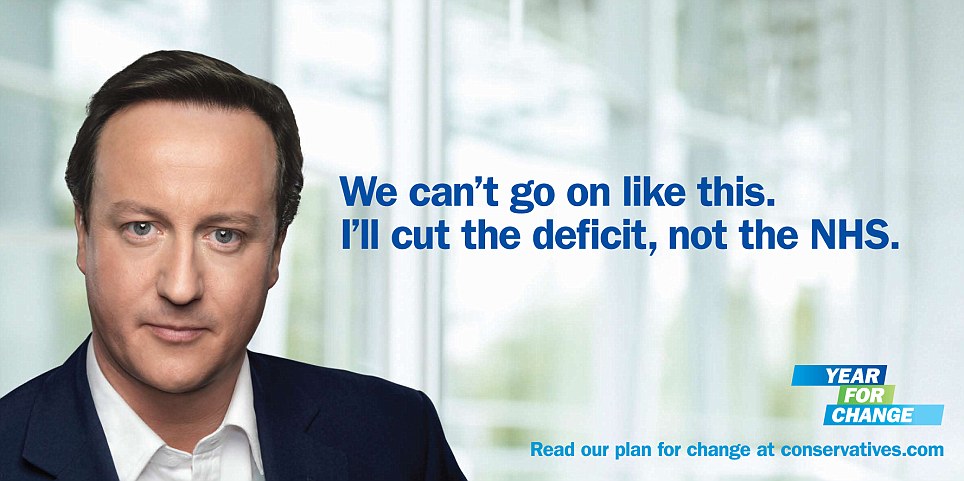
Conservative election poster 2010

A few recent news articles concerning the UK’s Conservative and Liberal-Democrat coalition government – the ConDem’s – brutal attack on the National Health Service.

Health reform ‘could destroy the NHS’, doctors warn – politics.co.uk

The government has defeated Labour following an opposition debate on NHS reforms, amid signs of deep division between the Liberal Democrats and the Conservatives.

The development comes as doctors warned David Cameron that the reforms could destroy the NHS.

MPs voted by a majority of 53 to defeat the Labour motion, following a bad-tempered debate in the Commons.

After a day which saw countless Tory and Lib Dem MPs attack each other on the airwaves and online, shadow health secretary John Healey told MPs: “The NHS has become [David Cameron’s] biggest broken promise.

“Many of the signs point to the prime minister’s pause to listen being a sham.

“We say [the bill] must be shelved in its current form. This is the test of the prime minister’s promise to protect the NHS.”

Health secretary Andrew Lansley commented: “I have been clear that there will be substantive changes to the bill if they deliver improvements for patients.”

[An obvious improvement for patients would be for the Secretary of State for Health to provide a national health service. The bill is getting rid of that requirement.]

Pharmaceutical Field – RCGP paper finds serious Bill concerns

The Royal College of General Practitioners (RCGP) has outlined changes to the Health and Social Care Bill that must be made to protect the principles of the NHS.

An RCGP analysis paper refutes the need for mass changes to the health service and calls on the Government to exercise necessary change or clarification on nine areas of serious concern.

RCGP Chair Dr Clare Gerada (pictured) has written to Prime Minister David Cameron listing the advised amendments to the Bill and hopes the Government “will act upon” the issues.

The Government’s Health Reforms: An Analysis of the Need for Clarification and Change (pdf) also included 24 recommendations, and insisted the Bill should clarify that the Secretary of State has a duty to provide a comprehensive health service.

Pressure piles on the Tories over NHS reform » Hospital Dr

The intensity of the campaign against the government’s Health Bill has increased following the Lib Dem leader’s adoption of a tougher stance in the wake of the local government elections.

In a Commons debate briefing, the BMA calls for Monitor, the foundation trust regulator, to protect and promote quality not competition.

It’s a message also sent by the Royal College of GPs to the Prime Minister in a letter this week. The RCGP calls on the government to allow Monitor, the National Commissioning Board and GP consortia to enable integrated services ‘without fear of a competition referral’.

RCGP chair Dr Clare Gerada also urged the government to revise its plans for abolishing practice boundaries, which she said will “undermine the relationship between a local GP and local patients”.

The BMA calls for commissioning decisions to be driven by clinical need, quality, sustainability and local priorities, as well as best value.

NHS reforms meet serious opposition from all sides / Britain / Home – Morning Star

Kill the Bill, not the NHS – that was the resounding message from unions, politicians and campaigners today as proposals to tweak the coalition’s health reforms were being debated in Parliament.

The Royal College of GPs had earlier warned the government that it must rewrite the parts of its Health and Social Care Bill that supposedly encourage greater competition.

And College chairwoman Dr Clare Gerada warned that the key element of the NHS reforms removes Health Secretary Andrew Lansley’s duty to provide a comprehensive healthcare system across England.

She argued that if this duty is scrapped the door will be open for NHS patients to be charged for parts of their services.

NHS reforms row hits the Commons – Channel 4 News

A day after the Deputy Prime Minister Nick Clegg undermined the reforms by claiming for the first time that the Health and Social Care Bill was deeply flawed, Labour said there now needed to be radical changes to the proposed reforms.

Opening a Commons debate, John Healey, the Shadow Health Secretary, quoted the Liberal Democrats’ description of the NHS reforms from their Spring Conference, saying the reforms were based on a “damaging and unjustified market-based approach”.

Mr Healey said that he agreed with Mr Clegg that “no bill is better than a bad one”. But Mr Healey said this was a bad bill and that a pause was no longer enough.

The Health Secretary, Andrew Lansley, rejected the calls, claiming once again that the plans for the NHS were an “evolution of the better policies of the past 20 years”. He said that fears over privatisation were misplaced. Mr Lansley said that it “was not his intention and had never been his intention to see the NHS fragmented and privatised”.

Andrew Lansley: GPs won’t need private help | Metro.co.uk

Health secretary Andrew Lansley has sought to allay fears about increased privatisation of the NHS as MPs debated the government’s controversial health reforms.

He insisted groups of GPs would not be required to turn to the private sector once they were handed control of much of the NHS budget to commission services from April 2013.

[This is just crap. GPs will clearly not be able to conduct their duties as GPs without delegating commissioning duties. GPs are private. It is still teh private sector even if they directly employ people to do commissioning. Lansley is saying that GPs will not be required to turn to the private sector but they will, they will not want that responsibility.]

Health Bill could ”unravel” NHS, say GPs – Public Service

The Health and Social Care Bill could end up “unravelling and dismantling” the NHS if it isn’t altered, according to the Royal College of General Practitioners (RCGP).

As part of the consultation while the Bill is put on ice, the college wrote to the Prime Minister David Cameron to tell him that the Bill needed to be overhauled. The college insisted that the NHS could cease to be a national service, the postcode lottery problem will get worse and companies outside the UK – including venture capitalists –will be able to take over hospitals and GP surgeries.

If there was more competition instilled into the NHS the service could disintegrate, costs could rise, and patient care could suffer, the RCGP warned. Also, GPs and hospitals could start charging patients for various services and some practices could collapse if patients are able to choose to see a GP outside the area where they live. This could mean surgeries in built up areas overwhelmed while those in rural areas might not be viable.

NHS reforms could leave cancer patients with worse care, say charities | Society | The Guardian

Cancer patients could receive poorer care as a result of the government’s plans to shake up the NHS in England, leading cancer charities are warning.

Andrew Lansley’s plans to stop funding England’s regional cancer networks next year will deprive GPs of a vital source of advice about where to send patients for treatment, according to the Cancer Campaigning Group (CCG), which represents more than 40 charities working on the disease.

They have told Lansley, the health secretary, that patients could suffer if the networks are disbanded a year before the planned new GP consortiums start work in 2013. They want funding extended until 2014.

The networks are groups of cancer specialists who help hospitals improve their cancer services and guide GPs about where their cancer patients should go to get the best quality care.

Public uses DoH website to savage NHS reforms | GP online

An overwhelming majority of comments left on the section of the DoH website dedicated to the NHS reform listening exercise are critical of the government’s plans.

Around 50 comments have been posted on the webpage for the NHS Future Forum, the group led by former RCGP chairman Professor Steve Field that is leading DoH efforts to engage with patients.

Many of the comments raised concerns relating to the introduction of competition, the lack of detail about the reforms in the government’s election manifesto and the evidence base for the reforms.

One comment said the proposed reforms were a ‘recipe for disaster’. It said: ‘Competition has never worked for the NHS and will not do so. What patients want is good quality local services, not services miles away from home.’

Another claimed that there was ‘no evidence’ that increasing choice was the most efficient way to improve quality. ‘Increasing choice decreases efficient delivery and effective use of funds,’ the respondent said.

Other comments referred to GP commissioning, with some concerned about the size of some consortia.


Oldham News | News Headlines | Meacher’s plea to scrap NHS reform – Chronicle Online

THE Government has the chance to scrap its health reforms and protect the much-loved NHS from privatisation.

Oldham West and Royton MP Michael Meacher made the plea as David Cameron came under renewed pressure to act following public calls from Lib-Dems to abandon the plans.

Health professionals have expressed great concern over Andrew Lansley’s proposed reforms of the NHS. The Health and Social care Bill will hand powers to GP to commission services in their area once the primary care trusts have been abolished.

Critics fear it will lead to privatisation of the NHS by the backdoor.

Mr Meacher said: “The NHS is a lifeline and that is why everyone loves it.

It is essential to the wellbeing and survival of everyone and it is the greatest pride of the last century. I have written to David Cameron about the 1,000 job losses at Pennine Acute and how he can stand by and say there will be no impact on front-line services. I am all in favour of cutting waste and value for money but he is making significant cuts to health service spending in real terms and it is completely unacceptable.

The entire bill should be withdrawn. There is no mandate for this, David Cameron went to the electorate on a promise of no top-down reorganisation of the NHS.”

HealthInvestor: Top health CEOs reveal fears for short-term

The NHS reforms will lead to “short-term pain” but huge long-term opportunities for independent healthcare providers, according to a survey of 20 leading chief executives in the sector.

Consultants The Parthenon Group interviewed 20 CEOs from the UK’s biggest healthcare companies including Nuffield Health, Barchester, Four Seasons, BMI and HCA.

Around 8/10 of respondents remain positive about NHS reform in the long term, with the government’s Any Qualified Provider (AQP) policy still likely to open up much of the NHS market.

Alistair Stranack, partner at The Parthenon Group’s healthcare practice, said he expects around 50% of the NHS’s £120bn funding will be up for grabs via AQP when the reforms are finally passed.

But continued bias against the private sector and worsening bureaucracy means the value of contracts actually awarded to the sector is unlikely to rise above 5-10% over the next five years, he said.

One CEO, responding to the survey, said “the bureaucratic burdeon of AQP is likely to slow down private sector participation and may prove more cumbersome than existing systems of choice like Choose and Book.”

There would be “some hiatus in the short term” but there was “no doubt we will see growth in the longer term as new areas are opened up to AQP,” another company leader commented.

Speaking at a Parthenon event in London, Nick Bosanquet, health economist at Imperial College, predicted that the current crisis in the NHS’s finances would lead to up to 25% of all healthcare in the UK being self-funded or insurance-based by 2018.

 

Continue ReadingNHS news review

NHS news review

Spread the love

I’m going to start with a few comments on Deputy Prime Minister Nick Clegg and the Liberal-Democrat Party. This involves the wider political situation and is not strictly NHS news but it does have relevence to the Con-Dem bill to destroy the NHS.

There were many elections in UK last Thursday. There were local elections for local councils in England and Wales, elections for the devolved Scottish and Welsh parliaments and a vote on the Alternative Vote electoral reform.

Nick Clegg’s Liberal-Democrat party is ruling in coalition with David Cameron’s Conservative Party, the stronger party in the coalition. Nick Clegg’s Liberal-Democrats achieved remarkably poor results in Thursday’s elections – losing 700 hundred councillors and control of many local councils, losing many Members of the Scottish Parliament (MSPs) to the Scottish Nalionalist Party (SNP) and losing the vote on electoral reform. Cameron’s Conservative Party, by contrast, made moderate gains.

This has led to claims by the Liberal-Democrats that they are getting blamed for unpopular Conservative policies. Further, there is the clear implication that such blame is undeserved – that the Lib-Dems are getting unfairly blamed for unpopular Conservative policies. In turn, this has led to Lib-Dems proclaiming that they will distinguish themselves more from their Conservative coalition allies and also that they may veto the bill to destroy the NHS.

Clegg threatens to veto NHS reforms in bid to reassert himself – UK Politics, UK – The Independent

Nick Clegg threatened to veto the Government’s controversial health reforms yesterday as he warned David Cameron that the Liberal Democrats would adopt a more independent stance inside the Coalition.

After a drubbing in last Thursday’s elections and the referendum on the voting system, Mr Clegg bowed to pressure from his party to reassert its separate identity from the Conservatives. The move also reflects the anger in Liberal Democrat circles that Mr Cameron allowed the No camp in the referendum battle to launch personal attacks on Mr Clegg for “broken promises” such as the rises in VAT and university tuition fees, which are government policies.

In an email to all Liberal Democrat members, Mr Clegg admitted he was “deeply disappointed” by a “bad set of results” last week. In a nod to his internal critics, he said: “I think it is clear that we need to do more to show people in the party and beyond what we are doing in Government and, perhaps more importantly, why.

After last week’s referendum showed the public’s limited appetite for constitutional reform, the Deputy Prime Minister has put health rather than an elected House of Lords at the top of his list of policy priorities. He wants to campaign on bread-and-butter issues such as the economy, education, welfare and health.

Yesterday, Mr Clegg declared that he would order his party’s MPs and peers to vote down the NHS reforms unless there are “substantial, significant changes” to the proposals from the Health Secretary Andrew Lansley.

“As far as government legislation is concerned, no Bill is better than a bad one, and I want to get this right. Protecting the NHS, rather than undermining it, is now my No 1 priority,” he told the BBC’s Andrew Marr Show. He said GPs should not be forced to take on the role of commissioning services before they are ready, and that there should be no artificial deadlines. His warning throws into doubt the April 2013 target set by Mr Lansley.

Mr Clegg said: “I am not going to ask Liberal Democrat MPs and peers to proceed with legislation on something as precious and cherished – particularly for Liberal Democrats – as the NHS unless I personally am satisfied that what these changes do is an evolutionary change in the NHS and not a disruptive revolution…. What you will see in this legislation are clear guarantees that you are not going to have back-door privatisation of the NHS.”

There are issues with this analysis.

Firstly, the Lib-Dems are responsible for imposing unpopular Conservative policies and shitting on their pre-election promises e.g. tuition fees and the rise in V.A.T. Putting aside the issue that these were local rather than national elections, it is the logical conclusion that the Liberal-Democrats should be blamed for imposing unpopular Conservative policies. They would not be possible without Liberal-Democrat support.

Secondly, the Liberal-Democrats position is to veto the bill to destroy the NHS. The Liberal-Democrat spring conference in early March overwhelmingly passed a motion opposing the NHS bill.

Nick Clegg suffers defeat as Liberal Democrats reject health reforms | Politics | guardian.co.uk

Nick Clegg suffered a humiliating defeat at the hands of his own party as Liberal Democrat activists voted overwhelmingly against coalition plans for a radical overhaul of the NHS.

Delegates rejected the “damaging and unjustified market-based approach” being championed by the health secretary, Andrew Lansley, as anger over the Tory-led NHS agenda boiled over at the party’s spring conference in Sheffield.

The Lib Dem leadership had gone into the session backing a motion unreservedly supportive of the Lansley approach – only to see the grassroots insert changes that would undermine the basic principles behind it.

After the crushing defeat, Clegg immediately faced demands from former education secretary Shirley Williams that he take the message back to the cabinet and demand that Lansley change the NHS bill to conform with Lib Dem demands.

Motion carried with amendments: Updating the NHS: Personal and Local | The Liberal Democrats: News Detail

Spring Conference 2011: Lines 6-15 deleted, Amendments 1 and 2 carried, Main motion carried as amended.

Twelve conference representatives
Mover: Paul Burstow
Summation: Cllr Richard Kemp

Conference believes that the NHS is an integral part of a liberal society, reflecting the social solidarity of shared access to collective healthcare, and a shared responsibility to use resources effectively to deliver better health.

Conference welcomes our Coalition Government’s commitment to the founding principles of the NHS: available to all, free at the point of use, and based on need, not the ability to pay.

Conference welcomes much of the vision for the NHS set out in the Government’s White Paper, Equity and Excellence: Liberating the NHS which commits the Government to an NHS that:

i) Is genuinely centred on patients and carers.

ii) Achieves quality and outcomes that are among the best in the world.

iii) Refuses to tolerate unsafe and substandard care.

iv) Puts clinicians in the driving seat and sets hospitals and providers free to innovate, with stronger incentives to adopt best practice.

v) Is more transparent, with clearer accountabilities for quality and results.

vi) Is more efficient and dynamic, with a radically smaller national, regional and local bureaucracy.

vii) Gives citizens a greater say in how the NHS is run.

Conference particularly welcomes the proposals to introduce real democratic legitimacy and local accountability into the NHS for the first time in almost forty years by:

a) Extending the powers of local authorities to enable effective scrutiny of any provider of any taxpayer funded health services.

b) Giving local authorities the role of leading on improving the strategic coordination of commissioning across the NHS, social care, and related childrens’ and public health services through councillor led Health and Wellbeing Boards.

c) Creating Health Watch to act as a local consumer champion for patients and to ensure that local patients are heard on a national level.

d) Returning public health duty to local government by ensuring that the majority of public health services will now be commissioned by Local Authorities from their ring-fenced public health budget.

Conference recognises however that all of the above policies and aspirations can be achieved without adopting the damaging and unjustified market-based approach that is proposed.

Conference regrets that some of the proposed reforms have never been Liberal Democrat policy, did not feature in our manifesto or in the agreed Coalition Programme, which instead called for an end to large-scale top-down reorganisations.

Conference therefore calls on Liberal Democrats in Parliament to amend the Health Bill to provide for:

I) More democratically accountable commissioning.

II) A much greater degree of co-terminously between local authorities and commissioning areas.

III) No decision about the spending of NHS funds to be made in private and without proper consultation, as can take place by the proposed GP consortia.

IV) The complete ruling out of any competition based on price to prevent loss-leading corporate providers under-cutting NHS tariffs, and to ensure that healthcare providers ‘compete’ on quality of care.

V) New private providers to be allowed only where there is no risk of ‘cherry picking’ which would destabilise or undermine the existing NHS service relied upon for emergencies and complex cases, and where the needs of equity, research and training are met.

VI) NHS commissioning being retained as a public function in full compliance with the Human Rights Act and Freedom of Information laws, using the skills and experience of existing NHS staff rather than the sub-contracting of commissioning to private companies.

VII) The continued separation of the commissioning and provision of services to prevent conflicts of interests.

VIII) An NHS, responsive to patients’ needs, based on co-operation rather than competition, and which promotes quality and equity not the market.

Conferences calls:

1. On the Government to uphold the NHS Constitution and publish an audit of how well organisations are living by its letter and spirit.

2. On Liberal Democrats in local government to establish local Health and Wellbeing Boards and make progress developing the new collaborative ways of working necessary to provide joined up services that are personalised and local.

3. The government to seize fully the opportunity to reverse the scandalous lack of accountability of publicly-funded local health services which has grown up under decades of Conservative and Labour governments, by:

a) Ensuring full scrutiny, including the power to require attendance, by elected local authorities of all organisations in the local health economy funded by public money, including Foundation Trusts and any external support for commissioning consortia; ensuring that all such organisations are subject to Freedom of Information requirements.

b) Ensuring Health and Wellbeing Boards (HWBs) are a strong voice for accountable local people in setting the strategic direction for and co-ordinating provision of health and social care services locally by containing substantial representation from elected local councillors; and by requiring GP Commissioning Boards to construct their Annual Plans in conjunction with the HWBs; to monitor their implementation at meetings with the HWBs not less than once each quarter; and to review the implementation of the Annual Plan with the HWBs at the end of the year prior to the construction of the Annual Plan for the forthcoming year.

c) Ensuring commissioning of health services has some degree of accountability by requiring about half of the members of the board of commissioning consortia, alongside GPs, to be local councillors appointed as non-executive directors.

d) Offering additional freedoms only to Foundation Trusts that successfully engage substantial proportions of their local populations as active members.

Applicability: England.

Clegg is directed by his party conference to oppose the NHS bill. Liberal-Democrat MPs are also directed by this motion. For further discussion of this motion and the Liberal-Democrat position see

Making sense of the ‘pause’ in Lansley’s Health Bill | Red Pepper

Nick Clegg has said he will not support privatisation of the NHS but he has repeatedly shown himself ready to sacrifice popularity with his supporters for the sake of his wider political ambitions, and Cameron and Lansley maintain that the Bill is not about privatisation, leaving Clegg plenty of room for fudge. The political calculation that he and Lib Dem MPs have to make in deciding whether to let Lansley get away with a fudge is going to be complicated. A key dimension will be how far they think the electorate will forget and forgive them if they allow the NHS to be eviscerated for the sake of their other goals.

Thirdly, Clegg still either doesn’t understand the effects of the bill to destroy the NHS or he supports it. He’s failing to comply with his conference’s directions by proposing only the slightest changes. The bill abolishes the requirement on the Secretary of State for Health to provide a health service. A comprehensive, national health service free at the point of use is to be abolished. Privatisation is what the bill is all about so that patients will have to pay for services no longer provided by the health service and private providers are given hugely preferrential terms to cherry-pick what services are provided.

Just as Clegg and the Liberal-Democrats have been blamed for tuition fees and V.A.T. they will be blamed for destroying the N.H.S. This bill should be opposed in its entirety.

Here’s another opportunity for the Liberal-Democrats to be accused of enabling unpopular Conservative policies. Thousands to march through London in protest over cuts to disability benefits | Society | The Guardian

Conservative election poster 2010

A few recent news articles concerning the UK’s Conservative and Liberal-Democrat coalition government – the ConDem’s – brutal attack on the National Health Service.

David Cameron sends his own spin doctors to help Lansley with NHS reforms – Telegraph

The crisis over NHS changes has already forced David Cameron to “pause” the reforms.

Now the Prime Minister has agreed that a civil service press adviser and his closest health special adviser will transfer from No10 to the Department of Health from Monday.

Much of the criticism of the health reforms from within the Coalition has concentrated on Mr Lansley’s inability to “sell” the reorganisation of services that includes the handing over of £80 billion to GP to provide services directly, stripping out Primary Care Trusts.

Clegg threatens to veto NHS reforms in bid to reassert himself – UK Politics, UK – The Independent

Nick Clegg threatened to veto the Government’s controversial health reforms yesterday as he warned David Cameron that the Liberal Democrats would adopt a more independent stance inside the Coalition.

After a drubbing in last Thursday’s elections and the referendum on the voting system, Mr Clegg bowed to pressure from his party to reassert its separate identity from the Conservatives. The move also reflects the anger in Liberal Democrat circles that Mr Cameron allowed the No camp in the referendum battle to launch personal attacks on Mr Clegg for “broken promises” such as the rises in VAT and university tuition fees, which are government policies.

Lansley health reforms may wreck NHS, doctors warn David Cameron | Society | The Guardian

The leaders of Britain’s 42,000 family doctors are warning David Cameron to radically overhaul the government’s unpopular health plans or risk them wrecking the NHS.

The Royal College of General Practitioners has written to the prime minister demanding major changes are made to the health and social care bill. It is undergoing a two-month “pause” while Cameron, his deputy, Nick Clegg, health secretary Andrew Lansley and a panel of health experts undertake a listening exercise designed to improve Lansley’s plans, which have drawn much criticism.

In a strongly worded submission – the first by a major health organisation during the renewed consultation – the college urges Cameron to remove or substantially amend many of the bill’s central proposals to radically reorganise the health service in England.

Without a major rethink, the NHS will cease to be a truly national service, postcode lotteries in care will be exacerbated and foreign firms will use EU competition laws to take control of hospitals and doctors’ surgeries, it says.

Calls for central funding of research | GP online

University of Cambridge academic and GP Dr Jonathan Graffy warned that ‘responsibility for research will fall to GP consortia’ after the government’s NHS reforms.

In an editorial in the British Journal of General Practice, Dr Graffy, senior clinical research associate in the department of public health and primary care at the University of Cambridge, said the NHS Commissioning Board would be responsible for promoting research nationally.

But it seemed likely that ‘GP consortia will need to review studies planned in their area, not least because of the impact of research on services they commission’, he said.

‘Commissioners who grasp the opportunity to collaborate with researchers in developing and testing their services will attract the best staff and bring new resources and insights to their work,’ Dr Graffy added.

GPC negotiator Dr Beth McCarron-Nash said that research should be funded centrally, especially during at time of economic crisis. She warned that failure to secure investment could put the NHS at risk. ‘Medical research is vital to remain at the forefront of best practice,’ she said.


27/11/13 Having received a takedown notice from the Independent newspaper for a different posting, I have reviewed this article which links to an article at the Independent’s website in order to attempt to ensure conformance with copyright laws.

I consider this posting to comply with copyright laws since
a. Only a small portion of the original article has been quoted satisfying the fair use criteria, and / or
b. This posting satisfies the requirements of a derivative work.

Please be assured that this blog is a non-commercial blog (weblog) which does not feature advertising and has not ever produced any income.

dizzy

Continue ReadingNHS news review

NHS news review

Spread the love

There seeems to be very little NHS news today. The news is instead dominated by the results of yesterday’s local and devolved assemblies elections and the vote on adopting the alternative vote voting system. I can’t say that I’m not pleased that the Liberal-Democrats did very poorly.

Conservative election poster 2010

A few recent news articles concerning the UK’s Conservative and Liberal-Democrat coalition government – the ConDem’s – brutal attack on the National Health Service.

Four in ten people cannot afford the dentist – Telegraph

Increased NHS charges and the rising cost of living have forced almost 40pc of people to skip routine visits to the dentist, according to new research.

Higher dental costs have meant that one in five people now pay for this treatment on credit card, potentially incurring interest charges – according to research from insurers Simplyhealth.

But avoiding check ups can prove to be a false economy. The British Dental Association (BDA) said those who cancel appointments and defer treatments often wind up needing emergency treatment which can result in bigger bill – particularly as they may then end up paying for private treatment.

The “free” NHS does not extend to dental charges. In England most adults can expect to pay up to £17 for treatments such as scaling and polishing; £47 for procedures such as fillings or extractions and £204 for crowns, bridges and dentures.

Those who don’t have access to an NHS dentist face even steeper charges, and with latest figures suggesting that one in seven NHS dentist’s lists is now closed to adults – and a further one in 10 refusing children – it is not hard to see why many people have little option but to pay expensive private dental fees.

Fat cats fail to convince over NHS / Britain / Home – Morning Star

Health activists accuse privateers of creating ‘PR puff’ over break-up

Campaigners accused private health companies today of creating “PR puff” to downplay plans to break up the NHS.

An alliance of five leading private health firms dubbed H5 accused unions of “scaremongering” over the shake-up of the NHS under the Health and Social Care Bill, which they stand to rake in massive profits from.

H5 chief executive Matt James said: “Unions have whipped up accusations of privatisation but that is not going to happen. I cannot see the amount of NHS work the private sector does increasing by that much.”

But he neglected to mention the full scale of increasing privatisation in the NHS already taking place, with Cambridgeshire’s Hinchingbrooke Hospital being the first NHS hospital set to be run by a private health firm, Circle.

The future of St Helens and Knowsley NHS Trust in Liverpool was also questioned after Health Minister Simon Burns failed to confirm whether the hospital rejected a government-proposed option for it to be privately managed.

POORLY children in North East Lincolnshire will suffer the most if a heart surgery unit at Leeds Royal Infirmary is forced to close as part of an NHS review, according to health bosses.

POORLY children in North East Lincolnshire will suffer the most if a heart surgery unit at Leeds Royal Infirmary is forced to close as part of an NHS review, according to health bosses.

If the unit closes, children will be forced to travel to Newcastle for treatment – putting local youngsters at the biggest disadvantage because of poor transport links.

Council health bosses claim consultants at the hospital have said the distance children are forced to travel for treatment is crucial and lives could be lost of the closure goes ahead.

It comes as staff at the unit revealed that 11 per cent of all the patients they treat come from the DN postcode area – which covers Grimsby, Cleethorpes, Barton, Barrow, Scunthorpe, Gainsborough and Doncaster.

As reported, the unit is being threatened with closure because of controversial NHS reforms, which will see the number of specialist heart units for children cut from 11 to six or seven.

A petition set up to demonstrate support for the Leeds unit currently has 31,000 signatures.


27/11/13 Having received a takedown notice from the Independent newspaper for a different posting, I have reviewed this article which links to an article at the Independent’s website in order to attempt to ensure conformance with copyright laws.

I consider this posting to comply with copyright laws since
a. Only a small portion of the original article has been quoted satisfying the fair use criteria, and / or
b. This posting satisfies the requirements of a derivative work.

Please be assured that this blog is a non-commercial blog (weblog) which does not feature advertising and has not ever produced any income.

dizzy

Continue ReadingNHS news review

Review of fasthostingdirect ‘No limits’ web hosting package by a customer

Spread the love

the WebI’ve just been advised that the old On a quiet day I can hear her breathing blog is to be discontinued at the end of the month. There are many unique, very angry posts there. If you’re a real big fan, mirror it before the end of the month. It was a free service with quite a few disadvantages like a limit of – I think that it was – 640k to each post and my blog getting deleted in December 2006 [8/5/11 edit: 2008]. That was never explained and I suspect that I must have seriously upset someone or other.

I’ve been hosted by fasthostingdirect.co.uk since January on their ‘No Limits’ package.

The advantages of this package are that it’s ridiculously cheap at £20 for 2 years hosting, unlimited bandwidth, seems fairly quick and with a good terms of service. The terms of service are attractive to me because they don’t prohibit abusive and insulting content as most ISPs do. I also pay an extra seven or eight pounds a year to hide my details in DNS lookups.

The disadvantages of this package are that WordPress features are not properly implemented and poor support.

I’ve had problems with WordPress’s RSS support and the timed publishing of articles. While these are known historical WordPress bugs, fasthostingdirect should have them working out of the box. They will be not working on all fasthostingdirect’s WordPress clients not just me.

I only have email support on the No Limits package which takes a good few hours to be answered. I’ve found that it’s not real support – I was referred to a not particularly relevant or helpful webpage when I contacted them on the timed publishing of WordPress articles. Like I mentioned earlier, this issue is likely to affect all fasthostingdirect’s WordPress clients. It should be resolved by them.

1 July 2013 update: Support is very poor. Although advertised as 24/7 it is email support only usually taking at least 8 hours to get a reply. My latest support request took 35 hours. I had resolved the issue myself by then and the advice from support which was received eventually was absolutely useless.

It’s very cheap and you don’t get what you don’t pay for. I’ll be looking for a provider with better, more responsive support if I have the money come renewal time. That’s assuming that I have something to say.

Continue ReadingReview of fasthostingdirect ‘No limits’ web hosting package by a customer

NHS news review

Spread the love

The main issue in today’s NHS news is that Con-Dem ‘reforms’ are driving GPs away from being GPs. There’s one article that I couldn’t understand that may be of interest to NHS insiders, GPs, etc: PCTs withhold GP consortia funding | GP online. The Guardian also has an article speculating that Lansley may be going.

There are local elections and a vote on adopting the Alternative Voting system in UK today. Don’t forget to vote if you intend to.

Conservative election poster 2010

A few recent news articles concerning the UK’s Conservative and Liberal-Democrat coalition government – the ConDem’s – brutal attack on the National Health Service.

Pulse – NHS reforms push third of GPs to head for exit

Exclusive: More than a third of GPs are planning to quit general practice in the next five years, with morale in the profession nose-diving in the wake of the Government’s NHS reforms, a Pulse survey has revealed.

The first part of Pulse’s State of the Profession Survey, published this week, paints an alarming picture of GPs’ working lives, suggesting they are being forced to work longer hours, are spending less time with patients and are struggling to meet expectations as a result. Almost half of the 576 GPs who responded to the poll reported they were suffering from stress.

But it is the fallout from the Government’s far-reaching NHS reforms that appears to have pushed the number of GPs looking to quit to the highest level for more than a decade, with 71% claiming morale had fallen as a direct result of the health bill and only 9% saying it had risen. Just 18% said they believe general practice is currently moving in the right direction.

The survey found 35% of GPs plan to leave the profession in the next five years – a sharp

increase from the findings of similar BMA surveys in recent years.

In 2001, the BMA warned that 25% of GPs hoped to leave within five years, while its survey of GP morale in 2007 found that 23% either hoped to retire or leave the profession within five years.

Cost-effective prescribing by GPs has cut NHS costs | GP online

GPC prescribing subcommittee chairman Dr Bill Beeby said the figures released last week suggested many GPs had already achieved large savings, but further savings may be harder to come by.

Overall numbers of prescriptions dispensed in the community in 2010 rose to 926,658 across England, up 5% from 885,999 in 2009. The net ingredient cost rose to £8,834,380, a rise of 3% from £8,539,421 in 2009.

But as the number of prescriptions showed a greater rise than the cost, the net ingredient cost per prescription fell to £9.53, down from £9.64 in 2009.

‘This reflects well on the prescribing behaviours of GPs, as they heed the need to contain costs by responsible choices of medication,’ Dr Beeby said.

The Quality, Innovation, Productivity and Prevention (QIPP) agenda may have meant GPs were already using more cost-effective treatment options, he said. ‘The new QIPP-related indicators for prescribing in the QOF are intended to have the same effect, though these figures may indicate that many have done the work and future savings may be smaller,’ he added.

BBC News – Don’t be a ‘slave to competition’, NHS told

The government must not become a “slave to competition” over the NHS, the ex-head of the health regulator says.

Anna Walker said competition had an important role to play in making the health service more efficient.

But Ms Walker, now head of the Office of Rail Regulation, said ministers had to learn from other sectors – and limit the scope of private involvement.

It came as private health firms hit out at what they said was scaremongering about the changes in England.

Under plans put forward by the coalition government, the NHS is to be opened up further to competition from private sector firms.

This has prompted unions to suggest the health service is at risk of being privatised.

Pulse – Labour pledges to strip financial responsibility from GPs

Exclusive: GPs would not be given real budgets to commission care under a Labour government, and the opposition is ready to systematically dismantle the coalition’s Health and Social Care Bill if it returns to power, the shadow health secretary has revealed.

In an exclusive interview with Pulse, John Healey said he fundamentally disagreed with the closer alignment of clinical and financial responsibility, and pledged to reverse plans to hand GPs real commissioning budgets. He also said he would oppose the abolition of PCTs and put the brakes on health secretary Andrew Lansley’s expansion of the NHS market.

The shadow health secretary said Labour would strip Monitor of its new expanded duty to enforce competition, and continue his predecessor Andy Burnham’s policy of making the NHS the ‘preferred provider’.

His stance on commissioning comes despite the previous Labour administration’s move to offer some GPs real budgets under practice-based commissioning.

Mr Healey said this policy would not be pursued in the future, claiming real budgets would jeopardise the doctor-patient relationship by creating insurmountable conflicts of interest.

Health watchdog reveals serious concerns about Medway NHS Trust finances

A HEALTH watchdog has said it has serious concerns about Medway NHS Trust’s finances.

The independent regulator Monitor said it found the trust, which runs Medway Maritime Hospital, was in “significant breach” of the terms relating to its foundation trust status.

It threatened formal intervention unless its board took immediate action and could show it was taking control.

The trust said it was “disappointed” with the findings, but had been hit with unexpected expenditure against a commitment to cost-saving.

Trust spokesman Kelly Trinder said: “Like all hospital trusts, Medway faces a challenging economic climate.

“In 2010/11 Medway set itself an ambitious target of making £15 million savings in its running costs.

“It successfully achieved £13.6 million of these but the shortfall, coupled with significant one-off losses such as cancelled operations due to the heavy snow in December, meant that it failed to meet all its financial targets.”

Monitor, which has the power to remove all directors and put in temporary replacements, said its inspection had resulted in concerns being raised about board-level scrutiny, financial planning and performance.

Continue ReadingNHS news review