The Paris Agreement 2015 is the latest international treaty on climate change.

Quoted from wikipedia

...
The Paris Agreement's long-term temperature goal is to keep the rise in mean global temperature to well below 2 °C (3.6 °F) above pre-industrial levels, and preferably limit the increase to 1.5 °C (2.7 °F), recognizing that this would substantially reduce the effects of climate change. Emissions should be reduced as soon as possible and reach net-zero by the middle of the 21st century.[3] To stay below 1.5 °C of global warming, emissions need to be cut by roughly 50% by 2030. This is an aggregate of each country's nationally determined contributions.
...
According to the 2020 United Nations Environment Programme (UNEP), with the current climate commitments of the Paris Agreement, global mean temperatures will likely rise by more than 3 °C by the end of the 21st century.
...
Countries determine themselves what contributions they should make to achieve the aims of the treaty. As such, these plans are called nationally determined contributions (NDCs).
...
In 2021, a study using a probabilistic model concluded that the rates of emissions reductions would have to increase by 80% beyond NDCs to likely meet the 2 °C upper target of the Paris Agreement, that the probabilities of major emitters meeting their NDCs without such an increase is very low. It estimated that with current trends the probability of staying below 2 °C of warming is 5% – and 26% if NDCs were met and continued post-2030 by all signatories.
...

The message from the above quotations is
1. The Paris Agreement is an attempt to limit climate change effects by keeping global mean (average) temperatures below 1.5C or 2C.
2. We are likely looking at global temperature rises between 2C and over 3C by the end of the century.


We are currently at 1.1 or 1.2C global mean temperature above pre-industrial levels. There are extreme climate events now never mind at 1.5, 2 or over 3C.

2022 saw record-breaking heat in UK while there were heatwaves and vast wildfires in North America, record-breaking temperatures and huge wildfires across France and Western Europe, huge drought followed by severe flooding in Pakistan, repeated flooding in Eastern Australia and currently East Africa is suffering the worst drought in decades.

We are in a climate crisis at 1.2C. The crisis is now.

The main cause of global warming is the use of fossil fuels. The best response to the climate crisis is to stop the use of fossil fuels as much as we possibly can and to transition to renewable sources of energy instead. This would also involve a programme of insulation to reduce the use of fossil fuels.

Politicians worldwide are neglecting to address the climate crisis in any meaningful way. The protest group Just Stop Oil is calling for no new development of fossil fuels. Grant Shapps, UK's Secretary of State for Business, Energy and Industrial Strategy is so totally out of touch that he's not even familiar with Just Stop Oil's objectives: “I’ve no issue with people arguing for lower levels of petrol, gas or whatever other thing they want to campaign for usage, that is fine, that is one thing. But don’t go disrupting other people’s lives - it’s unacceptable, it’s illegal!”, the Business Secretary said.

Young people particularly should get active opposing climate destruction because it's fekking their futures and otherwise they're just going to keep on getting totally disregarded, shat on. Extreme weather events at 1.2C are so serious, 3C may well lead to extinction and next to nothing is being done to prevent it.

Some links - try searching for your own e.g. extreme weather events 2022
https://en.wikipedia.org/wiki/Paris_Agreement
Met Office: Unprecedented extreme heatwave (UK), July 2022
Analysis: Africa’s unreported extreme weather in 2022 and climate change
Over 20,000 died in western Europe’s summer heatwaves, figures show

16/12/22 Climate Reality Check 2021
Category: politics
Climate Crisis Reality Check (2)
‘Deeply Depressing’ Study Shows Planet-Warming Emissions Continue to Rise

“If current emissions levels persist, there is now a 50% chance that global warming of 1.5°C will be exceeded in nine years.”
Republished from Common Dreams under Creative Commons (CC BY-NC-ND 3.0). Feel free to republish and share widely.
JAKE JOHNSONNovember 11, 2022
Rapid and drastic cuts to global greenhouse gas emissions are necessary to curb warming and prevent the most dire climate scenarios from becoming reality.
But a new study released Friday by the Global Carbon Project finds “no sign of the decrease that is urgently needed” as emissions remain at record levels this year, with fossil fuel giants and governments plowing ahead with new extraction efforts that could push critical climate targets out of reach.
Scientists with the Global Carbon Project estimate that total CO2 emissions will reach 40.6 billion tonnes this year—driven by rising pollution from fossil fuels—and will likely continue to rise in 2023 without bold action from policymakers worldwide.
“If current emissions levels persist, there is now a 50% chance that global warming of 1.5°C will be exceeded in nine years,” the researchers note. “Projected emissions from coal and oil are above their 2021 levels, with oil being the largest contributor to total emissions growth.”
“The 2022 picture among major emitters is mixed: emissions are projected to fall in China (0.9%) and the E.U. (0.8%), and increase in the USA (1.5%) and India (6%), with a 1.7% rise in the rest of the world combined,” the report finds.
Professor Pierre Friedlingstein of Exeter’s Global Systems Institute, the lead author of the new study, lamented in a statement that “we see yet another rise in global fossil CO2 emissions” in 2022 “when we need a rapid decline.”
“There are some positive signs,” Friedlingstein added, pointing to the slowing growth of fossil fuel emissions over the long term, “but leaders meeting at COP27 will have to take meaningful action if we are to have any chance of limiting global warming close to 1.5°C.”
That increasingly imperiled warming target remains a focus as world leaders gather in Sharm El-Sheikh, Egypt for the annual United Nations climate conference, a key opportunity for nations to commit to collective action against a climate emergency that is wreaking havoc worldwide.
Climate campaigners warn the opportunity is at risk of being squandered as Big Oil lobbyists swarm the conference and gas producers use the event to push their dirty energy source as a “transition fuel.”
Professor Corinne Le Quéré of the University of East Anglia, a co-author of the Global Carbon Project study, said that if governments respond to worsening climate chaos “by turbocharging clean energy investments and planting, not cutting, trees, global emissions could rapidly start to fall.”
“We are at a turning point and must not allow world events to distract us from the urgent and sustained need to cut our emissions to stabilize the global climate and reduce cascading risks,” Le Quéré warned.
Allowing planetary heating to exceed 1.5°C above preindustrial levels by the end of the century would spell disaster for large swaths of the planet as trends already seen around the world—from increasingly extreme weather events to species extinctions to rapidly melting sea ice—would accelerate, potentially locking in irreversible climate damage.
Professor Mark Maslin of University College London told The Guardian that the Global Carbon Project study is “deeply depressing.”
“It sends a clear message to the leaders at COP27—the world needs to have significant cuts in global emissions in 2023 if we are to have any chance to keep climate change to 1.5°C,” said Maslin.
Republished from Common Dreams under Creative Commons (CC BY-NC-ND 3.0). Feel free to republish and share widely.
Related
Analysis Exposes Big Oil’s Plot to Unleash Climate-Killing ‘Carbon Bombs’ Worldwide
Jake Johnson · May 11, 2022
Climate Crisis Pushing Up to 1 in 6 US Tree Species Toward Extinction: Study
Julia Conley · Aug 23, 2022
‘Abdication of Responsibility’: Fury as COP27 Draft Omits Oil and Gas Phase-Out
Julia Conley · Nov 17, 2022
‘We Must Wake Up!’ Study Says Climate Tipping Points Loom—But Some Are Avoidable
Brett Wilkins · Sep 8, 2022
RMT announce four weeks of rail strikes after bosses fail to offer new deal
TRADE unionists across Britain must “take a stand and fight for workers,” RMT urged today as it announced another four weeks of national rail strikes in a long-running dispute over jobs and pay.
The transport union said more than 40,000 of its members across Network Rail and 14 train operating companies will down tools during a series of 48-hour strikes in coming weeks.
…
Tory ministers have called for a resolution to the dispute, but the union said that, despite “every effort made by our negotiators, it is clear that that the government is directly interfering with our attempts to reach a settlement.”
…
Extinction Rebellion actions at fossil fuel enablers across London
From 11am on Monday November 21st, Extinction Rebellion and other aligned groups took nonviolent action at thirteen sites across central London, targeting the offices of companies and organisations which have links to the fossil fuel industry. The groups sent a universal message that it’s time to ‘cut the ties’ with fossil fuels.
Actions took place at BP, Hill+Knowlton Strategies, BAE Systems, Church House, Ineos, Eversheds Sutherland, Schlumberger, the International Maritime Organisation, the Institute of Economic Affairs, JP Morgan, Arch Insurance, the Ontario Teachers Pension Plan and the Department for Business, Energy and Industrial Strategy.
The actions follow the conclusion of COP27 in Egypt, which was widely criticised for the heavy presence of representatives of oil and gas companies. Hill+Knowlton Strategies, one of the companies targeted today, has worked for fossil fuel companies ExxonMobil, Shell, Chevron and Saudi Aramco and recently managed communications for Egypt’s presidency of the UN climate conference at Sharm El Sheikh.
Extinction Rebellion spokesperson, Sarah Hart, said: “Behind incomprehensible government decisions to double down on fossil fuel development, sign off new oil exploration licenses and allow the big energy companies to rake in record profits, lies a network of companies and organisations that are profiting from this destructive path.
“While the rest of us worry about the cost of turning the heating on our government is prioritising the profits of the very companies that are jeopardising our climate and environment. But everyday people are way ahead of politicians. They want to be able to heat their homes and they want a future for their children.
“So today, Extinction Rebellion are sending the message that it’s time to cut the ties with fossil fuels or lose the social license to operate in the UK.”
DETAILS OF THE ACTIONS:
XR Cymru at Hill+Knowlton Strategies offices, Clerkenwell Green
XR Cymru splattered fake oil over the offices of public relations consultancy Hill+Knowlton Strategies. Hill+Knowlton has worked for fossil fuel companies ExxonMobil, Shell, Chevron and Saudi Aramco and recently managed communications for Egypt’s presidency of the UN climate conference at Sharm El Sheikh.
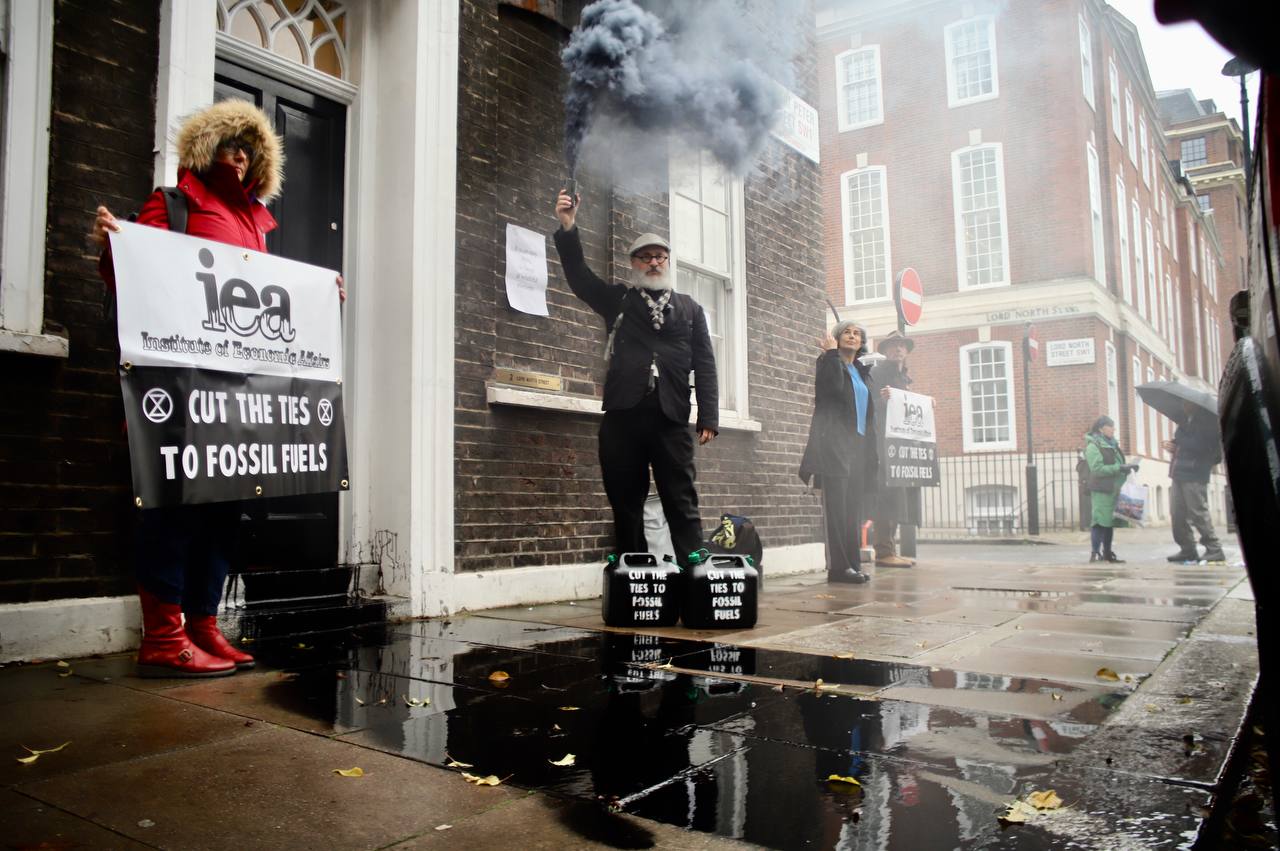
IEA Writers Rebel. Photo: Extinction Rebellion. Writers Rebel at the Institute of Economic Affairs, Lord North Street
Writers Rebel poured fake oil on the front steps of free market think tank the Institute of Economic Affairs. The institute, located just meters from the Houses of Parliament, has received money from fossil fuel companies, regularly publishes materials questioning the consensus on climate science and has huge influence on politicians.
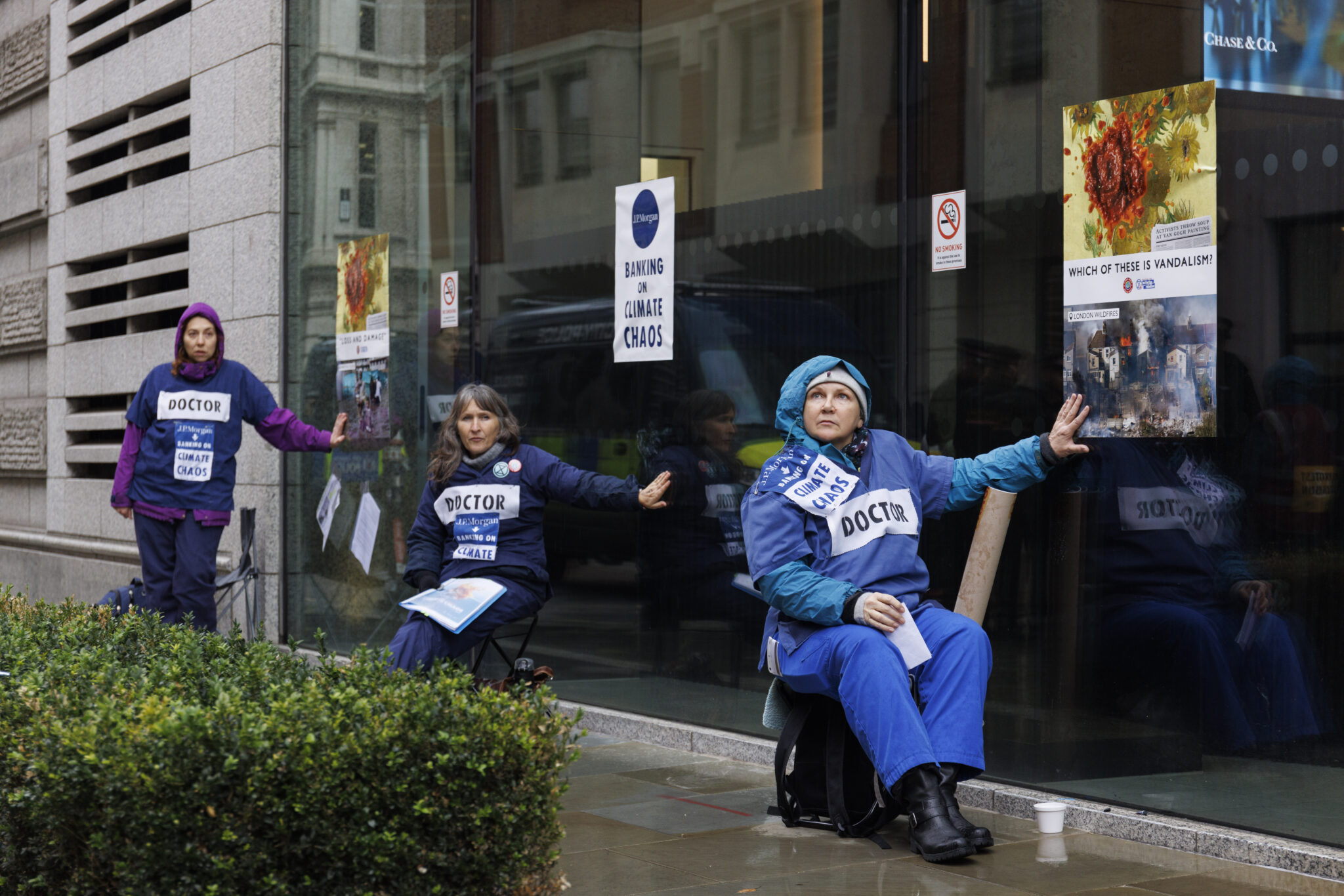
21st Nov 2022. J P Morgan offices, 60 Victoria Embankment, London, UK. Three Doctors for XR arrested after pasting posters and gluing themselves to the outside windows.Photo: Extinction Rebellion. Doctors for XR at JP Morgan, Victoria Embankment
Doctors for XR glued themselves to the windows at the London HQ of JP Morgan and pasted images to the front facade of the building depicting scenes of climate breakdown both here in the UK and overseas. JP Morgan are the world’s biggest fossil fuel financiers.Christian Climate Action at BAE Systems offices, Carlton Gardens
Christian Climate Action left handprints of fake blood and oil on the offices of Britain’s leading arms manufacturer BAE Systems. BAE Systems supply weaponry to conflicts which increase the vulnerability of people living on the front lines of climate change. The arms giant also provides military and technical support to Saudia Arabia, enabling the regime’s oil production.
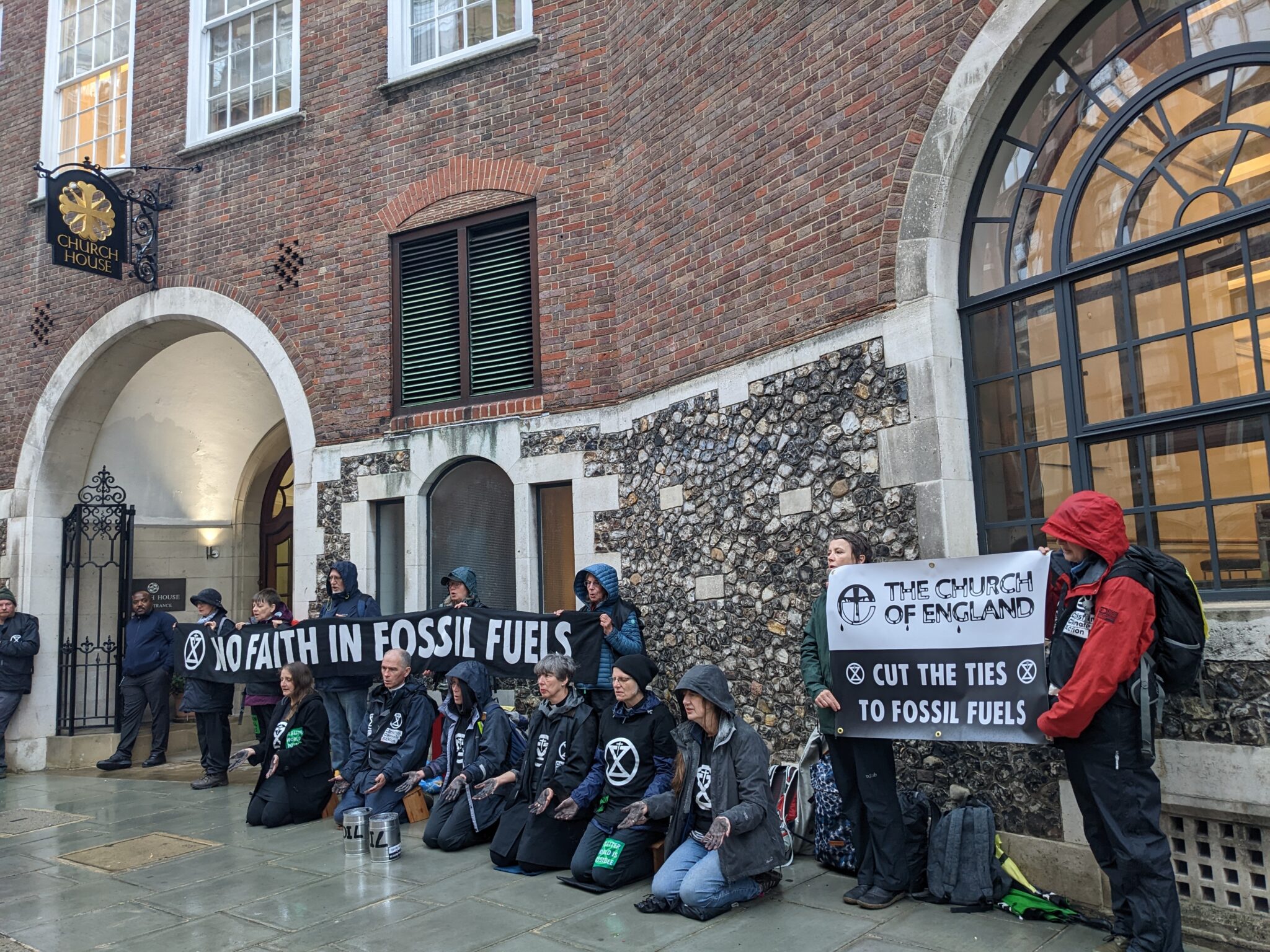
Christian Climate Action. Photo: Extinction Rebellion Holly Christian Climate Action at Church House, Great Smith Street
Christian Climate Action also took action outside Church House in Westminster to highlight the Church of England’s failing strategy to stay invested in fossil fuels and influence the industry as shareholders.A spokesperson for Christian Climate Action, said: “The Church should be showing moral leadership in rejecting profiting from investments in companies that continue to fuel climate suffering.”
Plastics Rebellion at Ineos offices, Hans Crescent
Plastics Rebellion sprayed fake oil outside the offices of Ineos, one of the world’s largest petrochemical producers and a significant player in the oil and gas market. Many of the plastics produced in the UK start their life at the INEOS Grangemouth refinery.HS2 Rebellion at Eversheds Sutherland, Wood Street
HS2 Rebellion sprayed the offices of multinational law firm Eversheds Sutherland with fake oil. As solicitors for HS2 and Esso, Eversheds Sutherland have been forerunners in criminalising nonviolent environmental protest through the use of injunctions.XR East of England and XR Youth at Schlumberger offices in London, Buckingham Gate
XR East of England and XR Youth poured fake oil over a globe at the offices of the world’s largest oilfields services provider Schlumberger to expose their complicity in ecocide. As the world’s largest oilfield services provider, Schlumberger enable fossil fuel extraction, operating in 120 countries around the world, with over 36,000 patents dedicated to extracting every last drop of oil and gas from the ground.Ocean Rebellion at the International Maritime Organisation, Albert Embankment
Ocean Rebellion held protests outside the offices of the International Maritime Organisation where performances illustrated the UN shipping body’s refusal to regulate shipping emissions. A heavy plume of smog filled the air and an oil slick appeared on the ground with dead birds caught in it.Money Rebellion at Arch Insurance, Great Tower Street
Money Rebellion poured fake oil at the offices of Arch Insurance. Arch Insurance are understood to be in negotiations with fossil fuel giant Total regarding the insurance of the East Africa Crude Oil Pipeline (EACOP), a project that will jeopardise important ecosystems, fuel climate change and pose significant risks to millions of people. Money Rebellion is there to say ‘Arch must rule out EACOP’.Sky Rebellion at Ontario Teacher’s Pension Plan, Portman Square
Sky Rebellion poured fake oil in front of the London offices of Ontario Teacher’s Pension Plan. The Canadian based pension fund invests in infrastructure projects including the controversial expansion of Bristol Airport which it owns.
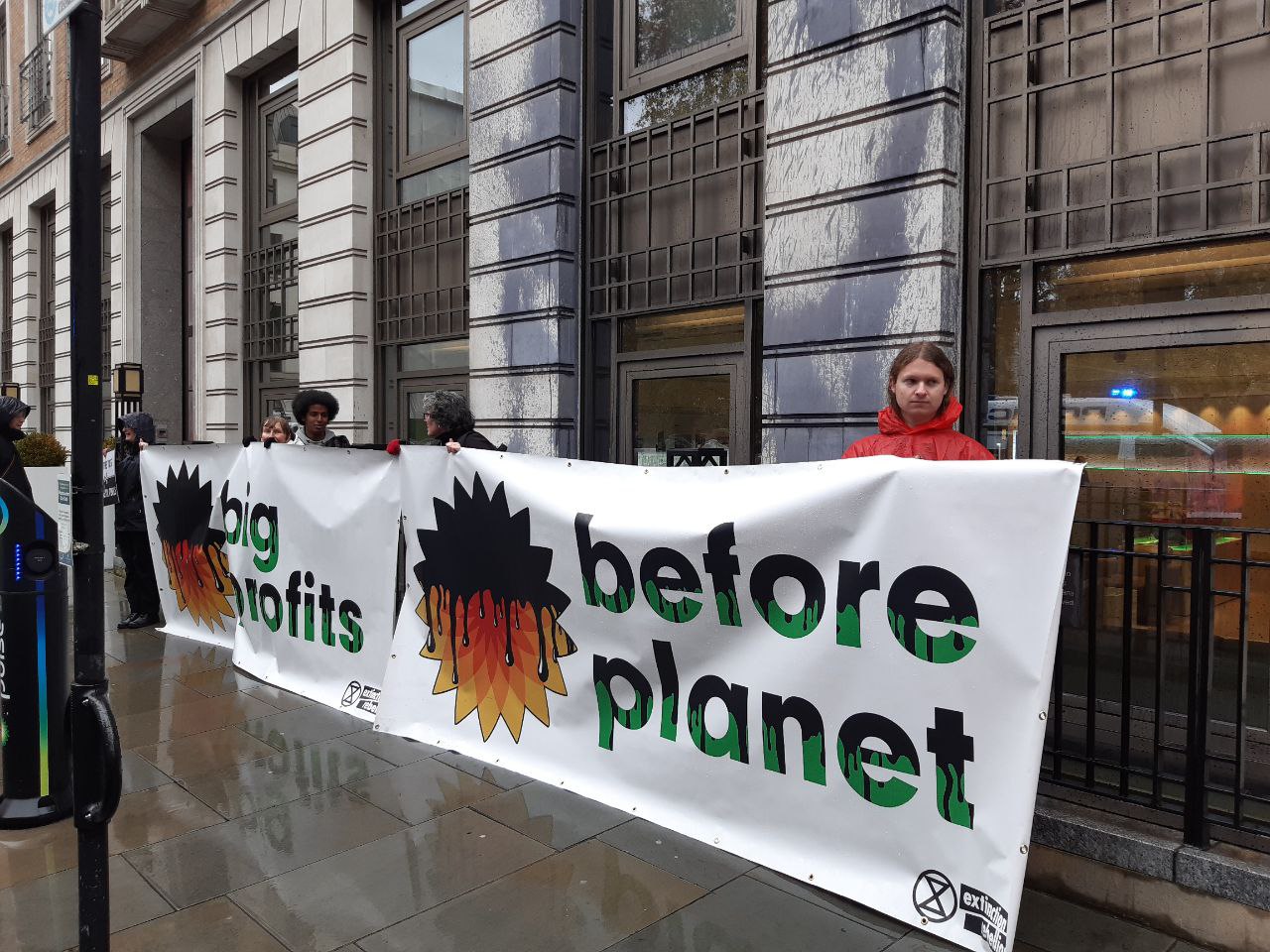
XR South East at BP. Photo: Extinction Rebellion XR South East at BP HQ, St James’ Square
XR South East used fire extinguishers to spray fake on oil BP headquarters in central London.A spokesperson for XR South East, said: “The addiction to fossil fuels must end. The huge fossil fuel corporations like BP and those who aid and abet them KNOW what we face. BP hides the dirty secrets that lie behind its latest big profit of £7,100,000,000. Enough is enough. Today we are exposing the ties between the collaborators and we will piece together the web of lies with our actions.”
XR South West at the Department for Business, Energy and Industrial Strategy, Victoria Street
XR South West sprayed fake oil on the Department for Business, Energy and Industrial Strategy to protest against its plans to issue more than 100 new licences for exploration and extraction of oil and gas in the North Sea – meaning renewed and accelerating extraction way beyond 2030 and way beyond the UK’s Paris Agreement commitments.XR Rhythms (marching between the locations listed above)
In June, London endorsed the Fossil Fuel Non-Proliferation Treaty, so XR Rhythms is marching through London to highlight the web of fossil fuel enablers still working in our city. We want to drum out fossil fuel investments and celebrate the future transition to a more sustainable economy![from an Extinction Rebellion press release.]
Faith Leaders, Zombies, Moms and Kids Agree: It’s Time for Wall Street to Stop Funding Fossil Fuels
Activists are not slowing down: it’s clear that Wall Street holds an outsized responsibility for the death, destruction, and chaos caused by the climate crisis.
Reposted from Common Dreams, licensed under Creative Commons (CC BY-NC-ND 3.0). Feel free to republish and share widely.
Arielle Swernoff November 18, 2022
Over the past few months, activists around the country and the world have laid the blame for climate disasters at Wall Street’s feet. In a wave of escalated actions under the name “Blame Wall Street,” dozens of groups have called out the financial industry for their financing of fossil fuels and complicity in the climate crisis.
Around the country, people took on elevated amounts of risk in order to increase pressure on the dirty banks, insurance companies, and asset managers financing the climate crisis.
Activists pummeled the banks with actions and protests for months. Over 40 groups across the country held over 50 actions and protests.
In New York City, a week of action targeting Citi began with moms and kids birddogging the bank’s chief sustainability officer, Val Smith, over Citi’s continued funding of Russian oil and gas interests. Later that week, activists infiltrated Citi’s Taste of Tennis gala and interrupted the event with a large banner accusing the bank of funding Russia’s war crimes.
Citi, the US’s largest funder of coal, faced additional protests at greenwashing PR events and at branches in Phoenix, Brooklyn, and other locations. Activists interrupted the speech of Citi’s Chief Sustainability Officer at a sustainable banking conference, and protested Citi, Wells Fargo, and Chase leadership at a Women in Banking event.
Chase emerged from its fall PR events similarly beleaguered. Activists crashed the Chase-sponsored US open, passing out fans to sweaty attendees accusing Chase of funding climate chaos. Later in the month, nine different affinity groups created a circus out of the San Francisco Chase Corporate Challenge, with activists taking over every part of the road race, which hundreds of Chase employees participate in, from the course to the finish line to the after party to protesting in kayaks along the route.
As the world’s largest funder of fossil fuels, it’s no surprise that Chase was protested again and again: Leavenworth, Washington; Worcester, Watertown, and Boston, Massachusetts; Madison, Wisconsin; Fort Lauderdale, Florida; Chicago, Illinois; Providence, Rhode Island; Silver Spring, Maryland; Sacramento, California; New Orleans, Louisiana; and New York City all saw protests at Chase branches or headquarters.
Another major target was asset manager BlackRock, one of the world’s top investors in fossil fuels and climate destruction. BlackRock saw protest after protest at their headquarters, with regular actions from September through November. People sang outside their building, came in costume, held prayer and faith actions, and stormed the headquarters with pitchforks and dumped coal on their escalators. BlackRock is on notice: time to stop financing fossil fuels.
Global climate strike protests also included demands on Wall Street and an end to fossil fuel financing, with activists in Los Angeles, Chicago, New York, and Maryland partnering with youth leaders to demand a safe and livable future. Climate strikers weren’t the youngest activists: in Los Angeles and New York, people protested the greed of the fossil fuel industry alongside their infants and toddlers.
Actions were creative, including art, music, and costumes. In Albany, New York, the red rebel brigade joined a protest outside of TD Bank. In Brooklyn, activists dressed up as Mr. Moneybags and brought bagpipes to branch locations of Citi, Chase, and Bank of America. In Sacramento, Denver, and New Orleans, activists staged Halloween actions, dressing up as endangered species or zombie bankers.
Faith leaders exercised their moral authority in calling on banks and asset managers to stop funding climate disaster. Near Philadelphia, Quaker activists held a prayer vigil outside of the Vanguard HQ, calling on the asset manager to stop financing fossil fuels. In Washington, DC, faith leaders called on the IMF and World Bank to do the same. Faith activists also held protests outside of the Bank of America headquarters in Charlotte, and a Bank of America branch in Springfield, Illinois. Leaders from different faith communities protested multiple times outside of BlackRock’s corporate headquarters in New York City—at one protest, 27 faith leaders were arrested.
Around the country, people took on elevated amounts of risk in order to increase pressure on the dirty banks, insurance companies, and asset managers financing the climate crisis. Dozens of people were arrested this fall—from San Francisco to New York to Pennsylvania to Rhode Island. These activists went to jail in order to show the world the greed of dirty Wall Street actors.
Activists innovated by taking repeated action at financial targets. Instead of one protest, people showed up week after week, increasing the pressure on banks and asset managers. In Phoenix, Arizona, Sacramento, California, Madison, Wisconsin, and Leavenworth, Washington, local actions happened again and again.
People targeted other financial actors, as well. Insurance companies received their fair share of pressure, with actions on Traveller’s, Hartford, and Chubb. One action saw a huge oil derrick parked outside of the home of Chubb CEO, Evan Greenberg. Groups protested the Federal Reserve in Jackson Hole, Wyoming and in Washington, DC, activists protested TIAA’s support for deforestation, there was an action outside of the shareholder meeting of Proctor & Gamble, and a noise protest outside of the homes of the CEOs of the private equity firms KKR and Blackstone. In Sierra Leone, youth activists protested the Central Bank’s support of fossil fuel expansion.
Activists are not slowing down: it’s clear that Wall Street holds an outsized responsibility for the death, destruction, and chaos caused by the climate crisis. With shareholder meetings coming up this spring, banks, insurance companies, asset managers, and pension funds should be ready for increased pressure. Banks are expected to see more shareholder resolutions calling on them to walk the talk on climate than ever before, and the grassroots movement to stop the flow of money to fossil fuels is only growing in energy and momentum.
Reposted from Common Dreams, licensed under Creative Commons (CC BY-NC-ND 3.0). Feel free to republish and share widely.
Arielle Swernoff is an organizer, strategist, and facilitator based in New York City. She is the Stop the Money Pipeline US Banks Campaign Manager.