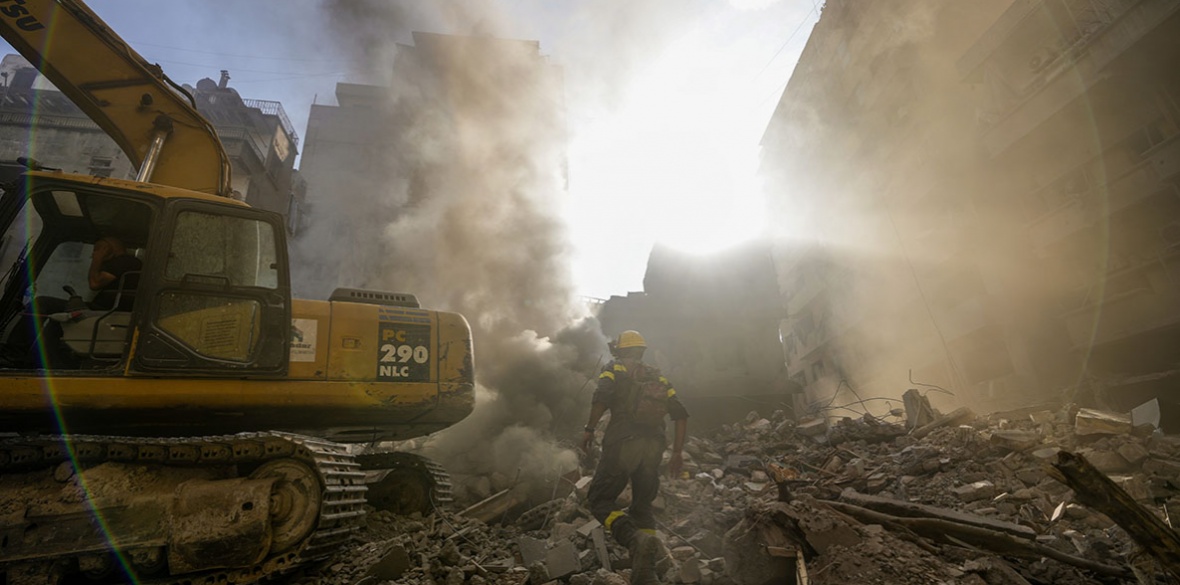
Rescue workers search for victims at the site of Thursday’s Israeli airstrike in Beirut, Lebanon, October 11, 2024
A NEW attack by Israeli forces on UN peacekeepers in southern Lebanon received swift and widespread condemnation today.
The Lebanese Ministry of Foreign Affairs said the attack had targeted a watchtower of a Sri Lankan battalion in Naqoura that is part of the UN Interim Force in Lebanon (Unifil).
The day before, 22 people were killed and dozens wounded in the deadliest Israeli air strike on central Beirut so far.
Lebanon’s National News Agency reported today that artillery shelling from an Israeli Merkava tank had wounded some of the Sri Lankan soldiers.
Speaking at a news conference in Beirut, Lebanese caretaker Prime Minister Najib Mikati described the attack as a “crime.”
UN secretary-general Antonio Guterres described Israel’s action as “intolerable” and said it “cannot be repeated.”
Zionist Keir Starmer is quoted “I support Zionism without qualification.” He’s asked whether that means that he supports Zionism under all circumstances, whatever Zionists do.
Prime Minister Keir Starmer during his talks with Nato Secretary General Mark Rutte in Downing Street, in London, October 10, 2024
LABOUR and Prime Minister Sir Keir Starmer’s approval ratings are still nosediving as the government marks 100 days in office tomorrow.
New Ipsos polling reveals Sir Keir’s net popularity has fallen to a record low of minus 26 points — worse than Reform leader Nigel Farage.
Rachel Reeves was doing even worse at minus 30 points with four in nine saying she is doing a bad job as Chancellor.
Experts blamed No 10 “turf wars,” scandals over ministerial freebies and cutting pensioner benefits as the Labour Party’s net popularity also plummeted 13.5 points to minus 21 points since the general election.
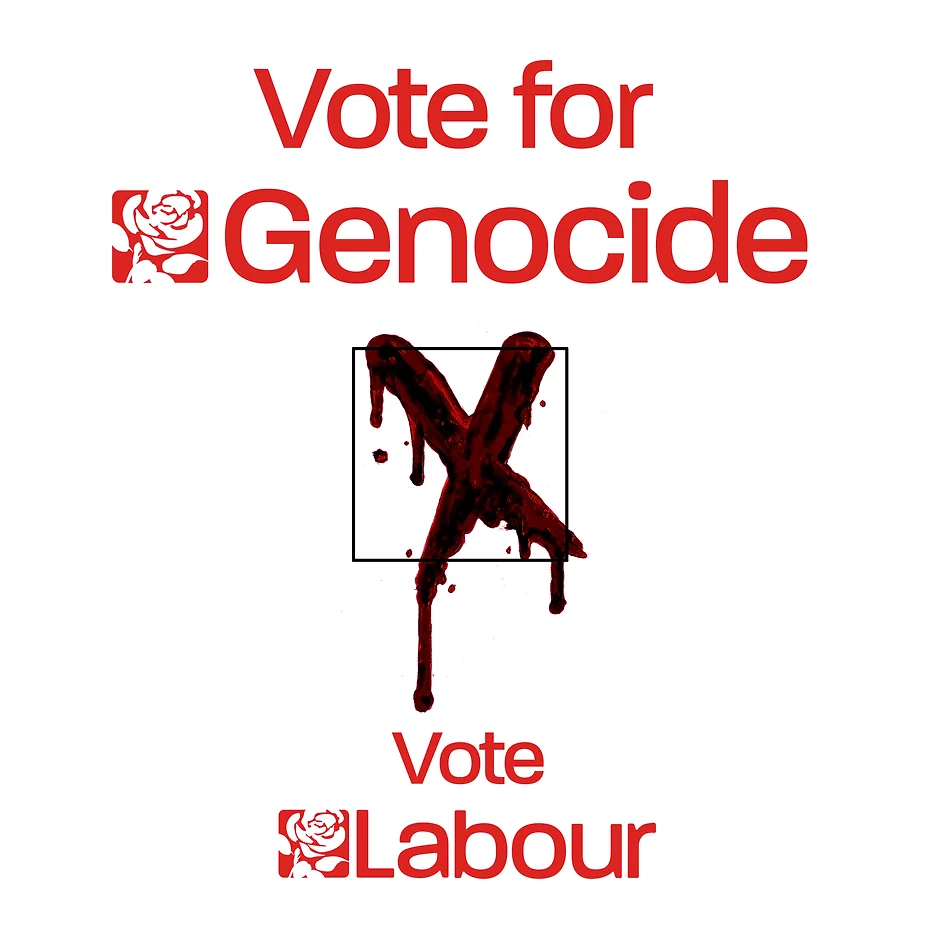
Keir Starmer explains that he feels no shame or guilt benefitting personally from gifts from the rich and powerful while insisting on policies of severe austerity causing suffering and death.Zionist Keir Starmer is quoted “I support Zionism without qualification.” He’s asked whether that means that he supports Zionism under all circumstances, whatever Zionists do.Vote For Genocide Vote Labour.
You probably missed it, but a few months ago a report was published that inspected how the UK government prepared for major emergencies. What it found has profound implications for the whole country.
The report was written by the UK’s public inquiry into the COVID-19 pandemic and explained how the pandemic was an example of what’s called a “non-malicious threat”. These are major threats to our collective security that arise not from hostile intent – like terrorism or war – but as a result of human error, structural failure, or natural disasters. In this instance it was a novel virus that jumped from animals to humans and then rapidly spread.
The pandemic affected everything. Its impact was so severe that it created what the government calls a “whole-system civil emergency”, a rapidly escalating crisis that significantly affected multiple dimensions of the UK’s security, from the health system, through economic stability, to public trust. This was the UK’s greatest security crisis since the second world war. Yet it had nothing to do with armed conflict.
The inquiry found that successive governments grossly underestimated pandemic threats. They were not given the same priority as security threats coming from hostile action, like Russian aggression or terrorism. The subsequent tragedy proved how much of a mistake this was. When it came to planning and responding to whole-system civil emergencies, the UK government “failed their citizens”, the inquiry said, before concluding that “fundamental reform” was needed.
We have worked on a new report that finds worrying similarities to another, even greater “non-malicious threat” to security: climate change.
Compounding climate risks
Two weeks ago Hurricane Helene crashed into Florida and proceeded to cut a chaotic swathe north. By the time it dissipated over Tennessee two days later, over 200 people were dead and losses amounted to tens of billions of dollars.
Now Florida has been battered by Hurricane Milton too, which may prove to be more destructive in part because it came in the wake of Helene. Much of the region’s road, rail, and power infrastructure was still damaged. Many of the buildings still standing had been seriously weakened. Piles of debris from the clean up quickly became dangerous projectiles in Milton’s powerful winds. Hurricanes such as Helene and Milton are now twice as likely given climate change.
From hurricanes to deadly heatwaves, crippling droughts to crop failures – the consequences of climate change are potentially catastrophic. And while we have improved our resilience to individual extreme weather events, increasing climate change makes it more likely that impacts will pile up with the sum of loss and damages being much higher than the parts. It is these cascading and compounding impacts that not only threaten local communities, but add up to destabilise the security of entire countries and the globalised systems that connect them.
Yet many governments do not routinely consider extreme climate scenarios in their security plans, and instead continue to assume that climate risks will gradually evolve over the long term.
This approach is proving to be grossly insufficient. Take food security for example. Cascading climate effects are estimated to have caused a third of UK food price inflation in recent years, an impact compounded by rising energy prices. Spiking energy prices were the result of our reliance on fossil fuels, which became far more expensive after Russia invaded Ukraine.
These episodes show us how the causes and consequences of climate change supercharge the world’s security problems.
Tipping towards catastrophe
These climate risks create the potential for further “whole-system civil emergencies”. One example is tipping points. For instance, one of the Earth’s key ocean current systems is the Atlantic meridional overturning circulation (Amoc), which transports vast amounts of heat from the tropics to the northern hemisphere. Yet climate change is weakening the Amoc, a process that could lead it to pass a tipping point and collapse at some point this century, though there is still much debate among climate scientists over exact dates and probabilities.
Collapse would effectively wipe out crop growing in the UK, and devastate food production over much of Europe and North America, while disrupting key weather patterns across the globe. This would be a planetary-scale cataclysm with unmanageable security outcomes. A collapse this century cannot be ruled out without urgent international action to reduce emissions.
Meanwhile, the collapse of a northern section of the Amoc – in the North Atlantic subpolar gyre – could happen much sooner. While less severe, a collapse would upend weather in the UK, destabilising food production, public health, and infrastructure. Evidence suggests that the likelihood of this collapse is alarmingly high – up to a 45% chance of occurring this century – and that it could happen as early as 2040, if not before.
Inadequate assessment
Yet these risks do not appear in the UK government’s national register of security threats. In fact, there isn’t even a dedicated security risk assessment of climate change. The government’s existing climate change risk assessment is not set up to assess broader security threats in the round and is not intended for high level security decision-makers.
There are also important analytical flaws, such as inadequate consideration of cascading and interacting risks like successive hurricanes or a flood that also spreads diseases or disrupts food supplies months later. Individually, these risks might be bearable; together, they could prove unbearable.
Meanwhile, responsibility for climate risks is currently siloed away in non-security departments, marginalising climate change from the top table of decision-making on security.
Thankfully, the new UK government is undertaking a review of its national resilience and security policies. Climate change should be at the heart of its plans. The pandemic inquiry’s findings could represent a warning from a future in which the threat posed by climate change is still not taken seriously in key parts of government.
We face a choice. We can wait until climate impacts spiral out of control, and panicked governments resort to false solutions like more border walls and militarisation. Worryingly, the chances of this are growing as governments continue to effectively fly blind into an increasingly dangerous future. Alternatively, the institutions of government that are intended to protect us against major emergencies can finally act and begin to turn us away from the gathering storm.
March for Palestine | Mark Kerrison/In Pictures via Getty Images
A new generation across the UK is demanding political representation. But this unstoppable force is meeting an immovable object, the Labour Party
A new generation across the UK is demanding political representation. Yet, this unstoppable force is now meeting an immovable object, the Labour Party.
On one hand, despite its failure to leave behind much grassroots organisation, Jeremy Corbyn’s leadership galvanised millions. This generation now knows what it’s like to have a voice in the political mainstream. It won’t tolerate being shut out of the political process indefinitely. The success of Green and independent candidates at this year’s general election was in part driven by this fact.
Meanwhile, the realities of climate breakdown, renewed austerity and a genocide in Gaza continue to alienate many. The British public backs the renationalisation of energy by a margin of four to one, the introduction of a wealth tax by a margin of eight to one, and a ban on arms exports to Israel by about three to one.
On the other hand, the Labour Party is a fortress. Many advisors and politicians of the Labour right regarded the party’s defeat under Corbyn in 2019 as a lucky escape, and remain terrorised by the prospect of losing their careers to an insurgent political force. Starmerism is a relentless campaign on behalf of this professional political class, which is determined to shut the left out. Their hubris is an existential threat not just to Labour’s role as a political home for the left, but to the party itself.
Both wings of the Labour Party are being blindsided by this process. The Labour right, and the commentariat that lives in its orbit, likes to think in terms of historical cycles and playbooks. The crushing of the post-Corbynite left was a repeat of Kinnock’s expulsion of the Militant Tendency. 2024 was just 1997 with TikTok.
Starmer’s first act in government – blaming the outgoing administration for an economic mess and indicating a shift towards austerity – was both a conscious mimicry of Tory George Osborne and an homage to New Labour’s fiscal hawkishness.
The Labour left’s attachment to the past is more nostalgic. Its leaders – Aneurin Bevan, Tony Benn, Corbyn – are stripped of their failings and revered. Its heroic defeats – the 1981 Deputy Leadership campaign, the Greater London Council’s fight for survival, Corbyn’s general elections – are endowed with their own folklore.
Life on the outside is unthinkable and futile, as illustrated by every past attempt (the Socialist Labour Party, the Socialist Alliance, Respect, the Trade Union and Socialist Coalition, Left Unity) to build an alternative. “It is the Labour Party or it is nothing”, as Bevan once wrote, chiding members of the Independent Labour Party when they split in 1932.
Both wings of Labour are good at producing a sense of collective memory that reinforces the party’s standing as immutable, and which relates new events to past ones. Neither are good at understanding when reality diverges from the historical script.
In 2015, the left challenged for power, and in doing so broke the old system. Tony Blair did not bother to get rid of Tony Benn. Yet Starmer almost immediately expelled Corbyn and changed Labour’s rule to ensure that no one like him could lead the party again. He has already suspended seven MPs for voting to abolish the two-child benefit cap. It is only a matter of time until more feel forced to rebel.
A politics from below
The real politics happens outside parliament. We’ve already witnessed huge protests take shape against the massacre in Gaza, and the coming years could see mass movements and industrial unrest over cuts and living standards. Having lived through the Corbyn years, the participants of these movements are unlikely to be satiated by the prospect of a soft left Labour leader some time in the 2030s.
Labour’s initial plans will provide some relief. The Employment Rights Bill is likely to be the most significant improvement in workers’ rights in decades. The renationalisation of the railways will also prove popular. But what happens once these progressive measures have been exhausted?
The Green Party came second behind Labour in 39 seats. Pro-Palestinian Independent candidates have made inroads into safe Labour areas. For this to have happened while Labour was in opposition is unprecedented. Unless the new government rapidly shifts its approach on public spending, redistribution and green investment, it will face an earthquake.
“Unless the new government shifts its approach on public spending, redistribution and green investment, it will face an earthquake”
To have any success, the post-Corbynite left will have to ditch its obsession with icons and celebrities. Despite its roots in social movements, Corbynism became a tightly centralised project, in which activists were given little, if any, role in determining policy and strategy. Even now, discussion of the left’s future beyond Labour seems to centre on the intentions of Corbyn, his former advisors, prominent commentators, or MPs.
Building a serious political project is about representing a solid base in society. This task flows from organising, and having roots in social and industrial struggle, not how many Twitter followers you have.
The green surge
Much of the left will also have to get over its age-old sectarianism towards the Greens, who have emerged as by far the most serious organised force to Labour’s left.
If you listen to many old Labour left activists, or read many socialist newspapers, you will be presented with a critique of the Greens that is at least two decades old. They are portrayed as ‘Tories on bikes’ and alternative medicine enthusiasts. Their ability to win seats in North Herefordshire and Waveney is said to be the product of triangulation towards right-wing rural voters. The compromises of Green parties in France and Germany are held up as the inevitable destiny of the UK Greens.
On the contrary, the Greens have become a major force precisely by occupying a space to the left of their sister parties in continental Europe. Since the turn of the millennium, their membership has risen twelve-fold to around 60,000. Waves of new members – from the ‘green surge’ of 2014 to today’s recruits – comprise its activist base.
Many joined on a radical environmental basis, but just as many did so to oppose austerity, champion freedom of movement, or fight for Palestinian rights. There might be a case that their time would be better spent in Labour, or that party affiliation often operates more like a consumer identity than a political strategy. But the existence of a genuinely left-wing, and increasingly successful, Green Party in Britain is simply a fact. Any attempt to rebuild the left as an electoral force – from within Labour or outside – must take account of this.
The landscape of the British left following the fall of Corbynism is still emerging. The only people who are definitely wrong are those who claim to know exactly what will happen. Perhaps Starmer will move back to the centre-left. Perhaps the social and industrial movements won’t materialise. There are many socialists – including me – who remain in Labour and will keep chipping away.
One thing we can be certain of is that things will never go back to the way they were before the Corbyn moment. The late 2010s unleashed forces that are only beginning to shape our politics. The left must adapt if it is to survive.
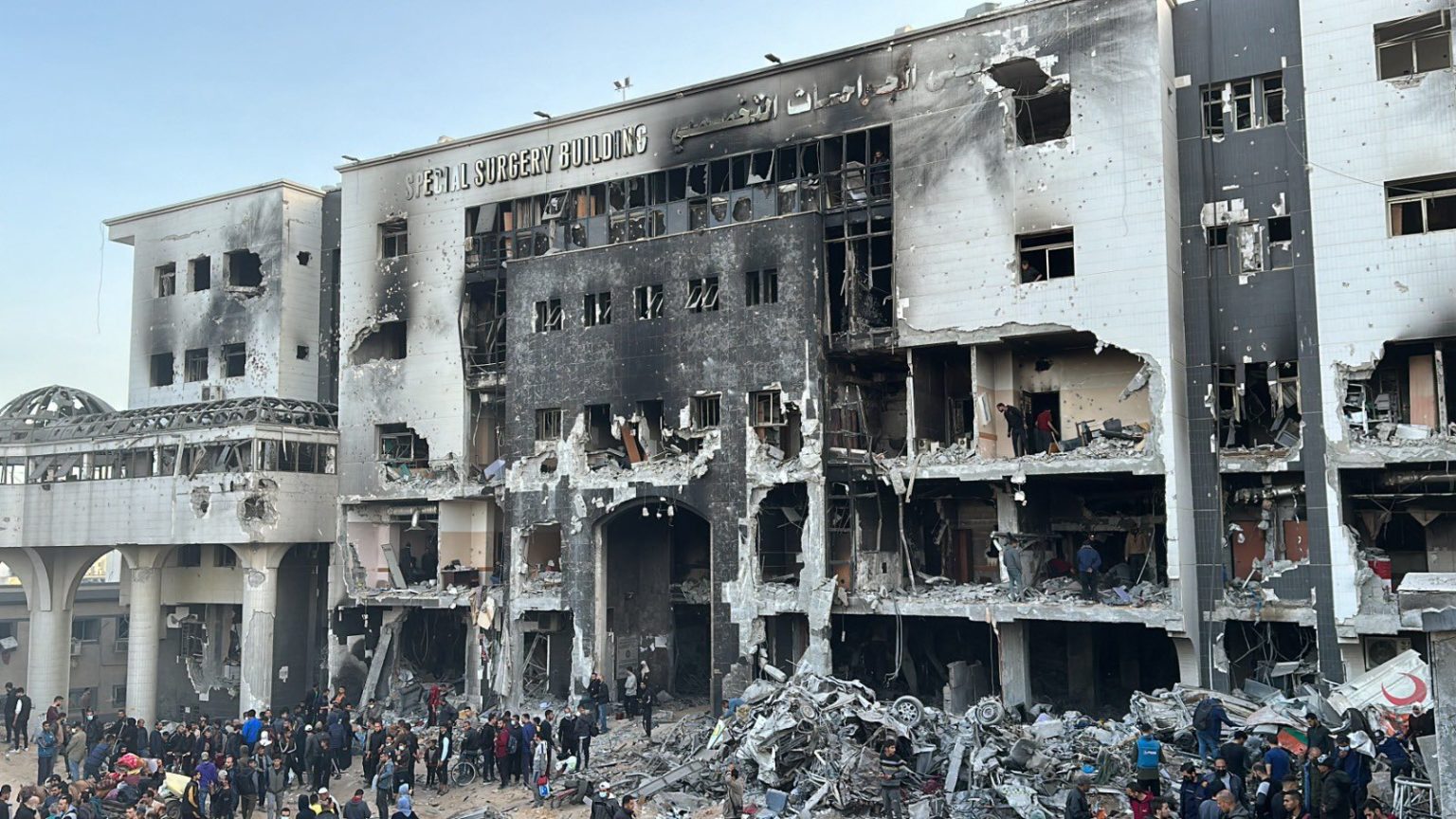
Al Shifa Hospital after a two-week Israeli siege, April 2024.
After a year of unrelenting Israeli attacks, Gaza’s healthcare system lies in ruins. Yet, health workers continue their steadfast efforts to provide care
After a year of relentless bombardment, Gaza’s healthcare system lies in ruins, and the warnings Palestinians have issued for decades are being confirmed: hospitals, clinics, and health workers are deliberate targets of Israeli Occupation Forces (IOF). What was once a systematic campaign against healthcare has escalated into an all-out assault, resulting in the decimation of most of the infrastructure. As the one-year anniversary of this ongoing genocide approached, Israeli forces continued their siege on northern Gaza, intensifying their attacks on health facilities.
Three hospitals still barely functioning in the area — including Al-Awda and Kamal Adwan — were just issued so-called “evacuation orders,” which, as pointed out by Medical Aid for Palestinians (MAP), are nothing short of forced removal orders. Kamal Adwan’s director, Hussam Abu Safiya, stressed the impossible position the hospital faced soon after the orders were issued. With critically injured children in their care, no means to safely evacuate them, and no other facility able to accept them, health staff are faced with the excruciating decision of either abandoning their patients or staying at the risk of their own lives.
“In between the constant bombardment occurring on the hospital and the surrounding buildings, the healthcare staff have become terrorized to a point where they are struggling to do their jobs,” Abu Safiya stated. Their situation is similar to that faced in other health facilities. Around the same time Abu Safiya recorded his statement, medics in Al-Awda were also issued forced removal orders—for the third time in a year—says Matilde De Cooman from Viva Salud, a Belgian organization partnering with the hospital.
The risks health workers face are all too real. Israeli forces have systematically besieged and destroyed healthcare infrastructure over the past 12 months, including Gaza’s largest hospitals, such as Al-Shifa. Under the pretext of searching for resistance fighters, the IOF raided operating rooms, destroyed medical equipment, and abducted patients and medical staff. In the aftermath of the attacks, civil defense teams discovered seven mass graves containing 520 bodies on hospital grounds.
Over 1,000 health workers have been killed since the genocide began, with hundreds more kidnapped and held in Israeli concentration camps. Those who have been released share harrowing accounts of torture: shackles, electric shocks, broken limbs, and sexual violence. Families of those still missing, like Dr. Ahmed Muhanna, the director of Al-Awda Hospital in northern Gaza, are not granted any official information about prisoners’ conditions. Dr. Muhanna was abducted in December 2023. Since then, no official word has emerged about his mental or physical condition, says De Cooman.
International campaigns to secure the release of Dr. Muhanna and other abducted health workers are ongoing, though disturbing reports of their treatment in Israeli camps have sparked both outrage and fear about what the future holds. Despite these developments, Gaza’s health workers remain resolute, refusing to abandon their patients. Their unwavering commitment, sumud (steadfastness), has been lauded by global health workers since the beginning of the genocide. Operating without pay or essential supplies due to the blockade, they have continued their work tirelessly since last October. “Even with Dr. Muhanna’s fate in mind, Al-Awda’s operating director, Mohammed Salha, never once considered abandoning the hospital,” says De Cooman. “As long as there is even one person left in the area, the hospital will remain open and stand by its people.”
The health suffering in Gaza extends far beyond the hospitals. With more than two million people pushed into poverty by the attacks and the aid blockade, food and clean water are scarce. Recent reports reveal that 35% of children and 40% of pregnant or breastfeeding women in Gaza are surviving on just one type of food. Malnutrition is rampant, and the World Health Organization (WHO) has documented cases of children starving to death as humanitarian aid convoys are blocked at Israeli-controlled checkpoints.
Hunger and disease go hand-in-hand, as the WHO continues to repeat. Gaza is witnessing a hard-to-imagine surge in infectious diseases—respiratory infections, skin diseases, Hepatitis A, and even polio, a virus that had been eradicated decades ago but resurfaced, paralyzing a 10-month-old child. The shortage of basic hygiene products, such as soap and clean water, only adds to the crisis.
The spread of diseases is anything but collateral damage: it is a calculated weapon in Israel’s strategy. As Jewish Voice for Peace remarked, in prisons, “skin diseases are a method of punishment. Prison authorities are allowing scabies to spread by restricting Palestinian inmates’ water supply and depriving them of clean clothes and medical care.”
On top of it all, Gaza’s whole environment is contaminated with asbestos dust raised by the constant bombardment. An estimated 800,000 tonnes of debris in Gaza could contain asbestos particles, as reported by Al Jazeera, raising the prospect of soaring cancer rates in the coming years.
“After a year, the occupying forces continue to practice an unprecedented genocide in modern history. What is particularly painful is the disgusting silence of the international community,” stated Hani Serag, Co-Chair of the People’s Health Movement. “We hope that activists across the world will continue expressing their solidarity to Palestinian people and refuse the barbaric practices of the occupying forces.”
Israeli crimes against healthcare are not confined to Gaza. In less than a month, Israeli forces have killed over 100 health workers in Lebanon and forced the closure of dozens of health centers. The destruction unfolding in Gaza serves as a blueprint for the invasion of Lebanon, raising the question: how long will the West look away while Israel continues its rampage?
People’s Health Dispatchis a fortnightly bulletin published by thePeople’s Health Movementand Peoples Dispatch. For more articles and subscription to People’s Health Dispatch, clickhere.