Category: politics

  • Center-left alliance challenges the ruling right alliance in India’s national elections

    Spread the love

    Original article by peoples dispatch republished under a Creative Commons Attribution-ShareAlike 4.0 (CC BY-SA) license.
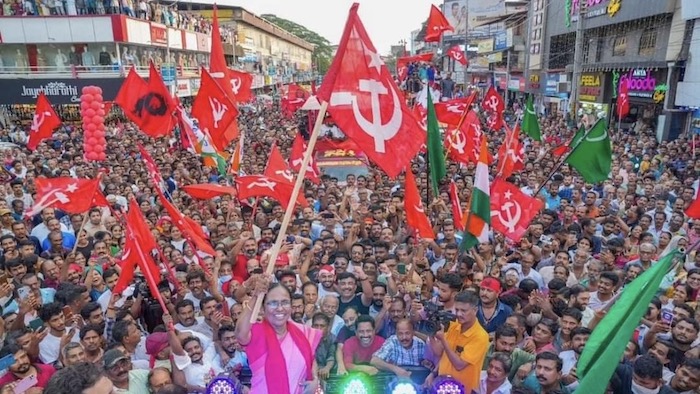
    Indian Prime Minister Narendra Modi may still be popular after a decade in power but his government’s failures to address basic livelihood issues for the majority of the people may give an advantage to the opposition.

    India, the world’s most populous nation, is in the middle of its 18th national elections. Two of the eight phases are already over, sealing the fate of over one third of representatives. However, the fight is still on for the majority of the seats. The incumbent Narendra Modi-led right-wing government, seeking a third straight term, is facing an upbeat center and left alliance led by Congress.

    This national election for India’s lower house of the parliament, called the Lok Sabha (the house of the people), is stretched between April 19 and June 1 and takes place in eight phases. The votes will be counted on June 4 and results will be declared on the same day.

    India is a parliamentary democracy with the first past the poll system. It is divided into 543 constituencies for the national elections with each constituency electing a single member for the Lok Sabha each. The party or alliance which wins the majority of seats (272) in the Lok Sabha elects the prime minister and forms the central government.

    Though India has a multiparty system, most of the parties this time are aligned with the two major pre-poll alliances seeking popular mandate. The ruling Bharatiya Janata Party (BJP) led right-wing National Democratic Alliance (NDA) and the Congress-led, center-left opposition, Indian National Developmental Inclusive Alliance (I.N.D.I.A.) or just INDIA.

    All the major left parties are part of the INDIA alliance and are contesting a large number of seats in states of Kerala, West Bengal, Tamil Nadu, Bihar and elsewhere with an objective to increase the presence of the left in the Indian parliament.

    Along with the national election, three states/provinces, Odisha, Andhra Pradesh in the country’s south-east, and Sikkim in the north-east, will also elect members of their respective state assemblies.

    Key issues

    Unlike the last national elections in India when Prime Minister Narendra Modi was able to use the popular polarization of votes around the issue of nationalism and national security, the present elections are largely being fought on the issue of his government’s failure on all major fronts affecting the majority of the population, principally economic issues such as price rises and unemployment.

    Indians are facing an unprecedented rise in the prices of all major essential commodities which has, in the absence of corresponding rise in the income, created a major crisis of living for the majority of the households in the country but particularly among the urban poor. India has seen an unprecedented decline in its standing on the annual global hunger index despite being one of the major food producers in the world and world’s fastest growing economy.

    The rising inequality and the growing perception of the Modi government being pro-big capital and allegations of cronyism have also become a major poll issue. Opposition parties have pointed out that while select corporate houses in the country have risen and made tremendous profits, it is at the cost of most of the small and medium sized enterprises in the country as well as public sector entities.

    The International Labor Organization (ILO) report on rising unemployment among educated youth in India has also attracted the attention of major opposition parties and become a major poll issue.

    Apart from the major economic issues, the opposition has raised the issue of alleged threats to democracy under the BJP rule. They have accused BJP of trying to suppress the voices of dissent by misusing the central law enforcement agencies. Several opposition leaders such as sitting chief minister of Delhi, Arvind Kejriwal, and former chief minister of Jharkhand, Hemant Soren, were arrested in allegedly trumped up corruption charges. BJP has also been accused of intimidating opposition leaders to switch sides using the threats of persecution or by offering them money.

    BJP and NDA have rejected most of the claims made by the opposition and instead accused INDIA alliance partners of being corrupt. The right-wing alliance has also declared that the INDIA alliance and particularly Congress is against the interest of the majority community in the country. It has sought the third term by also claiming it has been able to keep the Indian economy afloat amidst the challenges of COVID-19 and global recession.

    Uncertain predictions

    In the last elections in May 2019, the BJP-led NDA won 353 seats. BJP alone scored over 37% of votes and over 300 seats. It now seeks an over two-third majority in the ongoing elections with a slogan of “abki baar, 400 paar” (More than 400 seats in this election). While most of the pre-poll surveys predict a comfortable win for the NDA, the opposition has rejected those surveyed as compromised and claimed that the NDA will not get a majority.

    There are over 970 million eligible voters in the country of over 1.4 billion according to the Election Commission of India (ECI). A significant number of them are first time voters who are facing the challenges of unemployment and price increases, and the opposition is hoping they will vote for their agenda which promises more jobs and increased social spending.

    The left and other constituents of the INDIA alliance also believe that the most important factor in the revival of the opposition’s fate would be the farmers and workers who have faced complete neglect during the BJP rule in the last decade and even faced state repression during the months-long farmers’ agitation at Delhi’s borders and during the COVID-19 lockdowns.

    The opposition also believes that there is growing disenchantment among Dalits and other marginalized sections of the Indian society from the Narendra Modi government as there is a growing threat to affirmative action and social justice policy measures enshrined in the Indian constitution due to BJP’s aggressive pro-corporate and pro-market orientation.

    Will the BJP-led NDA fall under the weight of its own contradictions as the center-left alliance predicts, or will the BJP’s pro-corporate politics prevail? On June 4, the world will find out.

    Original article by peoples dispatch republished under a Creative Commons Attribution-ShareAlike 4.0 (CC BY-SA) license.
  • Government defeated in High Court over climate plans

    Spread the love

    https://www.bbc.co.uk/news/science-environment-68947242

    The government has been defeated in court – for a second time – for not doing enough to meet its targets for cutting greenhouse gas emissions.

    Environmental campaigners argued that the energy minister signed off the government’s climate plan without evidence it could be achieved.

    The High Court ruled on Friday that the government will now be required to redraft the plan again.

    In response the government defended its record on climate action.

    A Department for Energy Security and Net Zero spokesperson said: “The UK can be hugely proud of its record on climate change. We do not believe a court case about process represents the best way of driving progress towards our shared goal of reaching net zero.”

    The legal challenge was brought by environmental groups Friends of the Earth, ClientEarth and The Good Law Project.

    Tony Bosworth, lead campaigner at Friends of the Earth, said it was “an embarrassing day for the government”.

    Speaking outside the court to BBC News he said: “What we now need to see is a climate plan which is robust, which is comprehensive and which is fair, which makes sure we meet all our climate targets, and which does that in a way which doesn’t leave anybody behind.”

    …

    https://www.bbc.co.uk/news/science-environment-68947242

  • Basic UK local elections maths

    Spread the love

    Math in the US, maths in the UK …

    Summary of my basic maths on the UK election results so far. I’m starting from the interim results reported at https://www.bbc.co.uk/news/election/2024/england/results at 10.10 am BST, there are still a few results to be announced.

    The Conservative Party has done very poorly, losing 48.5% of it’s elected councillors.

    The Labour Party has only a 20% gain in elected councillors and so hasn’t done particularly well from Conservative losses.

    The Liberal Democrats have a 25% gain, getting an extra 101 elected councillors.

    The Green Party and Independents have a gain of between 69 and 70%, the big winners yet again.

    Residents Associations have a 30% gain.

    Reform UK have done well with 2 councillors, none before.

    Workers Party of Britain – George Galloway’s party – have done very well with 4 councillors, none before.

    My maths skills are not capable of calculating percentage increase from nothing to 2 or 4, don’t know how it is applied.

  • Nearly All 600,000 Kids in Rafah ‘Injured, Sick, Malnourished,’ Says UNICEF

    Spread the love

    Original article by JESSICA CORBETT republished from Common Dreams under Creative Commons (CC BY-NC-ND 3.0). 

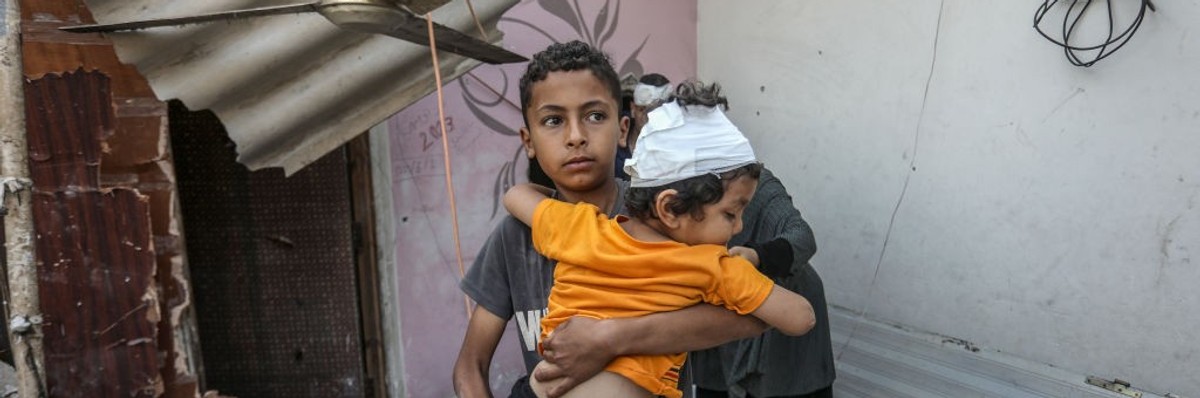
    Palestinians, including children, collect remaining belongings from the rubble of destroyed houses after Israeli attacks on May 1, 2024 in Rafah, Gaza.
     (Photo: Abed Rahim Khatib/Anadolu via Getty Images)

    A full-scale Israeli assault on the crowded southern Gaza city “would bring catastrophe on top of catastrophe for children.”

    “The children in Gaza need a cease-fire.”

    That’s how Catherine Russell, executive director of the United Nations Children’s Fund (UNICEF), concluded a brief video Wednesday about the harrowing conditions across the Gaza Strip, particularly in Rafah, where about 1.5 million of the besieged enclave’s 2.3 million residents have sought refuge from Israel’s devastating assault.

    The video was released nearly seven months into Israel’s retaliation for the Hamas-led October 7 attack—which has killed at least 34,596 Palestinians in Gaza, wounded another 77,816, and left thousands more missing—and as a full-scale Israeli assault of Rafah looms.

    The war has already taken “an unimaginable toll,” and a major military operation against the crowded southern Gaza city “would bring catastrophe on top of catastrophe for children,” Russell warned. “Nearly all of the some 600,000 children now crammed into Rafah are either injured, sick, malnourished, traumatized, or living with disabilities.”

    “Many have been displaced multiple times and lost homes, parents, and loved ones,” the UNICEF chief noted. “There is nowhere safe to go in Gaza. Homes throughout the Gaza Strip lie in ruin. Roads are destroyed and the ground littered with unexploded ordnances.”

    “Rafah is also the main hub for the humanitarian response, which includes UNICEF, and the city has some of the last functioning healthcare facilities,” she explained.

    Israeli forces launched at least 435 attacks on health facilities or personnel during the first six months of the war, and just 10 of the enclave’s 36 hospitals remain partially functional, according to the World Health Organization. As Common Dreams reported Wednesday, thousands of Palestinian child amputees are struggling to recover due to the destruction of Gaza’s healthcare system.

    “UNICEF continues to call for the protection of all women and children in Rafah and throughout the Gaza Strip—and the protection of the infrastructure, services, and humanitarian aid they rely on,” said Russell. “We repeat our calls for the unconditional release of all hostages in Gaza who need to be home with their children and families. The violence must end.”

    The agency’s five core demands for Gaza are:

    1. An immediate and long-lasting humanitarian cease-fire;
    2. Safe and unrestricted humanitarian access;
    3. The immediate, safe, and unconditional release of all abducted children, and an end to any grave violations against all children;
    4. Respect and protection for civilian infrastructure; and
    5. Allow patients with urgent medical cases to safely access critical health services or leave.

    As Russell called for peace in video form, James Elder, UNICEF’s global spokesperson, penned a Wednesday opinion piece for The Guardian following his recent trips to Gaza. He began with a startling anecdote:

    The war against Gaza’s children is forcing many to close their eyes. Nine-year-old Mohamed’s eyes were forced shut, first by the bandages that covered a gaping hole in the back of his head, and second by the coma caused by the blast that hit his family home. He is nine. Sorry, he was nine. Mohamed is now dead.

    “From looming famine to soaring death tolls, the latest fear is the much-threatened offensive in Rafah in southern Gaza,” he wrote. “Can it get any worse? It always seems to.”

    “Rafah will implode if it is targeted militarily,” Elder stressed. “Water is in desperately short supply, not just for drinking but sanitation. In Rafah there is approximately one toilet for every 850 people. The situation is four times worse for showers. That is, around one shower for every 3,500 people. Try to imagine, as a teenage girl, or elderly man, or pregnant woman, queueing for an entire day just to have a shower.”

    On October 31, just weeks after the start of what the International Court of Justice has since determined is Israel’s plausibly genocidal assault, UNICEF called Gaza a “graveyard” for children.

    “Can it get any worse? It always seems to.”

    “Last month I saw new graveyards in Rafah being constructed. And filled,” wrote Elder. “Every day the war brings more violent death and destruction. In my 20 years with the United Nations, I have never seen devastation like that I saw in the Gaza Strip cities of Khan Younis and Gaza City. And now we are told to expect the same via an incursion in Rafah.”

    Elder recalled that “in the north of the territory, close to where a UNICEF vehicle came under fire last month, a woman clutched my hand and pleaded, over and over, that the world send food, water, and medicine. I will never forget how, as I felt her grasp, I tried to explain we were trying, and she continued to plead.”

    “Why? Because she assumed the world did not know what was happening in Gaza. Because if the world knew, how could they possibly let this happen?” he continued. “How, indeed. The world has certainly been warned about Rafah. It remains to be seen how many eyes stay, or are forced, shut.”

    Original article by JESSICA CORBETT republished from Common Dreams under Creative Commons (CC BY-NC-ND 3.0). 

  • Antisemitism: The Big Lie Smearing Campus Protesters

    Spread the love

    Original article by RICHARD ESKOW republished from Common Dreams under Creative Commons (CC BY-NC-ND 3.0). 

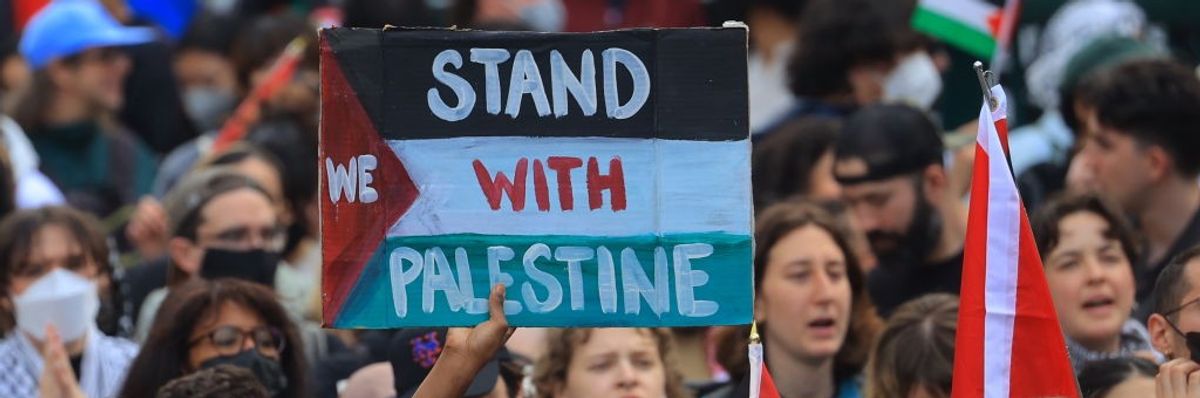
    Pro-Palestinian demonstrators and workers gather and take to the streets to protest against Israeli attacks on Gaza during ”May Day Rally” in New York, United States on May 01, 2024.  (Photo by Selcuk Acar/Anadolu via Getty Images)

    The people who make, report, and teach history should take note: it has never been kind to those who spread Big Lies. This time will be no different.

    Mainstream journalists and politicians have engaged in a campaign of mass slander against U.S. college students protesting the Gaza genocide. Their “antisemitism” Big Lie echoes the racist hate campaigns of the past, inciting hostility toward young people whose only crime is their dedication to justice.

    A newly published survey provides some important context for these protests and undermines the smear campaign against the protesters.

    Students Are Not Antisemitic

    The Chicago Project on Security and Threats (CPOST), a project of the University of Chicago, recently published “Understanding Campus Fears After October 7 and How to Reduce Them,” subtitled “a non-partisan analysis of Antisemitism and Islamophobia among College Students and American Adults.” Robert A. Pape, political scientist and CPOST’s director, writes that its findings “are an opportunity to re-center the national discussion around students and away from politics.” Let’s hope so.

    Understandably, Pape and his colleagues focus on the steps that should be taken to make all students feel safe on campus, regardless of religion, ethnicity, or politics. In doing so, their report includes important findings that deserve wider attention.

    Their “antisemitism’ Big Lie echoes the racist hate campaigns of the past, inciting hostility toward young people whose only crime is their dedication to justice.

    Is there a “climate of antisemitism” on campus? CPOST’s study found that college students are less Islamophobic than the general population, but they are not more antisemitic. The level of student bias against Jews is the same as their bias against Muslims, but no greater.

    Why, then, is there a national debate about campus antisemitism and none about the comparable scourge of Islamophobia? What message does that send to the Muslim students whose fears are being ignored?

    The Protests Aren’t Antisemitic, Either

    House Minority Leader Hakeem Jeffries wants a vote on the “Countering Antisemitism Act,” but neither he nor the president have proposed similar safeguards against Islamophobia. House Speaker Mike Johnson, who said that Columbia protesters have begun “to threaten lives and intimidate and harass people,” has an even more draconian antisemitism bill—also without plans to address Islamophobia.

    President Biden, like the others, has condemned what he calls “antisemitic protests.” That slur is challenged by the Chicago study. The authors found that “while college students are not more antisemitic than the general population,” they are “more anti-zionist.” They also found that “prejudicial antisemitism and anti-zionism are largely separate phenomena,” with an “overwhelming” absence of any overlap between antisemitism and a negative view of Israel.

    We’ve know for decades that the lie which equates anti-zionism with antisemitism serves a political goal by suppressing speech. We now have evidence to back it up.

    “From the River to the Sea”

    One protest slogan has been cited over and over as “antisemitic,” with accusers claiming it calls for genocide against Jews: “From the river to the sea, Palestine will be free.”

    Most students do not use it in anything approaching a genocidal way. The CPOST study found that only 14 percent of Muslim students, or roughly one in seven, interpret that slogan “to mean the expulsion or genocide of Israeli Jews.” That figure is too high, as is the 13 percent of students who believe that violence against Muslims is sometimes justified. But it also tells us that most people who use the slogan are not calling for harm against anyone.

    Does antisemitism exist among [protesters]? Since it is pervasive in this society, the answer is yes. But amplifying a comment or two from a couple of isolated individuals is a totalitarian smear tactic.

    That makes sense, since the phrase can be interpreted nonviolently in at least two ways. One is that a two-state solution should include the territory ceded to Palestine in 1948, which touched both the Jordan River and the Mediterranean Sea. Another is that Israel and Palestine should become a single, democratic, non-racial and non-theocratic state, with rights and safety for all. Under that interpretation, “Palestine will be free” is no more a call to genocide than “South Africa will be free” was a call to kill whites during the anti-apartheid struggle.

    The study does note that the slogan makes two-thirds of Jewish students feel unsafe. For that reason, Pape recommends avoiding it.

    But we now have confirmation that campus officials, politicians, and the media are misleading the public about that phrase. They’re endangering the protesting students and worsening the fears of pro-Israeli students. They should stop.

    Conclusion

    The political scientist Bernard Cohen once wrote that, while the press isn’t always successful and telling people what to think, “it is stunningly successful in telling people what to think about.” The student protests are a textbook example. The debate around these protests is focused on the false charge of antisemitism, not on the moral challenge raised by the protesters.

    Does antisemitism exist among them? Since it is pervasive in this society, the answer is yes. But amplifying a comment or two from a couple of isolated individuals is a totalitarian smear tactic. Republicans did it with the racist Willie Horton ads in 1988. Trump does it when he highlights crimes allegedly committed by immigrants. And politicians, journalists, and college administrators are doing it today with their charges of protester antisemitism.

    CPOST’s moderate recommendations for easing campus fears include, “Clear and immediate communication by college leaders condemning violence and intimidation by students and against students on their campuses.” Instead, those leaders are ordering police violence against protesting students, as they and the political/media elite stoke more fear and hatred against them—even in the wake of the anti-protestor mob violence at UCLA. That isn’t just wrong; it’s a dereliction of duty.

    As leaders, these prominent individuals have been entrusted with the care and protection of the nation’s young people. Instead, they’re slandering them and putting them at risk. Why? To distract us from a genocide.

    The people who make, report, and teach history should take note: it has never been kind to those who spread Big Lies. It won’t be this time, either.

    Original article by RICHARD ESKOW republished from Common Dreams under Creative Commons (CC BY-NC-ND 3.0).