Protesters take part in a demonstration outside the Foreign, Commonwealth and Development Office (FCDO) in Whitehall, London, calling for the government to protect the crew of Madleen, June 9, 2025
Jewish campaigners condemn Starmer’s claim that demonstrations against genocide are ‘un-British’
JEWISH campaigners have condemned Sir Keir Starmer’s “insulting” claim that demonstrations against genocide were “un-British.”
The Prime Minister’s remarks, made today, came ahead of several student protests on the anniversary of October 7, and the national march for Palestine this weekend.
An inter-university march set off in the capital from King’s College at 2pm, before passing the London School of Economics, University College London and ending at the gates of SOAS.
Joining them was Mark Etkind, the son of a Holocaust survivor, who said: “As we speak today, weapons made in Britain are contributing to the deaths of children and others in Gaza — that has to stop now in order to save those lives, so these brave student protesters have to keep demonstrating until that genocide stops.”
He accused the government of having slandered the students, making them out to be insensitive to October 7, “while ignoring the obvious fact that their priority is to … oppose the ongoing conflict which Britain unfortunately is complicit in.”
Rallies also took place in Sheffield, Glasgow and Edinburgh, where the institution’s principal emailed students warning them to “think carefully about their actions” ahead of the protest.
Edinburgh’s Justice for Palestine Society called it a “blatant attempt to suppress campus discourse on an ongoing genocide.”
Writing in the Times, Sir Keir said it was “un-British to have so little respect for others,” echoing comments made by Home Secretary Shabana Mahmood, who described Palestine protests held following Thursday’s attack on a Manchester synagogue as “fundamentally un-British.”
Naomi Wimborne-Idrissi, media officer for Jewish Voice for Liberation, said: “Those who protest are in despair at our government’s abject failure to take any kind of meaningful action to make the bombing, shooting, burning and starvation stop.
“For leaders of that government to accuse protesters of ‘un-Britishness’ is both insulting and counterproductive.
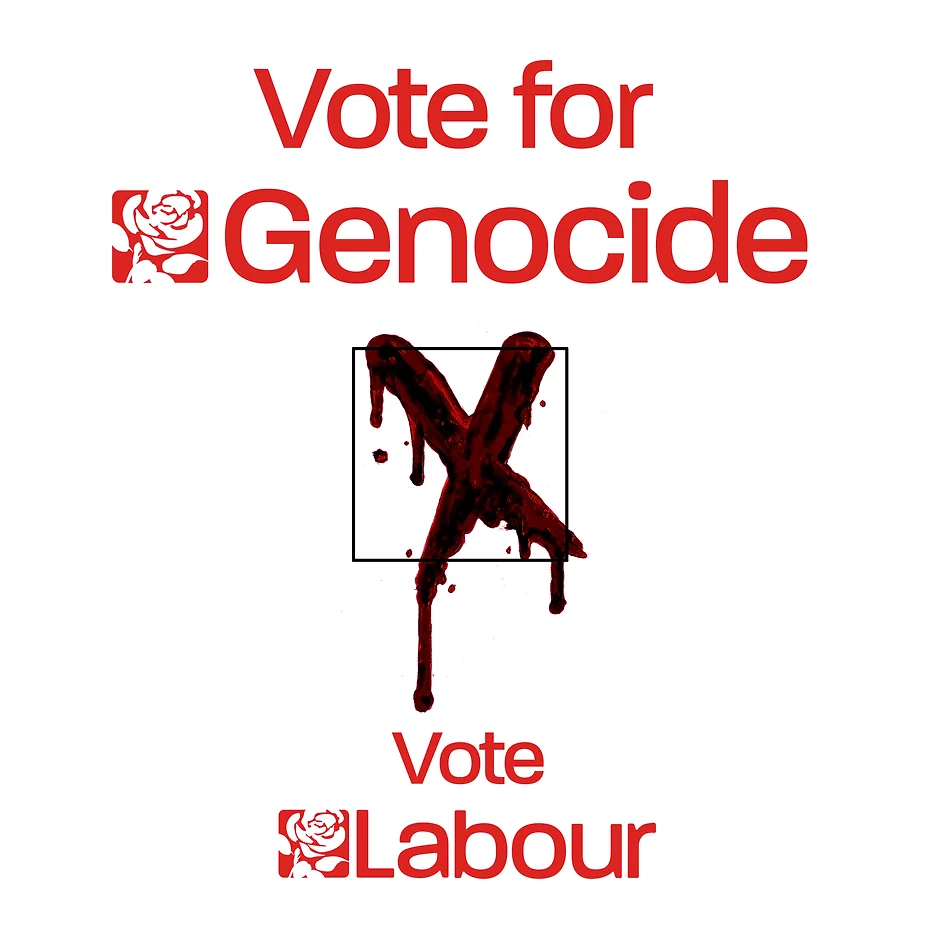
Keir Starmer objects to criticism of the IDF. He asks how could anyone object to them starving people to death, forced marches like the Nazis did, bombing Gaza’s hospitals and universities, mass-murdering journalists, healthworkers and starving people queuing for food, killing and raping prisoners and murdering children. He calls for people to stop obstructing his genocide for Israel.Orcas discuss Genocide-supporting and complicit Zionists. Donald Trump, Keith Starmer, David Lammy, Rachel Reeves, Angela Rayner and Wes Streeting are acknowledged as evil genocide-complicit and supporting cnuts.Vote Labour for Genocide.
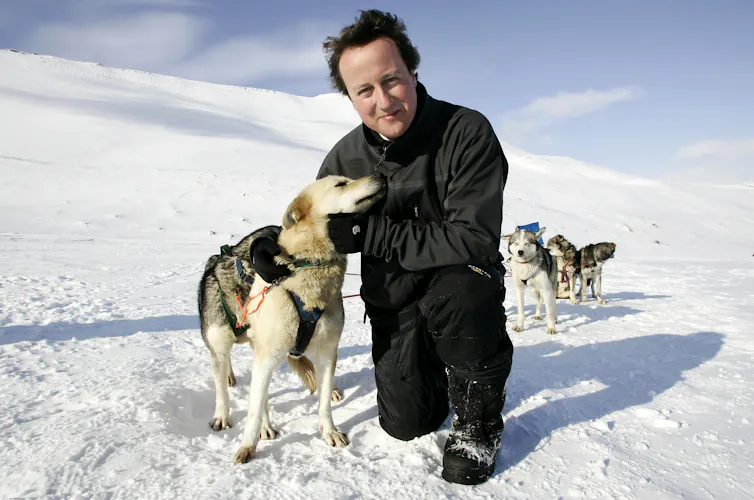
In the mid-2000s, soon after becoming Conservative leader, David Cameron hugged a husky on a trip to the Arctic, in what was widely described as an attempt to “detoxify” the Tory brand. Eighteen years later, Kemi Badenoch has promised to scrap the law that once made that rebranding credible.
Her announcement that the Conservatives will repeal the 2008 Climate Change Act if they win the next general election has the potential to be a major own goal – politically, environmentally and economically.
To understand why, we need to remember how the Climate Change Act came about. The bill was put forward by the Labour government of Gordon Brown, but it had enthusiastic support from the Conservative opposition, which tabled several amendments to strengthen it. Cameron had concluded that green policies were a good way to modernise his party and lead it back into power.
It worked, both for Cameron, who became prime minister in 2010, and for UK climate policy, which has enjoyed a unique period of consensus and stability. Over seven governments, multiple economic crises, Brexit, COVID-19 and the war in Ukraine, there has been clarity about Britain’s climate change objectives. Policies were chopped and changed, often to the frustration of investors, but the institutional framework was stable and widely appreciated.
The Climate Change Act gives the UK a statutory long-term emissions target – initially an 80% cut from 1990 levels by 2050, strengthened to net zero by 2050 by Theresa May, another Tory prime minister.
Progress is managed through a series of five-year carbon budgets, legislated 12 years in advance and monitored by a powerful independent body, the Climate Change Committee (CCC). For much of its existence, the CCC has been chaired by yet another environmentally-minded Tory, Lord Deben (John Gummer). It is this framework the Conservatives now say they want to dismantle.
Husky hugger David Cameron visits Svalbard, Norway, in 2008. Andrew Parsons / PA
Yet the Climate Change Act has delivered, both in terms of process and substance. Indeed, the UK model has been emulated around the world. Nearly 60 countries have UK-style climate change laws and over 20 countries have CCC-style advisory bodies, cementing the UK’s position as a climate leader.
The act gives the UK a steady institutional rhythm. Relevant businesses and other organisations know the formal set pieces, such as the CCC’s annual report to parliament, and can time their interventions accordingly.
When colleagues and I interviewed people from business and civil society about the act a few years ago, they emphasised the predictable process, the clear rules on accountability and the evidence-based discourse it has enabled. This all reduces uncertainty and enables long-term planning.
Importantly, the Climate Change Act has delivered environmentally too. Compared to 1990, UK greenhouse gas emissions are down by 50%. The UK economy now uses three times less carbon per unit of economic output than in 1990. Emissions are at their lowest level since 1872.
This trend started before the act, but it was helped and accelerated by it. This is perhaps most noticeable in the radical transformation of the electricity sector: coal has been completely phased out, while offshore wind and other renewables have flourished.
Most people want climate action
Voters value this progress more than politicians appreciate. A University of Oxford survey found that internationally public support for climate action is almost twice as high as policymakers assume. In the UK, three out of four people are fairly or very concerned about climate change.
Badenoch’s announcement comes just as households are starting to reap the financial benefits of clean technology. Colleagues and I have estimated that four out of five UK households, particularly those owning a car, would be better off if net zero was achieved. The typical savings are £100-£380 per household and year.
It is true that households do not yet see the benefits of renewables on their energy bills. We are still paying for the high costs of early investments in clean power, before technology and sheer scale brought the price down.
Successive governments have chosen to recoup these learning costs through electricity bills, rather than general taxation, which would have been easier on most households. But recent analysis suggests renewables are now cutting electricity prices by up to a quarter.
The policy uncertainty generated by the Tory announcement and similar pronouncements by Reform UK will eventually find its way into the risk premiums for investors, though for the time being this effect is still small.
But the reputational damage is immediate. Undoing the act would signal that the UK no longer values the long-term stability that has driven clean investment and made its climate policy admired around the world.
Climate policy requires debate. Deeply political choices need to be made about different decarbonisation strategies, how to pay for necessary investments or the role of controversial technologies like nuclear energy. The past 17 years have shown that these debates are best had within an agreed framework, with support from all major parties. That is what the Climate Change Act provides.
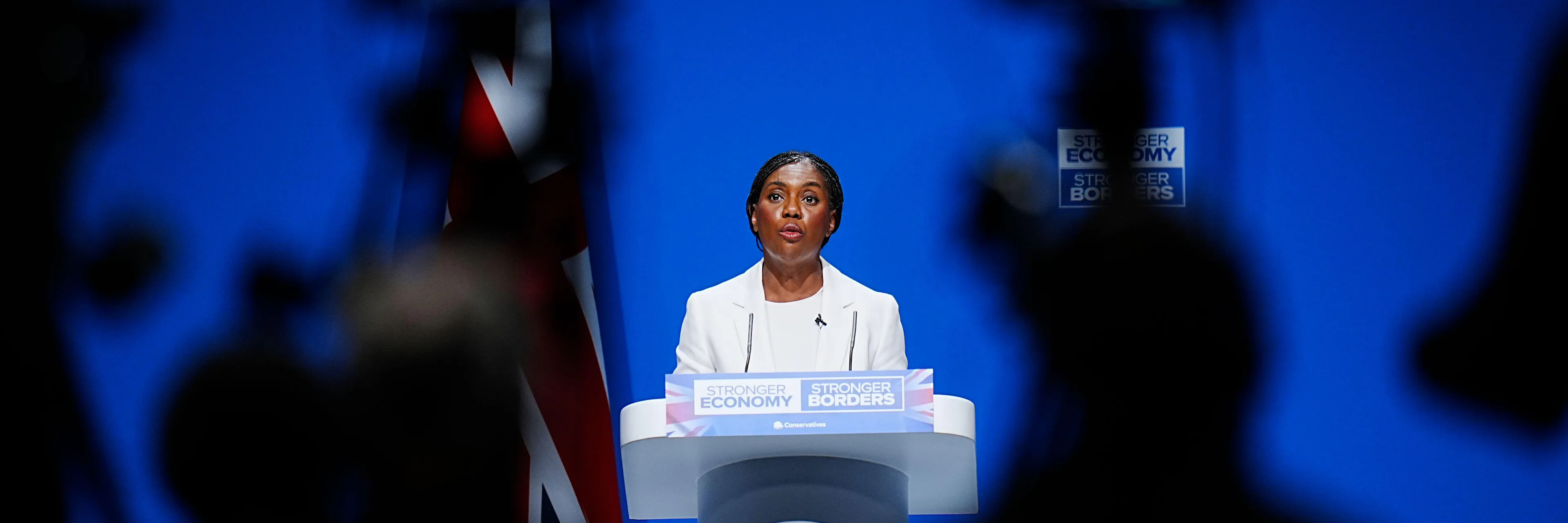
UK Conservative Party leader Kemi ‘not a genocide’ Badenoch explains her reality that the Earth is flat, the Moon is made of cheese and that she was born from
Unicorn horn dustNigel Farage urges you to ignore facts and reality and be a climate science denier like him. He says that Reform UK has received £Millions and £Millions from the fossil fuel industry to promote climate denial and destroy the planet.Orcas discuss how Trump was re-elected and him being an obviously insane, xenophobic Fascist.
To keep global warming below 1.5°C, greenhouse gas emissions had to peak no later than 2025. That was a key finding of the IPCC’s most recent major report on the topic, published a few years ago. Yet when we surveyed UK MPs and members of the public in four countries, fewer than 15% could identify this deadline correctly.
This matters. If politicians and voters underestimate how urgently we have to fight climate change, they are less likely to back the tough policies needed. Instead, they risk assuming we have more time, all while climate change targets slip further out of reach.
Our study, published in the journal Communications Earth and Environment, found that across Britain, Canada, Chile and Germany, about one-third of respondents thought emissions only had to peak by 2040 or later. In the UK, we also surveyed MPs. We found Labour politicians were more likely than Conservatives to answer correctly, but overall awareness was low in both groups.
Among the public, younger people, those worried about climate change, and those less prone to believing conspiracy theories were the most likely to know the right answer. But overall, the pattern was clear: most people – and most MPs – don’t grasp the urgency of the situation.
The distribution of responses was remarkably similar across the four countries. Kenny and Geese (2025)
Why awareness matters
Knowing the scientific facts does not automatically spur action. But political priorities are shaped by what MPs or their constituents consider as urgent (MPs sometimes cite a lack of urgency from constituents as an excuse for not taking climate actions even when they are concerned about it).
If neither MPs nor their voters realise how pressing the problem is, climate change risks being overlooked in favour of other issues. That MPs were largely not aware that much more immediate action was required may help explain why, by mid-2024, the UK was already behind the pace required to meet its own emissions reduction targets.
Partisan divides reinforce the problem. In our survey, 2019 Labour voters were more likely to know the correct 2025 deadline than those who voted Conservative. Political differences in knowledge were greater than the gap between MPs and the public, suggesting that party identity or political ideology, not just parliamentary expertise, is a factor in level of awareness.
Many of those Conservative MPs were replaced by new Labour MPs in the 2024 election, so perhaps a repeat survey today would show greater awareness of climate change among parliamentarians. But even Labour MPs are still not very likely to appreciate the urgency.
Labour-Tory was a bigger divide than public-politician. Kenny and Geese (2025)
The communication challenge
The IPCC and other big institutions produce authoritative reports, but they are not always written in a manner accessible to non-specialists. Policymakers are inundated with these reports and are expected to absorb huge amounts of information, digest it, and act on it. Crucial findings can get lost in the detail. If the urgency of climate action is not communicated clearly and memorably, it is less likely to be a factor in forming policy.
In the UK, scientists have long made “global greenhouse gases need to peak by 2025 for 1.5°C” a centrepiece of public and political communications. For example, it is there in the slogan of the Tyndall Centre, the major climate research hub where we work, that this is a Critical Decade for Climate Action.
But our findings suggest this message is not cutting through, with either politicians or the public. If deadlines are misunderstood, policies will inevitably not go far enough.
Make timelines impossible to ignore
The science is clear: emissions really did need to peak this year for a chance of staying within 1.5°C. A number of studies suggest this target is now effectivelyunreachable given the lack of substantial progress in recent years, but the urgency remains.
To close the gap between science and politics, communications must be sharper. Reports need to highlight timelines and consequences in ways that are impossible to ignore. Politicians and the public need to understand not just the scale of the climate crisis, but how immediate it is.
John Kenny, Research Fellow (Public Engagement with Climate Change), School of Environmental Sciences, University of East Anglia and Lucas Geese, Research Fellow, Tyndall Centre and School of Environmental Sciences, University of East Anglia
UK Conservative Party leader Kemi ‘not a genocide’ Badenoch explains her reality that the Earth is flat, the Moon is made of cheese and that she was born from
Unicorn horn dustNigel Farage urges you to ignore facts and reality and be a climate science denier like him. He says that Reform UK has received £Millions and £Millions from the fossil fuel industry to promote climate denial and destroy the planet.Orcas discuss how Trump was re-elected and him being an obviously insane, xenophobic Fascist.
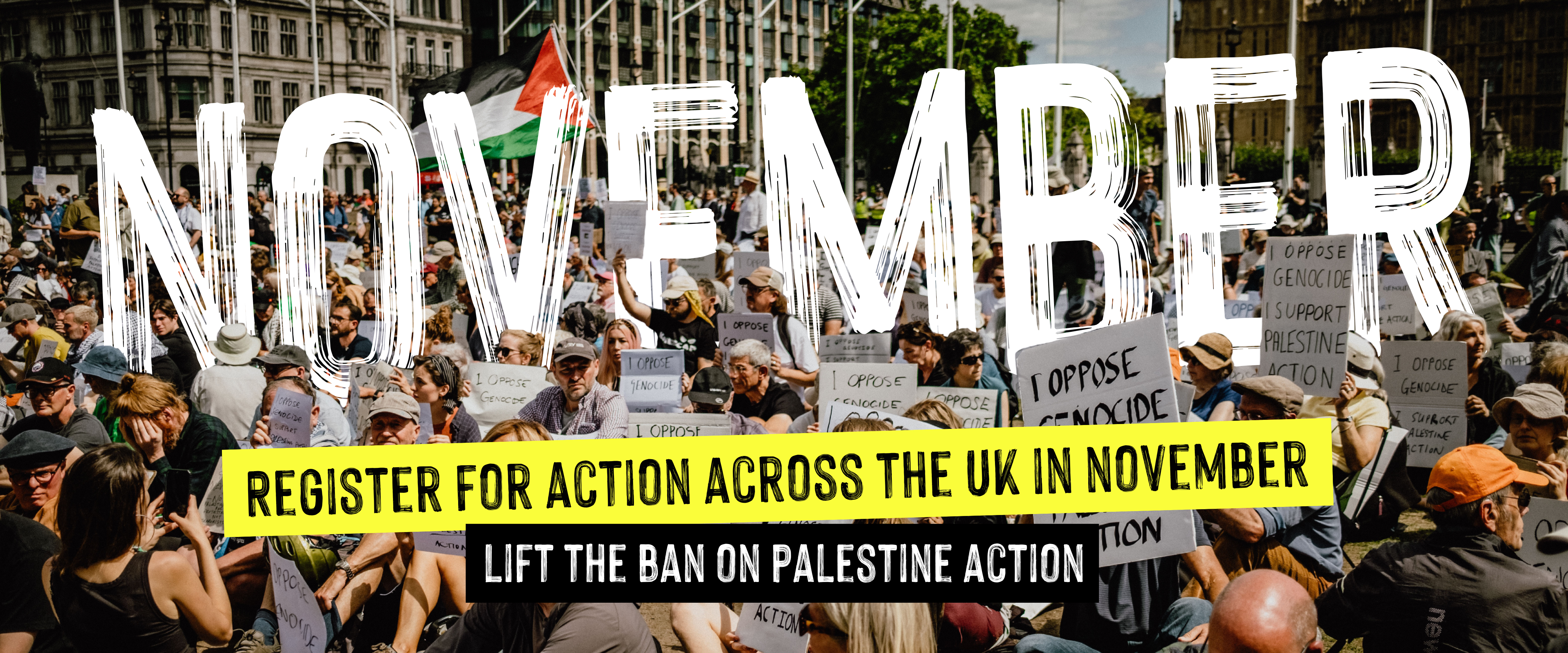
In November, Defend Our Juries will be escalating the campaign to Lift The Ban on Palestine Action ahead of the Judicial Review against the ban.
From Tuesday 18th November to Saturday 29th November, join thousands of others across the UK and in London on key dates, for the opportunity to hold seven peaceful words in unity.
There are signs that the authoritarian powers are cracking, the police are struggling to enforce this absurd law, with some police forces outright refusing to make arrests. International and national human rights groups, politicians and United Nations representatives have condemned both the ban and the subsequent attacks on our civil liberties. Unions are declaring that they will not recognise the ban, while over 1600 people were arrested prior to our October 4th action.
We will be holding our signs around the UK in key cities and towns, as well as converging on London for the Judicial Review Itself (25-27 November). Book time off now, and sign the form to tell us where you’ll be taking action.
We will not comply with anti-democratic laws. We call on the UK Government to Lift The Ban on Palestine Action and to end UK complicity in Israel’s genocide.
In unity, not uniformity, we join together.
*Please note that these actions come with significant risk of arrest and other legal consequences. Legal briefings and ongoing support are offered by Defend Our Juries and supporting organisations, to help ensure you are informed prior to taking action.
Keir Starmer objects to criticism of the IDF. He asks how could anyone object to them starving people to death, forced marches like the Nazis did, bombing Gaza’s hospitals and universities, mass-murdering journalists, healthworkers and starving people queuing for food, killing and raping prisoners and murdering children. He calls for people to stop obstructing his genocide for Israel.Palestine Action joke that appeared in the UK satirical magazine ‘Private Eye’.Orcas discuss Genocide-supporting and complicit Zionists. Donald Trump, Keith Starmer, David Lammy, Rachel Reeves, Angela Rayner and Wes Streeting are acknowledged as evil genocide-complicit and supporting cnuts.
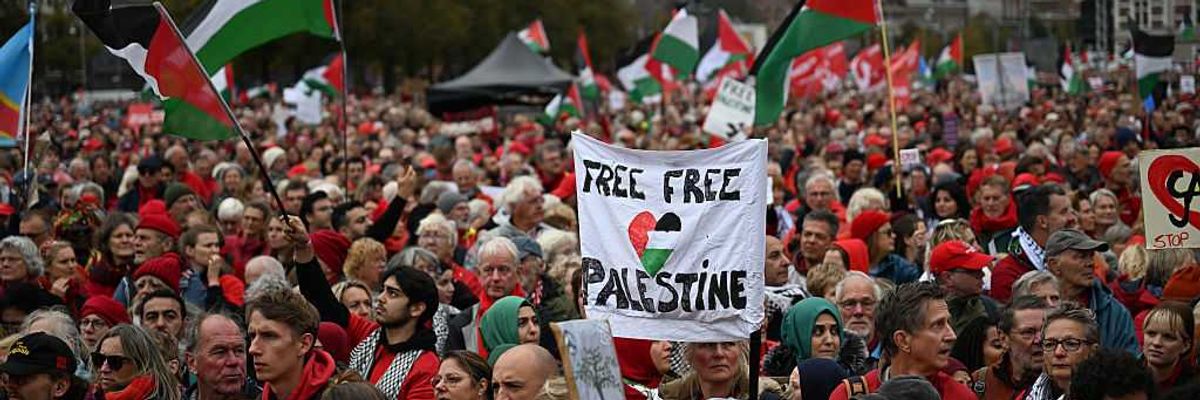
Thousands of demonstrators gather at Museumplein demanding firm government action to stop the Israeli attacks on Gaza, in Amsterdam on October 5, 2025. (Photo by Mouneb Taim/Anadolu via Getty Images)
An estimated 250,000 people dressed in red crowded into Museum Square in Amsterdam, demanding that the Dutch government end its support for Israel.
Expressing solidarity with Palestinians in Gaza and pressuring Dutch officials to end their longtime support for Israel were the goals of a massive demonstration in Amsterdam Sunday—one of the largest pro-Palestine protests held in Europe over the weekend as the two-year anniversary of Israel’s bombardment of the exclave approached.
“The bloodshed must stop—and we unfortunately have to stand here because we have such an incredibly weak government that doesn’t dare to draw a red line. That’s why we are here, in the hope that it helps,” protester Marieke van Zijl told the Associated Press on Sunday in Museum Square in central Amsterdam, where an estimated 250,000 people gathered.
The protests in Amsterdam and across Europe came as Israel garnered global condemnation for its interception of more than 400 humanitarians from around the world who sailed toward Gaza in recent weeks with the Global Sumud Flotilla with the aim of delivering aid to the besieged territory, where a famine was declared in August due to Israel’s near-total blockade on food, water, fuel, and other necessities entering Gaza.
Wow!
Amsterdam today 🇳🇱
A tsunami of people demanding an end to Israel’s genocide in Gaza.
In Sofia, Bulgaria, citizens carried signs reading, “Gaza: Starvation Is a Weapon of War,” while in Turkey’s capital of Ankara, protesters held up placards condemning Israel’s genocide in Gaza, where more than 67,000 Palestinians have been killed since October 2023.
Scholars on genocide and the Holocaust have joined leading human rights organizations—including some in Israel—and United Nations experts in declaring that Israel’s bombardment of Gaza is a genocide. The International Court of Justice is also considering an ongoing genocide case brought by South Africa regarding the military assault and starvation policy.
In Amsterdam, most protesters wore red in solidarity with Palestine and many displayed Palestinian flags.
In the Netherlands, the government has long been a staunch supporter of Israel but in recent months has increasingly denounced its attacks on Gaza. In July it banned Israeli Prime Minister Benjamin Netanyahu and National Security Minister Itamar Ben-Gvir from entering the country because they “repeatedly incited violence against the Palestinian population.”
On Friday, Dutch Foreign Minister David van Weel said he was “unlikely” to grant an export license to send F-35 fighter jet components to Israel. The country’s Supreme Court last week ordered the government to review the currently suspended license to determine whether reinstating it would violate international law. The Netherlands is home to one of three regional warehouses for components of the US-made fighter jets.
Marjon Rozema, a spokesperson for Amnesty International, which helped organize the demonstration, called for the Dutch government to use “all economic and diplomatic means to increase pressure on Israel.”
Mass demonstrations were also held over the weekend in countries including Spain and Italy, where demonstrators demanded the release of organizers who had been aboard the Global Sumud Flotilla.
Hundreds of thousands of people marched in Rome, Madrid, and Barcelona, home of former Mayor Ada Colau, who was among those detained by Israel last week.
JUST IN: 300,000 people marched in Barcelona, one of the LARGEST pro-Palestinian protests in the city’s history! pic.twitter.com/fdPVrDNDwd
Organizers in Rome said 1 million people took part in Saturday’s march, which followed Friday’s one-day general strike across Italy.
“Governments, especially the Italians, are not taking action against what is happening in Gaza,” one university teacher told the BBC on Friday at a rally. “We’re here to say that it is time to intervene and solve things.”
Hundreds of thousands fill the streets of Rome in support of Gaza and in protest against the genocide. pic.twitter.com/NNovgFmI69
“The Italian demonstrations for Gaza and the flotilla have been of a rather unprecedented power in recent times,” said scholar Bruno Montesano on Monday. “And they have had a global resonance that is equally surprising. And perhaps its strength derived from a sort of widespread spontaneous humanitarianism, as well as from the clashing contradictions between Western liberal-democratic chatter—certainly weakened even further due to the rise of the far right—and the racist and colonial practice of supporting Israeli fascism.”
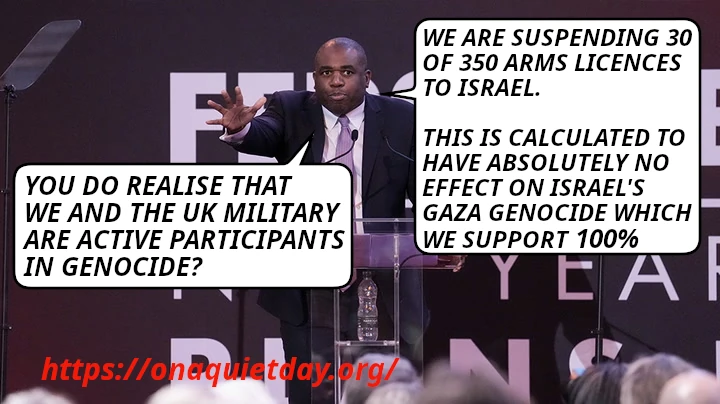
Keir Starmer objects to criticism of the IDF. He asks how could anyone object to them starving people to death, forced marches like the Nazis did, bombing Gaza’s hospitals and universities, mass-murdering journalists, healthworkers and starving people queuing for food, killing and raping prisoners and murdering children. He calls for people to stop obstructing his genocide for Israel.Orcas discuss Genocide-supporting and complicit Zionists. Donald Trump, Keith Starmer, David Lammy, Rachel Reeves, Angela Rayner and Wes Streeting are acknowledged as evil genocide-complicit and supporting cnuts.Genocide denying UK Foreign Secretary David Lammy says that UK is suspending 30 of 350 arms licences to Israel. He also confirms the UK government’s support for Israel’s Gaza genocide and the UK government and military’s active participation in genocide.

 Protesters take part in a demonstration outside the Foreign, Commonwealth and Development Office (FCDO) in Whitehall, London, calling for the government to protect the crew of Madleen, June 9, 2025