AFTER months in which Labour argued that such is the dire state of the economy that Tory spending limits must be maintained, the Chancellor of the Exchequer now says that further cuts in public expenditure are needed.
…
The question raised by any talk about varying the structure of taxation is where taxes fall. The richest 10 per cent of families hold 43 per cent of all wealth. The bottom 50 per cent — and be sure that this includes the greater proportion of people who see themselves as working class — possess less than 10 per cent of wealth.
…
When the overwhelming majority of voters, including Tory voters, see public ownership of rail, mail, water and energy as desirable this is not simply a yearning for the more efficient delivery of these services and utilities than private ownership is able to provide. More, it is an expression of a clear understanding that revenues from these myriad transactions should not be privately appropriated but applied to the common good.
The present Labour administration has, with rare exceptions, ruled out the recovery into public ownership of privatised sectors and, less performatively than Gordon Brown in his day but no less systematically, has assured the corporate world that not only are the foundations of private ownership safe but that Labour, even more than its Tory predecessors, holds appeasing the bond markets a central part of its economic strategy. Hence the cuts announced today.
Reeves’s dilemma is highlighted by the necessity to find £1 billion to fund the juniors doctors’ pay increase; something similar for the teachers and a backlog of other public-sector pay claims.
Under this system spending is always about priorities. But there is money about. She is already committed by Starmer’s diktat to find £57.1bn in defence spending in 2024-25 which is a 4.5 per cent increase in real terms. No cuts there!
A bigger source of revenue would result from taxing wealth at the same level as income by raising the capital gains and dividend tax rates to the level at which workers pay on their wages.
An even bigger windfall would result from a socialist economy in which all rents, interest and profits arising from human economic activity were held in common rather than being privately acquired.
At the end of last year, the UK was officially in recession. The economy shrank by 0.3% between October and December 2023, after a previous contraction between July and September.
New figures for January 2024 show a slight improvement. But there is nothing to indicate that the UK has made meaningful progress when it comes to productivity growth – and how the UK needs to produce more goods and services if living standards and wages are to improve.
Productivity growth in the UK has been virtually non-existent since the financial crisis of 2008. It lags significantly behind countries like Germany and France, and even further behind the US.
Growing productivity is not easy. Having researched this area of the economy extensively, I’m acutely aware of the the challenges facing firms which are trying to be more productive. They include everything from investment levels and access to research and development to regional inequality and a shortage of skills.
But there are some things that could be done to improve the situation. And two of the most important ones are greater investment, and a more localised approach to the national economy.
For example, one major problem in the UK is that its labour market prioritises what economists call “flexibility” – allowing firms to hire and fire employees fairly easily (compared say with France, where it is more difficult) – and getting people into entry-level jobs. It is much less focused on training and development.
Major investment in training at all levels, from basic skills through to high-level technical and managerial skills, would make workers more productive. It would allow greater job mobility, which in turn leads to a better match between demand and supply.
The UK also needs to invest in what’s known as “capital equipment” – the stuff that businesses use to produce things. For a building company this might mean buying a JCB digger instead of shovels, or for a dressmaker it could be buying a sewing machine. Put simply, if UK industries had more kit, productivity would improve.
A recent change to capital allowances which allows firms to offset investment against tax is welcome. But companies need to know that this will stay, and not be subject to political changes and inconsistent economic policy.
Freedom to grow
So money needs to be spent, and investments need to be made. But another crucial element is that the money needs to be invested locally, in the places where people actually live and work.
To be truly beneficial, this needs close collaboration between local authorities, education providers and the private sector. Local knowledge about where certain sectors are being held back, what skills are required and where they are needed, is fundamental.
Local authorities should be able to address these issues, rather than having to constantly defer to London. This means doing two more things (neither of which have ever had national government support).
The first is simplifying the workings of local government, which is notoriously complex and a constant drag on regional productivity.
And the second is helping those local governments financially, not just in terms of the current funding crisis, but also by allowing then to plan investments in skills and infrastructure over the long term, rather than having to bid piecemeal for short term funding.
It is clear to me from the work I have done in the West Midlands area of England that the UK economy is far too centralised. Everything from access to finance and venture capital, to investment in skills and infrastructure is heavily skewed towards the south east.
Away from that region, the UK has a low level of what economists call “aglomeration economies”, where a particular industry is concentrated within a geographical area, and supported by decent infrastructure and a good supply of skilled workers.
Compared to Germany or France, public transport in the UK is expensive and patchy, meaning people in towns often can’t access employment opportunities in cities which are relatively close by. This means that we see high levels of inequality over short distances, where poverty exists close by to great wealth.
This kind of imbalance could be addressed by combining increased investment (both public and private) with a much greater willingness to understand the various British regions which make up a currently disunited kingdom. These two steps would make the whole economic system more resilient, and in the long term, more productive.
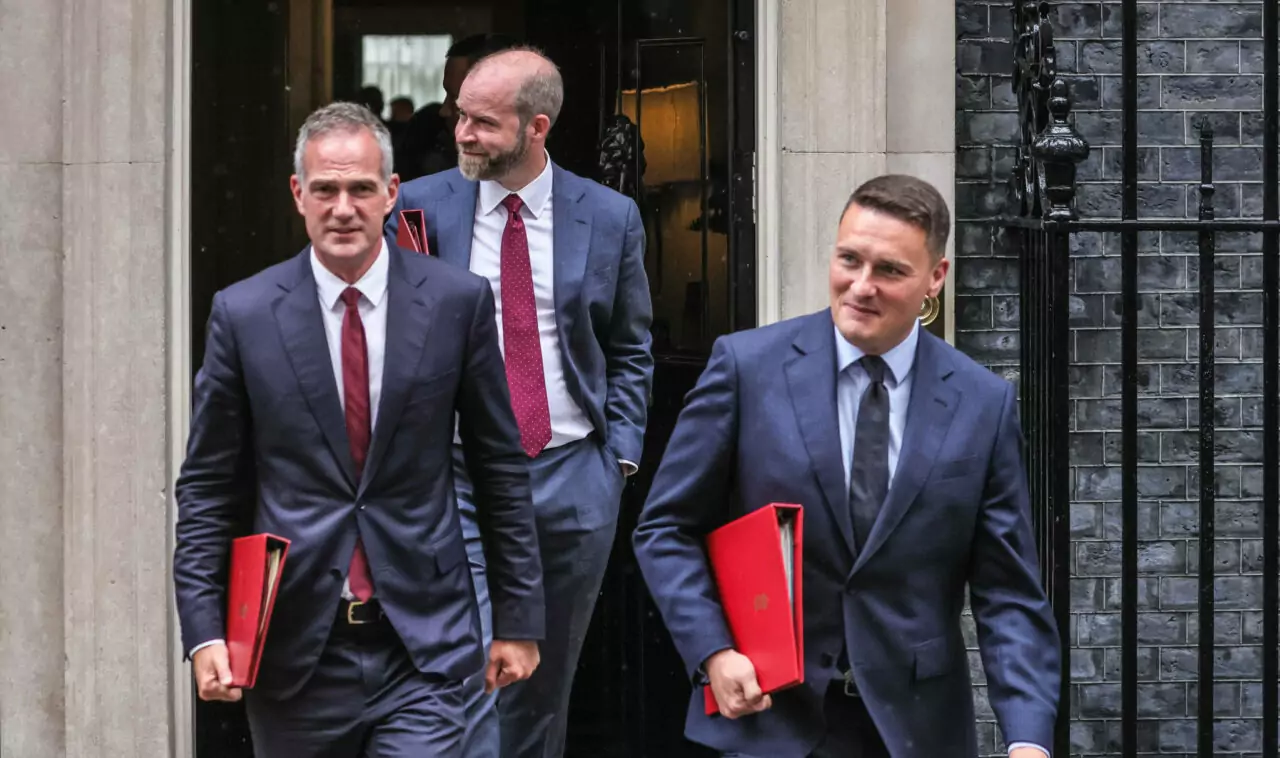
Wes Streeting, Peter Kyle and Jonathan Reynolds leave Starmer’s first cabinet meeting. (Photo: Alamy)
Declassified Exclusive: Labour’s top team has accepted over £600,000 from pro-Israel funders.
Pro-Israel lobbyists have donated to 13 out of Labour’s 25 cabinet members since they were first elected to parliament, Declassified can reveal.
The list of recipients includes prime minister Keir Starmer, his deputy Angela Rayner, chancellor Rachel Reeves, foreign secretary David Lammy and home secretary Yvette Cooper.
Jonathan Reynolds, who will oversee arms exports to Israel as UK trade secretary, is another beneficiary, alongside Labour’s election mastermind Pat McFadden, whose responsibilities now include national security.
Some of the donations were provided by Labour Friends of Israel (LFI), a lobby group which takes MPs on “fact-finding” missions to the region.
Reeves, McFadden, Reynolds and technology secretary Peter Kyle were recently listed as vice-chairs of LFI.
Other major funders include pro-Israel businessmen Gary Lubner, Trevor Chinn, and Stuart Roden.
The total value of the donations amounts to over £600,000.
…
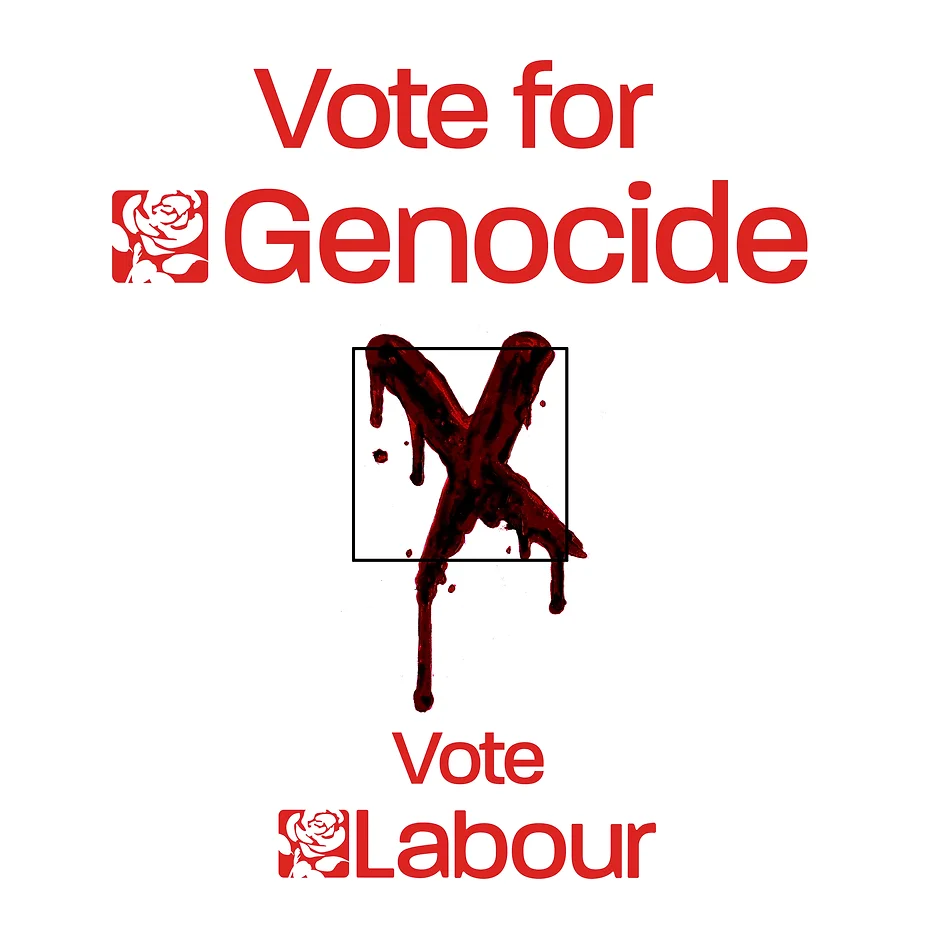
Vote For Genocide Vote Labour.Zionist Keir Starmer is quoted “I support Zionism without qualification.” He’s asked whether that means that he supports Zionism under all circumstances, whatever Zionists do.
Aides to Rachel Reeves and Wes Streeting took Israel lobby funding. (Photo: Stefan Rousseau via Alamy)
Israel is quietly financing assistants of British MPs, Declassified has found.
Israel has paid for at least a dozen UK parliamentary staff to visit the country on special delegations in the last five years.
A further 18 staffers have accepted funding or hospitality from pro-Israel lobby organisations in Britain such as Labour Friends of Israel and We Believe in Israel.
Several worked for MPs in Keir Starmer’s front bench team, including shadow chancellor Rachel Reeves, shadow health secretary Wes Streeting and shadow education secretary Bridget Phillipson.
Our investigation found how the Israeli embassy in London, its ministry of foreign affairs and associated lobby groups seek to influence not only MPs but also their assistants.
Declassified previously revealed that one in four British MPs in the last parliament accepted funding from pro-Israel lobby groups or individuals.
…
Israel lobby organisations have also sought to gain backdoor influence by funding, meeting, and providing hospitality to ministers’ special advisers, known as SPADs.
Special advisers are exempt from the Civil Service Code’s requirement of political impartiality.
Governmental departments are therefore [not?] required to publish the gifts and hospitality that they receive.
Deputy prime minister Oliver Dowden accepted funding from CFI when he was David Cameron’s SPAD in 2014.
Dowden was a prospective parliamentary candidate for Hertsmere at that time.
CFI paid for a special adviser to Cabinet Office minister Francis Maude to travel to Israel that same year, while in 2015 another four Downing Street special advisers received hospitality from CFI.
The group has continued to lobby SPADs in the prime minister’s and deputy PM’s office, as well as the leader of the House of Lords.
…
Zionist Keir Starmes is quoted “I support Zionism without qualification.” He’s asked whether that means that he supports Zionism under all circumstances, whatever Zionists do.
Zionist Keir Starmes is quoted “I support Zionism without qualification.” He’s asked whether that means that he supports Zionism under all circumstances, whatever Zionists do.
“Stability is Change!” This seemingly paradoxical, almost Orwellian statement is the principal slogan of the Labour Party’s current parliamentary election campaign. Labour leader Keir Starmer used the slogan at the party’s manifesto launch, and it provides a key prism for understanding the manifesto and its weaknesses.
There is little doubt that the UK electorate is in the mood for change. The widespread, off-stated consensus in the country is that nothing works. The National Health Service is so chronically underfunded that doctor’s appointments are difficult to get and long waiting lists proliferate. The trains are shockingly expensive but utterly unreliable.
The list could go on and on, but the image most frequently used to sum up the situation comes from the failure of the privatized water services. A lack of investment in infrastructure accompanied by the looting of those companies for huge shareholder dividend payouts has led to the near constant release of untreated sewage into the UK’s river system. It flows from there onto our beaches. The British are quite literally swimming in shit!
These problems are identified quite clearly in the Labour Party manifesto, but the diagnosis of their causes and therefore their solutions proves much less convincing. Labour may have a plan to win in July, but how it will govern in the interests of its voters is anybody’s guess.
…
The totality of Labour’s spending pledges amounts to just 0.2 percent of GDP, smaller even than the Conservative pledges of 0.8 percent and dwarfed by the previous two Labour manifestos, which promised 2.1 percent and 3.2 percent respectively. Even the pro-market Institute for Fiscal Studies called Labour’s plans “tiny, going on trivial”.
These policies do not point to stability, not least because they do not address the 18 billion pounds of government spending cuts that the Conservatives have already baked into the government budget going forward. The effects of implementing such cuts on government services — which have already suffered so badly under 14 years of severe austerity — makes it hard to imagine that Labour will stick to this commitment. It seems likely that money will be found to prevent the worst of these cuts through technical changes in accounting between the government and the notionally independent Bank of England.
Beyond this paddling, however, the need for investment in the UK is huge. Both public and private investment in the country has collapsed since 2008. It hasthe lowest business investment in the G7 and ranks just twenty-eighthout of the 31 OECD countries. In the face of this, Labour, hamstrung by self-imposed fiscal rules on bringing down government debt and pledges not to raise the main forms of taxation, are promising so little investment that their plans seem unbelievable.
…
Until last February, Labour was promising to immediately strengthen workers’ rights through a New Deal for Workers, and to spend 28 billion pounds per year to decarbonize the economy through its Green Prosperity Plan. The Labour Party’s current openness to corporate funding and lobbying, including the imposition of over30 parliamentary candidates with corporate lobbying backgrounds, has led to a dramatic watering down of these pledges. The Green Prosperity Plan has been reduced to just 3.5 billion pounds, but the form that spending will take reveals another logic or worldview which may come to the fore as crises mount.
The word “securonomics”, an ugly portmanteau favoured by shadow chancellor Rachel Reeves, makes an appearance in the manifesto, introducing the idea that public investment should support and de-risk private investment in strategically key sectors. The chief vehicle for this will be a National Wealth Fund “capitalised with £7.3 billion over the course of the next parliament”. What precisely this will look like has yet to be determined, but The National Wealth Fund “will have a target of attracting three pounds of private investment for every one pound of public investment”. This is an explicit return to and acceleration of the kind of public-private partnerships that lost legitimacy in the UK during the fallout from the disastrous Public Finance Initiative under New Labour.