Whale and Dolphin Migrations are Being Disrupted by Climate Change

Spread the love

Original article by Teresa Tomassoni republished from Inside Climate News under Creative Common License (CC BY-NC-ND 3.0)
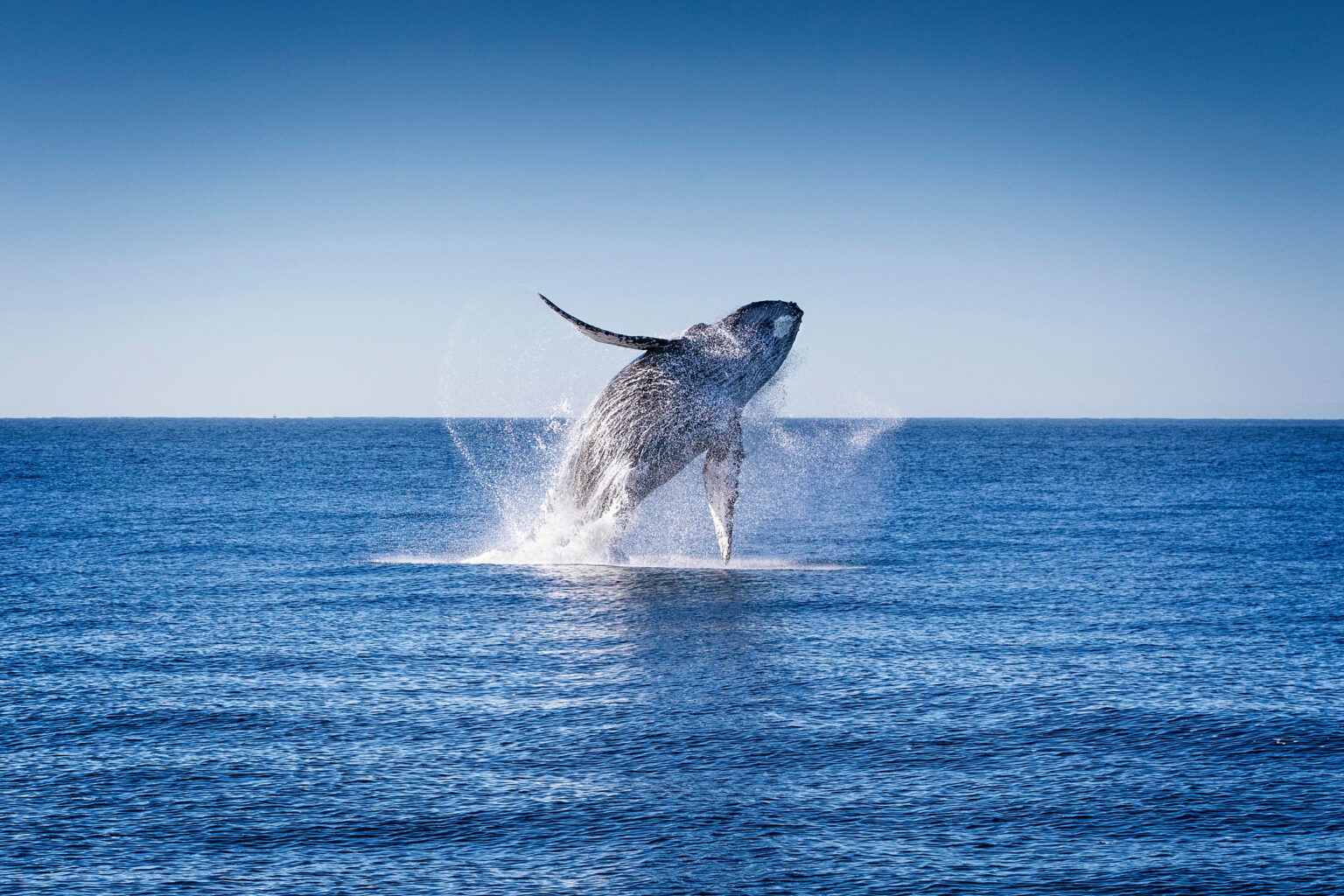
A humpback whale jumps out of the waters of the Pacific Ocean near Cabo San Lucas, Mexico. Credit: Alfredo Martinez/Getty Images

Rising ocean temperatures, heatwaves and dwindling prey are forcing marine mammals into new and more dangerous waters, scientists warn.

For millennia, some of the world’s largest filter-feeding whales, including humpbacks, fin whales and blue whales, have undertaken some of the longest migrations on earth to travel between their warm breeding grounds in the tropics to nutrient-rich feeding destinations in the poles each year. 

“Nature has finely tuned these journeys, guided by memory and environmental cues that tell whales when to move and where to go,” said Trisha Atwood, an ecologist and associate professor at Utah State University’s Quinney College of Agriculture and Natural Resources. But, she said, climate change is “scrambling these signals,” forcing the marine mammals to veer off course. And they’re not alone. 

Earlier this year, Atwood joined more than 70 other scientists to discuss the global impacts of climate change on migratory species in a workshop convened by the United Nations Convention on the Conservation of Migratory Species of Wild Animals. The organization monitors and protects more than 1,000 species that cross borders in search of food, mates and favorable conditions to nurture their offspring. 

More than 20 percent of these species are on the brink of extinction. It was the first time the convention had gathered for such a purpose, and their findings, published this month in a report, were alarming. 

“Almost no migratory species is untouched by climate change,” Atwood said in an email to Inside Climate News. 

From whales and dolphins, to arctic shorebirds and elephants, all are affected by rising temperatures, extreme weather and shifting ecosystems, which are disrupting migratory routes and reshaping critical habitats across the planet. 

Asian elephants, for instance, are being driven to higher ground and closer to human settlements as they search for food and water amidst intensifying droughts, fueling more frequent human-elephant conflicts, the report found. Shorebirds are reaching their Arctic breeding grounds out of sync with the insect blooms their chicks depend on to survive. 

The seagrass meadows that migrating sea turtles and dugongs feed on are disappearing due to warmer waters, cyclones and sea level rise, according to the report. To date, around 30 percent of the world’s known seagrass beds have been lost, threatening not only the animals that depend on them, but also humans. These vital ecosystems store around 20 percent of the world’s oceanic carbon, in addition to supporting fisheries and protecting coastlines. 
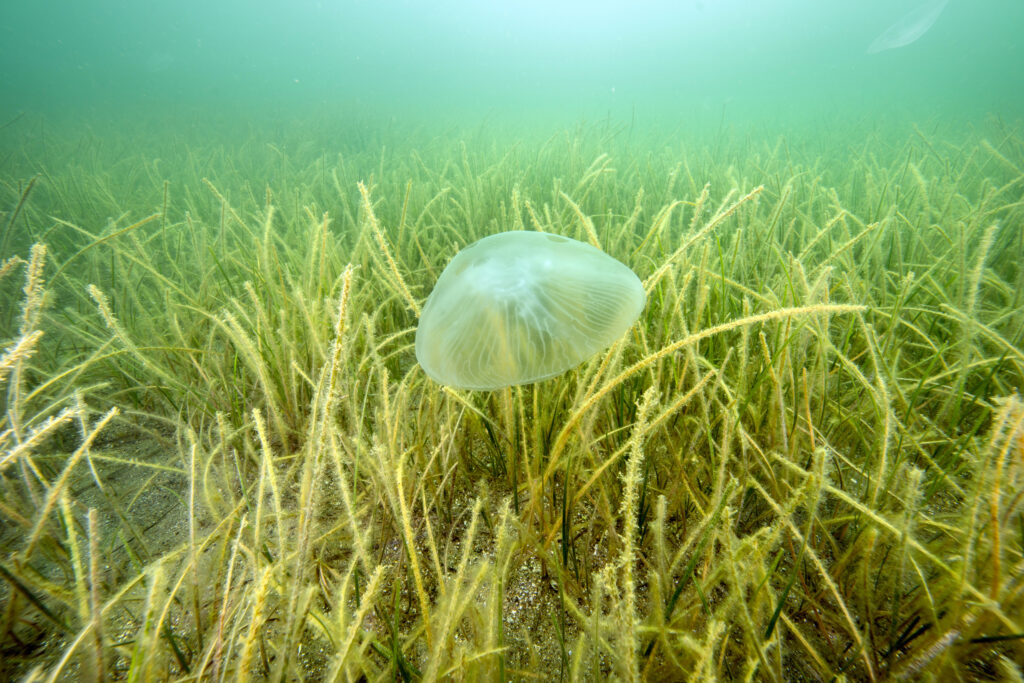
A view of seagrass meadows found in the depths of Izmit Bay off the coast of Karamursel, Turkey. Credit: Tahsin Ceylan/Anadolu via Getty Images

Together, these examples reveal how climate change is tipping the delicate balance migratory species have long relied on to survive. 

“Climate change is disrupting this balance by altering when and where resources appear, how abundant they are, the environmental conditions species must endure, and the other organisms they interact with, reshaping entire networks of predators and competitors,” Atwood said. 

Especially amongst marine life. 

On the United States’ West Coast, for instance, Atwood said, warming waters are pushing juvenile great white sharks out of their traditional southern habitats. This shift has led to a sharp rise in sea otter deaths in Monterey Bay, California, where they are increasingly getting bitten by the sharks.

Whales and dolphins are particularly vulnerable species as rising temperatures threaten both their prey and their habitat, according to the report. 

Heatwaves in the Mediterranean are projected to reduce suitable habitat for endangered fin whales by up to 70 percent by mid-century as their prey dwindles or moves due to rising temperatures. In some places, such as the Northern Adriatic Sea, hotter temperatures may eventually prove intolerable for bottlenose dolphins. “Rising water temperatures could exceed the species’ physiological tolerance,” the report says, which also acknowledges that this is already happening in other parts of the world, such as the Amazon River. 
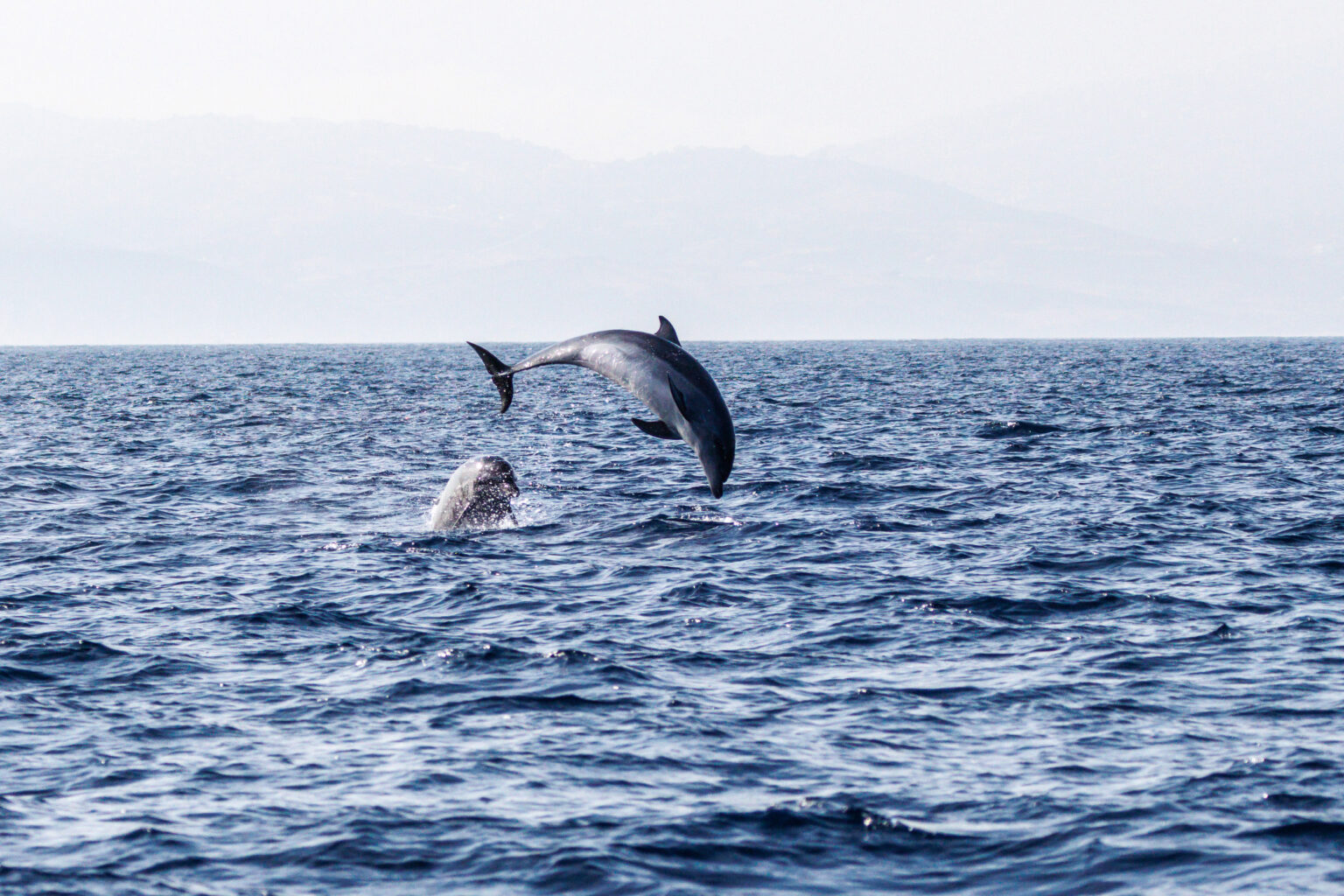
Two bottlenose dolphins play in the Mediterranean Sea off the coast of Tarifa, Spain on Sept. 21. Credit: Matthias Balk/picture alliance via Getty Images

In 2023, more than 200 river dolphins, which migrate seasonally between tributaries and lagoons in the Amazon, died due to record-high temperatures, along with much of their prey. In some areas, their shallow aquatic habitats exceeded 100 degrees Fahrenheit. “The river systems were unusually empty and dry and the animals got isolated,” said Mark Simmonds, scientific councilor for marine pollution for the U.N. convention, who led some of the discussions around climate change impacts on cetaceans at the workshop in February. “They lost the water that they would have been living in.” 

Loss of prey in traditional habitats is of particular concern for migrating marine mammals that are forced to follow their prey into new, and sometimes more perilous, waters. 

This is particularly evident in the case of critically endangered North Atlantic Right whales, which the report says are especially prone to ship strikes and entanglement in fishing gear as they pursue their prey—tiny crustaceans called copepods—which are moving towards cooler waters. There are fewer than 400 of the whales left.

The North Pacific humpback whales that feed off the coast of California are also at risk. 

Original article by Teresa Tomassoni republished from Inside Climate News under Creative Common License (CC BY-NC-ND 3.0)

Orcas comment on killer apes destroying the planet by continuing to burn fossil fuels.
Donald Trump urges you to be a Climate Science denier like him. He says that he makes millions and millions for destroying the planet, Burn, Baby, Burn and Flood, Baby, Flood.
Nigel Farage urges you to ignore facts and reality and be a climate science denier like him and his Deputy Richard Tice. He says that Reform UK has received £Millions and £Millions from the fossil fuel industry to promote climate denial and destroy the planet.

Continue ReadingWhale and Dolphin Migrations are Being Disrupted by Climate Change

How thousands of fossil fuel lobbyists got access to UN climate talks – and then kept drilling

Spread the love
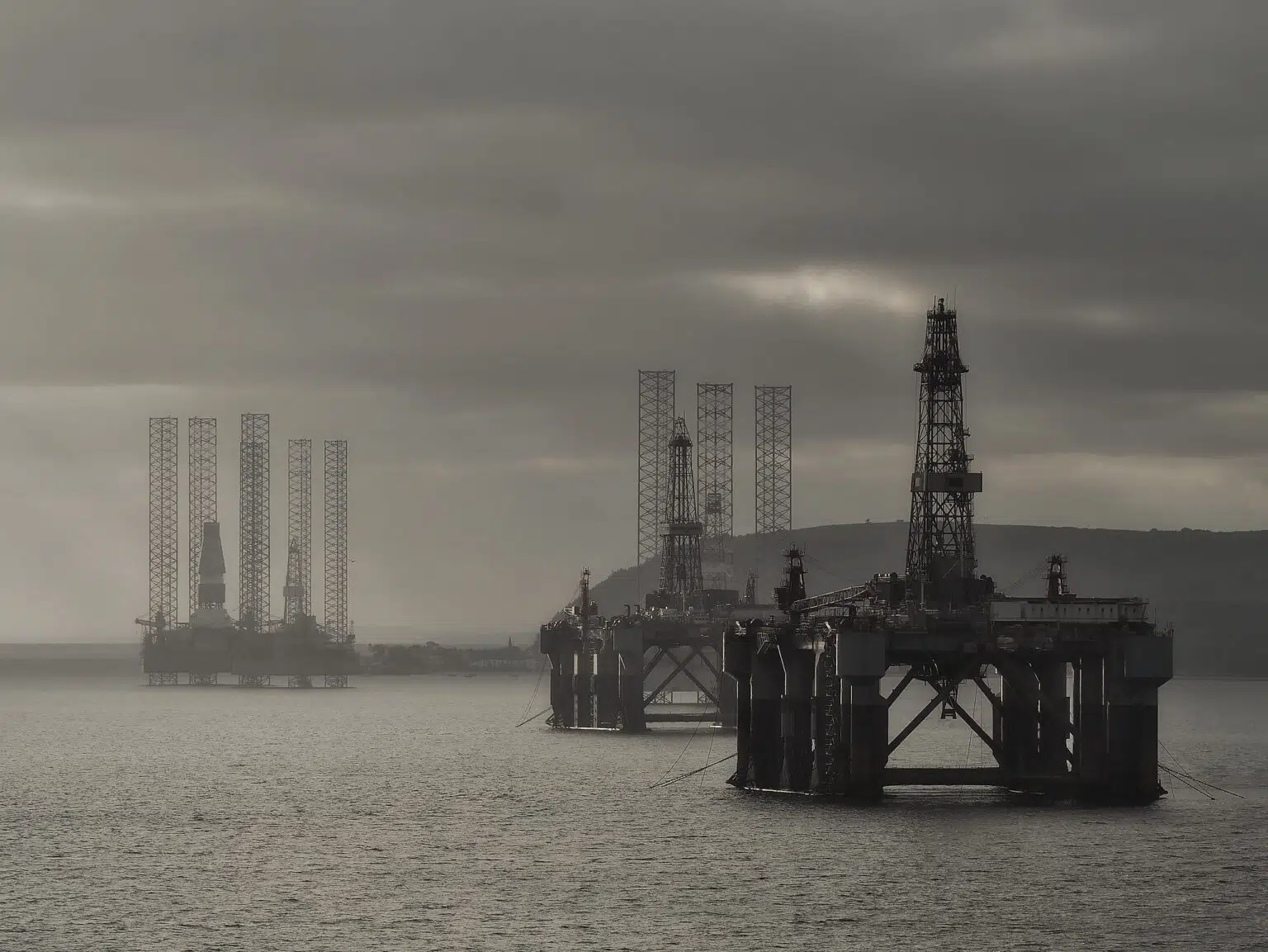
North Sea oil rigs in Cromarty Firth, Scotland. Credit: joiseyshowaa (CC BY-SA 2.0)

https://www.theguardian.com/environment/2025/nov/07/fossil-fuel-lobbyists-cop-un-climate

Exclusive: Research shows oil, gas and coal firms’ unprecedented access to Cop26-29, blocking urgent climate action

More than 5,000 fossil fuel lobbyists were given access to the UN climate summits over the past four years, a period marked by a rise in catastrophic extreme weather, inadequate climate action and record oil and gas expansion, new research reveals.

Lobbyists representing the interests of the oil, gas and coal industries – which are mostly responsible for climate breakdown – have been allowed to participate in the annual climate negotiations where states are meant to come in good faith and commit to ambitious policies to reduce greenhouse gas emissions.

The roughly 5,350 lobbyists mingling with world leaders and climate negotiators in recent years worked for at least 859 fossil fuel organizations including trade groups, foundations and 180 oil, gas and coal companies involved in every part of the supply chain from exploration and production to distribution and equipment, research shared exclusively with the Guardian has found.

The 30th UN climate summit (Cop30) opens on Monday in Belém, a city in the Brazilian Amazon – the world’s largest rainforest, which is being destroyed by ever-expanding fossil fuel exploitation, industrial agriculture and mining, among other extractive industries.

Growing anger at the lack of meaningful action by the world’s wealthiest, most polluting countries has been compounded by revelations that the fossil fuel industry appears to be granted greater access to the climate talks than most countries.

Last year, 1,773 registered fossil fuel lobbyists attended the summit in Azerbaijan – 70% more than the total number of delegates from the 10 most climate-vulnerable nations combined (1,033).

https://www.theguardian.com/environment/2025/nov/07/fossil-fuel-lobbyists-cop-un-climate

Elon Musk urges you to be a Fascist like him, says that you can ignore facts and reality then.
Donald Trump urges you to be a Climate Science denier like him. He says that he makes millions and millions for destroying the planet, Burn, Baby, Burn and Flood, Baby, Flood.
Nigel Farage urges you to ignore facts and reality and be a climate science denier like him and his Deputy Richard Tice. He says that Reform UK has received £Millions and £Millions from the fossil fuel industry to promote climate denial and destroy the planet.
Continue ReadingHow thousands of fossil fuel lobbyists got access to UN climate talks – and then kept drilling

Climate disasters in first half of 2025 costliest ever on record, research shows

Spread the love

https://www.theguardian.com/environment/2025/oct/22/climate-disasters-2025-cost

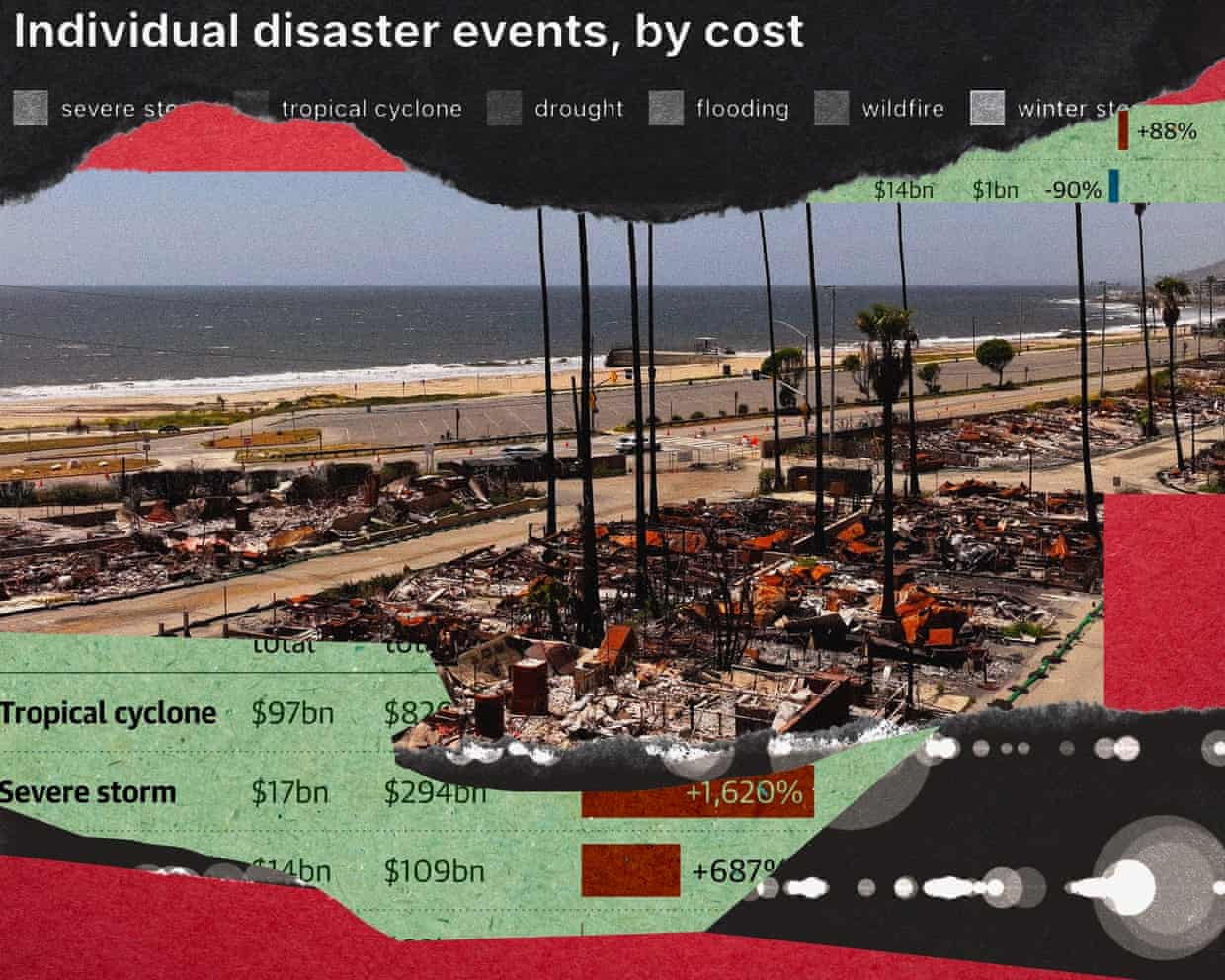
Fourteen separate weather-related disasters that each caused at least $1bn in damage hit the US in the first six months of the year. Composite: The Guardian/Getty Images

LA wildfires and storms this year cost $101bn, new study by non-profit resurrecting work axed by Trump says

The first half of 2025 was the costliest on record for major disasters in the US, driven by huge wildfires in Los Angeles and storms that battered much of the rest of the country, according to a climate non-profit that has resurrected work axed by Donald Trump’s administration that tracked the biggest disasters.

In the first six months of this year, 14 separate weather-related disasters that each caused at least $1bn in damage hit the US, the Climate Central group has calculated. In total, these events cost $101bn in damages – lost homes, businesses, highways and other infrastructure – a toll higher than any other first half of a year since records on this began in 1980.

The bulk of this toll was caused by the ferocious wildfires that razed parts of Los Angeles in January, a disaster that destroyed about 16,000 buildings and resulted in the indirect deaths of around 400 people. At $61bn in damages, the LA fires are one of the most expensive climate-related disasters on record in the US, and the only top 10 event that is not a hurricane.

Over the past four decades, such disasters have become far more savage. The cost of all disasters between 1985 and 1995 was $299bn, a figure dwarfed by the damages of the past decade – with $1.4tn in losses between 2014 and last year.

https://www.theguardian.com/environment/2025/oct/22/climate-disasters-2025-cost

Neo-Fascist Climate Science Denier Donald Trump says Burn, Baby, Burn.
Nigel Farage urges you to ignore facts and reality and be a climate science denier like him and his Deputy Richard Tice. He says that Reform UK has received £Millions and £Millions from the fossil fuel industry to promote climate denial and destroy the planet.
Donald Trump urges you to be a Climate Science denier like him. He says that he makes millions and millions for destroying the planet, Burn, Baby, Burn and Flood, Baby, Flood.
Continue ReadingClimate disasters in first half of 2025 costliest ever on record, research shows

Greenpeace responds to UNEP warning that 1.5°C will be passed

Spread the love
Neo-Fascist Climate Science Denier Donald Trump says Burn, Baby, Burn.

Amsterdam, Netherlands – Greenpeace demands world leaders agree on a global response plan at COP30 as a new major UN report warned the global temperature is projected to rise to 2.3-2.5°C above pre-industrial era global temperatures, putting the Paris Agreement limit of 1.5°C at risk in the short-term.

The UNEP Emissions Gap Report 2025 warned the world is heading towards “a serious escalation of climate risks and damages” due to a lack of ambition and action, and reports the multi-decadal average of global temperature rise will exceed 1.5°C, at least temporarily, requiring faster and bigger cuts in emissions to minimise the overshoot.

Jasper Inventor, Deputy Programme Director, Greenpeace International said: “How many warnings do we need? The time is now, but our leaders are asleep at the wheel, on a collision course to more devastating storms like Hurricane Melissa, human suffering, economic damages and climate injustice.”

“Warnings of a 1.5°C overshoot must be a rallying call for action and yet 2035 climate action plans have failed to bridge the ambition gap. We’re still only inching forward on cutting our emissions despite the demands of people and communities around the world.” 

“We have the renewable energy solutions and we are making progress, but emissions are still rising, the transition away from fossil fuels is too slow, and national climate action plans are barely moving the needle. It’s time for G20 countries, above all developed countries, to grab the wheel and really lead the transition, starting at COP30, where a global response plan to accelerate action must be agreed.”

The Emissions Gap Report 2025 predicted global temperatures to reach 2.3-2.5°C by the end of the century, down from 2.6-2.8°C last year. Since the adoption of the Paris Agreement 10 years ago, temperature predictions have fallen from 3-3.5°C, but faster action is required.

Similar to the UNFCCC’s NDC synthesis report, the UNEP also warned new 2035 climate action plans will have insufficient impact in reducing emissions, especially due to the intended US withdrawal from the Paris Agreement, and called on G20 nations to display climate leadership.

Elon Musk urges you to be a Fascist like him, says that you can ignore facts and reality then.
Donald Trump urges you to be a Climate Science denier like him. He says that he makes millions and millions for destroying the planet, Burn, Baby, Burn and Flood, Baby, Flood.
Nigel Farage urges you to ignore facts and reality and be a climate science denier like him and his Deputy Richard Tice. He says that Reform UK has received £Millions and £Millions from the fossil fuel industry to promote climate denial and destroy the planet.
Continue ReadingGreenpeace responds to UNEP warning that 1.5°C will be passed

Climate change is becoming an insurance crisis

Spread the love
oleschwander/Shutterstock

Meilan Yan, Loughborough University and Qiuhua Liang, Loughborough University

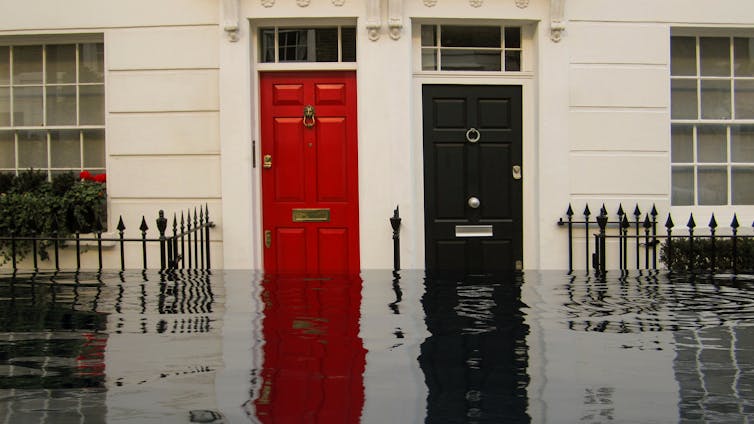
Imagine waking up to find your living room underwater for the second time in five years. You try to claim insurance, only to be told your property is now uninsurable. Premiums have tripled. Your mortgage lender is concerned. And your biggest asset, your home, is rapidly losing value.

This isn’t just a personal disaster. It’s a warning sign of a much broader crisis.

The risks associated with climate change are breaking the insurance industry. In the past decade alone, flood frequency has increased fourfold in the tropics and 2.5 times in mid-latitude regions). In the UK, at least one in six people already live with flood risk, heavy-rainfall extremes are increasing, and expected annual damages could rise by 27% by the 2050s.

Insurance claims from extreme weather are surging. The Association of British Insurers (the UK insurance and long-term savings trade body) reports a record £585 million in home weather-damage payouts for 2024.

Climate change is driving more frequent and severe events, pushing traditional insurance models to their limits. Insurers are left with little choice but to raise premiums sharply or withdraw coverage entirely. When insurance becomes unaffordable or unavailable, households are exposed, property values fall, mortgages become harder to secure, and the risk of a wider financial crisis grows.


Ever wondered how to spend or invest your money in ways that actually benefit people and planet? Or are you curious about the connection between insurance and the climate crisis?

Green Your Money is a new series from the business and environment teams at The Conversation exploring how to make money really matter. Practical and accessible insights from financial experts in the know.


Our research into the insurance industry shows that UK resilience is falling behind. Policymakers in the UK tried to avert an insurance crisis by launching Flood Re in 2016, a joint scheme between government and insurers designed to keep insurance affordable for households in high-risk areas. It was meant as a temporary bridge, due to close in 2039 once stronger flood defences and better land-use planning are in place.

But progress has been painfully slow. In January 2024, the House of Commons public accounts committee reported that the government’s £5.2 billion flood defence programme is 40% behind schedule and expected to protect just 200,000 properties by 2027 — far short of its original 336,000 target.

By 2025, Flood Re has been under mounting strain. Reinsurance costs had have risen by £100 million in just three years, and policy uptakes have jumped by 20% in a single year – both signs that private insurers were retreating from high-risk markets.

In July 2025, Flood Re’s CEO, Perry Thomas, warned that the UK’s overall flood resilience have worsened since the scheme’s launch, as mortgage lenders, housebuilders, and successive governments have “failed to pull their weight”.

tree fallen onto building on stree
Storm damage is more likely as climate change risk increases. pcruciatti/Shutterstock

When insurance becomes unaffordable or unavailable, households are left exposed and property values decline, making mortgages harder to obtain. This erosion of coverage threatens the wider financial system: banks rely on insured property as collateral, but without cover, that collateral rapidly loses value.

If the government fails to meet its climate adaptation targets, as many as 3 million UK homes could become effectively worthless within 30 years.

For the banking sector, this creates the risk of homes becoming stranded assets — uninsurable, unmortgageable and falling in value — leading to rising defaults and mounting losses. Unless lenders adopt climate-adjusted risk models that integrate physical hazards such as flooding, storms and heatwaves, they risk underestimating the true exposure of their mortgage portfolios.

If these climate-risk-exposed mortgages are mispriced and then bundled into mortgage-backed securities and sold to investors, the resulting shock could cascade through credit markets – like the 2008 subprime mortgage crisis, when large volumes of high-risk home loans to borrowers with poor or limited credit histories were repackaged and sold as safe investments. The difference is that this time the crash would be driven by physical climate damage rather than purely financial mismanagement.

A one-way street

Traditional financial crises follow cycles of growth, downturn and recovery, but climate risk moves in only one direction. Rising global temperatures are driving more frequent and severe floods and storms. Without timely adaptation, the damage compounds, eroding property values, undermining insurance and threatening financial stability.

Historical insurance models treated extreme weather as rare “tail risks,” but these events are now more frequent, severe, and interconnected. The tail is becoming “fat,” and shocks ripple across sectors and regions. In short, risk is evolving and insurance frameworks must evolve with it.

Flooding is no longer just an environmental issue. It is a systemic financial threat. Insurers, regulators and lenders must adopt forward-looking models that translate physical climate risks into financial metrics. These models influence market behaviour by shaping how capital is allocated, assets are valued, and risks are priced.

This, in turn, guides investment, planning and adaptation — the process of adjusting systems, infrastructure and practices to withstand and recover from climate impacts.

Effective adaptation measures, such as upgraded flood defences, reduce the future risk of climate-related damage. It’s a feedback loop: better modelling enables smarter adaptation, which in turn strengthens financial stability.


Don’t have time to read about climate change as much as you’d like?
Get a weekly roundup in your inbox instead. Every Wednesday, The Conversation’s environment editor writes Imagine, a short email that goes a little deeper into just one climate issue. Join the 45,000+ readers who’ve subscribed so far.


Meilan Yan, Senior Lecturer in Financial Economics, Loughborough University and Qiuhua Liang, Professor of Water Engineering, Loughborough University

This article is republished from The Conversation under a Creative Commons license. Read the original article.

Donald Trump urges you to be a Climate Science denier like him. He says that he makes millions and millions for destroying the planet, Burn, Baby, Burn and Flood, Baby, Flood.
Nigel Farage urges you to ignore facts and reality and be a climate science denier like him and his Deputy Richard Tice. He says that Reform UK has received £Millions and £Millions from the fossil fuel industry to promote climate denial and destroy the planet.
Continue ReadingClimate change is becoming an insurance crisis