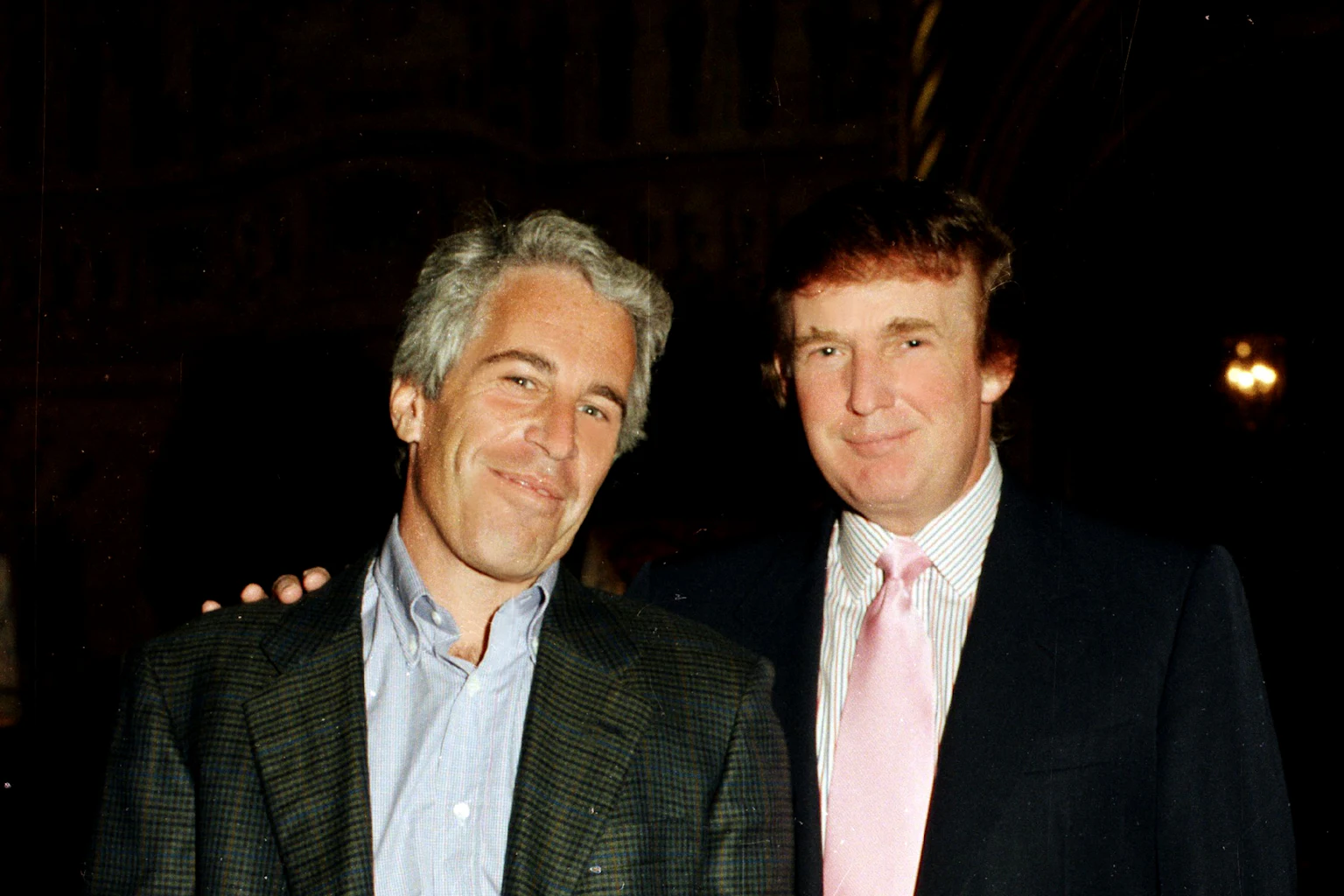
Remember that letter Trump swore doesn’t exist? Well, the Epstein estate just released it.
At the height of Donald Trump’s scandal surrounding notorious late sex criminal Jeffrey Epstein, the Wall Street Journal in July reported that the president had written a cryptic message wishing Epstein a happy 50th birthday in 2003. The note was reportedly contained within a marker drawing of a woman’s naked torso.
Trump insisted this was a “fake thing.” “I never wrote a picture in my life. I don’t draw pictures of women,” he told the Journal. “It’s not my language. It’s not my words.” Vice President JD Vance called it “complete and utter bullshit.”
The president filed a lawsuit against the newspaper in hopes of, in his words, suing owner Rupert Murdoch’s “ass off, and that of his third rate paper.”
Murdoch and the Journal’s asses may live to see another day, as the paper on Monday released a photo of the letter.
WSJ: Lawyers for Jeffrey Epstein’s estate have given Congress a copy of the birthday book put together for the financier’s 50th birthday, which includes a letter with Trump’s signature that he has said doesn’t exist. pic.twitter.com/D07zIL4g2K
Orcas discuss how Trump was re-elected and him being an insane, xenophobic Fascist.Donald Trump urges you to be a Climate Science denier like him. He says that he makes millions and millions for destroying the planet, Burn, Baby, Burn and Flood, Baby, Flood.Donald Trump decrees forbidden terms denying sexual diversity
“We are going to get all our oil and gas out of the North Sea”, Conservative Party leader Kemi Badenoch said recently. Her promise to “maximise extraction” sets up a clash between political ambitions, economic reality and geological limits.
Reform UK has also said drilling for more oil and gas in the North Sea would be a “day one” priority. But even if the Conservatives or Reform were to be elected and lifted the current moratorium on new exploration licenses, there might not be the promised prizes of oil and gas under the seabed – or enough appetite from investors – to deliver on that promise.
BP, in those days British Petroleum, first extracted gas from under the North Sea in 1967. It marked the start of what was to become, for decades, one of the most valuable sectors of the UK economy, with more than 400 separate oil and gas fields developed to date.
But production peaked in 1999 and the North Sea now produces less than half as much as in its heyday.
It is now a “mature” basin: most of the biggest and easiest-to-develop fields have already been discovered and depleted. What remains are smaller, sometimes more remote, and often more technically challenging or expensive resources and reserves.
This is typical of ageing oil and gas provinces, where production declines even as operating costs rise. New projects must compete with oil and gas extracted from other parts of the world where it is easier and cheaper and more appealing to investors.
Finding oil and gas
Historically, only one in eight exploration wells in the North Sea led to a field producing oil and gas. That ratio has improved: between 2008 and 2017, a bit more than one in four wells led to a commercial success.
But far fewer wells are being drilled today. Even with the advances in technology, such as improved geophysical imaging which allows us to better define opportunities ahead of drilling, the big discoveries were probably made decades ago.
UK exploration wells vs offshore fields by year:
The number of exploration wells is down hugely from its peak in the 1980s and early 90s. Mark Ireland / NSTA
The UK government’s North Sea Transition Authority estimates there could still be around 3.5 billion barrels of oil equivalent in more than 400 undeveloped prospects. But most of these potential fields are small, isolated or technically complex. Developing them will require high oil and gas prices, fiscal stability, and a lot of investor confidence.
Politics vs geology
Even if a future government relaxes exploration licensing rules, geology will remain the bigger constraint. The North Sea is simply not as cheap as it was, and global fossil fuel giants have many other options. It is currently far cheaper to produce oil and gas in other regions, the Middle East or North Africa for example. Projects in these countries are all competing for the same capital.
Volatility in the energy sector will continue to make investors cautious. The 2015 oil price crash cut activity in the UK sector to its lowest level in decades, and it has never fully recovered. As fossil fuels are sold on the global market, political volatility, international and national, can lead to rapid shifts in investor confidence.
In the UK the introduction of a windfall tax in 2023 and changing requirements for environmental impact assessments are all making decision making on long-term projects riskier. And while the UK still needs considerable volumes of gas in future (and more modest amounts of oil) both are declining as our energy system evolves and renewable energy expand.
The UK’s mix of economic uncertainty, mature geology and smaller discoveries will make it harder to attract major international energy firms.
The future of the North Sea
That doesn’t mean the North Sea has finished as a source of oil and gas. For instance, undeveloped discoveries – where oil or gas has been confirmed but not yet produced – represent a lower-risk opportunity. But returns may be modest as many are relatively small and isolated from existing infrastructure.
New exploration licenses, if issued, might extend production modestly, but they are unlikely to deliver another game-changing discovery.
Some analysts argue that future licensing should be highly strategic, limited to projects with clear economic importance or climate compatibility. That approach could reduce reliance on imported gas, which tends to be more carbon-intensive than gas produced domestically. This would certainly make more sense than restarting fracking. But it would still not recreate the industry’s heyday.
Easy oil is over
The North Sea will still produce oil and gas for years to come, but its role will shrink. Even with friendlier policies, the era of big discoveries and rapid growth isn’t coming back.
Maximising extraction may sound appealing to politicians, but geology, economics and climate commitments all point to the North Sea’s best oil and gas days being behind it. The real challenge now is managing the investment during decline while investing in the cleaner solutions that will replace it.
UK Conservative Party leader Kemi ‘not a genocide’ Badenoch explains her reality that the Earth is flat, the Moon is made of cheese and that she was born from
Unicorn horn dust
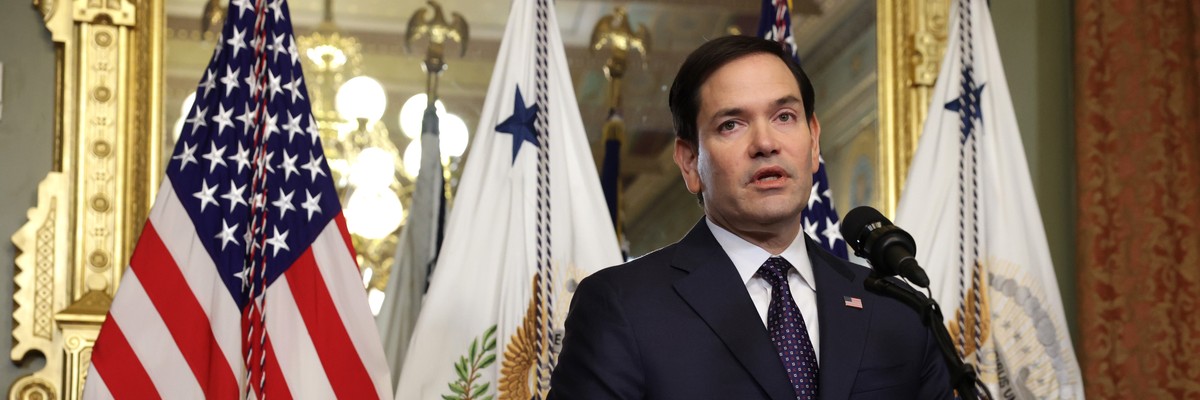
U.S. Secretary of State Marco Rubio speaks on January 21, 2025 in Washington, DC. (Photo by Alex Wong/Getty Images)
“There is no military solution to the overdose crisis, but there is a political solution to a president with authoritarian ambitions,” said one peace advocate. “Congress must act now to end unauthorized military action.”
As rights groups and Democratic lawmakers condemned the Trump administration’s bombing of a boat it claims—without evidence—was carrying drugs off the coast of Venezuela, Secretary of State Marco Rubio made clear on Thursday that targeting vessels linked to drug smuggling in Latin America, and possibly elsewhere, will be part of the White House’s ongoing policy.
At a news conference in Quito, Ecuador, Rubio suggested Latin American governments have a choice: Work with the Trump administration to crack down on drug trafficking or see the US kill more citizens suspected of trying to smuggle illegal substances.
“For cooperative governments, there’s no need because those governments are going to help us,” said Rubio. “They’re going to help us find these people and blow them up, if that’s what it takes.”
Some governments in the region have avoided criticizing this week’s bombing of a boat off the coast of Venezuela, which the US has said killed 11 people it had identified at “narco-terorrists” connected to Tren de Aragua, and which was conducted under the 2001 Authorization for the Use of Military Force.
The White House has not provided evidence of the suspected drug smuggling or that the victims were connected to the gang. US intelligence agencies have also called into question President Donald Trump’s claims that Tren de Aragua is a high-level gang that terrorist organization working with the Venezuelan government.
Ecuador’s government said Thursday it intends to revise its extradition agreement with the US, and President Daniel Noboa praised the US for its efforts to “actually eliminate any terrorist threat.” On the same day, Rubio announced $20 million in new security assistance for Ecuador.
“Under Trump, if the president declares you a terrorist, the U.S. military will apparently execute you on his behalf, no questions asked.”
The White House has also turned its attention to two Ecuadorian gangs, Los Lobos and Los Choneros, with Rubio announcing they have been designated as terrorist groups. The designation gives the Trump administration “all sorts of options,” Rubio claimed, for cracking down on the gangs’ activities, including potentially killing those suspected of being leaders or traffickers for the groups.
“This time, we’re not just going to hunt for drug dealers in the little fast boats and say, ‘Let’s try to arrest them,’” Rubio said. “No, the president has said he wants to wage war on these groups because they’ve been waging war on us for 30 years and no one has responded.”
As Rubio spoke in Quito, Defense Secretary Pete Hegseth said at Fort Benning in Georgia on Thursday that while Trump said he ordered the strike on the boat in the Caribbean this week, low-ranking military officers will soon be empowered to make final decisions on such attacks—strikes which international law experts have decried as nothing less than extrajudicial murder.
“The understanding is that those authorities are better made, those decisions are better made, by men and women in the professional arms,” Hegseth said.
Despite the administration’s use of the military to attack the boat near Venezuela this week and Rubio’s rhetoric about being at “war” with groups involved in the drug trade, human rights advocates and other Latin American leaders have stressed in recent days that drug trafficking is a crime that must be confronted by law enforcement—not an entity that the US can defeat through military action.
“We have been capturing civilians transporting drugs for decades without killing them. Those who transport drugs are not the big drug traffickers, but the very poor young people of the Caribbean and the Pacific,” said Colombian President Gustavo Petro.
Adam Isacson of the Washington Office on Latin America toldThe Washington Post that “you don’t just simply blow boats out of the water. You follow law enforcement procedures.”
Sara Haghdoosti, executive director of Win Without War, said that with this week’s deadly attack—and plans to conduct more strikes—Trump has brought former President George W. Bush’s “dream to full fruition.”
“Under Trump, if the president declares you a terrorist, the U.S. military will apparently execute you on his behalf, no questions asked,” said Haghdoosti. “That should deeply alarm us all, especially at a time when the president thinks nothing of labeling anyone from a USAID worker to a college student as a terrorist.”
The killing of 11 suspected Venezuelan gang members, added Haghdoosti, will make “no difference whatsoever in the lives of people struggling with their own or a loved one’s addiction,” particularly as the Republican Party’s budget cuts have “ravaged” funding for substance use disorder treatment and overdose prevention.
“There is no military solution to the overdose crisis, but there is a political solution to a president with authoritarian ambitions,” said Haghdoosti. “Congress must act now to end unauthorized military action in the Caribbean, investigate these apparently lawless killings, and restore the proven health and harm reduction programs that people struggling with the scourge of fentanyl desperately need.”
Donald Fuhrump says that Amerikkka doesn’t bother with crimes or charges anymore, not being 100% Amerikkkan and opposing his real estate intentions is enough.Donald Trump urges you to be a Climate Science denier like him. He says that he makes millions and millions for destroying the planet, Burn, Baby, Burn and Flood, Baby, Flood.Elon Musk urges you to be a Fascist like him, says that you can ignore facts and reality then.
Reform UK leader Nigel Farage at the party’s 2024 annual conference in Birmingham. Credit: Reform UK / YouTube
DeSmog and the New World have been blacklisted by Nigel Farage’s party.
A leading press freedom group has accused Reform UK of drawing from the “authoritarian playbook” by blocking media outlets from attending its annual conference this weekend.
The party informed DeSmog and the New World yesterday that its journalists would not be accredited for this year’s event. It did not offer an explanation.
The New World (formerly the New European) is a weekly newspaper with 35,000 subscribers whose contributors and editors include former New Labour communications chief Alastair Campbell, former global editor of the Bureau of Investigative Journalism James Ball, and former Spectator editor Matthew d’Ancona.
DeSmog is one of the UK’s leading climate investigations platforms. This year alone it has published stories in partnership with the likes of the BBC, The Guardian, the Financial Times, Private Eye, and The Mirror.
“It is shocking to see UK political parties seeking to pick and choose who can report on them,” said Fiona O’Brien, UK director of Reporters Without Borders (RSF).
“For democracy to work, journalists must be free to cover political events like party conferences and hold those in power to account, on behalf of the public.
“Reform UK’s actions in recent weeks – which include banning councillors from speaking to local journalists and falsely accusing journalists of activism – are straight out of the authoritarian playbook and should immediately be reversed.”
Reform’s leader of Nottinghamshire County Council, Mick Barton, has banned his councillors from speaking to local press outlet the Nottinghamshire Post and its online arm Nottinghamshire Live. The ban followed critical coverage of Reform by the publication, whose journalists were accused of acting “as activists” by the party’s deputy leader Richard Tice.
Reform’s leader Nigel Farage is paid more than £300,000 a year as a presenter on the anti-climate media outlet GB News, while Tice was formerly employed by GB News and its Murdoch-owned rival TalkTV.
Farage sported a GB News badge in Congress yesterday as he testified to U.S. lawmakers about supposed “free speech” issues in the UK.
The Reform leader used the session to compare Britain to North Korea, and to urge the U.S. to punish the UK for its alleged free speech infringements.
However, Farage was also held to account for his own questionable free speech record. Democrat Jamie Raskin asked the Reform leader: “Why do you ban journalists who oppose your views from coming to your events?”
“I don’t,” Farage responded. “I can’t think, if I go back over the past 25 years, of banning anybody.”
That statement is contradicted by Reform’s decision to ban DeSmog and the New World from this year’s conference.
Byline Times also announced today that it has been banned from attending this year’s Conservative Party conference. DeSmog and a number of other independent outlets were banned from last year’s Tory conference.
Reform Conference 2025
As reported by DeSmog yesterday, Reform’s conference in Birmingham will feature climate science deniers, anti-vaccine conspiracy theorists, and dark money campaign groups.
They include the Heartland Institute, a group close to Donald Trump’s administration that has called human-induced climate change a “delusion”, and Net Zero Watch – the campaign arm of the Global Warming Policy Foundation, which has claimed that carbon dioxide has been “mercilessly demonised”.
By giving them a platform, Reform is “showing open contempt for the British public already living with the realities of climate breakdown,” said Tessa Khan, executive director of the research and campaign group Uplift.
A recent report by the New Economics Foundation found that Reform’s climate policies – which include scrapping clean energy investment and drilling for more fossil fuels – would cost more than 60,000 jobs and wipe £92 billion off the UK economy.
DeSmog previously revealed that Reform is offering access to Farage during the conference in exchange for hefty donations. A sum of £250,000 buys 10 seats at a champagne breakfast with the Reform leader during the two-day event, as well as “chauffeur-driven travel”, a personal assistant, and the sponsor’s logo on the main conference stage and battle bus.
DeSmog asked Reform to explain why it had been banned from the event, but did not receive a response.
Nigel Farage explains the politics of Reform UK: Racism, Fake anti-establishmentism, Deregulation, Corporatism, Climate Change Denial, Mysogyny and Transphobia.Nigel Farage urges you to ignore facts and reality and be a climate science denier like him. He says that Reform UK has received millions and millions from the fossil fuel industry to promote climate denial and destroy the planet.Nigel Farage reminds you that he’s the man that brought you Brexit and asks what could possibly go wrong.
A “rogue” government could seize sensitive information on UK residents, data privacy experts fear.
Labour’s new data access law would allow the UK government to replicate an Elon Musk-style DOGE data-grab, experts and campaigners have warned.
They believe the new law is “ripe for abuse” and could be weaponised by a future Reform UK administration to further its anti-climate, anti-asylum, anti-government agenda.
The Data (Use and Access) Act, which will come into effect next year, empowers ministers to use ‘Henry VIII powers’ – named after the instruments the medieval King used in 1539 to bypass Parliament and rule by decree – to legally access massive quantities of government data with little parliamentary scrutiny.
“The bill has provided any government from this time onward with powers which are ripe for abuse. It gives any future government a blank cheque they can use to legalise the use, sharing and reuse of personal data for whatever purpose they see fit,” Mariano delli Santi, legal and policy officer at the data privacy campaign Open Rights Group, told DeSmog.
The passing of the act comes amid a flurry of concern over Labour’s growing ties to big tech companies, including recent deals with OpenAI and Google to provide artificial intelligence support for UK government initiatives.
“The Labour government has purposefully chosen to ignore risks and prioritise the commercial interests of U.S. and Chinese tech giants over the protection of UK residents’ data and their rights,” said delli Santi.
Technology Secretary Peter Kyle says the new law will “finally unleash” a “goldmine of data” to “help families juggle food costs, slash tedious life admin, and make our NHS and police work smarter”. The government claims it will “inject” the economy with £10 billion in the next 10 years.
The U.S. Department of Government Efficiency (DOGE), originally led by tech mogul Elon Musk and established by President Donald Trump, has sent teams of engineers into federal government departments to access vast amounts of highly sensitive personal data on U.S. residents in what has been widely dubbed a “digital coup”.
U.S. DOGE is now using those datasets, which include information on immigration status, healthcare, and social services, to collate a “master database” to surveil and track immigrants. The department has also overseen extreme cuts to vital, life-saving services, with a recent study by the Lancet medical journal estimating that Musk’s cuts to the U.S. international aid budget could lead to 14 million deaths by 2030.
Critics fear that Labour’s new data bill will make this sort of data-gathering legal in the UK.
Imitating Trump’s administration, Reform leader Nigel Farage has already established a secretive ‘UK DOGE’ unit intent on gaining access to council data in Reform-led areas.
Reform’s DOGE unit is led by former party chairman Zia Yusuf, a multi-millionaire tech entrepreneur who has not been shy about his desire to emulate Musk’s ideas in the UK.
The party is currently polling to win the next UK general election with 28 percent of the vote – seven points ahead of Labour.
If Reform gains power in 2029, campaigners say it could use Labour’s data access law to carry out its policies, which include a crackdown on immigration, the radical downsizing of the civil service, eliminating “government waste”, and decimating the UK’s net zero projects.
“Labour is handing over the means for a future Reform government to legalise DOGE-style data grabs. In as little as 28 days, a future Reform government could make it legal for a local council or any other public body to share personal data about you with their DOGE consultants,” delli Santi told DeSmog.
A Data Grab?
The Data (Use and Access) Act, which amends existing General Data Protection Regulation (GDPR) laws, expands the government’s ability to use personal data.
Currently, the UK’s GDPR laws require a risk assessment to establish a “balance” between the value of accessing data against the rights of those whose data is accessed.
However, under the new law, the secretary of state can dodge this process by declaring that the data is needed for a “recognised legitimate interest”, which the law says can include “crime prevention”, “safeguarding vulnerable people”, “responding to emergencies”, and “safeguarding national security”.
The categories are vague, and they could feasibly include controlling immigration or making cuts to the administrative state.
Data privacy experts have also expressed concerns – disputed by the government – that the new law provides a loophole allowing ministers to water down protection for “special categories” of data, which are designed to guard against intrusion in relation to the likes of religious beliefs, political opinions, and sexual orientation.
“Ultimately I remain worried that a bad faith actor could come in and abuse the Henry VIII powers – which were intended to make it easier to add protections to GDPR – to undermine the special category data protections,” Duncan McCann, the technology and data lead at the Good Law Project campaign group, told DeSmog. “The importance of special category data means that it should only be amended by Parliament”.
However, even if a government was successful in watering down special category protections, campaigners have warned that diverging from the status quo would seriously compromise the UK’s ability to transfer data with other countries, including the EU, and would have negative economic consequences.
McCann believes this would stop most governments from taking action. “This cost has ensured that governments don’t drastically alter the fundamentals of data protection legislation,” he said.
Despite this, McCann added that “a potential Reform government may be less interested or susceptible to rational economic arguments, making radical divergence from GDPR, if they won, more likely”.
Moreover, even if a Reform government maintained protections against sharing special category data, personal information including tax details, criminal convictions, and immigration status data are not protected in the same way and could be harvested by a Farage government.
Reform’s Council Crusade
Battles have ensued since Reform won control of 10 councils in May’s local elections, with Farage’s party attempting to wrest control of potentially sensitive data for its DOGE operation.
Kent County Council, the first to receive a visit from Yusuf’s unit and a letter from Reform demanding “all council-held documents, reports, and records”, has so far resisted the efforts, hiring external lawyers to challenge the plan.
West Northamptonshire Council agreed in July to allow Yusuf’s largely anonymous team of analysts to access council data and ostensibly reduce local “fraud and waste” – a move that has been labelled an “assault on local democracy” by critics.
Reform claims that it has already saved £100 million since May, although many of the projects cut by the party would have involved introducing clean heating technology that would have saved councils money.
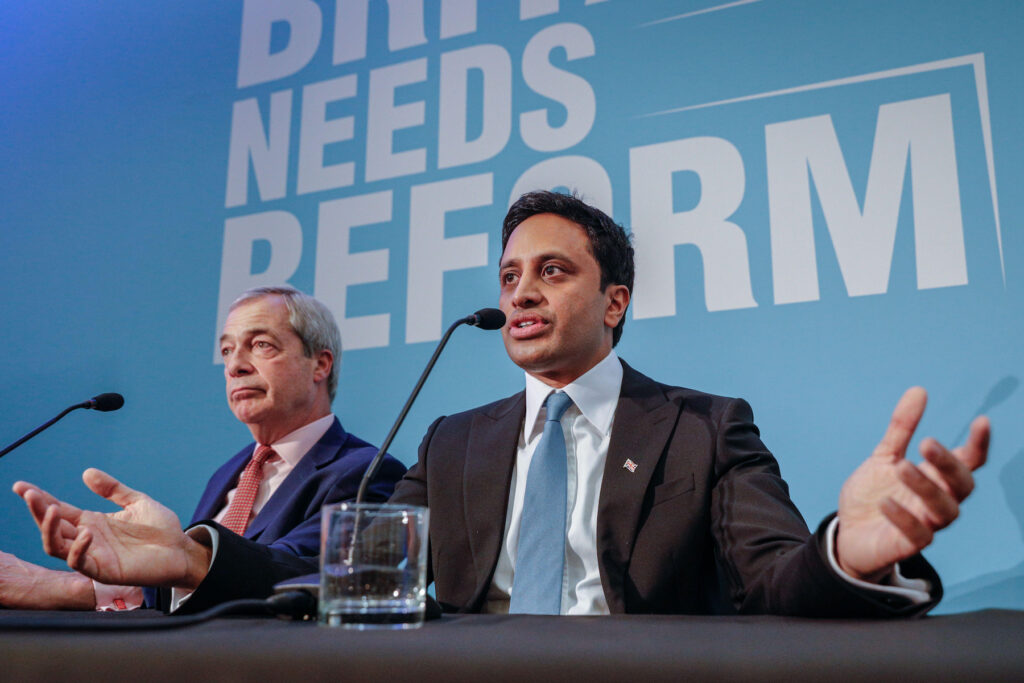
Reform UK chair Zia Yusuf and leader Nigel Farage. Credit: Imageplotter / Alamy Stock Photo
‘Project Chainsaw’
Labour has also used utopian language about the benefits of deploying data analysis and artificial intelligence to cut the size of the state.
“If we push forward with digital reform of government – and we are going to do that, we can make massive savings, £45 billion savings in efficiency. AI is a golden opportunity,” Prime Minister Keir Starmer said in March.
Starmer promised to “send teams into every government department with a clear mission from me to make the state more innovative and efficient”.
The initiative – which The Guardian reported was at one time referred to as “Project Chainsaw” – was seemingly influenced by a proposal from the Labour Together think tank. The name references Javier Milei, the President of Argentina, who gifted Elon Musk a chainsaw as a symbol for dismantling the U.S. state.
Milei has cut 50,000 public sector jobs and slashed Argentina’s health care budget by 48 percent in real terms since he took office in December 2023.
Labour Together told The Guardian that its initiative would have “’Milei’s energy but with a radical centre-left purpose”.
Data privacy experts have also cautioned that the data access law could “threaten democracy” by potentially compromising the integrity of elections. Campaigners warn the act will allow governments, including the current Labour government, to alter rules about how a political party can use data in the months leading up to an election, which could be used in a ruling party’s favour.
The government told DeSmog that “the Data (Use and Access) Act will not only allow us to harness the power of data to improve public services as part of our Plan for Change, but to do so in a way which also maintains our world-leading data protection standards.”
Despite these reassurances, delli Santi of Open Rights Group remains concerned. This law, he said, “lacks meaningful safeguards that would prevent it being used to enable disproportionate surveillance, discrimination, and creepy invasions into our private life”.
Nigel Farage explains the politics of Reform UK: Racism, Fake anti-establishmentism, Deregulation, Corporatism, Climate Change Denial, Mysogyny and Transphobia.Nigel Farage urges you to ignore facts and reality and be a climate science denier like him. He says that Reform UK has received millions and millions from the fossil fuel industry to promote climate denial and destroy the planet.Nigel Farage reminds you that he’s the man that brought you Brexit and asks what could possibly go wrong.