Category: the filthy rich

  • “Let’s Block Everything” protests challenge Macron’s austerity

    Spread the love

    Original article by Ana Vračar republished from peoples dispatch under a Creative Commons Attribution-ShareAlike 4.0 (CC BY-SA) license.
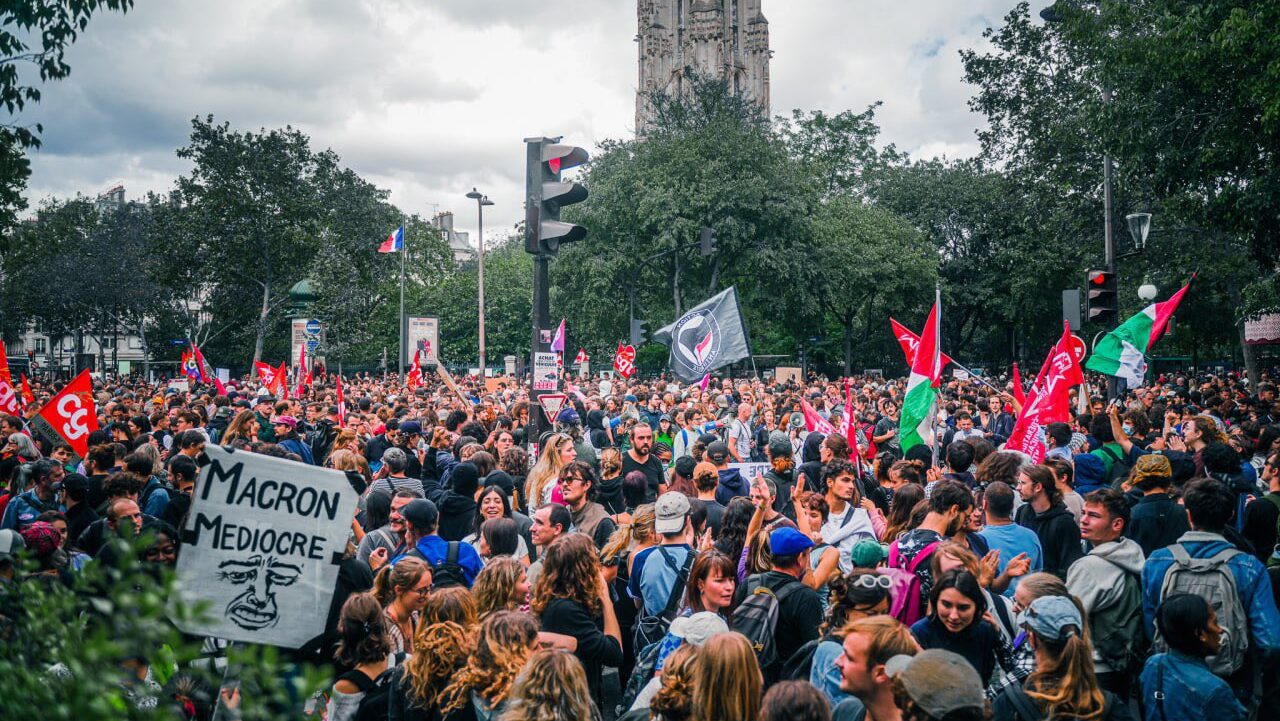
    September 10 mobilization in Paris. Source: Mathilde Panot/X

    Hundreds of mobilizations across France signaled public rejection of President Emmanuel Macron’s austerity path.

    Hundreds of mobilizations, including picket lines and strikes, took place across France on September 10, signaling general rejection of a new wave of austerity policies advanced by the neoliberal camp. Trade unions reported significant participation in multiple sectors, including railways, education, culture, and health – where at least 100 work stoppages occurred during the day.

    Grassroots networks estimate that approximately 500,000 people joined the demonstrations, held under the slogan “Let’s Block Everything” (Bloquons tout). Student collectives and Palestine solidarity groups were among those contributing to the day, among many others. Actions took place not only in major cities like Paris and Marseille but also in smaller towns such as Albi and Pau. The day was also marked by a heavy police presence and reports of violence against protesters, including the use of tear gas.

    The mobilization came just days after another prime minister appointed by President Emmanuel Macron, François Bayrou, lost a confidence vote in the National Assembly. Macron quickly replaced him with former defense minister Sébastien Lecornu, a representative of the center’s right-wing faction. The appointment irked the public further. Maurizio Coppola of the Italian left party Potere al Popolo, who took part in the actions, told Peoples Dispatch: “Many saw this hasty appointment of a new prime minister as a provocation on the eve of the mobilization.”

    Read more: Will another French prime minister fall over the austerity budget?

    Demonstrators also saw Lecornu’s appointment as a sign that Macron continues to pursue policies repeatedly rejected by the public. In a recent speech, France Unbowed (La France Insoumise) leader Jean-Luc Mélenchon highlighted the devastating social impact of neoliberal economic policies, pointing out that thousands of children and hundreds of thousands of people in France are homeless. Poverty and inequality, he described, plague the country. The trade union group Solidaires offered similar reflections on the day of action: “After the fall of the Bayrou government, the head of state’s desire to pursue the same policy in the service of special interests can only exacerbate fiscal and social inequalities and the ecological crisis.”

    “He must go”

    “Macron is to blame for this situation,” Mélenchon wrote on September 10. “He and his decisions are responsible for the chaos. He makes no effort whatsoever to show that he is receiving or listening to the messages coming from the National Assembly or the country. On the contrary, he brazenly pushes ahead to show that he remains in control of his strange and absurd plans. He must go.”
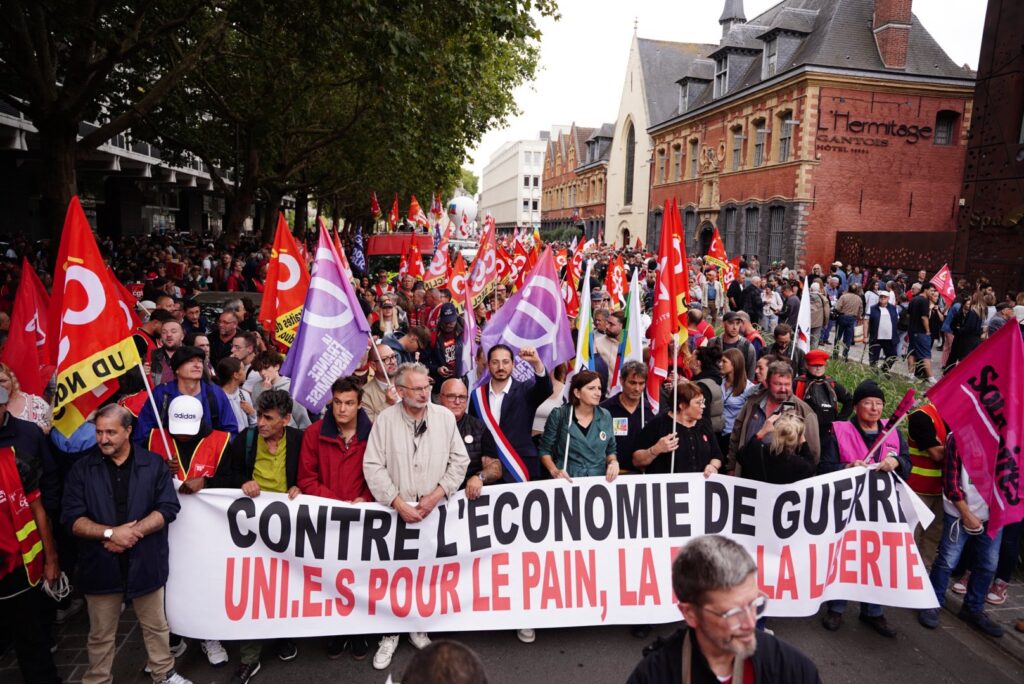
    Protesters marching with banner: “Against the war economy. United for bread, peace, and liberty.” Lille, September 10, 2025. Source: Aurélien Le Coq/X

    France Unbowed has campaigned for Macron’s removal since the 2024 national election, when he blocked the progressive New Popular Front (Nouveau Front Populaire) from forming a cabinet despite its electoral result, instead entrusting government formation to a succession of neoliberals. The party renewed its call after Bayrou’s collapse but also threw its weight behind the ongoing grassroots struggles. Coppola noted that activists from France Unbowed were active in preparing demonstrations across communities, helping amplify and link popular demands. “Their elected representatives marched with the protesters, defending them from police violence through their institutional status,” he added.

    The role of organized labor

    Despite the success of the day of action, questions remain. One concerns the role of labor unions, Coppola suggests. While certain unions and confederations, notably Solidaires, joined the call for September 10, others kept more distance. Branches of the General Confederation of Labor (Confédération générale du travail, CGT) and Workers’ Force (Force Ouvrière) participated in the actions, but their leadership chose to emphasize a strike call for September 18. By doing so, these organizations echoed popular demands against austerity but did not fully align themselves with the grassroots initiative.

    The ability of grassroots groups and labor unions to connect over and channel the anger that fueled the “Let’s Block Everything” protests may have an important impact on the mobilization’s long-term success. As Coppola points out, “where strikes and blockades were successful, this was only possible thanks to the presence of organized labor.” However, he also adds that some unions joined the day of action only because rank-and-file members pushed for it, highlighting how bottom-up participation remains vital across the struggle.

    Another unresolved question is the feasibility of France Unbowed’s proposal to remove Macron. While such an outcome would potentially be a significant victory against austerity, it would trigger new presidential elections with uncertain results. In 2024, the far-right National Rally (Rassemblement National) secured more votes than the left-progressive alliance, making the prospect of an extreme right president a genuine risk.

    Nevertheless, the message of September 10 was unmistakable and is unlikely to fade soon. “The message was clear everywhere: no to the [austerity] financial maneuver, [yes to the] strengthening of public services and workers’ rights, taxing the rich, and above all, the resignation of President Macron,” Coppola concluded.

    Original article by Ana Vračar republished from peoples dispatch under a Creative Commons Attribution-ShareAlike 4.0 (CC BY-SA) license.
  • Could Bolsonaro go to jail this week?

    Spread the love

    Original article by Brasil de Fato republished from peoples dispatch under a Creative Commons Attribution-ShareAlike 4.0 (CC BY-SA) license.

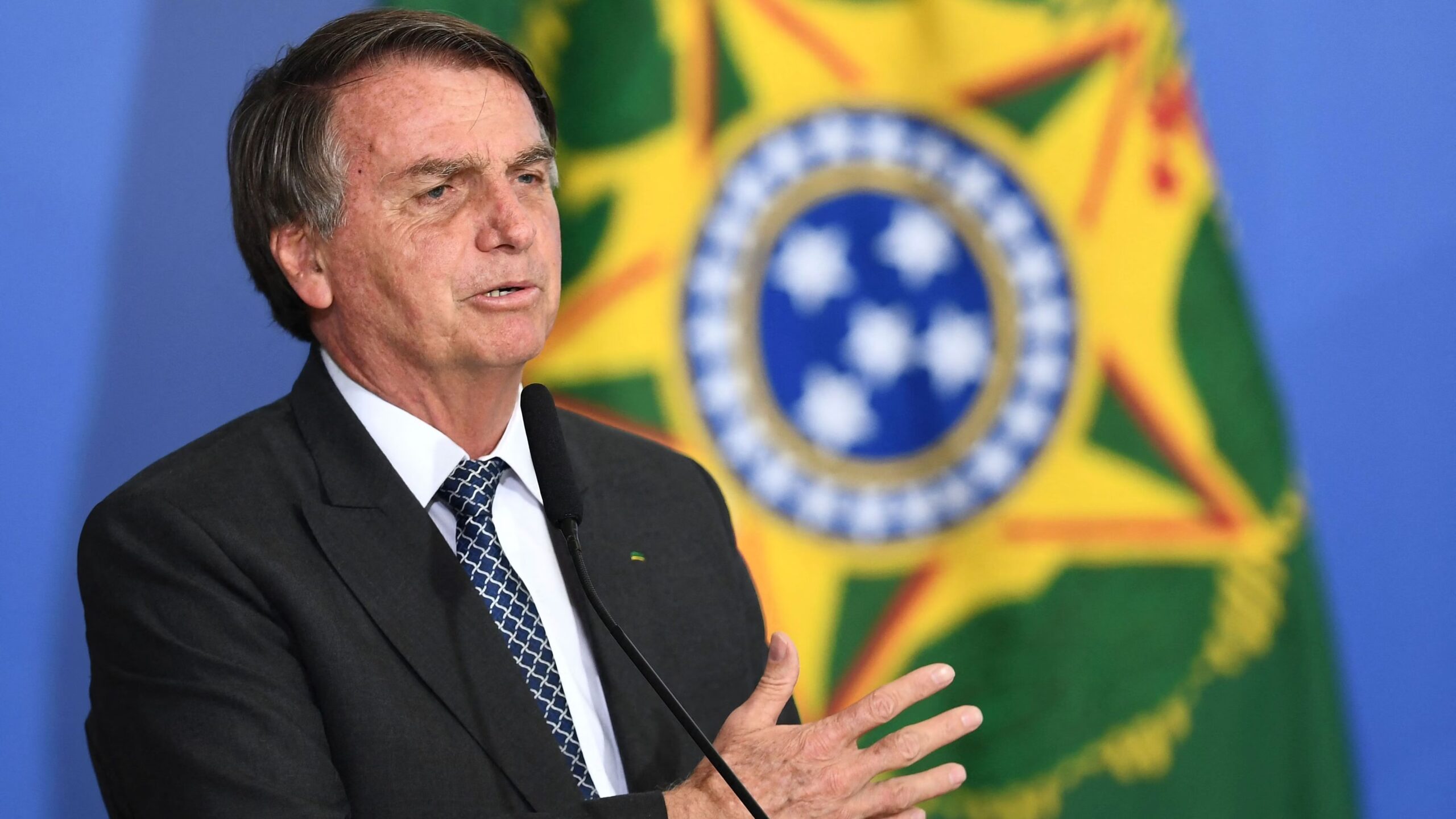
    Jair Bolsonaro in front of flag

    Former Brazilian President Jair Bolsonaro. Photo: Huete

    He is already under house arrest, but if convicted, he would be taken to a cell only after the sentence becomes final.

    The answer to the question is yes. In fact, former Brazilian President Jair Bolsonaro is already under house arrest after failing to comply with precautionary measures imposed by the reporting judge in the criminal case investigating the attempted coup in Brazil, Alexandre de Moraes, such as the prohibition on using social media.

    Lawyer Ney Strozake states that preventive detention could be imposed if there is a risk of flight. “If he [Bolsonaro] flees or takes actions that clearly demonstrate that he is going to flee, what could happen is that the Attorney General’s Office could request preventive detention and Alexandre Moraes could order preventive detention. But [only] because he is preparing to flee or because he has fled, which is the case with [Carla] Zambelli. She is already abroad and has announced that she has fled. Then her preventive detention was ordered. In Bolsonaro’s case, this could also happen,” explained the lawyer.

    However, these are preventive measures, which are primarily aimed at ensuring the smooth running of the proceedings and are unlikely to be taken on the eve of a sentence. The final arrest, in compliance with a possible sentence established by the First Panel of the Supreme Federal Court (STF), will still take a little more time, and this depends on how the five ministers will vote.

    Possibilities for appeals

    If there are at least two disagreements among the justices regarding the merits of the case, that is, regarding the conviction or acquittal of the defendants, the defense may file appeals to bring the case to the full court, known as infringements. The deadline for the defense to file these appeals is ten days, and there is no deadline for the court to decide whether to accept them.

    If there is not this minimum number of disagreements on the merits, the defense will be limited to only one possibility of appeal: the so-called motions for clarification. In this case, there is no possibility of changing the majority decision, but lawyers may contest or even request clarification regarding any measure imposed in the sentence, or request, for example, immediate progression to house arrest for health reasons. For this type of appeal, the deadline for filing defenses is five days after the sentence, and the judge in the case has the same amount of time to rule on them.

    Jail only after the final judgment

    According to the understanding established by the STF, those convicted will only begin serving their sentences after the so-called final judgment, that is, when there are no more possibilities for appeals.

    Former President Jair Bolsonaro and seven other defendants are identified by the Attorney General’s Office (PGR) as the “crucial nucleus” of the coup plot. They are accused of the crimes of armed criminal organization, attempted violent abolition of the Democratic Rule of Law, coup d’état, damage qualified by violence and serious threat, and deterioration of listed heritage.

    Together, the penalties related to the crimes identified by the Attorney General’s Office could total 43 years in prison, considering the maximum penalties for each crime and the possibility of aggravating circumstances.

    In addition to the former president, seven other men, all close allies during his administration, are being tried this week. They are: Alexandre Ramagem (former head of the Brazilian Intelligence Agency, Abin, and now a federal deputy for the Liberal Party in Rio de Janeiro); Almir Garnier Santos (former Navy commander); Anderson Torres (former Minister of Justice); Augusto Heleno (Army general and former Minister of Institutional Security); Mauro Cid (Bolsonaro’s former aide-de-camp); Paulo Sérgio Nogueira (who, like Braga Netto, was also Minister of Defense); and Walter Braga Netto (Army general and former Minister of Defense and Chief of Staff).

    Among the eight defendants, Ramagem is the only one charged with three crimes, rather than five, as the charges of aggravated damage and deterioration of listed property (relating to January 8) were suspended, since he was already a certified congressman at the time and therefore had parliamentary immunity.

    With the exception of whistleblower Mauro Cid, who has confessed to the charges, the others claim innocence.

    This article was first published in Brasil de Fato in Portuguese.

    Original article by Brasil de Fato republished from peoples dispatch under a Creative Commons Attribution-ShareAlike 4.0 (CC BY-SA) license.
  • The US Is Giving Away $35 Billion a Year to Cook the Planet

    Spread the love

    https://www.bloomberg.com/opinion/articles/2025-09-10/the-us-is-giving-oil-and-gas-producers-35-billion-a-year-to-cook-the-planet

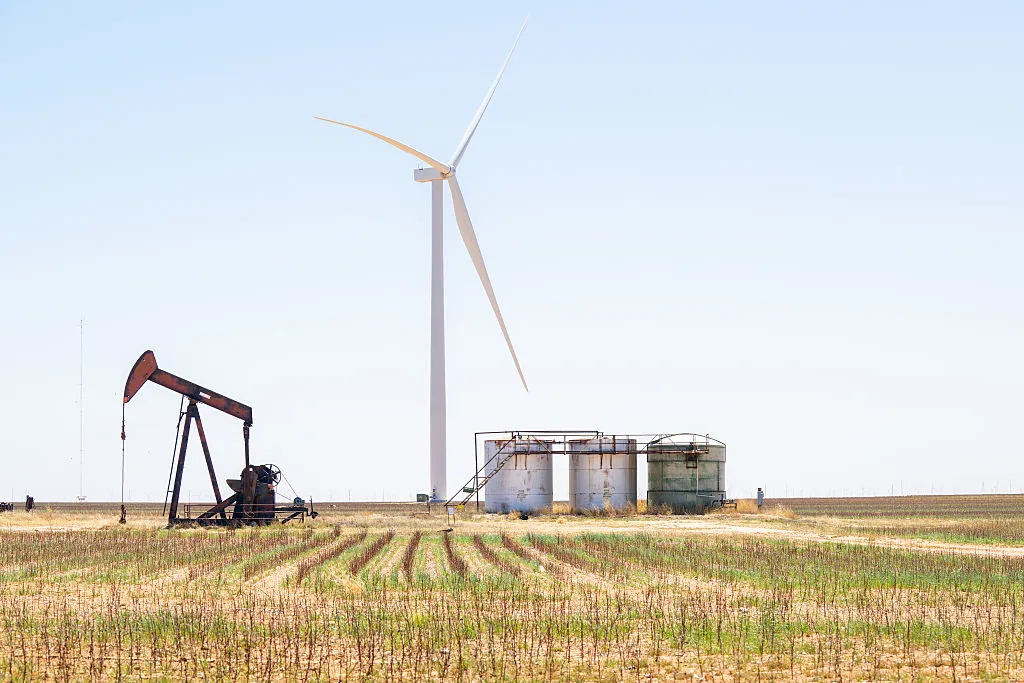
    Guess who gets subsidies?Photographer: Brandon Bell/Getty Images

    Fossil-fuel producers should be taxed to defray the cost of climate change, not be given even larger subsidies.

    By Mark Gongloff

    The price of eggs has more than doubled in the past eight years, which isn’t great, but at least you can eat eggs. The price of US government subsidies for the fossil-fuel industry has also more than doubled in that time, which is far, far less great. Welfare for an industry that makes billions of dollars in profits and pollutes the climate is worse than useless. It’s self-destructive.

    The federal government gives oil, gas and coal producers at least $34.8 billion in subsidies each year, according to a new study by the research and advocacy nonprofit Oil Change International. In 2017, OCI estimated these gifts at $14.7 billion annually. This doubling in federal largesse has taken place under both Democratic and Republican political administrations, highlighting the difficulty of stopping its growth, much less reversing it.

    Bloomberg Opinion

    In fact, some of the most recent extensions of federal aid have made it possible for these subsidies to explode in the future, threatening to reach trillions of dollars. When the world needs exponential growth in clean-energy investments to avoid the most catastrophic effects of global heating, the US government will be bankrolling fossil-fuel expansion and stoking the emergency.

    …

    Article continues at https://www.bloomberg.com/opinion/articles/2025-09-10/the-us-is-giving-oil-and-gas-producers-35-billion-a-year-to-cook-the-planet

    Donald Trump urges you to be a Climate Science denier like him. He says that he makes millions and millions for destroying the planet, Burn, Baby, Burn and Flood, Baby, Flood.
    Donald Trump urges you to be a Climate Science denier like him. He says that he makes millions and millions for destroying the planet, Burn, Baby, Burn and Flood, Baby, Flood.
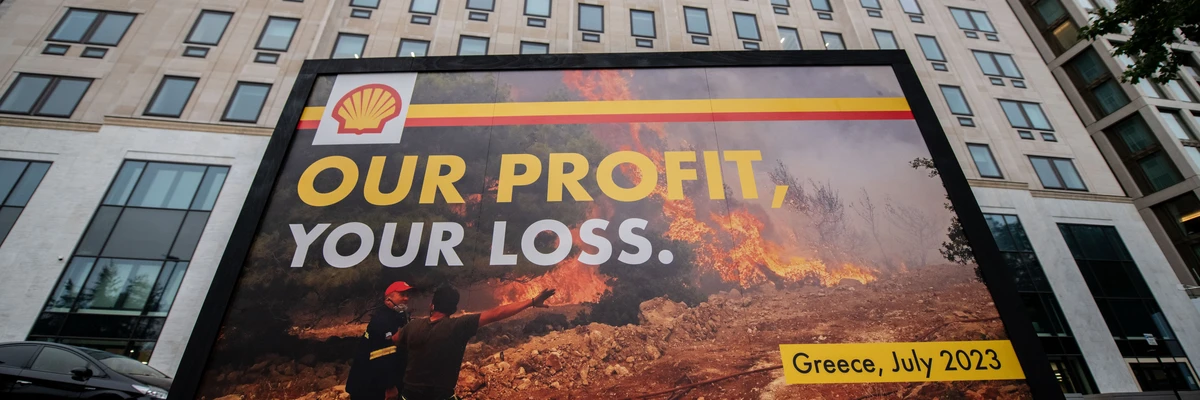
    Greenpeace activists display a billboard during a protest outside Shell headquarters on July 27, 2023 in London.
    Greenpeace activists display a billboard during a protest outside Shell headquarters on July 27, 2023 in London. (Photo: Handout/Chris J. Ratcliffe for Greenpeace via Getty Images)
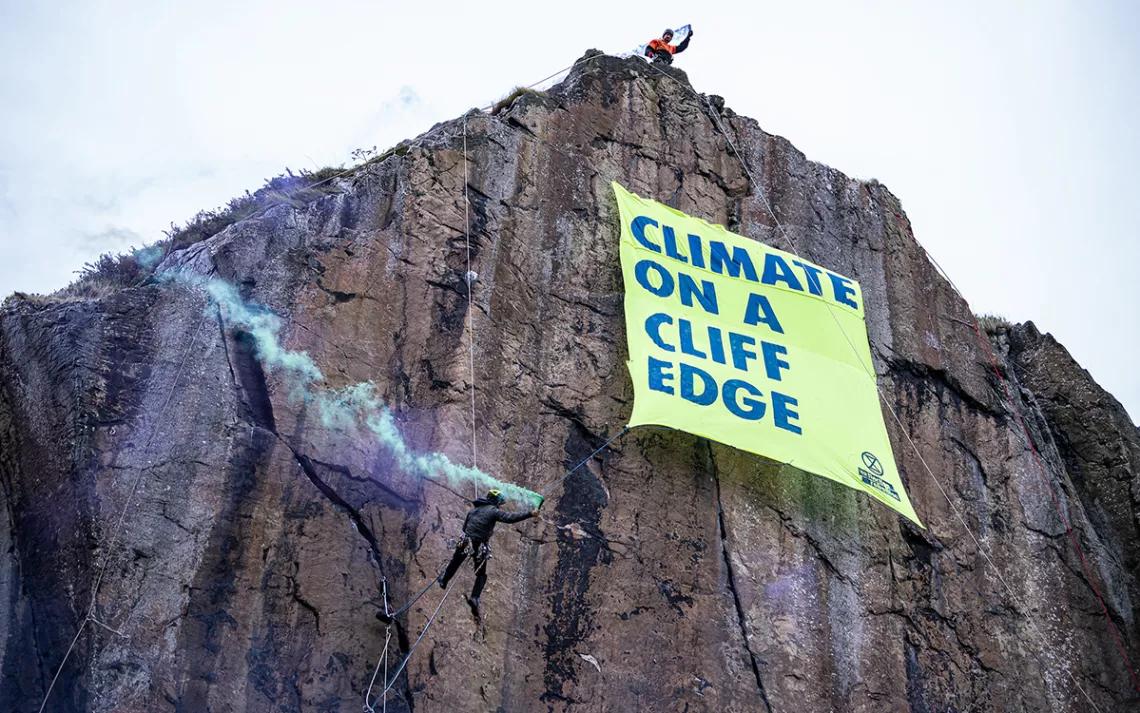
    Experienced climbers scale a rock face near the historic Dumbarton castle in Glasgow, releasing a banner that reads “Climate on a Cliff Edge.” One activist, dressed as a globe, symbolically looms near the edge, while another plays the bagpipes on the shores below. | Photo courtesy of Extinction Rebellion and Mark Richards
    Experienced climbers scale a rock face near the historic Dumbarton castle in Glasgow, releasing a banner that reads “Climate on a Cliff Edge.” One activist, dressed as a globe, symbolically looms near the edge, while another plays the bagpipes on the shores below. | Photo courtesy of Extinction Rebellion and Mark Richards
  • Milei suffers a resounding defeat in Buenos Aires provincial elections

    Spread the love

    Original article by Pablo Meriguet republished from peoples dispatch under a Creative Commons Attribution-ShareAlike 4.0 (CC BY-SA) license.
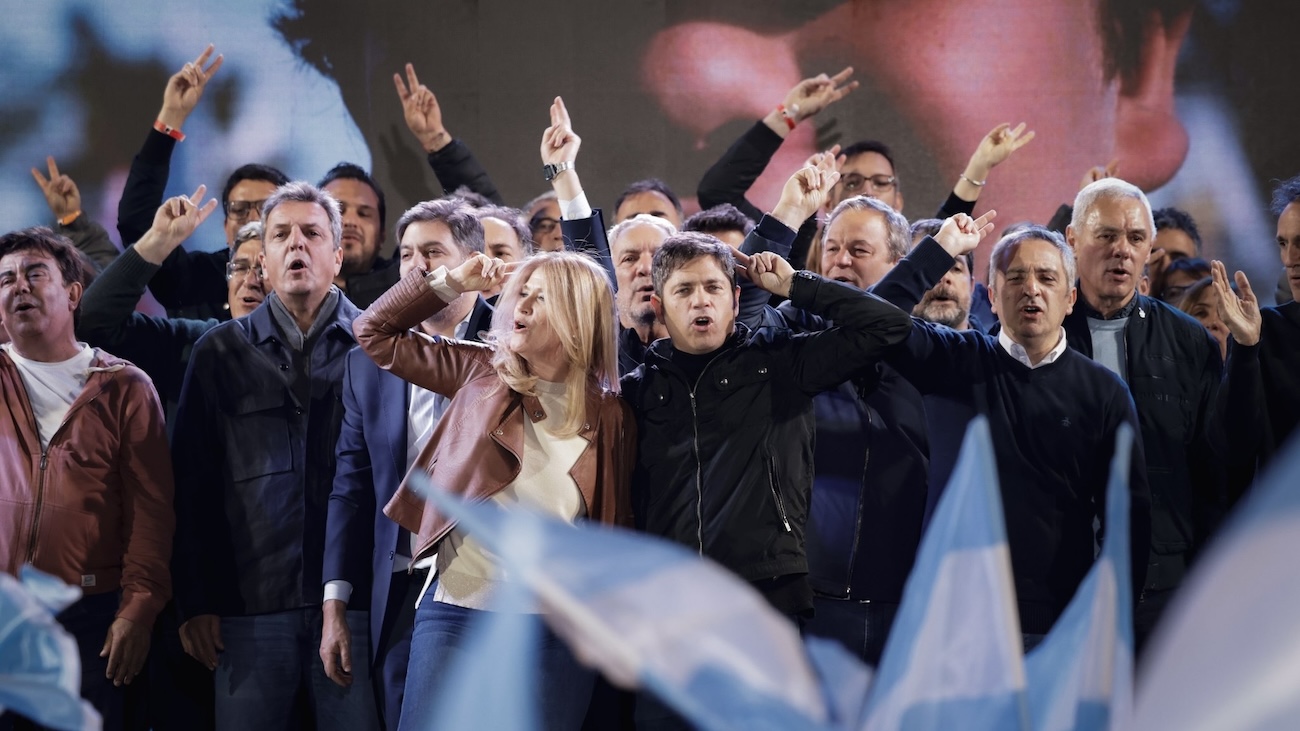
    Axel Kicillof and other Peronist leaders in Buenos Aires celebrating their victory on Sunday, September 7. Photo: Fuerza Patria / X

    Despite the president taking a front-line role in the election campaign and predicting victory for his party (“Buenos Aires will be painted purple,” Milei claimed), the figures speak for themselves. Voter turnout is estimated at almost 61%.

    On September 7, 2025, the province of Buenos Aires dealt a crushing defeat to the right-wing libertarian project of President Javier Milei, who, after learning the results of the provincial elections, said: “Today we have suffered a clear defeat and we must accept it.”

    The people of Buenos Aires province, which accounts for 38% of the country’s population, elected senators, deputies, and delegates of their municipalities. Peronism decided to join forces and form a large anti-Milei alliance called Fuerza Patria (Homeland Force), which, according to official data, obtained almost 47% of the valid votes. Meanwhile, La Libertad Avanza, Milei’s party that allied itself with the PRO (the party of former president Mauricio Macri), reached almost 34%. In third and fourth place were the centrist SOMOS and the Left Front, respectively, which each obtained almost 5%. The rest of the votes were divided among the other contenders.

    In other words, Peronism won by more than 13 points over the far right, allowing it to take six of the eight electoral districts. La Libertad Avanza only managed to win the fifth and sixth districts. In addition, Peronism swept the municipal elections, winning 95 of the 135 municipalities in the province.

    Milei says he will not back down

    Despite the resounding defeat, Milei stated that while the necessary political mistakes must be corrected, he will not back down from his neoliberal project. “We will not back down one millimeter in the government’s policy; we will accelerate the course even more. If we have made political mistakes, we will process them and do better to win in October… We will continue to defend fiscal balance.”

    He also took the opportunity to criticize his primary opposition, “They have put all the Peronist apparatus that they have been managing for 40 years into play, and this [result] is the floor for us and the ceiling for them.”

    Peronism celebrates

    For its part, the main opposition force, Peronism, celebrated the results. Former President Cristina Fernández, who is currently under house arrest, wrote on her X account: “Did you see that, Milei? Trivializing and vandalizing the ‘Never Again’ movement, which represents the darkest and most tragic period in Argentine history, does not come without a price. Neither is laughing at the death and pain of your opponents. But pointing fingers and stigmatizing the disabled, while your sister charges a 3% kickback on their medications, is lethal. And I’d better not even tell you how the rest (of those who still have jobs) are doing. Indebted for food, rent, expenses, or medications, and on top of that, with maxed-out credit cards. Get out of your bubble, brother.”

    Read more: “We will return,” former Argentine president Cristina Fernández tells supporters

    The Peronist governor of the province of Buenos Aires, Axel Kicillof, said to his supporters after learning the results: “The message from the polls is that you can’t govern for outsiders, for those who have the most. Milei: You have to govern for the people.” Furthermore, looking ahead to future elections, including the presidential election, Kicillof stated: “The elections have shown that there is another way, and today we are beginning to follow it.”

    What is the reason for the crisis of ultraliberalism?

    There are several elements which can help explain the defeat of Milei and his party on Sunday.

    One of them is the recent speculation and suspicion about the alleged involvement of the president’s sister, Karina Milei, in a corruption scheme involving the purchase of medicine. Many believe this directly affected Milei’s decline in popularity, which in turn affected his candidates in the province of Buenos Aires.

    Other interpretations also point to an increasingly difficult management of the economy. The government has implemented a radical neoliberal policy that is in line with the demands of the International Monetary Fund (IMF). This has brought some stability to inflation, but it has also caused enormous social unrest, such as that of retirees who have taken to the streets every week to protest against government cuts to health care and freeze pensions.

    Read more: Argentine pensioners face heavy repression in weekly march

    In this regard, journalist Federico Rivas Molina wrote in El País: “The economic team is finding it increasingly difficult to maintain the value of the peso against the dollar. To prevent the dollarization of peso portfolios, it first raised rates to 80%, triple the inflation forecast for this year. Then it raised bank reserve requirements to 50% to reduce the amount of pesos in circulation. In the middle of last week, the floating bands it had agreed with the International Monetary Fund and sold dollars from the Treasury. Milei then blamed the turbulence on what he called ‘the kuka risk,’ that is, the fear of a Kirchnerist victory that had investors terrified. With the prophecy fulfilled, the scenario is now much more hostile than it was on Friday.”

    Along these lines, Erika Gimenez, a journalist at ARG Medios, told Peoples Dispatch that Milei’s economic plan is not working and the people know it. She explained, “No one feels that their economic situation has improved under Milei’s government; quite the contrary: inflation is rising, salaries are insufficient, pensions for retirees and disabled people are being cut, among other cruel policies implemented by Milei. He is not convincing a sector that previously voted for him.”

    She also expressed her opinion that Peronism, which has several internal tendencies (not always compatible), could sustain this alliance in the medium term thanks to the emergence of a figure who can bring together the different internal forces: “I think that Axel Kicillof’s leadership [in Peronism] is indisputable.”

    Regarding the immediate future of Milei’s government, Gimenez said that a process of internal crisis is coming: “The figure of his sister is weighing on Milei, and despite this, he is not going to remove her. In addition, some ministers are going to resign or be fired, although it is not known which ones. There is a kind of political instability and instability in the Milei government’s economic project. It is most likely that between now and October, when there will be national legislative elections in which everyone in the country votes, political and economic stability will be at stake.”

    Original article by Pablo Meriguet republished from peoples dispatch under a Creative Commons Attribution-ShareAlike 4.0 (CC BY-SA) license.
  • The Caribbean on a knife’s edge: Trump’s military buildup threatens Venezuela

    Spread the love

    Original article by Manolo De Los Santos republished from peoples dispatch under  a Creative Commons Attribution-ShareAlike 4.0 (CC BY-SA) license.

    US President Donald Trump, Venezuelan President Nicolás Maduro. Photos via Presidential Press

    The war drums beating in Washington are not just a threat to a distant nation; they are a symptom of a political system that thrives on the distraction of war abroad to cover its internal crises.

    The sun glints off the gray hull of the USS Iwo Jima, a massive amphibious assault ship cutting through the Caribbean Sea. Secretary of War Pete Hegseth, a key architect of the Trump administration’s “maximum pressure” policies, stands on deck before a group of sailors and marines. His voice, amplified by the ship’s public address system, is a low, serious rumble that carries across the choppy waters. “What you’re doing right now is NOT training,” he says, in a scene reminiscent of George W. Bush’s staged landing to declare victory in Iraq. “This is a REAL-WORLD EXERCISE on behalf of the vital national interests of the United States of America, to end the POISONING of the American people.” His words hang heavy in the air, a dramatic prelude to what some suspect is an impending invasion of Venezuela.

    The history of the Caribbean is a bloody one, stained by the imperial ambitions of European powers and the United States. The region now sits on the verge of another bloody chapter. As the great writer and historian Juan Bosch once observed, this region of Latin America is a battleground where empires have fought to seize the rich lands of its peoples and to claim what other empires had already conquered.

    Today, the Caribbean is again being transformed into a stage for imperial aggression.

    In a dangerous and dramatic escalation, the government of the United States, through its aptly renamed Department of War, has amassed a formidable naval force and deployed advanced fighter jets to the waters off Venezuela. This military buildup, consisting of at least eight warships, 4,000 sailors and marines along with P-8 spy planes and at least one nuclear submarine, is a clear threat to Venezuelan sovereignty and a blatant crime against international law. Washington is hiding behind a well-worn, cynical pretext: the “war on drugs”.

    A sordid history of manufactured pretexts

    The latest act of lawlessness came on September 2, when US forces in the Caribbean allegedly interdicted a “drug trafficking” vessel. Instead of following international protocols, the US Coast Guard and DEA agents opened fire, destroying the boat and killing all 11 people on board. This extrajudicial execution at sea is a clear violation of international law, which mandates that law enforcement actions must prioritize arrest and the preservation of life. The use of lethal force is only permitted as a last resort in cases of immediate self-defense. Though the US is not a signatory to the United Nations Convention on the Law of the Sea, the US military’s legal advisors have previously said that the US should “act in a manner consistent with its provisions”. To destroy a vessel and summarily execute its occupants without due process is not law enforcement; it is a state-sanctioned massacre, a crime that echoes other massacres in American military missions abroad. Recently, Professor Michael Becker of Trinity College in Dublin told the BBC that the US action “stretches the meaning of the term beyond its breaking point”.

    This act of violence is not an anomaly but part of a deliberate pattern of provocation. The US Southern Command (SOUTHCOM) has significantly bolstered its presence with additional destroyers and littoral combat ships. Meanwhile, the US Air Force has sent F-35 fighter jets, aircraft designed for air dominance and striking high-value targets – not for intercepting drug runners – to its base in Puerto Rico, an island under US colonial domination. This military posture has nothing to do with curbing narcotics flow and everything to do with encircling and intimidating a nation that has defiantly resisted Washington’s hegemony for over two decades.

    The historical context is inescapable. The United States has a long and sordid history of fabricating justifications for military action to achieve its political ends. The sinking of the USS Maine, the Gulf of Tonkin incident, and the non-existent “Weapons of Mass Destruction” used to justify the invasion of Iraq are all well-worn chapters in the same playbook. The current administration, with its bellicose rhetoric, is drafting a new one. Key architect of Trump-era maximum pressure policies, Secretary of State Marco Rubio, has consistently agitated for regime change, framing the Venezuelan government as a “narco-state”.

    Exposing the “narco-state” smokescreen

    The “narco-state” narrative collapses under the weight of its own fiction. According to the United Nations Office on Drugs and Crime (UNODC) and the US State Department’s own annual reports, the vast majority of cocaine leaving South America originates from and passes through US-allied nations like Colombia, Ecuador, and Peru. Venezuela is not a significant producer of cocaine. The narrative is a convenient smokescreen, a lie sold to the public to manufacture consent for aggression. The hypocrisy is further exposed by Rubio’s recent tour of Ecuador, a nation with extremely high levels of collaboration with US anti-drug agencies. Despite this collaboration, Ecuador has been plunged into a devastating crisis of drug trafficking and gang violence, proving that US intervention solves nothing and only fuels instability.

    Read more: Noboa opens door to US military bases, backs Rubio’s FTO designation for Ecuadorian gangs

    The true goal of this military buildup is clearly the overthrow of Venezuela’s government and the seizure of its vast oil reserves. The threats emanating from Washington are not veiled. They range from scenarios of massive bombing campaigns to the outright kidnapping or assassination of President Maduro. Donald Trump’s past musings about a “military option” for Venezuela are now being operationalized.

    The Venezuelan people prepare for resistance

    In the face of this existential threat, the Venezuelan people are preparing to defend their homeland. President Maduro has called for a “people in arms”, and an estimated 8 million Venezuelans have joined citizen militias. Across the country, young people, students, workers, and retirees are training in basic combat, emergency response, and civil defense. Their resolve is a powerful testament to the spirit of resistance.

    Read more: Venezuela mobilizes 4.5 million militia members as US deploys troops to the Caribbean

    “We are not an army for aggression, but an army for peace, for the defense of our sacred land,” said Maria Delgado*, a 20-year-old university student and new militia member in Caracas. “They think that because we are young or because we are not professional soldiers, we will be afraid. They are wrong. We know what is at stake: our sovereignty, our future, and the project of justice that our parents built.”

    President Maduro has framed this mobilization in stark terms: “Venezuela is facing its greatest threat in 100 years. Having defeated all forms of hybrid warfare, they [United States] have opted for the worst mistake.”

    The war drums beating in Washington are not just a threat to a distant nation; they are a symptom of a political system that thrives on the distraction of war abroad to cover its internal crises. The billions spent on deploying F-35s and destroyers to the Caribbean are billions stolen from the right to healthcare, education, and housing of ordinary Americans at home.

    *Name changed

    Manolo De Los Santos is Executive Director of The People’s Forum and a researcher at Tricontinental: Institute for Social Research. His writing appears regularly in Monthly Review, Peoples Dispatch, CounterPunch, La Jornada, and other progressive media. He coedited, most recently, Viviremos: Venezuela vs. Hybrid War (LeftWord, 2020), Comrade of the Revolution: Selected Speeches of Fidel Castro (LeftWord, 2021), and Our Own Path to Socialism: Selected Speeches of Hugo Chávez (LeftWord, 2023).

    Original article by Manolo De Los Santos republished from peoples dispatch under  a Creative Commons Attribution-ShareAlike 4.0 (CC BY-SA) license.

    Orcas discuss how Trump was re-elected and him being an insane, xenophobic Fascist.
    Orcas discuss how Trump was re-elected and him being an insane, xenophobic Fascist.