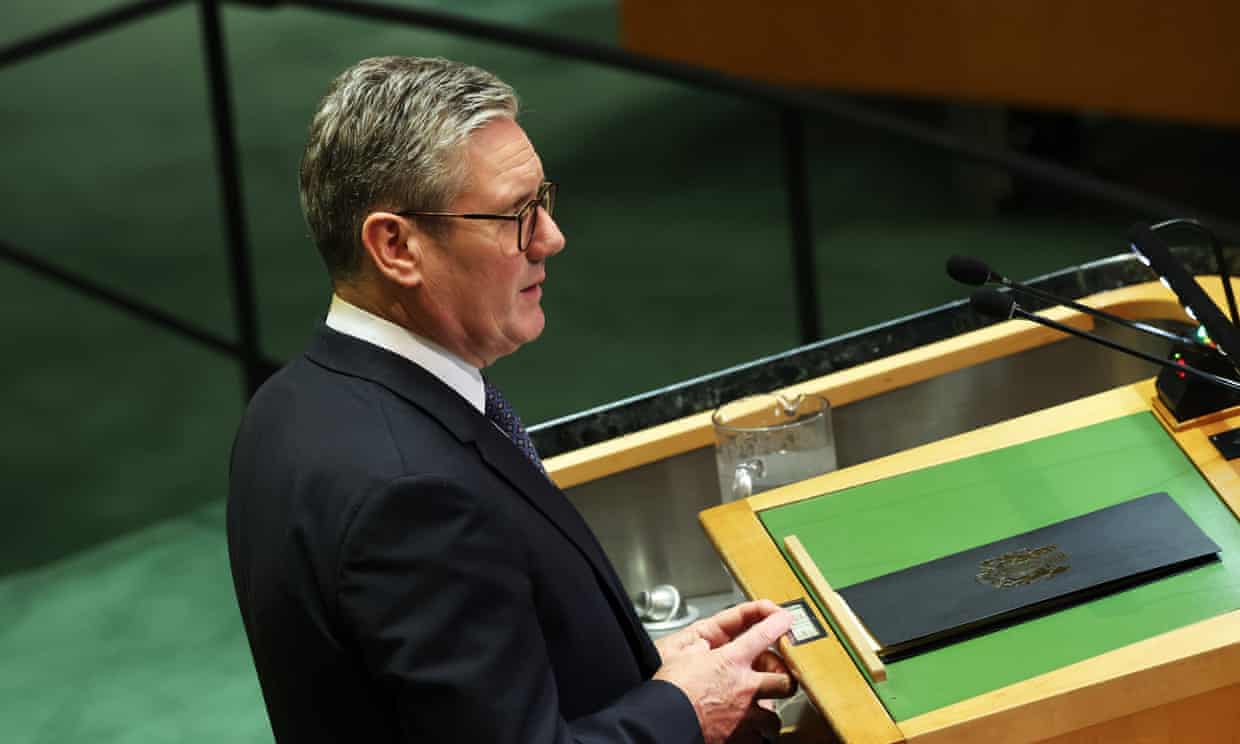
It is understood that Starmer has sought advice from the registrar of MPs’ interests and that the donations will be recategorised as donations in kind of clothing. Photograph: Michael M Santiago/Getty Images
Keir Starmer was given a further £16,000 worth of clothes by the Labour peer Waheed Alli, which was declared as money for his private office, the Guardian can reveal.
The donations, comprising £10,000 in October 2023 and £6,000 in February 2024, bring the total amount in gifted clothes to £32,000.
These latest gifts were not previously known about as they were described as being “for the private office of the leader of the opposition”.
The revelation is likely to reignite a row over the extent of donations that Starmer and some of his frontbench team acccepted while in opposition, much of it from Alli.
…
He has also been criticised for accepting tens of thousands of pounds’ worth of football and concert ticket freebies while leader of the opposition. His wife, Victoria, also received clothes as donations, as did Rachel Reeves, the chancellor, and Angela Rayner, the deputy prime minister.
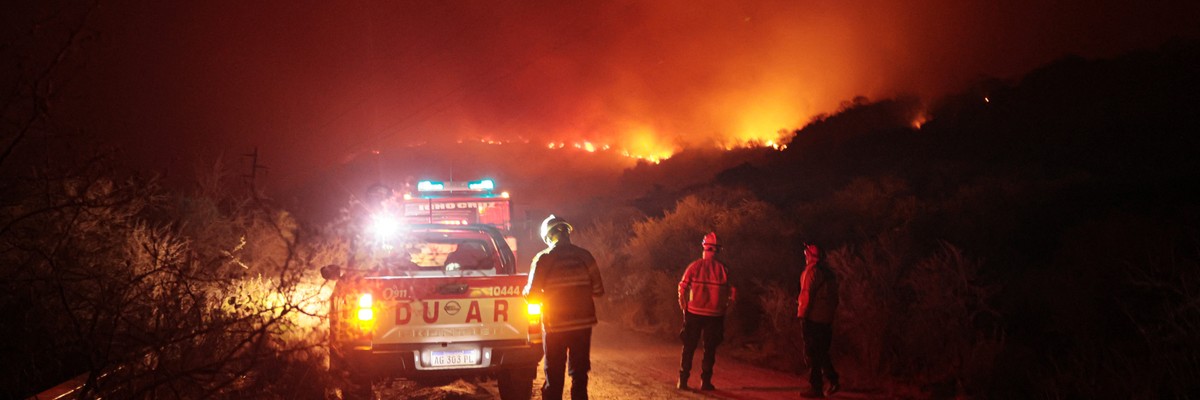
Wildfires are seen in San Marcos Sierra, Cordoba province, Argentina, on September 23, 2024. (Photo: Stringer/AFP via Getty Images)
“The real question isn’t whether we can afford to act, but whether we can afford not to.”
Research published Tuesday estimates that rich countries could mobilize over $5 trillion a year for climate action worldwide by cutting off subsidies to the oil and gas industry, imposing a levy on big polluters, and cracking down on tax evasion by large corporations and the rich.
The new report from Oil Change International (OCI) was released as world leaders gathered in New York City for high-level United Nations General Assembly talks, a meeting that comes less than two months before the COP29 climate summit in Azerbaijan.
OCI’s research, which includes a fact sheet outlining various proposals to raise funds for climate action, stresses that “there is no shortage of public money available for rich countries to pay their fair share on fair terms for climate action at home and abroad.”
“The urgency and extent of growing economic inequality, unfair sovereign debt crises, climate disasters, and fossil fuel profits have created significant momentum towards many of these measures in international and domestic policy spheres,” OCI’s research brief notes. “Finance has been in the spotlight in most major international political fora in the past few years in recognition that our current financial architecture is a major driver of these overlapping crises.”
Among the proposals laid out in OCI’s brief are an equitable end to “public finance, direct subsidies, and state-owned company investments in fossil fuels,” which could raise $846 billion a year globally; a “climate damages tax” on fossil fuel extraction, which could raise $618 billion a year; a 25% minimum corporate tax rate, which could raise $479 billion annually; and a wealth tax on billionaires, which could raise roughly $2.60 trillion a year in the Global North and over $5.6 trillion worldwide.
Laurie van der Burg, OCI’s public finance lead, said that the rich nations most responsible for the climate emergency “owe this money to Global South countries that have not caused this crisis and need fair finance to deliver strong climate plans next year that phase out fossil fuels.”
“This is essential to avoid climate breakdown and save lives,” she added.
The clock is ticking ⏰ Rich nations must deliver a roadmap for at least $1 TRILLION/year by 2025. No more empty promises. It's time to pay up for a just transition! 💚 Read the full report: https://t.co/eKwm0zXitspic.twitter.com/4qjTO5JQ8c
The COP29 climate summit will take place a year after nations agreed at COP28 to transition “away from fossil fuels in energy systems” in a “just, orderly, and equitable manner.”
The success of that pledge, OCI said, depends on rich nations contributing massively to global climate finance after years of falling short of their pledges and continuing to expand fossil fuel extraction and handouts. Worldwide, environmentally harmful subsidies—including fossil fuel subsidies—have surged to $2.6 trillion a year, according to a report released last week.
“Global North countries have a responsibility to redirect their share of these subsidies in support of climate action,” OCI said Tuesday.
The new report comes on the heels of a record-hot summer and amid devastating extreme weather, from massive flooding across Europe and Africa to wildfires in South America.
Andreas Sieber, associate director of policy and campaigns at 350.org, said Tuesday that “the real question isn’t whether we can afford to act, but whether we can afford not to.”
“It is a bitter irony that rich nations hide behind claims of fiscal restraint, yet trillions are still spent on fossil fuel subsidies and militarization,” said Sieber. “The truth is simple: the money exists, but the political will does not. By treating climate finance as a zero-sum game, wealthy countries not only deepen global inequality but also undermine their own futures.”
“The energy transition isn’t charity—it’s an investment in global stability and security,” Sieber added. “Ignoring the need for support only worsens the climate crisis, which knows no borders.”
A private jet operated by Aeropartner, comes in to land at Stansted Airport in Essex
FAIR taxes on private jets and superyachts could have raked in £2 billion last year to help communities devastated by climate change, an Oxfam report revealed today.
Britain has the second-highest number of private jet flights in Europe, trailing only behind France.
Oxfam found that there were 192,052 private jet flights to and from Britain last year, not including those for medical, government, or military purposes.
According to climate charity Possible, flying by private jet can be up to 30 times more polluting than standard flights.
Oxfam also found that Britain is also home to 450 fuel-guzzling superyachts.
Indiana University academics found that a superyacht with a permanent crew, helicopter pad, submarines and pools emits an estimated 7,020 (US) tonnes of CO2 a year. In comparison, petrol cars produce about 1,749kg a year.
Oxfam is calling on Chancellor Rachel Reeves to increase taxes on the super-rich using these modes of transport, and redirect the funds to help tackle the climate emergency, while preventing lower-income families from shouldering the burden.
Apparently, the world is about to get its first trillionaire.
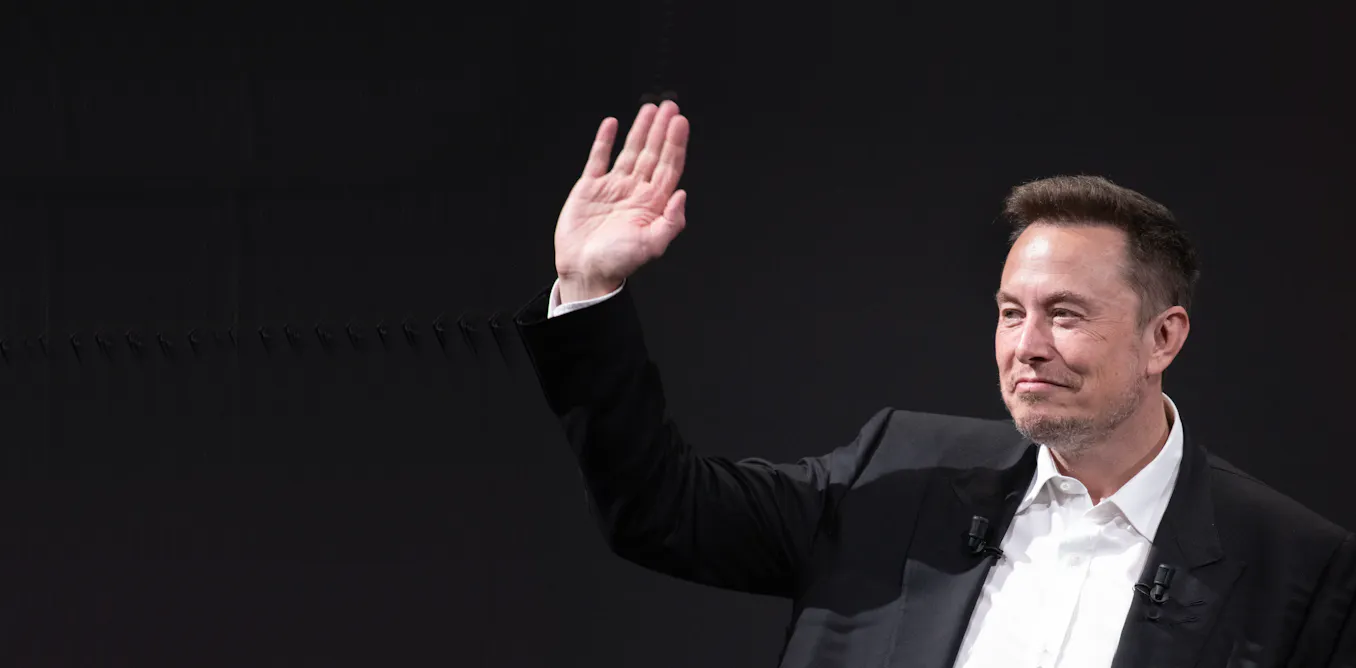
A report from the business intelligence agency Informa Connect says, at his present rate of wealth accumulation, tech billionaire Elon Musk is on track to be the world’s first trillionaire, three years from now.
At the moment Musk is said to be worth US$195 billion (A$293 billion), but if his wealth continues growing at the recent rate of 110% per year, he will hit US$1.195 trillion in 2027.
The next trillionaire after Musk should be Indian mining magnate Gautam Adani, followed by Nvidia chief Jensen Huang and Indonesian mining mogul Prajogo Pangestu, all of whom are on track to hit the milestone in 2028.
The nearly 1 billion human beings who don’t yet have electricity connected to their homes will doubtless be looking on with interest as the tech bros and mining bosses vie to crack 13 digits.
Before examining how it is that someone could ever make a trillion-dollar fortune, and what it might mean for the world for so much of the world’s wealth to be held in the hands of one person, it is important to first try to comprehend how big a trillion actually is.
One trillion seconds last 31,000 years
A million is a big number: it is 1,000 thousands. If you managed to retire with that many dollars in superannuation, you would have saved up more than 90% of your fellow retirees.
One billion is 1,000 millions. It takes 12 days for a million seconds to pass, but 31 years for a billion seconds to tick over.
That means a trillion seconds would equal 31,000 years.
If you had $1 trillion and did no more than stick it in the bank where it earned 4% interest per year you would get $40 billion per year in interest.
No one needs $1 trillion, and it is hard to see how anyone could spend it as fast as it grew, which raises important questions about how societies, economies and democracies will be able to function if and when governments allow trillionaires to emerge.
France’s King Louis XIV spent today’s equivalent of US$200 billion-300 billion building his palace at Versailles, and it was by no means his only palace.
Pyramids and sphinxes didn’t come cheap either, but these sorts of expenditures were seen as needed for beings selected by gods and not entirely mortal.
For mortals, some believe that the entire population benefits when a small minority controls most of the resources on the basis that it builds incentives.
Just as peasants spent millennia awaiting their reward in the afterlife while their rulers enjoyed heaven on earth, in modern economies we are told wealth and prosperity will trickle down to us eventually if we keep working hard.
Unfortunately for most of us, despite the wealth of the richest 200 Australians growing from A$40.6 billion to $625 billion over the past 20 years, neither the Australian economy nor the wages of ordinary Australians are soaring.
High profits are meant to be temporary
Incentives can and do play an important role in our economy.
In the so-called “free market” envisaged by 18th-century economist Adam Smith, if my new farming technique or silicon chip is so good that everyone wants one, it is considered only fair that I get an initial reward.
But after a while, everyone else will be free to compete with me by selling similar goods and in turn stopping me from getting an extraordinary ongoing reward.
The problem is that some markets aren’t free and don’t work properly. It is no accident that the world’s biggest fortunes are held by those who have monopoly rights to sell natural resources or technologies that are protected by patents or systems that lock in users.
That’s bad news for those still waiting patiently for wealth to trickle down or to be spread more evenly.
Technofeudalism keeps profits growing
In his latest book former Greek finance minister Yannis Varoufakis describes the world we now live in as one of technofeudalism in which online platforms have the ongoing opportunity to exploit workers, consumers and producers in ways Smith could not have imagined.
Having created digital platforms where the price of entry is handing over your personal details and preferences, modern tech titans use a new form of alchemy to convert data into knowledge that allows them to keep you on their platform and exploit you or advertisers or suppliers in the belief that you won’t leave.
And while there are physical limits to how big a car factory or fast-food chain can grow, there are almost no physical limits on how much money tech platforms can make by selling ads they didn’t make for products they didn’t make to consumers they know nearly everything about.
Restraining profits is pro-market
It isn’t anti-capitalist to want those profits competed away, it’s pro-market.
When the United States broke up J.D. Rockerfeller’s oil monopoly in the early 20th century, the oil industry prospered rather than vanished. consumers and the businesses that had dealt with Rockerfeller were better off, and so was the economy as a whole.
Democracies have, for now, the power to use taxes and regulations to redistribute the enormous benefits flowing to the new class of billionaires (and soon trillionaires) from the sale of scarce resources and the creation of platforms that keep us trapped.
Whether and how we use that power is up to us, but we mightn’t have it for long. The more the new class of billionaires and trillionaires becomes entrenched, the more it will be able to use the political system to protect their interests rather than those of mere mortals.
After 14 years of billionaires doubling their wealth, the political elite’s choice of starving pensioners and children shows austerity as a complete con job.
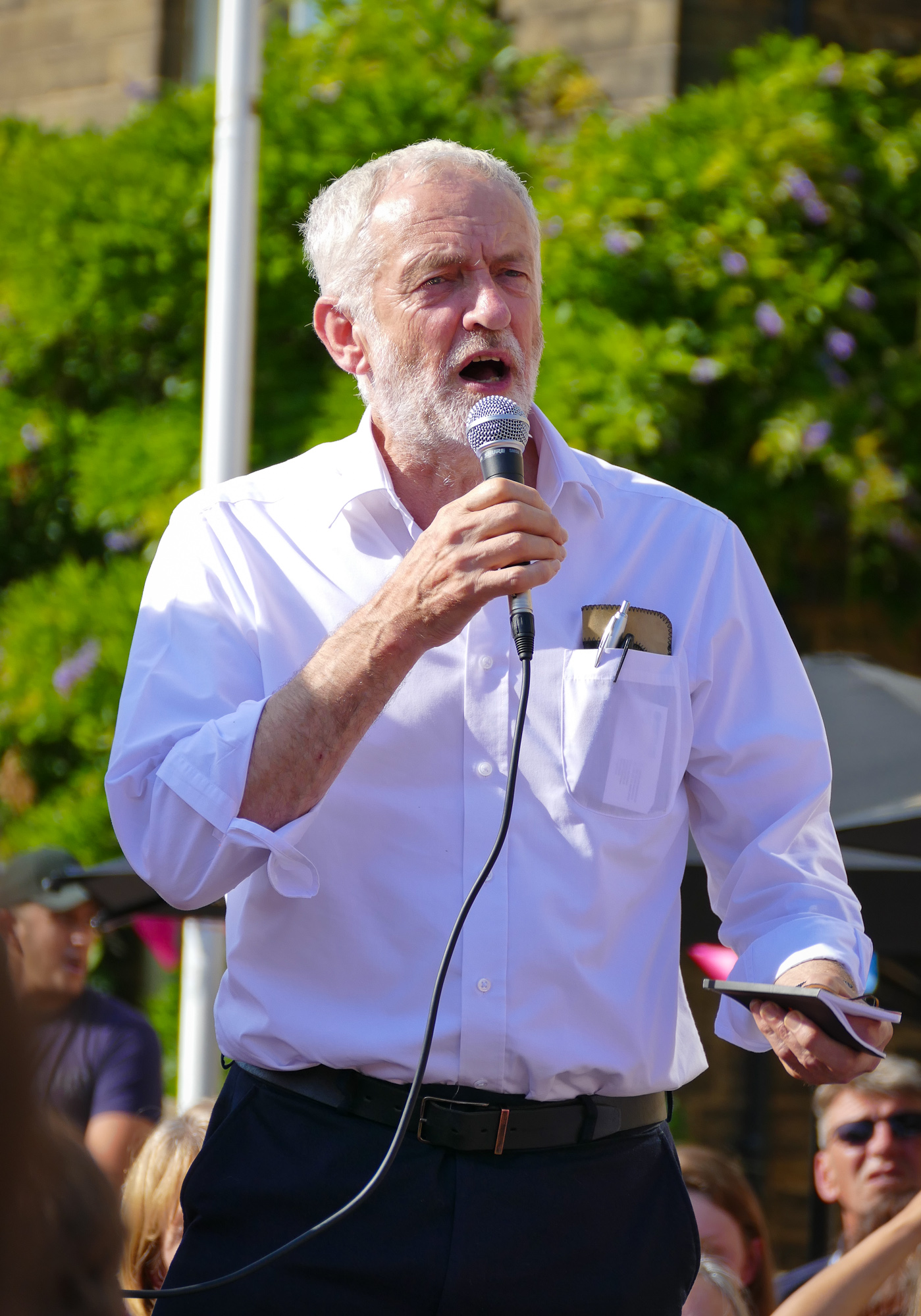
Jeremy Corbyn MP, former leader of the Labour Party
Every day, my constituents make tough choices. Tough choices like deciding whether to heat their homes or put food on the table. Tough choices like taking out a loan to pay for this month’s rent. Tough choices like selling their home to pay for their family’s social care.
People are making tough choices because governments have made the wrong choices. We warned that Tory austerity would weaken our economy and decimate our public services. We were ignored, and the poorest in society paid the price. Austerity is not just a buzzword. It is the ongoing, brutal reality for millions of people who have been pushed into destitution. It is the face of desperation and anxiety of those forced into a spiral of debt. It is a freezing cold night for the record numbers of people sleeping rough on the streets. It is the graveyard for those left without vital support: more than 300,000 excess deaths have been attributed to austerity policies.
We often talk about austerity in terms of cuts to public spending, but that is just one side of the coin. By starving public services of resources, the government manufactured a convenient excuse for their privatisation. We saw this most acutely with the NHS: an underfunded public service does not just cause satisfaction to plummet, but the belief in the principle of public healthcare itself. Austerity was never about saving money (the UK’s debt pile increased every single year under the Tories). It was about transferring money from the poorest to the richest. Between 2010 and 2018, aggregate wealth in the UK grew by £5.68 trillion. 94% went to the richest 50% of households. 6% went to the poorest 50%. As child poverty was heading towards its highest levels since 2007, Britain’s billionaires more than doubled their wealth.
It was a political decision to defund, dismantle and auction off our public services. And it will be a political decision to repeat this failed economic experiment. ‘It’s going to be painful’, the Prime Minister told the nation last week, prepping the public for ‘difficult choices’ ahead. Did he get permission from the Tories to reuse their trademark slogans? Other ministers have gone one step further, indicating that they do not have any choice at all but to impoverish children and pensioners. Keeping children in poverty is unavoidable, apparently, if we want to restore the public finances. Scrapping the winter fuel allowance is a necessity, we were risibly told, if we want to stop a run on the pound.
It is astonishing to hear government ministers try to pull the wool over the public’s eyes. The government knows that there is a range of choices available to them. They could introduce wealth taxes to raise upwards of £10 billion. They could stop wasting public money on private contracts. They could launch a fundamental redistribution of power by bringing water and energy into full public ownership. Instead, they have opted to take resources away from people who were promised things would change. There is plenty of money, it’s just in the wrong hands — and we will not be fooled by ministers’ attempts to feign regret over cruel decisions they know they don’t have to take.