Category: the filthy rich

  • ‘By and For the Ultra-Wealthy’: Here Are the Billionaires Set to Run Trump’s Administration

    Spread the love

    Original article by Jake Johnson republished from Common Dreams under Creative Commons (CC BY-NC-ND 3.0).
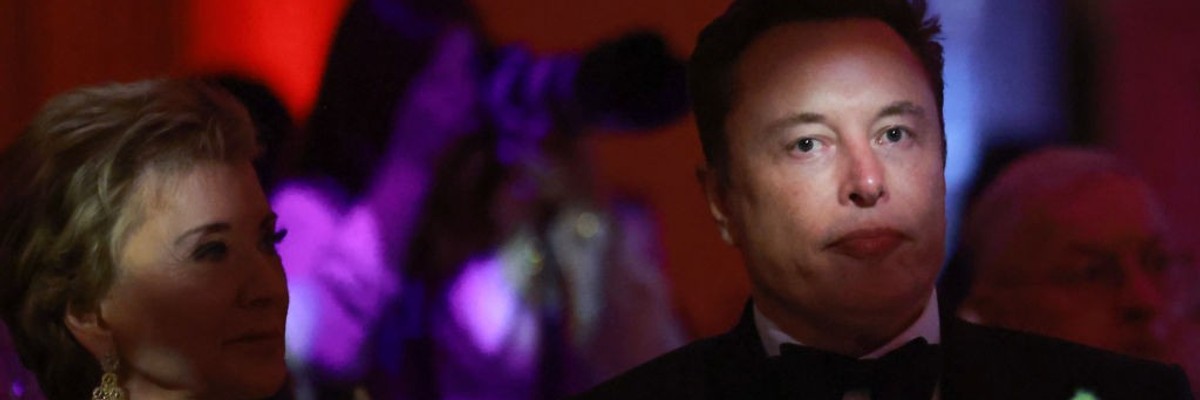
    Linda McMahon and Elon Musk attend the America First Policy Institute gala held at Mar-a-Lago on November 14, 2024 in Palm Beach, Florida.  (Photo: Joe Raedle/Getty Images)

    “Trump paid plenty of lip service to working-class Americans, but as president-elect, he’s moved quickly to stack his administration with billionaires that share his vision of a rigged economy that only works for people like them.”

    Since winning the presidential election earlier this month, Donald Trump has wasted no time working to fill his incoming administration with billionaires and other ultra-rich individuals who are poised to benefit from the GOP agenda of tax cuts for the wealthy and large-scale deregulation.

    In separate analyses published this week, Americans for Tax Fairness (ATF) and Accountable.US offered overviews of the president-elect’s key nominations and their potential conflicts of interest as Trump prepares to retake power in January.

    So far, Trump has announced plans to nominate billionaire hedge fund manager Scott Bessent to head the Treasury Department, WWE billionaire Linda McMahon to head the Education Department, billionaire crypto banker Howard Lutnick to head the Commerce Department, and billionaire entrepreneurs Elon Musk and Vivek Ramaswamy to head the Department of Government Efficiency—an outside advisory commission tasked with slashing federal spending and regulations.

    “These appointments clearly show the incoming administration will be run by and for the ultra-wealthy,” said David Kass, ATF’s executive director. “They’ve already announced plans to spend trillions of dollars to renew the Trump tax bill, to further enrich large corporations and wealthy elites like themselves while advocating for cuts to vital programs that working and middle-class Americans depend on.”

    ATF’s analysis, released Monday, shows that the combined wealth of Trump’s richest nominees and transition team members—including the president-elect and Sen. JD Vance (R-Ohio), the vice president-elect—is over $313 billion. By comparison, the combined net worth of President Joe Biden’s Cabinet is an estimated $118 million.

    “Even excluding Elon Musk—the world’s richest man and Trump’s co-director of the Department of Government Efficiency—the average net worth of Trump, his vice president, and top appointees is $616 million,” ATF observed. “This figure is over 616 times higher than the mean average wealth of the typical American household, which is a little more than $1 million.”

    ATF and Accountable.US also highlighted other ultra-rich individuals nominated for key roles in the incoming administration, including drilling enthusiast Doug Burgum, worth an estimated $100 million; Mehmet Oz, worth up to $315 million; and Chris Wright, who as of earlier this month held nearly $47 million worth of stock in his fracking company, Liberty Energy.

    https://twitter.com/accountable_us/status/1861433024581112204?ref_src=twsrc%5Etfw%7Ctwcamp%5Etweetembed%7Ctwterm%5E1861433024581112204%7Ctwgr%5E613844b34ff786b7d0c11bb9f514df799c4a1f8b%7Ctwcon%5Es1_c10&ref_url=https%3A%2F%2Fwww.commondreams.org%2Fnews%2Fbillionaires-trump-cabinet

    Sorry, this content could not be embedded. [again]

    X

    Tony Carrk, executive director of Accountable.US, said in a statement Tuesday that “Donald Trump paid plenty of lip service to working-class Americans” during the 2024 campaign, “but as president-elect, he’s moved quickly to stack his administration with billionaires that share his vision of a rigged economy that only works for people like them.”

    “Should the Senate rubber stamp these nominations,” Carrk added, “Trump’s department heads will be among the biggest beneficiaries of another promised tax giveaway for big corporations and the top 1%, paid for with deep cuts for seniors, veterans, and everyday workers.”

    Billionaires have already gotten significantly richer since Trump’s election victory, according to research published last week by ATF. In roughly the week after Trump’s win, the combined net worth of the nation’s 815 billionaires jumped by around $280 billion—with Musk’s wealth surge accounting for 20% of that gain.

    Original article by Jake Johnson republished from Common Dreams under Creative Commons (CC BY-NC-ND 3.0).
  • The Climate Finance Plan Leaders Won’t Consider at COP29? Tax the Rich

    Spread the love

    Original article by Sam Pizzigati republished from Common Dreams under Creative Commons (CC BY-NC-ND 3.0).

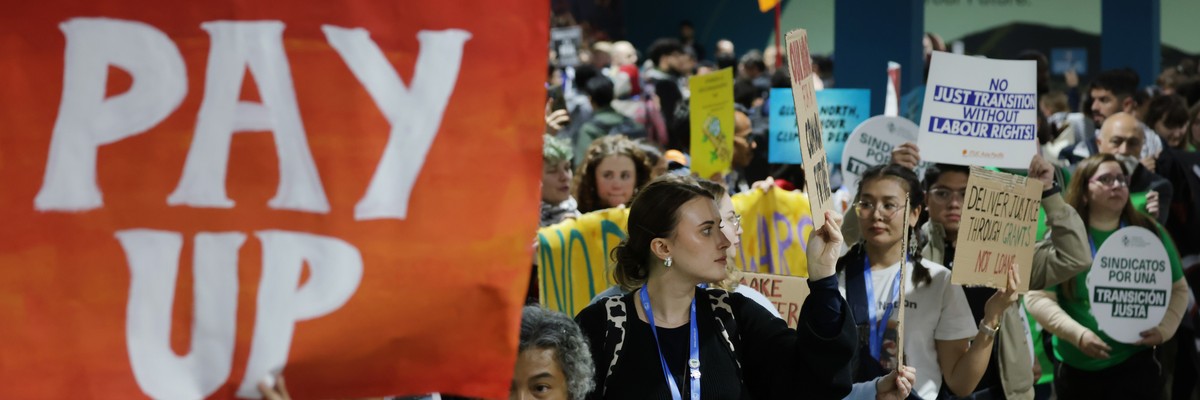
    Activists gather with banners, including one that reads: “Pay Up,” outside the plenary halls to voice their demands for a variety of climate-related issues, including labour rights, Indigenous peoples’ rights, loss and damage financing, and the expulsion of fossil fuel lobbyists from the conference on day six at the UNFCCC COP29 Climate Conference on November 16, 2024 in Baku, Azerbaijan. (Photo: Sean Gallup/Getty Images)

    A global 2% annual tax on billionaire wealth could raise $250 billion per year from just the world’s 100 richest families.

    The world desperately needs to pull the plug on fossil fuels. So agree most of the official delegates from nearly 200 nations who have gathered this month by the Caspian Sea for the 29th annual global “Conference of the Parties” on climate change—COP29 for short—in Azerbaijan’s capital city Baku.

    But not all the estimated 70,000 attendees at this year’s COP are practicing what they should be preaching. Private jet arrivals at Baku’s international airport, news reports note, have just doubled.

    What makes that such a big deal? Practically nothing symbolizes wanton disregard for our Earth’s environment more dramatically than private jet travel. A corporate executive taking a single long-haul private jet flight, points out the Travel Smart Campaign’s Denise Auclair, “will burn more CO2 than several normal people do in an entire year.”

    Instead of taxing the world’s wealthiest at higher levels, rich nations want to give their richest more opportunities to become ever richer.

    Researchers at Oxfam have just gone through the flight records of 23 global billionaires. Those airborne souls averaged 184 private jet flights each over a recent single year. They each essentially circumnavigated the globe 10 times over. Their flights averaged 2,074 tons of carbon emissions, an outlay an average person globally would take 300 years to emit.

    Extravagances like private jets help explain why global carbon emissions last year expanded by 1.3%. To get climate anywhere near under control, United Nations Secretary-General António Guterres noted on the eve of this month’s COP29 extravaganza, the world’s nations ought to be reducing carbon emissions by at least 9% a year.

    “The world is still underestimating climate risks,” Guterres added. “It’s absolutely essential to reduce emissions drastically now.”

    And that reducing will only unfold, the U.N. secretary-general emphasized in his COP29 opening remarks, if the world’s nations address the pivotal contribution to climate catastrophe that our world’s wealthiest are making.

    “The rich cause the problem,” as Guterres explained, “the poor pay the highest price.”

    Observers have tagged this year’s global environmental gathering the “climate finance COP.” The key question before all the official government delegates gathered in Baku: Who will actually pay the bill for addressing the climate change crisis?

    Back in 2009, national delegations to that year’s COP gathering pledged to raise an overall annual $100 billion over the next 15 years. The world’s nations have since then met that target only once. Any new annual target for the next 15 years, most researchers and activists agree, needs to run considerably higher, anywhere from $500 billion to $5 trillion higher.

    No one can reasonably expect governments alone, COP principals from rich nations counter, to come up with anywhere near that level of support. These rich-nation COP delegations want to encourage private investors to get more involved in financing new climate initiatives.

    In other words, instead of taxing the world’s wealthiest at higher levels, rich nations want to give their richest more opportunities to become ever richer.

    Nations rich with fossil fuels most heartily agree. The “onus” for financing moves to counter the climate crisis, COP29 President Mukhtar Babayev from Azerbaijan is arguing, “cannot fall entirely on government purses.”

    Our globe’s richest nations would also like to expand the trading of “carbon credits,” transactions that let wealthy developed nations delay making costly emissions cuts at home by underwriting much less costly climate actions in poor nations.

    But the offset projects that developed nations underwrite, The Guardiannotes, have regularly overpromised and underdelivered, leaving “wildfires burning through forests that were supposed to be protected and emissions from renewable energy projects being counted on balance books even though they would probably have been built anyway.”

    This year’s CO29 conference will wrap up on November 22, and no serious climate change analyst is predicting any consensus that could significantly slow our globe’s ever more perilous progress to climate collapse. Developed nations, Bloomberg’s Mark Gongloff observes, remain “loath to pitch in more than $100 billion a year.”

    “Transitioning the world to clean energy alone,” counters Gongloff, could actually cost $215 trillion by 2050.

    How could the world make real progress toward those trillions? Guardian environmental editor Fiona Harvey earlier this week ran down some promising options.

    Nations could for starters, Harvey notes, put a serious tax bite on the “unprecedented” profit bonanza that fossil fuel companies have enjoyed ever since Russia invaded Ukraine in 2022. Those companies have pocketed well over a quarter-trillion dollars in profits in the two years since.

    Nations could also place new taxes on the jet flights our richest so enjoy or move to end the more than $650 billion spent annually in the developing world on subsidies for fossil fuels and polluting industries. Better yet, in a world where our five richest billionaires have more than doubled their wealth since 2020, we could adopt the 2% annual tax on billionaire wealth that Brazilian president Luiz Inácio Lula da Silva has proposed.

    A global tax along that line could raise $250 billion per year from just the world’s 100 richest families.

    The only sure thing about initiatives like these: No proposals that could make a real climate difference will get any serious attention at COP29, as the prime minister of Albania, Edi Rama, observed in his brief and biting remarks to conference-goers. Rama opened his address to COP29 by noting that he had decided to ditch his prepared remarks after spending some time in the conference’s leaders lounge.

    The global notables in that lounge, Rama continued, had all gathered to “eat, drink, meet, and take photos together, while images of voiceless speeches from leaders play on and on and on in the background.”

    “To me, this seems exactly like what happens in the real world every day,” he went on to explain. “Life goes on with its old habits, and our speeches, filled with good words about fighting climate change, change nothing.”

    Concluded Rama, a former artist and the current chair of his nation’s Socialist Party: “What on Earth are we doing in this gathering, over and over and over, if there is no common political will on the horizon to go beyond words and unite for meaningful action?”

    That inaction—in the face of overwhelming global public support for greater pro-climate action—continues to comfort our world’s most fantastically wealthy.

    Original article by Sam Pizzigati republished from Common Dreams under Creative Commons (CC BY-NC-ND 3.0).

  • Tax Dodging by Super-Rich, Big Corporations Costs Nations Half a Trillion Per Year: Study

    Spread the love

    Original article by Jake Johnson republished from Common Dreams under Creative Commons (CC BY-NC-ND 3.0).
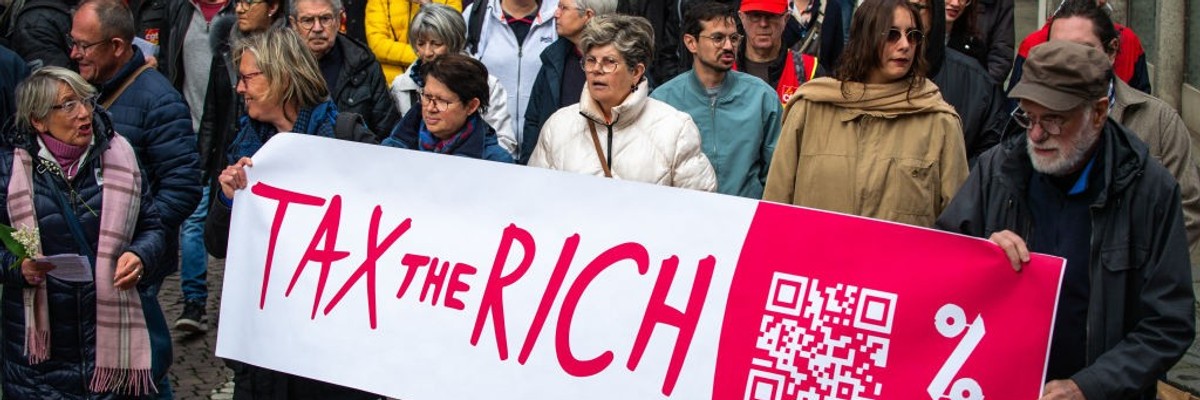
    A crowd of demonstrators marches in Saint-Brieuc, France on May 1, 2024. (Photo: Emmanuelle Pays/Hans Lucas/AFP via Getty Images)

    “The U.K. and the U.S. are both among the biggest enablers and the biggest losers of this lose-lose tax system,” said the chief executive of the Tax Justice Network.

    A study published Tuesday estimates that tax dodging enabled by the United States, the United Kingdom, and other wealthy nations is costing countries around the world nearly half a trillion dollars in revenue each year, underscoring the urgent need for global reforms to prevent rich individuals and large corporations from shirking their obligations.

    The new study, conducted by the Tax Justice Network (TJN), finds that “the combined costs of cross-border tax abuse by multinational companies and by individuals with undeclared assets offshore stands at an estimated $492 billion.” Of that total in lost revenue, corporate tax dodging is responsible for more than $347 billion, according to TJN’s calculations.

    “For people everywhere, the losses translate into foregone public services, and weakened states at greater risk of falling prey to political extremism,” the study reads. “And in the same way, there is scope for all to benefit from moving tax rule-setting out of the OECD and into a globally inclusive and fully transparent process at the United Nations.”

    The analysis estimates that just eight countries—the U.S., Canada, the U.K., Japan, Israel, South Korea, Australia, and New Zealand—are enabling large-scale tax avoidance by opposing popular global reform efforts. Late last year, those same eight countries were the lonely opponents of the United Nations General Assembly’s vote to set in motion the process of establishing a U.N. tax convention.

    According to the new TJN study, those eight countries are responsible for roughly half of the $492 billion lost per year globally to tax avoidance by the rich and large multinational corporations, despite being home to just 8% of the world’s population.

    “The hurtful eight voted for a world where we all keep losing half a trillion a year to tax-cheating multinational corporations and the super-rich,” Alex Cobham, chief executive of the Tax Justice Network, said in a statement Tuesday. “The U.K. and the U.S. are both among the biggest enablers and the biggest losers of this lose-lose tax system, and their people consistently demand an end to tax abuse, so it’s absurd that the U.S. and U.K. are seeking to preserve it.”

    “It’s perhaps harder to understand why the other handful of blockers, like Australia, Canada, and Japan, who don’t play anything like such a damaging role, would be willing to go along with this,” Cobham added.

    https://twitter.com/TaxJusticeNet/status/1858880408357888306?ref_src=twsrc%5Etfw%7Ctwcamp%5Etweetembed%7Ctwterm%5E1858880408357888306%7Ctwgr%5E212231be390df1278a214d4c3357d2bb5ea63942%7Ctwcon%5Es1_c10&ref_url=https%3A%2F%2Fwww.commondreams.org%2Fnews%2Fglobal-tax-dodging

    Sorry, this content could not be embedded.
    X

    TJN released its study as G20 nations—a group that includes most of the “hurtful eight”—issued a communiqué pledging to “engage cooperatively to ensure that ultra-high-net-worth individuals are effectively taxed.” Brazil, which hosted the G20 summit, led the push for language calling for taxation of the global super-rich.

    The document drew praise from advocacy groups including the Fight Inequality Alliance, which stressed the need to “transform the rhetoric on taxing the rich into global reality.”

    The communiqué was released amid concerns that the election of far-right billionaire Donald Trump in the U.S. could derail progress toward a global solution to pervasive and costly tax avoidance.

    The new TJN study cites Trump’s pledge to cut the statutory U.S. corporate tax rate from 21% to 15% and warns such a move would accelerate the global “race to the bottom” on corporate taxation.

    “People in countries around the world are calling in large majorities on their governments to tax multinational corporations properly,” Liz Nelson, TJN’s director of advocacy and research, said Tuesday. “But governments continue to exercise a policy of appeasement on corporate tax.”

    “We now have data from these governments showing that when they asked multinational corporations to pay less tax, the corporations cheated even more,” Nelson added. “It’s time governments found the spines their people deserve from their leaders.”

    Original article by Jake Johnson republished from Common Dreams under Creative Commons (CC BY-NC-ND 3.0).

  • Keir Starmer says the UK can decarbonise without disruption – that’s neither true nor helpful

    Spread the love
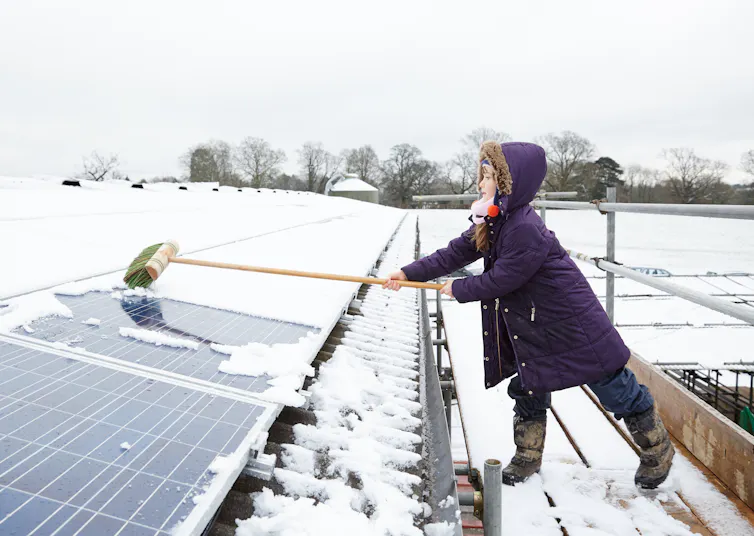
    A young girl removes snow from a solar panel at a power plant in Balcombe, southern England. Oliver Rudkin, CC BY

    Sam Hampton, University of Oxford and Lorraine Whitmarsh, University of Bath

    Keir Starmer’s pledge to cut the UK’s emissions by 81% by 2035 is undoubtedly ambitious. However, his assertion at the Cop29 climate conference that it can be achieved without “telling people how to live their lives” is probably not true – at least, not according to what scientists who study this problem have found.

    We are two such researchers. Our work concerns the lifestyle and behaviour changes needed to mitigate climate change and we argue that Starmer’s claim is not only unrealistic, it’s also potentially harmful to the prospects of effective climate action.

    Many politicians, including Starmer, subscribe to the belief that technological advancements alone – more efficient wind turbines or electric vehicle batteries – will solve the climate crisis. This kind of “techno-optimism” is rife in government policy statements and strategies, but it is misplaced.

    The latest scientific assessments, and our own research, show that systemic changes to society and the global economy are necessary to keep global warming at safe levels. While some progress has been made in shifting the supply of energy from fossil fuels to renewables (in the UK, renewables now account for 40% of electricity generation, though only 25% of total energy), far less attention has been paid to tackling demand – how we use energy and resources – which directly relates to people’s lifestyles and values.

    Radically different lifestyles

    Telling people “how to live their lives”, or more accurately, encouraging and enabling significant lifestyle changes, is essential for meeting climate targets. Most measures for reaching carbon targets in the UK will require changes to public behaviour. It’s the government’s job to make it easier, cheaper and advantageous for people to make those changes.

    The necessary scale of this change is startling. To stay within the emissions budget consistent with limiting global warming to 1.5°C, the average UK carbon footprint must shrink from the equivalent of 8.5 to 2.5 tonnes of CO₂ by 2030.

    This cannot be achieved through incremental change. It requires radically different lifestyles which involve flying less, eating more plant-based foods, wasting less and replacing boilers and combustion engines with heat pumps and electric vehicles.

    Not everyone needs to change their lifestyle to the same extent. Those with the largest carbon footprints – typically the wealthiest people – need to make the most significant changes. As well as having a moral responsibility to act, wealthy people also have a greater capability to change and have more potential to influence wider change as organisational leaders and investors.

    A line graph.
    Emissions inequality exists within and between countries. International Energy Agency/Samuel Hampton

    Change for the better

    Not all climate action is sacrifice. Pro-environmental behaviour and lifestyle change can improve your wellbeing.

    There is overwhelming evidence that climate action has health benefits, whether it is eating more plant-based food and less meat, or enjoying cleaner air as you walk or cycle instead of driving.

    People with greener lifestyles also tend to be happier. Our international analysis found people who took more environmental action reported higher wellbeing. It can also help manage anxiety about the climate. In this sense going green is more likely to improve your quality of life rather than diminish it.

    Importantly, research from numerous countries shows that there is public appetite for radical change. This includes not just a desire for governments and businesses to do more to address climate change, but also a willingness to make personal sacrifices. In a survey of 130,000 people randomly selected across across 125 countries, 69% said they would be willing to contribute 1% of their personal income to climate action.

    Achieving the necessary changes to our lives and wider society will require more than public information campaigns (“telling people how to live their lives”, as Starmer calls it). These are what we call downstream approaches: they urge people to make different decisions but have been shown to have little effect in changing behaviour in the long term.

    Instead, we need upstream approaches which change the array of options available to everyone. This could involve using regulations, taxes and subsidies to make low-carbon lifestyles easier, cheaper and more attractive to adopt. Most of these measures already enjoy public support.

    While Starmer’s emissions target is commendable, his reluctance to discuss lifestyle changes is at odds with the scientific consensus. Tackling climate change effectively requires a shift to a more equal society, where happiness is prioritised over consumption. It necessitates radical behavioural changes, particularly from the wealthiest, and policies that enable these changes.


    Imagine weekly climate newsletter

    Don’t have time to read about climate change as much as you’d like?
    Get our award-winning weekly roundup in your inbox instead. Every Wednesday, The Conversation’s environment editor writes Imagine, a short email that goes a little deeper into just one climate issue. Join the 40,000+ readers who’ve subscribed so far.


    Sam Hampton, Researcher, Environmental Geography, University of Oxford and Lorraine Whitmarsh, Professor of Environmental Psychology, University of Bath

    This article is republished from The Conversation under a Creative Commons license. Read the original article.

  • Ultra-rich using jets like taxis, climate scientists warn

    Spread the love

    https://www.bbc.com/news/articles/cx2lvq4el5vo

    Getty Images

    The mega-rich are using private jets like taxis, warn climate scientists who tracked flights to calculate the planet-warming gases they release.

    The scientists worked out that the carbon dioxide emissions, which contribute to climate change, rose by 46% between 2019 and 2023.

    Researchers traced all private flights globally, including summer weekend trips to Ibiza, Spain and travel to the Fifa World Cup and the UN climate conference in Dubai.

    Flying in a private jet for a single hour can release more carbon dioxide into the atmosphere than the average person produces in a year, according to the research team.

    “There are a lot of people using these aircraft as taxis, where you cover whatever distance by aircraft simply because it’s more convenient,” Professor Stefan Gossling, from Sweden’s Linnaeus University, who led the research, said.

    “If somebody’s flight emits in one hour as much as an average human being emits in a year – just to watch a soccer game – then perhaps it shows those people think they are outside the standards that we have as a global community.”

    …

    Article continues at https://www.bbc.com/news/articles/cx2lvq4el5vo

    Orcas comment on killer apes destroying the planet by continuing to burn fossil fuels. Second version, corrected text.
    Orcas comment on killer apes destroying the planet by continuing to burn fossil fuels. Second version, corrected text.