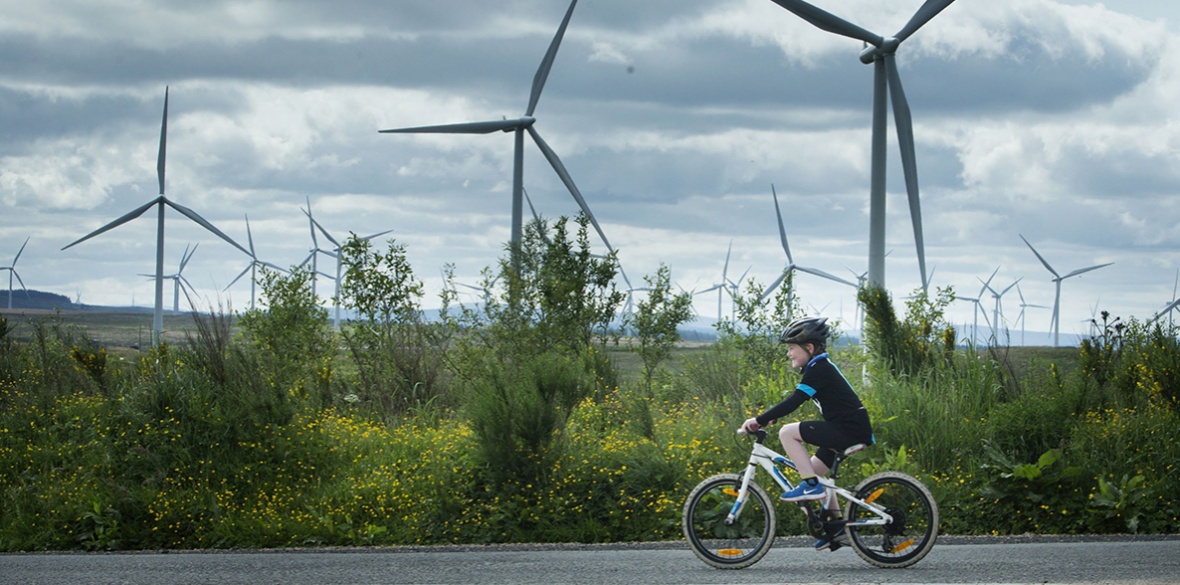
A child rides a bike at Whitelee Windfarm in East Renfrewshire, July 2015
But Unite warns that Labour has ‘missed a golden opportunity to bring the national grid under public ownership’
THE government announced plans for a new era of “clean energy” today.
Labour has pledged to create a 95 per cent low-carbon electricity grid by the end of the decade.
Energy Secretary Ed Miliband described the transition as the “social justice fight of our time” and that it aimed to shield working people from the “ravages of global energy markets.”
New measures will deregulate to speed up planning decisions on critical infrastructure and give ministers, rather than local councils, the final say on approving large projects such as onshore wind farms.
…
Just Stop Oil, which has 16 members serving a combined 41 years of jail time over protests demanding an end to oil and gas, said: “Whatever the Labour Party does, the world is going to pass through 2°C of heating in the 2030s.
“To pretend that ‘clean electricity’ will protect us from the consequences of this is to lie to, and to betray the British people.
“The predicament we find ourselves in needs the Labour Party to change everything to defend our values and hard won rights.
“It requires us to mobilise the country as if going to war, and the starting point is planning to end oil and gas extraction and use by 2030, while adapting our villages, towns and cities to the weather extremes coming our way.”
People take part in a Kurdish community march in central London in response to the arrest of seven people said to be associated with the Kurdistan Workers Party, known as the PKK. The group is proscribed by the government, and expressing support for it is a criminal offence, Scotland Yard said, December 1, 2024
SOCIALIST councillors in Haringey have expressed outrage at the Metropolitan Police’s treatment of the borough’s Kurdish community.
Six members of the Kurdish community in the north London borough were charged with membership of the Kurdistan Workers’ Party (PKK) on Tuesday, following raids on their homes and community centre on November 27. The organisation is proscribed as a terrorist organisation by Turkey and Britain.
Independent Socialist Group on Haringey Council leader Councillor Lotte Collett said that the raids seemed “totally disproportionate when measured against the charges that have been laid.”
She said: “We are minded to believe that this raid was a politically motivated assault on a minority ethnic community that have made their home in our borough carried out at the behest of the Turkish government and was probably sanctioned here at cabinet level.
Antarctica, the world’s most remote, harsh and pristine continent, is not free from marine pollution. Where human activity goes, plastic debris inevitably follows.
What might the early explorers of this icy wilderness think today, upon discovering a continent transformed by permanent fishing activities, research stations, military presence, tourism, and all their environmental impacts? Among these, plastic pollution stands out, as it has created a unique new ecological niche in the ocean.
Once it gets into the water, plastic debris provides surfaces that can be quickly colonised by microbial communities, forming a biofilm. This plastic-borne community is known as the plastisphere, and it poses a serious threat to marine ecosystems, particularly in the cold, understudied waters of the Southern Ocean.
The plastisphere: an emerging threat
As plastic debris drifts through the ocean, the plastisphere develops through typical ecological succession, eventually becoming a complex and specialised microbial community. Plastics not only provide shelter for these microorganisms but also act as a vector, allowing potentially harmful pathogens like Vibrio spp., Escherichia coli, and bacteria carrying antibiotic resistance genes, to spread across marine environments, even reaching remote, untouched areas.
Beyond being a home for microbes, the plastisphere can disrupt the natural balance of ocean life at the microscopic level. These changes don’t stay in the water, as they can spread outward, potentially affecting how the ocean absorbs carbon and produces greenhouse gases. This has consequences for the air we breathe around the world.
However, it’s not all bad news, as bacteria known for their potential to degrade plastics or hydrocarbons – such as Alcanivorax sp., Aestuariicella sp., Marinobacter sp. and Alteromonas sp. – are frequently identified on plastics.
The Antarctic plastisphere under the microscope: bacteria colonizing polystyrene. Author’s own
A hostile research environment
We currently know very little about the plastisphere, especially in the Southern Ocean, where uncovering its dynamics is key to understanding its impacts on one of the planet’s most remote and vulnerable marine environments. For this reason, our recent study sought to investigate the abundance and diversity of microbial communities in the Southern Ocean plastisphere, particularly following the initial colonisation of plastic debris.
Working in Antarctica is not an easy task. Just reaching this continent is a challenge, and once there, scientists have to contend with harsh environmental conditions: freezing temperatures, powerful winds, icebergs, and the constant pressure of limited time to carry out their work. These challenges make every moment in the field both demanding and invaluable.
This is why we approached our study with a controlled and manageable experiment. We set up aquariums filled with seawater collected near the Spanish research station on Livingston Island, South Shetlands. Inside, we placed small, rounded pellets of the three most common types of plastic polluting the sea – polyethylene, polypropylene, and polystyrene. We left them at environmental conditions (around 0 ºC and between 13 – 18 h of sunlight) for 5 weeks, aiming to recreate the most plausible outcomes in the field.
We compared the colonisation of plastics with glass, an inert surface. Samples of plastics and glass were collected periodically to track bacterial colonisation.
Plastisphere dynamics in Antarctica
Studying bacteria means making the invisible visible, so we combined several techniques to get a better picture of the plastisphere. Using scanning electron microscopy, we obtained biofilm images. We combined flow cytometry and bacterial culture to count total cells and colonies, and we sequenced the 16S rRNA gene to identify the succession of bacterial settlers.
This meticulous approach revealed that time was the key driver of change. Microbes quickly colonised the plastic, and within less than two days, bacteria like genus Colwellia were already fixed in the surface, showing a clear progression from initial settlers to a mature diverse biofilm including other genera like Sulfitobacter, Glaciecola or Lewinella.
These species, although also detected in water, show a clear preference for the social life of a biofilm community. Moreover, we did not detect clear differences between the bacterial communities from plastics and glass, suggesting that any stable surface can host these communities.
While similar processes happen in the other oceans, in Antarctica the process seems slower. The region’s lower temperatures slow bacterial development.
Plastic-eating bacteria?
One key discovery was the presence of Oleispira sp. on polypropylene. This bacteria is hydrocarbon-degrading, meaning it belongs to a group of microorganisms that can break down oil and other pollutants.
Their role within the Antarctic plastisphere raises important questions, like whether these kinds of bacteria could mitigate the impacts of plastic pollution. If so, they could be key to the future of Antartica and our oceans.
However, there is still much to be discovered, particularly regarding their potential for bioremediation in extreme environments. Understanding these processes could pave the way for innovative strategies to address the growing challenge of plastic waste in marine ecosystems.