Category: Uncategorized

  • How to know if a country is serious about net zero: look at its plans for extracting fossil fuels

    Spread the love

    Fergus Green, UCL

    Fresh emissions targets from Saudi Arabia and Australia – two of the world’s largest fossil-fuel producers – are due to arrive just in time for global climate talks in Glasgow. These would commit the two countries to reducing domestic emissions to net zero by around mid-century – though both are expected to continue exporting fossil fuels for decades to come.


    You can listen to more articles from The Conversation, narrated by Noa, here.


    For the leaders of countries and governments that produce fossil fuels, UN climate summits are a public relations boon. They get to talk up their commitments to a green and clean future without being held to account for their disproportionate role in fuelling the problem. It’s hard for experts, let alone the average citizen, to tell fact from fiction.

    Because it’s only domestic greenhouse gas emissions that are counted for the purpose of the UN climate negotiations, burning exported fossil fuels counts towards the emissions of the importing country. Accordingly, the role that major fossil fuel exporters like Saudi Arabia (oil and natural gas) and Australia (coal and natural gas) play in stoking global heating is not accurately reflected in the talks.

    Unlike some areas of international cooperation, like limiting the spread of nuclear weapons, climate-change summits aim to control something which evades easy calculation. Nuclear weapons and their production facilities are tangible, chunky and relatively few in number. Greenhouse gases are everywhere, invisible and caused by lots of different processes – from cow digestion to steel production.

    These gases are also in constant flux. Emissions are produced from ubiquitous sources, but there are also natural systems – especially forests and soil – that suck carbon dioxide (CO₂) from the atmosphere. These natural removals of carbon are known as sinks. That is why scientists and governments speak of net greenhouse gas emissions: emissions minus removals.

    It’s relatively easy to monitor aggregate levels of CO₂ in the global atmosphere. This is why scientists have a clear picture of how badly off-track the world is with tackling the climate crisis. But all this complexity concerning sources and sinks makes it easy for governments and corporations to obfuscate their real contribution to climate change.

    For example, countries with lots of uninhabited land, like Australia, have become especially adept at gaming the systems of accounting for net emissions of CO₂. Australia effectively gets credited for large amounts of carbon stored in forests, which make it look like overall emissions have been falling, even though emissions from burning fossil fuels have been growing for decades.

    Tree ferns in an Australian forest.
    The Australian government claims the country’s natural sinks offset its emissions elsewhere.
    Norman Allchin/Shutterstock

    One sure-fire way of telling whether a government official is hoodwinking you when lauding their government’s climate credentials is to look upstream and see whether they’re producing the coal, oil or gas that ultimately causes about three-quarters of global emissions, and if so, what they’re doing about it.

    Extracted fossil fuels are much easier to monitor and verify than greenhouse gas emissions. They come from a relatively small number of sources and are already measured by multiple parties for a range of purposes. Customers need proof that the shipments they receive reflect their contracts with suppliers. Governments collect production information to assess a company’s compliance with licensing requirements, tax liabilities and customs obligations.

    Fossil-fuel infrastructure and projects are even easier to monitor. Oil rigs, gas pipelines and coal mines are large, making them easy to see both on the ground and via satellite. These features make it simpler to hold fossil fuel-producing countries to account for their contribution to global heating, compared with the more slippery measure of net emissions.

    The fossil fuel production gap

    In a new report, the UN Environment Programme and other research institutions found that governments plan to produce more than twice the amount of fossil fuels in 2030 than would be consistent with limiting warming to 1.5°C above pre-industrial levels – the goal of the Paris Agreement. Countries’ fossil-fuel production plans and projections in aggregate even exceed, by close to 10%, the levels of global fossil-fuel production implied by their own climate pledges.

    A line graph comparing projected fossil fuel production with net zero targets.
    The production gap helps reveal how serious many national net zero pledges really are.
    SEI et al. The Production Gap: 2021 Report, Author provided

    Shockingly, governments are pouring fuel on the fire. G20 countries have directed more than US$300 billion (£218 billion) in new funds towards supporting fossil-fuel production, such as subsidies and tax breaks, since the beginning of the pandemic – about 10% more than they have invested in clean energy.

    The report echoes recent calls for greater transparency around fossil-fuel production and the support – financial and otherwise – governments provide at home and abroad. Research by various organisations has provided a better understanding of this, but the information is incomplete, inconsistent and scattered.

    Governments could help by disclosing plans, funding and projections for fossil-fuel production, and how they intend to manage a just transition away from coal, oil and gas. Fossil-fuel companies should disclose their spending and infrastructure plans, as well as all the greenhouse gas emissions their product is responsible for, and financial risks to their business from climate change.

    Numerous environmental organisations are working to build a global picture of the sources and flows of fossil fuels. So even if governments fail to illuminate the activities of fossil-fuel companies and their role in it, they can still be named and shamed.

    Talking only about a country’s net greenhouse gas emissions gives fossil fuel-producing companies and governments a free pass to bullshit their way through the climate negotiations. If we want to force the PR managers to really earn their money, we should turn the conversation to fossil-fuel production.

    COP26: the world's biggest climate talks

    This story is part of The Conversation’s coverage on COP26, the Glasgow climate conference, by experts from around the world.

    Amid a rising tide of climate news and stories, The Conversation is here to clear the air and make sure you get information you can trust. More. The Conversation


    Fergus Green, Lecturer in Political Theory and Public Policy, UCL

    This article is republished from The Conversation under a Creative Commons license. Read the original article.


  • Coming soon …

    Spread the love

    I need to write an article about how our recent ancestors fought a war and the United Nations was established in opposition to the realization of an evil, racist, apartheid ideology pursuing genocide and how it has failed. Associations between the classic Nazism and Zionism e.g. justifying, rationalising, excusing genocidal actions by claiming the victims to be less than human, etc, the UN and failures of democracy in preventing war crimes and genocide, failures of democracy in USUK and European countries encouraging, participating and complicity in war crimes, etc.

  • Green Party parliamentary candidate for Waveney Valley, Adrian Ramsay: We need to re-nationalise the water industry

    Spread the love
    Green Party Adrian Ramsay October 2023.
    Green Party Adrian Ramsay October 2023.

    Adrian Ramsay, co-leader of the Green Party and parliamentary candidate for Waveney Valley spent the weekend talking to people affected by the flooding in Eye, Suffolk. He said “The scenes and stories of flooding I’ve been seeing and hearing from Suffolk and Norfolk residents have been deeply shocking. This is not the first time East Anglia has been flooded, and it certainly won’t be the last. Climate change experts are shouting from the rooftops that these so-called ‘once in a generation’ events will become increasingly frequent.”

    “The Conservative government is letting us down badly.  Not only are they not taking the issue of climate change seriously – reigning in on existing commitments – but they, and private water companies, are also failing appallingly when it comes to flood risk management. ”  

     “Before privatisation, public water bodies were responsible for flood defences. Now defences are at best piecemeal. This is another good reason to take our water industry back into public control.”

    “We urgently need a long term and coordinated approach. This can only be achieved with a water industry focussed on investing in plugging leaks and protecting communities, not on syphoning off millions of pounds in dividends to shareholders. And rather than bulldozing planning laws, as Labour proposes, we need to reassess planning regulations which still allow for new buildings on flood plains.”

     “It is clear we will need Green MPs in parliament after the next general election making the case for climate action and protecting communities.” 

  • Health professionals risk arrest with road occupation, ‘die-in’ and ‘climate inquest’ outside JP Morgan

    Spread the love
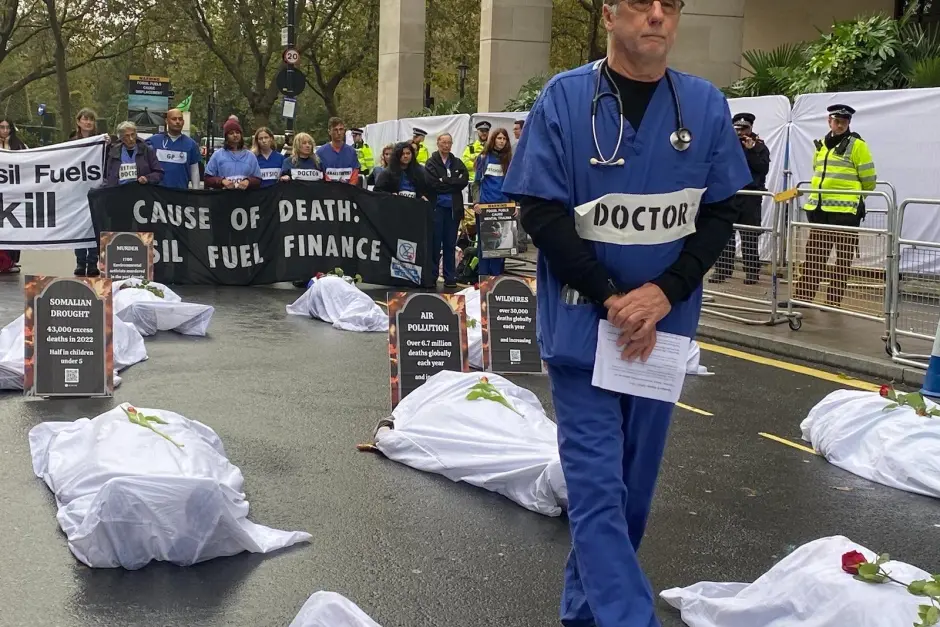
    Health for Extinction Rebellion protests at JP Morgan Chase’s London Embankment offices 19 October 2023.
    Health for Extinction Rebellion protests at JP Morgan Chase’s London Embankment offices 19 October 2023.

    As part of the Oily Money Out week of protests, over 60 health professionals are risking arrest this morning by staging a ‘die-in’ and ‘climate inquest’ in the road outside JP Morgan Chase’s London Embankment offices.

    The protest is designed to highlight the bank’s leading investment role in the new fossil fuel extraction which is driving increasing levels of climate-related death and suffering. 

    Health for Extinction Rebellion, who have a long running campaign against JP Morgan’s fossil fuel investments (HXR, 2021, 2022, 2022-2, 2022-3, 2022-4), sought to emphasise, through their action today, the intolerable and growing human health impacts of the climate and ecological crisis, and the complicity of firms, like JP Morgan, who continue to drive fossil fuel extraction.

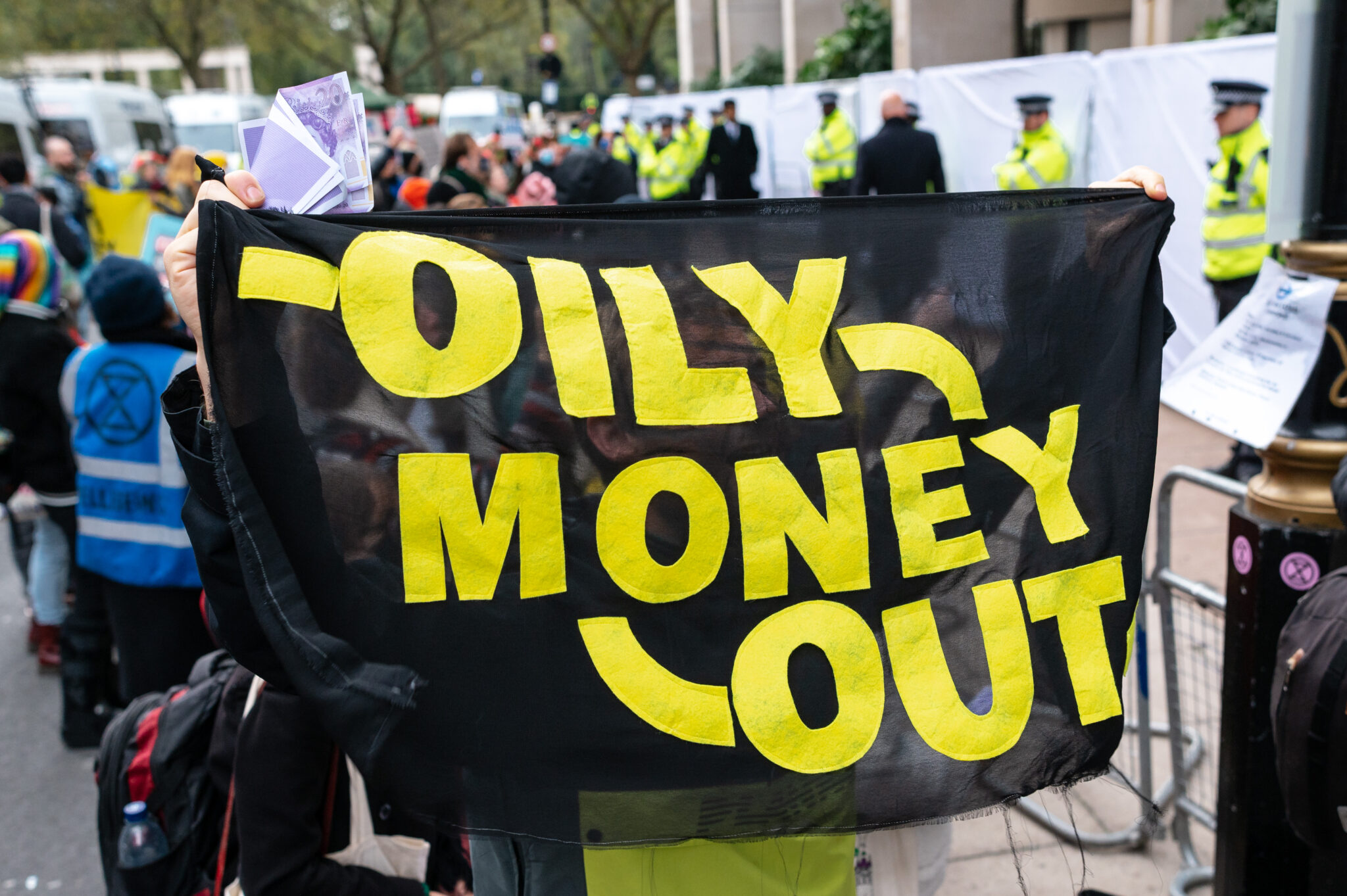
    The action comes as the ‘Energy Intelligence Forum’, being held in London this week, is the focus of major protests and demands to get “Oily Money Out” of our politics, out of COP 28, and out of power.

    Banner reads Oily Money Out. Protests London 18 October 2023.
    Banner reads Oily Money Out. Protests London 18 October 2023.

    Today’s action saw 14 health professionals lay themselves, shrouded, in the road outside the conference in military hospital style. Other health professionals circled amongst them, tending their ‘fallen’ colleagues, and laying headstones indicating the climate health impact each represented. A mock inquest was then held, in which health-workers gave testimony on the deaths already caused by the planetary emergency. These included among others, the 6 million deaths every year resulting from air pollution (Fuller, 2020), the 5 million deaths globally each year from extreme temperatures (Zhoa. 2021),  and the 43,000 who died from the climate-change associated drought and famine in Somalia last year (WHO/Unicef, 2021)  

    Following the action the group will be handing in a letter addressed to Luke Nelson, JP Morgan Chase’s head of sustainability. It reads:

    “Society in the future is likely to judge companies that continue such fossil fuel investments as both immoral and as operating outside international law. What does JP Morgan plan to do right now to avoid such a judgement?”

    New extraction goes against the explicit warning of the International Energy Agency (IEA, 2021) and the United Nations (UN news, 2022), yet politicians, lawyers and financiers continue to support a fossil fuel industry that has known for decades that fossil fuels cause deadly global warming (Scientific American, 2015). To emphasise this complicity, health workers today also held ‘Cigarette-style’ Health warnings, and banners reading ‘Fossil Fuels Kill’, and “Cause of Death = Fossil Fuel Finance”. The action sought to draw a direct parallel with the Tobacco industry which was complicit in 100,000’s if not millions of deaths, by knowingly misleading the public around the health impacts of smoking. 

    Despite the bleak reality of the climate crisis, the action also emphasised the numerous potential benefits for human health of climate action (The Health Foundation, 2023), and the need to galvanise mass support for the appropriate action needed to safeguard a healthy future.

    Health for Extinction Rebellion previously wrote to JP Morgan Chase’s CEO Jamie Dimon,  ( 3rd September 2021 to outline their concerns and to suggest a positive route forward for the bank, but have yet to receive a reply. They have returned on numerous occasions speaking ‘off record’ with concerned employees. 

    “During the August heatwave of 2022 my father suffered a heart attack and died the following week. He had chronic physical health problems and like many of the most vulnerable in our society could not manage the extreme heat that climate change is bringing to us. This is not a problem of the future. It is a health catastrophe that we are living through right now”.

    Dr Jethro Purkis Specialty Doctor Bristol 

    “Governments and companies that continue to finance and license new coal, oil and gas are doing so at the expense of their citizens. Fossil fuels are the drivers of deadly climate change and air pollution in our communities. This is an industry that has delayed and denied climate change for decades in the name of greed, putting profit above all else, and from a health and a moral perspective it’s beyond time to shut it down” 

    Dr Juliette Brown, Consultant Psychiatrist

    “I am here demonstrating for my pregnant patients, for the new mums and for their babies that I see on a daily basis, I am also here for my own children to say that the fossil fuel companies are destroying any chance of our children being able to live any sort of “normal” future.  That the burning of fossil fuels have caused irreversible damage to our planet and that we need companies to stop all new fossil fuel exploration and to start being world leaders in green energy.  It is possible, we just need them to start putting the planet and people before profit”.

    Charlotte Francis. Perinatal Pelvic Health Specialist Physiotherapist

    “I am a retired GP and  to my last breath I will endeavour to spread the scientific truths which the powers-that-be try so desperately to conceal from the public. I will always denounce the greed and self-interest borne of their grotesque worship of money which has clearly eaten away at their consciences, even their very humanity, to the extent that they are apparently unable to relate to the  enormous suffering already in the southern hemisphere, let alone envisage the horrors ahead if they continue their love-affair with Fossil Fuels”.

    Dr Valerie Davies,  Retired General Practitioner